Produced by:
The 2013 Guide to
Network Virtualization and SDN
By Dr. Jim Metzler, Ashton Metzler & Associates
Distinguished Research Fellow and Co-Founder
Webtorials Analyst Division
Table of Contents
Executive Summary ... 1
Chapter 1: The what, why and how of Network Virtualization4
Introduction ... 4
Traditional NV & The NV Use Case ... 6
Network Overlays via Tunneling: Benefits & Limitations ... 7
Cloud Orchestration ... 11
Controller Based NV Solution Architecture ... 13
Criteria to Evaluate Overlay NV Solutions ... 14
Tunnel Encapsulation ... 16
Tunnel Control ... 17
Comparison of Network Overlay Virtualization Solutions ... 19
Software Defined NV via Flow Table Segmentation ... 20
Enterprise Plans for NV Adoption ... 21
Chapter 2: The what, why and how of SDN ... 23
Background ... 23
Potential SDN Use Cases ... 24
A Working Definition of SDN ... 27
The SDN Solution Architecture ... 29
Criteria to Evaluate SDN Solution Architectures ... 31
The Inhibitors to SDN Adoption ... 32
The Overlay/Underlay Model ... 33
Network Function Virtualization ... 33
The Open Networking Foundation and OpenFlow ... 36
Potential Use Cases and Benefits of OpenFlow ... 38
The OpenDaylight Consortium ... 41
Security ... 43
Management ... 44
Appendix – Chapter 2 ... 46
Chapter 3: The NV and SDN Ecosystem ... 48
Overview of the NV and SDN Ecosystem ... 48
Representative Vendor - Avaya ... 53
Chapter 4: Planning for NV and SDN ... 55
Introduction ... 55
Market Research: The Current State of Planning ... 56
Crafting an NV and/or SDN Plan ... 59
2013 Guide to Network Virtualization and SDN December 2013
Page 1
Executive Summary
Over the last year, the hottest topics in networking have been Network Virtualization (NV) and Software Defined Networking (SDN). There is, however, considerable confusion amongst enterprise IT organizations relative to these topics. There are many sources of that confusion, including the sheer number of vendors who have solutions that solve different problems using different solution architectures and technologies, all of whom claim to be offering SDN and/or NV solutions.
The primary goal of the 2013 Guide to Software Defined Networking & Network Virtualization
(The Guide)is to eliminate that confusion and accelerate the adoption of NV and/or SDN. The
guide will achieve that goal by walking the readers through the following set of topics: 1. What are the problems and opportunities that NV and SDN help to address? 2. What are the primary characteristics of NV and SDN solutions?
3. How does NV and SDN help IT organizations respond to problems and opportunities? 4. How are IT organizations approaching the evaluation and deployment of NV and/or SDN? 5. What is the role of organizations such as the ONF and the OpenDayLight consortium? 6. What approach are the key vendors taking relative to NV and SDN?
7.
What should IT organizations do to get ready for NV and SDN?The Guide was published both in its entirety and in a chapter-by-chapter fashion. Chapter one of The Guide is focused on NV and it discusses:
• The primary NV use cases;
• Various ways that overlay NV solutions can be implemented and the benefits and limitations
of those solutions;
• The drivers and inhibitors of NV adoption;
• The role of orchestration and service chaining;
• A canonical architecture for a controller based NV solution;
• A comparison of current NV solutions;
• How to create NV solutions by manipulating OpenFlow tables.
The second chapter focuses on SDN and it discusses:
• Potential SDN use cases;
2013 Guide to Network Virtualization and SDN December 2013
Page 2
• Criteria to evaluate SDN solution architectures;
• The drivers and inhibitors of SDN adoption;
• The overlay/underlay model;
• Network function virtualization;
• Potential use cases and benefits of OpenFlow;
• The OpenDaylight consortium;
• The impact of SDN on security and on management.
The third chapter focuses on the NV and SDN ecosystem. The chapter identifies the primary classes of vendors in the ecosystem, their value proposition and also identifies some of the key players in each class of vendor. The classes of vendors discussed in chapter 3 are:
• Merchant silicon/chip vendors;
• Hyperscale data centers;
• Telecom service providers;
• Switch vendors;
• Network management and automation vendors;
• Providers of network services;
• Providers of test equipment or testing services;
• Standards bodies;
• Providers of controllers;
• Providers of Telecom Service Provider’s infrastructure/optical equipment;
• Networking vendors;
• Server virtualization vendors.
Chapter 3 also profiles some of the major players in the NV and SDN ecosystem. Included in each profile is the focus each vendor is taking, a discussion of their value proposition and the identification of some proof points that demonstrate their creditability. The following vendors are profiled in chapter 3:
• Avaya;
2013 Guide to Network Virtualization and SDN December 2013
Page 3
• Cisco;
• NEC;
• Nuage Networks;
• HP;
• Ciena;
• A10;
• Pica8;
• Packet Design;
• Netsocket;
• EMC.
Chapter 4 presents some market research that describes the current state of planning for NV and SDN. In addition, the chapter presents an outline that IT organizations can modify to use in their environment to plan for NV and SDN. That outline suggests that IT organizations that are interested in NV and SDN should:
• Create definitions of NV and SDN that are agreed to and well understood within their
organization;
• Identify the primary opportunities that the organization is hoping to address and identify the
key business metrics associated with each opportunity;
• Evaluate viable solutions;
• Determine how to integrate the solutions into the current environment;
• Educate the organization;
• Evaluate professional services;
• Eliminate organizational resistance;
• Perform a POC;
2013 Guide to Network Virtualization and SDN December 2013
Page 4
Chapter 1: The what, why and how of Network Virtualization
Introduction
Over the last couple of years a number of approaches to NV have emerged that are focused on addressing the limitations of the traditional techniques for network virtualization (e.g., 802.1Q VLANs and Virtual Routing and Forwarding (VRFs)). All of these approaches are based on creating a number of virtual Layer 2 or Layer 3 networks that are supported by a common physical infrastructure. The basic idea is to virtualize the network in a manner analogous to compute server virtualization. As a result of these developments, network designers will have the opportunity to choose among the following NV alternatives.
1. Traditional NV
2. Overlay Network Virtualization via Tunneling 3. Software Defined NV via Flow Table Segmentation 4. A combination of the above alternatives
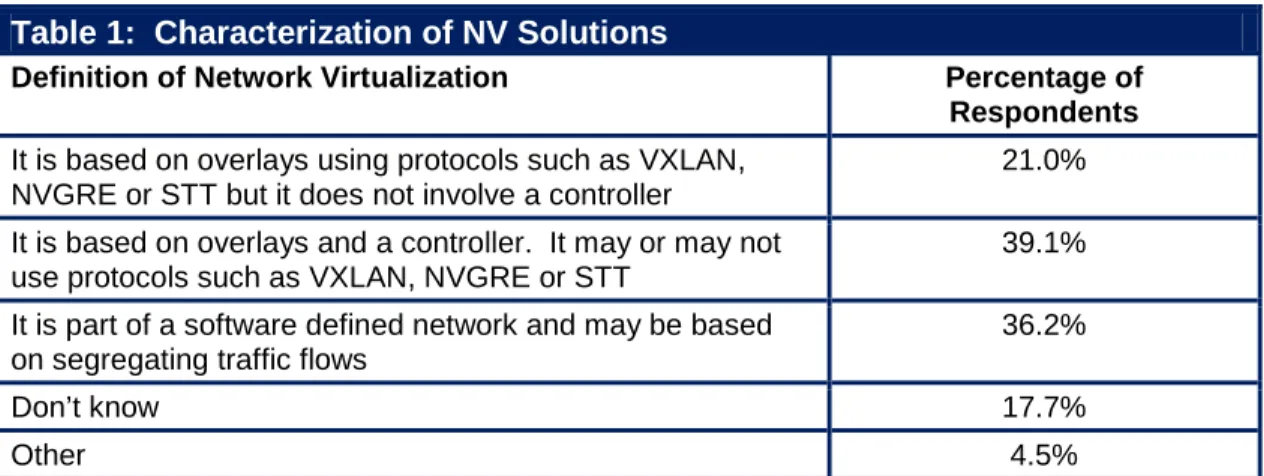
The Survey Respondents were asked to indicate how their organization defines network
virtualization and multiple answers were allowed. The survey question focused on the emerging
forms of network virtualization – bullets 2 and 3 in the preceding list. As indicated in Table 1,
some of the emerging forms of network virtualization are based on a device referred to as a controller. As is described below, one of the key roles of a controller is to serve as a central repository of address mappings.
The responses to this question are shown in Table 1.
Table 1: Characterization of NV Solutions
Definition of Network Virtualization Percentage of
Respondents It is based on overlays using protocols such as VXLAN,
NVGRE or STT but it does not involve a controller
21.0% It is based on overlays and a controller. It may or may not
use protocols such as VXLAN, NVGRE or STT
39.1% It is part of a software defined network and may be based
on segregating traffic flows
36.2%
Don’t know 17.7%
Other 4.5%
The data in Table 1 indicates that of the emerging forms of network virtualization, the
controller-based approaches to NV are by a wide margin the most popular.
VXLAN, NVGRE and STT are all draft IETF standards. To understand the role that standards play in the selection of NV solutions, The Survey Respondents were asked how important it was to their organization that NV solutions are based on open standards. Their responses are
2013 Guide to Network Virtualization and SDN December 2013
Page 5 Table 2: Importance of Open Standards
Level of Importance Percentage of Respondents
Extremely important 16.0%
Very important 32.1%
Moderately important 24.7%
Somewhat important 14.4%
Not important 7.4%
Don’t know 5.3%
The data in Table 2 indicates that NV solutions that are built on open standards are either very or extremely important to roughly half of The Survey Respondents.
2013 Guide to Network Virtualization and SDN December 2013
Page 6
Traditional NV & The NV Use Case
One-to-many virtualization of network entities is not a new concept. The most common
traditional applications of the virtualization concept to networks are VRF instances and VLANs. VRF is a form of Layer 3 network virtualization in which a physical router supports multiple virtual router (VR) instances, each running its own routing protocol instance and maintaining its own forwarding table. Unlike VLANs, VRF does not use a tag in the packet header to designate the specific VRF to which a packet belongs. The appropriate VRF is derived at each hop based on the incoming interface and information in the frame. An additional requirement is that each intermediate router on the end-to-end path traversed by a packet needs to be configured with a VRF instance that can forward that packet.
VLANs partition the standard Ethernet network into as many as 4,096 broadcast domains as designated by a 12 bit VLAN ID tag in the Ethernet header. VLANs have been a convenient means of isolating different types of traffic that share a common switched LAN infrastructure. In data centers making extensive use of server virtualization, the limited number of available VLAN IDs can present problems, especially in cases where a large number of tenants need to be supported, each of whom requires multiple VLANs. In contrast to this limitation of VLANs, part of the use case for the NV approaches that are described in The Guide is that these approaches enable IT organizations to establish virtual Ethernet networks without being constrained to only having 4,096 VLAN IDs.
Server virtualization is another factor that is driving the adoption of the approaches to NV that are described in this sub-section of The Guide. Due to server virtualization, virtual machines (VMs) can be dynamically created and moved, both within a data center and between data centers. Extending VLANs across a data center via 802.1Q trunks to support VM mobility adds operational cost and complexity due to the fact that each switch in end-to-end path has to be manually reconfigured. In data centers based on Layer 2 server-to-server connectivity, large numbers of VMs, each with its own MAC address, can also place a burden on the forwarding tables capacities of Layer 2 switches. A major component of the value proposition for the NV approaches that are described in The Guide is that they support the dynamic movement, replication and allocation of virtual resources without manual intervention. Another component of the value proposition for these approaches is that they avoid the issue of needing more MAC addresses than data center LAN switches can typically support.
The value proposition of network overlay solutions is expanded upon in the following sub-section. As is also described below, one characteristic of NV solutions that IT organizations need to understand is whether the solution enables the dynamic movement of virtual resources within a data center; between data centers; or between a data center and a branch or campus facility. A related characteristic that IT organizations need to understand is whether the solution leverages standards based protocols to federate with other NV solutions.
2013 Guide to Network Virtualization and SDN December 2013
Page 7
Network Overlays via Tunneling: Benefits & Limitations
A number of approaches to network virtualization leverage tunneling and encapsulation techniques to construct multiple virtual network topologies overlaid on a common physical network. A virtual network (VN) can be a Layer 2 network or a Layer 3 network, while the physical network can be Layer 2, Layer 3 or a combination depending on the overlay
technology. With overlays, the outer (encapsulating) header includes a field (generally up to 24 bits wide) that carries a virtual network instance ID (VNID) that specifies the virtual network designated to forward the packet.
Virtual network overlays can provide a wide range of benefits, including:
Virtualization is performed at the network edge, while the remainder of the L2/L3 network
remains unchanged and doesn’t need any configuration change in order to support the virtualization of the network. The most common approach is to perform the
encapsulation at the hypervisor vSwitch, which acts as the virtual tunnel endpoint (VTEP) or network virtualization edge (NVE). As a result, overlay NV solutions can generally be implemented over existing networks as either an enhancement to the conventional distributed network architecture, or as a step toward an SDN architecture.
Support for essentially unlimited numbers of VNs as the 24 bits that are typically used by
network overlays to identify VNs can identify slightly more than 16 million VN IDs. While theoretically NV solutions can support 16 million VNs, practical limits are often in the range of 16,000 to 32,000 VNs.
Decoupling of the virtual network topology from the physical network Infrastructure and
decoupling of the "virtual" MAC and/or IP addresses used by VMs from the infrastructure IP addresses used by the physical data center core network. The decoupling avoids issues such as limited MAC table size in physical switches.
Support for VM mobility independent of the physical network. If a VM changes location,
even to a new subnet in the physical network, the switches at the edge of the overlay simply update mapping tables to reflect the new physical location of the VM. The network for a new VM can be be provisioned entirely at the edge of the network.
Ability to manage overlapping IP addresses between multiple tenants.
Support for multi-path forwarding within virtual networks.
Ease of provisioning virtual appliances in the data path. Network services resident on
VMs can be chained together (a.k.a., service chaining) with point-and-click simplicity under the control of NV software.
For controller-based NV solutions, the controller is not in the data path, and so it does
not present a potential bottleneck.
The Survey Respondents were given a set of 15 possible challenges and opportunities and were asked to indicate which challenges and opportunities they thought that NV solutions could help them to respond to. The Survey Respondents were allowed to indicate multiple challenges
2013 Guide to Network Virtualization and SDN December 2013
Page 8 Table 3: Use Cases for NV Solutions
Challenge/Opportunity Percentage of Respondents
Better utilize network resources 44.0%
Support the dynamic movement, replication and allocation of virtual resources
39.1% Establish virtual Ethernet networks without the limit
and configuration burden of VLANs
32.5%
More easily scale network functionality 31.7%
Reduce OPEX 30.5%
Given the similarity of the second and third entries in Table 3, it follows that the primary value
that IT organizations see in NV solutions is the ability to dynamically implement virtual Ethernet networks that can support the dynamic movement, replication and allocation of virtual
resources.
Some of the limitations of overlay NV solutions include:
• Virtual and physical networks are separate entities, possibly with separate service
assurance solutions, policy management, provisioning, and control points.
• As the virtual networks grow and evolve, the physical network does not automatically
adapt to the changes. As a result, overlay NV requires a lightly oversubscribed or non-oversubscribed physical underlay network.
• Gateways between the virtual network and systems and network service points on the
physical network may need to pass high volumes of traffic. If a software gateway running on a VM or a dedicated appliance has insufficient processing power, hardware support for the gateway functionality may be required in physical switches or network service appliances. Some of the more recent merchant silicon switching chips support gateway functionality for VXLAN which is the most popular encapsulation protocol.
• Some value-added features in existing networks cannot be leveraged due to
encapsulation. For example, the physical network loses its ability to provide differentiated services based on the content of the packet header.
NV solutions also create some management challenges. For example, one of the primary benefits of overlay solutions is the ability to support multiple VNs running on top of the physical network. Effective operations management requires that IT organizations have tools that give them clear visibility into the relationships between virtual and physical networks and their
component devices. When performance or availability problems occur, both root cause analysis and impact analysis require bilateral mapping between the physical and virtual infrastructures. Both increasing and complicating the need for the visibility described in the preceding paragraph
is the ability of NV solutions to do service chaining. The phrase service chaining refers to the
ability to steer VM-VM traffic flows through a sequence of physical or virtual servers that provide network services, such as firewalls, IPS/IDS, DPI, or load balancers. The primary focus of service chaining is on services provided by virtual appliances. Most SDN or NV solutions
2013 Guide to Network Virtualization and SDN December 2013
Page 9
provide service chaining. For SDN, the controller configures the forwarding plane switches to direct the flows along the desired paths, For NV, the controller adjust the FIBs of the
vSwitches/vRouters to force the traffic through the right sequence of VMs. Network Function Virtualization, discussed in the next section of The Guide, is basically service chaining that focuses on network services/functions provided by virtual appliances, but isn’t necessarily dependent on SDN or NV.
The bottom line is that IT organizations need visibility not just into the overlay NV solution but into the complete solution and all of its components; e.g., firewalls, load balancers.
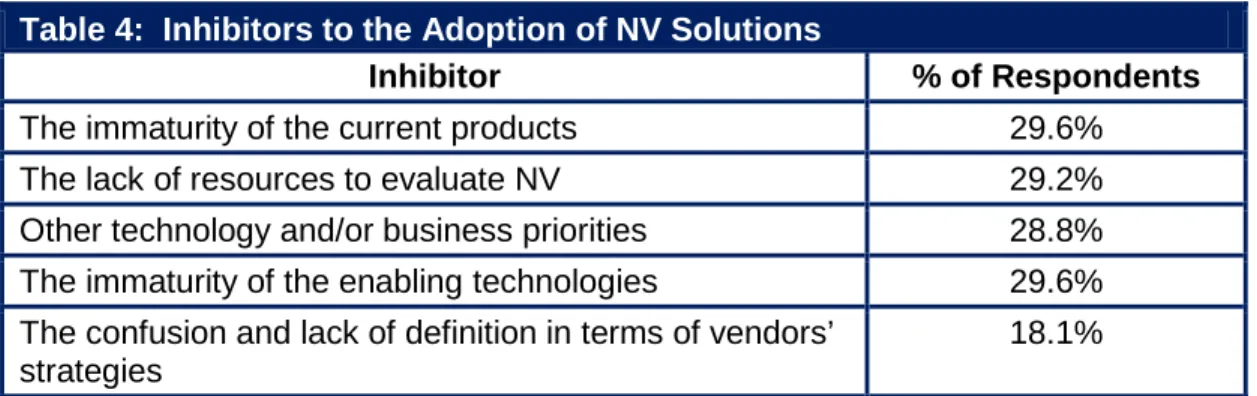
The Survey Respondents were given a set of 12 inhibitors to the adoption of NV and were asked to indicate the two biggest inhibitors to their company adopting NV sometime in the next
two years. The top 5 inhibitors are shown in Table 4.
Table 4: Inhibitors to the Adoption of NV Solutions
Inhibitor % of Respondents
The immaturity of the current products 29.6%
The lack of resources to evaluate NV 29.2%
Other technology and/or business priorities 28.8%
The immaturity of the enabling technologies 29.6%
The confusion and lack of definition in terms of vendors’ strategies
18.1%
One interesting observation that can be drawn from the data in Table 4 is that IT organizations
are not avoiding implementing NV solutions because they don’t see value in them. Rather, the key factors inhibiting the adoption of NV solutions are the same factors that typically inhibit the adoption of any new technology or way of implementing technology: Immaturity of products and strategies; confusion; and lack of resources.
The Survey Respondents were asked to indicate the impact they thought that NV would have on
security and network management. Their responses are shown in Table 5 and Table 6.
Table 5: Impact of NV on Security
Impact on Security % of Respondents
Networks will be much more secure 6.2%
Networks will be somewhat more secure 33.7%
NV will have no impact on network security 23.5%
Networks will be somewhat less secure 14.0%
Networks will be much less secure 2.5%
2013 Guide to Network Virtualization and SDN December 2013
Page 10 Table 6: Impact of NV on Management
Impact on Management % of Respondents
Networks will be much easier to manage 21.8%
Networks will be somewhat easier to manage 52.3%
NV will have no impact on management 4.5%
Networks will be somewhat more difficult to manage 9.9%
Networks will be much more difficult to manage 4.5%
Don’t know 7.0%
One conclusion that can be drawn from the data in Table 5 and Table 6 is that The Survey
Respondents generally think that implementing NV solutions will make their networks more secure and easier to manage. As such, security and ease of management can potentially be looked at as benefits of implementing NV solutions.
2013 Guide to Network Virtualization and SDN December 2013
Page 11
Cloud Orchestration
Cloud Orchestration platforms have evolved as a means of automating and facilitating the process of configuring pools of data center resources in order to provide a range of cloud or cloud-like services, such as Infrastructure as a Service (IaaS) solutions. The Orchestrator’s role is to manipulate the basic resources of the data center (i.e., VMs, networks, storage, and applications) at a very high level of abstraction to create the service. Orchestration is most effective when the data center is fully virtualized, facilitating software control/reconfiguration and automation. As a result, there is a naturally affinity between Orchestration and software-based network controllers, such as NV controllers or SDN controllers.
OpenStack is a cloud computing orchestration project offering free open source software released under the terms of the Apache License. The project is managed by the OpenStack Foundation, a non-profit corporate entity established in September 2012 to promote OpenStack software and its community. Apache CloudStack is another open source Apache Licensed orchestration system. Eucalyptus is a third open source orchestrator with tight technical ties to Amazon Web Services (AWS).
In addition, there are a number of proprietary orchestrators that offer open APIs to allow integration across vendor boundaries. These include VMware’s vCloud Director and IBM’s SmartCloud Orchestrator.
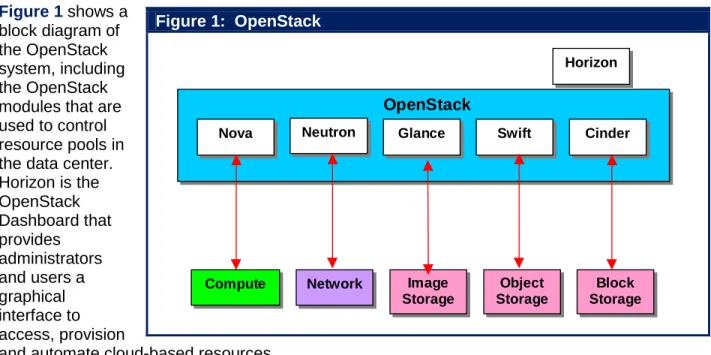
Figure 1 shows a block diagram of the OpenStack system, including the OpenStack modules that are used to control resource pools in the data center. Horizon is the OpenStack Dashboard that provides administrators and users a graphical interface to access, provision
and automate cloud-based resources.
Neutron (formerly called Quantum) allows users to create their own networks, provide connectivity for servers and devices, and control traffic. With appropriate Neutron plug-ins, administrators can take advantage of various NV and SDN solutions to allow for multi-tenancy and scalability. OpenStack networking also has an extension framework allowing additional network services, such as intrusion detection systems (IDS), load balancing, firewalls and virtual
private networks (VPN) to be deployed and managed.
Figure 1: OpenStack
Nova Neutron
OpenStack
Compute
Swift Cinder
Network Object
Storage
Block Storage Horizon
Glance
Image Storage
2013 Guide to Network Virtualization and SDN December 2013
Page 12
In conjunction with the Orchestrator, the role of the SDN or NV controller is to translate the abstract model created on the Orchestrator into the appropriate configuration of the virtual and physical resources that will deliver the desired service. For example, the orchestrator can instruct the controller to perform a variety of workflows, including:
• Create a VM
• Assign a VM to a Virtual Network (VN)
• Connect a VM to an external network
• Apply a security policy to a group of VMs or a Virtual Network
• Attach Network Services to a VM or chain Network Services between VMs
Figure 2 provides a
high level depiction of
how an orchestrator
(OpenStack) an
d a NV controller might interact to place a VM into service within a VN.The Nova module in OpenStack instructs the Nova Agent in the hypervisor to create the VM. The Nova agent communicates with the Neutron module in OpenStack to learn the network attributes of the
VM. The Nova agent then informs the vSwitch agent to configure the virtual network for the VM and then the controller provides the route table entries needed by the vSwitch.
Figure 2: VM Creation Workflow with OpenStack
Nova Neutron
NV Controller
vSwitch Agent Nova Agent
Hypervisor OpenStack
2013 Guide to Network Virtualization and SDN December 2013
Page 13
Controller Based NV Solution Architecture
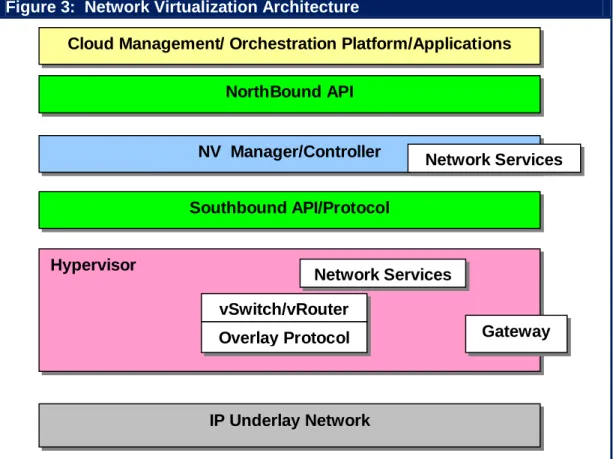
A Network Virtualization Solution typically has an architecture similar to the one shown in
Figure 3. The main components are typically the NV Controller, hypervisor-resident
vSwitches/vRouters, and gateways that provide connectivity from virtual networks to traditional network segments; e.g., VLANs, non-virtualized servers, or Internet routers. The controller function is generally supported by a high availability (HA) cluster or another HA configuration. Controller functionality may be comprised of a number of sub-functions running on different servers. Cloud Management/Orchestration is typically obtained from a third party and network services may be integrated with the controller, integrated via virtual appliances, or possibly integrated via physical appliances through the gateway.
Figure 3: Network Virtualization Architecture
Cloud Management/ Orchestration Platform/Applications
NorthBound API
NV Manager/Controller
Southbound API/Protocol
Hypervisor
vSwitch/vRouter Overlay Protocol
IP Underlay Network
Network Services
Gateway Network Services
2013 Guide to Network Virtualization and SDN December 2013
Page 14
Criteria to Evaluate Overlay NV Solutions
One of the primary criterion that IT organizations should use relative to evaluating overlay network virtualization solutions is how well it solves the problem(s) that the IT organization is looking to solve. For example, can the solution enable the IT organization to move workloads between data centers? Between a data center and a branch office?
Other solution level criteria that IT organizations should evaluate include:
• Does the solution federate and hence interoperate with other solutions?
• What interaction, if any, is there between the virtual networks and the physical
networks?
• What management functionality is provided into both the virtual and physical networks?
• Does the solution support service chaining?
The main technical differences between the various overlay NV solutions that IT organizations should evaluate fall into the following categories:
• Encapsulation formats. Some of the tunneling/encapsulation protocols that provide network virtualization of the data center include VXLAN, NVGRE, STT, and SPB MAC-in-MAC (SPBM). Both the IEEE and the IETF have already standardized SPB. It is unclear as to whether or not all of the other proposals will become standards.
• Tunnel control plane functionality that allows ingress (encapsulating) devices to map a frame to the appropriate egress (decapsulating) device. The first-hop overlay device implements a mapping operation that determines where the encapsulated packet should be sent to reach its intended destination VM. Specifically, the mapping function maps the destination address (either L2 or L3) of a packet received from a VM into the
corresponding destination address of the egress NVE device. The main differences here are whether a controller is used and the functionality of the controller.
Some of the initial, controller-less approaches to network virtualization relied on IP multicast as a way to disseminate address mappings. A more common solution is based on a central repository of address mappings housed in a controller. Vendors frequently refer to controller-based overlay NV solutions as SDN, while a more descriptive
terminology might be Software Defined Overlay Network Virtualization.
• vSwitches supported. A number of vSwitches are based to some degree on the open
source Open vSwitch (OVS)1, while other vSwitches are of proprietary design. Another
point of differentiation is whether the vSwitch is a virtual router as well as being an encapsulating Layer 2 switch. With Layer 3 functionality, a vSwitch can forward traffic between VMs on the same hypervisor that are in different subnets and can be used to implement Layer 3 VNs. Where the tunneling vSwitch has full Layer 3 functionality, the majority of intelligence can be implemented at the edge of network, allowing the underlay network to be implemented as a simple Layer 2 fabric.
1
2013 Guide to Network Virtualization and SDN December 2013
Page 15
• Broadcast/Multicast delivery within a given virtual network. NVEs need a way to deliver multi-destination packets to other NVEs with destination VMs. There are three different approaches that can be taken:
The multicast capabilities of the underlay network can be used
The NVEs can replicate the packets and unicast a copy across the underlay
network to each NVE currently participating in the VN.
The NVE can send the packet to a distribution server which replicates and
unicasts the packets on the behalf of the NVEs.
• Protocols. Another characteristic of centralized controller solutions is the choice of Southbound protocols/APIs employed between the NV controller and the NVE and the choice of Northbound protocols/APIs used between the NV controller and cloud management systems and hypervisor management systems. If the southbound
protocols are standardized, the NVE can potentially communicate with different types of NV controllers or controllers from different vendors. Some the alternatives here include OpenFlow, BGP, and CLI shell scripts.
If the northbound protocols are standardized, the controller can be integrated with network services from ISVs or different types of third party orchestration systems. Most overlay NV controllers support a RESTful Web API for integration with cloud
management and orchestration systems. With both southbound and northbound APIs the most important question becomes which third party switches, applications, virtual appliances, and orchestration systems have been certified and are supported by the overlay NV vendor.
•
VN Extension over the WAN. VN extension over the WAN can generally beaccomplished with most NV solutions. However, in some cases the encapsulation used over the wide area may differ from that used within the data center. Some of the
encapsulation techniques used for VN extension over the WAN include MPLS VPNs and two proprietary protocols from Cisco: Overlay Transport Virtualization (OTV) and
Locator/ID Separation Protocol (LISP). OTV is optimized for inter-data center VLAN extension over the WAN or Internet using MAC-in-IP encapsulation. It prevents flooding of unknown destinations across the WAN by advertising MAC address reachability using IS-IS routing protocol extensions. LISP is an encapsulating IP-in-IP technology that allows end systems to keep their IP address (ID) even as they move to a different subnet within the network (Location). By using LISP VM-Mobility, IP endpoints such as VMs can be relocated anywhere regardless of their IP addresses while maintaining direct path routing of client traffic. LISP also supports multi-tenant environments with Layer 3 virtual networks created by mapping VRFs to LISP instance-IDs. Inter-data center network virtualization could also potentially be based on Layer 3 vSwitches that support MPLS VPNS and implement network virtualization using RFC 4023 MPLS over IP/GRE tunnels through an IP enterprise network to connect to an MPLS VPN service. SPBM is unique in that it offers extensions over the WAN natively without requiring additional protocols such as OTV or MPLS VPNs.
The remainder of this sub-section of The Guide focuses on the primary differentiating features of Overlay NV solutions: tunnel encapsulation and tunnel control.
2013 Guide to Network Virtualization and SDN December 2013
Page 16
Tunnel Encapsulation
VXLAN: Virtual eXtensible LAN (VXLAN)2 virtualizes the network by creating a Layer 2 overlay on a Layer 3 network via MAC-in-UDP encapsulation. The VXLAN segment is a Layer 3
construct that replaces the VLAN as the mechanism that segments the data center LAN for VMs. Therefore, a VM can only communicate or migrate within a VXLAN segment. The VXLAN segment has a 24-bit VXLAN Network identifier. VXLAN is transparent to the VM, which still communicates using MAC addresses. The VXLAN encapsulation is performed through a function known as the VXLAN Tunnel End Point (VTEP), typically a hypervisor vSwitch or a possibly a physical access switch. The encapsulation allows Layer 2 communications with any end points that are within the same VXLAN segment even if these end points are in a different IP subnet. This allows live migrations to transcend Layer 3 boundaries. Since MAC frames are encapsulated within IP packets, there is no need for the individual Layer 2 physical switches to learn MAC addresses. This alleviates MAC table hardware capacity issues on these switches. Overlapping IP and MAC addresses are handled by the VXLAN ID, which acts as a
qualifier/identifier for the specific VXLAN segment within which those addresses are valid. As noted, VXLANs use a MAC-in-UDP encapsulation. One of the reasons for this is that modern Layer 3 devices parse the 5-tuple (including Layer 4 source and destination ports). While
VXLAN uses a well-known destination UDP port, the source UDP port can be any value. As a result, a VTEP can spread all the flows from a single VM across many UDP source ports. This allows for efficient load balancing across link aggregation groups (LAGs) and intermediate multi-pathing fabrics even in the case of multiple flows between just two VMs.
Where VXLAN nodes on a VXLAN overlay network need to communicate with nodes on a legacy (i.e., VLAN) portion of the network, a VXLAN gateway can be used to perform the required tunnel termination functions including encapsulation/decapsulation. The gateway functionality could be implemented in either hardware or software.
VXLAN is supported by a number of vendors including Cisco Systems, VMware, IBM, and Nuage Networks. Avaya’s SPBM implementation (Fabric Connect) can also support a VXLAN deployment, acting as a transport layer providing optimized IP Routing and Multicast for VXLAN-attached services.
STT: Stateless Transport Tunneling (STT)3 is a second overlay technology for creating Layer 2 virtual networks over a Layer 2/3 physical network within the data center. Conceptually, there are a number of similarities between VXLAN and STT. The tunnel endpoints are typically provided by hypervisor vSwitches, the VNID is 24 bits wide, and the transport source header is manipulated to take advantage of multipathing. STT encapsulation differs from VXLAN in two ways. First, it uses a stateless TCP-like header inside the IP header that allows tunnel
endpoints within end systems to take advantage of TCP segmentation offload (TSO) capabilities of existing TOE server NICs. The benefits to the host include lower CPU utilization and higher utilization of 10 Gigabit Ethernet access links. STT generates a source port number based on hashing the header fields of the inner packet to ensure efficient load balancing over LAGs and multi-pathing fabrics. STT also allocates more header space to the per-packet metadata, which provides added flexibility for the virtual network tunnel control plane. With these features, STT is
2
http://searchservervirtualization.techtarget.com/news/2240074318/VMware-Cisco-propose-VXLAN-for-VM-mobility 3
2013 Guide to Network Virtualization and SDN December 2013
Page 17
optimized for hypervisor vSwitches as the encapsulation/decapsulation tunnel endpoints. The initial implementations of Network Virtualization using STT from Nicira Networks are based on OpenFlow-like hypervisor vSwitches (Open vSwitches) and a centralized control plane for tunnel management via downloading mapping tables to the vSwitches.
NVGRE: Network Virtualization using Generic Router Encapsulation (NVGRE)4 uses the GRE tunneling protocol defined by RFC 2784 and RFC 2890. NVGRE is similar in most respects to VXLAN with two major exceptions. While GRE encapsulation is not new, most network devices do not parse GRE headers in hardware, which may lead to performance issues and issues with 5-tuple hashes for traffic distribution in multi-path data center LANs. With GRE hashing
generally involves the GRE key.
One initial implementation of NVGRE from Microsoft relies
on Layer 3 vSwitches whose mapping tables and routing tables are downloaded from
the vSwitch manager. Downloads are performed via a command-line shell and
associated scripting language.
SPBM5: IEEE 802.1aq/IETF 6329 Shortest Path Bridging MAC-in-MACuses IEEE 802.1ah
MAC-in-MAC encapsulation and the IS-IS routing protocol to provide Layer 2 network virtualization and VLAN extension in addition to a loop-free equal cost multi-path Layer 2 forwarding functionality. VLAN extension is enabled by the 24-bit Service IDs (I-SIDs) that are part of the outer MAC encapsulation. Unlike other network virtualization solutions, no changes are required in the hypervisor vSwitches or NICs and switching hardware already exists that supports IEEE 802.1ah MAC-in-MAC encapsulation. For SPBM, the control plane is provided by the IS-IS routing protocol.
SPBM can also be extended to support Layer 3 forwarding and Layer 3 virtualization as described in the IP/SPB IETF draft using IP encapsulated in the outer SPBM header. This specification identifies how SPBM nodes can perform Inter-ISID or inter-VLAN routing. IP/SPB also provides for Layer 3 VSNs by extending VRF instances at the edge of the network across the SPBM network without requiring that the core switches also support VRF instances. VLAN-extensions and VRF-VLAN-extensions can run in parallel on the same SPB network to provide isolation of both Layer 2 and Layer 3 traffic for multi-tenant environments. With SPBM, only those Switches that define the SPBM boundary need to be SPBM-capable. Switches not directly involved in mapping services to SPB service IDs don’t require special hardware or software capabilities. SPBM isn’t based on special vSwitches, data/control plane separation, or centralized controllers. SPBM hardware Switches are currently available from several vendors, including Avaya and Alcatel-Lucent.
Tunnel Control
As previously mentioned, initial implementations of VXLAN by Cisco and VMware use flooding as a distributed control solution based on Any Source Multicast (ASM) to disseminate end system location information. Because flooding requires processing by all the vSwitches in the multicast group, this type of control solution will not scale to support very large networks. .
A more recent approach is to implement tunnel control as a centralized controller function. A control plane protocol that carries both MAC and IP addresses can eliminate the need for ARP. One controller-based solution for VXLAN control, championed by IBM’s Distributed Overlay
4
http://datatracker.ietf.org/doc/draft-sridharan-virtualization-nvgre/ 5
2013 Guide to Network Virtualization and SDN December 2013
Page 18
Virtual Ethernet (DOVE) initiative, is to use a DNS-like network service to map the VM’s IP address to the egress VTEP’s IP address. IBM’s solution does not require Multi Cast enablement in the physical network. IBM’s Controller based solution has built-in IP routing capability.
In another controller-based approach, used by Nicira Networks, the controller maintains a data base of Open vSwitches (OVS) in the network and proactively updates OVS mapping tables via OpenFlow to create new tunnels when VMs are created or moved. The Nicira controller
focuses on the virtual network topology and is oblivious to the topology of the core physical network. The controller is integrated with hypervisor and cloud management systems to learn of changes in the population of VMs.
A third controller approach, used by Nuage Networks and Netsocket, involves the controller maintaining a full topology of the virtual and physical network and maintaining the full address mapping and routing tables derived from standard routing protocols, such as OSPF, IS-IS, or BGP. The portion of the table needed by the vSwitch is disseminated from the controller to the vSwitches via the OpenFlow protocol. The Nuage Networks’ vSwitches use VXLAN to
2013 Guide to Network Virtualization and SDN December 2013
Page 19
Comparison of Network Overlay Virtualization Solutions
The following table (Table 7) provides a high level summary of the primary features of some of
the Network Virtualization solutions that are available or have been recently announced. Note that the solutions described in columns two and three (Cisco, VMware) are not based on a controller.
Table 7: Network Overlay Virtualization features
Cisco VMware IBM VMware/
Nicira
Nuage Networks
Avaya Netsocket Juniper
Product Nexus 1000v
VSphere DS
SDN-VE NSX VSP Fabric
Connect
NVN Contrail
Overlay VXLAN VXLAN VXLAN VXLAN
STT?
VXLAN SPBM GRE MPLS/GRE
MPLS/UDP VXLAN VM-NVE Address Learning VTEP Multicast flooding VTEP Multicast flooding Pull From Controller’s Directory Push From Controller’s Data Base Push From Controller’s Map Table IS-IS SPB on physical switch Push From Controller’s Map Table Push From Controller’s Map Table Broadcast / Multicast within VN via underlay Multicast via underlay Multicast distribution server replication distribution server replication dVRS packet replication via SPB multicast VRouter packet replication or proxy Controller Topology Awareness
na na Virtual
Networks
Virtual Networks
Entire Network Entire Network Entire Network Entire Network Controller to NVE Protocol
NX-OS CLI VMware API Open source submitted to OpenDaylight
OpenFlow NSX API
OpenFlow IS-IS vFlow or
OpenFlow
XMPP
vSwitch Nexus 1000v VDS SDN-VE
vSwitch VDS, Open vSwitch** dVRS (Open vSwitch**) Native to Hypervisor
vFlowSwitch v Contrail vRouter vSwitch
L3
no no yes yes yes na yes yes
Gateway Support in Physical Switches Arista 7150s Brocade ADX Nuage Networks 7850 VSG na
Hypervisors ESXi, Hyper-V, XEN, KVM
ESXi ESXi
KVM
vSphere. ESXi, XEN, KVM ESXi, Hyper-V, XEN, KVM ESXi, Hyper-V, XEN, KVM Hyper-V ESXi Xen, KVM KVM, XEN Controller Federation via MP-BGP BGP DC-DC encapsulation
OTV OTV VXLAN GRE MPLS over
GRE to PE router
Over an SPBM WAN
GRE MPLS/GRE
OpenStack vCloud
OpenStack vCloud
OpenStack OpenStack CloudStack vCloud OpenStack CloudStack vCloud OpenStack Integration in controller OpenStack System Ctr. OpenStack.
2013 Guide to Network Virtualization and SDN December 2013
Page 20
Software Defined NV via Flow Table Segmentation
Network virtualization can also be implemented as an application that runs on an SDN controller. Virtual networks are defined by policies that map flows to the appropriate virtual network based on L1-L4 portions of the header. With this type of SDN-based NV, there is no need for tunnels and encapsulation protocols. One example of an NV application is the Big Virtual Switch that runs on the Big Network Controller from Big Switch Networks. The Big Network Controller implements VNs by configuring forwarding tables in OpenFlow physical and virtual switches. The OpenFlow switches can be from a variety of traditional switch vendors. Another alternative is to use Big Switch Switch Light OpenFlow thin software agent running on bare metal Ethernet switches based on Broadcom merchant silicon or on virtual switches. By exploiting the capability of OpenFlow to deal with encapsulation and de-encapsulation, the SDN controller NV application can also be used to implement overlay VNs running over a conventional L2/L3 network, or a hybrid network based partially on pure SDN VNs and partially on SDN NVs with OpenFLow virtual switches and a conventional core network.
Another slightly different approach to an NV application for SDN controllers is the Virtual Tenant Network (VTN) application developed by NEC and recently accepted as an application by the OpenDaylight consortium. The VTN solution provides a layer of abstraction between the virtual network and the physical network. In the event of a failed link, the VTN can detect and redirect the affected flows within milliseconds. This avoids the re-convergence delay associated with traditional network protocols. The VTN also supports redirection, which enables use cases related to traffic steering and service chaining. In addition, the VTN physical control of the network supports flow based traffic engineering as well as 8-way ECMP.
VTN is based on a logical abstraction that decouples the VTN from the physical network. A virtual network can be designed and deployed using the following set of logical network elements:
• vBridge L2 switch function.
• vRouter router function.
• vTEP virtual Tunnel End Point.
• vTunnel Tunnel.
• vBypass connectivity between controlled networks.
• vInterface end point on the virtual node.
• vLink L1 connectivity between virtual interfaces.
Using these elements allows the user can define a logical network with the look and feel of conventional L2/L3 network. VTN can also by used to implement an overlay network, an OpenFlow network, or a hybrid overlay/OpenFlow network. Once the network is designed on VTN, it can automatically be mapped onto the underlying physical network, and configured on the individual switches leveraging an SDN control protocol, Typically this would be OpenFlow. Mapping is used to identify the VTN to which each packet transmitted or received by an
OpenFlow switch belongs, as well as which interfaces on the OpenFlow switch can transmit or receive that packet. Flows are mapped to a VTN vBridge based on the ingress port on the OpenFlow switch, the source MAC address or the VLAN ID.
2013 Guide to Network Virtualization and SDN December 2013
Page 21
Enterprise Plans for NV Adoption
The Survey Respondents were asked a series of questions about their current position relative to evaluating and adopting NV solutions and how that position might change over the next two to three years. In the first of those questions, The Survey Respondents were given a set of alternatives and were asked to indicate the alternatives that described their company’s current
approach to implementing NV solutions. Their responses are shown in Table 8.
Table 8: Current Approaches to Adopting NV Solutions
Approach to Adoption NV Solutions % of Respondents
We have not made any analysis of NV 25.5%
We will likely analyze NV sometime in the next year 25.5%
We are currently actively analyzing the potential value that NV offers 24.7%
We expect that within a year that we will be running NV either in a lab or in a limited trial
13.6%
We are currently actively analyzing vendors’ NV strategies and offerings 11.5%
We currently are running NV either in a lab or in a limited trial 9.9%
We currently are running NV somewhere in our production network 7.4%
We looked at NV and decided to not do anything with NV over the next year
6.2% We expect that within a year that we will be running NV somewhere in
our production network
5.8%
Don’t know 4.9%
The data in Table 8 indicates that while there is currently little deployment of NV, there is a lot of
activity and interest relative to analyzing NV solutions. The data in Table 8 also suggests that over the next year the percentage of IT organizations that are either running NV somewhere in their production network, or in a lab or limited trial, will double.
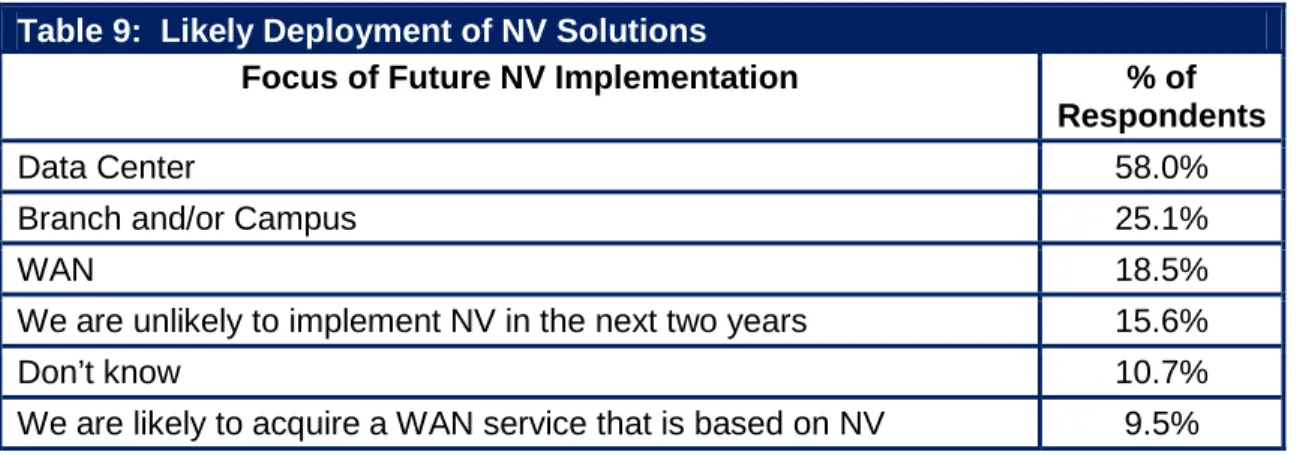
The Survey Respondents were given a two-year time frame and were asked to indicate where in their infrastructure their organization was likely to implement NV solutions. (Multiple
responses were allowed) Their responses are shown in Table 9.
Table 9: Likely Deployment of NV Solutions
Focus of Future NV Implementation % of Respondents
Data Center 58.0%
Branch and/or Campus 25.1%
WAN 18.5%
We are unlikely to implement NV in the next two years 15.6%
Don’t know 10.7%
2013 Guide to Network Virtualization and SDN December 2013
Page 22
The data in Table 9 indicates that IT organizations will primarily implement NV solutions within a
data center. However, the data also indicates that a sizeable percentage of IT organizations want to extend their NV solutions over the WAN and to also implement NV solutions in their branch and campus networks.
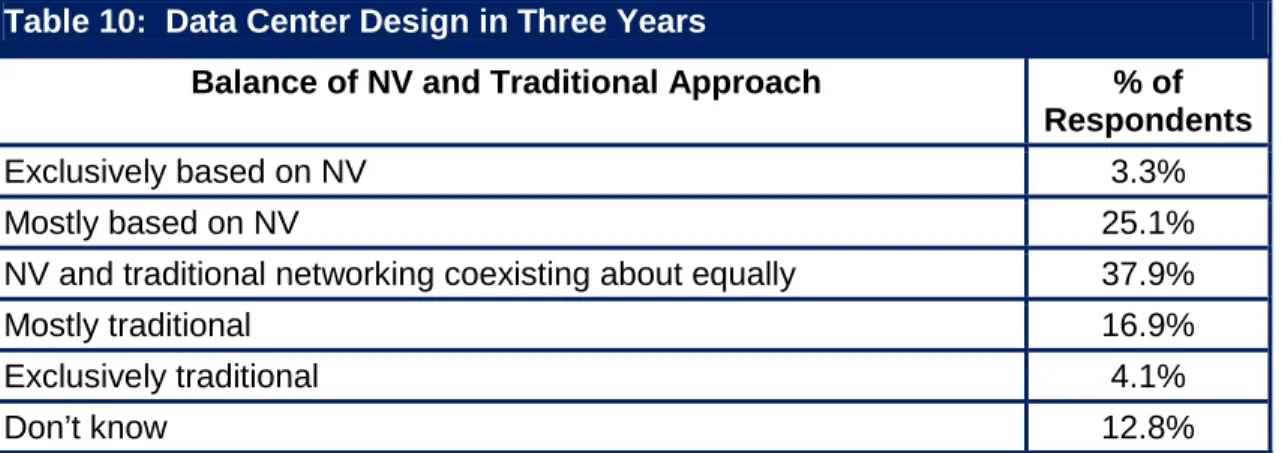
In the final question about their potential future use of NV solutions, The Survey Respondents were asked to indicate how broadly their data center networks will be based on NV three years
from now. Their responses are shown in Table 10.
Table 10: Data Center Design in Three Years
Balance of NV and Traditional Approach % of Respondents
Exclusively based on NV 3.3%
Mostly based on NV 25.1%
NV and traditional networking coexisting about equally 37.9%
Mostly traditional 16.9%
Exclusively traditional 4.1%
Don’t know 12.8%
The data in Table 10 indicates that the vast majority of The Survey Respondents expect that in
2013 Guide to Network Virtualization and SDN December 2013
Page 23
Chapter 2: The what, why and how of SDN
Background
In the traditional approach to networking, most network functionality is implemented in a dedicated appliance; i.e., switch, router, application delivery controller. In addition, within the dedicated appliance, most of the functionality is implemented in dedicated hardware such as an ASIC (Application Specific Integrated Circuit).
Some of the key characteristics of this approach to developing network appliances are:
• The ASICs that provide the network functionality evolve slowly;
• The evolution of ASIC functionality is under the control of the provider of the appliance;
• The appliances are proprietary;
• Each appliance is configured individually;
• Tasks such as provisioning, change management and de-provisioning are very time
consuming and error prone.
Networking organizations are under increasing pressure to be more efficient and agile. One source of that pressure results from the widespread adoption of server virtualization. As part of server virtualization, virtual machines (VMs) are dynamically moved between servers in a matter of seconds or minutes. However, if the movement of a VM crosses a Layer 3 boundary, it can take days or weeks to reconfigure the network to support the VM in its new location. It can sometimes be difficult to define exactly what it means for a network to be agile. That said, if it takes weeks to reconfigure the network to support the movement of a VM, that network isn’t agile.
The bottom line is that a traditional network evolves slowly; is limited in functionality by what is provided by the vendors of the network appliances; has a relatively high level of OPEX and is relatively static in nature. The majority of the potential SDN use cases (see below) are intended to overcome those characteristics of traditional networks.
2013 Guide to Network Virtualization and SDN December 2013
Page 24
Potential SDN Use Cases
There is scene in the novel Alice in Wonderland that is directly relevant to the adoption of NV
and SDN solutions. That scene is comprised of the following dialogue between Alice and the Cheshire cat.
Alice: “Would you tell me, please, which way I ought to go from here?”
Cheshire Cat: ‘That depends a good deal on where you want to get to.”
Alice: “I don’t much care where.”
Cheshire Cat: “Then it doesn’t matter which way you go.”
The relevance of that dialogue to SDN is that an analysis of SDN solution architectures and subtending protocols is totally irrelevant until IT organizations identify which use cases they are hoping to address with SDN.
The left hand column of Table 11 contains some of the primary challenges & opportunities
facing the typical IT organization. The Survey Respondents were shown those challenges & opportunities and were asked to indicate which of them they thought that SDN could help them to respond to and they were allowed to check all that applied. Each row of the right hand
column of Table 11 contains the percentage of The Survey Respondents that indicated that
they thought that SDN could help them to respond to the challenge or opportunity in the corresponding left hand column.
2013 Guide to Network Virtualization and SDN December 2013
Page 25 Table 11: Opportunities & Challenges that SDN Can Address
Challenge or Opportunity Percentage
Better utilize network resources 51%
Ease the administrative burden of configuration and provisioning QoS and Security
47%
Perform traffic engineering with an end-to-end view of the network 44%
More easily scale network functionality 39%
Support the dynamic movement, replication and allocation of virtual resources
38% Establish virtual Ethernet networks without the limitations and
configuration burden of VLANs
35%
Reduce Complexity 34%
Enable applications to dynamically request services from the network 32%
Reduce OPEX 30%
Have network functionality evolve more rapidly based on a software development lifecycle
27%
More easily implement QoS 27%
Implement more effective security functionality 26%
Reduce CAPEX 25%
We don’t see any challenges or opportunities that SDN can help us with 3%
Don’t know 3%
Other 3%
One observation that can be drawn from the data in Table 11 is that there is a wide range of
challenges and opportunities that The Survey Respondents believe that SDN can help with and conversely very few IT organizations believe that SDN won’t be beneficial. Having a wide range of potential challenges and opportunities to respond to bodes well for the long-term adoption of SDN. However, having so many challenges and opportunities to respond to can create confusion in the short term and can possibly delay SDN adoption.
To exemplify the relationship between the opportunities & challenges and the two types of solutions analyzed in The Guide (i.e., NV and SDN), assume that the opportunity that a hypothetical IT organization is attempting to respond to is the need to support the dynamic movement, replication and allocation of virtual workloads. The hypothetical IT organization can respond to this challenge using any of the NV solutions that were discussed in the preceding chapter; e.g., solutions from Nuage Networks, Netsocket, Avaya and NEC. As a reminder to the reader, the NV solutions from Nuage Networks, Netsocket and Avaya are based on overlay technologies and the NV solution from NEC is based on manipulating the flow tables in NEC’s SDN solution.
The situation is quite different if the opportunity that the hypothetical IT organization is trying to respond to is the need to make it easier to implement QoS or the need to enable applications to dynamically request services from the network. The hypothetical IT organization can potentially
2013 Guide to Network Virtualization and SDN December 2013
Page 26
respond to both of these challenges by implementing an SDN solution whereas that
organization couldn’t respond to those challenges by just implementing one of the controller based NV solutions that were discussed in the preceding chapter. As will be pointed out in the following discussion of a federated overlay/underlay model, it would potentially be possible for the hypothetical IT organization to respond to those challenges using a federation of NV overlay solutions and SDN solutions.
The challenges and opportunities that are identified in Table 11 aren’t dependent on any
particular technology. For example, there are a number of technologies that can be implemented in order to ease the burden of configuration management. That said, a
subsequent sub-section of this document identifies some of the specific use cases and benefits that are associated with the OpenFlow protocol.
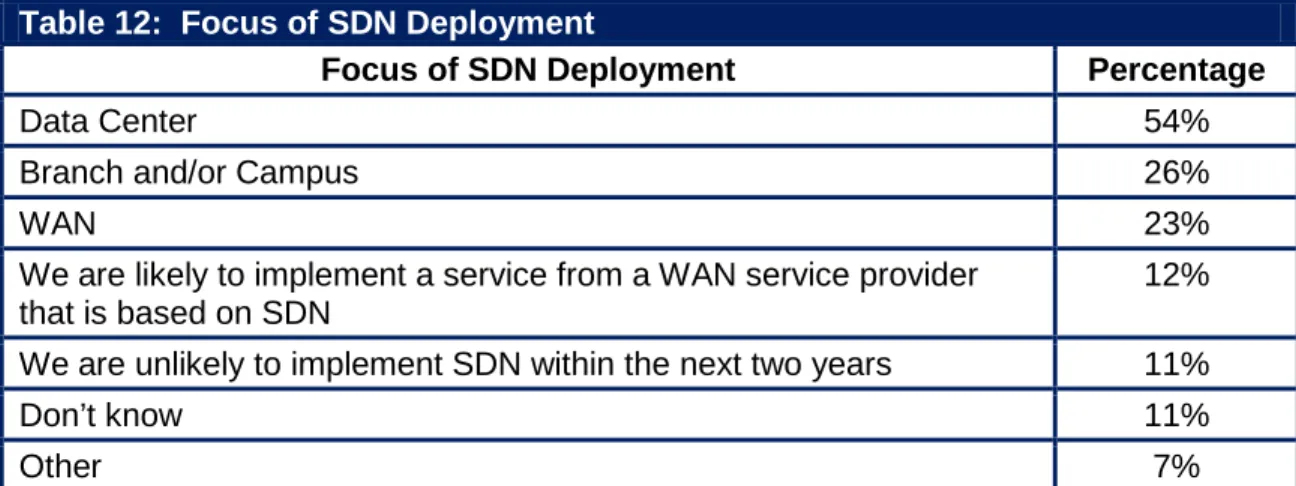
While the use of SDN in data centers receives the majority of attention, it is also possible to implement SDN in branch and campus networks as well as in wide area networks (WANs). In order to understand where SDN will likely be implemented, The Survey Respondents were asked “If your organization is likely to implement SDN sometime over the next two years, where
are you likely to implement it?” Their responses are summarized in Table 12.
Table 12: Focus of SDN Deployment
Focus of SDN Deployment Percentage
Data Center 54%
Branch and/or Campus 26%
WAN 23%
We are likely to implement a service from a WAN service provider that is based on SDN
12%
We are unlikely to implement SDN within the next two years 11%
Don’t know 11%
Other 7%
One observation that can be made from the data in Table 12 is that while the primary interest in
deploying SDN is focused on the data center, there is strong interest in deploying SDN broadly throughout an organization’s entire network.
2013 Guide to Network Virtualization and SDN December 2013
Page 27
A Working Definition of SDN
Within the IT industry, there is not a universally agreed to definition of SDN. While The Guide
will identify the primary characteristics of an SDN, it won’t make any attempt to define SDN. It is, however, helpful to have a working definition of SDN. The working definition of SDN that will be used in this publication is the one created by the Open Networking Foundation (ONF). The ONF is the group that is most associated with the development and standardization of
SDN. According to the ONF6, “Software-Defined Networking (SDN) is an emerging architecture
that is dynamic, manageable, cost-effective, and adaptable, making it ideal for the high-bandwidth, dynamic nature of today's applications. This architecture decouples the network control and forwarding functions enabling the network control to become directly programmable and the underlying infrastructure to be abstracted for applications and network services. The OpenFlow™ protocol is a foundational element for building SDN solutions.”
According to the ONF, the SDN architecture is:
• Directly programmable: Network control is directly programmable because it is decoupled from forwarding functions.
• Agile: Abstracting control from forwarding lets administrators dynamically adjust network-wide traffic flow to meet changing needs.
• Centrally managed: Network intelligence is (logically) centralized in software-based SDN controllers that maintain a global view of the network, which appears to
applications and policy engines as a single, logical switch.
• Programmatically configured: SDN lets network managers configure, manage, secure, and optimize network resources very quickly via dynamic, automated SDN programs, which they can write themselves because the programs do not depend on proprietary software.
• Open standards-based and vendor-neutral: When implemented through open standards, SDN simplifies network design and operation because instructions are provided by SDN controllers instead of multiple, vendor-specific devices and protocols. Part of the confusion that surrounds SDN is that many vendors don’t buy in totally to the ONF definition of SDN. For example, while the vast majority of vendors do include the centralization of control in their definition of SDN, there isn’t agreement as to how much control should be centralized. In addition, while some vendors are viewing OpenFlow as a foundational element of their SDN solutions, other vendors are taking a wait and see approach to OpenFlow. Another source of confusion is the relationship between NV and SDN. It’s possible to
implement an SDN that resembles the ONF definition of SDN and use that SDN to implement network virtualization. For example, the OpenDayLight foundation recently accepted a
contribution from NEC, referred to as Virtual Tenant Networking (VTN), which enables an SDN to implement network virtualization by manipulating the flow tables that are associated with the OpenFlow protocol. It is also possible, however, to implement network virtualization without
2013 Guide to Network Virtualization and SDN December 2013
Page 28
implementing an SDN as defined by the ONF. For example, as described in the previous
section of The Guide,Avaya offers an NV solution that doesn’t rely on a controller. In addition,
both Nuage Networks and VMware/Nicira implement network virtualization using an overlay model and a controller. To add to the confusion, Nuage Networks refers to their solution as SDN while VMware is adamant that their solution is network virtualization and not SDN.
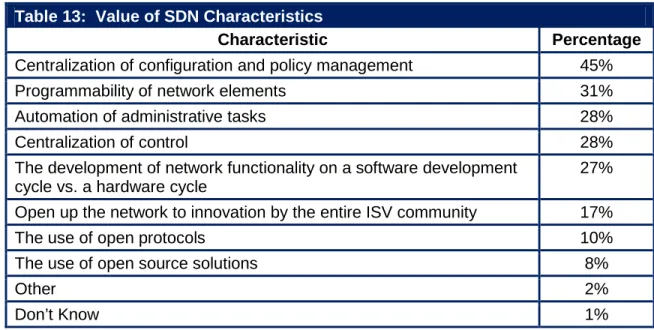
The Survey Respondents were given a set of characteristics that are often associated with SDN and were asked to indicate which two characteristics would provide the most value to their
company’s network. Their responses are shown in Table 13.
Table 13: Value of SDN Characteristics
Characteristic Percentage
Centralization of configuration and policy management 45%
Programmability of network elements 31%
Automation of administrative tasks 28%
Centralization of control 28%
The development of network functionality on a software development cycle vs. a hardware cycle
27%
Open up the network to innovation by the entire ISV community 17%
The use of open protocols 10%
The use of open source solutions 8%
Other 2%
Don’t Know 1%
One observation that can be drawn from Table 13 is that the characteristic of SDN that offers
the most value to The Survey Respondents is tactical: The centralization of configuration and policy management. However, the second most important characteristic, the programmability of network elements, is strategic. That characteristic is strategic because the programmability of network elements is a key component of the overall functionality that is required in order to enable applications to dynamically request the network services they need.
Another observation that can be drawn from Table 13 is that in spite of all of the discussion in
the industry about open networking, The Survey Respondents were not very enthusiastic about the value that open protocols would bring to their networks.
2013 Guide to Network Virtualization and SDN December 2013
Page 29
The SDN Solution Architecture
Figure 4 contains a graphical representation of the SDN architecture as envisioned by the ONF.
One key component of a complete SDN solution that is missing from Figure 4is cloud
orchestration platforms such as OpenStack. The role that these platforms play in both NV and SDN solutions was described in the preceding section of The Guide.
Figure 4: ONF’s SDN Architecture
Below are definitions of some terms that are commonly associated with SDN, some of which
appear in Figure 4.
• Business Applications
This refers to applications that are directly consumable by end users. Possibilities include video conferencing, supply chain management and customer relationship management.
• Network Services
This refers to functionality that enables business applications to perform efficiently and securely. Possibilities include a wide range of L4 – L7 functionality including load balancing and security capabilities such as firewalls, IDS/IPS and DDoS protection.
• Open Protocol
An open protocol is a protocol whose specification a company, or group of companies, has made public.
• Standards Based Protocol
A standards based protocol is an open protocol that was created by a recognized standards body such as the ONF, the IEEE or the IETF.
2013 Guide to Network Virtualization and SDN December 2013
Page 30
• Pure SDN Switch
In a pure SDN switch, all of the control functions of a traditional switch (i.e., routing protocols that are used to build forwarding information bases) are run in the central controller. The functionality in the switch is restricted entirely to the data plane.
• Hybrid Switch
In a hybrid switch, SDN technologies and traditional switching protocols run simultaneously on a given switch. A network manager can configure the SDN controller to discover and control certain traffic flows while traditional, distributed networking protocols continue to direct the rest of the traffic on the network.
• Hybrid Network
A hybrid network is a network in which traditional switches and SDN switches, whether they are pure SDN switches or hybrid switches, operate in the same environment.
• Southbound API
Relative to Figure 4, the southbound API is the API that enables communications
between the control layer and the infrastructure layer.
• Service Chaining7
Service chaining is the ability to steer VM-VM traffic flows through a sequence of
physical or virtual servers that provide network services, such as firewalls, IPS/IDS, DPI, or load balancers.
Figure 4 shows an API between the SDN control layer and the business applications. This API
is commonly referred to as the Northbound API. The role of the northbound API is to enable
communications between the control layer and the application layer. Currently there isn’t a standard for the Northbound API, although the ONF has recently begun a process that could lead to a standards based API. While it isn’t possible to state how the development of the northbound API will evolve, it is likely that there won’t be a single northbound API, but multiple northbound APIs. One viable alternative is that there will be a northbound API between the SDN control software and each of the following entities:
• Network services
• Business applications
• Cloud management/orchestration systems