February 7, 2011
Mr. David Stawick Secretary
Commodity Futures Trading Commission Three Lafayette Centre
1155 21st Street, N.W. Washington, DC 20581
Re: (1) RIN 3038–AD08 - Real-Time Public Reporting of Swap Transaction Data; (2) RIN 3038–AD19 - Swap Data Recordkeeping and Reporting Requirements; and (3) RIN 3038–AC96 - Reporting, Recordkeeping, and Daily Trading Records Requirements for Swap Dealers and Major Swap Participants
Dear Mr. Stawick:
The International Swaps and Derivatives Association, Inc.1 (“ISDA”) and the Securities Industry and Financial Markets Association2 (“SIFMA”) (hereinafter referred to as the “Associations”) are writing in response to three Notices of Proposed Rulemaking: Real-Time Public Reporting of Swap Transaction Data (the “Real-Time Reporting NPR”); Swap Data Recordkeeping and Reporting Requirements (the “Swap Reporting NPR”); and Reporting, Recordkeeping, and Daily Trading Records Requirements for Swap Dealers and Major Swap Participants (the “SD/MSP
Recordkeeping NPR”, and together with the Real-Time Reporting NPR and the Swap Reporting NPR, the “NPRs”) issued by the Commodity Futures Trading Commission (the “Commission”) to implement provisions of Title VII of the Dodd-Frank Wall Street Reform and Consumer Protection Act (“Dodd-Frank Act”).
The Associations respectfully submit the following comments regarding the NPRs. The comments are organized as follows:
• The first section identifies issues and presents our suggestions for future action relating to block trade exemption rules, which we regard as a critically important element of the reforms contained in Title VII of the Dodd-Frank Act.
1
ISDA, which represents participants in the privately negotiated derivatives industry, is among the world’s largest global financial trade associations as measured by number of member firms. ISDA was chartered in 1985 and today has over 800 member institutions from 54 countries on six continents. Our members include most of the world’s major institutions that deal in privately negotiated derivatives, as well as many of the businesses, governmental entities and other end users that rely on over-the-counter derivatives to manage efficiently the risks inherent in their core economic activities. For more information, please visit: www.isda.org.
2
SIFMA brings together the shared interests of hundreds of securities firms, banks, and asset managers. SIFMA’s mission is to support a strong financial industry, investor opportunity, capital formation, job creation and economic growth, while building trust and confidence in the financial markets. SIFMA, with offices in New York and Washington, D.C., is the U.S. regional member of the Global Financial Markets Association. For more information, please visit: www.sifma.org
• The second section sets out some general considerations that apply to all areas of the NPRs.
• The third section addresses specific points relating to the reporting of trade information under the Real-Time Reporting NPR.
• The fourth section deals with considerations relating to the reporting of collateral and valuation information under the Swap Reporting NPR.
• The fifth section responds to the Commission’s questions relating to responsibility for reporting, including consideration of issues relating to extraterritorial application of the NPRs.
• The sixth section responds to the Commission’s questions relating to swaps on commodities.
• The seventh section addresses considerations relating to recordkeeping and daily trading records requirements.
There are two Annexes to this letter. The first contains a table mapping the comments in the different sections of this letter to the specific questions contained in the NPRs. The second contains a study entitled “Block trade reporting for over-the-counter derivatives markets” (the “Block Trading Study”), which has been prepared by ISDA and SIFMA, with support from Oliver Wyman, to begin addressing considerations relevant to block trades, as explained in further detail in Section I below.
I. Block Trades - Appropriate Block Size Threshold and Public Dissemination Delay
The Associations consider the development of appropriate block trading exemptions from certain of the requirements of real time public dissemination of swap information to be of critical importance to the successful implementation of Title VII of the Dodd-Frank Act for the swap market. This is also explicitly recognized in the Dodd-Frank Act, which requires the Commission to specify the criteria for determining what constitutes a large notional swap transaction (block trade) for particular markets and contracts and to take into account whether the public disclosure will materially reduce market liquidity3.
The importance of appropriate block trade exemptions can be demonstrated through the following examples. If a corporate end-user plans to raise a significant amount of capital by issuing a large bond to investors, it is exposed to the risk that interest rates may rise by the time it is ready to issue the bond. It can hedge that risk by entering into an interest rate swap with a market maker that is willing to provide liquidity. The market maker would then typically hedge the risk it has just taken on by entering into one or more interest rate swap or other hedging transactions with other market participants, indeed the price of the interest rate swap will likely be related to the price at which the
3
market maker believes it can hedge the risk. If however the interest rate swap with the corporate end-user is reported to the market, then other potential counterparties will know that a market maker has executed a large swap and will be looking to hedge that risk in the market, and will change their prices accordingly, causing a risk of loss to the market maker. A rational market maker might react to this increased risk by either refusing to enter into the large transaction with the corporate end-user (thereby reducing liquidity), or by increasing the price of the interest rate swap offered to the corporate end-user to provide a buffer against the increased risk. The end-user may react by choosing to break the trade into smaller pieces, thus exposing itself to the liquidation risk that previously the market maker was tasked with managing. Any of these results is clearly detrimental to the end-user’s interests, and will have a negative impact on that end-user’s ability to raise capital, damaging investment in the U.S. economy.
Alternatively, if the corporate end-user, instead of issuing a bond, plans to raise capital using a loan, the lender may hedge its credit risk to that borrower by buying single name credit default swap protection on the borrower from a market maker that is willing to offer liquidity. In this case the lender’s willingness to lend or the price of the loan it is willing to offer the borrower will in part be determined by the price of that credit default swap offered by the market maker. The market maker will, in turn, typically hedge the risk it has just taken on by entering into one or more credit default swaps or other hedging transactions with other market participants. If however the credit default swap entered into by the lender and the market maker is reported to the market, then other potential counterparties will know that a market maker has executed a large credit default swap and will be looking to hedge that risk in the market, and will raise their prices accordingly, causing a risk of loss to the market maker. A rational market maker might react to this increased risk by either refusing to enter into the large transaction with the lender to the end-user (thereby reducing liquidity), or by increasing the price of the credit default swap protection offered to the lender. The lender may react by choosing to break the trade into smaller pieces, taking on liquidation risk. Any of these outcomes may result in a more expensive loan for the end-user. As in the example above, this will reduce the end-user’s ability to raise capital.
There will also be instances when dealers assume significant risk when another dealer exits a market and wishes to pass its entire derivative portfolio to another dealer – as has happened in the commodity markets – or when a dealer fails. In these cases special accommodations need to be made. Each individual transaction may not constitute a block but the portfolio as a whole generates so much risk that any public reporting would deter a dealer from assuming such high levels of risk. From the examples above, it can be seen that the risk of adopting block trading rules that are not proportionate to the available liquidity of an OTC derivatives market is that end-users’ ability to hedge their risk will be compromised or such hedging will become more expensive through a reduction in the opportunities to hedge that risk or through an increased cost of that hedging activity. The final rules should be constructed so that block trades can be both executed and hedged without negatively impacting liquidity or end-user funding and issuance costs. The Associations do not believe that either the distribution test or the multiple (social size) test of block threshold size discussed in the Real-Time Reporting NPR is likely to be a sufficiently well-calibrated test to avoid this risk. Furthermore, given that the distribution of transaction sizes in the swap market is likely to be discontinuous and fat tailed, it is natural to expect that a significant percentage of swap
transactions would qualify as block transactions, making the suggestion of placing an aggregate cap upon their occurrence unadvisable. It is, in our view, an error to extrapolate from the infrequent use of block trades in futures markets that similar infrequency in OTC markets will not
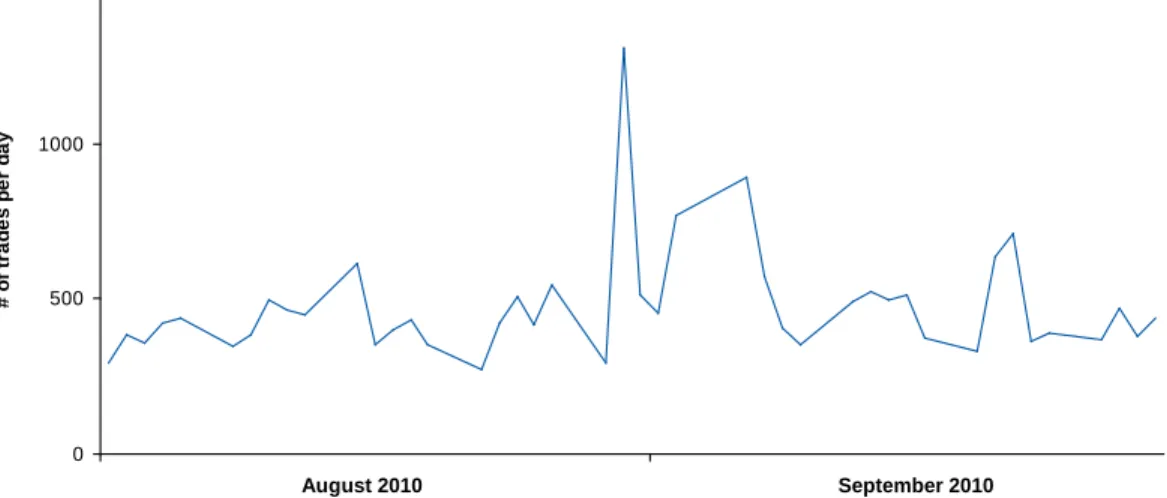
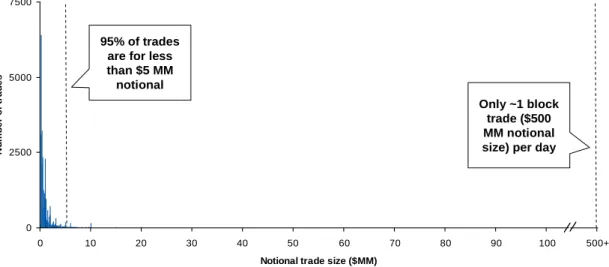
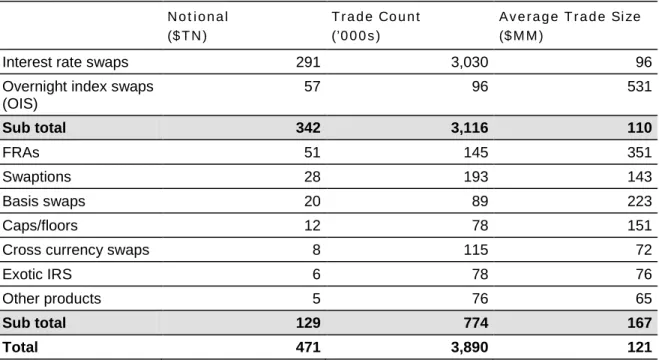
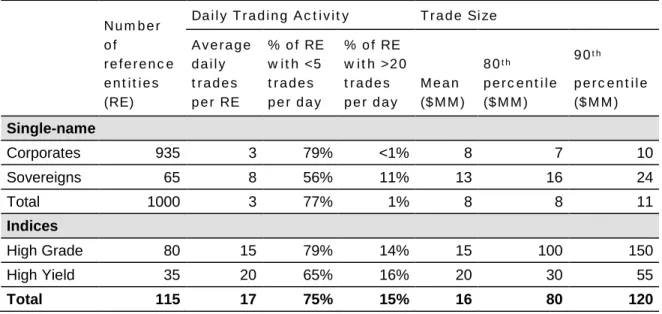
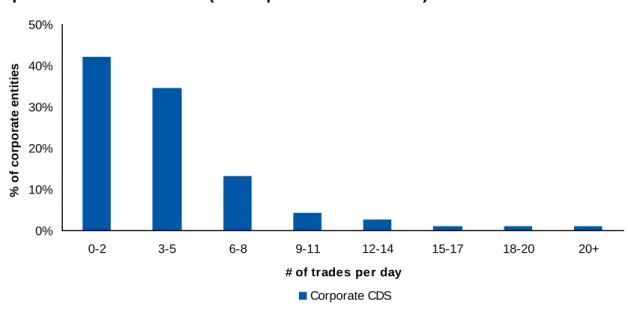
compromise liquidity. The current ability to trade in the OTC market without a block limits regime is the reason why block trades in futures are infrequent. We appreciate the need to harmonize the block levels across these markets but we are concerned that once swaps no longer provide this outlet, a recalibration of block levels will be required, if liquidity is not to be materially impacted. To develop appropriate and well-calibrated block trading exemption rules, the Associations believe that significant detailed research on swap markets must be performed before the appropriate block size threshold and reporting delay for particular swap transactions can be determined. The Block Trading Study, attached as Annex 2 to this letter, was prepared by ISDA and SIFMA to begin the research process, and is submitted for consideration by the Commission. The Block Trading Study was undertaken to help inform decisions about appropriate block trade reporting rules for OTC markets. It explores the goals of transparency, the importance of block trade reporting exemptions and the experience of other markets with transparency regimes and then uses trade-level data to identify unique characteristics of the OTC interest rate and credit derivatives markets. It also includes specific analysis of the proposals contained in the Real-Time Reporting NPR. While the Block Trading Study concludes that transparency can be increased in the OTC derivatives markets while preserving liquidity, it also finds that the Real-Time Reporting NPR would have a significant adverse effect on trading in less liquid instruments, because the proposed rules would impose block minimum size requirements without appropriately differentiating between instruments with very different levels of liquidity.
ISDA and SIFMA believe that, while the Block Trading Study is a significant contribution to the analysis undertaken to date on this subject, substantial additional research into appropriate block trade exemptions is still required. We therefore strongly support the Commission’s intention to collect and analyze additional data on the swap market in the coming months and suggest that research should be directed towards determining the size of a transaction that would likely “move the market” (i.e. change the prices that market participants would demand or accept for a particular swap transaction). The Associations recommend that relevant considerations should include the average daily trading volume for the relevant product and the size of two-way markets typically made by market makers, and that further investigation is required to ascertain whether these are in fact determinative factors. The analysis should be performed separately for different asset classes (in particular, applying the concepts discussed in the Block Trading Study to asset classes beyond interest rates and credit derivatives) and likely for different products within each asset class, as the appropriate test for one product may not be appropriate for another product; in fact, it may be appropriate to use different tests to determine the appropriate block size threshold and/or reporting delay for different products.4
4
The Commission may also find instructive the Committee of European Securities Regulators (“CESR”) proposal which supports deferred publication of equity transactions. We recommend the Commission focus its attention on the CESR framework, which establishes reporting intervals based on a matrix that looks both to the characteristics of the individual transaction and the liquidity characteristics of the market for the relevant underlying security. The CESR proposal permits reporting to occur at the end of day and where there are potential reductions in liquidity close to the end of a trading day, CESR recommend extending the end of day deadline to early the following trading day for trades executed late in the day. This approach is designed to ensure that the vast majority of deferred trades are reported no later than the end of the trading day on which they are executed while still providing protection for trades occurring late in the day.
For large notional swaps that are not centrally cleared it can be assumed that there is some non-standard element that involves the assumption by the swap dealer (“SD”) of some non-standard risk category, for example the risk in tranches of credit derivatives indices (which trade infrequently) or correlation risk across the yield curve. It may be appropriate that uncleared swaps receive substantially lower minimum block sizes and longer reporting times
than cleared swaps. Accordingly we recommend that the study give particular attention to the topic of large notional swaps.
The Associations recommend that independent academic research be undertaken to supplement the Block Trade Study and to determine the appropriate methodology for determining block size thresholds, public dissemination delays and the information publicly disseminated for block trades. ISDA has previously helped to co-ordinate similar research that examined the status of
transparency in interest rate and credit derivative markets. This research was first committed and then presented to an international group of supervisors, including the Commission5. ISDA would be pleased to work with the Commission to help co-ordinate a similar study in relation to block size thresholds and reporting delays, and recommends this course of action to the Commission.
The type of study envisioned above would require sufficient time to arrange and complete. We estimate that work could be completed by the end of the first quarter of 2011 (or within three months of the commencement of the study). This timing may be later than the Commission’s anticipated publication of specific block trade thresholds. However it should be stressed that this need not delay promulgation of the rules in the Real-Time Reporting NPR, merely the calibration of the block size thresholds and the appropriate reporting delay for block trades, which could be determined and published at a later date, independently of the other elements of the Real-Time Reporting NPR.
The definition of “swap instrument” should be defined with sufficient resolution such that block sizes established in relation to each swap instrument are appropriate. Although we recognize the need to balance simplicity with precision, we believe that too simplistic an approach will be damaging to liquidity. Even within the interest rate swaps category there are some types of swaps that merit different treatment. This need is pronounced in commodities markets
Determining block sizes for options based simply on notional size of trades fails to have regard for the risk profile of an option, which varies as much by strike as notional size.
In whatever methodology is eventually selected to determine block size thresholds, it is important that specific block size thresholds be updated frequently, at a minimum of once every three months, to reflect the latest market data, because liquidity in OTC markets can change quickly6.
We agree with the Real-Time Reporting NPR that if a transaction is a block trade, then the size of that transaction (other than the fact that it is a block trade) should not be disclosed at any time, similar to the Financial Industry Regulatory Authority’s Transaction Reporting and Compliance Engine system (“TRACE”) and as further discussed in the Block Trade Study.
Referring to the distinction drawn in Section II below between “execution” level data and “allocation” level data, the final rules should be clear that the determination of whether a
transaction is a block trade occurs at the execution level (in any event as a practical matter, for the reasons noted below in Section II(a)(iii), only the execution level data may be available in real time to determine whether the transaction is a block trade). Where a transaction is executed
electronically, this may already be implied because the electronic platform will not receive any
5
For details of the commitment, please see the letter dated March 1, 2010, available on the website of the Federal
Reserve Bank of New York
6
allocation information and will therefore record the transaction at the execution level. This
clarification is therefore particularly applicable where the transaction is not executed electronically. As with any proposed rule, the Commission could adjust the block size threshold tests over time to reflect market impact, and time should also be allotted to account for the fact that block trade size thresholds are new and a trade reporting system will have to be designed and implemented to address the proposed rules. We therefore recommend that block trade requirements be phased in and kept under periodic review. Please see further comments on phase-in generally in Section II(e) below.
II. General Considerations
In this section we set out some general considerations that apply across the broad spectrum of points relating to the NPRs.
(a) Consistency between CFTC and SEC rules and overseas regulators
Many market participants will likely be subject to parallel reporting requirements imposed by the Commission, the Securities Exchange Commission (the “SEC”) and overseas regulators. To remove inefficiencies, simplify compliance obligations and enhance regulatory agency capabilities, it is vital that the Commission, the SEC, and overseas regulators adopt consistent reporting
requirements, including a common implementation effective date, particularly where transactions in certain asset classes (such as credit derivatives) reported to the relevant swap data repository (“SDR”) may be subject in some cases to the Commission’s rules and in other cases to SEC rules. Inconsistencies between the NPRs and the SEC’s Proposed Regulation SBSR—Reporting and Dissemination of Security-Based Swap Information7 (the “SEC Proposed Regulation”) should be minimized to enhance compliance.
We have identified the following specific points that we think necessitate consistent ruling between the Commission and the SEC:
(i) The set of information to be publicly reported in real-time is quite different between the two sets of proposed regulations. The Real-Time Reporting NPR is more specific in terms of the set of information that is required, and also asks for a broader set of data elements.
(ii) In the model for reporting swap continuation data across asset classes, it is also critical to have consistency in the regulatory approaches. We would suggest that the approach for reporting swap continuation data (i.e. life cycle approach or snapshot approach) not be prescribed by regulation as proposed, but instead SDRs should be allowed to develop in the most efficient way to meet the objectives for the relevant asset class. Additionally, SDRs should be allowed to develop and improve on processes that will provide operational benefits to the industry, as well as meet regulatory requirements. We also note some issues specific to the life cycle event data reporting requirements in Section II(f) below.
7
(iii) Within each separate product type, the Commission and the SEC should harmonize rules to define when the timeline for reporting a transaction will commence for that product. In particular, the time at which a transaction becomes legally binding may not be the same for all products. Where the reporting timeline is based on market activity such as “affirmation”, “execution” and “confirmation”, the use of those terms should reflect long-standing market conventions that differ according to the type of underlying reference asset. Harmonization of use of such terms in the Commission's and SEC's rules for a particular product type will foster operational efficiency, lessen the
incidence of errors, and place fewer burdens on reporting parties. Further observations on the use of these terms and their application to total return swaps (“TRSs”), in particular, are set out below:
(A) In the Real-Time Reporting NPR, “affirmation” is proposed to be defined as counterparties’ verifying that they agree on primary economic terms but not necessarily all of the terms, as distinguished from confirmation and, in many cases, execution if execution does not occur when the parties affirm agreement to primary economic terms. “Execution” is the agreement between the parties that legally binds them.8
(B) For example, and as noted in the Associations’ submission to the SEC in
response to the SEC Proposed Regulation, for certain equity TRSs, “affirmation” addresses initial steps undertaken in advance of execution or confirmation; a swap order is initiated at the “affirmation” stage but is neither executed nor confirmed at this time. Affirmation can occur at the time or shortly after a trade is preliminarily discussed between two counterparties but occurs before material terms such as price and quantity are determined and the swap is executed or confirmed. Following affirmation, intra-day hedge transactions are executed on a regulated exchange and reported in real-time, in connection with, but separate from, the TRS which has yet to be executed or confirmed. Any hedge
transactions entered into in advance of the TRS transaction are executed and confirmed independently of the TRS. In order for reporting to be meaningful, the material terms of the TRS must be available to be reported. If price, a material term of the TRS, is not arrived at until after the hedge is consummated, then the parties cannot confirm the swap until such time. The legally enforceable TRS is made by way of swap transaction confirmation, which is agreed upon after the time that preliminary swap terms were affirmed and after independent hedge transactions are executed. For TRSs involving material terms such as pricing, which occurs derivatively based on the price available in the market end of day, the full terms of the TRS are not formed until end of day and therefore the TRS is not executed until end of day and confirmed thereafter. In these circumstances, after the TRS is confirmed by written trade confirmation, it may be reported in real-time.
8
As the Commission points out in the Real-Time Reporting NPR, “execution can occur immediately following or simultaneous with (the pre-execution) affirmation; the proposed definition of execution does not attempt to define what constitutes a legally enforceable contract, only that execution occurs if and when the parties have formed a legally enforceable contract, which is a matter to be decided by applicable law.” (Real-Time Reporting NPR (75 Fed.Reg.76140 at page 76144)).
(C) TRS transactions in other asset classes often also involve different stages. For the majority of swap transactions in Commodity index TRS, price is typically determined after affirmation. For these transactions, it is more appropriate to report when price or quantity have been determined, which occur later in the day or at the end of the day, rather than report at the affirmation stage. Similarly, for bespoke credit or interest rate TRS there may be instances where affirmation occurs separately from execution or confirmation, such that the material terms of the swap are not available until a time after affirmation occurs. Under these circumstances, reporting should occur after the full description of the trade becomes available.
(b) Trade allocations
It is common practice in the OTC derivatives markets for an asset manager to enter into a transaction with a counterparty for a particular notional size for an agreed price (the “execution” level), and for the asset manager to then allocate parts of that notional amount to multiple
underlying funds (the “allocation” level). Each fund is a separate legal entity, and so the agreement at the execution level will ultimately result in several separate transactions at the allocation level. As a result, we recommend the following:
(i) For the purpose of public real time trade reporting, the objective of which is transparency, participants should report the trade as executed by the desk. The reporting counterparty will not need to receive the allocation information from the client for the purpose of meeting the real time reporting obligations. Furthermore, this report will effectively reflect the pricing and size of the trade. This is also consistent with reporting under TRACE.
(ii) For the purpose of trade reporting to the SDR, by contrast, the allocation of the trade to the respective counterparties will be essential to understanding the final dispersion of risk derived from the initial trade. For transactions where the counterparty allocates to multiple funds (or other entities), therefore, the requirement to report should be triggered from the time when the reporting party receives the allocation from the customer - which is not typically within the reporting counterparty’s control. (c) Unique identifiers
The Associations believe it is critical to introduce one set of uniformly-applied unique identifiers within the derivatives industry for legal entities/counterparties, products and transactions, each as discussed further below. We encourage the Commission, together with the SEC, the Department of the Treasury and other regulators (including overseas regulators), to explore current best in class models and mechanisms and adopt best practices for the derivatives industry (e.g. DTCC gold standard). Industry utilities (meaning not-for-profit, industry-governed solutions) should be considered for assigning these unique IDs. Furthermore, we encourage the Commission to attempt to leverage existing market constructs used in the cash securities markets. Confidentiality and the protection of information is also critical.
The Commission should consider adopting a convention for assigning unique IDs and
incorporating a pilot or early adopter program for certain products and participants that will allow for end-to-end testing and a proof of concept. For example, as previously suggested to the SEC, a pilot program could consist exclusively of single name CDS traded by security-based swap dealers. The identifiers need to be universally adopted and the industry is committed to use the standard identifiers as and when they become available but allowing for an appropriate implementation period. There are a number of trade events, such as allocation, clearing, novation and compression, which will need to be described with respect to unique identifiers. The requirements for unique swap identifiers (“USIs”) must complement these events rather than dictate how they function. For example, the requirement for USIs should not prevent a DCO holding positions, as opposed to individual trades, for standardized instruments. A newly formed ISDA cross-product data working group, with representatives from sell side and buy side institutions, will look at proposed solutions and the practical implications of unique identifiers for the derivatives industry. Such an exercise should also cover the application of unique identifiers to pre-enactment swaps.
For legal entity identifiers (“LEIs”), we broadly support the principles set forth by the Office of Financial Research (“OFR”)9 and believe that the LEI should serve as the unique counterparty ID. The Commission proposes a universal, international standard based on a voluntary consensus standards body and states that it will prescribe its own method to create unique counterparty identifiers (“UCIs”) to be used in reporting if no internationally accepted identification system acceptable to the Commission is available prior to the implementation date of the final regulations. We strongly recommend that a single ID be implemented and that one entity administer the unique ID system to avoid the development of inconsistent standards. The solution needs to be
international; the entity operating the LEI issuance should be not for profit and operate on the principle of cost recovery. The industry should decide on the appropriate model for cost recovery. Additional input is needed to decide the right key minimum elements and their definition, which should also be determined by the industry.In a letter to the OFR on their statement, the
Associations and several other trade associations commented that they “agree with the Linchpin Discussion Paper that the number of data elements be kept at to the minimum necessary to assure the uniqueness of each legal entity”.10 We request that the Commission clarify that its UCI will be the same as the LEI to avoid any ambiguity and further the goals of harmonizing identifiers. Finally, we strongly urge the Commission to coordinate with all of the major domestic and global financial services regulators to ensure this standard identifier system is enacted and enforced on a consistent, global basis.
ISDA is willing to assume responsibility for developing the product identifiers for OTC derivatives products that reflect the FpML standard. ISDA would work closely with the Commission in this standardization effort. For this process we will follow the same general principles laid out for LEI. In the first instance, this work will focus on product identifiers for cleared products. ISDA/FpML is currently working on a pilot project with certain derivative clearing houses to provide a normalized electronic data representation through an FpML document for each OTC product listed and/or cleared. This work will include the assignment of unique product identifiers. We believe that before the requirement for the mandatory reporting of trading activity is implemented, the industry
9
OFR discussion paper: “Creating a linchpin for Financial Data: The Need for a Legal Entity Identifier”, December 10, 2010.
10
For further industry commentary on LEIs, please see the letter from the Associations and several other trade associations addressed to the Office of Financial Research dated January 31, 2011 Re: Statement on Legal Entity Identification for Financial Contracts.
standardization effort will need to have been completed and the industry given sufficient time to adopt these changes.
The Associations fully support the effort to also define a formal product topology, which would be essential to perform aggregations and promote transparency. Considering the evolving nature of OTC derivatives, we recommend that the Commission should not be prescriptive in this respect. The definition of the actual product topology would be more effectively developed through professional organizations like ISDA or SIFMA, which could bring together participants and regulators to (i) define an effective topology (as an example, the proposed “Contract Type” topology might not capture cases such as interest rate cap), and (ii) adapt it to reflect the evolution of OTC products. The FpML standard includes product schemes, which should be used as the starting point for such product topology. In considering the efficient development of product identifiers, the Associations believe that additional dialogue between the Commission, other interested regulators, and the industry is needed to understand the purpose and intended use of the product identifiers so that they may be appropriately tailored. For example, while we agree that a granular product identifier could provide an informational benefit for “asset based” derivatives that are linked to underlying cash or physical products (CDS or commodities, for example), the benefit of this data becomes less clear when applied to interest rate swaps that lack this linkage. Clarity on the aims of the Commission in collecting this data will best ensure development of the appropriate model.
With respect to USIs, we similarly suggest that the Commission state clear objectives rather than be prescriptive as to what the exact implementation will be, because it would be extremely difficult to define upfront an exact implementation that would cover all use cases. As an example, the proposed approach of having the USI be assigned by the reporting party may result in unexpected behavior in the case where that party assigns the contract (partially or completely) to another party. Also, while the proposed approach of having the reporting participants assign the USI is valid in the case where the role of the SDR is limited to collecting and reporting the trades, there may be a need for the SDR also to assign its own USI if its role extends to operational functions (as
illustrated by the DTCC implementation for credit derivatives). Furthermore, as the OTC derivatives markets are currently characterized by a diversity of business processes across asset classes (and even within asset classes), standardization will have a dramatic impact upon the participants’ systems and workflows. In the OTC derivatives space, an initial “transaction” typically defines a unique instrument that only exists between the two parties to the contract. Other “transactions” may change the counterparties to the instrument (i.e. assignment, partial assignment, novation, etc.) or modify the transaction (e.g. an amendment) but the instrument remains unique. At the end of each day, a party to the instrument will have a position in that instrument, sometimes referred to as a “trade” or “contract”. For certain instruments, they may become standardized enough that they cease to be unique (for example index CDS trades), in which case all reporting could be based on a party’s net position in that standardized instrument, in a similar manner to exchange-traded derivatives. If the Commission can state clearly their objectives, then the industry will work quickly to come up with ways of implementing as it has previously under the
commitment letter process. (d) Error reporting
The Associations support the objective of prompt correction of errors by the reporting
do not record the specific reason for an amendment. As a result, we recommend that while such errors should promptly be adjusted by market participants, the specific root cause of such
amendments (for example a booking error or a trade amendment between parties) could be omitted in line with current practice in listed markets. In addition, we urge the Commission to clarify that reporting parties are not responsible for data which is inaccurately transcribed or corrupted after it has been submitted to a SDR, and also have no duty to correct data errors of which they are unaware.
While the industry has done much to improve the speed at which trades are confirmed in recent years, it has done so over time and without sacrificing accuracy. The time frames proposed by the Commission are significantly more aggressive than what the industry has committed to in the past and it would be unfortunate if this were to lead to an increase in errors. We recommend the Commission aim for an appropriate balance between speed and accuracy in proposing time frames for regulatory reporting.
(e) Phase-in implementation
It is difficult to comment on the appropriate phase-in periods for the rules contained in the NPRs until the precise details of all reporting obligations are available in final form. However, in general terms, the phase-in period should be sufficient to afford the industry the time needed to build the technology infrastructure required to comply with regulations. We believe that virtually all existing systems would have to be significantly overhauled to satisfy real-time reporting obligations of the Real-Time Reporting NPR. The phase-in period should take account of the work needed for market participants to establish connectivity to the SDR for the relevant asset classes once the final
standards for data provision are known, including the determination of unique identifiers, as well as the time needed for the SDRs themselves to be properly established. This phase-in could take the form of staggered or delayed effective dates for regulations, as contemplated by the SD/MSP Recordkeeping NPR. We expect that it will be technologically challenging to establish an SDR in each asset class11, however given sufficient time, we do believe this will be achieved.12
11
ISDA has previously notified the Commission that the designation of a single registered SDR per class of swap would provide the Commission and market participants with valuable efficiencies and expressed views regarding the adoption of Financial Products Markup Language (“FpML”) as the protocol for reporting swap transactions to a SDR or the Commission. We re-iterate those views in the context of the NPRs. Please see the letter from ISDA and the Futures Industry Association to the Commission dated November 12, 2010 Re: Interim Final Rule for Reporting Pre-Enactment Swap Transactions (75 Fed. Reg. 63080).
(However, it is possible that sufficient differences may exist within the Commodities asset class to warrant separate SDRs at a sub-class level, e.g. Metals, Energy). We also expect that each SDR will operate across the G20. If a set of SDRs per jurisdiction results, this will require duplicative
implementation and costs that would be carried through to future enhancements. Additionally, this would carry the risk that a population of trades is not reported to any SDR impacting the
completeness and accuracy of information available to the Commission and other regulators. While there will be challenges in providing a single global access model to global regulators, we urge the Commission to address this in consultation with overseas regulators. We request clarity on time
12
By way of examples: There is currently no infrastructure in place to support alternative approaches for data reporting for commodity swaps. The ISDA Commodities Steering Committee is working on building out an SDR, which will begin by reporting on financial oil. More detailed information is available by coordinating with the Commodities Steering Committee. For equity swaps, industry participants are in the early stages of being able to report to a SDR. While there is significant additional work required to further this effort, to the extent that some undertakings have been made these alternatives should be explored further before the Commission implements entirely new reporting rules that require new and costly operational infrastructure to support.
lines, which we suggest should be estimated based on SDR registration and capability testing. Requiring compliance via non-electronic methods is not recommended, as this would increase systemic risk within the industry. Similarly, for the Commission to have to receive raw data from market participants would likely not be effective; clarification of how this would work in practice is required.
The industry has worked successfully with regulators in recent years to develop an industry infrastructure that has proved effective in reducing systemic risk and promoting regulatory goals, notably the process of commitment letters delivered to the Federal Reserve Bank of New York and other regulators. The Associations would welcome the opportunity to work further with the Commission and other regulators in a similar framework to structure the necessary development in the most effective manner and monitor progress towards established goals. For such an approach to be successful, the Associations would suggest that implementing rules reflect the outcome of such work and can be executed within such a framework.
As an example, the Credit Derivatives Trade Information Warehouse was implemented using a phase-in approach; new trades for dealers were first sent to the warehouse 12 months after work commenced and phased implementations over the following two years addressed on-boarding of clients and back-loading of trade populations. Over time the population of credit derivatives included in the warehouse has increased and timeliness of confirmation has improved through the industry commitment process outlined above.
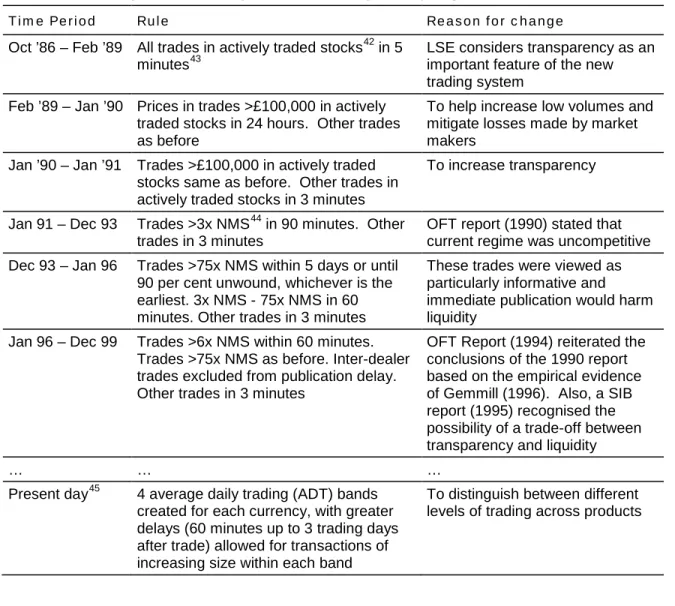
One aspect of phase-in that is not contemplated in the NPRs is a gradual phase-in of the targeted timeframe for reporting “real-time” information. By analogy with TRACE, the time required for reporting when the system was first introduced was 75 minutes, and over a period of several years this was reduced to 15 minutes as evidence was compiled that such reductions could be safely achieved technologically and without adverse market impact. The reporting requirements for swaps are significantly more complex than for TRACE, therefore the phase-in should reflect this degree of complexity.
In addition, any concerns related to confidentiality of data should be addressed prior to the Real-Time Reporting NPR being implemented. The fields to be publicly disseminated should be clearly defined in the final rules.
(f) Life cycle event data
The Swap Reporting NPR would require the reporting of all life cycle event data on the same day in which any life cycle event occurs. Life cycle events would include any corporate action affecting a security or securities on which the swap is based (e.g., a merger, dividend, stock split, or
bankruptcy). We would note two main concerns with this definition and the related reporting requirement.
• First, we refer to the SEC Proposed Regulation, which expressly excludes any “event that does not result in any change to the contractual terms” of the security-based swap from its definition of “life cycle event”. This exclusion is appropriate, particularly since credit and equity swaps typically contain contractual provisions to address adjustments needed to reflect events, such as a merger, dividend, stock split or bankruptcy. Any adjustments to the credit or equity swaps are made pursuant to the contractual terms of such credit or
equity swaps; therefore, such adjustments should not be considered a reportable event. Consequently, we would suggest that the Commission adopt the approach taken by the SEC.13
• Second, as a practical matter, the reporting party will not necessarily know that such a corporate action has taken place or all the relevant details, on the same day that such a corporate action takes place. In fact, the relevant details of the corporate action may not be available to the market until the issuer of the security makes a public filing (or even a series of public filings) in connection with such corporation action or the information becomes otherwise available through press releases or reporting by the media. The timing of such public filings or when information becomes available is outside the control of the reporting party; therefore, the reporting party may not be able to comply with the
requirement to report all life cycle event data on the same day in which such life cycle event occurs.
With respect to any event that is not already addressed by the contractual terms of the swap, an alternative approach would be to require the reporting of any change to data previously reported with respect to a swap at the time an adjustment to such data is made due to a life cycle event. We would also suggest that the life cycle event itself does not need to be reported since that
information would be in the public domain. This approach would still achieve the objective of keeping the swap data up-to-date, but at the same time allow the reporting party to be able to comply with the reporting requirement in a timely manner.
III. Reporting of Trade Information
ISDA and SIFMA support the objective of real time reporting for swap transactions contained in the Dodd-Frank Act and the Real-Time Reporting NPR. Initial trades reported should carry a primary reference number, and all amendments of that trade would then produce iterations of the original reference number. Initially trades would be submitted with primary economic data. Upon receipt of additional information pertaining to the original trade (e.g. trade specific allocations, partial or full termination), a subsequent version of trade will be submitted reflecting associated amendments.
(a) Information to report
We make the following specific recommendations regarding the set of information that has been identified to be reported:
(i) The Commission specifies the set of required data elements required for both real-time public reporting and swap data recordkeeping and reporting. Our understanding of the intent of the NPRs is that the former set of data elements will be a subset of those
13
On a similar note, we would also note that the SEC has excluded events such as a scheduled expiration of the security-based swap and a previously described and anticipated interest rate adjustment. These events would not need to be reported under the SEC Proposed Regulation. These same events are included in the definition of “contract-intrinsic event” under the Swap Reporting NPR and are required to be reported. We would suggest that the Commission adopt the approach taken by the SEC on these events as well.
required for swap data recordkeeping and reporting. As a result, we recommend that the Commission specify the data elements required for swap data recordkeeping and reporting in addition to the information to be reported in real time. This would provide more clarity in the regulation and avoid the risk of inconsistencies when specifying those data elements. In this context, we again note the crucial need for coordination and consistency between the data requirements adopted by the Commission, the SEC and overseas regulators. In addition, we respectfully suggest that the “Minimum Primary Economic Terms Data” specified as part of the Real-Time Reporting NPR are inconsistent across asset classes in some ways that are not justified by economic differences, nor by differences in the information required for regulatory supervision. The proposed rules require a set of data elements for credit and equity swaps (the qualification of the counterparty, the execution and clearing venues, the settlement terms, the data elements necessary to determine the market value of the transaction) which could be applicable to other asset classes. Conversely, the contract type and the timestamp for submission to the SDR are required only for FX, interest rates and other commodity swaps. This also does not appear to be justified by differences in the asset classes.
(ii) We suggest that the following requirement, part of the “Minimum Primary Economic Terms Data” specified in the Real-Time Reporting NPR, be clarified: “If the
transaction involved an existing swap, an indication that the transaction did not involve an opportunity to negotiate a material term of the contract, other than the
counterparty”. If this is intended only to refer to an assignment or novation of an existing transaction, then this should be made explicit.
(iii) The requirement to associate the execution time, to the second, with each of the reported trades, would prove extremely challenging and invasive in the case of voice trades, for which the entry time in the participants’ systems is typically provided, but not the execution time.
(iv) We make two further recommendations in relation to customized swaps:
(A) We believe that real time reporting and public dissemination of information relating to customized swaps, meaning a swap having any amount of
customization away from benchmark/standard swaps, will add little to no price discovery value as their terms will not be comparable with benchmark/standard swaps. Furthermore, we believe that such reporting would introduce the risk of providing price information that could potentially be misunderstood by some market participants. As a result, we recommend that such trades be excluded from the public dissemination of real time information (but not from regulatory reporting requirements under the Swap Reporting NPR).
(B) The marketplace experience in the development and usage of FpML as an electronic algorithmic representation of OTC derivatives leads us to recommend a pragmatic approach for the trade representation of such customized swaps which would be limited to a set of generic fields and be supplemented
(potentially at a later point upon request) by the actual confirmation (through a format such as PDF). This would be consistent with the current approach for
“Copper” records in credit derivatives and would facilitate the support of all trades in an asset class within a single SDR. Further, this approach would facilitate the monitoring of customized swaps and help direct efforts to expand the population of fully supported trades.
(v) As a general matter, the Associations urge the Commission to limit real time reporting requirements to new trading activity (including stepping into an existing transaction by assignment or novation). For example, transactions resulting from portfolio
compression exercises do not reflect trading activity and therefore contain no market information. As a result, we recommend that these types of events be excluded from the real time reporting requirement for price discovery purposes, but be included as part of the ongoing trade update reporting to the SDR at the end of the day (as they will impact trades that would have already been reported). We would further suggest that an inventory of activity that should be excluded from real time public reporting is established by asset class with input from industry groups.
(vi) We believe that, in the case of some asset classes, there is not a universal definition of the notional amount of a trade. This is particularly the case where the notional is not confirmable information. We therefore recommend that, as part of the NPRs, the Commission provide guidelines for reporting the notional amount, such as those already developed by the Federal Reserve Bank of New York14.
(vii) The final rules should be clear that the information required to be publicly
disseminated cannot identify the participants to a swap or provide information specific to the participants. Such information would include the title and date of any master agreement, and premiums associated with margin, collateral and independent amounts. The data element “Additional Price Notation” should not be included in real-time public reporting as this provides information on one party’s view on the
creditworthiness of its counterparty which could have a negative impact on that counterparty if disclosed. Additionally, bilaterally executed trades may contain a premium over market value that, while not associated with margin collateral or independent amounts, would need to be excluded from Real Time Public Reporting in order to prevent the price of the trade being misinterpreted by market observers. (viii) The Commission requests comment on whether date information for swaps should be
rounded to the nearest tenor/month. Many swaps meet specific requirements for end-users. To limit or manipulate data elements that are part of the Primary Economic Terms in order to allow trades with differing terms to be aggregated will reduce post trade transparency. We recommend that this proposal not be implemented.
(ix) The Commission requests comment on whether any data fields in the Master Reference Generic Data Fields List should be included in one or more of the Tables of required Minimum Primary Economic Terms. We have concerns that prescribing data elements to report may adversely affect the use and development of open industry standards, such as FpML, in the transmission of trade information to SDRs. We would
14
Guidelines are included under “Line Item Instructions for Derivatives and Off-Balance-Sheet Items Schedule HC-L” in the Board of Governors of the Federal Reserve System’s “Instructions for Preparation of Consolidated Financial
additionally point out that prescribing data elements to report could result in product types that come to market in the future not being adequately described by the data elements prescribed. As a result, and in keeping with our suggestion of harmonization of rules between the Commission and the SEC, we strongly urge the Commission to follow the same approach as the SEC by stating reporting requirements in broad-based generic terms. In the event that the Commission determines that a precise definition of data elements to report is required we would suggest that this information is put together by asset class with input from industry groups. At this time we would provide the following examples of items to address should the Commission wish to precisely define data elements to report:
(A) The “Start date” data element specified as part of the “Data Fields and Suggested Form and Order for Real-time Public Reporting of Swap Transaction and Pricing Data” is ambiguous, and we recommend that the Commission instead require participants to report the “Effective Date”, consistently with the SEC Proposed Regulation.
(B) In relation to the Commission’s request for comment on whether additions should be made to the proposed list of Minimum Primary Economic Terms Data based on the Master Reference Generic Data Fields List, we make two specific suggestions for fields that should not be added:
• The Order Entry Timestamp, because the OTC market is characterized by a multiplicity of client channels, a number of which do not translate into formal orders. Request for quotes would be an example of such a channel. • The Parent Counterparty, because this would be more effectively determined
centrally by either the SDR or regulators, as a result of the UCI initiative. (C) The proposals for Primary Economic Terms including the data elements
necessary for a person to determine the market value of the transaction would not be achievable for some complex trades. In order for a third party to value these transactions access would be required to proprietary market data and pricing models that would not be in the public domain. We request that the Commission consider how any requirement to provide valuation information interact with requirements under proposed “Business Conduct Standards for Swap Dealers and Major Swap Participants With Counterparties”15 and proposed “Swap Trading Relationship Documentation Requirements for Swap Dealers and Major Swap Participants” currently under consideration by the Commission. Please also see the general comments regarding valuation data in Section IV(b)(i) below.
(D) Reference is made to reporting of Primary Economic Terms, Affirmation and Confirmation at different times, which would lead to duplicative reporting. It would be preferable to have one set of required data elements, including
15
confirmation status submitted after the trade is confirmed. Any updates may be reported if there are changes to the data set.
(E) The requirement in the Swap Reporting NPR that “[a]ny other primary economic term(s) of the swap matched by the counterparties in verifying the swap” be reported is unclear. We request that the Commission either clarify what these data elements are intended to capture, or adopt an approach similar to the SEC by requiring more generically the data elements necessary to determine the market value of the transaction. We recommend the latter.
As noted in Section II, above, under “Phase-in Implementation”, compliance with the reporting requirements under consideration will require development of substantial technology infrastructure across a diverse range of asset classes. We therefore encourage the Commission to consider existing confirmation models and their requirements regarding economic fields that should be matched to confirm a transaction. Confirmation data can be relayed by derivatives clearing organizations (“DCOs”), swap execution facilities (“SEFs”) and middleware providers (including unregulated platforms). To promote successful implementation of the reporting regime, we strongly believe the Commission should leverage and build upon investments made within the industry over recent years. Specifically, the Commission should seek to pursue solutions based upon the benefits seen in existing trade repositories such as the Credit Derivatives Trade Information Warehouse, specifically that:
• leverage bi-laterally matched legally binding (“gold”) records, • handle most if not all lifecycle events,
• provide all participants with access to key operations controls and efficiencies such as central settlement, credit event, re-organization and rename processing, and
• provide regulatory access to key market and industry data.
(b) Total return swap transactions
There should be a general exemption from public dissemination of data with respect to TRSs and trades otherwise designed to offer risks and returns proportional to a position in the security, securities or loan(s) on which the TRS is based. TRS pricing information is of no value to the market because it is driven by many considerations including the funding levels of the
counterparties to the TRS and therefore may not provide information about the underlying asset for the TRS.
(c) Inter-affiliate transactions
Information relating to transactions undertaken within an organization to manage risk within the organization should not be publicly disseminated. For example, if a counterparty chooses to enter into a swap with a particular entity within an organization, such as a U.S. subsidiary, although the non-U.S. parent of the organization group is in a better economic position to incur the counterparty exposure from a risk management standpoint, the inter-affiliate transaction entered into between
the inter-company entities (not with the counterparty) does not contain any additional price
information beyond that contained in the transaction with the customer. As a result, we recommend that such inter-affiliate transactions be excluded from the scope of public real time reporting for price discovery purposes.
(d) Multi-asset swaps
We recommend that multi-asset swaps be reported as one trade only, to one specific SDR, and not be decomposed among their underlying asset class constituents for reporting purposes. The SDR designation could be determined by the reporting counterparty as the most significant asset class component (in practice, it will most often be the asset class of the desk that trades the swap). A specific indicator could be associated with the trade for such purpose.
IV. Reporting of Collateral Information
In Section IV(b) below, we offer specific comments on aspects of the Swap Reporting NPR relating to the reporting of collateral and valuation information. Before addressing these specific points, we would stress a few general points of clarification regarding collateralization in the OTC derivative market, distinguishing between uncleared and cleared transactions, as set out in Section IV(a) below.
(a) General comments regarding collateral in uncleared and cleared transactions.
In relation to uncleared transactions, the following points are critical to defining correctly the set of data fields in order to achieve the Commission's objectives for reporting and transparency. The Commission may find it helpful to refer to two documents that were published in 2010: the Market Review of OTC Derivative Bilateral Collateralization Practices published by ISDA (March 1, 2010)16, which provides an overview of the bilateral collateralization process and explains the use of collateral as a credit risk mitigant and the Independent Amounts white paper published by ISDA, SIFMA and the Managed Funds Association (March 1, 2010)17, which describes the usage and purpose of Independent Amount (“IA”) together with some of the risks and challenges associated with IA segregation.
Bilateral collateralization in the uncleared OTC derivatives market has several key distinguishing features that are materially different from margin arrangements relating to futures, options and securities transactions. For example:
• Collateral flows in both directions between the counterparties, according to the exposure that each has to the other at different times
16
The full Market Review can be found on ISDA’s website
17 The full IA White Paper can be found on ISDA’s website
• The total collateral requirement comprises two elements, exposure collateral (“EC”)18, which is present in all standard agreements and IA, which is optional according to bilateral negotiation. These two elements are netted to produce the total collateral requirement. • EC is required to cover the net estimated mark-to-market value of the portfolio of
transactions between two parties at the time of a collateral call.19 Importantly, the calculation of required collateral is performed at a netted portfolio level and collateral cannot be attributed at the transaction level - it is simply not possible to identify the specific exposure collateral associated with any particular transaction.
• IA is an optional additional amount of collateral that two counterparties may negotiate. In ISDA’s responses to other Notices of Proposed Rulemaking issued by the Commission, Independent Amount has been defined as “money, securities, or property posted by a party to secure its obligations pursuant to the terms of a swap agreement and either (i) specified as an “Independent Amount” in the relevant agreement of the parties or (ii) the amount of which is calculated based upon terms agreed between the parties (in addition to and separately from any Exposure Collateral requirement)”20. Its purpose is to protect the IA holder against adverse movement in the net mark-to-market value of the portfolio that occurs before additional EC can be obtained to cover that exposure. The calculation of IA generally takes into account the estimated period it would take to unwind trades and/or portfolios along with the volatility of the positions in a portfolio. IA is roughly analogous to Initial Margin in the existing futures and options markets. Within a single collateral agreement, IA may apply to all, some, or none of the transactions in the portfolio. If IA does apply to a particular collateral agreement, it may be specified at transaction level, at portfolio level, at some intermediate level (a combination of product type, currency and maturity, for instance), and possibly a hybrid of all three. Therefore it may or may not be possible to identify the IA associated with a particular transaction, but as a general matter this association cannot be reliably made.
• Generally, swap counterparties do not employ transaction-level collateral arrangements; instead collateral arrangements are managed and processed at the portfolio level. In rare cases of a single transaction with a specific collateral arrangement, this can be considered to be a special case of portfolio collateralization, but for a portfolio of one trade.
18
Exposure Collateral and Variation Margin are not defined terms in the bilateral space, however, to avoid confusion with the term “Variation Margin” in the cleared space which is used very differently, the Associations strongly believe that we need a different term for the uncleared derivatives market. ISDA has offered the following definition in several other response letters: “Exposure Collateral” means money, securities, or property posted by a party to secure its obligations pursuant to the terms of a swap agreement, the amount of which is based on an estimate of the net mark-to-market exposure of all transactions under the master swap agreement.
19
Specifically, the estimate (typically at mid-market) is of the amounts that would be payable between the parties if the transaction(s) were terminated, and is typically referred to as the “Exposure” of the party that would be entitled to receive a payment in the event of an early termination.
20
In light of these proposed changes to the definitions of Initial Margin and Variation Margin, we would propose a corresponding replacement of the definition of “Margin” with the following: “Uncleared Swap Collateral” means both Exposure Collateral and Independent Amount.
The implications of the points above for uncleared transactions should be considered in developing solutions to achieve the Commission’s objectives for reporting and transparency, as discussed further below in our comments on specific provisions in the Swap Reporting NPR.
In relation to cleared transactions, the situation is substantially simpler. We suggest that the most pragmatic solution to creating transparency of valuation and collateral for cleared derivatives would be for DCOs to report the transactions/positions (as appropriate) and collateral and
valuations on a portfolio level. We also suggest that in particular, DCOs’ values should be used for all cleared transactions. Because of its clarity, we would recommend this approach be adopted by the Commission.
(b) Specific comments in response to the Swap Reporting NPR
The remaining comments in relation to collateral information relate to specific provisions in the Swap Reporting NPR, which are quoted, together with relevant footnotes from the Swap Reporting NPR, in italics below:
(i) Valuation Data Reporting for all Swaps in All Swap Asset Classes
Valuation data is defined in the proposed regulations to mean all of the data elements necessary for a person to determine the current market value of a swap, including, without limitation, daily margin, daily mark-to-market, and other measures of valuation to be determined by the Commission prior to promulgation of its final swap data reporting regulations. Swap valuation data is essential to a variety of the regulatory functions of many financial regulators, and is crucial to fulfillment of fundamental purposes of Dodd-Frank, including systemic risk reduction and increased transparency of the derivatives marketplace to regulators. The Commission and other regulators would use valuation information regarding swaps reported to SDRs for prudential oversight, to monitor potential systemic risk, and to monitor compliance with regulatory requirements for SDs and MSPs. The importance of reporting swap valuation data to SDRs is recognized internationally.-- Swap Reporting NPR (75 Fed. Reg.76574 at 76584)
The Associations fully support the need for the supervisory and regulatory community to have access to valuation data. The largest SDs in the U.S. market are all prudentially regulated. In order to start collecting this information, the Commission should work closely with their prudential regulators, the Federal Reserve Banks and the Office of the
Comptroller of the Currency.
Longer term, the Associations recommend the creation of a “Counterparty Exposure Repository” as described below. We propose that this requirement would be in place of requiring valuation data on a transaction or swap level, which as discussed earlier is not possible due to the portfolio nature of collateral. Additionally, the computation of the mark-to-market value for a derivative position is quite complex for all derivatives. To perform this calculation one must be in possession of all the economic terms of a
transaction (which may be over 100 data fields per trade) and all of the lifecycle structure parameters of a transaction, to permit the cash flow structure of the transaction to be constructed and the appropriate discounting and estimation of future value to take place. To
perform these latter calculations, it is necessary to maintain a full set of current market data parameters, forward rates and the history of such market data. It is a computationally intensive and technically difficult task for each firm to compute the valuation each day for each transaction - all firms have invested significantly in the technology and staff to undertake this daily valuation, and even so it is not straightforward. Rather than the Commission duplicating these measures, we suggest that a data feed of general transaction data, plus the submitting firm's computed valuation, should be sufficient for market surveillance use, and will avoid the Commission incurring large expense in replicating existing computations. We note also that the prudential regulators of the SDs have the power (and frequently exercise the power) to review firms' internal valuation models, which would provide assurance that the valuation results being provided to the
Commissions are sound, and would permit more in-depth analysis of valuation methods and parameters if necessary.
Referring specifically to the text quoted above, as a technical matter, we note that “daily margin” is not a defined term in the bilateral OTC market. We remind the Commission that margin under Credit Support Annexes (“CSAs”) is typically not collected until the day following notice requesting such margin and that the routines that run the valuation of the portfolio are customarily run overnight. Accordingly, valuation data for uncleared swaps provided for end of day reporting to SDRs or other locations will not be “same day” but will refer to portfolio valuation on the close of the preceding day. Cleared swaps valuation may be reportable at the end of the trading day, but this will largely depend on the
capabilities of the DCO. In addition, we caution that the implementation of any valuation methodology requires significant operational and infrastructure development, and we are therefore concerned that the text quoted above indicates that the Commission’s final swap data reporting regulations may require further measures of valuation without further consultation.
(ii) Capturing Counterparty Risk Concentrations
“TRs should collect data to enable monitoring of gross and net counterparty exposures, wherever possible, not only on notional volumes for each contract but also market values, exposures before collateral, and exposure value net of collateral with a full counterparty breakdown. This would allow for the calculation of measures that capture counterparty risk concentrations both for individual risk categories as well as for the overall market .-- CFTC: NPR Reporting and Recordkeeping”52 -- Swap Reporting NPR (75 Fed. Reg.76574 at 76584)
52 FSB, Implementing OTC Derivatives Market Reforms: Report of the OTC Derivatives Working Group, October 20, 2010, at 48.
As noted above, the Associations support transparency to the regulators and supervisors, but only at the portfolio level in the aforementioned “Counterparty Exposure Repository”. We do not believe that this information should be provided on a transactional level. ISDA had proposed much the same idea to the OTC Derivatives Supervisor's Group in July 2010 and again to the Federal Reserve Board in August 2010. We set out below the data
elements that would be required to effect such monitoring. At the outset, we caution that an immense amount of data exists in firms’ internal systems, much of which is not helpful in providing the kind of risk concentration monitoring specified by the Commission. Having