TOYOTA AND ITS COMPONENT SUPPLIERS
– CASE STUDY
Automobiles, which make full use of the technology for the day are
necessities of life in the world. Even in the Antarctica or in the deserts
of the Middle East people go around on wheels. Japanese automobile
manufacturers apply the principle of “Quality First” so as to respond to
the expectations of users. Users expect manufacturers to build in
quality to the wide range of components and for any condition of use.
To meet this demand auto manufacturers must advance the quality
control activities in every field including component suppliers.
OUTLINE OF COMPONENT SUPPLIERS SURROUNDING
TOYOTA
Like a pyramid in Egypt, the automotive industry is established on the basis of many
component industries.
Toyota buys directly from two hundred component suppliers as shown in Table – 1.But the automotive industry in Japan is somewhat different from that in Europe with respect to the way the pyramid has been constructed. Let us understand this aspect. In Europe Industrial revolution occurred in eighteenth century and the auto Industry has spring up after basic and applied industries have been established. On the other hand, Japanese auto industry was founded during the 1930s at the same time as industrialization has made a sudden development. Consequently, the component industries, which had little experience and no stable basis, had to be brought up by the auto industry itself.
Toyota was not an exception and had to develop the component industries. For example, two of the largest component suppliers, Nippon Denso Co. Ltd., and Aisin Seiki Co. Ltd., were at first developed in Toyota and became independent later on.
TABLE – 1
OUTLINE OF TOYOTA’S COMPONENT SUPPLIERS
300 Million Dollars a Month
Values of Purchased Component
150 Thousand Kinds
Purchased Monthly
About 2 Billion Units
Number of the Components
200
Number of Suppliers
CONTENTS
ITEM
U.S., Canada, France, U.K.
Sweden etc.
Overseas
Toyota District 119
Tokyo District 66
Osaka District 25
Domestic
Distribution
of
BASIC CONCEPT OF QUALITY ASSURANCE
Because Toyota purchases components from as many as two hundred
suppliers it is very difficult to conduct detailed acceptance inspection.
Therefore, in order to secure quality of the components it relies on the
manufacturing and assembling process of these components for excellent
process capability. In other words, Toyota expects the component
suppliers for there excellent planning and maintenance of the process
capability. Quality audit on in-coming components means little unless it
implies the examination of process capability of suppliers and execution
of necessary actions to help suppliers maintain excellent process
capability.
TOYOTA’S BASIC POLICY OF PURCHASING
Based on the above concept, Toyota has the following expectations
for the component suppliers.
1.
Toyota does not easily accept an offer of an inexpensive component
unless it confirms that such price is based on the actual cost. If the
price is not based on the actual cost, the initial low price cannot last
long and little attention will be paid to the maintenance of quality.
2.
The management itself of the supplier must be excellent for
improving the quality and maintaining the low cost of its products.
Therefore, the excellency of the company as well as of the products
are required.
TOYOTA’S BASIC POLICY OF PURCHASING
3. Toyota always demands stronger and better administrative systems of the
suppliers from whom components are purchased.
4. To demand the suppliers such things as above, long lasting transactions are
absolutely desirable and necessary.
5. Thus, Toyota attaches utmost importance to long-term business relationship
with mutual trust, and does not easily establish a new transaction with
vendors presenting temporarily attractive offer. This is sometimes spoken
of as “Toyota Monroe Doctrine”. Still, Toyota looks for a mutually
beneficial transaction with any vendor whose technology and management
are excellent regardless of its nationality. Actually Toyota Motor transacts
directly with about ten overseas suppliers and indirectly with nearly one
hundred foreign companies.
CONTRACT BETWEEN TOYOTA
AND
COMPONENT SUPPLIERS
Based on the principle
of “long-term stable transaction”, Toyota
makes an unique “basic control of component transaction” with a
component supplier. On this contract Toyota confirms to
promote long lasting prosperity for both parties and an ideal
quality assurance for customers. Hoping that, perfect quality
control is carried but by every component manufacturer, Toyota
includes in the contract the basic rules of quality control, the
steps to be followed when defective goods come out and etc.
UPBRINGING OF COMPONENT SUPPLIERS
In order to develop the component suppliers Toyota assists them in
improving management as well as quality control.
Various means are available for assisting suppliers in improving systems of
management such as:
Toyota quality Control Reward
Guidance of Toyota Production system (Kanban System)
Mutual development by suppliers organisation and etc.
UPBRINGING OF COMPONENT SUPPLIERS
In order to develop the component suppliers Toyota assists them in improving
management as well as quality control.
Various means are available for assisting suppliers in improving systems of
management such as:
1)
Toyota quality Control Reward
2)
Guidance of Toyota Production system (Kanban System)
3)
Mutual development by suppliers organization and etc.
As for the means of assistance in improving quality control, there are the
guidance of technique of quality control, arrangement of educational courses and
the guidance of thorough going target control for decreasing defectives.
Toyota Quality Control Reward
Toyota Quality Control Reward established in 1969 to strengthen the
management control system of component suppliers by letting them review
their in-plant systems, make up shortcomings, develop good points further
and improve management system.
There are two kinds of reward, Excellence Reward which evaluates control
improvement activities in workshops, and Superiority Reward which
examines total managerial system including long-range management plan
and policy administration.
Component suppliers can decide which reward they challenge, but as a rule
they try the Superiority Reward after winning the Excellence Reward.
When the suppliers challenge the Toyota Quality Control Reward, Toyota by
the request from them, in improvement from the following points of view:
Is everything put in order in workshop? Are the ideal intermediate stocks of
half a day kept properly? Are the necessary actions for these taken?
Are the rules such as operation standard or condition control observed?
Are the activities for maintaining and improving quality and cost done
actively in the shops? In other words through the Q.C circle or the idea
proposal system attended by the entire members, do the resultant values from
improvements account for one percent of the annual sales?
Seventeen
suppliers won the Reward by today and some are challenging now. These suppliers are expected to play active roles as leaders among 200 suppliers in supplying the products of excellent quality.And these companies point out the following merits resulting from the reward:
1) Company policies or ideas have come to be diffused right through everyone on the bench. 2) Smoothness has been grown in the communication with top management, in cooperation
with top management, in cooperation with the union and the human relation.
3) Such self confidence has been grown that great achievement can be done if all the members of a company work together aiming at one target.
4) Short comings of suppliers own companies have been clearly identified and it has come possible to take counter measures more quickly than before.
The rewarded suppliers pointed out that they can improve the managerial system by challenging Toyota Quality Control Reward which is supported by participants of all members to Q.C circle and idea proposal system. More over, the suppliers obtained the valuable results in realizing the participation of all members in management through communication between employees and management.
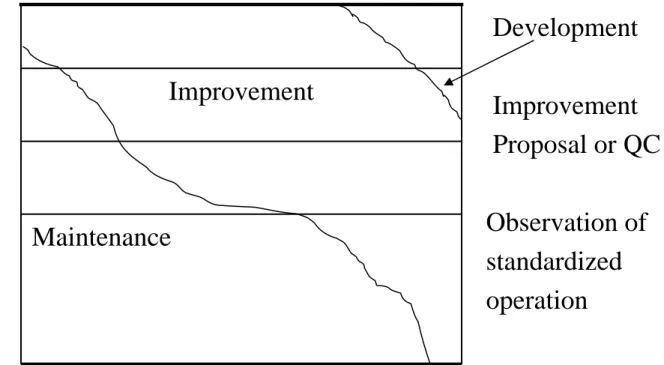
Maintenance Foreman
worker
Improvement
Development Improvement Proposal or QC Observation of standardized operation Top management
Manager
Fig. 1 – Allocation of Maintenance and Improvement work
Fig. 1. Shows how functions are allocated according to the ranks of company organization to ranks of company organization at Toyota Motor. Even a general worker is engaged in improvement work, which correspond to the Idea Proposal System and Q.C circle.
As a matter of course managers devote themselves mainly in improvement activities
MUTUAL DEVELOPMENT AMONG COMPONENT SUPPLIERS
Besides receiving assistance’s directly from Toyota, 200 component suppliers form the co-operative organization which is shown in Fig.2
This organization carries out the following activities
1) Request to Toyota for informing and explaining the policies of the company and of its purchasing departments.
2) Holding a meeting for mutual presentation of activities in defective reduction or quality improvement.
3) Lectures and contests on proper techniques (measuring techniques, selection method by spark, I.e. igniting spirit of enthusiasm).
PRESENTATION OF INTRODUCTORY & PRACTICAL COURSES OF S.Q.C.
Toyota arranges lectures and introduce to the suppliers new practical techniques of quality control and reliability so that these techniques can be used by the suppliers. Moreover, twelve Toyota group companies have set up seven educational courses in co-operation of J.U.S.E and central – Japan Quality Control Association, and encourages the suppliers attend the course.
TABLE 2
EXAMPLE OF COURSES
QC CIRCLE PROMOTER COURSE
PROBLEM SOLVING COURSE FOR FOREMAN 6
7 FOREMAN
QC BASIC COURSE
RELIABILITY BASIC COURSE DESIGN OF EXPERIMENT COURSE 3
4 5 STAFF
Q.C MANAGER COURSE
RELIABILITY MANAGER COURSE 1
2 MANAGER
ATTENDANT TITLE
COMMENDATION SYSTEM
Besides the Toyota Quality Reward which has already been explained, there are two other rewards to command the component suppliers, quality control excellence reward and cost improvement excellence reward. These rewards are presented to the companies which have performed market achievements with respect to quality and cost during a year. Quality Control Excellent Reward is given to the supplier
who has shown ;
1) Good claim rate
3) Prompt preventive measures for preventing recurrence of defectives.
And cost improvement Excellence Reward is granted to a company which has made many number of proposals or adopted proposals of V.A and has shown big resultant values. The purpose of these rewards is not to commend suppliers but to create the circumstance where the suppliers develop themselves or are guided to become worthy of being commanded. For this reason attention is paid to the following points:
1) Evaluation standards should be fair and objective.
In order to make it to understood that any suppliers can be highly evaluated and could be commended it if makes its best possible effort, fair evaluation must be released and the evaluation should not be made only by the purchasing departments but the opinions of the inspection departments of Toyota Motors should be considered.
2) Check points of evaluation should be announced beforehand. Items in commendation and evaluation standards are announced a year before so that suppliers can develop on announced points systematically in the company policies.
ISSUES FOR DISCUSSION
1) What are the salient points I in the approach adopted by Toyota to develop its component suppliers?
2) Looking back into the India scene of sub-contractor relationship and development, what are the issues which need attention in our industry to make a journey? What will be your proposed action plan?
GENERAL ASSEMBLY
SECRETARIES
CHAIRMAN
SECRETARIES
BODY
INTERIOR
COMPONENT
MEETING
FOUNDRY-
FORGING-PRESS PARTS
MEETING
FUNCTIONAL
COMPONENT
MEETING
QUALITY
COMMITTEE
COST
COMMITTEE
SECURITY &
POLLUTION
COMMITTEE
(Classified by kind of work)
Classified by function