The 1-D
Heat Equation
18.303 Linear Partial Differential Equations
Matthew J. Hancock
Fall 2006
1
The 1-D Heat Equation
1.1
Physical derivation
Reference: Guenther & Lee §1.3-1.4, Myint-U & Debnath §2.1 and §2.5 [Sept. 8, 2006]
In a metal rod with non-uniform temperature, heat (thermal energy) is transferred from regions of higher temperature to regions of lower temperature. Three physical principles are used here.
1. Heat (or thermal) energy of a body with uniform properties: Heat energy = cmu,
where m is the body mass, u is the temperature, c is the specific heat, units [c] = L2T−2U−1 (basic units areM mass, Llength, T time, U temperature). c is the energy
required to raise a unit mass of the substance 1 unit in temperature.
2. Fourier’s law of heat transfer: rate of heat transfer proportional to negative temperature gradient,
Rate of heat transfer ∂u
= −K0 (1)
area ∂x
where K0 is the thermal conductivity, units [K0] = M LT−3U−1 . In other words, heat
is transferred from areas of high temp to low temp. 3. Conservation of energy.
Consider a uniform rod of length l with non-uniform temperature lying on the x-axis from x = 0 to x = l. By uniform rod, we mean the density ρ, specific heat c, thermal conductivity K0, cross-sectional area A are ALL constant. Assume the sides
� � � �
of the rod are insulated and only the ends may be exposed. Also assume there is no heat source within the rod. Consider an arbitrary thin slice of the rod of width Δx between x and x+ Δx. The slice is so thin that the temperature throughout the slice is u(x, t). Thus,
Heat energy of segment = c ×ρAΔx ×u = cρAΔxu(x, t). By conservation of energy,
change of
heat in from heat out from heat energy of =
left boundary − right boundary . segment in time Δt
From Fourier’s Law (1),
∂u ∂u
cρAΔxu(x, t + Δt)−cρAΔxu(x, t) = ΔtA −K0 −ΔtA −K0
∂x x ∂x x+Δx Rearranging yields (recall ρ, c, A, K0 are constant),
u(x, t + Δt)− Δt u(x, t) = K0 cρ � �∂u ∂x � x+Δx − Δx �∂u ∂x � x �
Taking the limit Δt,Δx →0 gives the Heat Equation, ∂u ∂2u
∂t = κ ∂x2 (2)
where
κ = K0 (3)
cρ
is called the thermal diffusivity, units [κ] = L2/T. Since the slice was chosen arbi
trarily, the Heat Equation (2) applies throughout the rod.
1.2
Initial condition and boundary conditions
To make use of the Heat Equation, we need more information:
1. Initial Condition (IC): in this case, the initial temperature distribution in the rod u(x,0).
2. Boundary Conditions (BC): in this case, the temperature of the rod is affected by what happens at the ends, x = 0, l. What happens to the temperature at the end of the rod must be specified. In reality, the BCs can be complicated. Here we consider three simple cases for the boundary at x = 0.
(I) Temperature prescribed at a boundary. For t > 0, u(0, t) = u1 (t).
(II) Insulated boundary. The heat flow can be prescribed at the boundaries, ∂u
(0, t) = φ1 (t)
−K0
∂x
(III) Mixed condition: an equation involving u(0, t), ∂u/∂x(0, t), etc.
Example 1. Consider a rod of length l with insulated sides is given an initial temperature distribution of f (x) degree C, for 0 < x < l. Find u(x, t) at subsequent times t > 0 if end of rod are kept at 0o C.
The Heat Eqn and corresponding IC and BCs are thus
PDE: ut = κuxx, 0 < x < l, (4)
IC: u(x,0) = f (x), 0 < x < l, (5) BC: u(0, t) = u(L, t) = 0, t > 0. (6) Physical intuition: we expect u →0 as t → ∞.
1.3
Non-dimensionalization
Dimensional (or physical) terms in the PDE (2): k, l, x, t, u. Others could be introduced in IC and BCs. To make the solution more meaningful and simpler, we group as many physical constants together as possible. Let the characteristic length, time and temperature be L∗, T∗ and U∗, respectively, with dimensions [L∗] = L,
[T∗] = T, [U∗] = U. Introduce dimensionless variables via
x t � � u(x, t) f (x)
xˆ = , tˆ = , u x, ˆ ˆ t ˆ = , fˆ(ˆx) = . (7)
L∗ T∗ U∗ U∗
The variables ˆx, tˆ, ˆu are dimensionless (i.e. no units, [ˆx] = 1). The sensible choice for the characteristic length is L∗ = l, the length of the rod. While x is in the range
0 < x < l, ˆx is in the range 0 < x < ˆ 1.
The choice of dimensionless variables is an ART. Sometimes the statement of the problem gives hints: e.g. the length l of the rod (1 is nicer to deal with than l, an unspecified quantity). Often you have to solve the problem first, look at the solution, and try to simplify the notation.
� � � � From the chain rule,
∂u ∂uˆ∂tˆ U∗ ∂uˆ
ut = = U∗ =
∂t ∂tˆ∂t T∗ ∂tˆ
, ∂u ∂uˆ∂xˆ U∗ ∂uˆ
ux = = U∗ = ∂x ∂xˆ∂x L∗ ∂xˆ U∗ ∂2uˆ uxx = L2 ∗ ∂xˆ2
Substituting these into the Heat Eqn (4) gives
∂uˆ T∗κ ∂2uˆ
= ut = κuxx ⇒
∂tˆ L2
∗ ∂xˆ2
To make the PDE simpler, we choose T∗ = L2∗/κ= l2/κ, so that
∂uˆ ∂2uˆ
= , 0 < x < ˆ 1, ˆt > 0. ∂tˆ ∂xˆ2
The characteristic (diffusive) time scale in the problem is T∗ = l2/κ. For different
substances, this gives time scale over which diffusion takes place in the problem. The IC (5) and BC (6) must also be non-dimensionalized:
IC: uˆ (ˆx,0) = fˆ(ˆx), 0 < x < ˆ 1, BC: uˆ 0, tˆ = uˆ 1, tˆ = 0, t > ˆ 0.
1.4
Dimensionless problem
Dropping hats, we have the dimensionless problem
PDE: ut = uxx, 0 < x < 1, (8)
IC: u(x,0) = f (x), 0 < x < 1, (9) BC: u(0, t) = u(1, t) = 0, t > 0, (10) where x, t are dimensionless scalings of physical position and time.
2
Separation of variables
Ref: Guenther & Lee, §4.2 and 5.1, Myint-U & Debnath §6.4 [Sept 12, 2006]
We look for a solution to the dimensionless Heat Equation (8) – (10) of the form
Take the relevant partial derivatives:
′′ ′
uxx = X (x)T (t), ut = X(x)T (t)
where primes denote differentiation of a single-variable function. The PDE (8), ut =
uxx, becomes
′ ′′
T (t) X (x) =
T (t) X(x)
The left hand side (l.h.s.) depends only on t and the right hand side (r.h.s.) only depends on x. Hence if t varies and x is held fixed, the r.h.s. is constant, and hence T ′ /T must also be constant, which we set to −λ by convention:
′ ′′
T (t) X (x)
T (t) = X(x) = −λ, λ = constant. (12) The BCs become, for t > 0,
u(0, t) = X(0)T (t) = 0 u(1, t) = X(1)T (t) = 0
Taking T (t) = 0 would give u = 0 for all time and space (called the trivial solution), from (11), which does not satisfy the IC unless f (x) = 0. If you are lucky and f (x) = 0, then u = 0 is the solution (this has to do with uniqueness of the solution, which we’ll come back to). If f (x) is not zero for all 0 < x < 1, then T (t) cannot be zero and hence the above equations are only satisfied if
X(0) = X(1) = 0. (13)
2.1
Solving for
X
(
x
)
Ref: Guenther & Lee, §4.2 and 5.1 and 7.1, Myint-U & Debnath §7.1 – 7.3 We obtain a boundary value problem for X(x), from (12) and (13),
′′
X (x) +λX(x) = 0, 0 < x < 1, (14)
X(0) = X(1) = 0. (15)
This is an example of a Sturm-Liouville problem (from your ODEs class). There are 3 cases: λ > 0, λ < 0 and λ = 0.
(i) λ < 0. Let λ = −k2 < 0. Then the solution to (14) is
� �
� � � �
for integration constants A, B found from imposing the BCs (15), X(0) = A+ B = 0, X(1) = Aek + Be−k = 0.
The first gives A = −B, the second then gives A e2k −1 = 0, and since |k|> 0 we
have A = B = u = 0, which is the trivial solution. Thus we discard the case λ < 0. (ii) λ = 0. Then X(x) = Ax +B and the BCs imply 0 = X(0) = B, 0 = X(1) = A, so that A = B = u = 0. We discard this case also.
(iii) λ > 0. In this case, (14) is the simple harmonic equation whose solution is X(x) = Acos √λx + Bsin √λx . (16) The BCs imply 0 = X(0) = A, and Bsin √λ = 0. We don’t want B = 0, since that would give the trivial solution u = 0, so we must have
sin √λ = 0. (17)
Thus √λ = nπ, for any nonzero integer n (n = 1,2,3, ...). We use subscripts to label the particular n-value. The values of λ are called the eigenvalues of the Sturm-Liouville problem (14),
λn = n 2π2 , n = 1,2,3, ...
and the corresponding solutions of (14) are called the eigenfunctions of the Sturm-Liouville problem (14),
Xn (x) = bn sin (nπx), n = 1,2,3, ... (18)
We have assumed that n > 0, since n < 0 gives the same solution as n > 0.
2.2
Solving for
T
(
t
)
When solving for X(x), we found that non-trivial solutions arose for λ = n2π2 for all
nonzero integers n. The equation for T (t) is thus, from (12), T ′ (t) = −n 2π2T (t)
and, for n, the solution is
Tn = cne −n
2
π2
t , n = 1,2,3, ... (19)
�
� �
�
�
2.3
Full solution
u
(
x, t
)
Ref: Myint-U & Debnath §6.4, Ch 5
Putting things together, we have, from (11), (18) and (19), un (x, t) = Bn sin (nπx)e −n
2
π2
t , n = 1,2,3, ... (20)
where Bn = cnbn. Each function un (x, t) is a solution to the PDE (8) and the BCs
(10). But, in general, they will not individually satisfy the IC (9), un (x,0) = Bn sin (nπx) = f (x) .
We now apply the principle of superposition: if u1 and u2 are two solutions to the
PDE (8) and BC (10), then c1u1 + c2u2 is also a solution, for any constants c1, c2.
This relies on the linearity of the PDE and BCs. We will, of course, soon make this more precise....
Since each un (x,0) is a solution of the PDE, then the principle of superposition
says any finite sum is also a solution. To solve the IC, we will probably need all the solutions un, and form the infinite sum (convergence properties to be checked),
∞
u(x, t) = un (x, t). (21) n=1
u(x, t) satisfies the BCs (10) since each un (x, t) does. Assuming term-by-term dif
ferentiation holds (to be checked) for the infinite sum, then u(x, t) also satisfies the PDE (8). To satisfy the IC, we need to find Bn’s such that
∞ ∞
f (x) = u(x,0) = un (x,0) = Bn sin (nπx). (22)
n=1 n=1
This is the Fourier Sine Series of f (x).
To solve for the Bn’s, we use the orthogonality property for the eigenfunctions
sin (nπx),
� 1
0 m = n 1
sin (mπx) sin (nπx)dx = � = δmn (23)
0 1/2 m = n 2
where δmn is the kronecker delta,
0 m = n δmn = �
1 m = n The orthogonality relation (23) is derived by substituting
�
�
�
into the integral on the left hand side of (23) and noting � 1
cos (mπx)dx = δm0. 0
The orthogonality of the functions sin (nπx) is analogous to that of the unit vectors
x
ˆ and yˆ in 2-space; the integral from 0 to 1 in (23) above is analogous to the dot product in 2-space.
To solve for the Bn’s, we multiply both sides of (22) by sin (mπx) and integrate
from 0 to 1:
� 1 ∞ � 1
sin (mπx)f (x)dx = Bn sin (nπx) sin (mπx)dx
0 n=1 0
Substituting (23) into the right hand side yields
� 1 ∞
� 1
sin (mπx)f (x)dx = Bn δnm
2
0 n=1
By definition of δnm, the only term that is non-zero in the infinite sum is the one
where n = m, thus � 1 1 sin (mπx)f (x)dx = Bm 2 0 Rearranging yields � 1 Bm = 2 sin (mπx)f (x)dx. (24) 0
The full solution is, from (20) and (21),
∞ u(x, t) = Bn sin (nπx)e −n 2 π2 t , (25) n=1
where Bn are given by (24).
To derive the solution (25) of the Heat Equation (8) and corresponding BCs (10) and IC (9), we used properties of linear operators and infinite series that need justification.
3
Example : Cooling of a rod from a constant ini
tial temperature
Suppose the initial temperature distribution f (x) in the rod is constant, i.e. f (x) = u0. The solution for the temperature in the rod is (25),
∞ u(x, t) = Bn sin (nπx)e −n 2 π2 t , n=1
�
�
�
� �
where, from (24), the Fourier coefficients are given by
� 1 1
Bn = 2 sin (nπx)f (x)dx = 2u0 sin (nπx)dx.
0 0
Calculating the integrals gives Bn = 2u0
� 1
sin (nπx)dx = cos (nπ)−1 = 2u0 ((−1)n −1) = 0 n even
0 − 2u0 nπ −nπ 4u0 n odd nπ In other words, 4u0 B2n = 0, B2n−1 = (2n −1)π and the solution becomes
∞
u(x, t) = 4u0 sin ((2n −1)πx) � 2 � π (2n −1) exp −(2n −1) π
2t . (26)
n=1
3.1
Approximate form of solution
The number of terms of the series (26) needed to get a good approximation for u(x, t) depends on how close t is to 0. The series is
4u0 −π2
t sin (3πx) −9π2
t
u(x, t) = sin (πx)e + e + .
π 3 · · ·
The ratio of the first and second terms is |second term|
= e
−8π2
t |sin 3πx|
|first term| 3 |sin πx|
≤ e −8π2t using |sin nx| ≤n|sin x| 1
≤ e −8 for t ≥ π2
< 0.00034
It can also be shown that the first term dominates the sum of the rest of the terms, and hence 4u0 −π2 t 1 u(x, t)≈ sin (πx)e , for t ≥ π2 . (27) π
What does t = 1/π2 correspond to in physical time? In physical time t ′ = l2t/κ
(recall our scaling - here we use t as the dimensionless time and t ′ as dimensional
time), t = 1/π2 corresponds to:
t ′ ≈15 minutes, for a 1 m rod of copper (κ ≈1.1 cm2 sec−1)
t ′ ≈169 minutes, for a 1 m rod of steel (κ ≈0.1 cm2 sec−1)
At t = 1/π2, the temperature at the center of the rod (x = 1/2) is, from (27),
4
u(x, t)≈ u0 = 0.47u0.
πe
Thus, after a (scaled) time t = 1/π2, the temperature has decreased by a factor of
0.47 from the initial temperature u0.
3.2
Geometrical visualization of the solution
[Sept 14, 2006]
To analyze qualitative features of the solution, we draw various types of curves in 2D:
1. Spatial temperature profile, given by u = u(x, t0)
where t0 is a fixed value of x. These profiles are curves in the ux-plane.
2. Temperature profiles in time,
u = u(x0, t)
where x0 is a fixed value of x. These profiles are curves in the ut-plane.
3. Curves of constant temperature in the xt-plane (level curves), u(x, t) = C
where C is a constant.
Note that the solution u = u(x, t) is a 2D surface in the 3D uxt-space. The above families of curves are the different cross-sections of this solution surface. Drawing the 2D cross-sections is much simpler than drawing the 3D solution surface.
Sketch typical curves: when sketching the curves in 1-3 above, we draw a few typical curves and any special cases. While math packages such as Matlab can be used to compute the curves from, say, 20 terms in the full power series solution (26), the emphasis in this course is to use simple considerations to get a rough idea of what the solution looks like. For example, one can use the first term approximation (27), simple physical considerations on heat transfer, and the fact that the solution u(x, t) is continuous in x and t, so that if t1 is close to t1, u(x, t1) is close to u(x, t2).
3.2.1 Spatial temperature profiles
For fixed t = t0, the first term approximate solution (27) is
4u0
u(x, t)≈ e −π2t0
sin (πx), t ≥1/π2 . (28) π
� � � �
� � �
Figure 1: Spatial temperature profiles u(x, t0).
This suggests the center of the rod, x = 1/2, is a line of symmetry for u(x, t), i.e.
1 1
u + s, t = u
2 −s, t 2
and, for each fixed time, the location of the maximum (minimum) temperature if u0 > 0 (u0 < 0). We can prove the symmetry property by noting that the original
PDE/BC/IC problem is invariant under the transformation x → 1 −x. Note also that, from (26),
∞
ux (x, t) = 4u0 cos ((2n −1)πx) exp −(2n −1)2 π2t
n=1
Thus ux (1/2, t) = 0 and uxx (1/2, t) < 0, so the 2nd derivative test implies that
x = 1/2 is a local max.
In Figure 1, we have plotted two typical profiles, one at early times t = t0 ≈0 and
the other at late times t = t0 ≫ 0, and two special profiles, the initial temperature
at t = 0 (u = u0) and the temperature as t → ∞(u = 0). The profile for t = t0 ≫0
is found from the first term approximation (28). The line of symmetry x = 1/2 is plotted as a dashed line for reference in Figure 1.
� �
Figure 2: Temperature profiles in time u(x0, t).
3.2.2 Temperature profiles in time
Setting x = x0 in the approximate solution (27),
u(x0, t)≈ 4u0 sin (πx0) e −π 2 t , t ≥1/π2 . π
Two typical profiles are sketched in Figure 2, one near the center of the rod (x0 ≈1/2)
and one near the edges (x0 ≈ 0 or 1). To draw these we noted that the center of
the rod cools more slowly than points near the ends. One special profile is plotted, namely the temperature at the rod ends (x = 0,1).
3.2.3 Curves of constant temperature (level curves of u(x, t))
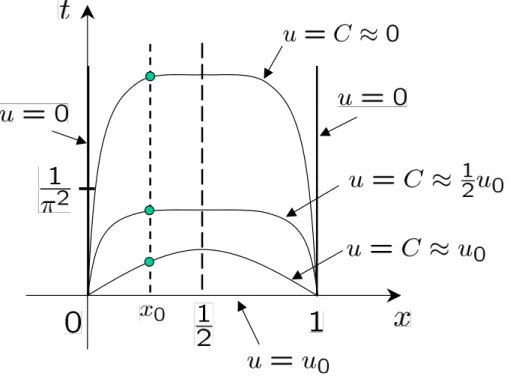
In Figure 3, we have drawn three typical level curves and two special ones, u = 0 (rod ends) and u = u0 (the initial condition). For a fixed x = x0, the temperature
in the rod decreases as t increases (motivated by the first term approximation (28)), as indicated by the points of intersection on the dashed line. The center of the rod (x = 1/2) is a line of symmetry, and at any time, the maximum temperature is at the center. Note that at t = 0, the temperature is discontinuous at x = 0,1.
To draw the level curves, it is easiest to already have drawn the spatial temperature profiles. Draw a few horizontal broken lines across your u vs. x plot. Suppose you draw a horizontal line u = u1. Suppose this line u = u1 crosses one of your profiles
u(x, t0) at position x = x1. Then (x1, t0) is a point on the level curve u(x, t) = u1.
Now plot this point in your level curve plot. By observing where the line u = u1
� �
� �
Figure 3: Curves of constant temperature u(x, t) = c, i.e., the level curves of u(x, t). this process for a few values of u1 to obtain a few representative level curves. Plot
also the special cases: u(x, t) = u0/w, u = 0, etc.
When drawing visualization curves, the following result is also helpful.
3.2.4 Maximum Principle for the basic Heat Problem
Ref: Guenther & Lee §5.2, Myint-U & Debnath §8.2
This result is useful when plotting solutions: the extrema of the solution of the heat equation occurs on the space-time “boundary”, i.e. the maximum of the initial condition and of the time-varying boundary conditions. More precisely, given the heat equation with some initial condition f (x) and BCs u(0, t), u(1, t), then on a given time interval [0, T], the solution u(x, t) is bounded by
umin ≤u(x, t)≤umax
where
umax = max max f (x), max u(0, t), max u(1, t) 0<x<1 0<t<T 0<t<T
umin = min min f (x), min u(0, t), min u(1, t) 0<x<1 0<t<T 0<t<T
� �
� �
�
Thus, in the example above, umin = 0 and umax = u0, hence for all x ∈ [0,1] and
t ∈[0, T], 0≤u(x, t)≤u0.
4
Equilibrium temperature profile (steady-state)
Intuition tells us that if the ends of the rod are held at 0o C and there are no heat
sources or sinks in the rod, the temperature in the rod will eventually reach 0. The solution above confirms this. However, we do not have to solve the full problem to determine the asymptotic or long-time behavior of the solution.
Instead, the equilibrium or steady-state solution u = uE (x) must be independent
of time, and will thus satisfy the PDE and BCs with ut = 0,
′′
uE = 0, 0 < x < 1; uE (0) = uE (1) = 0.
The solution is uE = c1x + c2 and imposing the BCs implies uE (x) = 0. In other
words, regardless of the initial temperature distribution u(x,0) = f (x) in the rod, the temperature eventually goes to zero.
4.1
Rate of decay of
u
(
x, t
)
How fast does u approach uE = 0? From our estimate (82) above,
|un (x, t)| ≤Be−n
2
π2
t , n = 1,2,3, ...
� �n
where B is a constant. Noting that e−n2
π2 t e−nπ2 t = e−π2 t , we have ≤ � ∞ � ∞ ∞ �� � � � n Br −π 2 t � un (x, t)� un (x, t) ≤B r = , r = e < 1 (t > 0). �n=1 � ≤ n=1 | | n=1 1−r �∞
The last step is the geometric series result n=1 rn =
1− r r , for |r|< 1. Thus � � t � ∞ � Be −π2 � un (x, t)� −π2 t, t > 0. (29) �n=1 � ≤ 1 −e Therefore
• u(x, t) approaches the steady-state uE (x) = 0 exponentially fast (i.e. the rod
cools quickly)
the first term in the series, sin (πx)e−π2
t (term with smallest eigenvalue λ = π)
•
determines the rate of decay of u(x, t)
• the Bn’s may also affect the rate of approach to the steady-state, for other
� � � � � � � � � � � � � � � �
4.2
Error of first-term approximation
Using the method in the previous section, we can compute the error between the first-term and the full solution (26),
� ∞ � |u(x, t)−u1 (x, t)| = �� n=1 un (x, t)−u1 (x, t)�� � ∞ � ∞ ∞ � � Br 2 = � un (x, t)� un (x, t) ≤B r n = �n=2 � ≤ n=2 | | n=2 1−r where r = e−π2
t . Hence the solution u(x, t) approaches the first term u
1 (x, t) expo nentially fast, Be−2π2 t |u(x, t)−u1 (x, t)| ≤ 1−e−π2t, t > 0. (30) With a little more work we can get a much tighter (i.e. better) upper bound. We
consider the sum ∞
|un (x, t)| n=N
Substituting for un (x, t) gives
∞ ∞ ∞ |un (x, t)| ≤B e −n 2 π2 t = Be−N2 π2 t e −(n2 −N2 )π2 t (31) n=N n=N n=N
Here’s the trick: for n ≥N,
n 2 −N2 = (n + N) (n −N)≥2N (n −N)≥0. Since e−x is a decreasing function, then
e −(n2−N2)π2t ≤e −2N(n−N)π2
t (32)
for t > 0. Using the inequality (32) in Eq. (31) gives
∞ ∞ |un (x, t)| ≤ Be−N 2 π2 t e −2N(n−N)π2 t n=N n=N � �N ∞ −2N π2t � � �n e = BeN2π2t e −2N π2t = BeN2π2t . 1−e−2N π2 t n=N
Simplifying the expression on the right hand side yields
∞ � Be−N 2 π2 t n=N |un (x, t)| ≤ 1−e−2N π2 t (33)
� � � � � � � � � � �
For N = 1, (33) gives the temperature decay
��∞ � �∞ t � � Be −π2 |u(x, t)|= � � n=N un (x, t) � �≤ n=N |un (x, t)| ≤ 1−e−2π2t, (34) which is slightly tighter than (29). For N = 2, (33) gives the error between u(x, t) and the first term approximation,
��∞ � �∞ Be−4π 2 t |u(x, t)−u1 (x, t)|= �� � un (x, t)�� � ≤ |un (x, t)| ≤ 1−e−4π2t n=2 n=2
which is a much better upper bound than (30).
Note that for an initial condition u(x,0) = f (x) that is is symmetric with respect to x = 1/2 (e.g. f (x) = u0), then u2n = 0 for all n, and hence error between u(x, t)
and the first term u1 (x, t) is even smaller,
� ∞ � ∞ |u(x, t)−u1 (x, t)|= �� � un (x, t)�� � ≤ |un (x, t)| n=3 n=3
Applying result (33) with N = 3 gives
Be−9π2
t
|u(x, t)−u1 (x, t)| ≤
1−e−6π2
t .
Thus, in this case, the error between the solution u(x, t) and the first term u1 (x, t)
decays as e−9π2
t - very quickly!
5
Review of Fourier Series
Ref: Guenther & Lee, §3.1, Myint-U & Debnath §5.1–5.3, 5.5–5.6 [Sept 19, 2006]
Motivation: Recall that the initial temperature distribution satisfies
∞
f (x) = u(x,0) = Bn sin (nπx). n=1
In the example above with a constant initial temperature distribution, f (x) = u0, we
have ∞ 4u0 sin ((2n −1)πx) . (35) u0 = π 2n −1 n=1
Note that at x = 0 and x = 1, the r.h.s. does NOT converge to u0 = 0, but rather to
0 (the BCs). Note that the Fourier Sine Series of f (x) is odd and 2-periodic in space and converges to the odd periodic extension of f (x) = u0.
� � � � � �
Odd periodic extension The odd periodic extension of a function f (x) defined
for x ∈[0,1], is the Fourier Sine Series of f (x) evaluated at any x ∈R,
∞
f˜(x) = Bn sin (nπx). n=1
Note that since sin (nπx) = −sin (−nπx) and sin (nπx) = sin (nπ (x + 2)), then f˜(x) = −f˜(−x) and f˜(x + 2) = f˜(x). Thus f˜(x) is odd, 2-periodic and f˜(x) equals f (x) on the open interval (0,1). What conditions are necessary for f (x) to equal f˜(x) on the closed interval [0,1]? This is covered next.
Aside: cancelling u0 from both sides of (35) gives a really complicated way of
writing 1, ∞ 4 sin ((2n −1)πx) 1 = . π 2n −1 n=1
5.1
Fourier Sine Series
Given an integrable function f (x) on [0,1], the Fourier Sine Series of f (x) is
∞ Bn sin (nπx) (36) n=1 where � 1 Bn = 2 f (x) sin (nπx)dx. (37) 0
The associated orthogonality properties are � 1
1/2, m = n = 0, sin (mπx) sin (nπx)dx = �
0 0, m = n.
5.2
Fourier Cosine Series
Given an integrable function f (x) on [0,1], the Fourier Cosine Series of f (x) is
∞ A0 + An cos (nπx) (38) n=1 where � 1 A0 = f (x)dx, (average off (x)) (39) 0 � 1 An = 2 0 f (x) cos (nπx)dx, n ≥1. (40)
� � � � � � �
The associated orthogonality properties are
� 1 1/2, m = n = 0,
cos (mπx) cos (nπx)dx = �
0 0, m = n.
e.g. The cosine series off (x) = u0 forx ∈[0,1] is justu0. In other words, A0 = u0
and An = 0 for n ≥1.
5.3
The (full) Fourier Series
The Full Fourier Series of an integrable function f (x), now defined on [−1,1], is
∞ fˆ(x) = a0 + (an cos (nπx) +bn sin (nπx)) (41) n=1 where 1 � 1 a0 = f (x)dx 2 −1 � 1 an = f (x) cos (nπx)dx −1 � 1 bn = f (x) sin (nπx)dx −1
The associated orthogonality properties of sin and cos on [−1,1] are, for any m, n = 1,2,3, ...
� 1
sin (mπx) cos (nπx)dx = 0, all m, n,
−1 � 1 1, m = n = 0, sin (mπx) sin (nπx)dx = � −1 0, m = n, � 1 1, m = n = 0, cos (mπx) cos (nπx)dx = � −1 0, m = n.
5.4
Piecewise Smooth
Ref: Guenther & Lee p. 50,
Provided a function f (x) is integrable, its Fourier coefficients can be calculated. It does not follow, however, that the corresponding Fourier Series (Sine, Cosine or Full) converges or has the sum f (x). In order to ensure this, f (x) must satisfy some stronger conditions.
�
Definition Piecewise Smooth function: A function f (x) defined on a closed
interval [a, b] is said to be piecewise smooth on [a, b] if there is a partition of [a, b], a = x0 < x1 < x2 < · · · < xn = b
such that f has a continuous derivative (i.e. C1) on each closed subinterval [x
m, xm+1].
E.g. any function that is C1 on an interval [a, b] is, of course, piecewise smooth on
[a, b].
E.g. the function
f (x) = 2x, 0 ≤x ≤1/2 1/2, 1/2 < x ≤1 is piecewise smooth on [0,1], but is not continuous on [0,1].
E.g. the function f (x) = |x| is both continuous and piecewise smooth on [−1,1],
′
despite f (x) not being defined at x = 0. This is because we partition [−1,1] into
′
two subintervals [−1,0] and [0,1]. When worrying about f (x) near x = 0, note that on [0,1] we only care about the left limit f ′ (0−) and for [−1,0], we only care about
the right limit f ′ (0+).
E.g. the function f (x) = |x| 1/2 is continuous on [−1,1] but not piecewise smooth on [−1,1], since f ′ (0−) and f ′ (0+) do not exist.
5.5
Convergence of Fourier Series
Ref: Guenther & Lee p. 49 and (optional) §3.3, Myint-U & Debnath §5.10
Theorem[Convergence of the Fourier Sine and Cosine Series]: Iff (x) is piecewise
smooth on the closed interval [0,1] and continuous on the open interval (0,1), then the Fourier Sine and Cosine Series converge for all x ∈[0,1] and have the sum f (x) for all x ∈(0,1).
Note: Suppose f (x) is piecewise smooth on [0,1] and is continuous on (0,1) except at a jump discontinuity at x = a. Then the Fourier Sine and Cosine Series converge to f (x) on (0,1) and converge to the average of the left and right limits at x = a, i.e. (f (a−) +f (a+))/2. At the endpoints x = 0,1, the Sine series converges to zero, since sin (nπx) = 0 at x = 0,1 for all n.
Theorem [Convergence of the Full Fourier Series]: If f (x) is piecewise smooth on the closed interval [−1,1] and continuous on the open interval (−1,1), then the Full Fourier Series converges for all x ∈[−1,1] and has the sum f (x) for all x ∈(−1,1).
5.6
Comments
� �
Given a function f (x) that is piecewise smooth on [0,1] and continuous on (0,1), the Fourier Sine and Cosine Series of f (x) converge on [0,1] and equal f (x) on the open interval (0,1) (i.e. perhaps excluding the endpoints). Thus, for any x ∈(0,1),
∞ ∞
A0 + An cos (nπx) = f (x) = Bn sin (nπx).
n=1 n=1
In other words, the Fourier Cosine Series (left hand side) and the Fourier Sine Series (right hand side) are two different representations for the same function f (x), on the open interval (0,1). The values at the endpoints x = 0,1 may not be the same. The choice of Sine or Cosine series is determined from the type of eigenfunctions that give solutions to the Heat Equation and BCs.
6
Well-Posed Problems
Ref: Guenther & Lee §1.8 and §5.2 (in particular p. 160 and preceding pages, and p. 150)
Ref: Myint-U & Debnath §1.2, §6.5
We call a mathematical model or equation or problem well-posed if it satisfies the following 3 conditions:
1. [Existence of a solution]: The mathematical model has at least 1 solution. Physical interpretation: the system exists over at least some finite time interval. 2. [Uniqueness of solution]: The mathematical model has at most 1 solution. Phys ical interpretation: identical initial states of the system lead to the same out come.
3. [Continuous dependence on parameters]: The solution of the mathematical model depends continuously on initial conditions and parameters. Physical interpretation: small changes in initial states (or parameters) of the system produce small changes in the outcome.
If an IVP (initial value problem) or BIVP (boundary initial value problem - e.g. Heat Problem) satisfies 1, 2, 3 then it is well-posed.
Example: for the basic Heat Problem, we showed 1 by construction a solution using the method of separation of variables. Continuous dependence is more difficult to show (need to know about norms), but it is true, and we will use this fact when sketching solutions. Also, when drawing level curves u(x, t) = const, small changes in parameters (x, t) leads to a small change in u. We now prove the 2nd part of well-posedness, uniqueness of solution, for the basic heat problem.
� �
6.1
Uniqueness of solution to the Heat Problem
Definition We define the two space-time sets
D = {(x, t) : 0 ≤x ≤1, t > 0} D = {(x, t) : 0 ≤x ≤1, t ≥0} and the space of functions
C 2 � D �
= �
u(x, t) : uxx continuous in D and u continuous in D
� .
In other words, the space of functions that are twice continuously differentiable on [0,1] for t > 0 and continuous on [0,1] for t ≥0.
Theorem The basic Heat Problem, i.e. the Heat Equation (8) with BC (10)
and IC (9),
PDE: ut = uxx, 0 < x < 1,
IC: u(x,0) = f (x), 0 < x < 1, BC: u(0, t) = u(1, t) = 0, t > 0, has at most one solution in the space of functions C2 .
� �
D
Proof: Consider two solutions u1, u2 ∈ C2 D to the Heat Problem. Let v =
u1 −u2. We aim to show that v = 0 on [0,1], which would prove that u1 = u2 and
then solution to the Heat Equation (8) with BC (10) and IC (9) is unique. Since each of u1, u2 satisfies (8), (9), and (10), the function v satisfies
vt = (u1 −u2)t (42) = u1t −u2t = u1xx −u2xx = (u1 −u2)xx = vxx, 0 < x < 1, and similarly, IC: v (x,0) = u1 (x,0)−u2 (x,0) = f (x)−f (x) = 0, 0 < x < 1, (43) BC: v (0, t) = u1 (0, t)−u2 (0, t) = 0, v (1, t) = 0, t > 0. (44)
Define the function
� 1
V¯ (t) = v 2 (x, t)dx ≥0, t ≥0.
� �
� �
�
Showing thatv (x, t) = 0 reduces to showing that V¯ (t) = 0, sincev (x, t) is continuous on [0,1] for all t ≥ 0 and if there was a point x such that v (x, t) =� 0, then V¯ (t) would be strictly greater than 0. To show V¯ (t) = 0, we differentiate V¯ (t) in time and substitute for vt from the PDE (42),
dV¯ 1 1
= 2 vvtdx = 2 vvxxdx
dt 0 0
Integrating by parts (note: vvxx = (vvx)x −vx2) gives
dV¯ � 1 1 � 1 2 dt = 2 0 vvxxdx = 2 vvx|x=0 − 0 vxdx Using the BCs (44) gives
dV¯ 1 2
dt = −2 0 vxdx ≤0. The IC (43) implies that
� 1
V¯ (0) = v 2 (x,0)dx = 0.
0
Thus, V¯ (t) ≥ 0, dV /dt ¯ ≤ 0, and ¯V (0) = 0, i.e. V ¯(t) is a negative, non-increasing function of time whose initial value is zero. Thus, for all time, V¯ (t) = 0 and v (x, t) = 0 for all x ∈[0,1], implying that u1 = u2. This proves that the solution
to the Heat Equation (8), its IC (9), and BCs (10) is unique, i.e. there is at most one solution. Uniqueness proofs for other types of BCs follows in a similar manner.
7
Variations on the basic Heat Problem
[Sept 21, 2006]
We now consider variations to the basic Heat Problem, including different types of boundary conditions and the presence of sources and sinks.
7.1
Boundary conditions
7.1.1 Type I BCs (Dirichlet conditions)
Ref: Guenther & Lee p. 149
Type I, or Dirichlet, BCs specify the temperature u(x, t) at the end points of the rod, for t > 0,
u(0, t) = g1 (t),
Type I Homogeneous BCs are
u(0, t) = 0, u(1, t) = 0.
The physical significance of these BCs for the rod is that the ends are kept at 0o C.
The solution to the Heat Equation with Type I BCs was considered in class. After separation of variables u(x, t) = X(x)T (t), the associated Sturm-Liouville Boundary Value Problem for X(x) is
′′
X + λX = 0; X(0) = X(1) = 0. The eigenfunctions are Xn (x) = Bn sin (nπx).
7.1.2 Type II BCs (Newmann conditions)
Ref: Guenther & Lee p. 152 problem 1
Type II, or Newmann, BCs specify the rate of change of temperature ∂u/∂x (or heat flux) at the ends of the rod, for t > 0,
∂u (0, t) = g1 (t), ∂x ∂u (1, t) = g2 (t). ∂x Type II Homogeneous BCs are
∂u (0, t) = 0, ∂x ∂u (1, t) = 0. ∂x
The physical significance of these BCs for the rod is that the ends are insulated. These lead to another relatively simple solution involving a cosine series (see problem 6 on PS 1). After separation of variables u(x, t) = X(x)T (t), the associated Sturm-Liouville Boundary Value Problem for X(x) is
′′ ′ ′
X + λX = 0; X (0) = X (1) = 0.
The eigenfunctions are X0 (x) = A0 = const and Xn (x) = An cos (nπx).
7.1.3 Type III BCs (Mixed)
The general Type III BCs are a mixture of Type I and II, for t > 0, ∂u (0, t) +α2u(0, t) = g1 (t), α1 ∂x ∂u (1, t) +α4u(1, t) = g2 (t). α3 ∂x
� �
� �
� � � �
After separation of variables u(x, t) = X(x)T (t), the associated Sturm-Liouville Boundary Value Problem for X(x) is
′′ X + λX = 0, ′ α1X (0) +α2X(0) = 0 ′ α3X (0) +α4X(0) = 0
The associated eigenfunctions depend on the values of the constants α1,2,3,4.
Example 1. α1 = α4 = 1, α2 = α3 = 0. Then
′′ ′
X + λX = 0; X (0) = X(1) = 0
and the eigenfunctions are Xn = An cos 2n2 −1πx . Note: the constant X0 = A0 is not
an eigenfunction here.
Example 2. α1 = α4 = 0, α2 = α3 = 1. Then
′′ ′
X + λX = 0; X(0) = X (1) = 0
and the eigenfunctions are Xn = Bn sin 2n2 −1πx . Note: the constant X0 = A0 is not
an eigenfunction here.
Note: Starting with the BCs in Example 1 and rotating the rod about x = 1/2, you’d get the BCs in Example 2. It is not surprising then that under the change of variables ˜x = 1−x, Example 1 becomes Example 2, and vice versa. The eigenfunctions also possess this symmetry, since
sin 2n −1 π(1−x) = (−1)n cos 2n −1 πx .
2 2
Since we can absorb the (−1)n into the constant Bn, the eigenfunctions of Example
1 become those of Example 2 under the transformation ˜x = 1−x, and vice versa.
7.2
Solving the Heat Problem with Inhomogeneous (time
independent) BCs
Ref: Guenther & Lee p. 149
Consider the Heat Problem with inhomogeneous Type I BCs, ut = uxx, 0 < x < 1
u(0, t) = 0, u(1, t) = u1 = const, t > 0, (45)
� �
�
�
Directly applying separation of variables u(x, t) = X(x)T (t) is not useful, because we’d obtain X(1)T (t) = u1 for t > 0. The strategy is to rewrite the solution u(x, t)
in terms of a new variable v (x, t) such that the new problem for v has homogeneous BCs!
Step 1. Find the steady-state, or equilibrium solution uE (x), since this by defini
tion must satisfy the PDE and the BCs,
′′
uE = 0, 0 < x < 1
uE (0) = 0, uE (1) = u1 = const.
Solving for uE gives uE (x) = u1x.
Step 2. Transform variables by introducing a new variable v (x, t),
v (x, t) = u(x, t)−uE (x) = u(x, t)−u1x. (46)
Substituting this into the Heat Problem (45) gives a new Heat Problem, vt = vxx, 0 < x < 1
v (0, t) = 0, v (1, t) = 0, t > 0, (47) v (x,0) = −u1x, 0 < x < 1.
Notice that the BCs are now homogeneous, and the IC is now inhomogeneous. Notice also that we know how to solve this - since it’s the basic Heat Problem! Based on our work, we know that the solution to (47) is
∞ � � 1 v (x, t) = Bn sin (nπx)e −n 2 π2 t , B n = 2 f (x) sin (nπx)dx (48) n=1 0
where f (x) = −u1x. Substituting for f (x) and integrating by parts, we find
� 1 Bn = −2u1 xsin (nπx)dx 0 �1 � xcos (nπx)� 1 1 = −2u1 − nπ � x=0 + nπ 0 cos (nπx)dx 2u1 (−1)n = (49) nπ
Step 3. Transform back to u(x, t), from (46), (48) and (49),
−n u(x, t) = uE (x) +v (x, t) = u1x + 2u1 ∞ (−1)n sin (nπx)e 2π2t . (50) π n n=1
The term uE (x) is the steady state and the term v (x, t) is called the transient, since
it exists initially to satisfy the initial condition but vanishes as t → ∞. You can check for yourself by direct substitution that Eq. (50) is the solution to the inhomogeneous Heat Problem (45), i.e. the PDE, BCs and IC.
� � � �
�� � � � �
7.3
Heat sources
7.3.1 Derivation
Ref: Guenther & Lee p. 6 (Eq. 3-3)
To add a heat source to the derivation of the Heat Equation, we modify the energy balance equation to read,
change of
heat in from heat out from heat generated heat energy of =
left boundary − right boundary + in segment . segment in time Δt
Let Q(x, t) be the heat generated per unit time per unit volume at position x in the rod. Then the last term in the energy balance equation is just QAΔxΔt. Applying Fourier’s Law (1) gives
∂u ∂u
cρAΔxu(x, t + Δt)−cρAΔxu(x, t) = ΔtA −K0 −ΔtA −K0
∂x x ∂x x+Δx +QAΔxΔt
The last term is new; the others we had for the rod without sources. Dividing by AΔxΔt and rearranging yields
∂u ∂u
u(x, t + Δt)−u(x, t) K0 ∂x x+Δx − ∂x x
+ Q
= .
Δt cρ Δx cρ
Taking the limit Δt,Δx →0 gives the Heat Equation with a heat source, ∂u ∂2u Q
= κ + (51)
∂t ∂x2 cρ
Introducing non-dimensional variables ˜x = x/l, t˜ = κt/l2 gives
∂u ∂2u l2Q
= + (52)
∂t˜ ∂x˜2 κcρ
Defining the dimensionless source term q = l2Q/(κcρ) and dropping tildes gives the
dimensionless Heat Problem with a source, ∂u ∂2u
= + q (53)
7.3.2 Solution method
Ref: Guenther & Lee p. 147 – 149, Myint-U & Debnath §6.7 (exercises)
The simplest case is that of a constant source q = q(x) in the rod. The Heat Problem becomes,
ut = uxx + q(x), 0 < x < 1, (54)
u(0, t) = b1, u(1, t) = b2, t > 0,
u(x,0) = f (x), 0 < x < 1.
If q(x)> 0, heat is generated at x in the rod; if q(x)< 0, heat is absorbed.
The solution method is the same as that for inhomogeneous BCs: find the equi librium solution uE (x) that satisfies the PDE and the BCs,
′′
0 = uE + q(x), 0 < x < 1, uE (0) = b1, uE (1) = b2.
Then let
v (x, t) = u(x, t)−uE (x).
Substituting u(x, t) = v (x, t) +uE (x) into (54) gives a problem for v (x, t),
vt = vxx, 0 < x < 1,
v (0, t) = 0, v (1, t) = 0, t > 0, v (x,0) = f (x)−uE (x), 0 < x < 1.
Note that v (x, t) satisfies the homogeneous Heat Equation (PDE) and homogeneous BCs, i.e. the basic Heat Problem. Solve the Heat Problem for v (x, t) and then obtain u(x, t) = v (x, t) +uE (x).
Note that things get complicated if the source is time-dependent - we won’t see that in this course.
7.4
Periodic boundary conditions
Ref: Guenther & Lee p. 189-190; for alternate method, see Guether & Lee p. 149 and then p. 147
[Sept 26, 2006]
Above, we solved the heat problem with inhomogeneous, but time-independent, BCs by using the steady-state. We now show how to solve the heat problem with inho mogeneous, but time-varying, BCs. We consider the heat problem with an oscillatory
� � � � � � (and periodic) BC, ut = uxx, 0 < x < 1 u(0, t) = Acosωt, u(1, t) = 0, t > 0, (55) u(x,0) = f (x), 0 < x < 1.
The physical meaning of the BC u(0, t) = Acosωt is that we keep changing, in a periodic fashion, the temperature at the end x = 0 of the rod.
We don’t expect the solution to be independent of time as t → ∞, since we’re changing the temperature periodically at one end. However, we do expect that after an initial transient time, the solution will become periodic with angular frequency ω, i.e.
u(x, t) = v (x, t) +A(x) cos (ωt+ φ(x))
where v (x, t) → 0 as t → ∞ is the transient, A(x) cos (ωt+ φ(x)) is what we call the quasi-steady state, A(x) and φ(x) are the amplitude and phase of the quasi steady state. To solve the problem, the goal is to first find A(x) and φ(x), and then v (x, t), if necessary. Often we might not care about the transient state, if we are more interested in the solution after ”long times”.
7.4.1 Complexify the problem
We use the notation Re{z}, Im{z} to denote the real and imaginary parts of a complex number z. Note that
1 � iθ� Re{z} = (z + z ∗ ), cosθ = Re e 2 Im{z} = 1 (z −z ∗ ), sin θ = Im � e iθ� 2i ∗
where asterisks denote the complex conjugate ((x + iy) = x −iy). Thus, we can write our quasi-steady solution in terms of complex exponentials,
A(x) cos (ωt+ φ(x)) = Re A(x)e iφ(x)e iωt = Re U (x)e iωt
where, for convenience, we have replaced A(x)eiφ(x) with the complex function U (x).
We do this because complex exponentials are much easier to work with than cos (ωt) and sin (ωt). Note that U (x) has magnitude A(x) = U (x) and phase φ(x) =
Im{U(x)}
| |
arctan Re{U(x)} . The phase φ(x) delays the effects of what is happening at the end
of the rod: if the end is heated at time t = t1, the effect is not felt at the center until
� �
�
� � � �
Lemma [Zero sum of complex exponentials] If, for two complex constants a, b, we have
ae iωt + be−iωt = 0 (56) for all times t in some open interval, then a = b = 0.
Proof: Differentiate (56) in time t, iω �
ae iωt −be−iωt�
= 0. (57)
Adding (56) to 1/iω×(57) gives
2ae iωt = 0.
Since eiωt is never zero (|eiωt| = 1), then a = 0. From (56), be−iωt = 0 and hence
b = 0.
Note that we could also use the Wronskian to show this:
iωt −iωt
W �
e iωt , e −iωt�
= det e e = −2iω = 0 iωeiωt −iωe−iωt �
and hence eiωt and e−iωt are linearly independent, meaning that a = b = 0.
7.4.2 ODE and ICs for quasi-steady state
Step 1. Find the quasi-steady state solution to the PDE and BCs of the Heat Problem (55) of the form uSS (x, t) = Re U (x)e = � iωt� 1 � U (x)e iωt + U ∗ (x)e −iωt� = A(x) cos (ωt+ φ(x)) 2 (58) where U (x) is a complex valued function. Substituting (58) for u(x, t) into the PDE in (55) gives
1
iωU (x)e iωt −iωU ∗ (x)e −iωt = 1 U ′′ (x)e iωt + U ′′∗ (x)e −iωt ,
2 2
for 0 < x < 1 and t > 0. Multiplying both sides by 2 and re-grouping terms yields (iωU (x)−U ′′ (x))e iωt + (−iωU ∗ (x)−U ′′∗ (x))e −iωt = 0, 0 < x < 1, t > 0.
(59) Applying the Lemma to (59) gives
′′
�
�
� � � �� �
� � � �� �
Note that the left and right hand sides are the complex conjugates of one another, and hence they both say the same thing (so from now on we’ll write one or the other). Substituting (58) into the BCs in (55) gives
1 � � A � iωt −iωt� 1 � �
U (0)e iωt + U ∗ (0)e −iωt = e + e , U (1)e iωt + U ∗ (1)e −iωt = 0,
2 2 2
(61) for t > 0. Grouping the coefficients of e±iωt and applying the Lemma yields
U (0) = A, U (1) = 0. (62)
To summarize, the problem for the complex amplitude U (x) of the quasi-steady state uSS (x, t) is, from (60) and (62),
′′
U (x)−iωU (x) = 0; U (0) = A, U (1) = 0. (63)
2
Note that (1 + i) = 2i, and hence
� �2
1 2 ω
iω = (1 +i) ω = (1 +i) .
2 2
Therefore, (63) can be rewritten as
� �2
ω
′′
U − (1 +i) U = 0; U (0) = A, U (1) = 0. (64) 2
7.4.3 Solving for quasi-steady state
Solving the ODE (64) gives
ω ω
U = c1 exp −
2 (1 +i)x + c2 exp 2 (1 +i)x (65) where c1, c2 are integration constants. Imposing the BCs gives
ω ω
A = U (0) = c1 +c2, 0 = U (1) = c1 exp −
2 (1 +i) +c2 exp 2 (1 +i) . Solving this set of linear equations for the unknowns (c1, c2) and substituting these
back into gives
Aexp ��ω 2 � (1 +i) c1 = ��ω � � �ω � exp (1 +i) −exp − � � (1 +i) � 2 2 Aexp ω 2 (1 +i) c2 = A−c1 = − exp ��ω 2 (1 +i) � − −exp � �ω 2 � (1 +i) −
� � � �� � �� � � � � � � � � � �� � � � � 0 0.5 1 0 0.2 0.4 0.6 0.8 1 |U(x)|/A 0 0.5 1 −0.4 −0.3 −0.2 −0.1 0 phase(U(x)) 2 x x (1 +i) (1− ) exp x ω 2
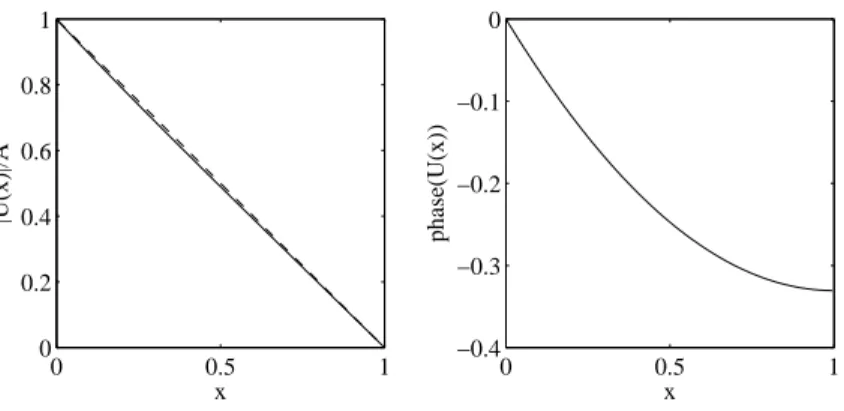
Figure 4: At left, the magnitude of U(x) (solid) and |U(x) (dash). At right, the | phase of U(x).
Substituting these into (65) gives
��ω � � �ω � (1 + � i) (1−x) � −exp � − � 2 U = A ω . (1 +i) (1 +i) exp −exp − 2 2 2
Therefore, the quasi-steady-state solution to the heat problem is
ω � � ω � exp (1 +i) (1−x) (1 +i) (1−x) � −exp � − � ω ω Ae iωt uSS (x, t) = Re . (1 +i) (1 +i) exp 2 −exp − 2
It is easy to check that uSS (x, t) satisfies the PDE and BCs in (55). Also, note that
the square of the magnitude of the denominator is
2
ω
(1 +i)
� 2
which is greater than zero since ω > 0 and hence cosh√2ω > 1 ≥cos√2ω. In Figure 4, the magnitude and phase of U (x) are plotted as solid lines. The straight dashed line is drawn with |U (x) for comparison, illustrating that | |U (x) is nearly linear in | x. The phase of U (x) is negative, indicating a delay between what happens at a point x on the rod and what happens at the end x = 0.
7.4.4 Solving for the transient
Step 2. Solve for the transient, defined as before,
v (x, t) = u(x, t)−uSS (x, t). (66)
ω �
cosh√2ω −cos√2ω
�exp −exp − (1 +i) = 2 > 0
� �� � �
� � � �
�
Substituting (66) into the heat problem (55), given that uSS (x, t) satisfies the PDE
and BCs in (55), gives the following problem for v (x, t), vt = vxx, 0 < x < 1
v (0, t) = 0, v (1, t) = 0, t > 0, (67) v (x,0) = f2 (x), 0 < x < 1,
where the initial condition f2 (x) is given by
f2 (x) = u(x,0)−uSS (x,0) ω � � ω � (1 +i) (1−x) −exp (1 +i) (1−x) 2 2 = f (x)−Re Aexp �� � � − � � . ω ω exp 2 (1 +i) −exp − 2 (1 +i)
The problem for v (x, t) is the familiar basic Heat Problem whose solution is given by (25), (24) with f (x) replaced by f2 (x), ∞ � � 1 v (x, t) = Bn sin (nπx)e −n 2 π2 t , B n = 2 f2 (x) sin (nπx)dx. n=1 0 7.4.5 Full solution
The full solution to the problem is exp � ω 2 (1 +i) (1−x) � � −exp � � − � ω 2 (1 +i) (1−x) � Aeiωt u(x, t) = Re ��ω ω � exp 2 (1 +i) −exp − 2 (1 +i) ∞ + Bn sin (nπx)e −n 2 π2 t . n=1
The first term is the quasi-steady state, whose amplitude at each x is constant, plus a transient part v (x, t) that decays exponentially as t → ∞. If the IC f (x) were given, then we could compute the Bn’s.
7.4.6 Similar problem: heating/cooling of earth’s surface
Consider a vertical column in the earth’s crust that is cooled in the winter and heated in the summer, at the surface. We take the x-coordinate to be pointing vertically downward with x = 0 corresponding to the earth’s surface. For simplicity, we model the column of earth by the semi-infinite line 0 ≤ x < ∞. We crudely model the heating and cooling at the surface as u(0, t) = Acosωt, where ω = 2π/τ and the (scaled) period τ corresponds to 1 year. Under our scaling, τ = κ×(1 year)/l2 . The
� � � �� �
� � �
� � � � �
� � � ��
� � �
bottom of the earth’s crust, still far away from the core, whose effects are neglected). What is the quasi-steady state?
The quasi-steady state satisfies the Heat Equation and the BCs,
(uSS)t = (uSS)xx , 0 < x < ∞ (68)
uSS (0, t) = T0 + T1 cosωt, uSS bounded as x → ∞, t > 0.
We use superposition: u(x, t) = u0 + u1, where
(u0)t = (u0)xx , (u1)t = (u1)xx , 0 < x < ∞, t > 0.
u0 (0, t) = T0, u1 (0, t) = T1 cosωt, u0, u1 bounded as x → ∞,
Obviously, u0 (x, t) = T0 works, and by uniqueness, we know this is the only solution
for u0 (x, t). To solve for u1, we proceed as before and let u1 (x, t) = Re{U (x)eiωt}
to obtain
′′
U (x)−iωU (x) = 0, 0 < x < ∞ (69) U (0) = T1, U bonded as x → ∞, t > 0.
The general solution to the ODE (69) is
ω ω
U = c1 exp −
2 (1 +i)x + c2 exp 2 (1 +i)x .
The boundedness criterion gives c2 = 0, since that term blows up as x → ∞. The
BC at the surface (x = 0) gives c1 = T1. Hence
ω U = T1 exp −
2 (1 +i)x . Putting things together, we have
ω uSS (x, t) = T0 + Re T1 exp − 2 (1 +i)x e iωt −√ωx ω 2 ω 2 = T0 + T1e Re exp −i 2 x + iωt −√ x ω = T0 + T1e − 2 x + ωt . (70) cos
uSS (x, t) is plotted at various dimensionless times ωt/π = 0,1/4,1/2,3/4,1 in Figure
−√ω 2x
5. Dashed lines give the amplitude T0 ±T1e of the quasi-steady-state uSS (x, t).
Physical questions: What is the ideal depth for a wine cellar? We want the wine to be relatively cool compared to the summer temperature and relatively warm to the
x 0 1 2 3 4 5 6 −5 0 5 10 15 20 25 0.75 1 1.25 1.5 0.5 1.75 0.25 0 u SS(x,t)
�
�
�
� �
winter temperature, and yet we want the cellar close to the surface (to avoid climbing too many stairs). Then we must find the smallest depth x such that the temperature uSS (x, t) will be opposite in phase to the surface temperature uSS (0, t). We take
κ = 2×10⁻³ cm2/s and l = 1 m. Recall that the period is 1 year, τ = (κ/l2) (1 year)
and 1 year is 3.15×10⁷ s. From the solution (70), the phase of u
SS (x, t) is reversed
when
ω x = π 2 Solving for x gives
x = π 2/ω Returning to dimensional coordinates, we have
2
′
x = lx = lπ τ = πκ(1 year) = π ×(2×10⁻³ cm2)×3.15×107 = 4.45 m.
2π
At this depth, the amplitude of temperature variation is
ω x −π T1e − √ 2 = T 1e ≈0.04T1
Thus, the temperature variations are only 4% of what they are at the surface. And
′
being out of phase with the surface temperature, the temperature at x = 4.45 m is cold in the summer and warm in the winter. This is the ideal depth of a wine cellar. Note: for a different solution to this problem using Laplace transforms (not covered in this course), see Myint-U & Debnath Example 11.10.5.
8
Linearity, Homogeneity, and Superposition
Ref: Myint-U & Debnath §1.1, 1.3, 1.4 [Sept 28, 2006]
Definition Linear space: A set V is a linear space if, for any two elements1 v 1,
v2 ∈ V and any scalar (i.e. number) k ∈R, the terms v1+v2 and kv1 are also elements
of V.
E.g. Let S denote the set of functions that are C2 (twice-continuously differen
tiable) in x and C1 (continuously differentiable) in t, for x ∈[0,1], t ≥0. We write S
as
S = {f (x, t)|fxx, ft continuous for x ∈[0,1] , t ≥0} (71)
If f1, f2 ∈ S, i.e. f1, f2 are functions that have continuous second derivatives in space
and continuous derivatives in time, and k ∈ R, then f1 + f2 and kf1 also have the
1
same, and hence are both elements of S. Thus, by definition, S forms a linear space over the real numbers R. For instance, f1 (x, t) = sin (πx)e−π
2
t and f
2 = x2 + t3 . Definition Linear operator: An operator L: V → W is linear if
L(v1 + v2) = L(v1) +L(v2), (72)
L(kv1) = kL(v1), (73)
for all v1, v2 ∈ V, k ∈R. The first property is the summation property; the second is
the scalar multiplication property.
The term “operator” is very general. It could be a linear transformation of vectors in a vector space, or the derivative operation ∂/∂x acting on functions. Differential operators are just operators that contain derivatives. So ∂/∂x and ∂/∂x+ ∂/∂y are differential operators. These operators are functions that act on other functions. For example, the x-derivative operation is linear on a space of functions, even though the functions the derivative acts on might not be linear in x:
∂ � 2� ∂ ∂ � 2� cosx + x = (cosx) + x .
∂x ∂x ∂x
E.g. the identity operator I, which maps each element to itself, i.e. for all elements v ∈ V we have I(v) = v. Check for yourself that I satisfies (72) and (73) for an arbitrary linear space V.
E.g. consider the partial derivative operator acting on S (defined in (71)), ∂u
= , D(u)
∂x u ∈ S. From the well-known properties of the derivative, namely
∂ ∂u ∂v (u + v) = + , u, v ∈ S, ∂x ∂x ∂x ∂ ∂u (ku) = k , u ∈ S, k ∈R ∂x ∂x
it follows that the operator D satisfies properties (72) and (73) and is therefore a linear operator.
E.g. Consider the operator that defines the Heat Equation ∂ ∂2
L =
∂t − ∂x2
and acts over the linear space S of functions C2 in x, C1 in t. The Heat Equation can
be written as
∂u ∂2u
L(u) =
� �
� � � �
For any two functions u, v ∈ S and a real k ∈R, ∂ ∂2 L(u + v) = ∂t − ∂x2 (u + v) ∂ ∂2 ∂u ∂2u ∂v ∂2v = ∂t (u + v)− ∂x2 (u + v) = ∂t − ∂x2 + ∂t −∂x2 = L(u) +L(v) ∂ ∂2 ∂ ∂2 ∂u ∂2u L(ku) =
∂t − ∂x2 (ku) = ∂t (ku)−∂x2 (ku) = k ∂t − ∂x2 = kL(u)
Thus, L satisfies properties (72) and (73) and is therefore a linear operator.
8.1
Linear and homogeneous PDE, BC, IC
Consider a differential operator L and operators B1, B2, I that define the following
problem:
PDE: L(u) = h(x, t), with
BC: B1 (u(0, t)) = g1 (t), B2 (u(1, t)) = g2 (t)
IC: I(u(x,0)) = f (x).
Definition The PDE is linear if the operator L is linear.
Definition The PDE is homogeneous if h(x, t) = 0.
Definition The BCs are linear if B1, B2 are linear. The BCs are homogeneous if
g1 (t) = g2 (t) = 0.
Definition The IC is linear if I is a linear. The IC is homogeneous if f (x) = 0.
8.2
The Principle of Superposition
The Principle of Superposition has three parts, all which follow from the definition of a linear operator:
(1) If L(u) = 0 is a linear, homogeneous PDE and u1, u2 are solutions, then
c1u1 + c2u2 is also a solution, for all c1, c2 ∈R.
(2) If u1 is a solution to L(u1) = f1, u2 is a solution to L(u2) = f2, and L is
linear, then c1u1 + c2u2 is a solution to
L(u) = c1f1 + c2f2,
for all c1, c2 ∈R.
(3) If a PDE, its BCs, and its IC are all linear, then solutions can be superposed in a manner similar to (1) and (2).
The proofs of (1)-(3) follow from the definitions above. For example, the proof of (1) is
L(c1u1 + c2u2) = L(c1u1) +L(c2u2)
= c1L(u1) +c2L(u2) = c1 ·0 +c2 · 0 = 0
The first step follows from the addition rule of linear operators; the second from the scalar multiplication rule, and the third from the fact that u1 and u2 are solutions of
L(u) = 0. The proofs of parts (2) and (3) are similar. E.g. Suppose u1 is a solution to
L(u) = ut −uxx = 0 B1 (u(0, t)) = u(0, t) = 0 B2 (u(1, t)) = u(1, t) = 0 I(u(x,0)) = u(x,0) = 100 and u2 is a solution to L(u) = ut −uxx = 0 B1 (u(0, t)) = u(0, t) = 100 B2 (u(1, t)) = u(1, t) = 0 I(u(x,0)) = u(x,0) = 0 Then 2u1 −u2 would solve
L(u) = ut −uxx = 0
B1 (u(0, t)) = u(0, t) = −100
B2 (u(1, t)) = u(1, t) = 0
I(u(x,0)) = u(x,0) = 200
To solve L(u) = g with inhomogeneous BCs using superposition, we can solve two simpler problems: L(u) = g with homogeneous BCs and L(u) = 0 with inhomo geneous BCs.
8.3
Application to the solution of the Heat Equation
Recall that we showed that un (x, t) satisfied the PDE and BCs. Since the PDE (8)
and BCs (10) are linear and homogeneous, then we apply the Principle of Superposi tion (1) repeatedly to find that the infinite sum u(x, t) given in (80) is also a solution, provided of course that it can be differentiated term-by-term.