International Journal of Advances in Management and Economics
Available online at:
www.managementjournal.info
RESEARCH ARTICLE
The
Contribution
of
Educational
Aspects
in
Entrepreneurship Development
Moses Isdory Mgunda
Faculty of Economics and Business, Diponegoro University.
Abstract: Education is contemplating as essential in the creation of entrepreneurs. Among many disciplines, entrepreneurship education is essential for development; this facilitates increasing entrepreneurial interest through inculcation of competencies, skills, and the provision of knowledge that enables individuals to become entrepreneurs. Despite the global interest in entrepreneurship education and training, many country's efforts have not been carefully evaluated, and the world's knowledge of these programs is not adequate. Educational institutions play a significant role in building entrepreneurial capacity by offering quality entrepreneurship education to individuals. This study discusses how educational aspects contribute to entrepreneurship development. Empirical literature reviews reveal that the educational aspect is critical in entrepreneurship development and is vital in contributing to economic development through innovation, prosperity, and employment.
Keywords: Development, Education Institutions, Entrepreneurship, Entrepreneurship education, Entrepreneurs.
Article Received: 01 Nov. 2019 Revised: 14 Nov. 2019 Accepted: 18 Dec. 2019
Introduction
Nowadays, people interpret and view that entrepreneurship is identical to what is possessed and done by entrepreneurs. These concepts are not accurate, because the entrepreneurial state and attitude are not only owned by entrepreneurs but also by each one who thinks creatively and acts innovatively, which includes all works, both private and government. Entrepreneurship is the mental attitude, soul, and ability to form something new that is significant valuable and beneficial for entrepreneurs and the community.
In development, the inculcation of entrepreneurial values is not only entrepreneurs but has developed into the world of education, wherein activities also an entrepreneurial state is needed. Entrepreneurship in the field of education aims to create a personalized holistically, as a person who has the character, understanding knowledge, and skills as an entrepreneur [1, 2].
According to [3], education is a critical issue for entrepreneur success. Indeed, it was the first failure of an entrepreneur because of using more experience than education. However, it did not ignore the importance of
experience for an entrepreneur; the second source of failure is if an entrepreneur applies only education without experience. Therefore education and experience are the major factors that determine entrepreneurial success. Entrepreneurship education can be implemented in an integrated manner with educational and school activities. The implementation of entrepreneurship education is done by principals, teachers, lecturers, education staff (counselors), and students together as a scholarly society.
The concept of entrepreneurship includes carefully reading, identification of opportunities, seeing each compound of school, institution become new or innovative, find out resources in a realistic and exploit it in a suitable way, risk management, identifying prosperity, benefits, and generating financial benefits (profits).
that occur to them and the community. However, this is not only cognitive knowledge but also the affective domain. The entrepreneurial feelings are part of the affective domain required to be entered into the student’s mind. Therefore, entrepreneurship in education is an individual who dares to improve, develop businesses, and new ideas to ameliorate the standard of living incorporated in school’s education through various activities like extra-curricular, learning a subject that is integrated with entrepreneurship.
Teachers and principals are supposed to be able to incorporate active learning entrepreneurship education in cognitive learning in different ways, approaches, and teaching methods. According to, compared to other staff, educated workers have more significant potential to become entrepreneurs because they have developed reasoning capabilities and broader thinking perspectives. A scholar also has two leading roles, first as a manager, and second as the originator of leadership.
The first role consists of finding the solutions to the problems, requiring enough management and practical application of knowledge. The other role is the need for the ability to formulate various alternatives solutions. In this case, complete scientific knowledge is critical. Therefore this paper discusses the notion of entrepreneurship and education, the role of education in entrepreneurship development, creation of Entrepreneurs, The Role of Entrepreneurship Education in motivating Entrepreneurs, the Implementation of Entrepreneurship Learning from Theory to Practice, and The Global State of entrepreneurship.
The following section of this paper is a literature review concern entrepreneurship; the second section is the methodology used by the researcher in examining the topic, the third party is results, and in-depth discussion concern the topic, and the last section is including conclusion and recommendation from the researcher.
Literature Review
Understanding Entrepreneurship
Until now, the concept of entrepreneurship is still developing. Entrepreneurship is an attitude, soul, and ability to create something new that is very valuable and useful for the
entrepreneur and other people. Entrepreneurship is a mental attitude, spirit, and state that normally active, creative, innovative, unpretentious, and struggles to increase income in business activities. Someone who has character is always dissatisfied with what has achieved. An entrepreneur is an individual who dares to take risks to open a business in various opportunities. Being courage to take risks means to be mentally independent and dare to start a business, without being overwhelmed by fear or anxiety even in uncertain conditions[4].
An entrepreneur can easily exploit opportunities to create a new business with enormous potential profit-not only opportunities in positive or good condition, but also bad conditions. An entrepreneur is a person who is knowledgeable and skilled in taking advantage of opportunities in developing the business to ameliorate the standard of living. An entrepreneur is one who creates a new business in the face of risk and uncertainty to gain profit and growth by identifying opportunities and assembling the necessary resources to capitalize on those opportunities."
Entrepreneurs are those people who can see and assess business opportunities, collect resources needed to take proper actions, take advantage and have nature, character, and willingness to identify innovative ideas into the real global world creatively in order to gain profit and success". In essence, an entrepreneur is a person who has an entrepreneurial character and applies the nature of entrepreneurship in life.
Some of the concepts show as if entrepreneurship is identical to the ability of entrepreneurs in the business world, whereas, in reality, entrepreneurship is not always synonymous with an entrepreneurial character alone because the character of entrepreneurship may also be owned by someone who is not an entrepreneur. Entrepreneurship covers all aspects of work, both private and government employees.
The entrepreneurial process includes all functions, activities, and actions related to the acquisition of opportunities and the formation of business organizations [5]. The essence of entrepreneurship is creating added value in the market through the process of combining resources in new and various ways in order to compete. According to, the added value can be created through the following methods:
Development of new technology Discovering new knowledge and skills Repairing and improving existing products
(goods and services)
Efficiency utilization of resources in production activities (discovering various ways of producing more goods and services with fewer resources).
Entrepreneurs can quickly analyze the demand for goods or services needed by the community, even in adverse conditions such as disasters and scarcity. The type of business that an entrepreneur engages in can create a new business or buying a business that has long been established. Global Entrepreneurship Monitor (GEM) is a research initiated by a partnership between London Business School and Babson College, tasked with researching entrepreneurship activities in various countries since 1999.
Initially, there were only ten countries studied, and then in 2011, it had grown to 54 countries. The GIM research program has three main objectives, such as (1) Measuring differences in the level of entrepreneurship activity among sample countries, (2) Revealing precisely the factors that cause different levels of entrepreneurship, (3) Providing policy advice that can increase the level of entrepreneurship activity in national. Many things can motivate entrepreneurs in starting a new business.
Global Entrepreneurship Monitor explains that there are two motivations for a person to become an entrepreneur; these are the basis of opportunity and necessity. A person's motivation to start a business by utilizing opportunities to generate income and profits in the future is called opportunity entrepreneurship, while the necessity of entrepreneurship is the encouragement and motivation to start a because of compulsion
factor and no other choice but to end up an effort to make ends meet.
The Nature of Education
Education is a transfer of skills, knowledge, and culture that can be directed at efforts to humanize humans. The nature of this educational process is an attempt to change the behavior of individuals or groups so that they have agreed on values based on religion, philosophy, ideological ideas, politics, economics, social, culture, and security and defense. According to Paula Freire's view, education is a process of cadre with the nature of the goal is liberation. The essence of education is the ability to educate oneself.
While education in the broad macro sense is the process of interaction between humans as individuals and the environment of the universe, social environment, society, socio-economic, socio-political, and socio-cultural. Education can also be interpreted as a. A process of growth that adapts to the environment b. A direction and guidance are given to children in their growth. c. A conscious effort to create a particular state or situation desired by the community. d. A formation of personality and ability of children to mature.
The Objectives of education are a set of targets where individuals targets to achieve through education. The form of educational goals can be in the form of knowledge, skills, values, and attitudes. So that the purpose of education can be interpreted as a system of values agreed upon in terms of truth and importance achieved through various activities, both in the field of school education and outside school.
Research Method
This paper used secondary data from the Global Entrepreneurship Index, and World Bank, The method used in this study is the literature through books and related scientific journals. To find out the contribution of education in the development of entrepreneurship.
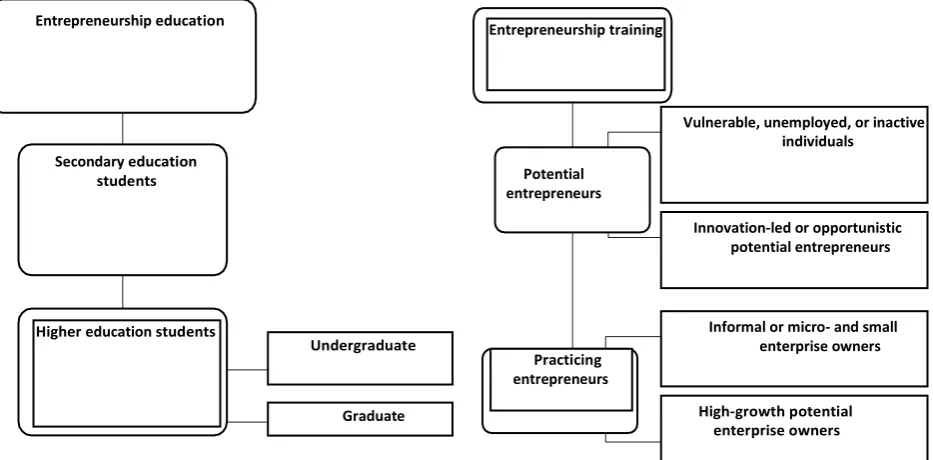
Entrepreneurship education
Secondary education students
Higher education students
Graduate Undergraduate
Entrepreneurship training
Potential entrepreneurs
Practicing entrepreneurs
High-growth potential enterprise owners Informal or micro- and small
enterprise owners Innovation-led or opportunistic
potential entrepreneurs Vulnerable, unemployed, or inactive
individuals applied in the creation of entrepreneurs in
developing countries.
Results and Discussion
Entrepreneurship Education and
Training (EET)
Entrepreneurship education is implemented in the curriculum by identifying the kinds of activities in schools, a university that can identify, entrepreneurship education can be identified by students in their daily lives and environment. In this case, entrepreneurship education programs in schools can be internalized through various aspects. Entrepreneurship in education is continuous hard work conducted by schools, institutions, especially principals in making schools more quality.Entrepreneurship education needs to be done through the provision of material and training.
Entrepreneurship material has been widely given, especially to students in tertiary institutions. In line with the explanation. There are four objectives in entrepreneurship education, such as motivational education,
knowledge education, expertise education, and capacity development. These objectives can be included in the learning curriculum. Entrepreneurs are groups who are good at taking advantage of opportunities and dare to take risks. So this goes back to the entrepreneur's "self-performance," that strong motivation, courage, and strong, soft skills will encourage entrepreneurs to dare to go to this stage. Lots of rigidity in shaping the character of students, especially in formal schools (Worl Bank study; Valerio, Parton and Robb, no date).
The development of soft student skills becomes less maximal even though the school has provided various specialization activities according to their talents. Soft skill development is not only influenced by character-building education but also the influence of the external environment. The concept of completing education than working well established has been embedded in students' perceptions so that many of the academic graduates are not interested in becoming entrepreneurs.
Figure 1. Grouping entrepreneurship education and training programs
Source: EET Programs around the World
The concept of completing studies then working well established has been embedded in students' attitudes so that many of the academic graduates are not interested in becoming entrepreneurs [6].
Comparative study about the impact of education and entrepreneurship training on Korean and United States students.
This significant progress is because of the orientation of the culture of entrepreneurship in Korea, which is still low and at the primary stage of development. While the United States already has a cultural orientation about entrepreneurship, so the impact of entrepreneurship education is relatively small.
The Global State of Entrepreneurship The Global Entrepreneurship Index (GEI) measuring the quality of entrepreneurship and the extent deep of the supporting health of the entrepreneurial ecosystem in the countries globally and then ranks the scores of each country [7]. Global Entrepreneurship Monitor also evaluates the pillars of the entrepreneurial ecosystem, which are
considered capable of creating an entrepreneurial climate[8]. The results of the 2017 survey show encouraging improvements in five pillars, such as access to finance, government policies, transfer of research and technology results, internal market dynamics, and entrepreneurship education for elementary and middle school age. Overall, North America has the most conducive entrepreneurial framework conditions, and Africa has underperformance in the 14 pillars of entrepreneurship[8]. Global Entrepreneurship Index focuses on three sub-indexes and 14 pillars viz Attitude sub-index, Capabilities sub-index, and Aspiration sub-index. In 2017, and 2018 still United States Of America (USA) is leading in GEI.
Table 1: Top Ten Countries in Global Entrepreneurship Index from the Year 2017-2018
GEI 2018 GEI 2017
Country Lower limit Upper limit GEI 2018 Rank 2018 Rank 2017 Country
United States 77.5 89.7 83.6 1 1 United States
Switzerland 72.5 88.4 80.4 2 2 Switzerland
Canada 73.9 84.6 79.2 3 3 Canada
United Kingdom 73.6 81.9 77.8 4 8 Sweden
Australia 69 82 75.5 5 7 Denmark
Denmark 64.8 83.8 74.3 6 5 Iceland
Iceland 63.6 84.7 74.2 7 6 Australia
Ireland 66.8 80.6 73.7 8 9 United Kingdom
Sweden 67.1 79.1 73.1 9 4 Ireland
France 59.9 77.1 68.5 10 13 Netherlands
Source: Global Entrepreneurship Index 2018
According to GEI measurements the quality of entrepreneurship and the health of the entrepreneurial ecosystem in the world, the outcomes indicate that those countries which have a high GEI limit also providing good entrepreneurship education and training to
their individuals within a particular country. The high performance of GEI in a particular country implies the outstanding implementation of educational aspects related to entrepreneurship, including both formal and non-formal education.
Table 2: Global Entrepreneurship Index Region Performance
World
rank Country Region capita PPP GDP per Individual variables Institutional variables GEI
1 United States North America $52.68 93 78.5 83.6
2 Switzerland Europe $54.93 93.8 71.5 80.4
5 Australia Asia-Pacific $42.15 82.2 74.3 75.5
16 Israel Middle East /
North Africa
$31.09 80.9 72.7 65.4
19 Chile South and
Central America / Caribbean
$21.30 68.9 75.9 58.5
52 Botswana Sub-Saharan
Africa $15.29 47.7 66 34.9
Source: Global Entrepreneurship Index 2018
The pillar of the entrepreneurial ecosystem is often the government's watch for policy evaluation. GEM data that has been collected for 19 years, many findings show that the conditions of policies and other entrepreneurial pillars need to develop entrepreneurship and innovation. Therefore, entrepreneurship is not only an
In its report for 2017/2018, countries with a higher level of economic development (based on the Global Competitiveness Index) tend to have a higher opportunity-based level of entrepreneurship and a higher level of innovation (entrepreneurship education). In Regions, North America (the United States and Canada) has the highest ratio for comparison between entrepreneurs who are based on the search for better opportunities (opportunity-driven) with entrepreneurs based on meeting economic needs (necessity-driven) North American ratio is 5, 2 (comparison of opportunity-driven and necessity driven) while the lowest ratio is for the Africa region, with a value of 1.5. Entrepreneurs based on opportunity tend to have a higher impact and tend to have prospects for job creation.
Overall, based on the 2017/2018 GEM report, there would be a decline in entrepreneurial expectations to create jobs, especially in countries with the lowest levels of economic development, or factor-driven economies. Compared to 2016, globally, 43% did not plan to increase the number of workers significantly within five years. In 2017, entrepreneurs who did not plan to increase the number of workers increased to 64%. This change indicates the tendency of entrepreneurs to operate their businesses or choose small businesses by relying on networks, partners and other factors such as the use of technology.
The Changes in the Implementation of
Entrepreneurship Learning from
Theory to Practice
Entrepreneurial learning is directed at gaining three competencies, which include the inculcation of entrepreneurial character, understanding concepts, and skills, with high weight on attaining knowledge, mental and skill competencies compared to understanding concepts. Many countries in the world, in the economics subjects, curriculum structure, teach several necessary Competencies that are related to the embryonic of education about entrepreneurship.
These subjects are courses and subjects that are directly introduce significant entrepreneurial, and to some extent, enables students to care and internalize these values. For instance, an entrepreneurial learning model that can foster entrepreneurial character and behavior can be done by
establishing an honesty canteen. Integration of Entrepreneurship Education into Materials like Textbooks Materials are the most influential learning component of what occurs in the learning process. Many teachers teach by merely following the order of presentation and activity of learning activities that have been designed by textbook authors, without making any significant adaptations. Internalization of entrepreneurial values can be done in teaching materials both in the presentation of material, assignments, and evaluations.
Integration of Entrepreneurship Education through School Culture/school culture is the atmosphere of school life where students interact with each other, teachers, counselors with each other, administrative staff with others, and among members of school community groups. The development of values in entrepreneurship education in school culture includes activities carried out by school principals, teachers, counselors, administrative staff when communicating with students and using school facilities; all school residents carry out entrepreneurial activities in the school environment such as honesty, responsibility, discipline, commitment and an entrepreneurial culture in the school environment [9].
The Role of Education in Forming Entrepreneurs
In creating entrepreneurs, the government can combine education and entrepreneurship training. Education serves to provide material for entrepreneurship while training intends to: hone the soft skills of prospective entrepreneurs. Through these two things, it is expected that aspiring entrepreneurs are motivated to open new businesses, dare to take risks, and not afraid to fail. The government plays a role as a mediation of capital problems. Government activities focused on increasing the number of entrepreneurs through capital loans are generally called business incubators. These funds are used as initial capital to set up a business.
Most of the entrepreneurs have a street-smart habit rather than a bookmark; this indicates that an entrepreneur likes to learn from experience rather than to learn from library books, schools, colleges, and formal education. Nevertheless, does this indicate that a person with a tertiary education cannot become a successful entrepreneur? Because in reality, it is inversely proportional. Researchers concluded that entrepreneurs who have the potential for success are those who understand the application of education to assist business activities and want to learn more in order to increase knowledge and skills.
The environmental educational is applicable by entrepreneurs as a means to an end; this means understanding issues that are seen from the standpoint of science or theory as a foundation for thinking. Therefore the role of education in the formation of entrepreneurs, especially young entrepreneurs, is critical; the schools, colleges, institutions, and Universities are the warehouse for young people who are skilled, knowledgeable, and ready to produce reliable entrepreneurs? Or institutions still adheres to the old system of only preparing graduates who are only ready to be job seekers whose roles have now begun to be taken by vocational high schools. The massive revolution needs to be done going forward in the globally competitive world.
The Role of Entrepreneurship
Education in Entrepreneur Motivation Entrepreneurship education and entrepreneurship motivation both are interrelated aspects. Issues concern the role of entrepreneurship education on entrepreneurship motivation; it is from factors influencing entrepreneurship motivation. The factors influencing entrepreneurship motivation are as follows:
Self-confidence, to have a strong belief in the strength that exists in itself.
Innovation, the creativity that applied, implemented, and gives added value to the inputs and creating new things that are not thought of by other individuals.
Leadership spirit, this is a crucial factor in facilitating the performance.
Effective and efficient, effective is a task that can be completed on time due to the pre-determined plan. On the other side, effective is to what extent the objectives
have been reached based on quality and quantity. Efficient is the best comparison between resources and output, between business power and outcomes of operations, or between consumption and income, efficiency is everything that can be conducted or solved appropriately, quickly, economically, and safely.
Future-oriented, this means the ability to see opportunities, a person who always look forward and not question what previous was done, but instead question what next can be done [1, 10].
The creation of entrepreneurial spirit is starting and caused by internal, external, and contextual factors. Internal factors beginning from within can be in the form of personal character, attitudes, perception, wills, and capability of the individual. While external factors come from outside the self-entrepreneurs, it can be from the family, community, business environment, and other socio-economic environments.
These factors play a role in fostering entrepreneurial motivation. Entrepreneurship education can promote the growth of entrepreneurial motivation for students. Entrepreneurial knowledge has positively significantly influencing entrepreneurial interest. It occurs that entrepreneurial motivation can be improved by entrepreneurship education carried out informal education, both schools, and colleges. Entrepreneurship education is among of the contextual factors that becomes a significant part. Academic support and social support have proven to have significant positive impacts on student entrepreneurial intentions [11].
"The contextual factors according to researchers, are education concern entrepreneurship, academic support, social support, and business environment conditions. Research conducted by of 640 students in Portugal found that entrepreneurship training had a positive significant impact on students' intention to commence business after the graduating from college. As the national entrepreneurship program develops, many parties organize seminars, workshops, and training and improve entrepreneurial encouragement and motivation among students.
To grow entrepreneurial motivation needed information about the benefits of entrepreneurship, so job finders change their mindset to open employment. benefits that motivate people to start a business are
Having the freedom to achieve goals. Freedom to reach the goals and dreams planned to be achieved can be attained when a person decides to become entrepreneurs. The freedom to plan and set business goals, the freedom to set a business plan, the freedom to set the operational schedule for business, also the freedom to determine the amount of profit to earn. A person who selects to be an entrepreneur can become the boss of his/her business.
It is gaining Profits that can exceed salaries as employees. If employees demo to raise salaries, employers can determine profits to be achieved. In entrepreneurship, not only material profits are obtained, but also gaining recognition for the success of the businesses they run.
Satisfaction with his potential, most employees feel bored with the same job every day. However, for entrepreneurs, encountered boredom is rarely. Due to fact, that is running a business which usually facing challenges that can cause to improve one's potential. Creativity, enthusiasm for work, and dreams to be addressed always offer a pleasant sensation in running a business.
Open new opportunities by opening a business-many new opportunities for entrepreneurs.
Creating employment, the merits of entrepreneurship is also beneficial for the community because it helps job seekers to get work. It also provides social benefits to entrepreneurs, because of assisting the people in the community getting a job, the community and government appreciate the presence of the role of an entrepreneur [12]. According to Sharma [12], "there are magnitudes of entrepreneurial contributions to national development, such as an entrepreneur: contributing to smooth production, distribution, and consumption processes. Assisting in solving the unemployment problem, increase community income, as a national warrior in the economic field, increasing national resilience, reducing dependence on foreign nations. ”It appears that the role of an entrepreneur is significant
for national development -the more entrepreneurs in a country, the more developed and prosperous in the country. The Influence of Entrepreneurs in the Development
The more entrepreneurs in a country, the higher the country's economic growth (GDP). There are several new combinations created by entrepreneurs, including (1) Introducing new products or service with new quality, (2) Introducing new production ways, methods (3) Opening new markets, (4) Gaining new sources of supply from materials or new components, (5) Running new organizations in the industry It also explained the correlation between entrepreneurial innovation and the combination of resources.
The development of information technology brings a significant impact on different aspects of life, specifically in the business sectors industry, These productive activities push development output, countries through schools, institutions, and universities compete to create new entrepreneurs by providing entrepreneurship education to students so that to enable them to become very creative and innovative in business, through this facilitates the increase of production activities that influence the economic growth and development
Conclusion
Education here means understanding the problems that are seen from the standpoint of science or theory as a basis. Entrepreneurship education is a process or activity carried out in the context of internalizing entrepreneurial mentality, transmitting entrepreneurial knowledge and skills to students through formal educational institutions, as well as non-formal institutions (training institutions) to take advantage of business opportunities. An entrepreneur who has the potential for success are those who understand the importance of education to support activities and are willing to learn in order to increase knowledge.
Therefore the researcher recommends to the people who want to start entrepreneurship should first find any school, college which provides entrepreneurship education, and learn about it in order to gain skills and knowledge about being an entrepreneur. For educational institutions, efforts should be made to further enhance the program of
activities and materials for entrepreneurship education in order to be able to increase entrepreneurial motivation. Especially in formal educational institutions such as tertiary institutions, entrepreneurship education is not only given entrepreneurship theory but also given through the practice of entrepreneurship [13,19].
References
1. E Providers (2018) “Enterprise and Entrepreneurship Education.
2. T Chimucheka (2015) “The Contribution of Entrepreneurship Education in Improving Entrepreneurial Skills and Knowledge of SMME Owners and Managers The Contribution of Entrepreneurship Education in Improving Entrepreneurial Skills and Knowledge of SMME Owners and Managers.
3. S. Churchill, “No Title.”
4. C Marques, CSE Marques, JJM Ferreira, FS Lages (2013) “Entrepreneurial orientation and motivation to start up a business: Evidence from the health service industry.
5. UP Indonesia et al (2019) “Entrepreneurial Skills at Retirement Age : Analysis of the Importance of Training for, 23(2):1-6.
6. C Mcloughlin, MJW Lee (2008) “The Three P’s of Pedagogy for the Networked Society : Personalization, Participation, and Productivity, 20(1):10-27.
7. T Sorin-george, R Papuc (2017) “Entrepreneurship in the World : The Analysis of the Global Entrepreneurship Index in the Period 2015-2017 Grădinaru Cătălin,” XVII (2):14-18.
8. Z J Acs, E Lafuente, A Lloyd (2018) The Global Entrepreneurship Index.
9. M Raposo (2011) “Entrepreneurship Education : Relationship Between Education and Entrepreneurial Activity Entrepreneurship Education : Relationship Between Education.
10.M Bernaert, G Poels (2013) Enterprise Architecture for Small and Medium-Sized Enterprises : A Starting Point for Bringing EA to SMEs , Based on Adoption Models Enterprise Architecture for Small and Medium- Sized Enterprises : A Starting Point for Bringing EA to SMEs , Based on Adop.
11.M Personal, R(2017) Archive, “Munich Personal RePEc Archive The Analysis of Attitude Factors on Students to Become Entrepreneur, 7076,
12.S Sharma, AK Mahajan (2018) “A comparative assessment of information value , frequency ratio and analytical hierarchy process models for landslide susceptibility mapping of a Himalayan watershed , India.
13.A Eversole (2017) “Age, Growth, and Sex Ratio of American Eels in Brackish-Water Portions of a South Carolina River, 8659. 14.WB Study, a Valerio, B Parton
Entrepreneurship Education and Training. 15.A Valerio, B Parton, a Robb,
Entrepreneurship Education and Training Programs around the World.
16.A Lloyd, “Zoltán J. Ács László Szerb Ainsley Lloyd.”
17.R Ningsih (2017) “Peranan Pendidikan Kewirausahaan Dalam Mahasiswa, 60-69. 18.SE Journal (2013, 2015) “Schumpeter’ S
View on Innovation and,” no. April.