International Journal of Advances in Management and Economics Available online at: www.managementjournal.info
RESEARCH ARTICLE
Effect of Compensation, Competencies and Organizational Culture
on Organizational Commitment its Implicationson Experts
Performance of Construction Services Company in Jambi
Province
Fakhrul Rozi Yamali
1Faculty of Economics, Master of Management,University Batanghari.
Abstract
The purpose of this research was to determine and analyze the effect of compensation, competencies and organizational culture partially and jointly, on organizational commitment. Then the effect of compensation, competencies, organizational culture and organizational commitment partially and jointly on the performance of experts. The population in this study amounted to 882 experts of construction services companies in Jambi Province. The method used in this research was descriptive survey method and explanatory survey with a sample of 350 respondents deployment after samples collected only 339 valid respondents, and the data analysis method used are SEM (Structural Equation Modeling). Based on the research resulth, the findings obtained compensation, organizational culture is partially positive and significant effect on organizational commitment, only competence and not significant positive effect on organizational commitment. But simultaneously positive and significant effect on organizational commitment. Contributions influences together (R2) by 67% while the balance of 33% is influenced by other variables, and organizational culture partially dominant influence on organizational commitment. Compensation, competencies, organizational culture and organizational commitment partially or jointly positive and significant effect on the performance of experts. Contributions influences together (R2) by 85% while the remaining 15% is influenced by other variables, but organizational commitment partially most dominant influence on the performance of experts.
Keywords: Compensation, Competencies, Organizational Culture, Organizational Commitment, Expert Performance.
Introduction
Infrastructure development is believed to have a significant multiplier effect for the
local economy. Currently, incoming
infrastructure development as one of the priority programs of development to enhance the competitiveness of the economy. One that has an important role in infrastructure development is construction services.
Referring to Law No. 18 of 1999 on construction services is a construction services is a consultancy service in construction work planning, construction work implementation services, consultancy service and supervision of construction work. Meanwhile the construction work itself is defined as the whole or part of a series of planning and / or implementation as well as monitoring including architectural, civil, mechanical, electrical, and environmental
governance respectively along with the accessories, for the realization of a building or other physical forms.
figure with the major growth rate was bolstered by high growth in the agricultural sector as well as trade, hotels and
restaurants as well as development
acceleration of the construction sector. The agricultural sector which is the main sector in Jambi contributed economic growth reached 2.57%, followed by trade, hotels and restaurants 1.76% and 1.35% of the construction sector. While total capital expenditure[1] 83.18% are construction spending and the building of the Jambi province expenditures reached USD 2559.27 billion or 92.51% of APBD-P from Rp 2766.57 billion.
The high economic growth and business entities of construction services in the province of Jambi supposedly offset by the higher performance of construction services, in fact the performance of the construction company in Jambi province up to 2012 has decreased, it is based on data from the Department of Public on the evaluation results of employment, housing, non-residential and civil works. In the year 2012 for the quality of work and timeliness of completion of the work, especially the work of housing and civil works decreased, except in the work of non housing increased quality reached 95.00% from the previous year which only reached 92.50%, but the time delay on average increased the reached 80.00% from the previous year 85.00%. [1]
According to Awadh and Saad [2] in their research that "The employee performance would be considered as the backbone organization as it leads to its development effectively". Then the low performance of construction services companies in Jambi Province caused by the relatively low performance of experts. The low performance of expert construction company in Jambi look of the effectiveness of the experts still not as expected or still under the effective category.
Expert input provide the highest contribution to the effectiveness in general, the input of 0.75 was declared effective because the value is in the range (0.685 to 0.834). While the contribution of the process of 0,58, 0,68 and outcome output of 0.65, the third is in the category fairly effective range (0.525 to 0.684). Lowest contribution was obtained from process experts to value the effectiveness of 0.58. Process experts in
construction services are still considered of 0.58 indicates that the performance of experts is still less than expected because it is close to the value is not effective, so the impact is reflected in the output and outcomes are still under the category of effective especially very effective [1].
Many factors lead to low employee performance, according to research results of Jamil and Sarfaraz [3] states that "The compensation practices are positively and significantly associated with the performance of public sector employee Organizations". In his research and Sarfaraz Jamil also stated that the basic purpose of any public organization is to compensate employees in every possible way.
Meanwhile Tahir Masood conducted an empirical study on the impact of HRM practices on employee performance bank in Pakistan based system recruitment, training,
performance appraisal, compensation
systems, career planning systems and employee participation. All practices are positively related to employee performance. But the systems of selection, training, compensation and employee participation have a strong influence on the performance of employees of banks.
Based on the above results, the low performance of expert construction company in Jambi province are likely due to the relatively low compensation experts in the construction services company. Low levels of compensation expert construction company in Jambi province is indicated based on the results of direct observation of researchers on the experts from some of the construction company, the average expert in each expert group and groups and levels of education (S1, S2 and S3), which consists of young experts, expert associate, and the main expert who only received a fee of 30% of basic salary after multiplied by 0.907 (index province) of the provisions of the Circular Letter of the Minister of Public Works No. 22, 2007.
18.60 million per month for the educated S / S3. Top Experts with experience of 9-12 years received from 14.60 to 17.35 million per month for the educated S1, and 19.65 to 22.70 million per month for the educated S2 / S3.
Likewise, other forms of financial
compensation as incentives and an average annual bonus are not in accordance with the expectations of employees and even some companies, employees are not getting incentives and annual bonuses. Based on the results of direct observation of researchers of 50 experts in the observation of 25 construction companies benefit fulfilled 100% is only the allowance of worker, while annual leave only 12% or only 6 companies, retirement benefits 4% (2 companies), allowance of 10% (5 companies) and training allowances 28% (14 companies).
Then, based on the results of research conducted by Ismail and Zainal [4] on a service company to go public in Malaysia, stating that the competence of the workers has a significant effect on the performance of the worker, in addition to the human resources and worker characteristics also determine the performance of workers in the service sector Malaysia private. So other factors that cause poor performance of construction experts in Jambi Province, referring to the results of the research results, are likely due to the relatively low competence of experts.
This is indicated by the Human Resources (HR) construction services are still facing problems in the certification process that is still less objective, thus directly or indirectly
cause experts and skilled workers
construction field is still far from enough that these are due to the implementation of assessment of certification is not appropriate the provisions of the National Competence Indonesia (SKKNI) [1].
Another indication then amplified by the Central Bureau of Statistics (BPS), which was published in the Bulletin of Construction Development Board nationally noted that until early 2013 recorded 6.9 million construction workers, where in 2006 only 4.7 million. But on the other hand, construction is still facing obstacles HR weak coaching competencies that lead to quality and
quantity of construction workers working in Indonesia is still far from the expected. While increasing the investment value of the construction sector from year to year, hence the need for the construction of a competent workforce and competitiveness will also be greater. So low competence of experts of construction services in the province of Jambi evident from the number of experts who are much smaller than the number of business entities of construction services, which only reached 39.1% of total enterprises.
Awadh and Saad [2]based on the results of their research stated that the organization's culture helps in internalization relationship together leading organizations to manage the
process effectively. Productivity and
organizational culture helps in improving performance. While Monetje and Martin [5] propose a finding from his research that a good organizational culture can boost a strong organizational commitment so as to improve organizational performance.
So based on the statement above, the poor
performance of construction services
company experts in Jambi province tend to be caused also by the relatively less favorable organizational culture that supports the construction company. It is indicated in some ways based on the data findings
Business Competition Supervisory
Commission (KPPU) of the Republic of Indonesia a lot of the discovery of the problem regarding the irregularities in the tender process or auction, which ultimately lead to failure of the building and construction quality that do not fit technical standards and even as a result of irregularities in the tendering process quite a lot of work that can not be resolved, some of which are caused by the lack of oversight and not inconsistent application of the Safety Management System and Occupational Health Construction (SMK3 Construction)
and Quality Management System
Construction (SMM Construction) which did not run consistent. In fact, until 2012, 70% of all cases in the Commission constitute bid rigging cases in which some of them related to the construction industry .
organization; the performance of employees is increasing. Then the results Memari, Mahdieh and Barati [7] research states that "the results revealed a positive relationship between organizational commitment and employees' job performance". Based on the statement of the results, the low performance of experts in construction services company in Jambi province tend to be caused by low organizational commitment. It is indicated based on the observation of the researcher on some construction services company registered in Jambi Province LPJK obtained that the high average rate of turnover of experts (engineer) per annum on construction services company.
Turn Over Average Experts Construction Services Jambi Province, in the year 2008 showed the 5.5% and 4.5% in 2009, 2.5% in 2010, 4% in 2011 and 4.75% in 2012. The above description clearly describes the current conditions and when on leave continues, then worry about the performance of expert construction company will continue to decline drastically that ultimately will
affect the implementation of the
infrastructure summit which had been proclaimed.
Problem Formulation
Based on the Identification of the above Problems, the Formulation of the Problem is as Follows
Is there a experts compensation influence on organizational commitment of the construction service company?
Is there any influence of experts
competence on organizational commitment of the construction service company?
Is there any influence of organizational
culture on organizational commitment of the construction service company?
Is there any influenze of experts
compensation, experts competencies and
organizational culture together on
organizational commitment of the
construction service company?
Is there any influence of experts
compensation on experts performance of the construction service company?
Is there any influence of expert competence
on experts performance of the construction service company?
Is there any influence of organizational
culture on experts performance of the construction service company?
Is there any influence organizational
commitment on experts performance of the construction service company?
Is there any influence of experts
compensation, experts competence,
organizational culture and organizational
commitment together on experts
performance of the construction service company?
Objective
Based on the Identification and Formulation of the Problem Above, the Purpose of this Dissertation Study was Conducted to Determine and Analyze
Influence of experts compensation on
organizational commitment of the
construction service company.
Influence of experts competence on
organizational commitment of the
construction service company.
Influence of organizational culture on
organizational commitment of the
construction service company.
Influence of experts compensation, experts
competencies and organizational culture together on organizational commitment of the construction service company.
Influence of experts compensation on
experts performance of the construction service company.
Influence of expert competence on experts
performance of the construction service company.
The influence of organizational culture on
experts performance of the construction service company.
The influence of organizational
commitment on experts performance of the construction service company.
The influence of experts compensation,
experts competence, organizational culture and organizational commitment together on experts performance of the construction service company.
Usability of Research
Theoretical aspects (scientific) provide an explanation of the effect of compensation, competencies, organizational culture and organizational commitment and Experts Performance in the construction services company. Can also be made in reference for further research.
Practical aspects (to like) is to contribute
ideas for companies engaged in
construction services in the province of Jambi in improving the performance of
experts in order to achieve the
implementation of the results of quality performance. As a reference which is the result of findings that can be used by the technical institutions related to the construction company or other organization that has been linked to the performance of experts.
Literature Compensation
Dessler [8] defines the compensation as all forms of payments or rewards given to
employees which arise from their
employment. So that compensation is one of the basic reasons for employees to seek employment. While Mathis and Jackson [9] argues, that basically compensation can be grouped into two groups, namely the
compensation of direct and indirect
compensation. Furthermore, direct
compensation consists of a basic salary and variable. Whereas indirect compensation in the form of allowances.
Competency
Ariffin, Kamalul and Zailani [10] states that competency is defined as a characteristic of an employee that contributes to successful job performance and the achievement of organizational results. Ariffin, Kamalul and Zailani also confirmed that the competence including knowledge, skills and abilities coupled with other characteristics, such as the values espoused in the work, motivation, and initiative, as well as self-control.
Francoise and Winterton [11] explain that ability is competence that is an unclear concept that touches on knowledge and skills and various elements that are important. So that Francoise and Winterton see that the competence is based on one-dimensional framework is not enough and suggested a multi-dimensional. So that competence is a combination of characteristics of experts who
have contributed to improve performance in achieving organizational goals that have been set. Dimensions competence refers to Francoise and Winterton covers of cognitive competence, functional competence and social competence.
Organization Culture
O’Reilly et al.[12]mention the definition of organizational culture with the statement
that the organisational culture can be
thought of as a set of cognitions that is shared by members of a specific social unit or organisation, which includes elements such
as fundamental assumptions, values,
behavioural norms and expectations.
According to Daft [13], organizational culture is the set of key values, assumptions, understanding, and norms that is shared by members of an organizations and taught to new members as correct. While Ndraha Taliziduhu [14] sees the organizational culture as a set of basic assumptions and beliefs that sharing between members of the organization as a learning process to resolve internal and external problems. Then Wallach in Jack Henry Syauta et al [15] culture of the organization are grouped into three, namely: a bureaucratic culture, innovative culture and supportive culture. Organizational Commitment
According to Sopiah [16] was concluded that organizational commitment is a psychological bond of employee to organization that is marked with (1) strong belief and acceptance for organizational goals and values (2) desire to reach organizational goals, and (3) strong will to defend their position as organization members.
Experts Performance
Mangkunagara [19] defines the performance is the result of the quality and quantity of work achieved an employee in performing their duties in accordance with the responsibilities given to him. Siagian [20] defines an employee's performance as a result of work achieved in executing the tasks assigned to him based on skills,
experience, sincerity and time. So that employee performance is the result of the maximum achieved by employees in carrying out its work based on skills, experience and seriousness as well as time. Mangkunagara [19] also states on the four factors of employee performance as a standard performance assessment, i.e. quality of work, quantity of work, Reliability, and Attitude.
Framework
Figure1:Model design research
Hipotesys of the Research
The Hypothesis in this Study as a Temporary Answer of a Formulation of the Problem Number 1 up to Number 9, so that Based on the Thought above Can be Collated Research Hypothesis as Follows
There is a compensation influence onorganizational commitment of the experts of construction company in Jambi Province
There is an influence of the competence onorganizational commitment of the experts of Construction Company in Jambi Province.
There is an influence of organizationalculture on organizational commitment of the experts of Construction Company in Jambi Province.
There is an influence of compensation,competencies and organizational cultures
together against the organizational
commitment of the experts of Construction Company in Jambi Province.
There is an influence of compensation on Experts Performance of Construction Company in Jambi Province.
There is an influence of the competence of experts on Experts Performance of Construction Company in Jambi Province.
There is an influence of organizationalculture on Experts Performance of Construction Company in Jambi Province.
There is an influence of organizational
There is an influence of compensation, competencies, organizational culture and organizational commitment together on the expert’s performance of Construction Company in Jambi Province.Used Method
The object of research into the independent variable in this study is the Compensation, Competence and Cultural Organization. While the dependent variable is the Organizational Commitment and Experts Performance.
The nature of this research is descriptive and verification. Given the nature of this research is descriptive and verification conducted through data collection in the field, the research method used is descriptive method survey and explanatory survey method. The unit of analysis in this study were experts in the construction company in Jambi Province
registered in Construction Services
Development Board (LPJK) Jambi Province. Time horizon in this study is cross-sectional, where the research was conducted at a time simultaneously.
Compensation (ξ1) as independent
variables
Competencies (ξ2) as independent variables
Cultural Organization (ξ3) as independent
variables
Organizational Commitment (η1) as an
intermediate variable
Experts Performance (η2) as the dependent
variable.
In this study, the population size is the expert members of professional associations that have been certified on any construction services company registered in Jambi Province LPJK the number of 882 experts.
In this study there were five variables so that the required minimum sample size of 200 experts. Taking into account the presence of data outliers [21] and the principle of the greater the sample size the better. Then most minimum sample size in this study by using a ratio of 1: 5, ie 5 respondents for each parameter in the research [21]. This study has 64 parameters (indicator) then obtained a minimum sample size of:
n = number of parameters x 5= 64 x 5 = 320 respondent
Based on the acquisition of a sample size of 320 respondents in the above, in order to avoid no return / reject questionnaire spread, so in this study were drawn sample of 350
respondents from five professional
associations, using proportionate cluster random sampling technique. While the selection of the sample population used proportionate cluster random sampling technique.
Discussion
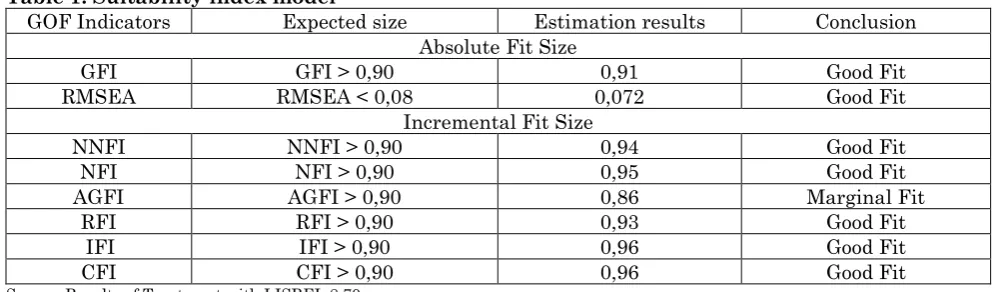
Table 1: Suitability index model
GOF Indicators Expected size Estimation results Conclusion Absolute Fit Size
GFI GFI > 0,90 0,91 Good Fit
RMSEA RMSEA < 0,08 0,072 Good Fit
Incremental Fit Size
NNFI NNFI > 0,90 0,94 Good Fit
NFI NFI > 0,90 0,95 Good Fit
AGFI AGFI > 0,90 0,86 Marginal Fit
RFI RFI > 0,90 0,93 Good Fit
IFI IFI > 0,90 0,96 Good Fit
CFI CFI > 0,90 0,96 Good Fit
Source: Results of Treatment with LISREL 8.70
Based on Table 1 above, only one index suitability models that are under size suitability good, but still be within the scope of the suitability of the marginal (marginal fit), namely AGFI. Marginal fit is the
condition of the suitability of the
Figure 2:Basic Model SEM (Standardized Model)
Figure 3: Basic Model SEM (t-Model)
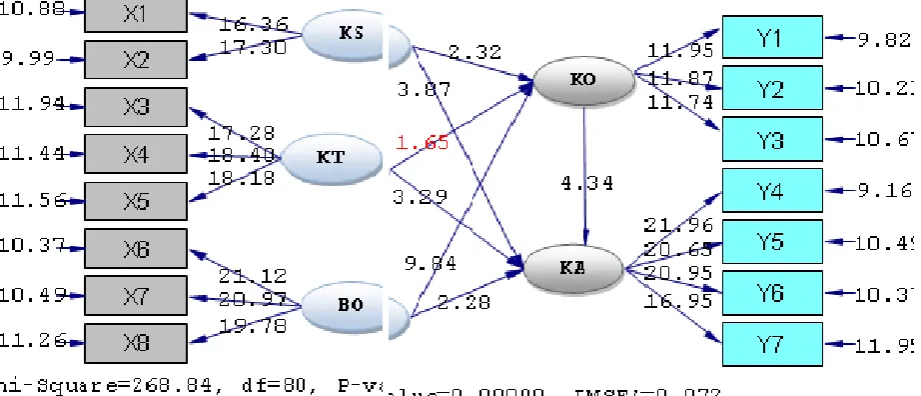
Based on Figure 2 and Figure 3 above shows
all the manifest (dimensions) has
standardized Loading Factor (SLF) ≥ 0.50 and │tvalue│≥1,96 or│ tvalue│≥2 value (at α = 0.05) [22], all manifest forming latent variables (exogenous and endogenous) is
significant, in other words it can be said that the manifest-manifest meaningful and significant in shaping the latent variables. So that all manifest in this study can be analyzed further, because it can form latent variables.
Table 2: Structural Equation Model
Source: Annex output LISREL 8.70
Figure 2 and Figure 3 above is the basis for further calculations, which will put forward the testing parameters γ and β (coefficient
factor) structural model of exogenous or endogenous, as shown in Table 3 below. KOMIT = 0.68*DISIPLIN + 0.100*KPUASAN, Errorvar. = 0.44, R² = 0.56 ... (1)
(0.11) (0.091) (0.093) (0.004)
6.45 1.10 4.72 144.89
KA = 0.33*KO + 0.31*KS + 0.29*KT + 0.21*BO, Errorvar. = 0.15, R² = 0.85 ... (2)
(0.076) (0.080) (0.088) (0.092) (0.012) (0.002)
Table 3: Test Statistics Structural Model
Structure Model Coefficient Factor
(Standardized) Standard Error
Tvalue/ Fvalue
Hypothesis Test Results
Endogen Variable Exogen/Endogen Variable
Organizational Commitment
Compensation 0.22 0.095 2.32 Significant (Partial)
Competencies 0.09 0.055 1.65 Insignificant (Partial)
Organizational Culture 0.60 0.061 9.84 Significant (Partial) Compensation, Competencies
and Organizational Culture 0.82 0.004 226.72
Significant (Together)
Experts Performance
Compensation 0.31 0.080 3.87 Significant (Partial)
Competencies 0.29 0.088 3.29 Significant (Partial)
Organizational Culture 0.21 0.092 2.28 Significant (Partial)
Organizational Commitment 0.33 0.076 4.34 Significant (Partial)
Compensation, Competencies, Organizational Culture and Organizational Commitment
0.92 0.002 473.17 Significant (Together)
Source: Data Processing, 2014
From the hypothesis test results above, then the direct and indirect influence of
Compensation, Competencies and
Organizational Culture on Organizational
Commitment of Experts in Construction Services Company in Jambi province are as follows:
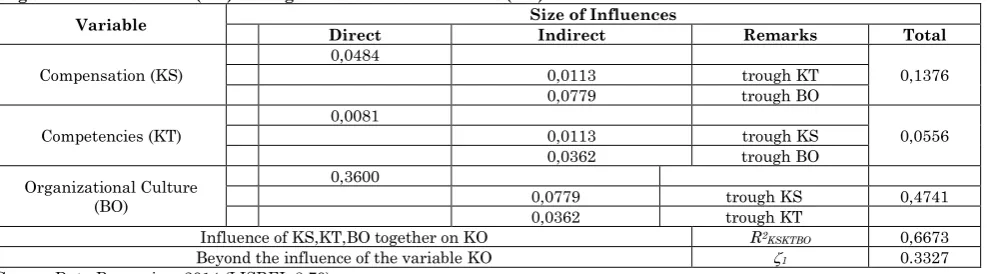
Table4: Calculation results of the Direct and Indirect Influenze of Compensation (KS), Competencies (KT) and Organizational Culture (BO) on Organizational Commitment (KO)
Variable Direct Size of Influences Indirect Remarks Total
Compensation (KS)
0,0484
0,1376
0,0113 trough KT
0,0779 trough BO
Competencies (KT)
0,0081
0,0556
0,0113 trough KS
0,0362 trough BO
Organizational Culture (BO)
0,3600
0,0779 trough KS 0,4741
0,0362 trough KT
Influence of KS,KT,BO together on KO R2KSKTBO 0,6673
Beyond the influence of the variable KO 1 0.3327
Source: Data Processing, 2014 (LISREL 8.70)
Based on Table 4 above explain that
Influence of Compensation (KS),
Competencies (KT) and Organizational Culture (BO) together on Organizational Commitment (KO) is 0.6673 ≈ 0.67 or R2 = 0.67 (see sub structural equation 1).
Based on Tables 3 and 4 above, it Can be Argued the Following Matters
Compensation variable influence to
variable declared Organizational
Commitment significant (unity hypothesis is accepted); with a total contribution
Compensation variable influence to
variable Organizational Commitment is equal to 13.76%.
Competencies variable effect on the
variable is declared insignificant
Organizational Commitment (second
hypothesis is not accepted), but still has a
contribution Competencies variable
influence to variable Organizational
Commitment by 5.56%.
Influence of Organizational Culture
variable to variable declared
variable Organizational Culture Organizational Commitment is equal to 47.41%.
Influences together Compensation,
Competencies and Organizational Culture on Organizational Commitment expressed
significantly (fourth hypothesis is
accepted); with a total effect of 67% and 33% the rest is the influence of other variables not examined in this study.
Referring to the description of 1 to 3 above,
then total the most dominant influence on Organizational Commitment
Organizational Culture is a factor with a contribution of 47.41% than Compensation factors and competencies that each only amounted to 13.76% and 5.56%.
In addition, the results of testing the above hypothesis, suggests a large direct and
indirect influence Compensation,
Competencies, Organizational Culture and Organizational Commitment to Experts
Performance in Construction Services
Company in Jambi province as follows:
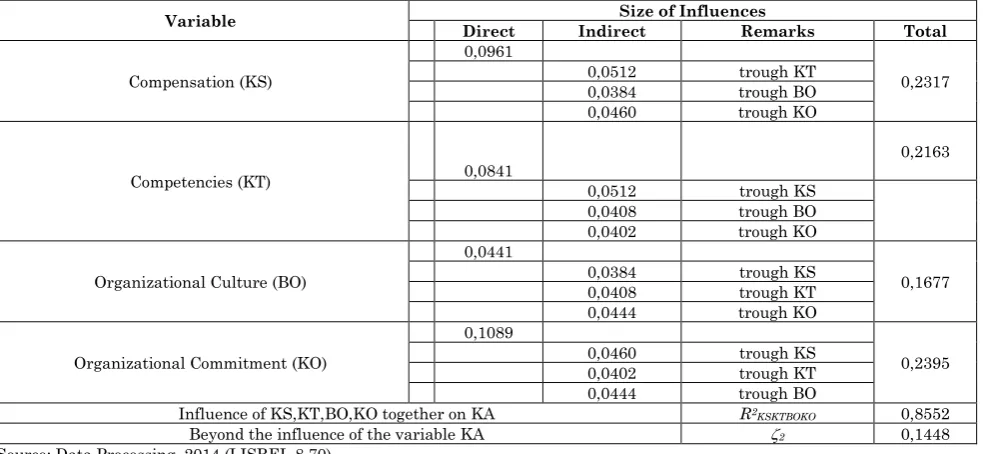
Table 5: Calculation results of the Direct and Indirect Influenze of Compensation (KS), Competencies, Organizational Culture (BO) and Organizational Commitment (KO) on Experts Performance (KA)
Variable Direct Indirect Size of Influences Remarks Total
Compensation (KS)
0,0961
0,2317
0,0512 trough KT
0,0384 trough BO
0,0460 trough KO
Competencies (KT) 0,0841
0,2163
0,0512 trough KS
0,0408 trough BO
0,0402 trough KO
Organizational Culture (BO)
0,0441
0,1677
0,0384 trough KS
0,0408 trough KT
0,0444 trough KO
Organizational Commitment (KO)
0,1089
0,2395
0,0460 trough KS
0,0402 trough KT
0,0444 trough BO
Influence of KS,KT,BO,KO together on KA R2KSKTBOKO 0,8552
Beyond the influence of the variable KA 2 0,1448
Source: Data Processing, 2014 (LISREL 8.70)
Table 5 above explain that influence of Compensation (KS), Competencies (KT),
Organizational Culture (BO) and
Organizational Commitment (KO) together on Experts Performance (KA) is 0.8552 ≈ 0.85 or R2 = 0.85 (see sub structural equation 2).
Based on Table 3 and 5 Above, it Can be Argued the Following Matters
The direct effect of the variable
Compensation Experts Performance
expressed significant (fifth hypothesis is accepted); with a total contribution Compensation variable influence to variable Experts Performance is equal to 23.17%. Competencies variable influence to variable
Experts Performance expressed significant (sixth hypothesis is accepted), with a total contribution of variable influence to variable
Experts Competencies Performance is equal to 21.63%.
Influence of Organizational Culture variable
to variable Experts Performance expressed significant (seventh hypothesis is accepted), with a total contribution of variable influence to variable Experts Organizational Culture Performance is equal to 16.77%.
Influence of Organizational Commitment
variable to variable Experts Performance expressed significant (eighth hypothesis is accepted); with a total contribution of variable influence to variable Experts Organizational Commitment Performance is equal to 23.95%.
Influences together Compensation,
hypothesis is accepted); with a total effect of 85% and 15% is the influence of other variables not examined in this study.
Referring to the description numbered 1
through 4 above, then the total influence most dominant Experts Organizational Commitment Performance is a factor with a contribution of 23.95% of the Compensation factors, Competencies and Organizational Culture, each of which only amounted to 23.17%, 21.63% and 16.77%.
The above test results show that the variable
Compensation, Competencies and
Organizational Culture Organizational
Commitment affect the variable with a
contribution of 67%. Then variable
Compensation, Competencies and
Organizational Culture Experts Performance effect on variables with a contribution of 48.52%.
But through Organizational Commitment, variable Compensation, Competencies and Organizational Culture Experts affect the Performance with a contribution of 85%. This shows that Organizational Commitment is a partial mediating variables Compensation and Organizational Culture toward Experts Performance and no mediating variables
Experts Competencies for Corporate
Performance on Construction Services in Jambi Province.
So based on testing hypotheses above, the findings of this research is to improve the Experts Performance Services Company Construction in Jambi Province mainly on the dimensions of the quality of work of experts (Y4) will be able to be increased if the Company's Construction Services in Jambi
Province is able to increase the
Organizational Commitment especially the dimension of affective commitment (Y1), where Organizational commitment will increase if the construction company is able to improve the organizational culture especially on the cultural dimensions of
bureaucracy (X7) and can improve
Compensation experts mainly on the dimensions indirect Compensation (X2). Likewise Experts Performance Construction Services Company in Jambi Province will be able to be upgraded directly, especially on the dimensions of job quality experts (Y4) to improve competencies of experts mainly on
the dimensions of functional competencies (X4).
Conclusions
Compensation partially positive and
significant impact on Organizational
Commitment to the experts, it means that the increase in Compensation experts will
result in increased Organizational
Commitment on expert Construction
Services Company in Jambi Province.
Competencies partially experts and not
significant positive effect on Organizational Commitment, meaning that increasing the competencies of experts will not result in increased Organizational Commitment on Expert Construction Services Company in Jambi Province.
Organizational Culture partially positive
and significant impact on Organizational Commitment, meaning that an increase would result in increased Organizational Culture on Organizational Commitment experts Construction Services Company in Jambi Province.
Compensation, Competencies and
Organizational Culture jointly positive and
significant impact on Organizational
Commitment to experts Company
Construction Services in Jambi province with the coefficient of determination (R2) of 67%, this shows that 67% of variables Organizational Commitment able to be explained together -Same by variable
Compensation, Competencies and
Organizational Culture whilst 33%
influenced by variables other than
Compensation, Competencies and
Organizational Culture. Increased
Compensation, Competencies and
Organizational Culture will result in increased Organizational Commitment.
Compensation partially positive and
significant impact on the Experts
Performance, meaning that an increase in Compensation experts will result in
increased Experts Performance
Construction Services Company in Jambi Province.
Competencies partially positive and
significant impact on the Experts
Performance, which means that the increase in competencies of experts will result in
Construction Services Company in Jambi Province.
Organizational Culture partially positive
and significant impact on the Experts Performance, meaning that an increase would result in increased Organizational Culture Experts Performance Construction Services Company in Jambi Province.
Organizational Commitment partially
positive and significant impact on the
Experts Performance, Organizational
Commitment means that an increase would result in increased Experts Performance of Construction Services companies in Jambi Province.
Compensation, Competencies,
Organizational Culture and Organizational
Commitment together positive and
significant impact on the Experts
Performance Company Construction
Services in Jambi province with the coefficient of determination (R2) of 85%, this shows that 85% of the variable Experts Performance capable described together
-Same by variable Compensation,
Competencies, Organizational Culture,
Organizational Commitment whilst 15% influenced by other variables. Increased
Compensation, Competencies,
Organizational Culture and Organizational Commitment will result in increased Experts Performance.
Managerial Implication
Organizational Commitment to experts Construction Services Company in Jambi province, especially in the dimension of Affective Commitment will be able to be increased if the Company's Construction Services in Jambi Province is able to improve the organizational culture mainly on the
dimensions of bureaucracy and
Compensation Experts mainly on the
dimensions of Indirect Compensation.
Organizational Commitment will be able to be improved by partial and dominant by Organizational Culture.
Experts Performance Services Company Construction in Jambi Province mainly on the dimensions of Quality of Work will be able to be increased if the Company's Construction Services in Jambi Province is
able to increase the Organizational
Commitment mainly on the dimensions of Commitment Affective, where Organizational Commitment will increase if the construction
company is able to improve the
Organizational Culture mainly on the dimensions of culture bureaucracy and improve Compensation experts mainly on the
dimensions of Indirect Compensation.
Experts Performance will be able to be improved by partial and dominant by Organization Commitment.
Likewise Experts Performance Construction Services Company in Jambi Province mainly on the dimensions of Quality of Work will be able to be increased directly by increasing Competencies Experts mainly on the dimensions of Functional Competencies. Managerial Suggest
Organizational Commitment on Expert
Construction Services Company in Jambi province has been relatively high visible than the average perception of respondents that would be able to provide an increase in Experts Performance in carrying out the construction work. Increased Organizational Commitment is influenced predominantly by the increase primarily on the dimensions of Organizational Culture Bureaucracy. Some
indicators on Organizational Culture
suggested to be maintained, especially in the cultural dimension of bureaucracy that is the indicator of the level of clarity of coordination, as well as the dimensions of Innovative Culture and Culture Supportive as the indicator of the level of innovation in thinking and the level of trust in the work. However, there are still some indicators on Organizational Culture suggested to still be considered as the indicator of the level of clarity of the rules of the organization, the level of clarity the working procedure, the level of innovation in completing the work, the level of transparency in the work, cooperation in works.
Experts on Company Performance
Construction Services in Jambi province has been relatively high visible than the average perception of respondents in carrying out the construction work. Improved Experts Performance influenced predominantly by Organizational Commitment primarily on the dimensions of Affective Commitment.
Some indicators on Organizational
Commitment suggested to be maintained, especially on the dimensions of Commitment Affective i.e. on indicator of emotional
attachment and suitability level
Continuous and Normative commitment as in indicator of the length of time worked, the level of liability for work, the level of attitudes and actions in accordance with the interests and goals of the organization. However, there are still some indicators on Organizational Commitment suggested to be considered by the Construction Services Company in Jambi Province on aspects such as the level of involvement, the desire to continue to work, the level of satisfaction with the organization, the level of demand, the level of moral judgment to stay in the organization. The most dominant dimension in improving Experts Performance that the dimensions of Quality of Work. Some indicators on Experts Performance is suggested to be maintained, especially on the dimensions of Quality of Work is the indicator of the level of conformity of the quality of work with job specifications, as well as on the dimensions Quantity of Work, Reliability and attitude of Experts as the indicator of the suitability of the work with the target job, the level of timeliness of completion of the work, the level of completion of the work exceeds the standard time, the level of initiative in solving the problem, the level of prudence in the work, and the level of loyalty to the leadership. However, there are still some indicators on Experts Performance recommended to be considered by the Company Construction Services in Jambi as on indicators of aspects of the level of conformity of the work with the standard of work, the level of ability of experts in carrying out the instruction leadership, level of initiative in carrying out the work, attendance levels in work, the level of ability of collaboration with colleagues, the level of cooperation with the leadership and loyalty to the organization.
Experts on Company Performance
Construction Services in Jambi province has been relatively high visible than the average perception of respondents in carrying out the construction work. Improved Experts
Performance directly affected by
Competencies Experts without mediating Organizational Commitment with the dimensions of the most dominant on the dimensions of Functional Competencies. Some indicators on Competencies experts suggested to be maintained, especially on the dimensions Competencies Functional as in indicator of the ability of experts to make decisions and the ability of experts in performing job functions, as well as on the dimensions Competencies Cognitive and Competencies Social as in indicator of the level of education experts, the experience level of experts, training of experts, communication skills in the work, and the ability to lead. However, there are still some
indicators on Competencies experts
suggested to be considered as the indicators of aspects of the knowledge level of expertise, the ability to solve problems, the ability to work in teams.
Suggestions for Further Research
There are many other variables that affect
Experts Performance at the Company's Construction Services in Jambi Province, such as work discipline, attachment to
work, motivation, satisfaction,
empowerment, leadership, managerial capacity and other variables in order to be further investigated, because there may be other variables besides existing in this study have a dominant influence in improving Experts Performance.
This study using the variable
Organizational Commitment as an
intermediate variable (intervening), so as to further research will likely produce different findings when using another variable or variables puts Organizational Commitment as a moderating variable (moderating).
The results could also be applied to
companies, institutions or government agencies, state-owned enterprises or private both provincial and national levels.
Reference
s1. LPJK Provinsi (2012) “Laporan Akhir Tahun”, Jambi. Lembaga Pengembangan Jasa Konstruksi. 2. Awadh Alharbi Mand Saad, Alyahya M (2013)
“Impact of Organizational Culture on Employee Performance”. International Review of Management and Business Research. 2-1.
4. Ismail, Rahmah, Zainal Syahida A (2010) “Impact of workers’ competence on their performance in the Malaysian private service sector”. Journal Business and Economic Horizons, ISSN: 1804-1205, 2 (2):25-36
5. Manetje, Martins (2009)“The relationship between organisational culture and organisational commitment”, Southern African Business Review, 13-1.
6. Mguqulwa Nomakhuze (2008) “The Ralatonships Between Organisational Commitment and Work Performance in an Agricultural Company” Universityof South Africa. Industrial and Organisational Psychology.
7. Memari Negin, Mahdieh Omid, Barati Ahmad Marnani (2013) “The impact of Organizational Commitment on Employees Job Performance”. Interdiciplinary Journal of Contemporary Research in Business, 5- 5
8. Dessler Gary (2005) “Human Resource
Management”, Tenth Edition, New Jersey: Prentice Hall.
9. Mathis RL, Jackson JH (2002) “Manajemen Sumber Daya Manusia”. Buku I. Jakarta. PT. Salemba Emban Patria.
10. Ariffin Suhaida Kamalul, Suhaiza Zailani (2011) “The Effect of Employees Competencies on Perceived Service Quality at a Municipal Council in Malaysia”. European Journal of Scientific Research ISSN 1450-216 X 57 (2):188-197.
11. Francoise Delamare Le Deist, Jonathan, Winterton (2005) “What Is Competence?”. Human Resources Development International,8(1):27 – 46,
12. O’Reilly CA, Chatman JIII, Caldwell DF (2009)Organizational Behavior [Essentials]. New York. McGraw-Hill.
13. Daft Ricard L (2005) “The Leadership Experience”, South Western: Thomson.
14. Ndraha Taliziduhu(2003) ”Organizational Culture”. Jakarta: Rineka Cipta.
15. Jack Henry Syauta, Eka Afnan Troena, Margono Setiawan, Dan Solimun (2012) “The Influence of
Organizational Culture, Organizational
Commitment to Job Satisfaction and Employee Performance” (Study at Municipal Waterworks of Jayapura, Papua Indonesia). International Journal of Business and Management Invention ISSN (Online): 2319 – 8028, ISSN (Print): 2319 – 801X,1(1):69-76
16. Sopiah (2008) “Organizational Behavior”. Yogyakarta. Penerbit CV. Andi Offset.
17. Rashid ZA, Sambas Ivan M, Johari J (2003) “The influence of corporate culture and organizational commitment on performance”. Journal of.
18. Coetzee M (2005) “Employee Commitment”.
University of Pretoria etd.
http://upetd.up.ac.za/available/etd04132005130646/ unrestricted/05chapter5.pdf.
19. Mangkunegara Anwar Prabu (2007)”Evaluasi Kinerja Sumber Daya Manusia”. Bandung: PT. Refika Aditama
20. Siagian Sondang P (2008) “Manajemen Sumber Daya Manusia”, Jakarta cetakan ketujuh: Penerbit Radar Jaya Offset.
21. Hair et al (2006) “Multivariate Data Analysis”, Fifth Edition, New Jersey. Prentice Hall, Upper Saddle River.
22. Wijanto (2008)“Sructural Equation Modeling dengan Lisrel 8.8”. Jakarta, Pasca Sarjana Ilmu Manajemen Fakultas Ekonomi UI.
23. Afshan Sultana et al (2012) “Impcat of Training on
Employee Performance”: A Study of
Telecommunication Sector in Pakistan.
Indiciplinary Journal of Contemporary Research in Business, 4-6
24. Bachrudin Achmad , Harapan L Tobing (2003) “Analisis Data untuk Penelitian Survey dengan Menggunakan Lisrel 8 Dilengkapi Contoh Kasus”, Bandung. Jurusan Statistika, FMIPA UNPAD. 25. Cascio WF (2006) “Managing Human Resources:
Productivity, Quality of Life, Profits”. London McGraw-Hill Irwin.
26. Dinas Pekerjaan Umum (2012) “Laporan Kinerja Tahunan” Provinsi Jambi. Kajian Mutu Internal. 27. Jöreskog Karl G, Dag Sörbom (2001) “LISREL 8:
User's Reference Guide”. Lincoln wood, IL: Scientific Software International, Inc.
28. Kementerian PU (2013) “Perkembangan Standar Competencies Kerja Nasional Indonesia (SKKNI) Jasa Konstruksi” Jakarta. Edisi II. Buletin Badan Pembinaan Konstruksi. ISSN 1907-0136
29. LPJK Nasional (2013) “Panduan Pelatihan Asesmen” Palembang. Lembaga Pengembangan Jasa Konstruksi.
30. Sugiyono (2013) “Statistika untuk Penelitian”, Bandung. Alfa Beta.
31. Suharsimi Arikunto (2002)”Prosedur Penelitian Suatu Pendekatan Praktek”, Jakarta: Rineka Cipta. 32. Tahir Masood Quershi (2010) “Relationship between
HR Practices and Perceived Employees'
Performance of Bankers in NWFP Pakistan”(An Empirical Evidence). African Journal of Business Management 4(7):1281-1288.