International Journal of Advances in Management and Economics
Available online at:
www.managementjournal.info
RESEARCH ARTICLE
Does Tax Transparency Tackle Tax Avoidance? A Stakeholder
Perspective
Paul Eisenberg*
The University of Portsmouth Business School, Portland St, Portsmouth PO1 3DE, United Kingdom.
*Corresponding Author: E-mail: [email protected]
Abstract: The present work approaches the research question: Does tax transparency through manda-tory corporate tax return disclosure tackle tax avoidance? Tax avoidance has far-reaching social impli-cations. The aim of this study is to shed light on tax avoidance and to help mitigate its adverse social repercussions. The research is inspired by The United Kingdom Corporate and Individual Tax and Fi-nancial Transparency Bill, which was proposed, albeit unsuccessfully, during the 2010-2015 UK Par-liament. The implications of a tax return disclosure regime are assessed against the WPP Group, a ma-jor UK public company listed on FTSE 100. The stakeholders affected by corporate tax return disclo-sure are analysed using the Power-Interest-Matrix. Their power is assessed through financial indicators derived from the company’s financial statements. Their interest is scrutinized through vocabulary anal-ysis with the Form-Oriented Content Analytic Method. The impact of the disclosed tax avoidance on the stakeholders and their response are mixed. There are numerous pathways available depending on the stakeholder group and their incentives. Also, stakeholders of the same group do not behave unanimous-ly. These findings are supported by empirical evidence from Europe, Asia and the USA. In order to channel dispersed stakeholder activity the study makes a proposal to introduce a threshold for parties interested in corporate tax information. The author is not aware on any tax avoidance research combin-ing the Power-Interest-Matrix and the Form-Oriented Content Analytic Method. This enhances the originality of the study and may encourage other scholars to enrich their research inventory through these instruments.
Keywords: Tax Avoidance, Tax Transparency, Stakeholder Analysis, Content Analysis, Power-Interest-Matrix.
Article Received: 30 Oct. 2018 Revised: 10 Nov. 2018 Accepted: 22 Nov.2018
Introduction
Back in 2013, Michael Meacher MP intro-duced The United Kingdom Corporate and Individual Tax and Financial Transparency Bill (hereafter referred to as UKCITFT) in the House of Commons of the British Parlia-ment as a Private Members' Bill. The focus of this research is on section 2, paragraph 2 UKCITFT titled: “Disclosure of taxation in-formation by selected large companies“: “HM Revenue & Customs shall publish on its web site in XBRL format on 31 December each year the corporation tax return of any dis-closable company received in the twelve month period to 31 March ending in that same calendar year or shall state that no such return has been received and what ac-tion is being taken to remedy that defect. “
The proposal aims to abolish taxpayer confi-dentiality of target companies that is current-ly protected by section 18 Commissioners for Revenue and Customs Act 2005. In return, it
expects to boost government revenues by £35bn a year if the public becomes aware of the corporate tax avoidance techniques through enhanced disclosure [1]. HMRC [2] defines tax avoidance as follows: “Tax avoid-ance is bending the rules of the tax system to gain a tax advantage that Parliament never intended. It often involves contrived, artifi-cial transactions that serve little or no pur-pose other than to produce a tax advantage. It involves operating within the letter – but not the spirit – of the law.” As such, the bill is understood by its promoter as a counterpart to the UK Action Plan published in June 2013 at the G8 summit in Lough Erne and that he considers addressing tax avoidance insufficiently [3].
be-comes law [4]. However, the hypothetical im-pact of UKCITFT on the stakeholders of the target companies is worthwhile analyzing with a view to future legislative proposals. Also, it is arguable that the target companies’ behaviour may change when affected by the reaction of the disclosure’s addressees [5]. Hence the analysis may be of interest to cor-porate decision makers faced with enhanced stakeholder perception of the entities’ tax position. Consequently, this study addresses the research question: Does tax transparency through mandatory corporate tax return dis-closure affect the stakeholders of the disclos-ing entity in a way that tackles tax avoid-ance?
The UKCITFT Provision under Consid-eration Focuseson
“All constituent members of the FTSE 100 within any year ending 31 March and those UK tax resident companies that are their related undertakings.” In order to assess the consequences of the UKCITFT on its target companies, the WPP Group (hereafter re-ferred to as WPP) has been chosen, a holding company listed on the London Stock Ex-change and member of the FTSE 100 index. There are several reasons that support this choice. One of the goals of the proposal is to “tackle the opacity in the tax affairs” [6].
WPP was among the companies which did not answer to the request of Stephen McPartl and MP to engage in tax transparency which he sent to all CEOs of the FTSE 100 during his Tax Challenge campaign [7].
This addresses the tax opacity issue. Richard Murphy, the famous UK tax blogger who drafted the bill highlights transparency about the usage of tax havens by multina-tional corporations (hereafter referred to as MNCs) as a purpose of UKCITFT [3]. Tax havens are identified by OECD [8] through the following four factors:
No or only nominal taxation,
No effective exchange of information with other jurisdictions,
Lack of transparency in the operation of the legislative, legal or administrative provisions,
No substantial activities of business are required.
In 2009 WPP was in the media spotlight for reducing its tax bill via setting up subsidiaries in low tax jurisdictions and
shifting profits to them out of the UK through interest and royalty payments [9]. A research undertaken by ActionAid [10] reveals that in 2011 WPP was engaged in 611 tax havens, the largest number among all FTSE 100 companies. This figure grew further to 618 in 2013 according to a follow-up study [11]. This constitutes the usage of tax havens.
Thus, WPP’s Tax Related Behaviour can be Considered Exemplary in the UKCITFT Context
Furthermore, by the end of 2012 WPP shareholders affirmed almost unanimously the board's proposal to move the group's headquarters back to the UK and to become tax resident in the UK again, after an escape to Ireland in 2008 due to then restrictive tax legislation [12].
This move does not only return WPP under the applicability of UK tax law and the proposed UKCITFT. It again shows that WPP is sensitive to tax legislation. Finally, WPP is the world's largest advertising enterprise with over 200,000 employees working in 113 countries [13]. Thus, WPP maintains relationships with a broad number of stakeholders. This makes it an attractive target for the stakeholder analysis undertaken by this research.
Methodology
The Contractarian theory states that a company is not only a legal entity, but a product of interactions of its stakeholders [14]. Freeman [15] defines stakeholders as follows: “A stakeholder in an organization is (by definition) any group or individual who can affect or is affected by the achievement of the organization’s objectives.” Some of business transactions are perceived to be tax sensitive by the company’s stakeholders [16]. Thus, stakeholders critically scrutinise the company’s tax policy [17].
Their relationship with the entity can change if new information becomes available which make them reconsider their position [18]. Therefore, the stakeholders are valued by the company according to their power to influence its affairs [19].
Stakeholder mapping technique is used to evaluate the stakeholders’ position towards WPP. In 1991 Mendelow developed the
Power-Interest-Matrix on which stakeholders are matched to four quadrants, as shown in
Graphic 1:
Graphic 1: Power-Interest-Matrix according to Mendelow
The allocation depends of the stakeholders’ power to influence the company and on their interest to take part in the company’s affairs [20]. The most important stakeholders are to find in quadrant D (key players). These are the most powerful and most interested par-ticipants, for example the shareholders or major financiers with far-reaching loan cove-nant. The company must act in a way ac-ceptable to the key players [21].
The stakeholders in quadrant C should be kept at least satisfied as they possess enough power to influence the company, like institu-tional investors [22]. Quadrant B is reserved for stakeholders who are interested in the company’s affair, like local residents or activ-ist groups. They do not have enough power to act on their own, but they could try to influ-ence other more powerful participants. They should be kept informed to prevent detri-mental activities [23]. Finally, stakeholders in quadrant A should be given least attention [24]. Stakeholder mapping is commonly used to evaluate the impacts of strategic choice [22].
Regarding the proposed tax return disclo-sure, WPP has no strategic playing field, but to disclose its tax return, as delisting from FTSE 100 is considered not an option [14]. Traditional stakeholder positioning is a mat-ter of judgment [20]. It is also an exercise of evaluating power and interest measured by indicators like informal influence or skills [22].
This study tries to overcome this subjectivity by using numerical values of power and in-terest for stakeholder segmentation. The power of the stakeholders is measured by the
frequency of keywords used in the financial statements of WPP for the year 2012, the year preceding the legislative proposal. It is assumed that the more powerful the stake-holders are the more attention is paid to them in WPP publications [25]. Keywords are associated with stakeholder groups applying the Form-Oriented Content Analytic Method. Using this method, a text body is analysed for the presence of a predetermined list of items. This method is widely recognized in the narrative analysis literature for its objec-tivity [26]. For the purpose of this study, the business vocabulary index of Mascul [27] is used to assign business related words to the respective stakeholder group. This task is performed in several steps.
First, Stakeholders of WPP are identi-fied With Reference to Bennett [28] as no Specific Stakeholder Groups are enumerated in the Financial Publica-tions of WPP
Shareholders Management Employees Customers Suppliers Government Society
Competitors
not necessarily aligned and there may be a huge power gap between high rank corporate officers and other personnel [5]. Government covers the public sector in its broadest terms, including the HMRC as a body most relevant for taxation issues [29]. It also covers, letting aside separation of power issues, the British Parliament [31]. The media, non-governmental organisations (hereafter re-ferred to as NGOs) [30] and international organisations are included in Society [31].
Competitors are frequently mentioned in tax disclosure literature as unintentional benefi-ciaries of corporate publicity [14]. After hav-ing identified the stakeholders, the Mascul [27] business vocabulary index is analysed for items related to the respective stakehold-ers. The index consists of 765 vocabularies from “accountant” to “zone” (hereafter re-ferred to as keywords).
In the next step, the Annual Report and Ac-counts and the Sustainability Report of WPP for the year 2012 are combined in a single document. Then all the keywords are searched for in this document. The creation of a single document facilitates the search, as only one run for each keyword has to be per-formed. To obtain accurate results, the search is constructed as follows:
Singular and plural form of the nouns are searched for and the results added up, Compound expressions (e.g. balance sheet)
are decomposed and the search is accom-plished for the respective singe noun, No abbreviations are searched,
Nouns, which have the same form as verbs (e.g. cover) or adjectives (e.g. future) are counted only when used as nouns,
Personal names (e.g. Miles) are deleted from the results,
The following nouns are deleted from the results to avoid blurring, because they are numerously repeated in the table of content and the headings of the different sections of the WPP’s financial statements:
Letter (occurs 53 times), Report (occurs 339 times), Share (occurs 27 times).
The results range from 0 (noun not used) to 773 (noun most frequently used). In the next
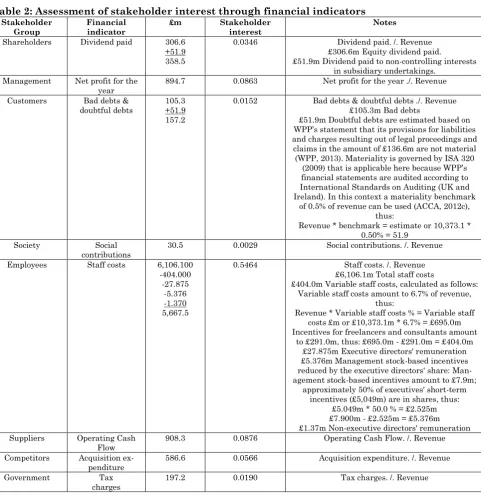
step, keywords associated with the particular stakeholder group are summed up, as pre-sented in the Appendix, Table 1. The inter-est of the stakeholders in the affairs of WPP is assessed by the financial indicators derived from the financial statements of WPP for the year 2012. These performance indicators are financial statements line items scaled by to-tal sales. It is assumed that different stake-holder groups are interested in different fi-nancial statements line items, because they are affected by the specific line items, rather than by the whole financial statements [32].
Total sales are used for scaling for two rea-sons: First, although revenue can be manipu-lated by false cut-off procedures [33] and one-time transactions [34] it is still less suscepti-ble to earning management [35] as for exam-ple net profit, which is a residual figure after the application of numerous estimation and valuation techniques [36-37]. Second, reve-nue is repeatedly addressed in the media in connection with taxes paid (or unpaid) by MNCs. Their tax expense is often perceived to be disproportionate to total sales [38].
This perception is also behind the UKCITFT [39]. Each group of stakeholders is assigned a financial indicator, as presented in the Ap-pendix, Table 2. Whereas it is self-evident that shareholders may be interested in divi-dend payments, employees in wages and gov-ernment in tax payments, other financial indicators may need clarification. Thus, management is responsible for the company's performance [21]. It may be interested in the net profit for the year as a benchmark of its achievement [23].
New and existing customers may approxi-mate poor services delivered by WPP from bad debt & doubtful debt figures. However, it should be kept in mind that outstanding re-ceivables may also be traced back to financial difficulties on part of the very customers. Alternatively, warranty provisions or provi-sions for liabilities and charges could be used as indicator. However, warranty provisions or other provisions related to customers were not extractable from WPP’s financial state-ments for the year 2012.
result in cash that could be used to settle trade payables [23]. Competitors may want to know the percentage of earnings spent on acquisition of other market participants [19]. This is a valid assumption given WPP's ex-tensive acquisition policy [40]. Through the transformation of qualitative characteristics (power & interest) into numerical values the
x-axis (interest, i.e. financial indicators) and the y-axis (power, i.e. keyword frequency) of the Power-Interest-Matrix can be drawn and the stakeholders can be assigned to the re-spective quadrant of the matrix, as presented by Graphic 2. The y-axis is transformed through logarithmic scaling.
Shareholders
Management
Customers
Society
Suppliers
Employees
Competitors
Government
0 200 400 600 800 1000 1200 1400 1600 1800 2000 2200 2400 2600 2800
0,001
Low
0,01 0,1 1Low
Level of interest
High
High
Power
A
Minimal Effort
Keep informed
B
C
Keep satisfied
Key players
D
Graphic 2: Power-Interest-Matrix for WPP Stakeholders
Limitations
The Results are subject to the Following Restrictions
The keywords used may be accounted for without giving consideration to the context (Beattie et al., 2004). Also, they do not in-clude verbs, adjectives and composite expres-sions. But more importantly, they may be assigned to more than one stakeholder group. With regard to the financial indicators other financial statement line items may be used, probably affecting the stakeholders’ position in the matrix.
For example, Freeman [15] suggests that the net profit should not be used as a proxy for management performance on a stand-alone basis. Instead the measure should be sup-plemented by spending on safety or pollution technology. Thus, the definition of perfor-mance can be debated, especially when tak-ing into consideration integrated reporttak-ing [41] and sustainability reporting [42].
Furthermore, a clear-cut between stakehold-er groups may be not possible, e.g. employees may be part of the general public, but also consumers and shareholders [15]. Apart from these issues there are limitations inher-ent to the Mendelow matrix. The matrix does not address opposite interests and hostility among the stakeholders of the same group [23], thus reducing clarity [22].
Above this, individuals and the stakeholder roles they perform are hardly substitutable. This is especially the case with government agencies where a change of officers may re-sult in a modified conduct of the agency and
exten-sive way, which would justify their placement in quadrant D [43].
Also, it can be argued, that stakeholders co-operate with each other or gain institutional support fortifying their position [18]. Finally, the matrix does not address urgency, i.e. the time pressure put on stakeholders when rais-ing claims against the company. Under this dynamic view the company may preferably address stakeholder claims that are subject to time constraints [44]. However, urgency is not a critical issue for the purpose of this study. The time lag between the proposed publication of the tax returns and the under-lying transactions hardly calls for immediate action by WPP and its stakeholders [45].
Discussion
Shareholders
Shareholders are situated in Quadrant D of the Power-Interest-Matrix and thus consti-tute top priority for WPP. Shareholders are primarily concerned with net earnings that can be distributed as dividends [46-47] as well as with stock price increases [48].
Freedman et al. [49] suggest that sharehold-ers prefer stable returns not affected by tax disputes. ActionAid [30] argues that disclosed tax returns revealing tax avoidance would depress stock prices, thus affecting returns to shareholders. Furthermore, tax avoidance can increase uncertainty as tax authorities can challenge questionable tax positions and supplementary tax payments may become due.
This may increase liabilities and decrease future cash flow [50] reducing cash available for dividend payments. However, this is not univocally supported by empirical evidence. Hanlon and Slemrod [51] demonstrate that the market does not perceive tax avoidance as seriously as accounting irregularities. A study carried out by Gallemore et al. [52] shows that stock price declines associated with tax avoidance reverse within a month.
Yeung [53] indicates for a sample of compa-nies listed in Hong Kong that aggressive tax positions are perceived to create shareholder value. It reveals that paying fewer taxes pre-serves cash flow which is deemed favourable by shareholders. The same is true according to the study of US companies conducted by Koester [54].
Nevertheless, the above studies do not ana-lyse market reaction in the setting of fully disclosed tax returns. Disclosed tax returns may constitute additional information rele-vant for decision making. Additional infor-mation supports decision making of investors [55]. However, a steadily increase of the amount of information available can distort decision making if the investors struggle to discover high quality information or cannot process sophisticated information without costly advisers [56].
This decreases market efficiency and nega-tively affects stock prices [57]. Indeed, it may be questionable, whether the majority of shareholders could process the additional information at all, once tax returns become public knowledge. However, professional in-stitutional investors are unlikely to incur difficulties in processing tax return infor-mation [57].
Therefore, it can be assumed that profession-al investors will be able to scrutinize dis-closed tax returns and assess the possibility and magnitude of tax avoidance. Thus, WPP should focus on institutional investors that are able to process tax return information in a well-thought manner. This may radiate on other stock owners as they tend to adopt the behaviour of major block holders [58]. Thus, the tax strategy of WPP has to be aligned with the strategy of its shareholders. Accord-ing to prior research, this will stabilise the share price, and may even increase the share price if the shareholders perceive tax avoid-ance as value creating.
Management
However, due to information asymmetry be-tween managers and shareholders the latter may be deprived from the benefits of tax sav-ings by managers. This leads to increased monitoring costs and thus to higher equity cost [66]. In view of these challenges call for increased transparency, as is demanded by UKCITFT. However, managers may refrain from avoidance to preserve reputation [67], either under public pressure [68] or to gain trust among business partners [69-70].
Though, reputable social engagement may not inevitably go hand in hand with tax com-pliance [71]. Also, argues that reputation of an incorporated body does not necessarily affect that of the corporation’s officers. Fur-thermore, managers may prefer overpaying taxes, i.e. paying taxes on overstated income to prevent detection of earnings management during tax audits [72]. WPP has a record of media accusation of questionable accounting [73] and may be susceptible to tax overpay-ment as a consequence of earnings manage-ment.
To conclude, the impact of tax return disclo-sure on the stakeholder group of managers is not clear. Managers could either continue with tax avoidance (first option), but they could also adopt a higher degree of tax com-pliance under public scrutiny (second option). If they chose the first option, the agency costs in the form of cost of capital may increase for WPP [74]. If they follow the second option, cost of capital may decrease [66]. Though, a higher tax expense would be the consequence of the second option.
Customers
Customers are allocated to Quadrant C of the Power-Interest-Matrix. WPP has to satisfy them to be able to sell its service on the ongo-ing basis and thus to remain in business. WPP does business with commercial custom-ers that may be interested in accuracy and legal compliance on the part of WPP [32].
There is a risk that customers may boycott products of a tax avoiding company for repu-tational reasons. Substitutable goods like advertising services can be easily purchased from another agency outside the WPP Group. Nevertheless, Austin and Wilson [75] demon-strate for the USA that companies depending on brand names and thus being highly vul-nerable to reputational damage do not give up tax management. Instead, they seek to
modify their financial reporting techniques to make tax management less discernible.
Also, commercial customers are not to be ex-pected to actively observe WPP’s tax behav-iour as opposed to activists groups [75]. On that background it is doubtful whether WPP will adjust its tax positions in order to satisfy commercial customers.
Employees
Employees’ moral attitude towards the em-ployer can be affected by the way tax law is upheld by the very employer [31]. The same is true for employees’ operational perfor-mance that can be affected by the (in) accura-cy with which the company handles its tax obligations [76]. The Power-Interest-Matrix reveals that employees are regarded by WPP as a group to be kept informed only (Quad-rant B). Such a position does no call for major efforts. Indeed, the employment relationship is governed by wages and working conditions, not taxes. However, disclosed tax returns can be screened by employees (or their represent-atives) for additional information to be used in wage negotiations.
For example, from the UK corporation tax form CT600B tax credits on profits from con-trolled foreign companies can be obtained. Hence, from the employees’ point of view, it may not be too far-fetched to claim that for-eign profits and tax credits should be utilised to the benefit of domestic employment [45].
Suppliers
Suppliers may pay attention to WPP’s cor-rectness and truthfulness [32]. The percep-tion of being a reliable partner may enhance business relationships [57]. With regard to the Power-Interest-Matrix suppliers are situ-ated in Quadrant B, which is not a powerful position. In case of WPP, many of them are substitutable freelancers and consultants [40].
The logic works as follows: tax avoidance re-duces tax payments through sophisticated techniques, whereas debt finance reduces tax payments through tax deductible interests. Now, under UK tax law, the so-called DO-TAS-arrangements (Disclosure of Tax Avoid-ance Schemes) are to be disclosed to the tax authorities [77].
It can be argued that a company using DO-TAS-arrangements which become subject to public disclosure may be persuaded to give up tax avoidance. In such a case, the compa-ny’s demand for debt finance will increase. This result of tax return disclosure may be of great interest for finance providers. In the hypothetical case that WPP becomes subject to a tax disclosure regime, finance suppliers could become more interested in its tax posi-tion and more powerful, should WPP demand debt finance. Thus, finance suppliers could move over the Power-Interest-Matrix to a more influential quadrant [44].
Competitors
Competitors are the third and last group of stakeholders situated in Quadrant B of the Power-Interest-Matrix. This may come at a surprise, as keeping competitors informed may be not the major goal of a business enti-ty. Their position in Quadrant B can be ex-plained by the financial indicator assigned to competitors. The indicator is calculated using acquisition expenditure as a numerator. This is the fourth-highest number among the indi-cators used.
The amount of the acquisition expenditure has to do with WPP’s trading model to gain market share through acquisitions. Thus, the competitor’s position in Quadrant B is appro-priate if viewed from the stance of profes-sional and collegial behaviour towards poten-tial acquirees. Whether competitors are to remain in Quadrat B depends on whether they will be able to utilise any information from disclosed tax returns of WPP.
In case competitors recognise that they bear a higher tax burden compared to the disclos-ing company, they may try to highlight this fact among the wider public for the sake of its own reputation. This was the approach taken by Costa Coffee versus Starbucks in 2012 during Starbucks’ tax controversy with the HMRC [30]. Other risks from tax disclosure with regard to competitors are perceived to be low by research. Lenter et al. [56] point
out that confidentiality issues may hardly arise due to extensive financial reporting that is already available to competitors. Above this, tax return information is too ag-gregated to draw valuable conclusions [45].
For example, the UK corporate tax form for the Research and Development tax relief CTR&D (AA) reveals R&D expenditure in numbers, but no technical secrets. In case of subsidiaries only hypothetical suggestions about the profitability of particular markets and regions can be derived from tax returns [59]. A study from the US state of Massachu-setts demonstrates that hardly any tax in-formation disclosed was valued by competi-tors [78]. Research undertaken on SEC-registered US companies provides no evi-dence about market share losses to the non-disclosing counterparts [45]. On the other hand, Avi-Yonah and Siman [14] argue that a level playing field would be created through tax return disclosure, which could intensify competition. Increased competition would benefit the public in a market economy [78].
Society
As shown by society’s position in Quadrant A of the Power-Interest Matrix, society is re-garded as a highly unimportant stakeholder by WPP. At first glance this may be puzzling. The frequency of keywords related to society is 1,327. This is above average and indicates strong reporting on social issues in WPP’s financial statements. However, its financial indicator is measured by contributions to socially valuable projects scaled by revenue and is just 0.0029.
This demonstrates an inconsistency between reporting and spending – WPP’s social in-vestments are by far not comparable to its effort to present itself as a socially engaged entity. This ambiguous behaviour among businesses is heavily criticized by Sikka [79]. Despite WPP’s perception of society as an unimportant stakeholder there is no doubt that the public is highly aware of the tax de-bate concerning the nation’s major undertak-ings.
accusa-tions [82]. This may cause the company to engage in costly media campaigns to explain the critical issues and to save the company’s standing [79].
Spending on public relations to clarify ques-tionable tax management techniques may be inevitable, to the detriment of profits. The critical law provisions may be amended as a consequence of the public outcry following tax return disclosures [56].
Government
Government is situated in Quadrant A of the Power-Interest Matrix. WPP regards any efforts to uphold its relationship with the Government as unnecessary. This may change if HMRC were to follow up media coverage of disclosed tax returns and start investigative proceedings. The impact on WPP may therefore depend on how sensitive-ly the government reacts to public accusa-tions against the company. The Govern-ment’s position towards WPP may be not di-rectly affected by corporate tax return disclo-sure, because the tax return information is available to HMRC in any case.
Though, HMRC may start investigations of already processed tax returns if a certain tax position attains public interest and receives media coverage. This way, tax authority’s attention was triggered in case of Goldman Sachs and Vodafone in UK [30], in case of Glencore in Zambia [81] and in case of SUB Miller in Zambia, Tanzania, Ghana and South Africa [83]. This may lead to increased audit costs and tax adjustments.
As long as tax returns remain confidential, the company can learn about tax schemes of peers and about enforcement action by tax authority mainly from the media. But follow-ing disclosure it could verify how successful the tax strategy of other businesses works and how effective the tax authority operates in reality. If the peers’ schemes escape unde-tected that would undermine the company’s confidence in governmental procedures. Thus, tax avoidance may become a profitable choice undermining the reciprocity theory. According to this theory, a taxpayer complies as long as his peers do [84].
He / she could refrain from tax avoidance if it regards tax return disclosure as adding fair-ness to tax administration [85]. However, this view is not clearly supported by
empiri-cal studies. On the one hand, shows for Ja-pan that (partially) disclosure does not pre-vent tax avoidance. On the other hand, Slem-rod et al. [86] find for Norway a slightly in-crease in reported business income after a shift from paper-based towards online tax return disclosure. A model developed by Laury and Wallace [87] shows a marginally growth of reported income if confidentiality diminishes. This may be caused by compa-nies anticipating public scrutiny. Also, the possibility of being caught and punished in-creases with disclosure [84]. Interestingly, Pomp [78] shows for the US state of Arkan-sas that despite an exemption regime not to publish certain data of state tax returns only few companies made use of the exempting provision. This evidence may suggest that tax return disclosure does not constitute such a regulatory threat as one could presume.
Conclusion
This study shows that stakeholder perception of tax avoidance that is made public through corporate tax return disclosure depends on the very group of the stakeholders concerned. But even inside the respective group there may be no uniform behaviour. Shareholders may be interested in achieving their desired rate of return and thus be supportive to the cash flow preserving tax avoidance.
However, they may be afraid of penalty pay-ments if tax avoidance disclosure is followed up by tax authority investigations. Managers may try to extract personal benefits from corporate tax savings achieved via tax avoid-ance. Yet, they may refrain from avoidance for reputational reasons. Finally, managers may even abstain from tax avoidance and overpay taxes trying to hide upward earnings management. Customers may drop a compa-ny following a tax avoidance disclosure and switch to another producer or service provid-er for reputational reasons.
But they can also behave similar to employ-ees and try to renegotiate their contracts, especially if both the groups perform substi-tutable jobs.
Finance suppliers may be regarded as a dis-tinct group among suppliers. They may bene-fit from tax avoidance termination if tax sav-ings from deductible interest expenses and tax savings from avoidance are considered substitutes. Competitors may utilise their own disclosed tax compliance to stand out versus the tax avoiding company in order to attract socially-conscious customers.
Apart from that, they may derive little addi-tional insight into the company’s affairs from the disclosed tax returns. The society at large may struggle to exercise due diligence in processing the disclosed tax returns. Premature accusations of tax avoidance may follow, causing expensive media campaigns to preserve the company’s reputation.
Moreover, society is hardly a solid block of unified interests, but rather a mix of the stakeholder groups with deviating and con-trary interests. Finally, the government may be regarded as aware of the relevant tax in-formation in any case, as tax returns are submitted to the tax authorities in absence of public disclosure. Nevertheless, it may find itself forced into further tax investigations
following public scrutiny of disclosed tax re-turns.
The divergence of the stakeholder percep-tions and interest may be responsible for the mixed empirical evidence regarding tax avoidance under tax disclosure regimes. Also, the debate focussing on corporate taxation may be overstating. Corporate tax is far not the only tax borne by companies and it is even not the major one. It was one of 25 taxes in 2013 imposed on businesses in the UK and accounted for 25.9% of revenue. Revenue de-rived from corporate tax was exceeded by employers' national insurance contributions, accounting for 27.5% of revenue [88].
Perhaps, it was a stroke of destiny that UKCITFT failed during the legislative proce-dure. Now it can make place to a more so-phisticated proposal that has already proved manageable in the USA [56]. Shareholders possessing at least 1% of stock could be al-lowed to inspect corporate tax returns upon written request at HMRC comparable to Sec. 6103 of the US Internal Revenue Code (IRC).
This threshold can be considered high enough to avoid unsubstantiated public witch-hunt, but low enough for minority shareholders. However, this proposal deprives external stakeholders not owning shares in the com-pany form any insight into its tax affairs – an issue that may be at the very heart of the tax transparency debate.
References
1. Meacher M (5 September 2013a) my draft bill
against tax avoidance. The Guardian. Retrieved from:
http://www.theguardian.com/business/2013/sep/05/d raft-bill-against-tax-avoidance.
2. Her Majesty's Revenue and Customs (HMRC) (2013)
Tackling tax avoidance. Retrieved
from:https://www.gov.uk/government/uploads/syste m/uploads/attachment_data/file/89029/briefing-avoidance.pdf
3. Meacher M (2013b) this is how an Act to enforce tax
transparency & prevent tax avoidance should work.
Retrieved from:
http://www.michaelmeacher.info/weblog/2013/09/thi s-is-how-an-act-to-enforce-tax-transparency-prevent-tax-avoidance-should-work/
4. House of Commons Information Office (2010)
Pri-vate Members’ Bills Procedure. Factsheet L2.
Re-trieved from:
http://www.parliament.uk/documents/commons-information-office/l02.pdf
5. Benshalom I (2014) who should Decide Whether the
Apple is Rotten? Tax Disclosure and Corporate
(Po-litical) Agency. Columbia Journal of Tax Law, 6:86-117
6. Meacher M (2013c) Publish the tax returns of the biggest 250 companies and of the 250 wealthiest
in-dividuals. Retrieved from:
http://www.michaelmeacher.info/weblog/2013/08/pu blish-the-tax-returns-of-the-biggest-250-companies-and-of-the-250-wealthiest-individuals/
7. McPartland S (2013) Tax challenge to FTSE 100
companies. Retrieved from: http://www.stephen- mcpartland.com/tax-challenge/383-tax-challenge-to-ftse-100-companies
8. Organization for Economic Co-operation and
Devel-opment (OECD) (1998) Harmful tax competition: an
emerging global issue. Retrieved from:
http://www.oecd.org/tax/transparency/44430243.pdf
9. Tax gap reporting team (4 February 2009) seeing
double: Avoidance scheme allegedly used by UK ads
agency. The Guardian. Retrieved from:
http://www.theguardian.com/business/2009/feb/04/ta x-gap-series
10. ActionAid (2011a) Addicted to tax havens: The
from:http://www.actionaid.org.uk/sites/default/files/d oc_lib/addicted_to_tax_havens.pdf
11. Ball J (12 May 2013) FTSE 100's use of tax havens –
get the full list. The Guardian. Retrieved from: http://www.theguardian.com/news/datablog/2013/ma y/12/ftse-100-use-tax-havens-full-list
12. Budden R (11 December 2012) WPP investors vote
to move back to UK. The Financial Times. Retrieved from: http://www.ft.com/intl/cms/s/0/66303bf8-43a9-11e2-a48c-00144feabdc0.html#axzz32CiuJs3o
13. WPP Group (2016) WPP at a glance. Retrieved from:
http://www.wpp.com/wpp/about/wppataglance/
14. Avi-Yonah, RS, Siman A (2014) The one percent
solution: corporate tax returns should be public
(and how to get there). Research Paper. Retrieved
from:
http://papers.ssrn.com/sol3/papers.cfm?abstract_id= 2389956
15. Freeman RE (2010) Strategic management: a
stake-holder approach. Cambridge: Cambridge University Press.
16. Fraser R (2008) Aggressive tax behavior` and
corpo-rate social responsibility: a response. In J. Freed-man (Ed.). Beyond boundaries: developing ap-proaches to tax avoidance and tax risk management. Oxford: Oxford University Centre for Business Tax-ation.
17. Van Eijsden A (2013) the relationship between
corporate responsibility and tax: unknown and un-loved. EC Tax Review, 22 (1):56-61.
18. Friedman A, Miles S (2002) Developing stakeholder
theory. Journal of Management Studies, 39 (1):1-21.
19. Mintzberg H (1983) Power in and around
organiza-tions. Englewood Cliffs: Prentice-Hall.
20. Scholes K (1998) Stakeholder mapping: a practical tool for managers. In V. Ambrosini, G. Johnson, K. Scholes (Eds.). Exploring techniques of analysis and evaluation in strategic management. Hertfordshire: Prentice Hall Europe.
21. Association of Chartered Certified Accountants
(ACCA) (2012a) Governance, risk and ethics (6th edn.). London: BPP Learning Media Ltd.
22. Johnson G, Scholes K, Whittington R (2008)
Explor-ing corporate strategy (8th edn.). Essex: Pearson Education Ltd.
23. Association of Chartered Certified Accountants
(ACCA) (2012b) Business analysis (6th edn.). Lon-don: BPP Learning Media Ltd.
24. Association of Chartered Certified Accountants
(ACCA) (2011a) Accountant in business. Berkshire: Kaplan Publishing UK.
25. Beattie V, McInnes B, Fearnley S (2004) A
method-ology for analyzing and evaluating narratives in an-nual reports: a comprehensive descriptive profile and metrics for disclosure quality attributes, Ac-counting Forum, 28 (3):205-236.
26. Dragomir VD (2010) environmentally sensitive
disclosures and financial performance in a European setting. Journal of Accounting & Organizational Change, 6 (3):359-388.
27. Mascul B (2002) Business vocabulary in use. Cam-bridge: The Press Syndicate of the University of Cambridge.
28. Bennett C (2011) Creating taxpayer awareness:
corporate social responsibility and the forums for taxpayer – tax administration dialogue. In 45th
CIAT General Assembly, Tax morale as determining factor in improving the effectiveness of the tax ad-ministration. Quito, 4-11 April 2011. Retrieved from:
http://www.ciat.org/index.php/en/international- cooperation/international-activities/general-assemblies/1364.html
29. Klynveld Peat Main Goerdeler (KPMG) (2004) Tax
in the boardroom: a discussion paper. Retrieved from: https://www.kpmg.com/ca/en/topics/managing-
risk-driving-
perfor-mance/documents/tax%20in%20the%20boardroom.p df
30. ActionAid (2013) Tax responsibility: key questions
for investors. Retrieved from:
http://www.actionaid.se/sites/files/actionaid/tax_guid e_for_investors_final.pdf
31. Ernst, Young (2011) Tax transparency: seizing the
initiative,. Retrieved from:
http://www.ey.com/Publication/vwLUAssets/Tax_Tr
ansparen-cy__Seizing_the_initiative/$FILE/EY_Tax_Transpar ency.pdf
32. Klynveld Peat Main Goerdeler (KPMG) (2007a) the
governance of tax: a discussion paper. Retrieved
from:
http://www.audit-committee-
insti-tute.be/dbfetch/52616e646f6d4956ba3754dfd73bcc4c 3fc79f032ab9d4a8/20070314-_kpmg_report_-_the_governance_of_tax.pdf
33. Amor K, Warner A (2003) Uncovering creative
accounting. Harlow: Pearson Education Ltd. 34. Schilit HM (2010) financial shenanigans: how to
detect accounting gimmicks & fraud in financial re-ports (3rd edn.). New York: McGraw-Hill.
35. Young S (2005) Earnings management and
corpo-rate governance. In C. L. Cooper, C. Argyris, W. H. Starbuck (Eds.). The Blackwell Encyclopedia of Management (2nd Ed.). Malden: Blackwell Publish-ing Ltd.
36. Mulford CW, Comiskey EE (2002) the financial
numbers game: detecting creative accounting prac-tices. New York: John Wiley & Sons. Inc.
37. Ketz JE (2003) Hidden Financial Risk. Hoboken:
John Wiley & Sons. Inc.
38. Bergin T (2012) Special report: how Starbucks
avoids UK taxes, Reuters. Retrieved from: http://www.reuters.com/article/2012/10/15/us-britain-starbucks-tax-idUSBRE89E0EX20121015
39. Hansard HC (2013) [567] [Pt 45] col 641 (6).
40. WPP Group (2013) Sustainability Report 2012/2013.
Retrieved from:
41. International Integrated Reporting Committee (IIRC) (2011) Towards Integrated Reporting. Com-municating Value in the 21st Century. Retrieved
from:
http://integratedreporting.org/wp- content/uploads/2011/09/IR-Discussion-Paper-2011_spreads.pdf
42. Global Reporting Initiative (GRI) (2013) Reporting Principles and Standard Disclosures. Retrieved from:
https://www.globalreporting.org/resourcelibrary/GRI G4-Part1-Reporting-Principles-and-Standard-Disclosures.pdf
43. Association of Chartered Certified Accountants
(ACCA) (2012c) Audit and assurance (United King-dom) (6th Ed.). London: BPP Learning Media Ltd.
44. Mitchell R, Agle B, Wood D (1997) toward a theory
of stakeholder identification and salience: defining the principles of whom and what really counts. Academy of Management Review, 22 (4):853-886. 45. Mazerov M (2007) State corporate tax disclosure:
the next step in corporate tax reform. Retrieved from: http://www.cbpp.org/cms/?fa=view&id=1048
46. Henderson Global Investors (2005) Tax, risk and
corporate governance: findings from a survey of the
FTSE350. Retrieved from:
http://www.henderson.com/content/sri/publications/r eports/taxriskcorporategovernance.pdf
47. Sustain Ability (2006) Taxing issues: responsible
business and tax. Retrieved from:
http://www.taxjustice.net/cms/upload/pdf/Sustainabi lity_taxing_issues.pdf
48. Harari M, Sitbon O, Donyets-Kedar R (2013)
Ag-gressive tax planning and corporate social responsi-bility in Israel. In Accountancy, Business and the
Public Interest. Retrieved from:
http://visar.csustan.edu/aaba/HarariandSitbon2013. pdf
49. Freedman J, Loomer G, Vella J (2007) Moving beyond avoidance? Tax risk and the relationship be-tween large business and HMRC. Report of a
Pre-liminary Survey. Retrieved from:
http://www3.law.ox.ac.uk/themes/tax/documents/Mo vingbeyondavoidance.pdf
50. Christian Aid (2011) Tax and sustainability: a
framework for businesses and socially responsible
investors. Retrieved from:
https://www.christianaid.org.uk/images/tax-and-sustainability-2011.pdf
51. Hanlon M Slemrod J (2007) what does tax aggres-siveness signal? Evidence from stock price reactions to news about tax aggressiveness. Research Paper.
Retrieved from:
http://papers.ssrn.com/sol3/papers.cfm?abstract_id= 975252
52. Gallemore J, Madew EL, Tharnock JR (2013) the
reputational costs of tax avoidance. Research Paper.
Retrieved from:
http://papers.ssrn.com/sol3/papers.cfm?abstract_id= 1986226
53. Yeung CKT (2010) Effects of corporate governance on tax aggressiveness. Bachelor Thesis. Retrieved
from:
http://lib-sca.hkbu.edu.hk/trsimage/hp/07014341.pdf
54. Koester A (2011) Investor valuation of tax avoidance
through uncertain tax positions. Research Paper,
Retrieved from:
http://papers.ssrn.com/sol3/papers.cfm?abstract_id= 1905210
55. Bauman MP, Shaw KW (2008) the usefulness of
disclosures of untaxed foreign earnings in firm val-uation. Journal of the American Taxation Associa-tion, 30 (2):53-77.
56. Lenter D, Slemrod J, Shackelford D (2003) Public disclosure of corporate tax return information: ac-counting, economics, and legal perspectives. Nation-al Tax JournNation-al, 56 (4):803-830.
57. Dalley PJ (2007) the use and misuse of disclosures as a regulatory system. Florida State University Law Review, 34:1089-1131.
58. Desai MA, Dyck A, Zingales L (2003) Corporate
governance and taxation. Research Paper. Retrieved from:
http://citeseerx.ist.psu.edu/viewdoc/download?doi=1 0.1.1.199.2145&rep=rep1&type=pdf
59. Tannenwald R (1993) Corporate tax disclosure: good
or bad for the commonwealth ?Retrieved from: https://archive.org/details/corporatetaxdisc00tann 60. Avi-Yonah RS (2004) Corporations, society and the
state: a defense of the corporation tax. Research
Pa-per. Retrieved from:
http://papers.ssrn.com/sol3/papers.cfm?abstract_id= 516202
61. Desai MA, Dharmapala D (2006) CSR and taxation:
the missing link. Leading Perspectives. Retrieved
from:
http://www.bsr.org/reports/leading-perspectives/2006/2006_Winter.pdf
62. Desai MA, Dharmapala D (2007) Taxation and
corporate governance: an economic approach.
Re-search Paper. Retrieved from:
http://papers.ssrn.com/sol3/papers.cfm?abstract_id= 983563
63. Desai MA,Dharmapala D (2011) Corporate tax
avoidance and firm value. Research Paper.
Re-trieved from:
http://papers.ssrn.com/sol3/papers.cfm?abstract_id= 912289
64. Jain T (2012) Tax and corporate governance:
explor-ing the connect. Journal on Governance 1 (5):451-463.
65. Fisher JM (2014) fairer shores: tax havens, tax avoidance and corporate social Responsibility. Bos-ton University Law Review, 94:337-365.
66. Garbarino C (2008) Aggressive tax strategies and corporate tax governance: an institutional approach.
Research Paper. Retrieved from:
http://papers.ssrn.com/sol3/papers.cfm?abstract_id= 1428772
67. Her Majesty's Revenue and Customs (HMRC) (2006)
Tax on the boardroom agenda: the views of business.
Retrieved from:
http://customs.hmrc.gov.uk/channelsPortalWeb App/channelsPortalWebApp.portal?_nfpb=true&_pa
68. Freedman J (2003) Tax and corporate responsibility.
The Tax Journal, 695 (2),Retrieved
from:http://www.google.de/url?sa=t&rct=j&q=&esrc =s&source=web&cd=1&ved=0ahUKEwiQjfv3Z3PAh
UMExoKHeLjCjwQFggf-MAA&url=http%3A%2F%2Fwww3.law.ox.ac.uk%2F themes%2Ftax%2Fdocuments%2FTax.Journal.02.0
6.03.doc&usg=AFQjCNEhPRbvceE62-Q2LSzODHkPtyDddA&sig2=FDmnaoJQ14Q_dBy7r AGBgg&bvm=bv.133387755,d.d2s
69. Posner E (2000) Law and social norms: the case of tax compliance. Virginia Law Review, 86:1781-1819.
70. Mazza SW (2003) Taxpayer Privacy and Tax
Com-pliance. Kansas Law Review, 51, pp. 1065-1144.
71. Davis AK, Guenther DA, Krull LK, Williams BM
(2013) Taxes and corporate accountability reporting: is paying taxes viewed as socially responsible? Re-search Paper. Retrieved from: http://areas.kenan-
flag- ler.unc.edu/conferences/2013cfea/Documents/Davis-Guenther-Krull-Williams.pdf
72. Erickson M, Hanlon M, Maydew E (2002) How much
will firms pay for earnings that do not exist? Evi-dence of taxes paid on allegedly fraudulent
earn-ings. Research Paper. Retrieved from:
http://papers.ssrn.com/sol3/papers.cfm?abstract_id= 347420
73. Cassy J (22 July 2002) WPP denies it 'bent'
account-ing rules. The Guardian, Retrieved from: http://www.theguardian.com/business/2002/jul/22/cit ynews.advertising
74. Association of Chartered Certified Accountants
(ACCA) (2012d) financial management (6th edn.). London: BPP Learning Media Ltd.
75. Austin CR, Wilson R (2013) Are reputational costs a determinant of tax avoidance? Research Paper.
Re-trieved from:
http://papers.ssrn.com/sol3/papers.cfm?abstract_id= 2216879
76. William D (2007) Developing the concept of tax
governance. Retrieved from:
http://www.kpmginstitutes.com/tax-governance-institute/insights/2009/tax-governance.aspx
77. Her Majesty's Revenue and Customs (HMRC) (2014)
Guidance Disclosure Of Tax Avoidance Schemes.
Retrieved from:
https://www.gov.uk/government/uploads/system/upl oads/attachment_data/file/492629/DOTAS_guidance _Nov_15_version_-_for_publishing-3.pdf
78. Pomp RD (1993) Corporate tax policy and the right
to know: improving state tax policy making by en-hancing legislative and public access. Research
Pa-per. Retrieved from:
http://www.fiscalpolicy.org/wpcontent/uploads/2012/ 07/CorporateTaxPolicyAndTheRightToKnow.pdf
79. Sikka P (2010) Smoke and Mirrors: corporate social
responsibility and tax avoidance. Accounting Forum, 34 (3-4):153-168.
80. Bernasek A (14 February 2010) should tax bills be public information? The New York Times. Retrieved from:
http://www.nytimes.com/2010/02/14/business/yourta xes/14disclose.html?_r=0
81. ActionAid (2011b) Tax responsibility: the business case for making tax a corporate responsibility issue.
Retrieved from:
http://www.actionaid.org.uk/sites/default/files/doc_li b/tax_responsibility.pdf
82. Klynveld Peat Main Goerdeler (KPMG) (2013) Tax
morality and tax transparency: an overview. Re-trieved
from:https://www.kpmg.com/Ca/en/External%20Doc uments/Tl0408-Tax-Transparency-Report-Final-Web.pdf
83. Maylie D (17 June 2011) SABMiller under scrutiny.
The Wall Street Journal. Retrieved
from:http://online.wsj.com/news/articles/SB1000142 4052702304665904576385631268570442
84. Blank J.D (2011) in defense of individual tax
priva-cy. Emory Law Journal, 61:265-348.
85. Kornhauser ME (2005) Doing the full monty: will publicizing tax information increase compliance? Canadian Journal of Law and Jurisprudence, 18 (1):1-22.
86. Slemrod J, Thoresen TO, Bø EE (2012) Taxes on the
internet: deterrence effects of public disclosure.
Re-search Paper. Retrieved from:
http://ideas.repec.org/p/ces/ceswps/_4107.html
87. Laury S, Wallace S (2005) Doe’s confidentiality
affects tax compliance? National Tax Journal, 58:427-438.
88. Perrin S (2014) the bigger picture. Accounting and Business, 18-20.
89. Association of Chartered Certified Accountants
(ACCA) (2011b) financial accounting. London: BPP Learning Media Ltd.
90. Commissioners for Revenue and Customs Act
(2005).
91. International Standard on Auditing (ISA) 320
(2009) Materiality in Planning and Performing
Au-dit. Retrieved from:
http://www.ifac.org/system/files/downloads/a018-2010-iaasb-handbook-isa-320.pdf
92. The United Kingdom Corporate and Individual Tax
and Financial Transparency Bill (2013) Retrieved
from:
Appendix
Table 1: Assessment of stakeholder power through frequency of keywords used Stakeholder
Group Frequency of keywords
Shareholders 2,529
Management 2,427
Customers 2,091
Society 1,327
Employees 991
Suppliers 915
Competitors 190
Government 52
Table 2: Assessment of stakeholder interest through financial indicators Stakeholder
Group
Financial indicator
£m Stakeholder
interest
Notes
Shareholders Dividend paid 306.6
+51.9 358.5
0.0346 Dividend paid. /. Revenue
£306.6m Equity dividend paid.
£51.9m Dividend paid to non-controlling interests in subsidiary undertakings.
Management Net profit for the year
894.7 0.0863 Net profit for the year ./. Revenue
Customers Bad debts &
doubtful debts 105.3 +51.9 157.2
0.0152 Bad debts & doubtful debts ./. Revenue £105.3m Bad debts
£51.9m Doubtful debts are estimated based on WPP’s statement that its provisions for liabilities and charges resulting out of legal proceedings and claims in the amount of £136.6m are not material (WPP, 2013). Materiality is governed by ISA 320
(2009) that is applicable here because WPP’s financial statements are audited according to International Standards on Auditing (UK and Ireland). In this context a materiality benchmark
of 0.5% of revenue can be used (ACCA, 2012c), thus:
Revenue * benchmark = estimate or 10,373.1 * 0.50% = 51.9
Society Social
contributions
30.5 0.0029 Social contributions. /. Revenue
Employees Staff costs 6,106.100
-404.000 -27.875
-5.376 -1.370 5,667.5
0.5464 Staff costs. /. Revenue
£6,106.1m Total staff costs
£404.0m Variable staff costs, calculated as follows: Variable staff costs amount to 6.7% of revenue,
thus:
Revenue * Variable staff costs % = Variable staff costs £m or £10,373.1m * 6.7% = £695.0m Incentives for freelancers and consultants amount
to £291.0m, thus: £695.0m - £291.0m = £404.0m £27.875m Executive directors' remuneration £5.376m Management stock-based incentives reduced by the executive directors' share: Man-agement stock-based incentives amount to £7.9m;
approximately 50% of executives' short-term incentives (£5,049m) are in shares, thus:
£5.049m * 50.0 % = £2.525m £7.900m - £2.525m = £5.376m £1.37m Non-executive directors' remuneration Suppliers Operating Cash
Flow
908.3 0.0876 Operating Cash Flow. /. Revenue
Competitors Acquisition
ex-penditure 586.6 0.0566 Acquisition expenditure. /. Revenue
Government Tax
charges