ENERGY CRITERIA IN BIOSYSTEMS
G. А. Korablev
[a]*Keywords: Potential gradient; corpuscular-wave dualism; Spatial-energy parameter; biosystems; stationary and pathological states.
An analysis of the orientation of structural interactions was carried out on the basis of the first law of thermodynamics. In the systems in which the interaction proceeds along the potential gradient (positive work), the resultant potential energy is found based on the principle of adding reciprocals of corresponding energies of subsystems - there is a corpuscular mechanism. In the systems in which the interactions proceed against the potential gradient (negative performance) the algebraic addition of their masses, as well as the corresponding energies of subsystems is performed - there is a wave mechanism. Act of quantum action expressed via Plank’s constant is narrowed to the energy equilibrium-exchange redistribution between the corpuscular and wave processes, which is demonstrated via the angular vector of such motion. Energy characteristics of functional states of bio-systems are defined basically by P-parameter values of atom first valence electron. The principles of stationary biosystem formation are similar to the conditions of wave processes in the phase. Under the condition of the minimum of such interactions, the pathological (but not stationary) biostructures containing the molecular hydrogen can be formed.
* Corresponding Authors
E-Mail: [email protected]
[a] Izhevsk State Agricultural Academy, Izvhessk? Russian Federation
Introduction
To obtain the dependence between energy parameters of free atoms and degree of structural interactions in simple and complex systems is one of the strategic tasks in physical chemistry. Classical physics and quantum mechanics widely use Coulomb interactions and their variations for this.
Thus in Van der Waals treatment, 1 orientation and
charge-dipole interactions are referred to electron-conformation interactions in bio-systems and as a particular case, exchange-resonance transfer of energy. But biological and many cluster systems are electroneutral in structural basis. Therefore non-Coulomb equilibrium-exchange spatial-energy interactions, i.e. non-charge electrostatic processes, are mainly important for them.
The structural interactions of summed electron densities of valence orbitals of corresponding conformation centres take place, that is processes of equilibrium flow of electron densities, due to overlapping of their wave functions.
Heisenberg and Dirac2 proposed the exchange
Hamiltonian assuming a direct overlapping of wave functions of interacting centres, H̅ = −I0S1S2, where: Н̅ = spin operator of isotropic exchange interaction for pair of atoms, I0is the exchange constant, S1and S2are the overlapping integrals of wave functions. In this model electrostatic interactions are modelled by effective Hamiltonian exchange acting in the space of spin functions. In particular, such approach is applied to the analysis of structural interactions in cluster systems. It was demonstrated in Anderson’s works3 that in compounds of
transition elements when the distance between paramagnetic ions considerably exceeds the total of their covalent radii, “superexchange” processes of overlapping cation orbitals
In this work similar equilibrium-exchange processes are evaluated through the notion of spatial-energy parameter, the Р-parameter.
Principles of adding energy characteristics of interactions
The analysis of kinetics of various physical and chemical processes shows that in many cases the reciprocals of velocities, kinetic or energy characteristics of the corresponding interactions are added. It is also known from classical mechanics that the relative motion of two particles with the interaction energy U(r) takes place as the motion of material point with the reduced mass μ (eqn. 1), in the field of central force U(r), and general translational motion, as a free motion of material point with the mass (eqn.2). Such relationships are known in quantum mechanics as well.4
1
𝜇= 1
𝑚1+ 1
𝑚2 (1)
𝑚 = 𝑚1+ 𝑚2 (2)
For moving thermodynamic systems, the first rule of thermodynamics is given by eqn. (3), where E = amount of energy transferred to the system, 𝑑(𝑈 + 𝑚𝑣2/
2) characterizes the changes in internal and kinetic energies of the system, +A is the work performed by the system and
−A is the work performed with the system.
𝛿𝐸 = 𝑑 (𝑈 +𝑚𝑣2
2 ) ± 𝛿𝐴 (3)
As the work value numerically equals the change in the potential energy, then
+𝛿𝐴 = −∆𝑈 (4)
The character of the change in the potential energy value (U) was analyzed by its sign for various potential fields and the results are given in Table 1. From the Table 1 it can be seen that the values –U and accordingly +A (positive work) correspond to the interactions taking place along the potential gradient, and U and −A (negative work) occur during the interactions against the potential gradient.
The solution of the interaction of two material points with masses m1 and m2 obtained under the condition of the
absence of external forces, corresponds to the interactions flowing along the gradient, the positive work is performed by the system (similar to the attraction process in the gravitation field).
Table 1. Direction of the interaction processes.
No. Systems Type of
potential field
Process U r2/r1;
x2/x1
U2/U1 Sign
U
Sign
A
Direction of potential field
1 opposite electrical charges
electrostatic attraction −𝑘𝑞1𝑞2
𝑟
𝑟2 < 𝑟1 𝑈2> 𝑈1 - + along the
gradient
repulsion
−𝑘𝑞1𝑞2 𝑟
𝑟2 > 𝑟1 𝑈2< 𝑈1 + - against the
gradient
2 similar electrical charges
electrostatic attraction
𝑘𝑞1𝑞2 𝑟
𝑟2 < 𝑟1 𝑈2> 𝑈1 + - against the
gradient repulsion 𝑘𝑞1𝑞2
𝑟
𝑟2 > 𝑟1 𝑈2< 𝑈1 - + along the
gradient
3 elementary masses m1
and m2
gravitational attraction −𝛾𝑚1𝑚2
𝑟
𝑟2 < 𝑟1 𝑈2> 𝑈1 - + along the
gradient
repulsion −𝛾𝑚1𝑚2
𝑟
𝑟2 > 𝑟1 𝑈2< 𝑈1 + - against the
gradient
4 spring deformation
field of elastic forces
compression
𝑘𝛥𝑥
2
2
𝑥2< 𝑥1 𝑈2> 𝑈1 + - against the
gradient extension
𝑘𝛥𝑥
2
2
𝑥2> 𝑥1 𝑈2> 𝑈1 + - against the
gradient
5 photoeffect electrostatic repulsion 𝑘𝑞1𝑞2
𝑟
𝑟2 > 𝑟1 𝑈2< 𝑈1 - + along the
gradient
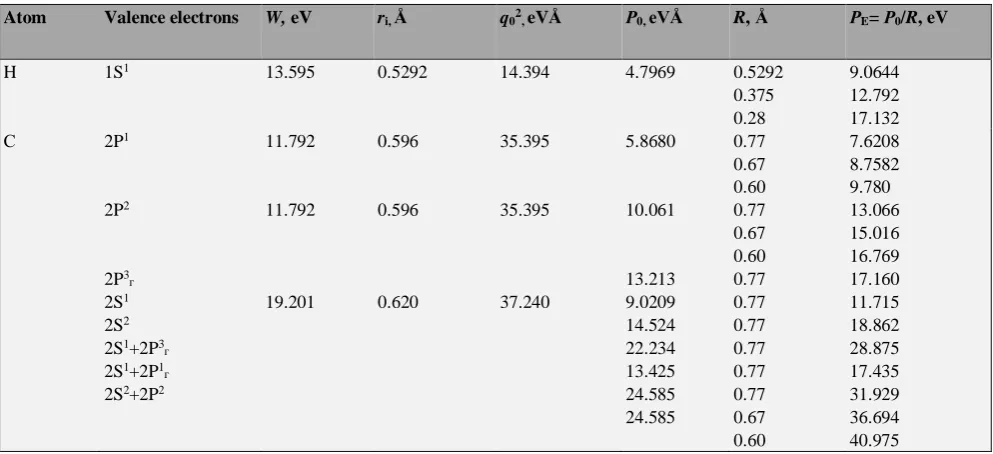
Table 2. Р-parameters of atoms calculated via the electron bond energy.
Atom Valence electrons W, eV ri, Å q02
, eVÅ Р0, eVÅ R, Å РE= Р0/R, eV
H 1S1 13.595 0.5292 14.394 4.7969 0.5292
0.375 0.28
9.0644 12.792 17.132
С 2P1
2P2
2P3г
2S1
2S2
2S1+2P3г
2S1+2P1г
2S2+2P2
11.792
11.792
19.201
0.596
0.596
0.620
35.395
35.395
37.240
5.8680
10.061
13.213 9.0209 14.524 22.234 13.425 24.585 24.585
0.77 0.67 0.60 0.77 0.67 0.60 0.77 0.77 0.77 0.77 0.77 0.77 0.67 0.60
N 2P1
2P2
2P3
2S2
2S2+2P3
15.445
25.724
0.4875
0.521
52.912
53.283
6.5916
11.723
15.830
17.833 33.663
0.70 0.55 0.70 0.63 0.70 0.55 0.70 0.70
9.4166 11.985 16.747 18.608 22.614 28.782 25.476 48.090
O 2P1
2P1
2P2
2P4
2S2
2S2+2P4
17.195
17.195
17.195
33.859
0.4135
0.4135
0.4135
0.450
71.383
71.383
71.383
72.620
6.4663
11.858
20.338
21.466 41.804
0.66 0.55 0.66 0.59 0.66 0.59 0.66 0.66 0.59
9.7979 11.757 17.967 20.048 30.815 34.471 32.524 63.339 70.854
The solution of this equation via the reduced mass () is the Lagrangian equation for the relative motion of the isolated system of two interacting material points with masses m1 and m2, which in coordinate х is as follows.
𝜇 ∙ 𝑥"= −𝑈
𝑥 (6)
Here U is the mutual potential energy of material points, is reduced mass. At the same time, х″ = a (feature of the system acceleration). For initial portions of the interactions
∆х can be taken as follows.
𝑈𝑥 ≈∆𝑈
∆𝑥 (7a)
that is
𝜇𝑎∆𝑥 = −∆𝑈 (7b)
then
1 1/(𝑎∆𝑥)×
1
(1/𝑚1+1/𝑚2)≈ −∆𝑈 (7c)
and
1
1/(𝑚1𝑎∆𝑥)+1/(𝑚2𝑎∆𝑥)≈ −∆𝑈 (8)
or
1
∆𝑈≈ 1
∆𝑈1+ 1
∆𝑈2 (9)
where ∆U1 and ∆U2 are potential energies of material points on the elementary portion of interactions and ∆U is the resulting (mutual) potential energy of these interactions. Therefore:
1. In the systems in which the interactions proceed along the potential gradient (positive performance), the resulting potential energy is found based on the principle of adding reciprocals of the corresponding energies of subsystems.5
Similarly, the reduced mass for the relative motion of two-particle system is calculated.
energies of subsystems, is performed (by the analogy with Hamiltonian).
Spatial-energy parameter (P-parameter)
From the Eqn. (9) it is seen that the resulting energy characteristic of the system of two material points interaction is based on the principle of adding reciprocals of initial energies of interacting subsystems.
Electron with mass m moving near the proton with mass
М is equivalent to the particle with mass as given in eqn. (10).6
𝜇 = 𝑚𝑀
𝑚+𝑀 (10)
Therefore, when modifying the eqn. (6), we can assume that the energy of atom valence orbitals (responsible for interatomic interactions) can be calculated5 by the principle
of adding reciprocals of some initial energy components based on the following equations.
1 𝑞2/𝑟
i+ 1 𝑊i𝑛i=
1
𝑃E (11)
1 𝑃0=
1 𝑞2+
1
(𝑊𝑟𝑛)i (12)
𝑃E= 𝑃0
𝑟i (13)
Here Wi is the electron orbital energy,7ri is orbital radius
of i–orbital,8q=Z*/n*,9n
i is the number of electrons of the
given orbital, Z* and n* are nucleus effective charge and effective main quantum number and r is the bond dimensional characteristics.
Р0 was called spatial-energy parameter (SEP), and РE –
electron-[𝑃0] = [𝑞2] = [𝐸] × [𝑟] = [ℎ] × [𝑣] = 𝑘𝑔×𝑚3
𝑠2 = 𝐽 × 𝑚
(14)
where [E], [h] and [υ] are dimensions of energy, Planck’s constant and velocity, respectively. Thus Р-parameter corresponds to the processes going along the potential gradient.The introduction of Р-parameter should be considered as further development of quasi-classical notions using quantum-mechanical data on atom structure to obtain the criteria of energy conditions of phase-formation. At the same time, for the systems of similarly charged homogeneous systems (e.g., orbitals of the given atom) the principle of algebraic addition of such parameters is preserved.
∑ 𝑃E= ∑(𝑃0/𝑟) (15)
or
𝑟 ∑ PE= ∑ 𝑃0 (16)
The Р-parameters of valence orbitals of all the atoms are given in Table 2.
According to the established rule5 about addition of P
-parameters of similarly charged or homogeneous systems for two orbitals in the given atom with different quantum characteristics and also according to the energy conservation rule we have eqn. (17), where Ek=mv2/2 and is electron
kinetic energy.
𝑑2𝑃0
𝑑𝑥2 + 8𝜋2𝑚
ℎ2 𝑃0𝐸k= 0 (17)
Schrodinger equation for the stationery state in coordinate
х is given in eqn. (18).
𝑑2𝜓 𝑑𝑥2+
8𝜋2𝑚
ℎ2 𝜓𝐸k= 0 (18)
By comparing these two equations, we see that Р0
-parameter correlates numerically with the values of 𝜓 -function i.e., 𝑃0≈ 𝜓, and is generally proportional to it or
Р0~ 𝜓. Taking into account the broad practical opportunities
of applying the P-parameter methodology, we can consider this parameter as the materialized analog of 𝜓-function. Since Р0-parameters like 𝜓-functions have wave properties,
the superposition principles should be fulfilled for them also, defining the linear character of the equations of adding and changing P-parameters.
Structural exchange spatial-energy interactions
In the process of solid solution formation and other structural equilibrium-exchange interactions the single electron density should be set in the points of atom-component contact. This process is accompanied by the redistribution of electron density between the valence areas of both particles and transition of the part of electrons from some external spheres into the neighbouring ones.
Apparently, the frame atom electrons do not take part in such exchange.
Obviously, when electron densities in free atom-components are similar, the transfer processes between boundary atoms of particles are minimal. This will be favourable for the formation of a new structure. Thus, the evaluation of the degree of structural interactions in many cases means the comparative assessment of the electron density of valence electrons in free atoms (on averaged orbitals) participating in the process, which can be correlated with the help of P-parameter model.
The less is the difference (Р'0/r'i – P"0/r"i), the more
favourable is the formation of a new structure or solid solution from the energy point of view.
In this regard, the maximum total solubility, evaluated via the coefficient of structural interaction , is determined by the condition of minimum value, which represents the relative difference of effective energies of external orbitals of interacting subsystems (eqns. 19 and 20), where РS, the
structural parameter is found by the eqn. (21), where N1 and N2 are the number of homogeneous atoms in subsystems.
(Table 3).
𝛼 = 𝑃′o/𝑟′i−𝑃"o/𝑟"i (𝑃′
o/𝑟′i−𝑃"o/𝑟"i)/2100% (19)
𝛼 =𝑃′c−𝑃"c
𝑃′c+𝑃"c200% (20)
1
𝑃c= 1
𝑁1𝑃′E+ 1
𝑁2𝑃"E+ ⋯ (21)
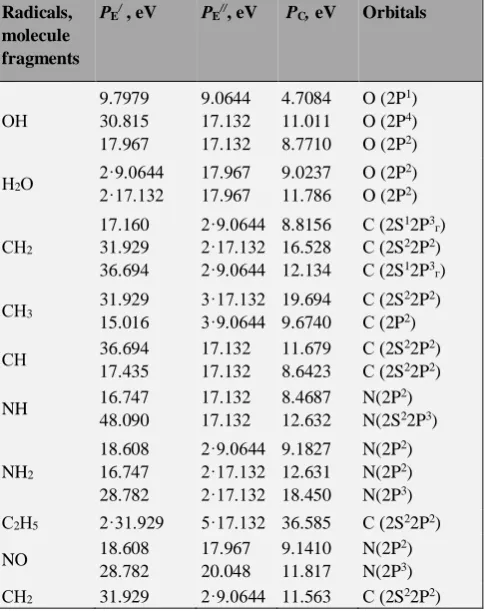
Table 3.Structural РC-parameters calculated via the electron bond
energy.
Radicals, molecule fragments
РE/ , eV РE//, eV PC, eV Orbitals
ОН
9.7979 30.815 17.967
9.0644 17.132 17.132
4.7084 11.011 8.7710
O (2P1)
O (2P4)
O (2P2)
Н2О
2·9.0644 2·17.132
17.967 17.967
9.0237 11.786
O (2P2)
O (2P2)
СН2
17.160 31.929 36.694
2·9.0644 2·17.132 2·9.0644
8.8156 16.528 12.134
С (2S12P3г)
С (2S22P2)
С (2S12P3г)
СН3
31.929 15.016
3·17.132 3·9.0644
19.694 9.6740
С (2S22P2)
С (2P2)
СН 36.694
17.435
17.132 17.132
11.679 8.6423
С (2S22P2)
С (2S22P2)
NH 16.747
48.090
17.132 17.132
8.4687 12.632
N(2P2)
N(2S22P3)
NH2
18.608 16.747 28.782
2·9.0644 2·17.132 2·17.132
9.1827 12.631 18.450
N(2P2)
N(2P2)
N(2P3)
С2Н5 2·31.929 5·17.132 36.585 С (2S22P2)
NO 18.608
28.782
17.967 20.048
9.1410 11.817
N(2P2)
N(2P3)
СН3 16.769 3·17.132 12.640 С (2P2)
СН3 17.160 3·17.132 12.865 С (2P3г)
СО–ОН 8.4405 8.7710 4.3013 С (2P2)
СО 31.929 20.048 12.315 С (2S22P2)
С=О 15.016 20.048 8.4405 С (2P2)
С=О 31.929 34.471 16.576 О (2P4)
СО=О 36.694 34.471 17.775 О (2P4)
С–СН3 31.929 19.694 12.181 С (2S22P2)
С–СН3 17.435 19.694 9.2479 С (2S12P1)
С–NH2 31.929 18.450 11.693 С (2S22P2)
С–NH2 17.435 18.450 8.8844 С (2S12P1)
С–ОН 8.7572 8.7710 4.3821
Applying the reliable experimental data we obtain the nomogram of structural interaction degree dependence (𝜌) on coefficient , for a wide range of structures (Figure 1).
Figure 1. Nomogram of structural interaction degree dependence (ρ) on coefficient α. The curve 2 is for biosystems.
This approach gives the possibility to evaluate the degree and direction of the structural interactions of phase formation, isomorphism and solubility processes in multiple systems, including molecular ones.
Corpuscular-wave mechanism
The formalism of the Eqns. (11), (12) and (21) is not principally new. Already in 1924 the following equation was obtained based on Compton’s effect.
1
ℎ𝑣′= 1
ℎ𝑣+ 1−cos 𝜃
𝑚𝑐2 (22)
Here, hν' the energy of scattered photon, hν is energy of
incident photon, mc2 is the own energy of electron and is
the scattering angle. At the same time, the energy of photons decreases by the value additionally obtained by the electron. In this way the act of quantum action takes place, resulting in the energy redistribution between the corpuscular and wave properties of the interacting systems. In this process, the same as in photo effect, the interaction proceeds along the potential gradient and the work is positive.
During the quantum transitions in the atom, similarly charged particles (electrons) interact by irradiation, i.e., by
It is known that a particle can have three main motions, translational, rotational and oscillatory. But quantum mechanics does not consider the issue of electron trajectory as we can speak only of the possibility of its location in the given point in space. But an electron also moves if this translational motion goes along the potential gradient, then it corresponds to corpuscular process, and rotational motion to wave one. Electric current is the motion of electrons along the potential gradient.
If we assume that the magnetic field generated by it is a wave process, there has to be a ratio between the electric and magnetic constants. The difference of phases of electric and magnetic oscillations in electromagnetic wave is π/2. Having introduced the coefficient (2/π)2, we have the
equation for Plank’s constant with the accuracy close to the initial data themselves.
ℎ = (4/𝜋2+ 𝑎)𝑃𝑒𝜀/𝜇 (23)
Here а = 0.0023293 and is defined as experimental quantum correction to spin gs-factor of the electron, ɛ is the electric
constant, µ = magnetic constant and h is Plank’s constant. For a free electron Pе = Wr, where W = 0.510034 МeV =
0.81872x10⁻¹³ J. The value of classical radius of electron r =
2.81794x10⁻¹⁵ m was used as the dimensional characteristic
and, therefore, Ре = 2.30712x10⁻²⁸ Jm.
The proportionality coefficient in the eqn. (23) has the velocity dimensionality (m s-1) for the ratio (F/H
n), i.e. in
such way the rate of energy redistribution in the system “particle-wave” is characterized. Therefore, the act of quantum action expressed via Planck’s constant is narrowed to the energy equilibrium-exchange redistribution between the corpuscular and wave processes.
Generalizing the formalism of the eqns. (11), (12) and (21) onto all other interactions flowing along the potential gradient, we can make the conclusion that corpuscular processes take place in these cases, and wave dualism corresponds to the interactions against the potential gradient.
Corner angles
Let us consider some macro processes important in this case. The silkworm winds the natural (organic) silk thread only at a definite rotation angle. In cosmonautics the cellulose-viscose thread is wound around the metal cylinder of the spaceship following the special technology, and, what is important, at the same winding angle as the silkworm. The spaceship becomes most durable, more technologically high-quality and lighter.11-13 We can also speak of other
examples of such phenomenon. This angle (mainly as applicable to organic systems) was called the geodesic angle: φg = 54.73º = 54º44'.
The notions of breaking stress in the process of plastics stretching by its winding pitch has been reported in literature,12,13 where σα = axial and σβ = circumferential
stress, which are replaced by the value Nα = axial effort and Nβ = circumferential effort proportional to them. At the
This condition allows the formation of equally tensioned system of threads with the minimal item weight.13 Thus, the
rotation angle numerically determines the ratio of two legs of the triangle, whose values characterize energy and dependencies in the system with quantum and wave processes through axial and circumferential stresses.
All this is broadly demonstrated in macro- and micro-processes. Below are some examples.
(1) Characteristic of spin-orbital interaction – constant of fine structure α = r/λ, where r = classical radius of electron, λ = its Compton wavelength.
(2) Formally, but similarly: the interaction force of two long conductors with current is proportional to the ratio l/2πr, where l = length of conductors and r is the distance between them.
(3) π equals the ratio of circumference length to its diameter.
(4) In quantum mechanics the ratio of magnetic moment to its mechanical moment is called the magnetomechanic ratio, g. At the same time, gs = 2, if the magnetic moment of
an electron is conditioned only by the spin component, and g = 1, if it is produced by the orbital motion of electrons. Their ratio gs/g = 2, the same as tg2φg =2, which
characterizes the existing corpuscular-wave dependencies.
In these examples, as in many others, such approach allows evaluation of structural interactions based on corpuscular and wave dependencies in each action act, e.g., in the equation of dependence of rotational and orbital motion of planets.14 Using the algorithm in the ratio ρ/α to
obtain the linear dependence with the rotation angle φ and in accordance with the Eqn. (24) we have:
ln(ρ/α)= tgφ (25)
In homogeneous systems with the closeness of values of their P-parameters (wave process) if α→0, then tgφ→∞ and
φ=90°. In the corpuscular mechanism of interaction if α→∞, then tgα→0, and φ=0. In general case, in the system “particle-wave” the rotation angle φ changes from 0° (at ρ = 0 %) up to 90° (at ρ = 100 %). It can be assumed that equally strained system is obtained under the condition of approximate equality of corpuscular and wave parameters, i.e. at the geodesic angle ρ = 50 %. Then the calculation of the coefficient α by the eqn. (25) gives 12.16 %, approximately corresponding to the coordinates obtained in nomogram in figure 1. Similar types by this nomogram and its reverse-reading variants are the graphic characteristics of many phenomena and processes in nature, engineering and economy. Therefore, such S-curves have been called “Lines of life”.
Bio-structural energy criteria of functional states
Isomorphism as a phenomenon is usually considered as applicable to crystal structures. But, obviously, similar processes can also flow between molecular compounds, where the bond energy can be evaluated via the relative difference of electron densities of valence orbitals of interacting atoms. Therefore, the molecular electronegativity
is quite easily calculated via the values of the corresponding
P-parameters. Since Р-parameter possesses wave properties (similar to φ-function), mainly the regularities in the interference of the corresponding waves should be fulfilled. The minimum interference, oscillation weakening (in anti-phase), takes place if the difference in wave move (∆) equals the odd number of semi-waves (eqn. 26).
∆= (2𝑛 + 1)𝜆
2= 𝜆(𝑛 + 1
2) where n = 0, 1, 2, 3 (26)
The difference in wave move (∆) for Р-parameters can be evaluated via their relative value.
…. 𝛾 =𝑃2
𝑃1= (𝑛 + 1 2) =
3 2,
5
2 (27)
Maximum interference, oscillation enhancing (in phase), takes place if the difference in wave move equals an even number of semi-waves.
Δ = 2𝑛𝛾
2= 𝛾𝑛 or Δ = 𝛾(𝑛 + 1) (28)
As applicable to P-parameters, the maximum enhancement in interaction in the phase corresponds to the interactions of similarly charged systems or systems homogeneous by their properties and functions (e.g. between the fragments or blocks of complex organic structures, such as CH2 and NNO2). And then
𝛾 =𝑃2
𝑃1= (𝑛 + 1) (29)
It has been shown15 that the molecular negativity is
numerically equal to the P-parameter of the first valence electron divided by 3. Hydrogen atom, element No 1 with orbital 1S1 defines the main energy criteria of structural
interactions (their “ancestor”).
Table 1 shows its three РE-parameters corresponding to
three different characteristics of the atom.
R1 = 0.5292 Å, the orbital radius, a quantum-mechanical
characteristic gives the initial main value of РE-parameter
equal to 9.0644 eV. R2 = 0.375 Å, a distance equal to the
half of the bond energy in Н2 molecule. But if hydrogen
atom is bound with other atoms, its covalent radius is 0.28 Å.
In accordance with equation (23) Р2 = Р1(n+1), therefore Р1
9.0644 eV, Р2 18.129 eV. These are the values ofpossible energy criteria of stable (stationary) structures. The dimensional characteristic 0.375 Ådoes not satisfy them, therefore, there is a transition onto to the covalence radius
0.28 Å, which provides the value of P-parameter approximately equal to Р2.It was shown earlier5 that the condition for the formation
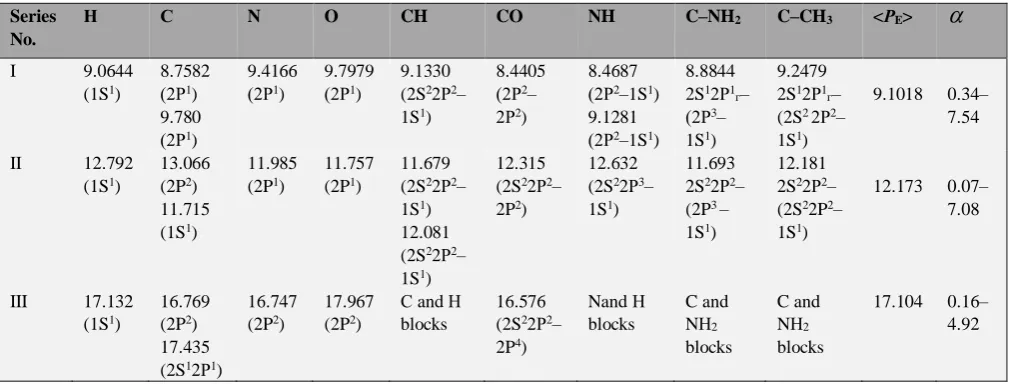
First series for РE = 9.0644 eV, the initial satge, where Н,
С, О, N atoms have РE-parameters only of the first electron
and interactions proceed in the phase.
Second series for Р'E = 12.792 eV is the non-rational and
pathological as it more corresponds to the interactions in anti-phase by eqn. (27) and Р''E = 13.596 eV. Coefficient α
between the parameters Р'E and Р''E equals 6.1 %, thus
defining the possibility of forming “false” biostructures containing the molecular hydrogen. Coefficient between series I and II is 34.1 %, thus confirming the irrationality of series II.
Third series for Р'E = 17.132 eV and is stationary as the
interactions are in the phase. By eqn. (27) Р''E = 18.129 eV
(= 5.5 %).
Table 4. Biostructural spatial-energy parameters (eV).
Series No.
Н С N O CH CO NH C–NH2 C–CH3 <РE>
I 9.0644
(1S1)
8.7582 (2Р1)
9.780 (2Р1)
9.4166 (2Р1)
9.7979 (2Р1)
9.1330 (2S22Р2–
1S1)
8.4405 (2Р2–
2Р2)
8.4687 (2Р2–1S1)
9.1281 (2Р2–1S1)
8.8844 2S12Р1г–
(2Р3–
1S1)
9.2479 2S12Р1г–
(2S2 2Р2–
1S1)
9.1018 0.34– 7.54
II 12.792
(1S1)
13.066 (2P2)
11.715 (1S1)
11.985 (2P1)
11.757 (2P1)
11.679 (2S22Р2–
1S1)
12.081 (2S22Р2–
1S1)
12.315 (2S22Р2–
2P2)
12.632 (2S22Р3–
1S1)
11.693 2S22Р2–
(2P3 –
1S1)
12.181 2S22Р2–
(2S22P2–
1S1)
12.173 0.07– 7.08
III 17.132 (1S1)
16.769 (2P2)
17.435 (2S12Р1)
16.747 (2P2)
17.967 (2P2)
С and Н blocks
16.576 (2S22Р2–
2P4)
Nand Н blocks
C and NН2
blocks
C and NН2
blocks
17.104 0.16– 4.92
Effect of specific local energy (electromagnetic fields, radiation, etc.) upon structural conformations can increasingly follow the pathological series II. It may be one of the reasons of normal functioning failure in biosystems, e.g., in oncological diseases. If so, some practical recommendations can be done, which come down to the necessity of converting the molecular hydrogen into the atomic one, e.g., through the interaction with hydroxyl OH group.
From Table 4 it is seen that the majority of atoms and radicals, depending on the bond types and bond lengths, have РE-parameters of different series. When introducing the stem cells, it is important for the molecular hydrogen should not be present in their structures. Otherwise atoms and radicals can transfer into the series II and disturb the vital functions of the main first system.
Conclusion
1. It is demonstrated that corpuscular interactions flow along the potential gradient (principle of adding reciprocals of energies), and wave processes flow against the potential gradient (principle of algebraic addition of energies).
2. Р-parameters of the first valence electron of atoms define the energy characteristics of stationary states (in normal state) under the condition of the maximum of wave processes.
3. Under the condition of the minimum of such
References
1Rubin A. B., Biophysics, Book 1, Theoretical biophysics,
Vysshaya shkola, Moscow, 1987, 319.
2Dirac, P. A., Quantum Mechanics, Oxford University Press,
London, 1935.
3Anderson, P. W., in Magnetism, Vol. 1, Academic Press, New
York, 1963, 25.
4Blokhintsev, D. I., Basics of quantum mechanics, Vysshaya shkola,
1961, 512.
5Korablev, G. A., Spatial-Energy Principles of Complex Structures Formation, Brill Academic Publishers and VSP, Netherlands, 2005, 426.
6Eyring, G., Walter, J., Kimball, G., Quantum chemistry, Wiley
and Sons, New York, London, 1948, 528.
7Fischer C. F., Average-energy-of-configuration Hartree-Fock
results for the atoms helium to radon, Atomic Data and
Nuclear Tables, 1972, 4, 301-399.
https://doi.org/10.1016/S0092-640X(72)80008-1
8Waber, J. T., Cromer, D. T., Orbital Radii of Atoms and Ions, J. Chem. Phys., 1965, 42, 4116-4123.
https://doi.org/10.1063/1.1695904
9Clementi, E., Raimondi, D. L., Atomic Screening Constants from
SCF Functions, J. Chem. Phys., 1963, 38, 2686-2689.
https://doi.org/10.1063/1.1733573
10Korablev, G. A., Kodolov, V. I., Lipanov, A. M., Analog
comparison of Lagrange and Hamilton Functions with a spatial and energy parameter, Khim. Fiz. Mezoshkopiya, (Chem. Phys. Mesoscopy), 2004, 6, 5-18.
11Pidgainy, Yu. M., Morozova, V. M., Dudko, V. A., Mechanics of Polymers, 1967, 1096-1104.
13Kodolov, V. I., Polymeric composites and technology of producing aircraft engines from them, Izhevsk Mechanical Institute, 1992, 200.
14Korablev, G. A., Dynamics of rotational motions in macro- and
microsystems, Eur. Chem. Bull., 2017, 6(2), 79-82. DOI: 10.17628/ecb.2017.6.79-82.
15Korablev, G. A., Spatial-energy parameter and its application in research, LAP LAMBERT Academic Publishing, Germany, 2016. 1-65.