Available online throug
ISSN 2229 – 5046
ON THE WIENER AND HYPER WIENER INDICES
OF CERTAIN DOMINATING TRANSFORMATION GRAPHS OF KRAGUJEVAC TREES
B. BASAVANAGOUD*
1, SUJATA TIMMANAIKAR
21
Department of Mathematics, Karnatak University, Dharwad-580 003, India.
2
Department of Mathematics, Government Engineering College-581 110, Haveri, India.
(Received On: 15-12-16; Revised & Accepted On: 23-01-17)
ABSTRACT
L
etG
be a graph. The distanced
G(
u
,
v
)
between the verticesu
andv
of the graphG
is equal to the length of the shortest path that connectsu
andv
.
The Wiener indexW
(
G
)
is the sum of distances between all pairs of vertices ofG
,
whereas the hyper-Wiener indexWW
(
G
)
is defined as [ ( , ) ( , ) ]2 1 = )
( 2
) ( ) , (
v u d v u d G
WW G G
G V v u
+
∑
⊆
.
In this paper Wiener and hyper-Wiener indices are obtained for dominating transformation(d-transformations) graphs of Kragujevac tree
T
.Keywords: distance, Wiener index, hyper-Wiener index, d-transformation graphs.
Subject Classification: 05C05, 05C07, 05C69.
1. INTRODUCTION
In this paper we are concerned with simple graphs, having no directed or weighted edges, and no self loops. Let
)
,
(
=
V
E
G
be such a graph. The number of vertices ofG
we denote byn
and the number of edges we denote by,
m
thus|
V
(
G
)
|=
n
and|
E
(
G
)
|=
m
. By the open neighborhood of a vertexv
ofG
we mean the set)}
(
:
)
(
{
=
)
(
v
u
V
G
uv
E
G
N
G∈
∈
. The distanced
G(
u
,
v
)
between the verticesu
andv
of the graphG
is equal to the length of a shortest path that connectsu
andv
. LetS
be a finite set and letF
=
{
S
1,
S
2,...,
S
n}
be a partition ofS
.
Then the intersection graphΩ
(
F
)
ofF
is the graph whose vertices are the subsets inF
and in which two verticesS
i andS
j are adjacent if and only ifS
i∩
S
j≠
Φ
.
For terminology not defined here we referthe reader to [6].
A topological index of a graph is a single unique number characteristic of the graph and is mathematically invariant under graph automorphism. Usage of topological indices in biology and chemistry began in 1947 when H. Wiener [17, 18] introduced Wiener index which is denoted by W and is given by
)
,
(
=
)
(
) ( ) , (
v
u
d
G
W
GG V v u
∑
⊆The hyper-Wiener index of acyclic graphs was introduced by Milan Randic in 1993. Then Klein et al. [11], generalized Randic’s definition for all connected graphs, as a generalization of the Wiener index. It is defined as
]
)
,
(
)
,
(
[
2
1
=
)
(
2) ( ) , (
v
u
d
v
u
d
G
WW
G GG V v u
+
∑
⊆
Further, information about Wiener index and hyper-Wiener index are given in [2, 3, 4, 9, 10, 19].
Corresponding Author: B. Basavanagoud*
1graphs of Kragujevac trees / IJMA- 8(1), Jan.-2017.
2. KRAGUJEVAC TREES
A connected acyclic graph is called a tree. A rooted tree is a tree in which one particular vertex is distinguished; this vertex is referred to as the root. The vertex of degree one is a pendant vertex. The vertex adjacent to pendant vertex is called support vertex. The formal definition of a Kragujevac tree was introduced in [5].
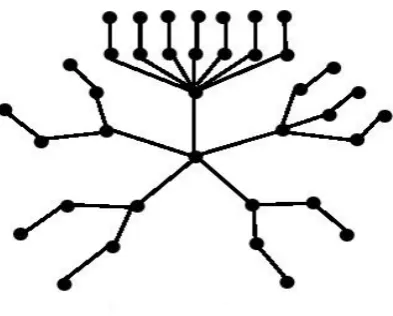
Definition 1. [5]: Let
P
3 be the 3-vertex tree,rooted at one of its terminal vertices.Fork
=
2,3,...
, construct the rooted treeB
k by identifying the roots of k copies ofP
3. The vertex obtained by identifying the rootsP
3-trees is the root ofB
k.Examples illustrating the structure of the rooted tree
B
k depicted in Figure 1.Figure 1 : Tℎe structure of the rooted tree Bk
Definition 2.[5]: Let
d
≥
2
be an integer. Letβ
1,
β
2,
β
3...
β
d be rooted trees specified in Definition 1, i.e.,,...}
,
{
...,
,
,
2 3 2 31
β
β
β
d∈
B
B
β
. A Kragujevac tree T is a tree possessing a vertex of degree d, adjacent to the roots ofd
β
β
β
β
1,
2,
3...,
. This vertex is said to be the central vertex of T, where d is the degree of T. The subgraphsd
β
β
β
β
1,
2,
3...,
are the branches of T. Recall that some (or all) branches of T may be mutually isomorphic.A typical Kragujevac tree of degree d=5 is depicted in Figure 2.
Figure 2: Kragujevac tree of degree d = 5
Clearly, the branch
B
k has 2k+1 vertices. Therefore, the vertex set and the edge set of the Kragujevac tree T are:1)
(2
=
)
(
1)
(2
1
=
)
(
1 = 1
=
+
+
+
∑
∑
d ii i
d
i
k
T
E
and
k
T
V
We denote the vertices of Kragujevac trees as follows:
• pendant vertices by
x
i• support vertices by
w
i• vertices belongs to the set
N
(
w
i)
−
{
x
i}
ik=1 byv
i• the central vertex by
u
3. d-TRANSFORMATION GRAPHS
The theory of domination has emerged as one of the most studied area in graph theory and its allied branch in mathematics. The wide variety of domination parameters have been defined and studied their applications in various fields [7]. A subset
D
⊆
V
(
G
)
is a dominating set ofG
if every vertex ofV
(
G
)
\
D
has a neighbor in D. Thedomination number of graph
G
, denoted byγ
(
G
)
, is the minimum cardinality of a dominating set ofG
.
The dominating setD
is called a minimal dominating set if no proper subset ofD
is a dominating set. For a comprehensive survey of domination in graphs, see [8].In the mathematical literature several transformation graphs have been considered and constructed. Let G denote the set of simple undirected graphs. Various important results in graph theory have been obtained by considering some functions F : G→ G or Fs : G1× …× Gs→ G called transformations or operations (here each Gi = G ) and by establishing how these operations affect certain properties or parameters of graphs. The complement, the k-th power of graph, line graph and the total graph are well known examples of such transformations or operations. The same concept of transformation has been applied to dominating sets and defined a variety of dominating transformation(d-transformation) graphs by Prof. V.R.Kulli and his students [12, 13, 14, 15, 16]. In what follows we define the best known representatives of such graphs.
The minimal dominating graph MD(G) of a graph
G
is the intersection graph defined on the family of all minimal dominating sets of vertices inG
[12].The common minimal dominating graph CD(G) of a graph
G
is the graph having same vertex set asG
with two vertices are adjacent if and only if there exist a minimal dominating set inG
containing them [13].The vertex minimal dominating graph
M
vD
(
G
)
of a graphG
=
(
V
,
E
)
is a graph withS
V
V
G
D
M
V
(
v(
))
=
′
=
∪
, whereS
is the collection of all minimal dominating sets ofG
with two verticesV
v
u
,
∈
′
are adjacent if and only if they are adjacent inG
orv
=
D
is a minimal dominating set ofG
containingu
[14].The dominating graph D(G) of a graph
G
=
(
V
,
E
)
is a graph withV
(
D
(
G
))
=
V
∪
S
,
whereS
is the set of all minimal dominating set ofG
and with two verticesu
,
v
∈
V
(
D
(
G
))
are adjacent ifu
∈
V
andv
=
D
is a minimal dominating set ofG
containingu
[15].graphs of Kragujevac trees / IJMA- 8(1), Jan.-2017.
In Figure 4, Kragujevac tree 𝑇𝑇 and its d-transformation graphs 𝑀𝑀𝑀𝑀(𝑇𝑇),𝐶𝐶𝑀𝑀(𝑇𝑇),𝑀𝑀𝑣𝑣𝑀𝑀(𝑇𝑇) 𝑎𝑎𝑎𝑎𝑎𝑎 𝑀𝑀(𝑇𝑇) are given.
4. COMPUTING WIENER INDEX FOR MD(T) ,CD(T), MvD(T)AND D(T) OF KRAGUJEVAC TREE T. We begin with the following straightforward, previously known auxiliary result.
Lemma 1: The dominating sets of Kragujevac tree
T
are:1
=1
=
,
k
i i
D
u
w
∑
2
=1
=
,
k
i i
D
u
x
∑
3
=1 =1
=
,
d k
i i
i i
D
v
w
∑ ∑
4
=1 =1
=
,
d k
i i
i i
D
v
x
∑ ∑
Theorem 2: The Wiener index of the minimal dominating graph of Kragujevac tree
T
isW
(
MD
(
T
))
=
8.
Proof: Let
T
be any Kragujevac treeT
of degreed
≥
2.
Then by Lemma 1, there exist four minimal dominating sets namelyD
1,
D
2,
D
3and
D
4.
Hence by the definition ofMD
(
G
)
, the vertex set of the minimal dominating graph of Kragujevac tree two vertices. Therefore,d
MD(T)(
u
,
v
)
=
1
if u and v are minimal dominating sets with common vertex, otherwised
MD(T)(
u
,
v
)
=
2.
Now by employing definition of Wiener index we get8.
=
))
(
(
MD
T
W
Before going to prove our next result we need the following lemma.
Lemma 3: The distance between each vertex in the common minimal dominating graph of Kragujevac tree T is:
1.
d
CD(T)(
u
,
v
i)
=
2
2.
d
CD(T)(
u
,
x
i)
=
1
3.
d
CD(T)(
u
,
w
i)
=
1
4. ( ) =1
,
= 1
d
CD T i i
i
d
x
v
∑
5. ( ) =1
,
= 2
k
CD T i i
i
d
x
w
∑
6.
d
CD(T)(
x
i,
x
j)
=
1
7.
d
CD(T)(
w
i,
w
j)
=
1
8.
d
CD(T)(
v
i,
v
j)
=
1
9. ( )
=1
,
= 1.
d
CD T i i
i
d
w
v
∑
Theorem 4: The Wiener index of the common minimal dominating graph of Kragujevac tree T is
.
]
2[
=
)]
(
[
CD
T
k
2kd
k
C
2d
C
2W
+
+
+
k+
+
dProof: By the definition of
CD
(
G
)
it is clear thatV
(
CD
(
T
))
=
V
(
T
).
By using the definition of Wiener index and Lemma 3, we have)
,
(
=
))
(
(
( )) , (
v
u
d
T
CD
W
CDTgraphs of Kragujevac trees / IJMA- 8(1), Jan.-2017.
)
,
(
)
,
(
)
,
(
=
( )1 = )
( 1 = )
( 1 =
i T CD k
i i T CD k
i i T CD d
i
w
u
d
x
u
d
v
u
d
∑
∑
∑
+
+
+
+
+
+
∑
∑
(
,
)
∑
(
,
)
∑
( )(
,
)
< )
( 1 = )
( 1 = 1 =
j i T CD j i i i T CD k
i i i T CD d
i k
i
x
x
d
w
x
d
v
x
d
)
,
(
)
,
(
)
,
(
( )1 = 1 = )
( < )
( <
i i T CD d
i k
i j i T CD j i j i T CD j i
v
w
d
v
v
d
w
w
d
∑
∑
∑
∑
+
+
+
)
(
(2)]
[
)
(
(1)
(1)
2
=
))
(
(
CD
T
d
k
k
k
d
k
k
C
2C
2C
2k
d
W
+
+
+
+
+
k+
k+
d+
.
]
2[
=
k
2+
k
+
kd
+
kC
2+
d
+
dC
2Thus, the result follows.
Lemma 5: The distance between each vertex in the vertex minimal dominating graph of Kragujevac tree
T
is:1. D(T)
(
,
i)
=
1
v
M
u
v
d
2. D(T)
(
,
i)
=
3
v
M
u
x
d
3. D(T)
(
,
i)
=
2
v
M
u
w
d
4. ( ) =1
,
= (3
2)
k
M D Tv i i
i
d
x
w
k
−
∑
5. ( ) =1
,
= 2
d
M D Tv i i
i
d
x
v
d
∑
6. ( )
=1
,
= 2
1
k
M D Tv i i
i
d
w
v
d
−
∑
7. D(T)
(
i,
j)
=
2
v
M
x
x
d
8. D(T)
(
i,
j)
=
2
v
M
w
w
d
9. D(T)
(
i,
j)
=
2
v
M
v
v
d
10.
4
( ) =1
,
= 6
M D Tv i
i
d
u
D
∑
11.
4
( ) =1
,
= 6
M D Tv i i
i
d
x
D
∑
12.
4
( )
=1
,
= 6
M D Tv i i
i
d
w
D
∑
13.
4
( ) =1
,
= 6
M D Tv i i
i
d
v
D
∑
14. ( )
(
,
)
=
14.
<
j i T D v M j i
D
D
d
∑
Theorem 6: The Wiener index of the vertex minimal dominating graph of Kragujevac tree
T
is20.
7
2
4
14]
4
[3
=
)]
(
[
M
D
T
k
k
+
d
+
+
C
2+
C
2+
d
+
W
v k dProof: By the definition of
M
vD
(
G
),
V
(
M
vD
(
T
))
=
V
∪
S
,
whereS
=
{
D
1,
D
2,
D
3,
D
4}
. By using the definition of Wiener index and Lemma 5, we have,)
,
(
=
))
(
(
( )) , (
v
u
d
T
D
M
W
MvDTV v u
v
∑
)
,
(
)
,
(
)
,
(
)
,
(
=
1 = ) ( 1 = )
( 1 = )
( 1 = )
( 1 =
i k
i i T D v M k
i i T D v M k
i i T D v M k
i i T D v M d
i
w
x
d
w
u
d
x
u
d
v
u
d
∑
∑
∑
∑
∑
+
+
+
( ) ( ) ( )
=1 =1 =1 =1 <
,
,
( ,
)
k d k d
M D Tv i i M D Tv i i M D Tv i j
i i i i i j
d
x
v
d
w
v
d
x x
+
+
+
∑
∑
∑
∑
∑
4 4
( ) ( ) ( ) ( )
< < =1 =1 =1
(
,
)
( ,
)
,
,
k
M D Tv i j M D Tv i j M D Tv i M D Tv i i
i j i j i i i
d
w w
d
v v
d
u
D
d
x
D
+
+
+
+
∑
∑
∑
∑
∑
4 4
( ) ( ) ( )
=1 =1 =1 =1 <
,
,
(
,
)
k d
M D Tv i i M D Tv i i M D Tv i j
i i i i i j
d
w
D
d
v
D
d
D D
+
+
+
∑
∑
∑
∑
∑
2 2
2
2
(6)
1)
(2
(6)
)
(
2
2)
(3
6
(2)
(3)
(1)
=
d
+
k
+
k
+
+
k
−
k
+
d
k
+
k
+
d
−
k
+
k
+
kC
+
kC
14
6
2
2+
+
+
dC
d
20.
7
2
4
14]
4
[3
=
)]
(
[
M
D
T
k
k
+
d
+
+
C
2+
C
2+
d
+
W
v k dLemma 7: The distance between each vertex in the dominating graph of Kragujevac tree
T
is1.
d
D(T)(
u
,
v
i)
=
4
2.
d
D(T)(
u
,
x
i)
=
2
3.
d
D(T)(
u
,
w
i)
=
2
4. ( )
=1
,
= 2
d
D T i i
i
d
x
v
∑
5.
d
D(T)(
x
i,
w
i)
=
4
6.
d
D(T)(
x
i,
x
j)
=
2
7.
d
D(T)(
w
i,
w
j)
=
2
8.
d
D(T)(
v
i,
v
j)
=
2
9. ( )
=1
,
= 2
d
D T i i
i
d
w
v
∑
10.
4
( ) =1
,
= 8
D T i
i
d
u
D
∑
11.
4
( ) =1
,
= 8
D T i i
i
d
x
D
∑
12.
4
( )
=1
,
= 8
D T i i
i
d
w
D
∑
13.
4
( ) =1
,
= 8
D T i i
i
d
v
D
∑
14. ( )
(
,
)
=
16.
<
j i T D j i
D
D
d
∑
Theorem 8: The Wiener index of the dominating graph of Kragujevac tree
T
is24.
2
4
12
5)
(
4
=
)]
(
[
D
T
k
k
+
d
+
+
d
+
C
2+
C
2+
W
k dgraphs of Kragujevac trees / IJMA- 8(1), Jan.-2017.
)
,
(
=
))
(
(
( ) ) , (v
u
d
T
D
W
DTV v u
∑
∈)
,
(
)
,
(
)
,
(
)
,
(
=
1 = ) ( 1 = ) ( 1 = ) ( 1 = ) ( 1 = i d i i T D k i i T D k i i T D k i i T D d iv
x
d
w
u
d
x
u
d
v
u
d
∑
∑
∑
∑
∑
+
+
+
)
,
(
)
,
(
)
,
(
)
,
(
( ) < ) ( < ) ( 1 = 1 = ) ( 1 = j i T D j i j i T D j i i i T D k i i d i i T D k iw
w
d
x
x
d
w
x
d
v
w
d
∑
∑
∑
∑
∑
+
+
+
+
)
,
(
)
,
(
)
,
(
4 1 = ) ( 1 = 4 1 = ) ( ) ( < i i i T D k i i i T D j i T D j iD
x
d
D
u
d
v
v
d
∑
∑
∑
∑
+
+
+
)
,
(
)
,
(
)
,
(
( ) < 4 1 = ) ( 1 = 4 1 = ) ( 1 = j i T D j i i i i T D d i i i i T D k iD
D
d
D
v
d
D
w
d
∑
∑
∑
∑
∑
+
+
+
16
8
8
8
8
2
2
2
)
)(
4(
2
2
2
2
4
=
d
+
k
+
k
+
kd
+
kd
+
k
k
+
kC
2+
kC
2+
dC
2+
+
k
+
k
+
d
+
24.
2
4
12
5]
[
4
=
k
k
+
d
+
+
d
+
kC
2+
dC
2+
5. COMPUTING HYPER-WIENER INDEX FOR MD(T) ,CD(T), MvD(T)AND D(T) OF KRAGUJEVAC TREE T. Using the definition of hyper-Wiener index and Lemma 1,3,5 and 7 we can deduce the expression for the hyper-Wiener
index of
MD
(
T
)
,CD
(
T
)
,M
vD
(
T
)
andD
(
T
)
of Kragujevac treeT
.Theorem 9: The hyper-Wiener index of the minimal dominating graph of Kragujevac tree
T
isWW
(
MD
(
T
))
=
10.
Proof: By the definition of hyper-Wiener index
].
)
,
(
)
,
(
[
2
1
=
)
(
2 ) ( ) , (v
u
d
v
u
d
G
WW
G GG V v u
+
∑
∈Then by Lemma 1 and using the definition of minimal dominating graph it is clear that
WW
(
MD
(
T
))
=
10.
By the definition of common minimal dominating graph
CD
(
G
)
and Lemma 3, we can deduce hyper-Wiener index for)
(
T
CD
for Kragujevac tree in the following theorem.Theorem 10: The hyper-Wiener index of the common minimal dominating graph of Kragujevac tree
T
is1)].
(
1)
(
2
2
)
2(
4
2)
(2
[2
2
1
=
))
(
(
2 2 2 22 2
2
2
+
+
+
+
+
+
+
+
+
+
C
C
C
C
kd
k
d
d
d
k
k
T
CD
WW
k k d dProof: By the definition of
CD
(
G
)
it is clear thatV
(
CD
(
T
))
=
V
(
T
).
By using the definition of hyper-Wiener index and Lemma 3, we have]
)
,
(
)
,
(
[
2
1
=
))
(
(
( ) ( ) 2) ( ) , (
v
u
d
v
u
d
T
CD
WW
CDT CDTG V v u
+
∑
∈)
,
(
[
]
)
,
(
)
,
(
[[
2
1
=
( ) 1 = 2 ) ( 1 = ) ( 1 = i T CD k i i T CD d i i T CD d ix
u
d
v
u
d
v
u
d
∑
∑
∑
+
+
]
)
,
(
)
,
(
[
]
)
,
(
( ) 21 = ) ( 1 = 2 ) ( 1 = i T CD k i i T CD k i i T CD k i
w
u
d
w
u
d
x
u
d
∑
∑
∑
+
+
+
]
)
,
(
)
,
(
[
2 ) ( 1 = 1 = ) ( 1 = 1 = i i T CD d i k i i i T CD d i k iv
x
d
v
x
d
∑
∑
∑
∑
+
+
)
,
(
[
]
)
,
(
)
,
(
[
( ) < 2 ) ( 1 = ) ( 1 = j i T CD j i i i T CD k i i i T CD k ix
x
d
w
x
d
w
x
d
∑
∑
∑
+
+
+
]
)
,
(
)
,
(
[
]
)
,
(
( ) 2< ) ( < 2 ) ( < j i T CD j i j i T CD j i j i T CD j i
w
w
d
w
w
d
x
x
d
∑
∑
∑
+
+
)
,
(
[
]
)
,
(
)
,
(
[
( ) 1 = 1 = 2 ) ( < ) ( < i i T CD d i k i j i T CD j i j i T CD j iv
w
d
v
v
d
v
v
d
∑
∑
∑
∑
+
+
+
]]
)
,
(
2 ) ( 1 = 1 = i i T CD d i k iv
w
d
∑
∑
+
)
)
(
(
)
4
(2
)
(
)
(
)
(
)
4
[(2
2
1
=
d
+
d
2+
k
+
k
2+
k
+
k
2+
kd
+
k
2d
2+
k
2+
k
4+
kC
2+
kC
2 2)]
)
(
(
)
)
(
(
)
)
(
(
kC
2+
kC
2 2+
dC
2+
dC
2 2+
kd
+
kd
2+
1)].
(
1)
(
2
2
)
2(
4
2)
(2
[2
2
1
=
2 2 2 22 2
2
2
+
+
+
+
+
+
+
+
+
+
C
C
C
C
kd
k
d
d
d
k
k
k k d dThus, the result follows.
Theorem 11: The hyper-Wiener index of the vertex minimal dominating graph of Kragujevac tree
T
is1)
)
(2
4
1)
(2
4
7)
(37
14)
93
12
(9
[
2
1
=
))
(
(
M
D
T
k
k
3−
k
2+
k
+
+
d
d
+
+
kd
kd
−
k
+
+
C
2C
2+
WW
v k k
+
2
C
2(
C
2+
1)
+
252].
d d
Proof: By the definition of hyper-Wiener index and Lemma 5, we have
]
)
,
(
)
,
(
[
2
1
=
))
(
(
( ) ( ) 2) ( ) , (
v
u
d
v
u
d
T
D
M
WW
DTv M T D v M G V v u
v
∑
+
∈
)
,
(
[
]
)
,
(
)
,
(
[[
2
1
=
( ) 1 = 2 ) ( 1 = ) ( 1 = i T D v M k i i T D v M d i i T D v M d ix
u
d
v
u
d
v
u
d
∑
∑
∑
+
+
]
)
,
(
)
,
(
[
]
)
,
(
( ) 21 = ) ( 1 = 2 ) ( 1 = i T D v M k i i T D v M k i i T D v M k i
w
u
d
w
u
d
x
u
d
∑
∑
∑
+
+
+
]
)
,
(
)
,
(
[
2 1 = ) ( 1 = 1 = ) ( 1 = i k i i T D v M k i i k i i T D v M k iw
x
d
w
x
d
∑
∑
∑
∑
+
+
]
)
,
(
)
,
(
[
2 1 = ) ( 1 = 1 = ) ( 1 = i d i i T D v M k i i d i i T D v M k iv
x
d
v
x
d
∑
∑
∑
∑
+
+
2
( ) ( ) ( )
=1 =1 =1 =1 <
[
(
,
)
(
,
) ] [
( ,
)
k d k d
M D Tv i i M D Tv i i M D Tv i j
i i i i i j
d
w
v
d
w
v
d
x x
+
∑
∑
+
∑
∑
+
∑
]
)
,
(
)
,
(
[
]
)
,
(
( ) 2< ) ( < 2 ) ( < j i T D v M j i j i T D v M j i j i T D v M j i
w
w
d
w
w
d
x
x
d
∑
∑
∑
+
+
+
)
,
(
[
]
)
,
(
)
,
(
[
4 1 = ) ( 2 ) ( < ) ( < i i T D v M j i T D v M j i j i T D v M j iD
u
d
v
v
d
v
v
d
∑
∑
∑
+
+
+
]
)
,
(
)
,
(
[
]
)
,
(
2 4 1 = ) ( 1 = 4 1 = ) ( 1 = 2 4 1 = ) ( i i i T D v M k i i i i T D v M k i i i T D vM
u
D
d
x
D
d
x
D
d
∑
+
∑
∑
+
∑
∑
+
]
)
,
(
)
,
(
[
2 4 1 = ) ( 1 = 4 1 = ) ( 1 = i i i T D v M k i i i i T D v M k iD
w
d
D
w
d
∑
∑
∑
∑
+
+
)
,
(
[
]
)
,
(
)
,
(
[
( ) < 2 4 1 = ) ( 1 = 4 1 = ) ( 1 = j i T D v M j i i i i T D v M d i i i i T D v M d iD
D
d
D
v
d
D
v
d
∑
∑
∑
∑
∑
+
+
+
]]
)
,
(
2 ) ( < j i T D v M j iD
D
d
∑
+
kd
k
k
k
k
k
k
k
k
d
d
)
(3
9
)
(2
4
)
(6
36)
(3
2)
(3
2)
2
[(
2
1
=
+
2+
+
2+
+
2+
+
+
−
+
2−
2+
( )
22 2 2 2 2 2 2 2 2
2
4
2
36
6
1)
(2
1)
(2
36
6
4
k
d
+
k
+
k
+
d
−
k
+
d
−
k
+
k
+
k
+
kC
+
kC
+
kC
+
( )
2
4
( )
6
36
14
(14)
]
4
2 2+
2+
2 2+
+
2+
+
2graphs of Kragujevac trees / IJMA- 8(1), Jan.-2017.
1)
(2
4
1)
(2
4
7)
(37
14)
93
12
(9
[
2
1
=
)]
(
[
M
D
T
k
k
3−
k
2+
k
+
+
d
d
+
+
kd
kd
−
k
+
+
C
2C
2+
W
v k k
+
2
C
2(
C
2+
1)
+
252].
dd
Thus, the result follows.
In the following theorem we deduce the hyper-Wiener index of dominating graph
D
(
T
)
of Kragujevac treeT
by using Lemma 7 and definition of hyper-Wiener index.Theorem 12: The hyper-Wiener index of the dominating graph of Kragujevac tree
T
is]
2
[1
2
]
2
[1
4
3]
[20
4
5]
35
[4
[4
2
1
=
))
(
(
D
T
k
k
3k
d
d
kd
kd
C
2C
2WW
+
+
+
+
+
+
+
k+
k
+
4
C
2[1
+
2
C
2]
+
344].
dd
Proof: By the definition of hyper-Wiener index and Lemma 7, we have
]
)
,
(
)
,
(
[
2
1
=
))
(
(
( ) ( ) 2) , (
v
u
d
v
u
d
T
D
WW
DT DTV v u
+
∑
∈]
)
,
(
)
,
(
[
]
)
,
(
)
,
(
[
[
2
1
=
( ) ( ) 21 = 2 ) ( ) ( 1 = i T D i T D k i i T D i T D d i
x
u
d
x
u
d
v
u
d
v
u
d
+
+
∑
+
∑
)
,
(
[
]
)
,
(
)
,
(
[
1 = ) ( 1 = 2 ) ( ) ( 1 = i d i i T D k i i T D i T D k iv
x
d
w
u
d
w
u
d
∑
∑
∑
+
+
+
]
)
,
(
)
,
(
[
]
)
,
(
2 1 = ) ( 1 = ) ( 1 = 2 1 = ) ( i d i i T D i d i i T D k i i d i i TD
x
v
d
w
v
d
w
v
d
∑
+
∑
∑
+
∑
+
]
)
,
(
)
,
(
[
]
)
,
(
)
,
(
[
( ) ( ) 2< 2 ) ( ) ( 1 = j i T D j i T D j i i i T D i i T D k i
x
x
d
x
x
d
w
x
d
w
x
d
+
+
+
+
∑
∑
)]
,
(
)
,
(
[
]
)
,
(
)
,
(
[
( ) ( ) < 2 ) ( ) ( < j i T D j i T D j i j i T D j i T D j iv
v
d
v
v
d
w
w
d
w
w
d
+
+
+
+
∑
∑
)
,
(
[
]
)
,
(
)
,
(
[
4 1 = ) ( 1 = 2 4 1 = ) ( 4 1 = ) ( i i i T D k i i i T D i i TD
u
D
d
u
D
d
x
D
d
∑
+
∑
+
∑
∑
+
]
)
,
(
)
,
(
[
]
)
,
(
2 4 1 = ) ( 4 1 = ) ( 1 = 2 4 1 = ) ( i i i T D i i i T D k i i i i TD
x
D
d
w
D
d
w
D
d
∑
+
∑
∑
+
∑
+
]
)
,
(
)
,
(
[
2 4 1 = ) ( 4 1 = ) ( 1 = i i i T D i i i T D d iD
v
d
D
v
d
∑
∑
∑
+
+
]]
)
,
(
)
,
(
[
( ) ( ) 2< j i T D j i T D j i
D
D
d
D
D
d
+
+
∑
)
4
(2
)
4
(2
)
4
(2
)
4
(2
)
)
(4
[(4
2
1
=
d
+
d
2+
k
+
k
2+
k
+
k
2+
kd
+
k
2d
2+
kd
+
k
2d
2)
)
(
4
(2
)
)
(
4
(2
)
)
(
4
(2
)
16
)
)(
(4(
k
k
+
k
4+
kC
2+
kC
2 2+
kC
2+
kC
2 2+
dC
2+
dC
2 2+
256)]
(16
)
64
(8
)
64
(8
)
64
(8
64)
(8
+
+
+
2+
+
2+
+
2+
+
+
k
k
k
k
d
d
]
2
[1
2
]
2
[1
4
3]
[20
4
5]
35
[4
[4
2
1
=
))
(
(
2 23
C
C
kd
kd
d
d
k
k
k
T
D
WW
+
+
+
+
+
+
+
k+
k
+
4
C
2[1
+
2
C
2]
+
344].
dd
ACKNOWLEDGEMENTS
This research is supported by UGC-SAP DRS-III, New Delhi, India for 2016-2021: F.510/3/DRS-III/2016 (SAP-I) Dated: 29tℎ Feb. 2016.
REFERENCES
1. R. Cruz, I. Gutman, J, Rada, Topolgical indices of Kragujevac trees, Proyecciones Journal of Mathematics, 33(4)(2014) 471–482.
2. A. A. Dobrynin, R. Entringer, I. Gutman, Weiner index of trees: theory and applications, Acta Appl. Math. 66(2001) 211–249.
3. M. Essalih, M. E. Marraki, G. E. Hagri, Calculation of some topological indices of graphs, Journal of Theoretical and applied Information Technology vol.30. No.2 (2011) 122–127.
4. M. R. Farahani, M. R. Rajesh Kanna, Computing the Hosoya polynomial, Wiener index and hyper- Wiener index of the Harary graph, Applied Mathematics, 5(5) (2015) 93–96.
5. I. Gutman, Kragujevac trees and their energy, SER A: Appl. Math. Inform and Mech. 6(2) (2014) 71–79. 6. F. Harary, Graph Theory, Addison-Wesley, Reading, Mass, (1969).
7. T. W. Haynes, S. T. Hedetniemi, P. J. Slater, Fundamentals of domination in Graphs, Marcel Dekker, Inc., New York, (1998).
8. T. W. Haynes, S. T. Hedetniemi, P. J. Slater, Domination in Graphs- Advanced Topics, Marcel Dekker, Inc., New York, (1998).
9. S. M. Hosamani, On the terminal Weiner index and Zagreb indices of Kragujevac trees, Iranian Journal of Mathematical Sciences (Submitted).
10. M. H. Khalifeh, H. Yousefi-Azari, A. R. Ashrafi, The hyper-Wiener indx of graph operations, Computers and Mathematics with Applications 56(2008) 1402–1407.
11. D. J. Klein, I. Lukovits, I. Gutman, On the definition of the hyper Wiener index for cycle-containing structures, J. Chem. Inf. Comput. Sci. 35 (1995) 50–52.
12. V. R. Kulli, B. Janakiram, The minimal dominating graph, Graph Theory Notes of New York, New York Academy of Sciences, 28 (1995) 12-15.
13. V. R. Kulli, B. Janakiram, The common minimal dominating graph, Indian J. Pure Appl. Math. 27 (1996) 193–196.
14. V. R. Kulli, B. Janakiram, K. M. Niranjan, The vertex minimal dominating graph, Acta Ciencia Indica, 28 (2002) 435–440.
15. V. R. Kulli, B. Janakiram, K. M. Niranjan, The dominating graph, Graph Theory Notes of New York, New York Academy of Sciences, 44 (2004) 5-8.
16. V. R. Kulli, B. Janakiram, On common minimal dominating graph, Graph Theory Notes of New York, New York Academy of Sciences, 34 (1998) 9-10.
17. H. Wiener, Structural determination of paraffin boiling points, J. Amer. Chem. Soc. 69 (1947) 17–20. 18. H. Wiener, Relations of the physical properties of the isomeric alkanes to molecular structure: surface tension,
specific dispersion and critical solution temperature in aniline, J. Phys. Chem, 52 (1948), 1082–1089.
19. K. Xu, M. Liu, K. C. Das, I. Gutman, B. Furtula, A survey on graphs extremal with respect to Distance-based topological indices, MATCH. Commun. Math. Comput. Chem. 71(2014) 461–508.
Source of support: UGC, India, Conflict of interest: None Declared.