International Journal Advances in Social Science and Humanities
Available Online at: www.ijassh.com
RESEARCH ARTICLE
The Pattern and Factors of Residential Water Supply In Ankpa
Town, Kogi State, Nigeria
Aper JA*, Aku E
1. Department of Geography, Benue State University, Makurdi, Nigeria.
2. Department of Works and Infrastructure Ankpa Local Government, Kogi State, Nigeria.
*Corresponding Author: Aper JA
Abstract
Ankpa town in Kogi State experiences scarcity of water supply and the use of pipe borne water is absent in most parts the town. The town’s waterworks even when functional covers only one-third of the residents due to inadequate distribution network. The boreholes are few and costly and these ground water resources are also affected by the unreliability and seasonality of the precipitation and geology. This study examines the pattern and factors of water supply for residential use in Ankpa urban area. The primary data was collected from questionnaire and interviews on households and observations and secondary data from existing records in Ankpa town. Results indicate that Ankpa town needs about 24,179 litres per household (LPH) daily as against the mean household water supply of 19,329 LPH, indicating a mean deficiency of 5,850 LPH (24%). An analysis of the 19 determinant variables summarized the scenario into six factor components that account for the variation in residential water supply in Ankpa town. The factors are defined mainly around: i) high cost of public water supply in the town, ii) availability of household water storage facilities, iii) presence or absence of alternative water supply sources in the neighborhood, iv) functionality of water supply facilities in neighborhoods, v) presence of manpower for water facility maintenance and vi) accessibility to available water supply sources in neighborhoods. These factors cumulatively explain about 82% of the prevailing household water supply pattern in Ankpa town. The study therefore recommends that the urban community should be trained to manage breakdown in water equipment. The government should make efforts to improve water supply in Ankpa town by increasing funding to boost the distribution network of the public water system to neighborhoods not covered under the existing scheme. Also proper treatment of alternative water sources should be practiced at household level to improve quality of water consumed and reduce incidence of water related diseases, and the households should practice safe water storage in-between supplies for domestic use.
Keywords: Determinants, Pattern, Household, Water Supply, Residential, Ankpa.
Introduction
In most cities of the developing world, the water supply services have not kept pace with the increasing residential water demand and a significant percentage of the population still does not have access to piped water [1]. Availability of clean water, which is one of the essential requirements for a good quality life, is as well a critical challenge in urban governance [2].
The number of urban residents without access to improved water sources in the developing world rose from 113 million in 1990 to 173 million in 2000 as the piped water supply covers only 23% of the urban dwellers. Thus millions of people in nearly all urban areas of the developing countries do
not realize their daily needs as many still rely on unsafe alternative water sources like streams, rivers, ponds, and hand-dug wells, and springs. In addition to these unreliable sources, the urban poor typically bears 5-10 times more per unit cost of water than do the people with access to central and public piped water sources.
Many interrelated factors such as spatial network and the pattern of rainfall affect water supply and distribution. Also factors such as inappropriate technology, insufficient financing, and lack of basic planning,
manpower shortages, difficulties in
influence water demand and supply in many parts of the world. This study therefore attempts to elicit information on the water sources and drivers of the pattern of residential urban water supply in Ankpa town. The main aim is to determine the extent we an determine and explain the pattern of residential water supply in the study area.
In Ankpa town for example, there is much scarcity of water supply and the use of pipe borne water is absent in most parts the town. The only waterworks has functioned effectively twice in the last 5 years only due to poor maintenance. Even when functional, only one-third of the town is covered due to poor distribution network. The problem of water supply is visible as residents trek distances from their homes with containers to fetch water for their domestic use mostly from nearby rivers/streams or buy from vendors who use wheel cart and other facilities to convey water. The town has only one river and few bore holes. The problem of water supply for domestic use which is even more severe during the dry season has compelled many people to drill holes for water supply.
The boreholes are recent and they serve both the urban as well as the nearby semi-urban dwellers for their various activities. Unfortunately, these ground water resources are also affected by the unreliability and seasonality of the precipitation and geology. Thus most of the bore holes provide water for a little period or no water at all during the dry seasons. Some of these sources despite the unreliability of water output are also likely polluted and can cause water borne diseases.
At a time in Ankpa town, half of the hospital beds were occupied by patients suffering from water related disease such as cholera, typhoid, and dysentery with cases of high mortality rate. This study looks at the nature, sources, pattern and factors of water supply for residential use in Ankpa urban area. This research work has provided useful information on the current status of water supply situation in the area.
Materials and Methods
Study AreaAnkpa town, located in Ankpa Local Government Area (LGA) lies approximately
between latitudes 70 18’ N and 70 43’ N and
longitudes 70 22’ E and 70 52’ E respectively.
The town is situated on the eastern part of Kogi State and serves as the headquarters of the Ankpa LGA. Ankpa is in the humid tropical savanna, in the Koppen’s AW climate, characterized by the wet and dry seasons. The wet season has heavy rainfalls from convective activities from April-October, while the dry season is from November-March. Ankpa LGA town has an undulating relief where interfluves alternate with valley.
The gentle undulating terrain is bisected by River Anambra and the high land area is over 200 meters above sea level. The geology of Ankpa town consists of sand stones and an upper coal measure formation, the false-bedded sand stone, coarse grain about 450 meters thick and dated from the upper Senonian age. The surface area is covered with lateritic material with intermittent rock out-crops in all parts of the town except the eastern part. Due to the nature of the underlying geology, the ground water aquifer is deep seated and limited in yield. The lithology in the area belongs to the ferralitic group, which are deep porous red soil with high sand and lateritic content, very poor in organic matter and minerals giving rise to poor structure and infiltration and soil can be broken easily by impact of raindrops.
The population Ankpa town projected from 2005 is now 28,881 according to the 2006 national census. The settlement pattern of the town is made of both traditional and planned residential areas laid out in the form of compound and individual units designated into neighbourhood’s residential areas as GRA, Angwan Liberia, Geri, COE, Sabon Geri, Owele, and Ogaji, Opulega, Ankpa
Central, Onogaji, Ojede, Interlona,
Angwa/Ojede, Opulega/Ejegbo, and Enokpoli Layout, and Agric Quarters. According to Demoyer and Horwitz (1954), water distribution network system comprises components from distribution of finished or potable water by means of pumps and gravity system through a network of pipes and taps to consumers.
in the developing countries do not distribute enough nor disinfect the water supplied to consumers as a result of lack of technical capacity, cost and operation and maintenance
problem. The UN and WHO standard stipulate a minimally acceptable water access as having a source of abundant safe drinking water within 200 metres [3].
Fig. 1: Ankpa Town, Kogi state, Nigeria Bottom of Form
However given the pressure of urban growth, especially the increase in low income, providing adequate supplies of safe water from the distribution network systems to them remains one of the biggest urban challenges in many decades. In Nigeria, many water supply systems show extensive deterioration and poor utilization of existing capacity due to aging distribution system, under-maintenance and lack of fund for operation.
It is common that 40% or more of all water that enters the distribution systems is not unaccounted for, through theft, illegal connections, and abuse of the right or privileged to water and more importantly through leakages either through public
mains or household connections.
Furthermore, as much as 90% of consumer meters where they exist are not functioning leading to poor urban water supply accountability [4]. The public water system in Ankpa town, the Ankpa waterworks was built in 1976 to supply water to the habitant of Ankpa town. The oldest and the only water works are located about 50 meters to the
main and only natural water source which is river Mabulor. The water works has a
capacity of 912,600 lpd with one
sedimentation tank (200,000 liters), two high lift pumps, pre-cast underground concrete reservoir (200,000 liters). Treatment of raw water is by slow filtration method. The raw water from the river is pumped into the sedimentation tank. Alum, lime and chlorine are added to the water to purify it.
urban growth. The public water supply is highly mismanaged and abandoned. Several factors affects the water supply from the public water system and this include, the problem of finance, erosion menace, intermittent power supply and low voltage
with no stand by generator, aged
infrastructure, embargo on the locally generated revenue, role of topography which constitutes the greatest physical factor of pipe borne water supply and distribution network in the area and the role of community (private sector vending system) and administrative problems which affects public water supply.
The private sector water vending is responsible for over 75% of water sales in monetary terms, yet most people in Ankpa town are paying high prices for a service which might be inferior to that which would
be provided by a well-run public piped system. Majority of the people in Ankpa town are engaged in commercial and civil service work. Ankpa town is the main service centre in Ankpa L.G.A.
Data Collection and Interpretation The purpose of the data collected is to examine the residential water supply situation in Ankpa town of Kogi State with view to investigate some factors that explain the water supply situation in the town. The
primary data was collected from
questionnaire, interviews on households and observations and secondary data from existing records. In determining the factors that causes water supply variation in Ankpa town, data were collected to cover the following variables in realm of physical, economic, social and human drivers of the water supply system defined in the following variables.
Level of accessibility to source of water in dry season x1
Level of accessibility to source of water in rainy season………. x2
Number of source of water supply in dry seasons…………. x3
Number of source of water supply in the rainy seasons……. x4
Size of storage facilities in the household……… ……… x5
Capacity of reservoir at water works in Ankpa Town……… x6
Month’s water work supply water per annum to household….. X7
Functionality of the central water supply facilities …… x8
Non-functional alternative water facilities in neighborhoods’…. x9
Access to water supply distributional network in Ankpa ……… x10
Regularity of maintenance of water facilities ……… x11
Role of government in water supply in Ankpa town…….. X12
Role of community in water supply in Ankpa town…….. X13
Perceived quality of water supply in dry season by households . X14
Perceived quality of Water Supply in rainy season by resident. X15
Money spent on water supply in the dry season by household…… x16
Money spent on water supply in the rainy season by household. X17
Number of workers involved in water supply project………. x18
Months boreholes yield water in a year available to household … x19
Data on sources of water supply were collected with the use of questionnaires which were administered to households. Data on the quantity of water demanded, the
Data on quantity of water was collected by estimated capacities of storage facilities in households. Other variables were measured by either nominal or ordinal scaling. Principal component analysis was used as the statistical techniques to analyze the multi-variant data collected from the field into factorial dimensions. This was done by means of segregating all the variables that were obtained from the field into parametric variables.
The selected variables of water supply were related to various indices of water supply using correlation to determine which crop of factors affect which aspect of water supply in Ankpa Town. Factor analysis and principal component analysis are multivariate analysis techniques, which are widely used to perform data reduction tasks to generate principal dimensions of multivariate dimensions and quantify cumulative influence describe component analysis statistics as one of the
widely used multivariate statistical
techniques in factor analysis to reduce a set of large numbers of inter-correlated variables into basic factorial dimensions. Given the complexity of most geographic problems with regards to the number of interrelated variables that have to be considered,
multivariable procedures are increasingly been preferred in complex geographical analyses [5] .Factor analysis provides interrelationship between many variables that can be analyzed in a smaller number of basic components with containing significant variables to achieve economy in data description and interpretation and to discriminate relative homogeneous variables.
Results and Discussion
Socio-Demographic Structure of Ankpa Town
According to Akintola and Areola [6], the
socio-economic status of people has
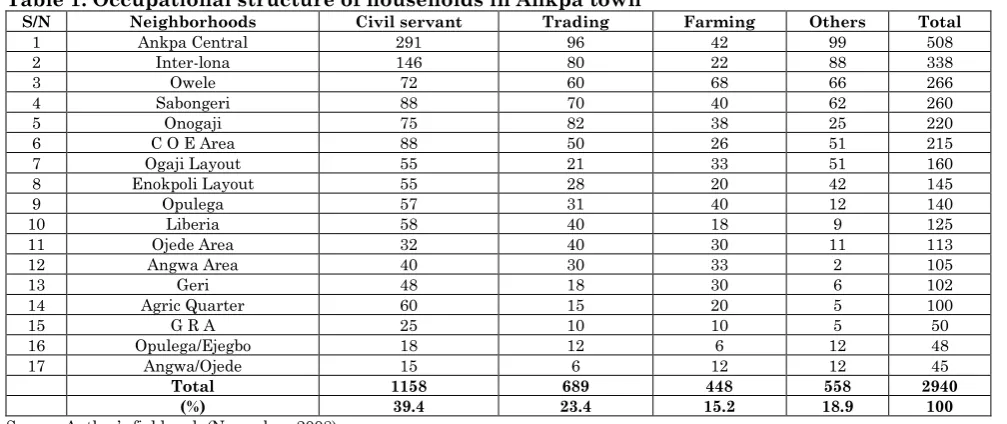
implication on the need for supply of water. Ankpa town comprises people of different occupations. From the study, the civil servants who are educated and need more water dominate the occupation of the town (39.4%). Also, their relatively high level of income and education reflect in the housing stock as most of them live in modern apartments with indoor water systems that require more water use. Trading is the second large occupation (23.4%). Farmers and other occupations have 448 respondents (15.2%) and mechanic, tailoring, plumbing have (18.9%) of respondents.
Table 1: Occupational structure of households in Ankpa town
S/N Neighborhoods Civil servant Trading Farming Others Total
1 Ankpa Central 291 96 42 99 508
2 Inter-lona 146 80 22 88 338
3 Owele 72 60 68 66 266
4 Sabongeri 88 70 40 62 260
5 Onogaji 75 82 38 25 220
6 C O E Area 88 50 26 51 215
7 Ogaji Layout 55 21 33 51 160
8 Enokpoli Layout 55 28 20 42 145
9 Opulega 57 31 40 12 140
10 Liberia 58 40 18 9 125
11 Ojede Area 32 40 30 11 113
12 Angwa Area 40 30 33 2 105
13 Geri 48 18 30 6 102
14 Agric Quarter 60 15 20 5 100
15 G R A 25 10 10 5 50
16 Opulega/Ejegbo 18 12 6 12 48
17 Angwa/Ojede 15 6 12 12 45
Total 1158 689 448 558 2940
(%) 39.4 23.4 15.2 18.9 100
Source: Author’s fieldwork (November, 2008)
The educational level of an individual to a large extent influences his socio-economic status as expressed in the form of job, income level and standard of living. The educational exposure of an individual affect the amount and quality of waters he needs to meet his various residential activities. From the study, the educational levels of the households in the town shows that post
secondary education comprises 947 (32.2%) households and secondary education has 762, (25.9%), households. Also, data from respondents indicate that, 552 (17.8%) and
405 (13.8) have attained university
attainment is dominated by Diploma and NCE, and secondary education and Degree above etc which is the third highest, water demand and use will be affected. More water will be needed to handle sanitary and hygienic situation and by implication, reduction in incidences of water related diseases.
Spatial Pattern of Residential Water Supply in Ankpa Town
In reference to table 8, the mean household water need of Ankpa town was found to be 24,179 litres per household (LPH) daily as against the mean household water supply of 19,329 LPH. This creates a mean deficiency of household water supply of 5850 LPH (24 %). This deficiency in water supply (consumption) varies from place to place within the town.
The variation can be attributed to availability of water within an area. Also, the per capita water need for household in Ankpa town was found to be averagely 1,394 LPH as against the per capita water consumption of 1,053 LPH. This indicates that there is deficiency of per capita household water supply needs of about 341 LPH which also represents about 80% often per capita
household water demand. As the study shows, Onogaji has the lowest deficiency percentage of 8% though it is one of the most populated areas of the town. This is because Onogaji is about half a kilometer to the only river and the water works. if, when a water is pumped from the water works, they have the tap run hours because the settlement are on a gentle slope and, also have private sources of water like boreholes and water vendors in large number.
The situation of Ankpa Central is different. From data presented in table 8, Ankpa central has the highest deficiency percentage (42%) and the highest mean house hold water need of 5288L per day. This is expected because the area is the most urbanized and the most populated in Ankpa town.
The few sources of water supply available to the household are limited compared to the population of the place. From observation and responses, most of the boreholes drilled in this area dry up in the dry season and some are affected by poor water quality such as taste and odour. In consequence, water related conflicts arise from the acquisition of water from the few sources available.
Table 2: Pattern of household water need and supply in ankpa town S/
N Neighborhood capita Per househol
d water needed (per litre
per day)
Mean househol
d actual water needed (per itre per day)
Per capita househol
d water consume d (per litre per
day)
Mean househol
d actual water consume
d (per litre per
day)
% actual water consume
d (per litre per
day)
% deficienc
y of water needed (per litre
per day)
Deficienc y
1 Ankpa Central 104 5288 61 3085 58 42 2203
2 Inter lona 71 2394 61 2031 85 15 363
3 Owele 70 1873 56 1593 86 15 280
4 Sabongeri 82 2139 67 1750 82 18 389
5 Onaogaji 72 1586 66 1464 92 8 122
6 C O E Area 75 1607 62 1343 84 16 264
7 Ogaji Layout 73 1166 60 962 83 17 204
8 Enokpoli
Layout 87 1261 70 1025 81 19 236
9 Opulega 86 1202 63 986 82 18 216
10 Liberia 76 949 50 620 65 35 329
11 Ojede Area 92 1036 65 736 71 29 300
12 Angwa Area 71 781 53 561 72 28 220
13 Geri 81 829 68 689 83 17 140
14 Agric Quarter 76 756 56 556 74 24 200
15 G R A 106 528 76 378 76 28 150
16 Opulega/
Ejegbo 83 399 55 262 66 34 137
17 Angwa/Ojede
Layout 86 385 64 288 75 25 97
Total 1394 24179 1053 19329 80 24 5850
The situation in respect of Liberia, (35%) Opulega/Ejegbo (34%) can be as a result of non functional and few functional water facilities in the area, the few functional boreholes dry up completely in the dry season. The residents in this area are also affected by distance to river, from interview, residents in this area trek about 2km and 1.5km to the river in dry season to fetch water for their needs.
The high percentage deficiency in water supply in this area is as a result of low accessibility. On a general note, the variation in water needs and supply in the study area may be explained in the context of various factors that affect water demand in different areas of Ankpa town. This may be physical and socio-economic factors. For instance, according to the data gathered, heavy rainfall affect water quality from the river making it coloured there by it unfit for drinking and for other domestic activities.
Also, from observation and interview with respondents, geological and topographic conditions of the town causes variation in water need and supply. For instance, many people have made unsuccessful attempts to dig boreholes in their compound, but have either met with disappointment by the low yield of the impenetrable nature of the under lying granitic rock. The result is that, some parts of the town suffer critical waters shortage even when these areas are supposed to be getting water.
Factors of Residential Water Supply in Ankpa Town
Many factors have influenced the pattern of water supply in Ankpa town. It is important to know that water supply projects have failed in many urban areas of Nigeria because factors that significantly influence them are not taking into consideration during planning and implementation. Here, the variable maximization factor rotation method was used to enhance spread of variables among factor loadings (Table 4).
Component I has high positive loadings on three variables, namely, number of sources of water supply (0.624), amount spent on water supply in the dry season (0.887), and number of workers involved in water supply projects.
This component has a total loading of 3.43 and explains 18.07% of the variation in water
supply in the study area. It defines cost of
water supply maintenance in the study
area as a factor. Component II loads positively on two variables: capacity of reservoir at water works (0.845) and perceived quality of water in the dry season (0.903) having an eigen-value of 3.04, explaining 16.02% additional variation in water supply. This component best describes
storage and safety of water supply in the
town as a factor of water supply in the study area. Component III has high loadings on two variables having an eigen-value of 2.59 and explains 13.61% of the total variance bringing the cumulative explanation to 47.70%.
The variables are, number of alternative sources of water supply in rainy season (0.942), and functional and available water facilities (-735). This component relate to the
potency of functional water sources in the
study area. Component IV loads significantly on two variables such as size of storage facility in residence (0.697), non functional water supply facilities (-.845).
This component has an eigen-value of 2.37 and explains 12.48% of the total leading to 60.18% cumulative loading. This component
best explains water storage capacity of
households as a factor affecting domestic
water supply in the study area.Component V has negative and positive loadings on three variables.
These are months water works supply water per annum to households (0.690), access to water distribution network in Ankpa town (0.805) and role of community in water supply in Ankpa town (-.905). The component 5 has an eigen-value of 2.33 and explains
12.24% variance bringing cumulative
explanation to 72.42. This components best
describe the level of man power to maintain
and operate water supply projects and frequency of water supply to neighborhoods from the water works as a factor of water supply in the study area.
describes accessibility to available water
sources as a factor of water supply in the study area.
Table 3: Rotated component of water supply variables in ankpa town
Variables Component
1 2 3 4 5 6
X1 X2 X3 X4 X5 X6 X7 X8 X9 X10 X11 X12 X13 X14 X15 X16 X17 X18 X19 Eigen value % Variance Cumulative % 0.135 -.149 (0.624) -.027 0.156 -.231 -.132 0.494 0.273 -.209 -.075 -.556 -.018 0.220 0.351 (0.887) 0.380 (0.878) 0.309 3.43 18.07 18.07 0.176 -.563 0.586 -.043 0.038 (0.845) 0.250 -.200 0.186 -.136 -.127 -.309 -.010 (0.903) -.378 -.123 0.549 0.098 -.293 3.04 16.02 34.10 -.113 0.261 -.197 (0.942) 0.072 0.242 0.245 (-.735) -.034 0.079 -.324 0.193 0.080 -.275 0.570 0.022 0.257 -.107 0.529 2.59 13.61 47.70 -.111 0.266 -.224 0.071 (0.697) -.085 -.031 -.133 (-.845) 0.253 0.334 0.243 0.123 -.033 0.570 0.107 -.554 -.146 -.301 2.37 12.48 60.18 -.118 0.169 0.240 -.031 -.013 -.020 (0.690) -.252 -.059 (0.805) -.187 0.194 (-.905) 0.100 -.032 -.074 0.107 0.083 0.329 2.33 12.24 72.42 (0.872) 0.594 0.122 0.109 -.218 0.237 -.136 0.010 -.105 0.302 (-.615) 0.043 0.034 0.038 -.101 -.290 0.272 -.165 0.087 1.83 9.62 82.04
Loading significant at+/- 0.60(Significant coefficients are in parenthesis)
From this analysis, it is seen that the six components explains 82.04% variation in water supply as determined by the above factors in the study area. The variables offering the components are described as the major parameters affecting water supply in the study area. The remaining is redundant and unexplained as they only contributed a residual variation of 17.96% spread across them. The variables defined by these six components are the main factors of water supply in the area under study.
The six Components have the following Underlying Dimensions
Level of government expenditure and cost of
water in water supply in Ankpa
Storage facilities and quality of water
supply in the neighborhood
Availability of alternative water supply
sources in the neighborhood
Inadequacy of water supply facilities in the
neighborhood
Level of manpower in water supply
maintenance
Accessibility of water supply sources to the
neighborhood
Thus, it is noted that the public water system in Ankpa as at the time of this study is operating on zero percent. Tap run have not been in existence for the past five years.
From the data gathered from water works officials, the water works ran into difficulties in water delivery to the populace of Ankpa town and later went out of use completely leaving the whole systems non functional.
The situation is not different in Enugu State as Ezenwaji [7], also reported that water supplies in Enugu urban by April 2000 satisfy only 41.6% of the demand in the same vein, Adekule et al [8], indicated that in Ibadan and the metropolis as a whole, pipe borne water is both inadequate in quantity and quality, water related disease such as typhoid, cholera often have their epidemics especially in the dry season.
The data also revealed that factor such as power failure, topographical effect, poor finance, infrastructure and erosion menace have led to the inability of water work to function.
The Socio-Economic Implication of the Water Supply Pattern in Anka Town The analysis of water supply pattern in Ankpa town reveals that there is water supply shortage in the area. The analysis also indicates the extent to which water supply have negative implications on the inhabitants of Ankpa town.
The main perceived problems associated with water supply and uses are the poor access to water supplies. Distance to water supply sources attracts the quantity of water availability in the household. The nearer the sources of water, the more frequency to the source(s) and the more the quantity of water available in the homes and the farther the source(s), the lesser the frequency to the source of water and the less quantity of water available to household and the more the problems emanating from the water supply.
Acute water shortages especially in the long dry seasons compounds the problems of water supply in some area as inhabitants convey water by head through the long distance exacerbating the problems of water supply and increase in the incidence of tiredness and general body weakness. At this time, water purchase becomes prohibitively expensive and household water uses are reduced significantly. From field data, most households in Liberia neighborhood area trek a distance of between 1-4 km to access water for use.
According to Jill [9] larger populations general required more water than the smaller ones and that the number of household in urban areas worldwide has also increased, and at a faster rate. This means that the higher the size of household, the higher the quantity of water that will be needed to satisfy their water need. From observation, most of the household consist of 1-16 peoples indicating that household water need for domestic activities in the area is high.
However, it was also observed that, most men in the area have more than two wives both of whom are bearing children, the possibility of increases in a household size and total population in the near future are high. Water demand may also increase significantly with time. On the other hand, some large household may have steady and reliable source of water supply. In this
situation, the effects of water supply shortage may not be felt in such household. Generally, the increase in the number of household affect fresh water supply. The study also revealed that the time spent in searching for water often affects household activities. Without connection to the main water supply system, members of the household have to stay on queue at borehole or public tap a long time or go far distance in search for water, some people prefer purchasing water from vendors by paying highly for supply that they are not sure of its sources.
Often, this water will come after hours of waiting, arrive at inconvenient hours and at designated places from which the household would need to be carried home. Much time is wasted in trying to fetch water, as water is purchased mostly on who come first. The excess time spent in the dry season could be devoted to some other ventures which could boost the economy of the place. The income level as observed to the reasonable extent determines the quantity and quality of water need with the highest income groups demanding and having access to large quantity of safe water supply.
The lower income earner household tends to compromise quality and quantity, during the water scarcity periods. The cost of water supply to the household affect its water use habit, where much money is spent daily or monthly on water supply, water is prudently managed in a household to save cost. From the data collected, it is commonly assumed that households will spend 35% of their income on domestic water supply.
In the study area, the inadequacy of pipe borne water is almost endemic. This inadequacy is in both quantity and quality. Also, other sources of water supply dry up completely and some may reduce in volume especially in the dry season. These factors create unreliability of water supply sources. As a result of this, the inhabitants are left with trekking long distance to available sources for water for domestic uses.
Ejegbo area is no longer producing water as at the time of this study. Data on the field revealed that drilling of open well is highly prohibited in Ankpa town for reason not known to me as at the time of the study, rain water is scarce in the dry season because it cannot be stored for a longer period. All this makes life difficult in respect to residential water use in the area.
Conclusion
This research was designed primarily to investigate the factoral dimensions of portable water supply in Ankpa town. The study had determined the sources of water supply to include both natural (river, rain water) and man-made (boreholes, vendor, sachet/ bottled water). The pipe borne water does not cover the town.
Thus the most prominent sources of water supply are vendors and rain water, in the rainy seasons and boreholes and rivers where they exit in both seasons. The study revealed that, households are already paying water vendors 2-3 times the operation and maintenance costs of a piped distribution system. Indices of water supply such as quantity of water needed, quantity supplied, the deficiency and spatial variability of water supply have indicated a mean deficiency of
5,850 LPH (24%). An analysis of the scenario into major factors that account for the pattern and variation in residential water supply in Ankpa town has identified 6 factors that cumulatively explain about 82% of the prevailing household water supply pattern in Ankpa town.
The implication of water supply inequality on the inhabitants of Ankpa town has been discussed to portend dangers associated with water borne diseases and retarded
socio-economic development. The study
recommends community participation in operation maintenance of public water projects in the area.
Also more sources of water such as public boreholes, private water works should be provided to alleviate dangers emanating from limited sources of water supply. The water service points should be sited close to the users to avoid loss of time and energy from trekking long distance to collect water for household needs. The urban community should guard against theft, breakdown of
water equipment and ensure better
management of available water supply to sustain the prevailing domestic water needs. [10-25]
References
1.Andrew N (2006) Urban Water Supply in
Saguapa. International Development
Department, School of Public Policy, University of Birmingham.
2.World Health Organization (2001) “Water for Basic Needs, World Water Day”, WHO Geneva. 3.World Bank (2001) “Water Supply Situation in
Africa”. World Bank Publications, Washington Dc.
4.Federal Republic of Nigeria (2002):“Water Supply and Sanitation”. Interim Strategy Note, Executive Summary. Federal Ministry of Water Resources, Abuja.
5.King LJ (1969) Statistical Analysis in Geography. Eagle Wood Cliffs Prentice – Itill Inc.
6.Akintola FA , AREOLA O (1980)“Domestic Water Consumption in an Urban Area: A Case Study of Ibadan City, Nigeria” Water Supply and Management. 5-6:13-321.
7.Ezenwaji EE (1991) Sectoral Water Demand in Onitsha Urban Area, Nigeria. Unpublished M. Sc Thesis, University of Nigeria Nsukka.
8.Adekunle LV (2004) “An Assessment of the Health and Socio-Economic Implication of Sachet Water in Ibadan Nigeria” Africa Journal of Biomedical Research.7: 5-8
9.Jill B (2005) How Demographic Changes and Water Management Policies Affect Fresh Water Supply Resources. Rand publication, Santa
Monica 1-2
http://www.raid.org.publication/ma/mG358/1 10. Ademola A (2004) Water Privatization. The
Policy Issues. Center for Public-Private Cooperation, Ibadan, Nigeria.
11. Ayoade JO (1975) “Water Resources and their Development in Nigeria”. Hydrology Bulletin, 20.
12. Chima GN (1988) Rural Water Supply in Isi-Ala Ngw. L.G.A of Imo State, Nigeria. Unpublished M.sc Dissertation, Department of Geography, University of Nigeria, Nsukka.
14. Dar AL-Handasah Consultants (1974) Ankpa and Abajekolo Master Plans 1974-2005, Benue State Nigeria. Project 764.
15. Demoyer R, Horwitz (1954) “A System
Approach to Water Distribution Modeling and Control” Luxington Books, London.
16. Federal Ministry Of Agriculture, Water
Resources (2007) “Water Situation in Nigeria”: A success Story In Daily Trust Monday, 48-49. 17. Frederick R (2005) “Water Provision has
Improved in Darkar” A Model for Water Provision in Africa; 22.
18. Gleick PH (1996) “Basic Water Requirement for Human Activities”. Meeting Basic Needs, Water International 21:83-92.
19. Gleick PH (1999) “The Human Right to Water” (5) Water Policy journal 487-503.
20. Handidu JA (1990) “National Growth, Water Demand and Supply Strategies in Nigeria in the 1960s” Journal of the Nigerian Associations of Hydro geologist (NAH)2(1):1-7.
21. Iheziako MN (1985) Residential Water Demand in Enugu Urban Area of Nigeria Unpublished M.sc thesis, Department of Geography, University of Nigeria, Nsukka.
22. Vision 21 (2001) Water Supply and Sanitation Collaborate Council (WSSCC), Domestic Water Supply Hygiene and Sanitation; Brief 3 of 14.
23. World Bank (1990) “Water Vending and
Willingness to pay for Urban Services in Onitsha Nigeria, World Bank Publication”, Washington Dc.
24. World Bank and the Federal Environmental Protection Agency (1998) Development of Environmental Action Plan for Benue State, Nigeria. Triple “E” Systems Associates Limited, Ikorodu road, Anthony, Lagos, Nig. (Final Report).
25. World Health Organization Fact Sheet (2000) “Sustainability and Optimization of Water Supply and sanitation Services”, Water Partner
Fact Sheet.