Proceedings of the
11th International Workshop on Graph Transformation and
Visual Modeling Techniques
(GTVMT 2012)
Modeling context with graph annotations
Paolo Bottoni, Francesco Parisi Presicce
14 pages
Guest Editors: Andrew Fish, Leen Lambers
Managing Editors: Tiziana Margaria, Julia Padberg, Gabriele Taentzer
Modeling context with graph annotations
Paolo Bottoni1, Francesco Parisi Presicce1
Department of Computer Science, ”Sapienza” University of Rome1
Abstract: Organisational policies are often formed of declarational (defining con-straints on functional services) and operational (realising functionalities via simple activities) aspects. However, when several perspectives are involved, constraints and operations can comprise different aspects, without identifying the origin of some details. We propose the use of annotations as a way to flexibly add and remove ap-plication conditions on rules, while maintaining an indication of their origin. We use graph transformations to model operations in some application domain, graph con-straints to model conditions imposed by some external domain, and annotations to combine domains. We explore the problem of failure of transactions due to the addi-tional constraints imposed by the contextual domain, and describe a way to redefine the success conditions for transactions employing the modified rules.
Keywords:Contextual domain, Graph annotation, Graph constraints
1
Introduction
Separation of concerns leads to modeling systems under different perspectives, for example, the control-flow, data, resource, and operational ones for workflows [AH02]. High-order views of service architectures are based on the composition of abstract business models with security, distribution, or communication protocols [LWF03]. In the field of programming languages, es-pecially Java, aspects and annotations are ways to enrich behaviours or structure of programs through the action of specific engines. In particular, aspect-oriented programming is based on weaving management of non-functional concerns with operational functionalities [KLM+97].
In general, organisational policies are formed of declarative and operational aspects. The declarative part defines the constraints regulating the overall delivery of the functional services, while in the operational part, these services are realised by the coordination of simple activities. However, when several perspectives are involved, constraints and operations can comprise dif-ferent aspects, without the ability to identify the origin of some details. A typical example of this is the construction of application conditions constraining the application of rules in a graph transformation approach to process modeling [EEHP06,KP06].
Besides showing how annotated constraints can be employed to defined application conditions, in quite a standard way, we explore the problem of how the execution of transactions can be affected by the context. We observe that a typical transactional pattern is of the forminception
-execution-termination, where inception is modeled by a rule setting the process in motion and typically producing a token to identify the transaction instance, execution is modeled by some sequence of rules (we consider here iteration of a single rule), and termination ensures that the result is collected and consumes the instance token. When contextual application conditions place additional constraints on the execution rule, it is possible that a transaction fails, which would otherwise terminate correctly, as the original conditions for termination can be no longer satisfied, even if some iteration has been performed. In this case, the typical constructions for modifying a single rule based on constraints are insufficient, and we present a method to modify both the inception and the termination rule based on the modification of the execution rule. The involved techniques are illustrated on a running example based on the domain of distributed document management, with contextual annotations deriving from security and locality domains. Paper organisation. We give the graph transformation framework in Section2and illustrate the running example in Section3. A formal definition of annotation and the involved constructions are given in Section4 and Section5 applies the construction to annotations on the contextual domains. Finally, Section6discusses related work and Section7conclusions and future work.
2
Preliminaries
We adopt the framework of typed graphs. A graph G = (V,E,s,t) consists of a set of nodes V =V(G), a set ofedges E=E(G), andsourceandtargetfunctions,s,t:E→V. For a setS, its cardinality is denoted by∣S∣. In atype graph T G= (VT,ET,sT,tT),VT andET are sets of node and edge types, while the functionssT:ET→VT andtT:ET→VT define source and target node types for each edge type. ForGa typed graph onT G, there is a graph morphismtype:G→T G, withtypeV :V →VT andtypeE :E→ET s.t. typeV(s(e)) =sT(typeE(e))andtypeV(t(e)) =
tT(typeE(e)).
We use graph transformations according to the Single PushOut (SPO) approach [L¨ow93]. An SPO rule has the formp:L→r RwhereLandRare called left-hand and right-hand side graphs, respectively, and pis a type-preserving partial morphism. The left of Figure 1shows an SPO direct derivation diagram, modeling the application of a rule p:L→r R to ahost graph G to produce atargetgraph H, via a matchmforLinG. Basically,H contains allg∈Gs.t. there is nox∈L∖dom(r)withg=m(x)and allz∈Rexcept the elementsr(y)s.t. m(y) =m(x)for
x∈L∖dom(r)andy∈dom(r). Notice that m′ can be partial even ifmis total. We denote the application of the rulepon a matchm:L→GbyG⇒m
pHand writeG⇒pHifHcan be derived fromGby applyingpwith respect to some matchmforLinG.
Anatomic constraintis a morphism of typed attributed graphsc:X→Y. A graphG satisfies c, notedG⊨c, if for eachmatch morphism m:X →Gthere exists a morphismy:Y →Gs.t.
y∘c=m. Forc:X→Y an atomic constraint,¬cis an atomic constraint, andG⊨¬c iff G⊭c. An atomic constraint of the formnX:X→/0 is called anegative atomic constraint. We callM(c)
={G∣G⊨c} the set ofmodelsforc, and assume that a constraint systemCis consistent, i.e. ∩
L r // m R m′
Yi j
oi j
// = Xi ni ,, = yi j
oo L r //
n oo m R m′
G //H G //H
Figure 1: SPO Direct Derivation Diagram for simple rules (left) and with AC (right).
both for constraints and rules.
The right of Figure 1 shows that an atomic constraint can be associated with a rule as an
application conditionAC, of the form{xi:L→Xi,{yi j:Xi→Yi j}j∈Ji}i∈I, for a matchm:L→G of the LHS of a rule, whereI andJi are index sets for eachi∈I. An AC is satisfied bymif, for eachni:Xi→Gs.t. ni∘xi=m, there exists someoi j :Yi j →Gs.t. oi j∘yi j=ni. Anegative
application condition(NAC) derives from a negative constraint: for the rule to be applicable,
Xi must not be present. A general application condition (GAC) is a composition of nested constraints according to the operators∃,∀,∧and∨.
We use control expressions over identifiers of rules to govern rule application for transactional processes. Expressions are built on a grammar allowing single rules, the sequential construct ‘;’, and the iteration constructr∗, whereris a single rule identifier.
3
The running example
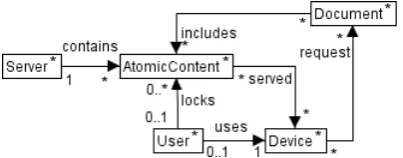
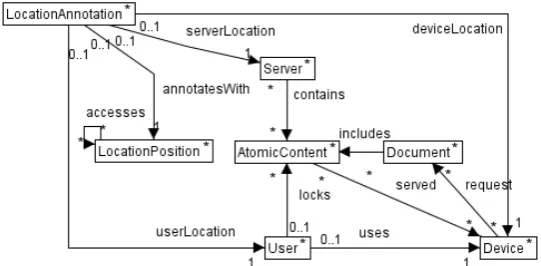
To ilustrate our techniques, we use an example of production of, and access to, distributed doc-uments, where the application domain is described by the typed graph of Figure2. Types of relations are concretely described as edge types between node types.
Figure 2: The type graph for the document access domain.
Adocumentis composed of someatomic content, distributed over someserver. Auserobtains access to documents via some controlleddevice. By considering multiplicities, one notices that users are always in control of exactly one device, while devices can be available for the next user. Hence, the processes of user and device creation differ in that a user is added to the system only if a device is available for him/her. In particular, new devices can always be added while a user can be added only if a device is available (we omit presenting the corresponding rules, due to their simplicity). Users can switch from using a device to another, provided that a request is not being served by the old device, and that the new device is not in use (see Figure3).
Figure 3: The rule for changing the user of a device.
Figure 4: The rule for starting a request.
it can be shared by several documents). The rulestartRequest activates a process which guarantees that all content from the document is served on the device. As shown in Figure4, two NACs are defined, one preventing the replication of the same request, the other checking that no content included in the document is locked by a user. For all of these rules we consider partial, type preserving morphisms, and we allow non-injective matches. Atomic contents which are parts of the document are served on the requesting device if not served already to that device and if they are not locked, (see ruleserveContentin Figure5). The process is completed when
g1
mg1
P P P P P P '' P P P P P P g0 oo
mg0
@ @ @ @ @ @
L r //
oo mL R m′
G //H
all contents have been served, as defined by rulerequestEnded in Figure6. This rule (represented asL→r Rin the diagram on the right) is equipped with a GAC expressed by the graphs
g0 andg1on the left of Figure 6and the formula∀mg0.∃mg1.
Heremg0 andmg1 are matches forg
0andg1, respectively, such
that the diagram commutes, withmLa match ofLinG. The
expressionstartRequest;serveContent∗;requestEndedgoverns the process.
4
Annotations
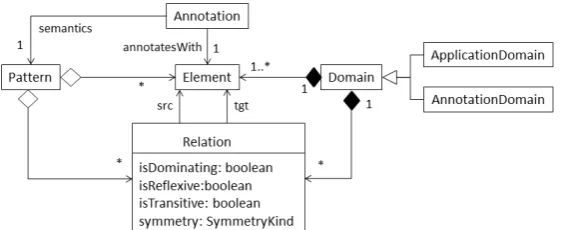
Figure7 presents a metamodel for annotation of patterns from some application domain with values from some other domain, providing the annotation content. ADomainis therefore
(a)g0 (b)g1
Figure 6: The rule for signaling completion of a request.
posed of at least one metatype ofdomain elementsand some metatype ofdomain relationships. Relationships are here considered to be binary and directed.
Figure 7: The metamodel for the annotation activity.
We consider one domain to be theapplication domain, and annotate it with elements from a number ofcontextual domains. TheAnnotationmetatype is used to indicate the semantics re-lation by which some domainPatternisannotated withsome element in a contextual domain, where a pattern is formed by any aggregation of elements and relationships. We express invari-ants on the metamodel using OCL. For navigation expressions, if the association does not have a name, we use the name of the navigation target with a lowercase initial. As annotations relate elements in different domains, the following invariants hold in the context of anAnnotation:
(1):self.annotatesWith.domain.isOclKindOf(AnnotationDomain).
(2):(self.semantics.element.domain->union(semantics.relation)) ->forall(d|d.isOclKindOf(ApplicationDomain)).
For each annotation domain, exactly one special relation is taken as thedominatingrelation, whereby some structure can be imposed on the elements of the domain. Therefore, in the context of aRelation, the following invariant holds:
(3):(self.isDominating=true)implies
(self.domain.isOclKindOf(AnnotationDomain)),
while in the context of anAnnotationDomainwe have:
(4):self.relation->select(r|r.isDominating=true)->size()=1.
Figure 8: Constraints expressing the reflexivity and symmetry axioms.
Figure 9: Constraint expressing the transitivity axiom.
show three meta-constraints, using injective morphisms, to be specialised to the types of elements and relations used for annotation. They describe reflexivity and symmetry (Figure8left/right, resp.), and transitivity (Figure9). Antisymmetry can be expressed by composing symmetry and reflexivity, using non-injective morphisms.
Finally, patterns are closed w.r.t. relations. Hence, in the context of aPatternwe have:
(5):self.relation->forall(r|self.element->contains(r.src) && self.element->contains(r.tgt)).
We discuss here the case in which the annotation domain is restricted to a single type of element used for annotating and to the use of only the dominating relation. The annotation process is employed to place additional constraints on the application domain. Moreover, we consider only annotations on nodes, leaving the treatment of the general case of annotation of relations and patterns for future work. In particular, we show how to lift rules on the application domain to their annotated versions, and how to place additional conditions (of positive, negative or general form) as a result of adding constraints employing elements from the annotation domain to rules in the application domains. We summarise the approach in the following definitions.
Definition 1(Domain) Given a type graphT Gand a setC of constraints on it, adomainis the set of graphs typed byT Gand satisfying all of the constraints inC.
Definition 2(Annotation type graph) LetD andA be two domains andT GDandT GA their type graphs. Anannotation type graphis formed by designating inT GDa subsetSV ⊂VT(T GD) and incrementingT GDwith: a node typel∈VT(T GA), an edge typer∈ET(T GA), s.t.sT(r) =
tT(r) =l, a new node typea∕∈VT(T GD)∪VT(T GA), and a set of edge typesL,L∩(ET(T GD)∪
ET(T GA)) = /0 s.t.∀v∈SV.∃!l∈L.((sT(l) =a)∧tT(l) =v).
Definition 3(Annotated graph) Given anannotation type graph T G, a graphGtyped on T G
Definition 4(Annotated constraint) ForT Ganannotation type graph, withA,DandSV as in Definition2, anannotated constraintis an injective morphism p:P,→Cs.t.P∈D,Cis an an-notated graph onT G, and∀χ∈V(P).((typeT(χ)∈SV)⇒((∃!α∈V(C),ρ∈E(C)).typeT(α) =
a∧typeE(ρ)∈L∧s(ρ) =α∧t(ρ) =p(χ))).
The most important construction for adapting domain rules p:L→r Rto (atomic, positive) contextual constraintsc:P→Cis shown in Figure10. Here,X is a maximal overlap between
RandPandQis their pushout with respect toX; the graphWobtained fromQby applying the
inverse rulep−1:Rr
−1
→Lrepresents the part of the premisePof the constraint already present in
L. The graphZis obtained as the pushout ofRandCwith respect toX, and the result of applying
r−1to it (via the morphism induced by the pushout) is denoted byM. This graph represents the part of the conclusionC of the constraint already present in L. The morphisms Q→Z and
W→Mexist and are unique because of the universal property of the pushouts forQandW. The morphismsh:L→M andk:W→Mare then used to build application conditions, as will be discussed in Section5. An analogous construction builds negative application conditions in the case of negative constraints. Note that there may be several morphismsW →M for different choices ofX. In the rest of the paper, we consider only situations in which the annotations inZ
only refer to elements which are not produced byR. For the case that also elements produced by
Rare annotated inC, that we do not discuss here, one would need to activate some repair action, after applying p:L→R, to produce proper annotations for these elements.
L r //
h w @ @ @ @ @ @ @ @ R > > > > > > >
r−1
ww > > > > > > > X ? _
oo //P
c W k ~~ ~~~~~~ ~~ Q oo
M //Zoo C
Figure 10: Construction of graphMfor application conditions.
5
Applying annotations
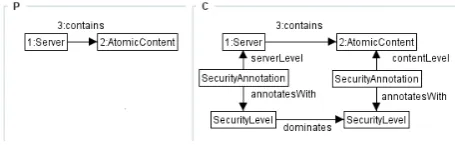
We now present two cases of annotation for document distribution, one from the security domain, ensuring that content is served only in a way complying with security levels, and one from the localisation domain, where distribution is restricted to accessible locations. In the first case the dominating relation is anti-symmetric, while in the second case we do not demand anything with respect to symmetry. In both cases the relation is also reflexive and transitive.
security level than the content level, while Figure13constrains an atomic content to be served only to more secure devices. Analogous constraints (not shown here) require users to only use devices with a higher security level and to lock content with lower security level.
Figure 11: Introducing security annotations on the domain model.
Figure 12: Constraining distribution of content over servers.
Due to this additional constraint on service of content, particular care must be given to the roles of the rules in the control expression for document service, in order to ensure termination of the process. More precisely, one needs to make the conditions on starting and running the process more stringent, and the conditions on concluding the process more relaxed, acting on the application conditions of the corresponding rules. To this end we need different constructions.
(a) For the starting rule, one has three choices with respect to the security level
(a1) For anexistentialcondition at least one content can be served.
(a2) For auniversalcondition all of the contents can be served.
(a3) Acontextualcondition relaxes the universal condition so that the security level is not checked on contents excluded from service based on other conditions.
Figure 13: Constraining access to secured documents.
(c) For the concluding rule, depending on choice made for (a), a different GAC is required. For (a1) and (a3) all elements which were not served based on some criterion can also be present, for (a2) all elements have had been served.
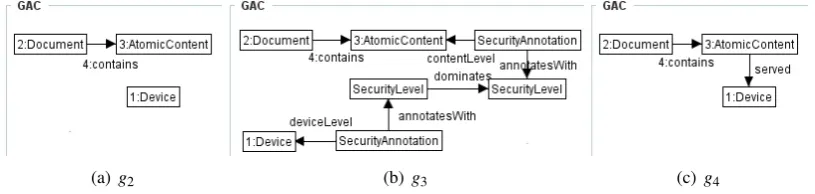
We deal with case (a) by considering the nested GACs of Figure14. The graphg2on the left
describes a situation in which the document contains some content, the graphg3 in the middle
describes a situation where content is servable in a secure way, while g4 on the right depicts the situation where content has already been served. For the case (a1) the associated formula is
∃mg2, for case (a2) we have∀mg2.∃mg3, while for case (a3) the formula is∀mg2.(∃mg3∨ ∃mg4).
(a) g2 (b)g3 (c)g4
Figure 14: Application conditions for starting the content service process.
Figure15shows on the left the graphg5used in the GACs for dealing with case (b), and on
the right the graphg6 in the GACs for case (c). For (b) we simply add an application condition requiring the existence of a morphism mg5 while for case (c), to deal with subcase (a1) and
(a3) we extend the formula of Section3so that it becomes∀mg0.(∃mg1∨ ∃mg1), with the same
convention on the name of matches. To deal with subcase (a2) the original GAC built on graphs
g0andg1in Section3can be employed. All of the graphsg3,g5, andg6 are constructed as the
graphMof Figure10, starting from the corresponding rules and the constraint in Figure13. The resulting version of the transaction is correct in the sense of Proposition1.
Proposition 1 Let Γ=r1;r∗2;r3 be the control expression for the transaction above and let
Γa=ra1;r2a∗;ra3 be its annotated version. Then, for any graph G in whichΓwould succeed,Γa
(a)g5 (b)g6
Figure 15: Application condition for serving content and terminating a request.
Proof. In general, the only case in whichΓdoes not succeed is one where some element has not
been processed byr2 due to the failure of some application condition. In the case of document
serving, there is no such case. For the annotated version, in case (a1),ra1 is applied if at least a content can be served. ra2 will serve this content, plus any other legitimate content. r3acan then fail only if some content which was servable has not been served, but this cannot happen due to the iteration ofra2. For case (a2) all contents were servable and iteratingr2ahas served them, while for case (a3) a content is non- servable if already served.
In order to detect violations of security, one can modify the GAC for rulera3to check that all contents are served. For the cases (a1) and (a3) the failure of this rule would signal the violation. Figure16 presents the type graph for annotating the document distribution domain with lo-calisation values. The dominating relation, called accesses is reflexive and not transitive and indicates direct accessibility of locations. We are not interested here in whether it is symmetric or not. The constraint in Figure17(left and middle) states that a user can only use a device lo-cated in some position accessible from the user location. Introducing this constraint modifies the rule for changing a device (see Figure3) by introducing a GAC based on graphg7 on the right
of Figure17associated with the morphismg7L:L→g7. In a similar way, constraints on location
add GACs to the rules managing the request process, following the construction described above.
The effect of combined annotations with security and localisation context is readily express-able by taking the co-limits of the resulting application conditions. Alternatively, one can con-struct layers of nested annotations, each time redefining as application domain the resulting of applying an annotation layer. This opens the way to unifying several models for role-based ac-cess control. As an example, one can first annotate an acac-cess domain with role information, then the resulting domain with temporal information, then with geographical information, etc.
(a) (b) (c)g7
Figure 17: Constraining use of a device based on location.
5.1 Modeling GeoRBAC
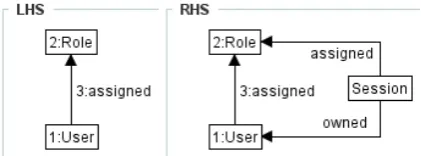
In this section we discuss how the approach can be applied also in the case when the constraints involve not simply the existence of an instance of the dominating relation between values of the annotation domain, but require that specific values be assigned to elements. We show this extension by considering the addition of location annotations to the Role Based Access Control model [SFK00]. The players in this model are users, roles, sessions and permissions. For this example we ignore the permissions, which play no part in the extensions with localities. In order for a user to access objects with permissions, the user opens a session (which becomesownedby the user) that is associated with some role authorized for the user (the system then checks that the permissions requested belong to the role, but this is irrelevant in our example). The simple rule corresponding to this operation is shown in Figure18.
Figure 18: Creating a session based on role.
fea-turesFs and non-spatial featuresFns, and a functionLocOb j:F →(GEO∪ {⊥})to associate features with geographical locations. Features are typed, and a partial order on these types rep-resents the usual notion of containment (a room part of a building, a town inside a region, etc.). The type graph for this extended model of RBAC with annotations is shown in Figure19.
Figure 19: The type graph for annotating RBAC with geographical information.
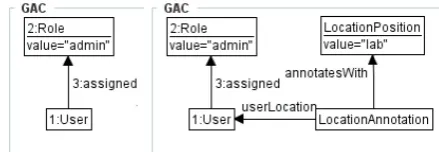
In this extended model, we want to add a constraint, shown in Figure20: a user can open a session in the role of administrator only if the user is present in a certain location, say a
laboratory. The rule in Figure18is no longer safe as it would allow the session to be opened in the administration role even when the user is elsewhere. General application conditions need to be added. The two components resulting from of the application of the procedure in Section4 are shown in Figure21. By callingLthe LHS of Figure18 andg8,g9the two components of
the GAC from left to right in Figure21, we obtain the formula∀g8L:L→g8.∃g98:g8→g9. Note
that in this caseg8corresponds toWin Figure10, whileg9corresponds toM.
(a) g8 (b) g9
Figure 20: The location constraint for creating a session as administrator.
6
Related work
The problem of adapting organizational policies to context conditions is not new. Several papers extend well known security models to incorporate context conditions, e.g. the location of the requester or of the resource requested, or the time and duration of the request.
In the standard Role Based Access Control model RBAC [SFK00], users have access to a resource only if an appropriate role, authorized for the user and associated to the requested oper-ation, has been activated. In the Geo-RBAC [DBCP07] extension, such a role is activated only if the context is right, viz. if the user location is correct. Spatial and location-based information is modelled as spatial entities and the whole hierarchy of RBAC models is extended with this ad-dition using role schema. The framework used is the usual set-theoretic one. Another important extension is Temporal RBAC [BBF01], where roles are made available to users only at certain times. The organizational policies are modified depending on an external context with periodic role enabling and disabling, role triggers and temporal dependencies among actions. Again, the formalism is set-theoretical and the approach is ad hoc. Despite both Geo-RBAC and GTRBAC being extensions of RBAC taking into account an external context for the activation of roles, one approach is not easily adapted to the other.
Koenig [Koe05] develops an extensive theory of annotated hypergraphs, where a hypergraph annotation is a morphism from a (typed) hypergraph to a (complete) lattice and morphisms can also be annotated by functions, in such a way that the composition of annotated morphisms results into a morphism annotated by the composition of the annotating functions. In this paper we embed annotations in the typing system, relaxing conditions on the domain and providing a different mechanism for composition of annotations.
Ehriget al.[EEHP06] provide a general approach to the construction of application conditions on rules, while Koch and Parisi [KP06] present a method for composition of security policies through the addition of application conditions. In both cases, the analysis deals with individual rules or sets of rules, but not with their composition into transactional specifications.
Lamberset al.[LET08] explore conditions for success of sequences of DPO rules with NACs, but they do not describe how these conditions change when new constraints are added on rule application. However, their analysis can be used to discover causes for failure in modified rules.
7
Conclusions
We have presented an approach to enriching models of some application domains with con-straints coming from contextual domains through the use of annotations relating values from the latter to model elements of the first. In particular, we have focused on the generation of appli-cation conditions on model rules, and on the management of transactions following a typical inception-execution-pattern, where execution is modelled as iteration of a single rule.
In this paper, we have considered only increasing or decreasing rules in the application domain and positive atomic constraints for the contextual domain. The case of more general rules and of negative or nested contextual constraints should also be investigated. Moreover, we need to properly formalise, along the lines discussed in Section4, the construction of repair actions for situations in which elements which in a rule have also to be constrained. Finally, while the use of general sequences in a transaction can be, under certain circumstances, reduced to that of a single rule [LET08], more general control expressions could require more complex constructions.
Bibliography
[AH02] W. M. P. van der Aalst, K. M. van Hee.Workflow Management: Models, Methods, and Systems. MIT Press, 2002.
[BBF01] E. Bertino, P. A. Bonatti, E. Ferrari. TRBAC: A temporal role-based access control model.ACM Trans. Inf. Syst. Secur.4(3):191–233, 2001.
[DBCP07] M. L. Damiani, E. Bertino, B. Catania, P. Perlasca. GEO-RBAC: A spatially aware RBAC.ACM Trans. Inf. Syst. Secur.10(1), 2007.
[EEHP06] H. Ehrig, K. Ehrig, A. Habel, K.-H. Pennemann. Theory of Constraints and Ap-plication Conditions: From Graphs to High-Level Structures. Fundam. Inform.
74(1):135–166, 2006.
[KLM+97] G. Kiczales, J. Lamping, A. Mendhekar, C. Maeda, C. V. Lopes, J.-M. Loingtier, J. Irwin. Aspect-Oriented Programming. InECOOP. Pp. 220–242. 1997.
[Koe05] B. Koenig. A general framework for types in graph rewriting. Acta Informatica
42(4/5):349–388, 2005.
[KP06] M. Koch, F. Parisi Presicce. UML specification of access control policies and their formal verification.Software and System Modeling5(4):429–447, 2006.
[LET08] L. Lambers, H. Ehrig, G. Taentzer. Sufficient Criteria for Applicability and Non-Applicability of Rule Sequences.ECEASST 10, 2008.
[L¨ow93] M. L¨owe. Algebraic Approach to Single-Pushout Graph Transformation. TCS
109(1&2):181–224, 1993.
[LWF03] A. Lopes, M. Wermelinger, J. L. Fiadeiro. High-order architectural connectors.ACM Trans. Softw. Eng. Methodol.12(1):64–104, 2003.