Asian J Pharmaceut Res Health Care Volume 5 Issue2 65-71
AJPRHC
Research Article
ANTIOVULATORY AND ESTROGENIC ACTIVITY OF LEAVES OF DATURA STRAMONIUM LINN. IN FEMALE ALBINO RATS
PRIYANKA SONI1*, ANEES AHMAD SIDDIQUI2, JAYA DWIVEDI3, VISHAL SONI1 1
Department of Herbal Drug Research, B.R. Nahata College of Pharmacy, Research Centre, Mhow Neemuch Road, Mandsaur 458001, India
2
Department of Pharmaceutical Chemistry, Jamia Hamdard University, New Delhi-110062 3
Deptatment of Chemistry, Banasthali Vidyapith Banasthali University, Rajasthan, 304022 *Corresponding author
E- mail: [email protected]
This paper is available online at www.jprhc.in
ABSTRACT:
The effect of petroleum ether (60-80 C), ethanol and aqueous extracts of Datura stramonium Linn. leaves on the estrous cycle were studied and identify the estrogenic activity of active ethanol extract in female albino rats.
After the oral acute toxicity study, plant extracts were administered at two dose levels: 200 and 400 mg/kg,
respectively. Ethanol extract at a dose of 200 mg/kg has increased the duration of the estrous cycle by directly
increasing the diestrous phase, while the 400 mg/kg dose has significantly (P < 0.01) reduced the proestrous phase and on the other hand increased the duration of the diestrous phase. Histological studies of the uterus were carried
out to confirm their estrogenic activity of treatment. The ethanol extract showed significant estrogenic and
antiestrogenic activity. All findings suggest that the antifertility activity of extract could be possibly through the changes in the prolonged estrous cycle and antiestrogenic activity. Hence the extract possesses antifertility activity without adverse toxicity in female rats.
Keywords: Antifertility, antiovulatory activity, estrous cycle, estrogenic, antiestrogenic, Datura stramonium Linn.
INTRODUCTION
Rapid population growth has caused serious problem in economic growth and human development in the developing countries1. Accordingly, population control is of immense importance for individual and national welfare. The search for an oral contraceptive agent to control human fertility is as old as recorded history. Even though an extensive variety of synthetic contraceptive agents are available, these cannot be used constantly due to their side effects2. Due to these side effects, an approach was pursued to identify new antifertility agents from natural sources. Numerous indigenous drugs have been described in folkloric. Many plant preparations are reported to have antifertility regulation properties and only a few have been tested for such effects. However, so far no single plant is available which can be developed into a potent antifertility agent3.
Asian J Pharmaceut Res Health Care Volume 5 Issue2 65-71
withanoloids. The seeds contain fluorescent compound, flurodaturatine and homo-flurodaturtine, atropine (1.69-2.71) scopolamine (0.36-0.69). Careful consideration of the toxicity of the plant is requiring before its use. It is toxic at more than small dose7.
In the ethanobotanical claim, Datura stramonium Linn. leaves, fruit and root are used to control child birth or for fertility regulation in India8. According to reference available in Yogarantnakara and Rasaratnasamuccaya, the root of plant collected on the 14th day of black fortnight and inserted in to uterus to prevent conception9. Leaves Literature reviews indicated that antifertility activity of leaves of Datura stramonium Linn. has not been scientifically evaluated so for. In view of this, the present study was aimed at evaluating the antifertility activity leaves of Datura stramonium Linn in female albino rats.
MATERIALS AND METHODS Plant
Leaves of D. stramonium were collected from the medicinal garden, B. R. Nahata College of Pharmacy, Mandsaur in the month of July- August and positively identify by Dr. S. N. Mishra, Botanist, and K.N.K College of Horticulture, Mandsaur, and Madhya Pradesh (MP). A voucher specimen (BRNCP/D/003/2010) was deposited in the herbarium of the department of Pharmacognosy, BRNCOP and Mandsaur for future reference. The material was dried under shade, powdered mechanically and stored in air tight container.
Preparation of extracts
The shade dried leaves were coarsely powdered. The powdered material was extracted using petroleum ether (60-70 C), for 72 h and successively extracted with ethanol and water for 72 h each in a Soxhlet apparatus. The extracts were evaporated under reduced pressure to solid masses and the percentage yield of extracts was found to be 3.7%, 7.5% and 5.6% w/w, respectively.
Preliminary Phytochemical screening
In order to determine the presence of various phytoconstituents, a preliminary phytochemical study (colour reaction) with extracts was carried out by using the standard procedure10.
Experimental animals
Female albino rats six in each group (Wister strain weighing 150-200 g) were used for antiovulatory activity and immature female rats of 21-23 days old, were used for estrogenic activity. The animals were housed in standard environmental condition of temperature (21 2 C), humidity (55 10%) and a 12-h light dark cycle. The rats were acclimatized to laboratory hygienic conditions for 10 days before stating the experiment. Animal study was performed in the Division of Pharmacology, BR Nahata College of Pharmacy. All the experimental protocols were approved by Institutional Animal Ethics Committee for the purpose of control and supervision of experiment on animal (CPCSEA) guidelines (918/ac/05/CPCSEA/53).
Acute Toxicity studies
Petroleum ether, alcoholic and aqueous extracts of leaves of D. stramonium studied for acute oral toxicity according to the guidelines set by Organization for Economic Co-operation and development (OECD) guideline number 420. Female Wistar rats (150–180 g) were used for this study. After the sighting study, a starting dose of 2,000 mg/kg (p.o.) of the test samples were given to various extract groups containing five animals in each groups. The treated animals were observed for 14 days for mortality and general behaviour.
Antifertility activity Antiovulatory activity
Asian J Pharmaceut Res Health Care Volume 5 Issue2 65-71
Vaginal smear from each animal was observed every morning between 9-10 A.M for five days of treatment and subsequently for 15 days11.
Estrogenic and antiestrogenic activity
The extract with antiovulatory activity was further evaluated for estrogenic activity and antiestrogenic activity12. Immature female Wistar strain rats, 30-35 day old, weighing between 35 and 45 g, were divided in to 6 groups of six rats each. The first group served as control and received the vehicle only (1% Twine 80,). The second group received ethinyl estradiol (standard) in distil water at a dose of 0.02 mg/kg body weight. The third and fourth group received the most active ethanolic extract of D. stramonium leaves at two dose level 200 and 400 mg/kg body weight, respectively. The groups fifth and sixth received ethinyl estradiol in addition to a test dose of the ethanolic extract of leaves at the same dose. All the above treatment was given for three days (p.o.).
Histopathology
On the fourth day, the rats were sacrificed by decapitation, the uteri dissected out and surrounding tissues removed and washed with normal saline. The uteri were blotted on filter paper and weight quickly on a sensitive balance and fixed in Bouin’s solution for 24 h. The paraffin-embedded tissues were cut at 5 mm thickness and stained with hematoxylin-eosin solution. The sections were examined microscopically for histological observation13. The ethanol extract exhibited estrogenic activity as shown by the sinifict increases I uterine weight diameter of endometrial epithelim and vagnal epithelial cornification.
Statiscal analysis
Statistical analysis was carried out by one-way (ANOVA) followed by Dunnett-test. Results were expressed as mean ± SEM from six rats in each group. P values p<0.001 were considered significant.
RESULTS
Preliminary Phytochemical investigation
The phytochemical screening of different extracts revealed the presence of various constituents as shown in Table 1. Acute toxicity studies
No mortality and changes in the behaviour was observed in the treatment groups up to 2000 mg/kg body weight and from the results 400 mg/kg dose was chosen as maximum dose for further experimentation
Effect of extracts of D. stamonium leaves on the estrous cycle of rats
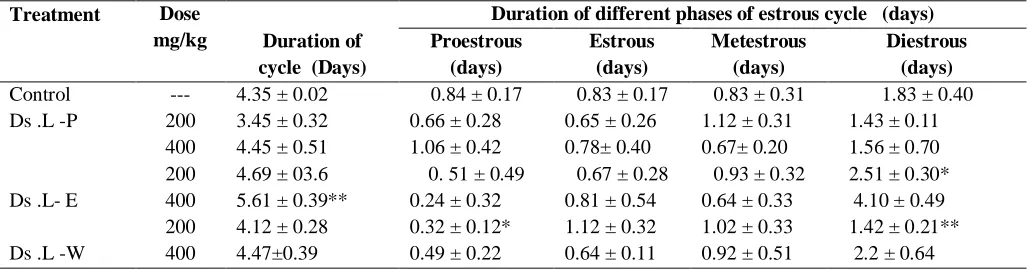
The present study revealed that the ethanol extract of D. stamonium leaves showed an antifetility effect. Treatment of rats with ethanol extract for five days prolonged the estrous cycle significantly (P<0.05, P<0.01) as indicated in Table 2. It is observed that in the control group of animals treated with 1% Tween 80 which was used as a vehicle in the present experiment all the six animals manifested normal cyclical oestrus phase throughout the study period. The estrous cycle in rats with ethanolic extract at dose level of (200 mg/kg), normal cyclical oestrus phase was absent in all the six animals after 4.5 days on an average. With higher doses in 2nd group (400 mg/kg) estrous phase disappeared more quickly i. e within 3 days on an average. This estrous suppressing effect of ethanol extract lasted for some period of drug treatment and even after discontinuation of the drug. In the group treated with 200 mg/kg ethanol extract, estrous suppressing effect lasts for about 10 to 14 days and in the 2nd group treated with 400 mg/kg ethanol extract suppress estrous phase for about 15 to 22 days. From the above observation it is seen that ethanol extract of D. stamonium leaves caused suppression of the estrous phase in female albino rats in a dose dependent, reversible manner. Since estrous phase in animal is a manifestation of ovulation, it may be presumed that suppression of estrous phase in albino rats is due to suppression of ovulation, suggesting an antiovulatory effect of the drug in the experimental group of animals. Different phases of estrous cycle are shown in Figure 1.
Estrogenic activity and antiestrogenic activity
Asian J Pharmaceut Res Health Care Volume 5 Issue2 65-71
compared to the control rats (Figure 2, 3 & 4). The uteri of these rats were inflated and full of fluid resembling the proestrous/estrous uterus. The epithelium of the endometrium consisted of spindle shaped cells with basal nuclei. The stroma consisted of loose and edematous fibroblast-type cells with edema. The control rats shows closed vagina whereas the treated rats showed an open vagina. Examination of the vaginal smears of the treated rats revealed predominantly cornified and nucleated epithelium cells. The administration of ethanol extract aggraved a significant increases in the uterine weight, signifying the estrogenic activity. However, when treated with ethinyl estradiol, it lowers the effect of estrogenic activity produced by ethinyl estradiol (Figure 3) comparatively the ethanol extract was found to be more active.
Histopathology
Histological examination of the uteri were carried out in the ethanol extract of D. stamonium leaves treated groups of animals with an idea to substantiate the experimental findings. . Ethanol extract of Datura stramonium
leaves exhibited estrogenic activity by significant increases in uterine weight, diameter of uterus and thickness of the endometrial epithelium, when compared to the control. Estrogen stimulates the content of these in uterus thereby changing the uterine milieu and creating contraceptive condition. The leaves extract acted as estrogen when given alone but when given with ethinyl estradiol it exhibited slight antiestrogenic activity.
Table 1. Preliminary phytochemical Screening of various extracts of D. stamonium Plant extracts Constituents
Ds .L -P Fats, steroids
Ds .L E Carbohydrates, alkaloids, Tannins, glycosides, Phenolics, saponin Ds .L -W Carbohydrates, alkaloids, proteins, saponin, tannins
Ds .L -D. stramonium Leaves,
P- Petroleum ether (60-80ºC), E- Ethanol, W- Aqueous
Table. 2. Effect of treatment of various extracts of D. stramonium (Linn.), on estrous cycle for 5 days in rats. Values are expressed in mean ± SEM, n= 6
Ds .L -D. stramonium Leaves,
Each value represents the mean ± S.E.M. (n=6); * P < 0.05. ** P < 0.01 vs control (Dunnett test)
Treatment Dose
mg/kg Duration of cycle (Days)
Duration of different phases of estrous cycle (days) Proestrous
(days)
Estrous (days)
Metestrous (days)
Diestrous (days)
Control --- 4.35 ± 0.02 0.84 ± 0.17 0.83 ± 0.17 0.83 ± 0.31 1.83 ± 0.40 Ds .L -P 200 3.45 ± 0.32 0.66 ± 0.28 0.65 ± 0.26 1.12 ± 0.31 1.43 ± 0.11
400 4.45 ± 0.51 1.06 ± 0.42 0.78± 0.40 0.67± 0.20 1.56 ± 0.70
Ds .L- E
200 4.69 ± 03.6 0. 51 ± 0.49 0.67 ± 0.28 0.93 ± 0.32 2.51 ± 0.30* 400 5.61 ± 0.39** 0.24 ± 0.32 0.81 ± 0.54 0.64 ± 0.33 4.10 ± 0.49
Ds .L -W
Asian J Pharmaceut Res Health Care Volume 5 Issue2 65-71
Table No. 3 Estrogenic and antiestrogenic activity of acetone and ethanol extracts of Datura stramonium Linn.
Values are expressed in mean ± SEM, n= 6
Groups Dose (mg/kg) Uterine weight
(mg/100 g body weight)
Control (Tween-80, 1%) 47.50 ± 1.25 Ethinylestradiol 0.02 145 ± 3.787***
Ds. L-E 200 68.43± 0.78* Ds. L-E 400 74.65 ±3.45** Ethinylestradiol+Ds. L-E 0.02+200 116 ± 2.34**† Ethinylestradiol+Ds. L-E 0.02+400 121 ± 1.12**† Ds .L -D. stramonium Leaves
P- Petroleum ether (60-80ºC), E- Ethanol, W- Aqueous.
Each value represents the mean ± S.E.M. (n=6); *P < 0.05,**P < 0.01,***P < 0.001Vs Control.
†
P < 0.05, ††P < 0.01 Vs Ethinyl estradiol (Dunnett’s test)
Figure 1. Vaginal smear of the rats on four-day estrous cycle. CXR III camera × 400. Control: 1st
day (A), 2nd day (B), 3rd day (C), 4th day (D)
Figure 2: Photograph of transverse section of control group showing surface epithelium with no secretary activity (Control group)
Asian J Pharmaceut Res Health Care Volume 5 Issue2 65-71
Figure 4: Photograph of transverse section of uterus of ethinyl estradiol (0.2 mg/kg p.o.) treated rats showing proliferating stage.
DISCUSSION
In the present study, leaves of D. stramonium were tested for its antiovulatory and estrogenic activity properties. Ovulation in rat is known to be correlated with the appearance of oestrus phase, manifested by the presence of almost 100% cornified cells in the vaginal smear in every four to five days. Ethanol extract, in the present study was observed to cause persistent absence of cornified epithelium in the vaginal mucosa in the entire animal in a dose dependent reversible manner, suggesting a ovulation suppression effect. The duration of the estrous cycle in rats is normally 4–5 days. Three cell types are found in the vaginal smear during a normal rat estrous cycle. The presence and absence of these cell types, and the relative proportion of each cell type, determine the stages of the estrous cycle. The ethanolic extract of D. stamonium exhibited significant antifertility activity (Fig.1) of the three extracts tested for the antiovulatory activity, ethanol extract produced a temporary and reversible modification on the estrous cycle. The prolongation in the diestrous phase explains the remote possibility of the rats getting pregnant. The reversible nature of the antifertility activity of the extract is explained through the observation that there was no significant change in the diestrous and the estrous cycle after withdrawing the extract from those of the control. As a result, the extracts provoked inhibition of the ovulation with consequent reduction of the cyclicity. Estrous cycle and the shift in different stages are mainly governed by the synthesis of ovarian estrogen, which, in turn, is controlled by the secretion of pituitary gonadotropins and hypothalamic-releasing factor. Ethanol extract of Datura stramonium
leaves exhibited estrogenic activity by significant increases in uterine weight, diameter of uterus and thickness of the endometrial epithelium, when compared to the control. Estrogen stimulates the content of these in uterus thereby changing the uterine milieu and creating contraceptive condition. The leaves extract acted as estrogen when given alone but when given with ethinyl estradiol it exhibited slight antiestrogenic activity. This shows that the extract acted as competitive antagonist to the much more potent ethinyl estradiol14.It is well known fact that estrogenic substances inhibit pregnancy by suppressing the level of both follicular stimulating hormone (FSH) and luteinizing hormone (LH), which in turn prevent the implantation. Estrogen and progesterone are the hormones responsible for histology and functional modifications of female genital tract15. Preliminary phytochemical studies indicated the presence of Carbohydrates, alkaloids, Tannins, glycosides, flavonoid, saponin. According to the literatures, flavonoids and saponins are known to exhibit antifertility activity2,11,14. The ethanol extract displayed significant activity when compared with controls, indicating that flavonoids could be responsible for the activity.
CONCLUSION
Asian J Pharmaceut Res Health Care Volume 5 Issue2 65-71
ACKNOWLEDGEMENT
The authors are thankful to Director, B R Nahata College of Pharmacy, Mandsaur College of Pharmacy and Management for providing all necessary facilities to carry out this research work. The authors also sincerely thank Dr. Bagdi, Department of Pathology, and India for providing assistance in histopathological study.
REFERENCES
1. Shagal MH, Modibbo UU, Liman AB. Pharmacological justification for the ethanomedical use of Datura
Stramonium stem-bark extract in treatment of diseases caused by some pathogenic bacteria. Inter Res of Pharm and
Pharmaco2012;2:016-019.
2.Vishnukanta, Rana AC. Antifertility activity of the leaves of Plumbago zeylanica L. in female albino rats. Indian J pharm Educ Res 2010;44:123-26.
3. Das T, Bhushan MS, Mrinmoy B, Mohanty JP, Dibyendu S. Evaluation of phytochemical screening and antifertility activity of Curcuma Aromatica salisb. Internatin J of Pharma sci and Res 2010;1:18-22.
4.Oseni OA, Olarinoye CO, Amoo IA. Studies on chemical compositions and functional properties of thorn apple (Datura stramonium L) Solanaceae. African J Food Sic 2011; 5:40– 44.
5. Pandey M, Debnath M, Gupta M, Chikara SK. Phytomedicine: An ancient approach turning into future potential source of therapeutics. J of Pharm and Phyto 2011;3:27-37.
6. Kritikar RK, Basu DB. Indian Medicinal Plants. Delhi, Jayyed Press; 1975, p. 1465–1470.
7. Devi1 MR, Meenakshi B, Paul SB, Sharma GD. Neurotoxic and Medicinal Properties of Datura stramonium L. – Review. Bio and Enviro Sci 2011;7:139-144.
8. Dinesh K, Ajay K, Om P. Potential antifertility agents from plants: A comprehensive review.J of Ethnopharm, 2012;140:1– 32.
9. Mali RG, Hundiwale JC, Gavit RS, Patil DA., Patil, KS. Herbal abortifacients used in North Maharashta. Natural Product Radiance, 2006;5:315–318.
10. Khandelwal KR. Practical Pharmacognosy. Pune: Nirali Prakashan; 2005.p.149–157.
11. E Sheeja, Joshi SB, Jain DC. Antiovulatory and estrogenic activity of Plumbago rosea leaves in female albino rats. Indian J Pharmaco, 2009;41:273–277.
12. Ghosh AK, Das AK, Patra AK. Studies on antifertility effect of rhizome of curcuma longa linn.. Asian J of Pharm and Life Sci, 2011; 1:2231- 4423.
13. Nirmala M, Girija K, Lakshman K, Divya T. Hepatoprotective activity of Musa paradisiaca on experimental animal models. Asi Pac J of Tro Bio, 2012:11-15.
14. Pattanayak SP, Mazumdar PM. Effect of Dendrophthoe falcate on female reproductive system of Wistar rats. Contracep, 2009; 80:314-320.