AJPRHC
Research Article
FORMULATION AND EVALUATION OF THE METHANOLIC EXTRACT OF CAESALPINIA PULCHERRIMA LEAVES FOR ITS WOUND HEALING ACTIVITY
KAVITH AN1, NAIRA NAYEEM2 For Author affiliations see end of the text This paper is available online at www.jprhc.in
ABSTRACT:
The present study was aimed at formulating and evaluating the methanolic extract of the leaves of Caesalpinia
pulcherrima for its wound healing activity. Excision and incision wound models were used for the evaluation of the
activity .Healthy animals were divided into four groups and they were treated as follows: Group I: control, Group II: standard nitrofurazone 0.2% (w/w) ointment, Group III: ointment base and Group IV: formulation .The animals treated with the extract exhibited significant wound healing activity. The period of epithelization (100%) for the animals treated with the extract was 14 days when compared to the control group which was 20 days. This activity was attributed to the analgesic, antiinflammatory, anti bacterial and anti oxidant activities of the plant.
KEY WORDS: Caesalpinia pulcherrima, ointment, wound healing.
INTRODUCTION
Caesalpinia pulcherrima is an important plant belonging to the family Leguminosae. It consists of yellow, pink,
off-white and red flowers. It is a commonly used medicinal plant[1,2]. Plants belonging to this species exhibit analgesic, adaptogenic, anthelmintic, anti ulcer, antibacterial, anti-inflammatory, antipyretic and antioxidant activities[3-7]. The wound healing activities of plants and their phyto constituents have been explored in folklore for many decades. Several Ayurvedic herbal plants have been reported to play an important role in the process of wound healing. The
inflammatory phase is the body’s natural response to injury; the other phases of wound healing being proliferation
and maturation. Inflammation and Wound infection is detrimental to wound healing as they cause impairment of wound healing. Antioxidants reduce the adverse effects of wounds by removing products of inflam-mation[8].Review of literature has revealed that any plant having analgesic, anti inflammatory, anti oxidant and anti bacterial can be efficient as a wound healing agent. The plant of interest has been reported to posses the various activities that help in the healing of wound. Hence this study was aimed at evaluating the wound healing activity of the methanolic extract of the leaves of Caesalpinia pulcherrima.
MATERIALS AND METHODS:
Collection of Plant:
The leaves of the Caesalpinia pulcherrima. (L.) were collected from the botanical gardens of Krupanidhi College of Pharmacy, Bangalore .They were dried and pulverized to get a coarse powder.
Preparation of the methanolic Extract: The methanolic extract of the leaves was prepared by macerating coarse powder for 24 hours by soaking in methanol then filtered and concentrated.
Preparation of formulation:
The extract was formulated as 5% (w/w) in a hydrophobic base using the fusion method.
Excision wound model [9,10]:
Healthy Sprague-Dawley (SD) rats of either sex weighing 200-250 gm were used for this study. The animals were maintained under standard conditions and were fed with commercial diet and water adlibitum during the entire course of the experiment. Ether was use to anesthetized the animals. An impression was made on the dorsal thoracic region 1 cm away from the vertebral column and 5 cm away from the ear of the anesthetized rat. The skin of that area was depleted and was excised to obtain a wound area of about 500 mm2. The animals were divided into four groups and they were treated. Group I was used as: control, Group II for standard nitrofurazone 0.2% (w/w) ointment, Group III was utilized for ointment base and Group IV was applied with formulation of the extract. The ointments were applied daily until complete healing of wound. A millimeter scale graph paper was used to measure the wound area .The percentage of wound healing was calculated on alternate days after wounding. Falling of scar was taken as the endpoint for complete epithelization and the days taken for this was considered as period of epithelization.
Incision wound model
In the incision wound model two para vertebral straight incisions of 6 cm were made on either sides of the vertebral column of each animal and anesthetizing the animals. Homeostasis was achieved by blotting the wound with a cotton swab dipped in saline and the wound was closed by means of interrupted sutures at equidistance 1 cm apart. Animals were treated daily with drugs, as mentioned above under excision wound model from 0 day to 9th post-wounding day. The tensile strength in each group is determined by estimating the wound breaking strength on the 10th day by continuous constant water flow technique.
Statistical analysis
Results are expressed as mean ± SEM. one way analysis of variance (ANOVA) followed by Dunnet test was used. P<0.05 was considered significant.
RESULTS AND DISCUSSION:
Wound healing is a complicated process. It involves stages like inflammation, wound contraction and epithelization .Any extract that posses activities like analgesic, anti inflammatory, anti microbial, antioxidant etc may also exhibit wound healing activity. Several drugs obtained from plant sources are known to increase the healing of wounds by their synergistic activity [9].
The phytochemical analysis of the methanolic extract revealed the presence of sterols, saponins, flavonoids, tannins, phenolic compounds, carbohydrates and proteins.
The methanolic extract of the leaves was formulated in 5 % hydrophobic ointment base by fusion method to get a homogeneous ointment. The wound healing activity of the medicated ointment was compared with that of the control.
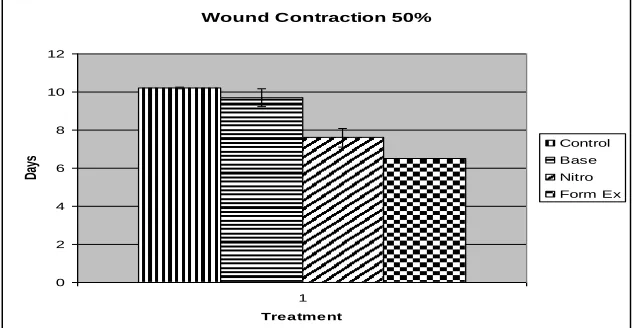
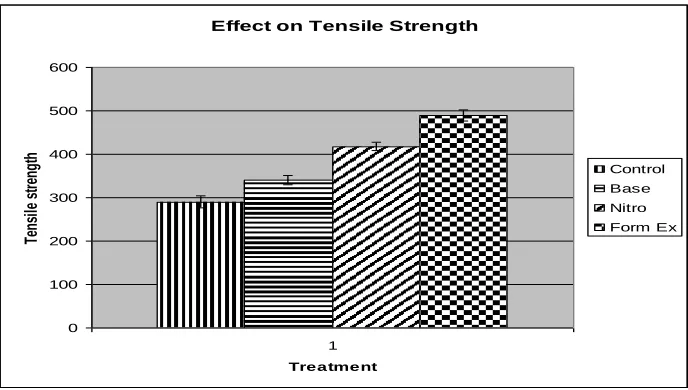
<0.01). The period of epithelization was 14 days which was significant when compared to the control in the excision wound model. The breaking strength of the 10 day old incision wound was increased by the extract formulation as depicted in table 1 and figures 1, 2, and 3
Table 1: Effect of the methanolic extract on the period of epithelization and wound contraction 50% in excision wound model and tensile strength in incision wound model:
Groups Excision wound Incision wound
Period of epithelization (in days)
Wound contraction 50%(in day)
Breaking strength
Control 19.80±0.40 10.2±0.04 290±13.90
Base 18.60±0.48 9.7±0.48 340±10.40
Nitrofurazone 15.40±0.00** 7.6±0.48** 418±9.40** Extract 13.60±0.48** 6.5±00** 490±12.80**
All values are mean± SEM, n=6, **P<0.01 vs. control
Fig 1: Effect of the formulated extract on Period of epithelization in excision wound model:
period of epitheliz ation 100%
0 5 10 15 20 25
1
Treatment
Da
ys
control base nitro form ex
Fig 2: Effect of the formulated extract on wound contraction 50% in excision wound model:
Wound Contraction 50%
0 2 4 6 8 10 12
1
Treatment
Da
ys
Fig 3: Effect of the formulated extract on tensile strength in incision wound model:
Effect on Tensile Strength
0 100 200 300 400 500 600
1
Treatment
Te
ns
ile
s
tr
eng
th
Control Base Nitro Form Ex
Literature survey has revealed that phenolic compounds promote wound healing effect by several mechanisms that include antioxidant, antimicrobial chelation of free radicals and astringent property[11,12] .We have already reported the amount of phenolic compounds, condensed tannins and flavonoids of the plant extract[13]. The wound healing activity of the methanolic extract can be attributed to the presence of these phytoconstituents which may be active individually or due to synergistic activity of these constituents.
CONCLUSION: From the results of our studies we can conclude that the methanolic extract of the leaves of
Caesalpinia pulcherrima has exhibited significant wound healing activity by the combined activities like analgesic,
anti inflammatory, anti oxidant and anti microbial activities. The phytoconstituents present in this plant are a contributing factor for the activity. Further studies can be carried out to identify the constituents that may be responsible for these activities
REFERENCES:
1. Baldim Z , Carvalho B A , Martineli P S , Santos M H , Lago J H., Sartorelli P. The Genus Caesalpinia L. (Caesalpiniaceae):Phytochemical and Pharmacological Characteristics. .Molecules 2012; 17: 7887-7902.
2.Kirtikar KR, Basu BD. Eds., In; Indian medicinal plants, 2nd Edn., vol-2, Periodical Experts Book agency, New Delhi, 1991, p.p. 848.
3. Al-Yahya MA, Rafatullah S, Mossa JS, Ageel AM, Al-Said MS, Tariq M. Gastric antisecretory, antiulcer and cytoprotective properties of ethanol extract of Alpinia galanga willd in rats. Phytotherapy Res 1990; 4:112-4. 4. Manoj K, Thangavel Sr. Anti-inflammatory and antinociceptive activityof pods of Caesalpinia pulcherrima.J Appl Pharma Sci 2011;1 (7): 180-184.
5. John D B, Herin S G, Steena RS. Antibacterial activity of a few medicinal plants against Xanthomonas campestris and Aeromonas hydrophila. J Biopesti 2011; 4 (1): 57 – 60.
6.Patel SS, Verma NK, Chatterjee C, Gauthanman K., Screening of Caesalpinia pulcherrima Linn flowers of analgesic and anti inflammatory activity. Inter J App Res Nat Pro 2010; 3(3):1-5.
8.Vijaya B, Kumudha V, Jayashree, Suseela L, Thirumal M Antioxidant and wound healing studies on different extracts of Stereospermum colais leaf R Int J Res Pharm Sci 2010;1(4): 435-439.
9.Majumdar, Nayeem N, Kamath JV, Asad M.Evaluation of Tectona grandis leaves forwound healing activity. Pak J Pharma Sci 2007; 20(2): 120-124.
10. Naira Nayeem, Karvekar MD.Comparative phytochemical and pharmacological screening of the methanolic extracts of the frontal and mature leaves of Tectona grandis. Inter J Pharma Bio Sci 2010;1(3).
11.Amarowicz R, Naczk M, F Shahidi M.Anti oxidant activity of canola and rape seed hulls.J Amer Oil Chem Soc 2002; 77(9):957-961.
12. Manjunath BK, Vidya M, Krishna V, Mankani KL. Wound healing activity of Leucas Hirta. Ind J Pharma Sci. 2006; 5: 380-84.
13.Determination of Total phenolic acids, condensed tannins and flavonoids in the leaves of Caesalpinia
pulcherrima (Linn.)Swathi Perumalla, Naira Nayeem. Inter J Phytother Res 2012;2(3):16-19.
AUTHORS AFFILIATION AND ADDRESS FOR CORRESPONDENCE
1. Department of Pharmaceutics, Krupanidhi College of Pharmacy, Bangalore