Eriocaulon madayiparense
(Eriocaulaceae) – A new
species from the foot hills of the Western Ghats of India
M. M. Swapna1, K. P. Rajesh2, C. N. Manju2, R. Prakashkumar1
1 Malabar Botanical Garden, G.A. College P.O., Kozhikode-673 014, Kerala, India 2 The Zamorin’s Guru-vayurappan College, G.A. College P.O., Kozhikode-673 014, Kerala, India
Corresponding author:K. P. Rajesh ([email protected])
Academic editor:S. Knapp | Received 30 October 2011 | Accepted 5 March 2012 | Published 16 March 2012
Citation: Swapna MM, Rajesh KP, Manju CN, Prakashkumar R (2012) Eriocaulon madayiparense (Eriocaulaceae) – A new species from the foot hills of the Western Ghats of India. PhytoKeys 10: 19–23. doi: 10.3897/phytokeys.10.2297
Abstract
EriocaulonmadayiparenseSwapna, Rajesh, Manju & Prakashkumar, sp. nov. is described and illustrated from the Madayipara, a lateritic hillock in the midland of Kannur District of Kerala. The species is allied to E. eurypeplon Koernicke, in its two free male and female sepals, female sepals being keeled and acute and not exceeding the floral bracts, acuminate leaf apex and setiform seed appendages appearing in verti-cal rows, but differs mainly in having yellow seeds with solitary appendage arising from transverse radial walls, curved and connate with the adjacent ones of the same vertical row forming longitudinal parallel ribs on the surface of the seeds.
Keywords
Eriocaulonmadayiparense, Eriocaulaceae, India, Western Ghats, Madayipara, Laterite hill
Introduction
The genus Eriocaulon is well represented in India with many endemic species. Ansari and Balakrishnan (2009) provided a detailed account of 80 species in India. However, novelties are being added in the genus in recent years such as Eriocaulon epedunculatum
Potdar et al.(Yadavet al.(2008), E. baramaticum Shimpale et al. (2009), E. belgau-mensis Shimpale& Yadav(2010), E. wayanadense Viveket al. (2010), E. malabaricum
Pradeep & Nampy and E. pykarense Nampy & Manudev (Nampy et al. 2011). The present one is another addition, from the foot hills of the Western Ghats of India. It www.phytokeys.com
Copyright M. M. Swapna et al. This is an open access article distributed under the terms of the Creative Commons Attribution License 3.0 (CC-BY), which permits unrestricted use, distribution, and reproduction in any medium, provided the original author and source are credited.
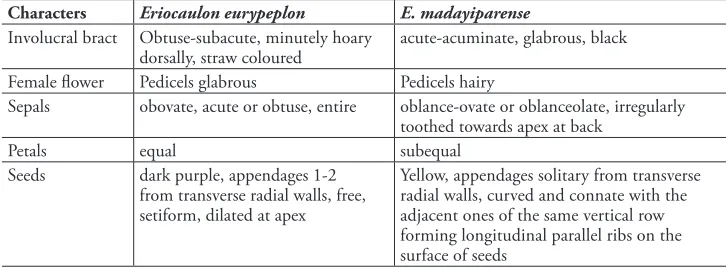
belongs to the section VI proposed by Ansari and Balakrishnan (2009). It is allied to E. eurypeplon Koernicke, and shows resemblances such as two free male and female sepals, female sepals being keeled and acute and not exceeding the floral bracts, acuminate leaf apex and setiform appendages appearing in vertical rows. However it strongly differs in having black coloured, glabrous, acute-acuminate involucral bracts, female sepals being irregularly toothed towards apexat back, unequal petals and yellow seeds with solitary appendage arising from transverse radial walls, curved and connate with the adjacent ones of the same vertical row forming longitudinal parallel ribs on the surface of seeds (Table 1). Hence it is described here as a new species.
table 1. Comparison between Eriocaulon eurypeplon and E. madayiparense
Characters Eriocaulon eurypeplon E. madayiparense
Involucral bract Obtuse-subacute, minutely hoary
dorsally, straw coloured acute-acuminate, glabrous, black
Female flower Pedicels glabrous Pedicels hairy
Sepals obovate, acute or obtuse, entire oblance-ovate or oblanceolate, irregularly toothed towards apex at back
Petals equal subequal
Seeds dark purple, appendages 1-2 from transverse radial walls, free, setiform, dilated at apex
Yellow, appendages solitary from transverse radial walls, curved and connate with the adjacent ones of the same vertical row forming longitudinal parallel ribs on the surface of seeds
Eriocaulon madayiparense Swapna, Rajesh, Manju & Prakashkumar, sp. nov. urn:lsid:ipni.org:names:77118190-1
http://species-id.net/wiki/Eriocaulon_madayiparense
Diagnosis.Eriocaulon madayiparense is allied to E. eurypeplon Koernicke, but differs mainly in having black, glabrous, acute-acuminate involucral bracts, pedicels of female flowers hairy at base, female sepals oblance-ovate or oblaceolate, cuneate, conduplicate, keeled, irregularly toothed towards apex, yellow seeds with solitary appendage arising from transverse radial walls, curved and connate with the adjacent ones of the same vertical row forming longitudinal parallel ribs on the surface of seeds.
Type.INDIA. Kerala, Kannur District, Madayipara, 40 m alt., 5 September 2011,
ca. 1.8 × 1.3 mm, coriaceous, minutely hoary dorsally towards apex, black. Male flow-ers: Pedicels minute. Sepals 2, free, oblanceolate, obtuse or acute, keeled, ca. 1.2 mm long, minutely hoary along keels towards apex, black. Stipe of corolla ca. 0.9 mm long. Petals 3, equal, minute, oblong, minutely hoary and minutely toothed at apex with a black gland, anthers 6, black. Female flowers: Pedicels minute, hairy at base. Sepals 2, free, similar, oblanceolate-ovate or oblanceolate, cuneate, conduplicate, keeled, ir-regularly toothed towards apexon keel,ca. 1.5 mm long, minutely hoary along keels towards apex, black. Petals 3, linear, subequal, ca. 0.6 to 0.8 mm long, hyaline, barbate towards apex, with or without a black gland, not stipitate between sepals and petals. Ovary sessile, globose, stigmas 3. Seeds ca. 0.6 × 0.3 mm, yellowish, cells of seed coat transversely elongated, aligned in vertical rows, appendages solitary from the middle of the transverse radial walls, curved and connate with the adjacent ones of the same vertical row forming longitudinal parallel ribs on the surface of the seed (Fig. 1 A–F).
Distribution. It is distributed in the laterite hills of Northern Kerala in Peninsular India.
Ecology. The specimens were collected from the Madayipara, a lateritic hillock in Kannur District of Kerala, at latitude 12°2'N and longitude 75°16'E, and with an alti-tude of 40–47 msl. It is a notable area being the type locality of some narrow endem-ics such as Nymphoides krishnakesara (Joseph and Sivarajan 1990), Rotala malabarica
(Pradeep et al. 1990), Justicia ekakusuma (Pradeep et al. 1991)and Lepidagathis keralen-sis (Madhusoodanan and Singh 1992). The lateritic outcrops of this area support a grassland-scrub system, unique in its ecology, being active along with the monsoon rains, supporting rich assemblages of many aquatic and semi-aquatic plants and ani-mals, and remaining as barren land as the rain recedes (Palot and Radhakrishnan 2002, 2005, Balakrishnan et al. 2010). More than 500 species of plants were recorded from the area, which includes 59 Peninsular Indian endemics, of which 14 are narrow endemics of Kerala state, confined to the laterite hillocks (Balakrishnan et al. 2010). Eriocaulon is also well represented in Madayipara with five species, viz., E. cuspidatum, E. heterolepis, E. lanceolatum, E. parviflorum and E. xeranthemum. The present species is growing in wet areas of Madayipara, along with species such as Utricularia reticulata, Rotala mala-barica, Rotala malampuzhensis, Rhamphicarpa longiflora, Oryza rufipogon, etc.
Flowering and fruiting. August–December.
Etymology. The species is named after the type locality, Madayipara.
Conservation status. The laterite hillocks in general and the Madayipara in par-ticular are facing high degree of danger of habitat degradation due to ignorance by the public and administrators. The areas are being heavily converted to building sites, min-ing grounds, dumpmin-ing sites, etc. The uncontrolled tourist activities are also damagmin-ing this fragile ecosystem. The present species, like other narrow endemics mentioned ear-lier, is also confined to the seasonal pools or wet areas of the lateritic hills. The habitat may be lost irrecoverably, if proper conservation measures are not taken.
Acknowledgements
The authors are thankful to Dr. R. Ansari for confirming the novelty of the present species. We are also thankful to the editor and reviewers for their critical comments. Financial assistance from the Kerala State Council for Science, Technology & En-vironment (KSCSTE), Thiruvananthapuram is also acknowledged. K.P. Rajesh and C.N. Manju are grateful to the authorities of the Zamorin’s Guruvayurappan College (ZGC), Kozhikode for encouragement.
references
Ansari R, Balakrishnan NP (2009) The family Eriocaulaceae in India. Bishen Singh Mahendra Pal Singh, Dehra Dun (Rev. ed.).
Balakrishnan VC, Palot MJ, Rajesh KP(2010) Observations on the flora of Madayipara a mid-land laterite hill in Kannur district, Kerala. Malabar Trogon 8 (2&3): 14–29.
Joseph KT, Sivarajan VV (1990) A new species of Nymphoides from India. Nordic J. Botany 10: 281-284. doi: 10.1111/j.1756-1051.1990.tb01773.x
Madhusoodanan PV, Singh NP (1992) A new species of Lepidagathis (Acanthaceae) from south India. Kew Bulletin 1:19–22
Nampy S, Manudev KM, Pradeep AK (2011) Two new species of Eriocaulon (Eriocaulaceae) from India. Edinburgh J. Botany 68: 257–263.
Palot MJ, Radhakrishnan C (2002) Herpetofauna of Madayipara hill, Kannur district, Kerala. Cobra 48: 3–6.
Palot MJ, Radhakrishnan C (2005) Faunal diversity of a laterite hill system at Madayipara, Kannur district, Kerala State, India. Rec. Zool. Surv. India Occ. Paper No. 242. Zoological Survey of India, Kolkata, 1–98.
Pradeep AK, Joseph KT, Sivarajan VV (1991) Justicia ekakusuma a new species of Acanthaceae from Peninsular India. Rheedea1: 40–43.
Pradeep AK, Joseph KT, Sivarajan VV (1990) Rotala malabarica a new species of Lythraceae from India. Bot. Bull. Acad. Sinica31: 51–61.
Shimpale VB, Yadav SR (2010) Eriocaulon belgaumensis: a new species of Eriocaulaceae from the Western Ghats of India. Kew Bulletin 65(2): 337–339. doi: 10.1007/s12225-010-9204-5
Shimpale VB, Bhagat RB, Deshmukh RB, Yadav SR (2009) A new species of Eriocaulon (Erio-caulaceae) from Maharashtra, India. Rheedea 19 (1 & 2): 47–49.
Vivek CP, Swapna MM, Suresh KK (2010) Eriocaulon wayanadense (Eriocaulaceae), a new spe-cies from Kerala, India. Rheedea 20(1): 25–27.