Systematics of
Disakisperma
(Poaceae, Chloridoideae, Chlorideae)
Neil Snow1, Paul M. Peterson2, Konstantin Romaschenko2,3
1 Department of Biology, Pittsburg State University, Pittsburg, KS 66762 USA 2 Department of Botany
MRC-166, National Museum of Natural History, Smithsonian Institution, Washington, DC 20013-7012 USA
3 M.G. Kholodny Institute of Botany, National Academy of Sciences, 01601 Kiev, Ukraine
corresponding author:Neil Snow ([email protected])
Academic editor:Leonardo Versieux | Received 25 May 2013 | Accepted 17 September 2013 | Published 27 September 2013
Citation: Snow N, Peterson PM, Romaschenko K (2013) Systematics of Disakisperma (Poaceae, Chloridoideae, Chlorideae). PhytoKeys 26: 21–70. doi: 10.3897/phytokeys.26.5649
Abstract
Disakisperma Steud. is a genus of four predominantly perennial C4 (NAD-ME) species in the Americas,
Africa, and Asia. Its species previously were treated in Eleusine, Eragrostis, Coelachyrum, Cypholepis,
Lep-tochloa, or Diplachne by nearly all authors.It includes the widespread North and South American
amphi-tropical disjunct Disakisperma dubium (type of the genus), D. eleusine from southern Africa, D.
obtusiflo-rum from central and northern Africa to southern Asia, and D. yemenicum, comb. nov. from eastern and
southern Africa to Yemen. This paper provides a key to the species, geographic distributions, descriptions, including comments on the anatomy of leaves, stems, lemmatal micromorphology, a phylogram based on five molecular markers, and discussions of chromosome numbers. The species are rarely, if at all, known outside of their native ranges and are unlikely to become aggressively invasive. All species are considered
Least Concern following IUCN guidelines. Lectotypes are designated for Diplachne dubia var. pringleana
Kuntze, Disakisperma mexicana Steud., Eragrostis yemenica Schweinf., and Leptochloa appletonii Stapf.
Resumen
Disakisperma Steud. es un género de quatro especies perennes C4 (NAD-ME), las cuales que son de las
Américas y África y Asia. Sus especies previamente fueron tratados en Eleusine, Eragrostis, Coelachyrum,
Cypholepis, Leptochloa, o Diplachne por casi todos los autores. Incluye la generalizada del Norte y América
del Sur amfitropical disjunta D. dubium (tipo del género), D. eleusine desde el sur de África, D.
obtusiflo-rum del centro y el norte de África hasta el sur de Asia, y D. yemenicum, comb. nov. del este y sur África
a Yemen. Este documento proporciona una clave para las especies y las descripciones completas, incluidos los comentarios sobre la anatomía de las hojas, tallos, micromorfología lemmatal, una filograma basado en cinco marcadores moleculares y las discusiones de los números de cromosomas. Las especies son rara-www.phytokeys.com
Copyright Neil Snow et al. This is an open access article distributed under the terms of the Creative Commons Attribution License 3.0 (CC-BY), which permits unrestricted use, distribution, and reproduction in any medium, provided the original author and source are credited.
mente, si acaso, conocida fuera de sus áreas de distribución natural y es poco probable para convertirse en invasora agresiva. Todos las epecies se consideran la designación de Least Concern sigue IUCN. Se designa
lectotipos para Diplachne dubia var. pringleana Kuntze, Disakispermamexicana Steud., Eragrostis yemenica
Schweinf. y Leptochloa appletonii Stapf.
Keywords
Conservation, Coelachyrum, Cypholepis, Disakisperma, grasses, ITS, leaf anatomy, lectotypification,
Lep-tochloa, phylogeny, plastid DNA sequences, stem anatomy, systematics, taxonomy, Thysanoptera
Introduction
Recent molecular studies by Peterson et al. (2010, 2012) determined Leptochloa P. Beauv. s.l. (Snow 1997) to be polyphyletic, with its sampled species partitioned into five strongly supported clades. Peterson et al. (2012) analyzed 22 of the 32 species of Leptochloa and a wide representation of taxa from related genera in subfamily Chlo-ridoideae, tribe Chlorideae. Disakisperma Steud. was one of the proposed segregate genera (Peterson et al. 2012), but that generic name has not been used widely since its description by Steudel (1854). Nearly all authors have placed Disakisperma in Leptoch-loa or Diplachne (see summaries in Valls 1978; McNeill 1979; Snow 1997).
The clade in Peterson et al. (2012) that we recognize as Disakisperma included Leptochloa dubia (Kunth) Nees, L. eleusine (Nees) Cope & N. Snow, and L. obtusiflo-ra Hochst. These were the first molecular results to suggest a close relationship among these species, although based on overall morphology Steudel (1841: 30) placed Lep-tochloa obtusiflora Trin. ex Steud. (nom. inval.) as a synonym of L. dubia, suggesting their affinity. In a paper documenting C4 origins in the grasses, Aliscioni et al. (2012) presented a summary tree for Chloridoideae derived from rbcL, ndhF, and trnK/matK sequences, which united Leptochloa dubia and Coelachyrum yemenicum (Schweinf.) S.M. Phillips in a clade with moderate bootstrap support. For this study we included two samples of Coelachyrum yemenicum to test its relationship with other members of Disakisperma.
Snow is Leptochloa obtusiflora, first described by Hochstetter (1855); and Coelachryum yemenicum was first described by Schweinfurth (1894) as an Eragrostis, placed in the monotypic Cypholepis by Chiovenda (1908), who transferred it to Eleusine (Chiovenda 1912), and finally Phillips (1982), who transferred it to Coelachyrum.
The purpose of this paper is to present a systematic account of Disakisperma as part of a series of papers separating Leptochloa s.l. (Snow 1997) into monophyletic genera (see also Snow and Peterson 2012). In addition, we include a phylogram derived from analysis of combined plastid and ITS sequences that suggests evolutionary relation-ships among the four species of Disakisperma.
Materials and methods
We viewed over 1500 herbarium specimens from nearly 60 herbaria for this revision (see Acknowledgements). However, we estimate that less than half of the existing speci-mens of Disakisperma dubium have been cited, particularly in the southwestern USA and northwestern Mexico, given the large numbers of collections deposited in the larger herbaria (e.g., ARIZ, ASU, MEXU, TAES, TEX) and in many smaller herbaria that we have not visited in North America and southern South America. The first au-thor has collected a dozen specimens of D. dubium in the USA and parts of Mexico and D. eleusine in South Africa, whereas the second author has collected 85 specimens of D. dubium across much of its native range, and D. obtusiflorum (3) and Coelachryum yemenicum in Tanzania. Geographic range abbreviations follow Brummitt (2001) and herbarium abbreviations follow Thiers (2013).
Fresh leaf and stem material was preserved for anatomical analysis and studied for (but not summazied) in Snow (1997). Leaf anatomy terminology follows Ellis (1976). Characters of lemmatal micromorphology were studied using scanning elec-tron microscopy (Snow 1996), and caryopsis features were viewed using simple light microscopy (Snow 1998b).
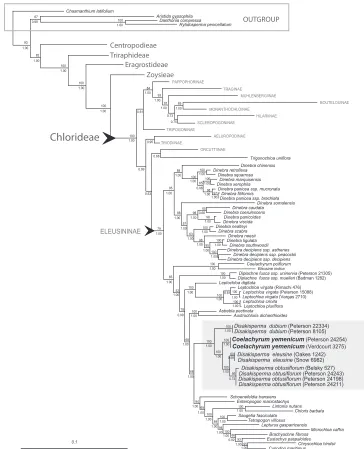
Figure 1. Phylogram of maximum-likelihood tree from analysis of combined plastid (rpL32-trnL, ndhA
intron, rps16 intron, and rps16-trnK) and ITS sequences. Numbers above branches represent bootstrap
values; numbers below branches represent posterior probabilities; gray highlighted area is the
Tab
le
1.
S
pecimens sampled in the
Disakisper
ma−Coelachr
yum y
ememicum
clade, v
ouchers (MO = M
issouri Botanical G
ar
den; US = U
nited S tates N ational H erbarium, S mithsonian I nstitution), countr
y of origin, and G
enB
ank accession numbers for DNA sequences. All accessions mar
ked in
bold
ar
e ne
wly submitted
sequences to G
enB ank. Tax on Voucher Countr y rpl32-tr nL ndhA intr on rps16 intr on rps16-tr nK ITS Disakisper ma dubium (K unth) P .M. P eterson
& N. S
no
w
Peterson 22334 & S
aar ela (US) M exico GU359811 GU359442 GU360416 GU360695 GU359145 Disakisper ma dubium (K unth) P .M. P eterson
& N. S
no
w
Peterson 8105 & Annable (US)
M exico JQ345332 JQ345214 JQ345290 JQ345247 JQ345179 Disakisper ma eleusine (N ees) P .M. P eterson & N.S no w Sno
w 6982 (MO)
South Africa JQ345333 JQ345215 JQ345291 JQ345248 JQ345180 Disakisper ma eleusine (N ees) P .M. P eterson & N.S no w O
akes 1242 (US)
South Africa KF574410 KF574416 KF574422 KF574399 Disakisper ma obtusiflor um (H ochst.) P .M.
Peterson & N. S
no
w
Peterson 24243, S
or eng & Romaschenko (US) Tanzania KF574413 KF574407 KF574419 KF574425 KF574402 Disakisper ma obtusiflor um (H ochst.) P .M.
Peterson & N. S
no
w
Belsky 527 (MO)
K enya JQ345340 JQ345298 JQ345255 JQ345187 Disakisper ma obtusiflor um (H ochst.) P .M.
Peterson & N. S
no
w
Peterson 24198, S
or eng & Romaschenko (US) Tanzania KF574411 KF574405 KF574417 KF574423 KF574400 Disakisper ma obtusiflor um (H ochst.) P .M.
Peterson & N. S
no
w
Peterson 24211, S
or eng & Romaschenko (US) Tanzania KF574412 KF574406 KF574418 KF574424 KF574401 Disakisper ma y emenicum (Schw einf .) P .M.
Peterson & N. S
no
w
Peterson 24254, S
or eng & Romaschenko (US) Tanzania KF574414 KF574408 KF574420 KF574426 KF574403 Disakisper ma y emenicum (Schw einf .) P .M.
Peterson & N. S
no
w
Ver
dcour
t 3275 (US)
Results and discussion
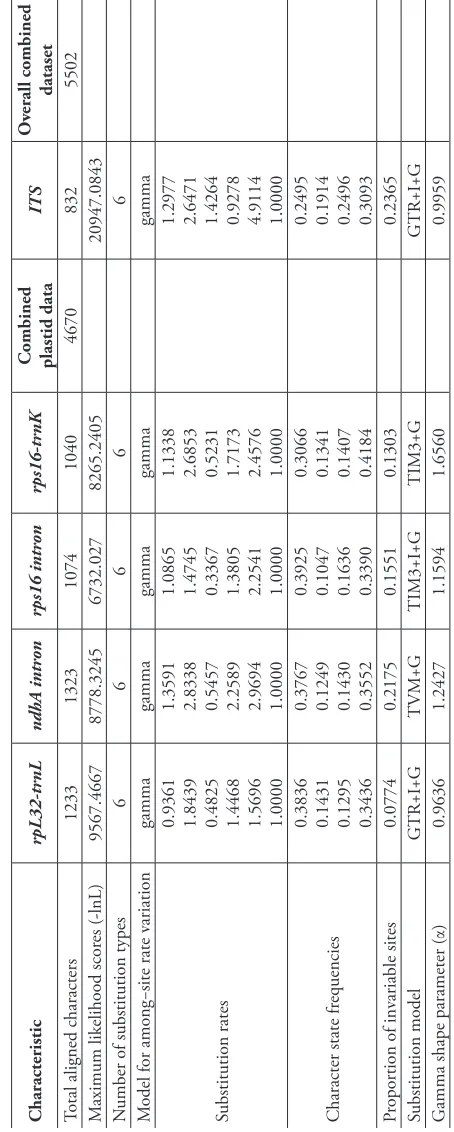
Phylogeny. A total of 29 sequences from six species are newly reported in GenBank (Table 1). Total aligned characters for individual regions are noted in Table 2. We com-bined the plastid−ITS sequences in our analysis since there were acceptable levels of congruence between the majority of the data sets in Peterson et al. (2012).
The maximum-likelihood tree from the combined analysis of four plastid regions (rpL32-trnL, ndhA intron, rps16 intron, and rps16-trnK) and ITS is well resolved, with strong to moderate support for the tribes and most subtribes of the Chloridoideae (Fig. 1). The Chloridoideae is composed of five tribes; followed by, in order of divergence: Cen-tropodieae, Triraphideae, Eragrostideae, Zoysieae, and Chlorideae (Peterson et al. 2010, 2011, 2012). Within the subtribe Eleusininae, species of Leptochloa s.l. form four ma-jor clades: Dinebra, Diplachne, Leptochloa s.s., and Disakisperma (including Coelachyrum yemenicum). Trigonochloa, a genus with only two species (formerly placed in Leptochloa) is sister to the Orcuttiinae; and together these are sister to the Eleusininae (Peterson et al. 2012; see also Snow and Peterson 2012). In the Disakisperma clade (incl. Coelachyrum yemenicum; bootstrap: BS = 100, posterior probability: PP = 1.00), D. eleusine and D. obtusiflorum are sister (BS = 100, PP = 1.00); C. yemenicum is sister to these (BS = 100, PP = 1.00); and D. dubium is sister to all three species (BS = 100, PP = 1.00) [Fig. 1].
Morphology. Disakisperma (including Coelachyrum yemenicum) can be recog-nized by its paniculate inflorescence (=synflorescence) composed of several unilateral racemes that are racemosely to subdigitally inserted along a central axis, spikelets with multiple florets (4−14), mostly 3-nerved lemmas and 1-nerved glumes, and dorsally flattened, mostly elliptical caryopses that are shallow to broadly concave on the hilar surface with a pericarp weakly adnate to endosperm.
Lemmatal micromorphology. The four species share a similar but not identical suite of lemma micromorphological traits, including the presence of silica cells, cork cells, long cells and short cells, and bicellular microhairs. The lemmatal hairs of Disakisperma eleu-sine, D. obtusiflorum and D. yemenicum are clavicorniculate (apically club-shaped with a pointed tip), whereas those of D. dubium are acute or rounded apically (Snow 1996). These four species form a strongly supported clade in the phylogram (Fig. 1).
Table 2.
Summary of the four plastid and nrDNA ITS regions used in the maximum likelihood and Bayesian searches indicated by Akaike’s I
nformation Criterion (AIC).
Characteristic rpL32-tr nL ndhA intr on rps16 intr on rps16-tr nK
Combined plastid data
ITS
Ov
erall combined dataset
Total aligned characters
1233 1323 1074 1040 4670 832 5502 M
aximum likelihood scor
es (-lnL) 9567.4667 8778.3245 6732.027 8265.2405 20947.0843 N
umber of substitution types
6 6 6 6 6 M
odel for among−site rate v
ariation gamma gamma gamma gamma gamma Substitution rates
0.9361 1.8439 0.4825 1.4468 1.5696 1.0000 1.3591 2.8338 0.5457 2.2589 2.9694 1.0000 1.0865 1.4745 0.3367 1.3805 2.2541 1.0000 1.1338 2.6853 0.5231 1.7173 2.4576 1.0000 1.2977 2.6471 1.4264 0.9278 4.9114 1.0000
Character state fr
equencies
0.3836 0.1431 0.1295 0.3436 0.3767 0.1249 0.1430 0.3552 0.3925 0.1047 0.1636 0.3390 0.3066 0.1341 0.1407 0.4184 0.2495 0.1914 0.2496 0.3093
Pr
opor
tion of inv
ariable sites 0.0774 0.2175 0.1551 0.1303 0.2365 Substitution model GTR+I+G TVM+G TIM3+I+G TIM3+G GTR+I+G G
amma shape parameter (
1998b). Valls (1978) noted considerable variation in caryopsis morpholgy among the cleistogenous spikelets of D. dubium that occur within the leaf sheath, but Snow (1998b) did not measure variation among cleistogamous spikelets.
In transverse section the caryopsis of Disakisperma is usually transversely elliptic (Snow 1998b). This shape accords with many previous observations that the spikelets are strongly flattened dorsally in species now treated in Diakisperma (Parodi 1927; Mc-Neill 1979; Lazarides 1980; Phillips 1982; Jacobs 1988; Nowack 1994; Nicora 1995). Snow (1998b) also reported “rounded shallowly obtriangular” for D. eleusine, but in reviewing his original notes for that project, now considers that report erroneous.
In addition to its transversely elliptic shape, all four species typically (but not always) have caryopses that are concave on the hilar surface (Snow 1998b). For example, in D. dubium the broad shallow concavity was noted for Warnock 46783 from Texas (NCU), Kral 51801 from Florida (MO), and Hernández & Mathia N-2066 from San Luis Po-tosí, Mexico (GH). The depression was not noted specifically for Mearns 1213 (US) from Kinney County, Texas; Gould 12183 (K) from Baja California Sur, or Castillon 43560 (GH) from Tucumán, Argentina, although it probably was shallow in these. Broad to shallow concavities were noted to characterize the caryopses of some species for all speci-mens observed by Snow (1998b) for D. eleusine and D. obtusiflorum (and, newly noted here for the latter, Blesky 433 (BH) from Kenya). However, broad to shallow depressions were noted for many specimens of species treated by Snow (1997) in Leptochloa s.l., including: Dinebra aquatica (Scribn. & Merr.) P.M. Peterson & N. Snow: Pringle 6664 (US); Dinebra chinensis (L.) P.M. Peterson & N. Snow: Davidse 7471 (MO) from Sri Lanka; D. decipiens (R. Br.) P.M. Peterson & N. Snow subsp. decipiens: Lazarides 5634 (US) from Queensland, Australia; Dinebra decipiens subsp. peacockii (Maiden & Betche) P.M. Peterson & N. Snow: R. Johnson 713 (CANB) from Queensland, Australia; Dine-bra panicoides (J. Presl) P.M. Peterson & N. Snow: Francoer & Williams 47 (ENCB) from Oaxaca, Mexico; Dinebra viscida (Scribn.) P.M. Peterson & N. Snow: Palmer 1789 (GH) from Sinaloa, Mexico; Leptochloa digitata (R. Br.) Domin.: Blake 6320 (CANB) from Queensland, Australia; Leptochoa longa Griseb.: Davidse 2612 (MO) from Trini-dad; and Coelachyrum yemenicum: Schweickerdt 2011 (S) origin not recorded.
The pericarp is weakly adnate among species of Disakisperma and disassociates relatively quickly in water at room temperature (Snow 1998b). This is a homoplastic trait within Chlorideae given its recurrence in Diplachne s.s. (Snow 1997, 1998b; Pe-terson et al. 2012), Dinebra panicoides, and D. viscida, the latter two of which form a distinct clade in the combined plastid and ITS phylogram (Fig. 3 in Peterson et al. 2012). Leptochloa chloridiformis (Hack. ex Stuck.) Parodi, in the newer and narrower circumscription of Lepotchloa (Peterson et al. 2012), was the only species in which the pericarp readily disascociated in water (Snow 1998b). Valls (1978: 104) also reported a freely disassociating pericarp for the rarely collected Leptochloa longa Griseb., of which we have not yet obtained molecular data.
To summarize, when used with other characters, species of Disakisperma generally can be characterized by the dorsally flattened caryopses that are broadly to shallowly con-cave on the hilar side, with pericarps that detach readily from the seed wall of the caryopsis in water. However, since some species in closely related chloridoid genera also share these homoplastic traits, features of the caryopsis by themselves are insufficient to diagnose Di-sakisperma. This observation echoes Vavilov (1922) and his “Law of Homologous Series in Variation”. However, the term homologous is a misnomer as presently used by evolution-ary biologists, given that such traits are now considered non-homologous (homoplastic).
Taxonomic treatment
DisakispermaSteud., Syn. Pl. Glumac. 1: 287. 1854.
http://species-id.net/wiki/Disakisperma
Type species. Disakisperma mexicana Steud. = Disakisperma dubium (Kunth) P.M. Pe-terson & N. Snow.
Description. Plants perennial, rarely annual in a few populations, occasionally stoloniferous. Culms 30–200 cm long, solid, decumbent or clambering to erect; nodes glabrous. Leaf sheaths half as long to slightly longer than internodes, glabrous or ciliate apically along margins; ligule membranous, 0.5–1.5 mm long, ciliate or fimbriate api-cally; leaf blades cauline, linear. Inflorescence apical and exserted at maturity or cleis-togamous in lower leaf sheaths, a panicle composed of several to numerous unilateral racemes, racemosely or subdigitately scattered along a central axis; branches at matu-rity slightly reflexed to ascending or steeply erect. Spikelets sessile to subsessile, dorsally rounded to flattened, typically overlapping, disarticulation above the glumes; florets 4−13; glumes 2, 1-nerved or occasionally with remnants of two additional nerves near base, mucronate or emucronate; lemmas 3-nerved, rarely with remnants of two ad-ditional nerves near base, sometimes cartilaginous towards the base, macrohairs acute, obtuse, or clavicorniculate; paleas often somewhat cartilaginous towards base. Stamens 3. Lodicules 2, flabellate. Caryopses dorsally flattened, broadly concave on the hilar surface; pericarp weakly adnate to endosperm. 2n = 40, 60, 80 (Snow 1997).
Vernacular name. In light of its only recent resurrection from generic synonymy (Peterson et al. 2012), no common name exists for Disakisperma. We suggest Jacob-sgrass to honor the memory of Dr. Surrey W. L. Jacobs (1946−2009), an Australian friend, colleague, and chloridoid specialist (e.g., Jacobs 1988).
Key to the species of Disakisperma
1 Panicles 1–3 cm wide; branches mostly erect or steeply ascending, stiff, 2–10.5 cm long ...2
2 Lemmas membranous throughout, margins not involute near base; adaxial leaf blades surfaces without long hairs; anthers 0.9−1.0 mm long ...D. eleusine
– Lemmas cartilaginous below, margins involute near base; adaxial leaf blade with scattered, delicate, straight hairs near the base, the hairs 3−5 mm long; anthers 0.2−0.3 mm long ...D. yemenicum
3 Lemmas 3.5−5.0 mm long with round- to acute-tiped hairs along margins and sometimes the midnerve below; glumes 3.3−6.0 mm long; cleistogamous spikelets hidden in lower leaf sheaths; anthers 1.0−1.6 mm long; native to the Americas ...D. dubium
– Lemmas 2.2−2.8 (−3.0) mm long with clavicorniculate (club-shaped) hairs along the margins and midnerve below; glumes 1.5−2.9 mm long; cleistoga-mous spikelets absent in the lower leaf sheaths; anthers about 0.7 mm long; native to Africa and Asia ...D. obtusiflorum
Disakisperma dubium (Kunth) P.M. Peterson & N. Snow, Ann. Bot., 109: 1327. 2012.
http://species-id.net/wiki/Disakisperma_dubium
Figure 2A−P
Chloris dubia Kunth, Nov. Gen. Sp. 1: 169. 1816. Leptostahys dubia (Kunth) G.
Mey., Prim. Fl. Esseq. 74. 1818. Leptochloa dubia (Kunth) Nees, Syll. Pl. Nov. 1: 4. 1824. Festuca obtusiflora Willd. ex Spreng., Syst. Veg. 1: 356. 1825.
Diplachne dubia (Kunth) Scribn. Bull. Torrey Bot. Club 10: 30. 1883.
Rab-dochloa dubia (Nees) Kuntze ex Stuck., Anales Mus. Nac. Buenos Aires 11: 121. 1904. Sieglingia dubia (Kunth) Kuntze ex Stuck., Anales Mus. Nac. Buenos Aires 11: 128. 1904.
Schismus patens J. Presl. Reliq. Haenk. 1(4-5): 269. 1830. Leptochloa patens (J. Presl) Kunth, Enum. Pl. 1: 271. 1833. Diplachne patens (J. Presl). TYPE: Chile, Hab. in Cordilleris chilensibus, T. Haenke s.n. (holotype: PR; isotype: US-A78816!). Disakisperma mexicana Steud., Syn. Pl. Glumac. 1: 287. 1854. (“1855”). TYPE:
Mex-ico, Vallee de MexMex-ico, Aug 1827, J.L. Berlandier 758 (lectotype: P ex herb. Drake barcode P02295597 seen digitally!; isolectotypes: MO-134708 seen digitally!, US-90594, US-865873 frag. ex CN!).
Uralepis brevicuspidata Buckley, Proc. Acad. Nat. Sci. Philadelphia 1862: 93-94. 1862. TYPE: U.S.A., Northern Texas, Wright 767 (lectotype: PH! designated by Hitch-cock Man. Grass. U.S. 877. 1935 but without designating a herbarium; isolecto-type: US-2786821-photo!).
Ipnum mendocinum Phil., Anales Univ. Chile 36: 211. 1870. Diplachne mendocina
(Phil.) Kurtz, Bol. Acad Ci. (Córdoba) 15: 521. 1897. Eragrosits mendocina (Phil.) Jedwabn., Bot. Arch., 5(3–4): 192. 1924. TYPE: Argentina, Mendoza (holotype: SGO; isotype BAA-1452!).
Beal. TYPE: USA, Arizona, Pima Co., Arizona, Sierra Tucson, 27 Apr 1884, C.G. Pringle 13 (holotype: MSC-8177 seen digitally!; isotypes: GH, US-78806!, VT). Diplachne dubia var. kurtziana Kuntze, Révis. Gen. Pl. 3 (2): 349. 1898. TYPE:
Argen-tina, Córdoba, F. Kurtz 6647 (holotype: NY, fragment US-86574!).
Diplachne dubia var. pringleana Kuntze, Revis. Gen. Pl. 3 (2): 349. 1898. Leptochloa dubia var. pringleana (Kuntze) Scribn. & Merr., U.S.D.A. Div. Agrostol. Bull. 24: 27. 1901. TYPE: Mexico, Chihuahua, Hills and plains near Chihuahua, Pringle 422 (lectotype: NY! here designated, barcode 00019500; duplicates of lectotypes: GH!, MSC, NY-19498!, NY-19500!, P!, PH!, PR!, RSA!, US-899043!, VT).
Type. MEXICO. F. Humboldt & A. Bonpland 4172 (lectotype: P! barcode P032678 designated by Snow et al., J. Bot. Res. Inst. Texas 2: 863. 2008; isolectotypes: B-Willd. barcode 02095-010! seen digitally May 2013, HAL-107044! seen digitally May 2013, K, K-microfiche, US-865876 frag. ex P!).
Figure 2. Disakisperma dubium (Kunth) P.M. Peterson & N. Snow A habit B culm andinflorescence
C sheath, ligule, and blade, ventral view D spikelet E floret F lower glume g upper glume h lemma,
dorsal view I palea, dorsal view J palea, ventral view K lodicules L floret, ventral view M perfect flower
with lodicules, pistil, and stamens enclosed in palea n caryopsis, ventral view o caryopsis, dorsal view
P caryopsis, cross section. A−C, M drawn from Peterson & Annable 5387 (US); D−L, N−P drawn from
Leaf anatomy. Previous authors discussed aspects of cross-section laminar anato-my of D. dubium (Brown 1960, Black and Mollenhauer 1971, Gutierrez et al. 1974, Valls 1978), whose collective data agree with our findings of the C4 NAD-ME photo-synthetic pathway.
Midrib absent, or if present then lacking associated lacunae. Primary bundles (metaxlyem elements present) separated from one another by up to five secondary bundles (metaxylem elements absent). Primary and secondary bundles projecting lit-tle if at all adaxially or abaxially in fresh material. Outer primary bundle sheath cells continuous or interrupted adaxially but typically interrupted abaxially. Primary and secondary bundles often with colorless extension cells and sclerenchyma girders associ-ated above and below. Colorless cells lacking between adjacent bundles; chlorenchyma always continuous. Bulliform cells present between primary and secondary bundles [Vouchers: Snow 5865 (MO), Snow 6673 (MO)].
Stem anatomy. The culm anatomy of D. dubium was discussed briefly by Canfield (1934) and Brown et al. (1959). The cross-section shown in Valls (1978, see fig. 21) is indented on one side where an axillary cleistogamous infloresence likely was located.
Culm solid. Outer sclerenchyma ring (subjacent to epidermis) present and some-times surrounding outermost vascular bundles. Assimilatory (=assimilation) tissue (chloroplast-bearing and lightly staining parenchyma tissue (Pée-Laby 1898; Metcalfe 1960) often present between outermost vascular bundles. Additional vascular bundles scattered in outer ca. 1/3 of cortical tissue. Inner sclerenchyma ring absent or present (Valls 1978). [Voucher: Snow 5865 (MO)].
Chromosome number. Individuals of Disakisperma dubium are tetraploid (Covas 1949; Valls 1978, voucher not seen), hexaploid (Brown 1950, voucher confirmed by Valls 1978), or octaploid (Gould 1960, 1965, vouchers confirmed by Valls 1978). Vari-ation in ploidy number has not been shown to correspond with morphological variVari-ation or have a clear geographical pattern (Valls 1978), although sampling has been limited.
Phenology. Flowering commencing after the dormant season and continuing sev-eral months thereafter, or year–round in tropical climates at lower altitudes.
Distribution. Native: In the USA from Arizona to Oklahoma and Texas, and disjunct in southern Florida, in much of Mexico, sporadically in the Carribean and in Mesoamerica to Bolivia and Chile east to Paraguay, Uruguay, and Argentina; in a variety of vegetation and soil types (including limestone), but most frequently on well-drained slopes, mostly 100–2500 m, to 3150 m in the Andes of South America (e.g., Vargas 13770 [US]). (TDWG: AGE-CD, AGE-CN, AGW-JU, AGE-LP, AGW-CA, AGW-LR, AGW-ME, AGW-SA, AGW-SE, AGW-SJ, AGU-TU, BOL, CLM, ECU, MXC-DF, MXC-PU, AG, CO, CU, DU, GU, MXE-HI, MXE-NL, MXE-QU, MXE-SL, MXE-TA, MXE-ZA, MXN-BS, MXS-MI, MXT-CI, PER, PUE, ARI, FLA, NWM, OKL, TEX.) Non-native: USA in Califor-nia, Hawaii (Snow and Davidse 2011), Kansas, and Missouri (TDWG: CAL, KAN, MSO). Its occurrences in the high Andes of Colombia, Ecuador, Bolivia, and Peru may be as introductions.
Etymology. The Latin dubium means wavering or doubtful, which may refer to Kunth’s uncertainty about its inclusion in Leptochloa at the time of its description, but the intention behind the specific epithet is uncertain.
Vernacular names. Green sprangletop; Texas crowfoot (Valls 1978), Zacate gi-gante (Beetle et al. 1991). Suggested name: American Jacobsgrass.
Comments. The combination of its perennial habit, cleistogamous inflorescences inserted in the sheath near the base of the culms, short ciliate ligules, typically notched lemma apices, frequently (but not always) widely diverging florets during anthesis, and typically racemose to subdigitately arranged panicle branches, generally distinguish Disakisperma dubium from others in its geographical range. Among former compo-nents of Leptochloa s.l. (Snow 1997), Disakisperma dubium is sometimes confused with Diplachne fusca (L.) P. Beauv. ex Roem. & Schult. subsp. uninervia (J. Presl) P.M. Peterson & N. Snow, which also has truncate to (usually) emarginate lemma apices. However, D. fusca subsp. uninervia is an annual (that sometimes is weakly perennial), has much longer and apically attenuated (and often lacerated) ligules, lacks hairs on the outer edges of the collar, lacks cleistogamous inflorescences, and grows most frequently in disturbed areas in heavier and more poorly-drained soils, often in disturbed habits or along watercourses.
The root hair formula of Disakisperma dubium is P-I-I (Row and Reeder 1957), whereas its embryo formula (Reeder 1957) is P+PP (Valls 1978). Branching, if present, usually occurs only at the basal most nodes (Valls 1978). The cleistogamous lateral inflorescences (Parodi 1927; Gould 1975; Valls 1978), which correspond to subtype 1b of Campbell et al. (1983), do not occur in the D. eleusine, D. obtusiflorum, or D. yemenicum. Obligate cleistogamy by means of inserted inflorescences in Eragros-tideae (sensu Clayton and Renvoize 1986) also occurs in some species of Muhlenbergia Schreb., Triplasis P. Beauv., and Cleistogenes Keng (Clayton and Renvoize 1986; Pe-terson and Annable 1991; Chen and Phillips 2006). Species formerly placed in Lep-tochloa s.l. (Snow 1997) in which basal panicle branches typically are not completely exserted, and for which some degree of cleistogamy likely occurs, include Dinebra viscida, Diplachne fusca subsp. fascicularis (Lam.) P.M. Peterson & N. Snow, and D. fusca subsp. muelleri (Benth.) P.M. Peterson & N. Snow.
panicles, an overall growth form that also occurs in some plants from Argentina. The short stature, however, may be a phenotypic response to frequent grazing by cattle (Valls 1978) or due to lower levels of soil moisture typical of sands. Variation in lem-matal shape and spikelet shape also can be considerable (Valls 1978; Nicora 1995; Snow 1997, 2012). For example in Argentina, where the species is cultivated (Nicora 2006), specimens may have either exceptionally wide lemmas or acute, unnotched lemmatal apices. The lemmas and upper glumes occasionally have indistinct additional nerves at the base. The palea is atypical and somewhat cartilaginous and flared out-wards near the base, thereby surrounding the adjacent rachilla segment. Since mor-phological variantion intergrades more or less continuously, we feel that recognition of infraspecific taxa is unwarranted.
Snow (1997) included Leptochloa digitatiformis Beetle (1982) as a synonym of D. dubium, which merits additional explanation. The original description by Bee-tle (1982) was sparse, who for reasons unknown compared the species to Leptochloa chloridiformis, a non-persisting South American species collected for a brief period in North America during the 1940s in Cameron County, Texas (Snow 2003). Beetle’s concept of L. digitatiformis was a combination of D. dubium and Chloris submutica Kunth, the latter of which is sometimes perceived as immature D. dubium and misi-dentified as such. The basis for this conclusion is a result of the first author having seen numerous specimens of D. dubium and C. submutica annotated in Beetle’s hand as L. digitatiformis (e.g., White 3606 [MEXU], Cervera 90 [SARH], Carranco & Brito 59 [SARH], Murrieta 17 [SARH], Banks 1832 [WYAC], Llmeida et al. 121 [WYAC]). This name is now exluded (see Excluded name, below) from Disakipserma.
The species apparently provides moderate forage quality for livestock (Valls 1978; Nicora 2006) although it rarely occurs in dense stands in native vegetation. Marone et al. (1998) reported that the caryopses of D. dubium constitute a significant component of the seed mass consumed by graniverous birds in the Monte Desert of Argentina.
Valls (1978: 144) reported thrips (Thysanoptera) in the spikelets of D. dubium.
airmiles due N of W end of Tom Miller (Lake Austin) Dam, Carr 6161 (BRIT); Mc-Donald Ranch, Higdon 121 (TEX, US); Onion Ck., Moon 134 (TEX); Watkins Ranch, Tharp et al. 49033 (KANU, TEX); Colorado Riv. flood plain, Armer 5301 (TEX); Mt. Barker, Austin, Innes 171 (GH). Uvalde Co., Montell, Palmer 13016 (UC, MO). Val Verde Co., 5 mi E of Comstock on Hwyt 90, Zuberbueler 73 (TAES); 11.2 mi W of Comstock on US Route 90, Van Devender 84-653 et al. (ARIZ); 9-1/4 mi N of Del Rio, Parks & Cory 20831 (TAES); 3 mi N of Juno, Gould 9954 (TAES); Seminole Canyon State Historical Park, Labus 4 (TEX); Devil’s Riv., Tharp 43072 (TEX); Devil’s Riv. bridge on Hwy US 90 (W of Del Rio), Gould 9748 (TAES, TEX); 5 mi E of Juno, Warnock 15066 (TEX). Webb Co., N of Laredo, Silveus 7557 (ARIZ, BRIT). Williamson Co., 0.5 mi N of Round Rock, Gould 8420 (TAES, UC). Win-kler Co., Along Concho Bluff, 20 mi NE of Kermit, Collins 667 (BRIT). Young Co. Graham, Reverchon 3451 (GH, MO, NY, US). Zapata Co., 15 mi N of San Ygnacio, Cory 35815 (TAES).
Disakisperma eleusine (Nees) P. M. Peterson & N. Snow, Annals Bot. 109: 1327. 2012.
http://species-id.net/wiki/Disakisperma_eleusine
Figure 3A−P
Diplachne eleusine Nees, Fl. Afr. Austr. 255. 1841. Uralepis eleusine (Nees) Steud., Syn. Pl. Glumac. 1: 248. 1854. Tridodia eleusine (Nees) T. Durand & Schinz, Consp. Fl. Afr. 5: 877. 1894. Leptochloa eleusine (Nees) T. A. Cope & N. Snow, Novon 8: 78. 1998.
Type. SOUTH AFRICA, Katrivierspoort, JF Drège 3906 (lectotype: B!, designated by Snow (1998a); isolectotype: P!).
Figure 3.Disakisperma eleusine (Nees) P.M. Peterson & N. Snow A habit B culm andinflorescence
C sheath, ligule, and blade, ventral viewD branch of inflorescence E spikelet F floret, ventral view
g clavicorniculate hairs h lower glume I upper glume J lemma, dorsal view K palea, ventral view L palea,
dorsal view M stamens and pistil n lodicules o caryopsis, dorsal view P caryopsis, ventral view. Drawn
ovate, smokey white, bronze, light green, lateral nerves distinctly raised, sericeous along lower half of lateral nerves, midnerves and often between nerves, the hair tips clavicorniculate, apex obtuse and sometimes bifid, awnless and often erose, hyaline; paleas subequal to lemma, elliptic to ovate, membranous, with short clavicorniculate or nonswollen hairs between lateral nerves, apex broadly acute. Anthers 0.9–1.0 mm long, brown or yellow. Lodicules 0.7−0.8 mm long. Caryopses 1.7–2.0 mm long.
Leaf anatomy. Ellis (1977) reported C4 NAD-ME anatomy for Diplachne eleusine,
which we confirm here. Primary, secondary, and occasionally (e.g., Snow & Burgoyne 7021 [MO]) tertiary bundles are evident. Midrib present but lacking associated lacu-nae. Primary bundles easily distinguished from secondary bundles; tertiaries separable from secondaries based on much smaller diameter and absence of associated scleren-chyma girders. Primary and secondary bundles in fresh material projecting somewhat adaxially but not abaxially. Outer bundle sheath cells of primary and secondary bun-dles interrupted adaxially and abaxially. Extension cells occurring adaxially above pri-mary and secondary bundles but more so over primaries. Sclerenchyma girders present adaxially and abaxially above primaries and secondaries (more so adaxially) but lacking from tertiaries. Colorless cells lacking between adjacent bundles; chlorenchyma con-tinuous between all bundles. Bulliform cells between primary and secondary bundles but adaxial (above) to tertiary bundles [Vouchers: Snow & Burgoyne 6941 (MO), 7021 (MO); photographs of cross sections seen by the first author and housed at PRE: Ellis 2057, 2058, 2059, 2106, 3546, 3868].
Stem anatomy. Outer (subepidermal) ring of sclerenchyma present. Broadly tri-angular sclerenchyma girders (broadest near epidermis) arising from outer ring and projecting inwardly to connect with outermost ring of vascular bundles. Assimilatory tissue present, partially ringed by Kranz-like cells, in distinct patches between adjacent vascular bundles and associated triangular girders. Inner ring of sclerenchyma present, continuous, and several layers thick. Inner ring of vascular bundles scattered in the remaining cortical tissue but these mostly close to but not touching inner sclerenchy-ma ring. Cortical vascular bundles surrounded by sclerenchysclerenchy-ma at least around their xylem-bearing portion [Voucher: Halse 29 (MO)].
Chromosome number. Not known.
Phenology. Flowering year-round.
Distribution. Native: Africa south of about latitude 20°S and most common in
South Africa; growing in heavy clays to sandy soils, in rocky open sites or disturbed woodland or bushveld, infrequent to common. Elevation ca. 300 to 2000 m. (TDWG: BOT, MOZ, NAM, CPP-WC, CPP-EC, CPP-WC, TVL-GA, TVL-MP, TVL-NP, NAT-OO, SWZ). Non-native: None known.
invo-lute margins, leaf blades with scattered delicate, long hairs (3−5 mm long), smaller anthers 0.2−0.3 mm long, and shorter paleas (1/2–2/3 as long as the lemma). The base of the ligule is often dark brown in D. eleusine.
Conservation status. Least Concern (IUCN 2010).
Etymology. The epithet eleusine probably was used to suggest that the species resembles Eleusine Gaertn.
Vernacular name. South African sprangletop (Snow 1997). Suggested name: Southern African Jacobsgrass.
2011 (B, BM, US); Lebowa: Stellenbosch, 56 km van Burgersfort op Pietersburg pad, draii NO af vir 10 km, du Toit 1001 (PRE); Noordelike kant van Soutpansberg, Nel 320 (PRE). Mpumalanga: Loskopdam Nature Reserve, along dirt road leading west from administration buildings, ca 2 km along road, Snow et al. 6941 (MO, PRE); Loskop Dam Nature Reserve, Ellis 2058 (PRE); Blyde Riv. Canyon Nature Reserve, north end of nature reserve, just off of Hwy R532, Snow et al. 7021 (MO, PRE); Bellevue, SO van Steilloopbrug, du Toit 161 (PRE); Distr. Potgietersrust, Spring-buck Flats, de Winter 2331 (PRE). Swaziland. Farm Mlawula, below western edge Lubombo Mts, Upper Nkumbane Valley, small dam near Cyrildene fence, Culverwell 298 (PRE); 2–3 mi W of Border (with Natal) at Cecil Mack Pass, Maguire 8398 (M); Mlawula Nature Reserve, SARA campsite, Braun 119 (PRE).
Disakisperma obtusiflorum (Hochst.) P. M. Peterson & N. Snow, Annals Bot. 109:
1327. 2012.
http://species-id.net/wiki/Disakisperma_obtusiflorum
Figure 4A−O
Leptochloa obtusifloraHochst. Flora 38: 203. 1855. Eleusine obtusiflora (Hochst.) Blatt.,
Rec. Bot. Surv. India 8: 505. 1936.
Type. ETHIOPIA, W. Schimper in Herb. Buchinger 1204 (holotype: STR; isotypes: B!, P!, S! co-mounted with a specimen of Trigonochloa uniflora (Hochst. ex A. Rich) P.M. Peterson & N. Snow).
Figure 4.Disakisperma obtusiflorum(Hochst.) P. M. Peterson & N. Snow A habit B culm and
inflo-rescence C sheath, ligule, and blade, ventral view D branch of inflorescence E spikelet F floret, ventral
view g lower glume h upper glume I palea, dorsal view I lemma J lodicules and pistil enclosed in palea
K lodicules and stamens enclosed in palea L palea, dorsal view M lodicules and stamens n caryopsis,
ovate, light brown, green, or maroon, the lateral nerves distinctly raised and usually bright green, sericeous along the lower ¾ of the nerves and between the nerves, the hair tips clavate or clavicorniculate, apex obtuse and sometimes bifid; paleas 2.0–2.3 mm long, membranous, ovate, sparsely short pubsecent on lower half between nerves or nearly glabrous, apex broadly acute. Anthers ca 0.7 mm long, yellow. Lodicules 0.2−0.3 mm long. Caryopses 1.4–1.5 mm long, 0.7–0.8 mm wide.
Leaf anatomy. Midribs are always present and the diameter of primary bundles exceeds that of the secondaries.
Stem anatomy. Culms with outer (subepidermal) and inner (cortical) scleren-chymatous rings. Other details uncertain [Voucher: Harris & Tadres 2151 (MO)].
Chromosome number. n = 20 (Ammal 1955; voucher not seen).
Phenology. Flowering July through December.
Distribution. Native: India west to Saudia Arabia, Yemen and Somalia; south through Tanzania, and Angola; in a variety of semi–open or disturbed habitats in rocky areas or sandy to heavy soils, from sea level to 1900 m. (TDWG: ANG, BUR, CON, ERI, ETH, KEN, SAU, SOM, SUD, TAN, UGA, YEM. Non-native: IND (see comment below).
Conservation status. Least Concern (IUCN 2010).
Etymology. The epithet probably refers to the obtuse lemma apex.
Vernacular name. North African sprangletop. Somalia: Buldorle, Rareh. Sug-gested: African Jacobsgrass.
Comments. Herbarium specimens (and label descriptions) often indicate the pani-cle as nodding or pendulous, which contrasts with the more nearly erect panipani-cle of the re-lated D. eleusine, which D. obtusiflorum closely resembles, but which occurs farther. The collection of Jackson 3977 (K) differs in its short stature, profuse branching, and short panicles that bear only 1–2 branches, which may reflect local grazing selection. Over ninety collections have been seen from Uganda, although not all are reported below.
The species evidently may occur in nearly pure stands and is known in abandoned cultivated areas. The label of Greenway 2213 (US) indicates the species is “A useless fodder as it causes dysentery in cattle according to the Wapares.” Boonman (1993) reports that D. obtusiflorum is a potential species for reseeding denuded pasture.
Hooker (1896) clearly included Poa maysorensis Rottler ex Hook. f., nom. inval., in synonymy of D. obtusiflorum, and merely cited the Rottler name as being in manu-script. Hooker (1896) suggested that the presence of the species in southern India in Kochi (“Cochin”) was an introduction due to heavy trade between that port and Africa.
Magunga Estate, Faulkner 961 (A, K); 5 km W of Tonibombo, Peterson, Soreng & Romaschenko 24211 (DSM, US); Muheza, Hitchcock 24540 (US); Mkaramo, Mkwaja Subchiefdom, Pangani Distr., Tanner 2346 (K, NY, UC). Zanzibar Central/ South Province, Kisuani [Airport], Greenway 2213 (K, US). Unknown Province: T3, Kwamarukanga, Magogo 344 (K); Saira, HG Faulkner 3775 (K, P). Uganda. Central Region, Mengo–Kisenyi, Kyadondo, W. Mengo District, Rwaburindore 2134 (MO). Eastern Region, Buyonjo, Lake side, Busogo, Maitland 1100 (US); Serere, at Robori, Maitland 1345 (B, K, US). Western Region, Katwe Ruwenzori, Maitland 963 (B); Butiala, Lake Albert, Thomas 4086 (K); Mohokya Toro, AS Thomas 2757 (K). Yem-en. Between Beni Omer & Barakain, Hoogariah, Wood 1407 (BM, K); Between Taiz & Sharab (Roona), Wood Y/75/966 (BM); Hadia, Wood Y/75/797 (BM).
Disakisperma yemenicum (Schweinf.) P.M. Peterson & N. Snow, comb. nov.
urn:lsid:ipni.org:names:77131997-1
http://species-id.net/wiki/Disakisperma_yemenicum
Figure 5A−Q
Eragrostis yemenica Schweinf., Bull. Herb. Boissier 2 (App. 2): 41. 1894. Cypholepis yemenica (Schweinf.) Chiov., Annuario Reale Ist. Bot. Roma 8(3): 357–358. 1908. Eleusine yemensis (Schweinf.) Chiov., Ann. Bot. (Rome) 10: 410. 1912. Coelachy-rum yemenicum (Schweinf.) S.M. Phillips, Kew Bull. 37(1): 159. 1982.
Leptochloa appletonii Stapf, Bull. Misc. Inform. Kew 6: 223. 1907. TYPE: SOMALIA. Golis Range, Drake-Brockman 147 (lectotype: G (photo)!, designated here). Eragrostis diplostachya Peter, Repert. Spec. Nov. Regni Veg. Beih. 40 (1, Anhang): 100,
t. 58, f. 1. 1929. TYPE: TANZANIA. Lushoto District, Buiko, Peter 11083 (lec-totype: B designated by S.M. Phillips, 59. Cypholepis, Gramineae, part 2, Fl. Trop. E. Africa 250. 1974; K-photo!).
Type. YEMEN. Arabia Felici, 2 Feb 1889, G.A. Schweinfurth 1332 (lectotype: G-photo! designated here, S.A. Chaudhary, Grasses of Saudi Arabia 274. 1989, earlier cited no specific herbarium). We are choosing the G specimen as the lectotype because it is easily seen (electronically), was previously selected by Chaudhary (1989), and the orginal collection at B was destroyed.
Figure 5. Disakisperma yemenicum (Schweinf.) P.M. Peterson & N. Snow A habit B sheath, ligule, and
blade, ventral view C branch of inflorescence with glumes D spikelet E lower glume F upper glume floret,
ventral view g floret, lateral view h floret, central view I lemma J palea with rachilla joint K palea, ventral
view L pistil and stamens M caryopsis, lateral view n caryopsis, dorsal view o caryopsis, cross section
Panicles 3.5−19 cm long, 1.0–3.0 cm wide, exserted at maturity, composed of 2−8 racemosely arranged branches; branches 2–7 cm long, alternate along rachis, rachis often somewhat zig-zaged from each spikelet insertion to the next, steeply ascending to erect, rigid, axis scabrous. Spikelets 5–10 mm long, pedicels mostly less than 0.5 mm long, usually imbricate, 7–12-flowered; callus glabrous; glumes 2−3.8 mm long, subequal, 1-nerved, membranous, lanceolate to narrowly ovate, scabrous on mid-nerve, the midnerve dark green; apex acute to obtuse; rachilla joint cartilaginous and expanded above; lemmas 2.5–4.7 mm long, usually 3-nerved, membranous above, lower margins cartilaginous and involute, ovate, pale green with dark green nerves, often tinged with dark or olive-green, glabrous above and appressed pilose on lower half, the hairs clavicorniculate, apex obtuse to subacute, awnless; paleas 1/2−2/3 as long as the lemma, ovate, longitudinally bowed-out, the keels ciliolate, dorsal surface glabrous or with appressed clavicorniculate hairs on the lower half, apex obtuse. An-thers 0.2–0.3 mm long, yellowish. Lodicules about 0.2 mm long. Caryopses 1.2–1.5 mm long, 0.7−0.9 mm wide.
Leaf anatomy. Watson and Dallwitz (1992) reported C4, XyMS+ anatomy with centripetal chloroplasts. Midribs conspicuous with colorless cells, having a conven-tional arc of bundles (a large bundle, flanked on each side by two smaller bundles). All vascular bundles accompanied by sclerenchyma (Watson and Dallwitz 1992; Snow unpublished). Bulliforms present in simple fans.
Stem anatomy. Not known.
Chromosome number. Not known.
Phenology. Flowering July through December.
Distribution. Native: Saudia Arabia, Oman, Yemen, Eritrea, Ethiopia, Soma-lia, Kenya, Tanzania, and South Africa; growing in Acacia and miombo woodlands on dry, shallow, often stoney soils among rocks, often in disturbed habitats (Phillips 1974b). Elevation 250−2100 m. (TDWG: CPP, ERI, ETH, KEN, OM, SAU, SOM, TAN, YEM.)
Non-native: Not known.
Conservation status. Least Concern (IUCN 2010).
Etymology. The epithet refers to Yemen, the geographical origin of the holotype.
Vernacular name. Suggested: Yemen’s Jacobsgrass.
Comments. Disakispermum yemenicum most closely resembles D. eleusine by virtue of the ascending to erect panicle branches, but the base of the lemma of D. yemenicum is cartilaginous, the base of the leaf blade adaxially has delicate straight hairs mostly 3−5 mm long, and its anthers are less than 0.5 mm long (vs. 0.9−1.0 mm in D. eleusine). We have examined relatively few specimens of D. yemenicum given that initital herbarium studies did not believe it was a part of Leptochloa s.l. (Snow 1997).
Kimberley Div. M. Wilman s.n. (US); Farm Rosenthal Mopane, L.E.W. Codd 4455 (US); North Cape, A. Brueckner 1032 (US). Tanzania. Shinyanga Region, Serengeti National Park, Naabi Hill, Peterson, Soreng & Romaschenko 24254 (DSM, US).
Excluded names
Leptochloa digitatiformis Beetle, Phytologia 52: 14. 1982. TYPE: Mexico, Sonora,
Mpio. Fronteras, ejido km 47 km, Bernal & Cuadra s.n. (holotype: SARH, A. Beetle pers. comm. to N. Snow in 1993, but not found there by Snow).
Comment. The status of this taxon is not entirely certain since we cannot locate the type for study (see comments above under species).
Diplachne dubia var. humboldtiana Kuntze, Revis. Gen. Pl. 3(2): 349. 1898. Leptochloa dubia var. humboldtiana (Kuntze) Beetle, Phytologia 54: 4. 1983. TYPE: Mexico.
Comment. We have been unable to locate a type for this name (but not at NY; P.M. Peterson, pers. obs., 2013).
Acknowledgments
(MONT), Rob Soreng (US) and Gerrit Davidse (MO) sent or clarified information on short notice. Alice R. Tangerini (US) provided the excellent new drawings. The comments of two anonymous reviewers helped improvement the manuscript.
References
Aliscioni S, Bell HL, Besnard G, Christin P-A, Columbus JT, Duvall MR, Edwards EJ, Gius-sani L, Hasenstab-Lehman K, Hilu KW, Hodkinson TR, Ingram AL, Kellogg EA, Mash-ayekhi S, Morrone O, Osborne CP, Salamin N, Schaefer H, Spriggs E, Smith SA, Zuloaga F (2012) New grass phylogeny resolves deep evolutionary relationships and discovers C4 origins. New Phytologist 193: 304–312. doi: 10.1111/j.1469-8137.2011.03972.x Ammal EKJ (1955) In: Darlington CD, Janaki EK Ammal (Eds) Chromosome Atlas of
Flow-ering Plants. George Allen and Unwin, Ltd., London.
Beetle AA (1982) Noteworthy grasses from Mexico. IX. Phytologia 52: 11–17.
Beetle AA, Gordon DJ, Navarro Córdova A, Alcaraz Flores R (1991) Gramíneas de Sonora.
Secretaria de Agricultura y Recursos Hidraulicos, Comisión Técnico Consultiva de Coefi-cientes de Agostadero. ix + 174 pp.
Black CC, Mollenhauer HH (1971) Structure and distribution of choroplasts and other or-ganelles in leaves with various rates of photosynthesis. Plant Physiology 47: 15–23. doi: 10.1104/pp.47.1.15
Boonman JG (1993) East Africa’s Grasses and Fodders: Their Ecology and Husbandry. Kluwer Academic Publishers, Dordrecht, The Netherlands. doi: 10.1007/978-94-015-8224-7 Brown WV (1950) A cytological study of some Texas Gramineae. Bulletin of the Torrey
Bo-tanical Club 77: 63 –76. doi: 10.2307/2482267
Brown WV (1960) A cytological difference between the Eupanicoideae and the Chloridoideae (Gramineae). The Southwestern Naturalist 5: 7–11. doi: 10.2307/3669348
Brown WV, Harris WF, Graham JD (1959) Grass morphology and systematics. Southwestern Naturalist 4: 115–125. doi: 10.2307/3669019
Brummitt RK (2001) World geographical scheme for recording plant distributions. Edition 2. International Working Group on Taxonomic Databases (TDWG). XV, 153. http:// grassworld.myspecies.info/sites/grassworld.myspecies.info/files/tdwg_geo2.pdf
Campbell CS, Quinn JA, Cheplick GP, Bell TJ (1983) Cleistogamy in grasses. Annual Review of Ecology and Systematics 14: 411–441. doi: 10.1146/annurev.es.14.110183.002211 Canfield RH (1934) Stem structure of grasses of the Jornada Experimental Range. Botanical
Gazette 95: 636–648. doi: 10.1086/334434
Chase A, Niles CD (1962) Index to Grass Species. G.K. Hall and Company, Boston. Chaudhary SA (1989) Grasses of Saudi Arabia. Safir Press, Saudi Arabia, 274−275.
Chen S-L, Phillips SM (2006) 126. Cleistogenes Keng, Sinensis 5: 147. 1934. In: Zhengyi W, Raven PH, Deyuan H (Eds) Flora of China, Vol. 22, Poaceae. Science Press, Beijing and Missouri Botanical Garden Press, St. Louis, 460–464.
Chiovenda E (1912) Plantae novae vel minus notae e regione aethiopica. Annali di Botanica IX, Fasc. 3: 383–415.
Clayton WD, Renvoize SA (1986) Genera Graminum: Grasses of the World. Kew Bulletin Additional Series 13: 1–389.
Covas G (1949) Estudios cariológicos de Antófitas. III. Darwiniana 9: 18–162.
Ellis RP (1976) A procedure for standardizing comparative leaf anatomy in the Poaceae. I. The leaf-blade as viewed in transverse section. Bothalia 12: 65–109.
Ellis RP (1977) Distribution of the Kranz syndrome in the southern African Eragrostoideae and Panicoideae according to the bundle sheath anatomy and cytology. Agroplantae 9: 73–110.
Gibbs Russell GE, Watson L, Koekemoer M, Smook L, Barker NP, Anderson HM, Dadllwitz MJ (1991) Grasses of Southern Africa. Reprinted edition. Memoirs of the Botanical Sur-vey of South Africa No. 58: 1–437.
Gould FW (1960) Chromosome numbers in southwestern grasses. II. American Journal of Botany 45: 757–767. doi: 10.2307/2439737
Gould FW (1965) Chromosome numbers in some Mexican grasses. Boletin de Sociedad de Botanica Mexicana 29: 49–62.
Gould FW (1975)The Grasses of Texas. Texas A & M University Press, College Station. Gutierrez M, Gracen VE, Edwards GE (1974) Biochemical and cytological relationships in C4
plants. Planta 119: 279–300. doi: 10.1007/BF00388331
Hochstetter CF (1855) Plantas novas africanas proponit et describit. I. Gramina. Flora 38: 193–206.
Hooker JD (1896) Flora of British India. Vol. VII. L. Reeve & Co, Covent Garden.
IUCN (International Union for the Conservation of Nature) (2010) Guidelines for using the IUCN red list categories and criteria. Version 8.0. Prepared by the Standards and Peti-tions Working Group of the IUCN SSC Biodiviersity Assessments Sub-Committee in March 2010.
Jacobs SWL (1988) Systematics of the chloridoid grasses. In: Soderstrom TR, Hilu KW, Campbell CS, Barkworth ME (Eds) Grass Systematics and Evolution. Smithsonian Insti-tution Press, Washington, D.C., 277–286.
Kunth CS (1816) Nova Genera et Species Plantarum (quarto ed). Librarie-Gide, Paris. Lazarides M (1980) The genus Leptochloa Beauv. (Poaceae, Eragrostideae) in Australia and
Papua New Guinea. Brunonia 3: 247–269. doi: 10.1071/BRU9800247
Marone L, Rossi BE, de Casanave JL (1998) Granivore impact on seed-soil reserves in the central Monte desert, Argentina. Functional Ecology 12: 640–645. doi: 10.1046/j.1365-2435.1998.00226.x
McNeill J (1979) Diplachne and Leptochloa (Poaceae) in North America. Brittonia 31: 399–404. doi: 10.2307/2806134
Metcalfe CR (1960) Anatomy of the Monocotyledons. I. Gramineae. Clarendon Press, Oxford.
Nees von Esenbeck CG (1841) Florae Africae Australioris. I. Gramineae. Prausnitzianis,
Glogaviae.
Nicora EG (2006) 2. Diplachne P. Beauv. In: Molina AM, Rúgolo de Agrasar ZE (Eds) Flora Chaqueña - Argentina: familia Gramíneas. Colección Ceintífica del Instituto Nacional de Tecnología Agropecuaria 23: 263–272.
Nowack R (1994) Revison of Leptochloa Beauv. (incl. Diplachne Beauv.) (Poaceae) in Malesia. Rheedia 4: 79–92.
Parodi LR (1927) Revisión de las gramíneas del género Diplachne. Revista de la Facultad de Agronomía y Veteriaria, Buenos Aires 6: 21–43.
Pée-Laby E (1898) Étude anatomique de la feuille des Graminées de la France. Annales des Sciences Naturellles Botanique, Series 8(8): 227–346.
Peterson PM, Annable CR (1991) A revision of Chaboissaea (Poaceae: Eragrostideae). Madroño 39: 8–30.
Peterson PM, Romaschenko K, Johnson G (2010) A classification of the Chloridoideae (Poaceae) based on multi-gene phylogenetic trees. Molecular Phylogenetics and Evolution 55: 580–598. doi: 10.1016/j.ympev.2010.01.018
Peterson PM, Romaschenko K, Barker NP, Linder HP (2011) Centropodieae and Ellisochloa,
a new tribe and genus in the Chloridoideae (Poaceae). Taxon 60: 1113−1122.
Peterson PM, Romaschenko K, Snow N, Johnson G (2012) A molecular phylogeny and clas-sification of Leptochloa (Poaceae: Chloridoideae: Chlorideae) sensu lato and related genera. Annals of Botany 109: 1319–1327. doi: 10.1093/aob/mcs077
Phillips SM (1974a) Studies in the Gramineae: XXXV. Kew Bulletin 29: 267–270. doi: 10.2307/4108540
Phillips SM (1974b) 59. Cypholepis. In: Polhill RM (Ed) Flora of tropical east Africa, Gramineae, part 2. Crown Agents for Oversea Governments and Administrations, London, 248−250. Phillips SM (1982) A numerical analysis of the Eragrostideae (Gramineae). Kew Bulletin
37: 133–162. doi: 10.2307/4114733
Reeder JR (1957) The embryo in grass systematics. American Journal of Botany 44: 756–768. doi: 10.2307/2438397
Row HC, Reeder JR (1957) Root-hair development as evidence of relationships among genera of Gramineae. American Journal of Botany 44: 596–601. doi: 10.2307/2438933
Schweinfurth GA (1894) Bulletin de l’Herbier Boissier ii. App. 2, 41.
Snow N (1996) The phylogenetic utility of lemmatal micromorphological characters in Lep-tochloa and related genera in subtribe Eleusininae (Poaceae, Chloridoideae, Eragrostideae). Annals of the Missouri Botanical Garden 83: 504–529. doi: 10.2307/2399991
Snow N (1997) Phylogeny and systematics of Leptochloa P. Beauv. sensu lato (Poaceae, Chlo-ridoideae, Eragrostideae). Ph.D. Dissertation, Washington University, St. Louis, Missouri. Snow N (1998a) Nomenclatural changes in Leptochloa P. Beauvois sensu lato (Poaceae:
Chlo-ridoideae). Novon 8: 77–80. doi: 10.2307/3391899
Snow N (1998b) Caryopsis morphology of Leptochloa sensu lato(Poaceae, Chloridoideae). Sida 18: 271–282.
Snow N (2003) 17.19 Leptochloa P. Beauv. In: Barkworth ME, Capels KM, Long S, Piep MB
Snow N (2012) Leptochloa P. Beauv. In: Zuloaga FO, Rúgolo ZE, Anton AM (Eds) Flora Argentina, Vol. 3, Tomo 2. Graficamente Ediciones, Córdoba, 131–138.
Snow N, Davidse G (2011) Notes on grasses (Poaceae) in Hawai’i: 3. Bishop Museum Occasional Papers 110: 17−22.
Snow N, Peterson PM (2012)Systematics of Trigonochloa (Poaceae: Chloridoideae: Cynodonteae). PhytoKeys 13: 25–38. doi: 10.3897/phytokeys.13.3355
Snow N, Peterson PM, Geraldo-Cañas G (2008) Leptochloa (Poaceae: Chloridoideae) in
Co-lombia. Journal of the Botanical Research Institute of Texas 2: 861–874. Steudel EG (1841) Nomenclator Botanicus II. J.G. Cottae., Stuttgart et Tubing.
Steudel EG (1854) Synopsis Plantarum Glumacearum. Pars 1. Gramineae. J. B. Metzler, Stuttgart. Thiers B (2013) Index Herbariorum: A global directory of public herbaria and associated staff.
New York Botanical Garden’s Virtual Herbarium.http://sweetgum.nybg.org/ih/
Valls JFM (1978) A biosystematic study of Leptochloa with special emphasis on Leptochloa dubia
(Gramineae: Chloridoideae). Ph.D. Dissertation, Texas A&M University, College Station. Vavilov NI (1922) Law of homologous series in variation. Journal of Genetics 12: 47–87. doi:
10.1007/BF02983073