ARTIGO ORIGINAL
Sociodemographic Determinants of Caesarean Delivery
in the Largest Public Maternity Hospital in Angola
Determinantes Sociodemográficos do Parto por
Cesariana na Maior Maternidade Pública de Angola
Tazi NIMI1,3, Diogo COSTA1,2, Paulo CAMPOS3, Henrique BARROS1,2
Acta Med Port 2019 Jun;32(6):434–440 ▪ https://doi.org/10.20344/amp.10409
1. Institute of Public Health. University of Porto. Porto. Portugal.
2. Department of Clinical Epidemiology, Predictive Medicine and Public Health. Medical School. University of Porto. Porto. Portugal. 3. Faculdade de Medicina. Universidade Agostinho Neto. Luanda. Angola.
Autor correspondente: Tazi Nimi. [email protected]
Recebido: 14 de fevereiro de 2018 – Aceite: 14 de janeiro de 2019 | Copyright © Ordem dos Médicos 2019
ABSTRACT
Introduction: This study aimed to describe demographic, socioeconomic and pregnancy-related characteristics associated with a caesarean delivery in Luanda.
Material and Methods: We conducted a cross-sectional study which included 995 puerperal women and who were assessed between December 2012 and February 2013 at Lucrécia Paím maternity hospital in Luanda, Angola. Data was collected using a structured ques-tionnaire administered by trained interviewers. Logistic regression models were fitted to estimate the magnitude of associations (odds ratios—95% confidence intervals) between the type of delivery and variables showing a significant association in the bivariate analysis.
Results: The prevalence of caesarean section was 44%. Women with caesarean delivery were less educated, resided more often in a periurban area and were more likely to disclose lower family income when compared with women who had vaginal delivery. Living in a periurban area was significantly associated with a caesarean delivery regardless of all covariates considered, for primiparous women (adjusted odds ratios, 95% confidence intervals = 2.14, 1.27 – 3.62) and for multiparous women (1.78, 1.26 – 2.51). Among multiparous women, a lower family income was also significantly associated with caesarean delivery. Hypertensive disorders during the current pregnancy were associated with a caesarean delivery in the multivariate models fitted for primiparous (3.96, 1.57 – 9.98) and for multiparous women (1.68, 1.03 – 2.74).
Discussion: The associations between low socioeconomic position and high risk of caesarean delivery demonstrated in this study are consistent results in previous researches curried out in African contexts. The poorer and less educated women, who live far from health facilities, have few antenatal care visits and often arrive with complicated conditions, justifying a caesarean delivery. Lack of qualified human and material resources to manage emergencies in peripheral health centers and delaying in the reference system also leads to an increase in the number of caesareans performed in this particular maternity hospital.
Conclusion: Sociodemographic differences were observed according to the type of delivery. Cesarean section was more prevalent among women with lower income and residents in periurban areas.
Keywords: Angola; Cesarean Section; Socioeconomic Factors RESUMO
Introdução: Este estudo teve como objetivo descrever as características socioeconómicas e demográficas associadas ao parto por cesariana em Angola.
Material e Métodos: Estudo transversal que incluiu 995 participantes puérperas no período compreendido entre dezembro de 2012 a fevereiro de 2013 na Maternidade Lucrécia Paím, em Luanda, Angola. A informação foi recolhida através de um questionário estru-turado aplicado por entrevistadores treinados. Foi utilizada regressão logística para estimar a magnitude da associação (odds ratios — intervalos de confiança a 95%) entre o tipo de parto e as covariáveis.
Resultados: A prevalência de cesariana neste estudo foi de 44%. As mulheres que fizeram cesariana eram menos escolarizadas, resi-diam mais frequentemente em zonas periurbanas e com rendimentos mais baixos quando comparadas com as mulheres que tiveram parto vaginal. Residir numa área periurbana estava significativamente associado ao parto por cesariana independentemente de outros fatores, (odds ratios ajustado para mulheres primíparas, intervalos de confiança 95% = 2,14, 1,27 – 3,62) e mulheres multíparas (1,78, 1,26 – 2,51). Hipertensão durante a gravidez atual associou-se ao parto por cesariana tanto em primíparas (3,96; 1,57 – 9,98) como em multíparas (1,68; 1,03 – 2,74).
Discussão: As associações entre baixa posição socioeconómica e o alto risco de cesariana demonstradas neste estudo são resulta-dos consistentes em pesquisas prévias realizadas em contextos africanos. As mulheres mais pobres e menos instruídas, que residem longe das unidades de saúde, têm poucas consultas pré-natais e muitas vezes chegam com condições complicadas, justificando um parto por cesariana. A falta de recursos humanos e materiais qualificados para gestão de emergências em centros de saúde periféricos e o atraso no sistema de referência também leva a um aumento no número de cesarianas realizadas nesse hospital particular.
Conclusão: Foram observadas diferenças sociodemográficas de acordo com o tipo de parto. O parto por cesariana foi mais frequente entre mulheres com rendimentos mais baixo e residentes em áreas periurbanas.
Palavras-chave: Angola; Cesariana; Factores Socioeconómicos
INTRODUCTION
A report from the Millennium Development Goals
ARTIGO ORIGINAL
Despite that, the sharp increase in caesarean rates in the last decades, especially in low and middle-income coun-tries,2,3 exceeding the upper limit proposed by the World
Health Organization (WHO) (10% – 15%) has become a public health problem worldwide.4 Unnecessary caesarean
sections result in avoidable suffering and wasted health care resources from unduly allocated staff, surgical procedures and longer hospital stays.5 Previous studies showed that
in developing countries, caesarian sections have increased among women from the richest classes,6 although in
devel-oped countries this increase was observed among poor and
less educated women.7
Although some well-established clinical indicators of caesarean sections are available, non-clinical factors often become key elements in decision-making. At the basis of such a decision is the encounter between the woman and her caregiver, in which the woman’s preferences and views regarding childbirth and the clinician’s subjective interpreta-tion of her obstetric risks and the percepinterpreta-tion of the desired mode of delivery are likely to influence the decision to proceed with a caesarean.8 A large body of research has
shown a clear association between caesarean rates and socioeconomic factors apart from the woman´s obstetric risk even where access to health care services is not an issue.9,10 These findings suggest that a woman’s preference
or her ability to engage in the decision-making process con-cerning the mode of delivery, are likely shaped by her soci-oeconomic context.
Since the independence of Angola, in 1992, the National Health System was created based on equity, universality and gratuity.11 Moreover, National Health System care in
Angola includes 2356 units, of which 1981 primary health care centres, 210 hospitals and 43 maternal and child health centers.12 According to the Inquérito de Indicadores Múlti-plos (IIMS) of Angola, 82% of women with one child born alive in the five years prior to the survey received pre-natal consultation. Nearly half of births (46%) occurred in a health facility (44% in the public sector and 2% in the private sec-tor). Nevertheless, more than half of births (53%) occurred outside the hospital with no medical assistance.11,13
However, there is a lack of studies focused on maternal health in the African context. Therefore, the aim of this study was to describe demographic, socioeconomic and preg-nancy-related characteristics associated with a caesarean delivery in the largest maternity hospital of Luanda, Angola.
MATERIAL AND METHODS Setting
A cross-sectional study conducted in the public Lucrécia Paím Maternity Hospital (MLP) located in Luanda (Angola), a national reference centre for maternal health care and also for research and training of future healthcare professionals. As a tertiary health facility, the maternity hospital is dedicat-ed to the most complicatdedicat-ed cases referrdedicat-ed from other health facilities in lower levels of care. The maternity hospital per-forms an average of 100 deliveries per day. It perper-forms cae-sarean deliveries, has intensive care units for both women
and newborns, has specialized areas for complicated preg-nancies or puerperal women and has on site laboratory support. According to the hospital’s internal records, during the study period (December 2012 to February 2013), there were 5442 deliveries in this hospital, of which 1686 were caesarean deliveries and 3756 vaginal deliveries.
Participants
Recruitment of participants occurred from December 2012 to February 2013. Women were invited to participate in the study after delivery and before hospital discharge. Women having a vaginal delivery were usually discharged after 6 hours and women undergoing caesarean delivery have a longer stay, from 3 to 7 days. Women having a vagi-nal delivery remained in two specific rooms of the maternity ward where trained staff introduced the study’s aims. Wom-en having a caesarean delivery remained in a separate ward and received the same invitation. Invitations occurred mainly during daytime (from 8 a.m. to 5 p.m.), and women were visited in specific days of the week, according to the delivery type, to maximize chances of recruitment: Mon-days, Wednesdays and Fridays for vaginal deliveries and Tuesdays and Thursdays for caesarean section.
Exclusion criteria were severe conditions complicating delivery (e.g. eclampsia/ pre-eclampsia, complicated malar-ia, post-partum haemorrhage), foreign nationality, residen-cy in Luanda for less than six months and twin pregnanresiden-cy. Data was collected by face to face interviews using a struc-tured questionnaire administered by six trained interviewers (three males and three females). Written or verbal informed consent (according to the women’s literacy) was obtained from all participants.
The questionnaire comprised a total of 77 questions assessing demographic and socioeconomic characteris-tics, medical and gynaecological history, history of pres-ent pregnancy, prenatal care, nutrition, smoking and alco-hol consumption. Variables related to hospital admission, delivery and newborn data were drawn from the clinical charts. During the recruitment period, 1040 women meet-ing criteria were invited to participate. Of these, 40 refused participation and 5 had missing information in their clinical files. Thus, for the present study, a total of 995 participants were considered.
As a strategy to involve women, the research team gave bed nets after completing the questionnaire, which was sponsored by the National Program Against Malaria. The project was approved by the Ethics Committee of the Facul-ty of Medicine of the UniversiFacul-ty Agostinho Neto.
Outcomes and covariates
ARTIGO ORIGINAL periurban area (municipalities outside Luanda, specifically Viana, Cazenga, Belas, Cacuaco, Icolo E Bengo and
Kissa-ma); current household income per month (< 100; 100 – 300 and > 300 USD or other that includes those women who do not know/ prefer not to disclose). Smoking during pregnan-cy was recorded as “yes or no” and alcohol consumption according to the question “Have you taken any type of alco-holic beverage during this pregnancy?” (yes, no).
The following variables related to current pregnancy and antenatal care were considered: year of the first sexual con-tact (< 15 years old, ≥ 15 or does not know); first antenatal care visit (first trimester, second trimester, third trimester); frequency of antenatal care visits (1, 2 – 4, ≥ 5); hospitali-zation during pregnancy (yes or no); satisfaction with ante-natal care (rated in a 5 point scale further dichotomized in ≥ 3 as “satisfied” and < 3 as unsatisfied); type of antenatal care (only public services or at least one visit to a private doctor or service); complication or diseases during current pregnancy (hypertension, malaria, urinary infections, haem-orrhage and threat of abortion).
The number of previous pregnancies was considered for the coding of two variables categorizing women accord-ing to history of caesarean (primiparous, multiparous with no previous caesarean and multiparous with at least one previous caesarean) and according to history of pregnancy complications, i.e., self-reported history of diabetes,
hyper-tension, urinary infection or hemorrhage (primiparous, mul-tiparous with no history of complications and mulmul-tiparous with previous complications).
Statistical analysis
Analysis of data was performed with SPSS 21. Chi-square or Fisher exact tests were used to compare the prev-alence of vaginal deliveries and caesarean sections accord-ing to demographic, socioeconomic, lifestyle, reproductive health related characteristics and pregnancy complications.
Logistic regression models were fitted to estimate the magnitude of associations [odds ratios (OR), 95% confi-dence (CI)] between the type of delivery (vaginal versus
caesarean) and variables showing a significant association in the bivariate analysis. Models were fitted separately for primiparous and for multiparous and adjusted for potential confounders.
RESULTS
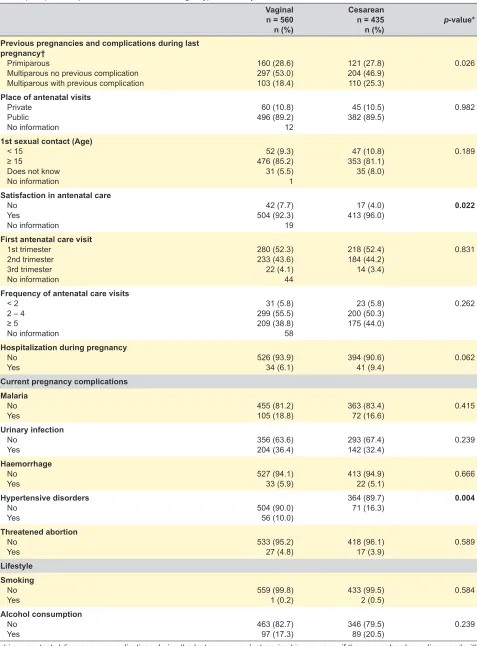
In our study, the prevalence of caesarean section was 44%. Table 1 shows the characteristics studied in our popu-lation according to the type of delivery (vaginal and caesar-ean). Women with caesarean delivery were less educated, resided more often in a periurban area and were more likely to disclose lower family income when compared with wom-en who had vaginal delivery.
Table 1 – Participants characteristics’ according to type of delivery
Vaginal n = 560 n (%)
Cesarean n = 435
n (%) p-value*
Sociodemographic characteristics Maternal age (years)
< 18 18 – 34 ≥ 35
No information
65 (11.6) 431 (77.1) 653 (11.3) 2
40 (9.2) 327 (75.3) 67 (15.4)
0.096
Education (years)
< 9 9 – 12 ≥ 12
No information
255 (45.9) 240 (43.2) 60 (10.8) 8
249 (57.6) 141 (32.6) 42 (9.7)
0.001
Marital status
Married (or in cohabitation)
Single 417 (74.5)143 (25.5) 347 (79.8)88 (20.2) 0.059
Place of residence
Urban Periurban No information
328 (58.9) 229 (41.1) 6
178 (41.2)
254 (58.8) < 0.001
Household income (dollars)
< 100 100 – 300 > 300
Do not know/ prefers not to disclose No information
34 (6.2) 128 (23.4) 175 (32.1) 209 (38.3) 27
50 (11.8) 126 (29.9) 112 (26.5) 134 (31.8)
0.001
Previous pregnancies and caesarean
Primiparous
Multiparous no c-section Multiparous previous c-section
160 (28.6) 351 (62.7) 49 (8.8)
121 (27.8) 170 (39.1) 144 (33.1)
ARTIGO ORIGINAL Vaginal
n = 560 n (%)
Cesarean n = 435
n (%) p-value*
Previous pregnancies and complications during last pregnancy†
Primiparous
Multiparous no previous complication Multiparous with previous complication
160 (28.6) 297 (53.0) 103 (18.4)
121 (27.8) 204 (46.9) 110 (25.3)
0.026
Place of antenatal visits
Private Public No information
60 (10.8) 496 (89.2) 12
45 (10.5)
382 (89.5) 0.982
1st sexual contact (Age)
< 15 ≥ 15
Does not know No information
52 (9.3) 476 (85.2) 31 (5.5) 1
47 (10.8) 353 (81.1) 35 (8.0)
0.189
Satisfaction in antenatal care
No Yes
No information
42 (7.7) 504 (92.3) 19
17 (4.0)
413 (96.0) 0.022
First antenatal care visit
1st trimester 2nd trimester 3rd trimester No information
280 (52.3) 233 (43.6) 22 (4.1) 44
218 (52.4) 184 (44.2) 14 (3.4)
0.831
Frequency of antenatal care visits
< 2 2 – 4 ≥ 5
No information
31 (5.8) 299 (55.5) 209 (38.8) 58
23 (5.8) 200 (50.3) 175 (44.0)
0.262
Hospitalization during pregnancy
No
Yes 526 (93.9)34 (6.1) 394 (90.6)41 (9.4) 0.062
Current pregnancy complications Malaria
No
Yes 455 (81.2)105 (18.8) 363 (83.4)72 (16.6) 0.415
Urinary infection
No
Yes 356 (63.6)204 (36.4) 293 (67.4)142 (32.4) 0.239
Haemorrhage
No
Yes 527 (94.1)33 (5.9) 413 (94.9)22 (5.1) 0.666
Hypertensive disorders
No
Yes 504 (90.0)56 (10.0)
364 (89.7)
71 (16.3) 0.004
Threatened abortion
No
Yes 533 (95.2)27 (4.8) 418 (96.1)17 (3.9) 0.589
Lifestyle Smoking
No
Yes 559 (99.8)1 (0.2) 433 (99.5)2 (0.5) 0.584
Alcohol consumption
No
Yes 463 (82.7)97 (17.3) 346 (79.5)89 (20.5) 0.239
*chi-square test; †diseases or complications during the last pregnancy (categorized in yes or no, if the woman has been diagnosed with any of the following: diabetes, hypertension, urinary infection, hemorrhage or complications from obstetric causes including placenta praevia, open cervix and threat of abortion).
ARTIGO ORIGINAL pregnancy, current pregnancy and antenatal care, we found Regarding the characteristics related to the previous
that 33% of women with a caesarean delivery were mul-tiparous with a history of previous caesarean while this proportion was 9% among women with a vaginal delivery. Also, 25% of women with a caesarean delivery and 18% of women with vaginal delivery reported previous pregnancy complications. Overall, few women reported dissatisfaction with the antenatal care provided, less frequent among wom-en with a caesarean delivery compared to womwom-en with a vaginal delivery (4% vs 8%, respectively, p = 0.022). No statistically significant differences were observed between vaginal and caesarean deliveries according to the place, frequency and time of first antenatal care visits, nor accord-ing to hospitalization duraccord-ing pregnancy.
According to the complications assessed during the current pregnancy, we observed a higher proportion of hypertensive disorders women among those with a caesar-ean delivery compared to vaginal deliveries (16% vs 10%,
p = 0.004). We did not find statistically significant differenc-es regarding smoking habits and consumption of alcohol.
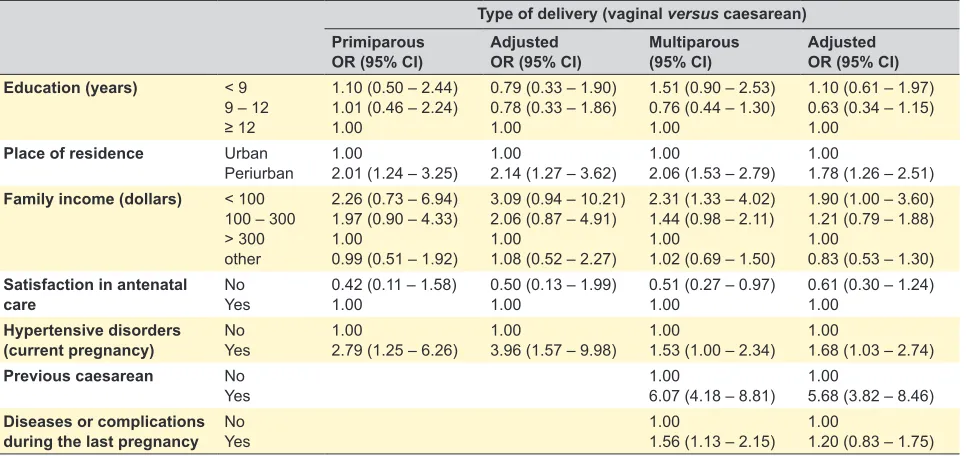
Table 2 presents the associations between the type of delivery and the factors that were statistically significant in the bivariate analysis, stratified for primiparous and multipa-rous women. A periurban residency (versus urban) was sig-nificantly associated with a caesarean delivery regardless of all covariates considered, for both primiparous women (adjusted OR, 95% CI = 2.14, 1.27 – 3.62) and multipa-rous women (1.78, 1.26 – 2.51). Hypertensive disorders during the current pregnancy were also significantly asso-ciated with a caesarean delivery in the multivariate models fitted for primiparous (3.96, 1.57 – 9.98) and for multiparous
women (1.68, 1.03 – 2.74). Among multiparous women, a family income < 100 was also significantly associated with caesarean delivery, compared to a family income of > 300 dollars in the fully adjusted model (1.90, 1.00 – 3.60). As expected, a history of previous caesarean was positively associated with a current caesarean among multiparous women (5.68, 3.82 – 8.46).
DISCUSSION
The caesarean delivery was highly prevalent in this sam-ple of Angolan women. Moreover, higher rates of caesarean were observed in women with lower family income and living in a periurban area, regardless of parity status and even after additional adjustment for conditions such as hypertension. These results are consistent with previous studies in African contexts, that report associations between a low socioeco-nomic position and a high risk of caesarean delivery.14
We hypothesize that poorer and less educated women, who live far from health facilities, have few antenatal care visits and often arrive with complicated conditions, justify-ing a caesarean delivery. Furthermore, the lack of qualified human and material resources to manage emergencies in peripheral health centres and the delay in the reference system (which consists of transferring a patient to a high-er level health facility with Infrastructures, qualified human resources and equipment for to response) also leads to an increase in the number of caesareans performed in this par-ticular maternity hospital.
A study using data from the most recent DHS survey from countries in Sub-Saharan Africa, South and Southeast Asia, Latin America and the Caribbean from which infor-mation on caesarean and the wealth index were available,
Table 2 – Association between sociodemographic characteristics and type of delivery
Type of delivery (vaginal versus caesarean) Primiparous
OR (95% CI) AdjustedOR (95% CI) Multiparous(95% CI) AdjustedOR (95% CI) Education (years) < 9
9 – 12 ≥ 12
1.10 (0.50 – 2.44) 1.01 (0.46 – 2.24) 1.00
0.79 (0.33 – 1.90) 0.78 (0.33 – 1.86) 1.00
1.51 (0.90 – 2.53) 0.76 (0.44 – 1.30) 1.00
1.10 (0.61 – 1.97) 0.63 (0.34 – 1.15) 1.00
Place of residence Urban
Periurban 1.002.01 (1.24 – 3.25) 1.002.14 (1.27 – 3.62) 1.002.06 (1.53 – 2.79) 1.001.78 (1.26 – 2.51)
Family income (dollars) < 100 100 – 300 > 300 other
2.26 (0.73 – 6.94) 1.97 (0.90 – 4.33) 1.00
0.99 (0.51 – 1.92)
3.09 (0.94 – 10.21) 2.06 (0.87 – 4.91) 1.00
1.08 (0.52 – 2.27)
2.31 (1.33 – 4.02) 1.44 (0.98 – 2.11) 1.00
1.02 (0.69 – 1.50)
1.90 (1.00 – 3.60) 1.21 (0.79 – 1.88) 1.00
0.83 (0.53 – 1.30)
Satisfaction in antenatal
care NoYes 0.42 (0.11 – 1.58)1.00 0.50 (0.13 – 1.99)1.00 0.51 (0.27 – 0.97)1.00 0.61 (0.30 – 1.24)1.00
Hypertensive disorders
(current pregnancy) NoYes 1.002.79 (1.25 – 6.26) 1.003.96 (1.57 – 9.98) 1.001.53 (1.00 – 2.34) 1.001.68 (1.03 – 2.74)
Previous caesarean No
Yes 1.006.07 (4.18 – 8.81) 1.005.68 (3.82 – 8.46)
Diseases or complications
ARTIGO ORIGINAL
contrasts with our results. It showed that the richest classes have the highest rates of caesarean section.6 The
expan-sion of medical indications, such as the liberalization of the threshold for these indications appears to have occurred over time. As a result, an increase in non-medically indi-cated cesarean sections was noted among the wealthi-est.6 However, some studies show that in poorer countries,
particularly in sub-Saharan Africa, large segments of the population have almost no access to potentially life-saving caesareans and women are likely to die for lack of access to the procedure.6,15 In the African context, we should find
lower rates of caesarean delivery, because African wom-en oftwom-en refuse surgery because of fear and the perception of the importance of vaginal delivery that defines woman-hood. However, this explanation cannot explain our results regardless of socioeconomic status.16
In this study a caesarean delivery was associated with a history of previous caesarean section, with complications in previous pregnancies and with hypertensive disorders in the current pregnancy. A review showed that maternal
complications occur in 3% – 18% of caesarean rates.17
A study done in five low-income countries (Bangladesh, Guinea, Mali, Niger and Uganda), among the indications for a caesarean delivery, previous caesarean ranged between 0.7% and 18.7% and severe preeclampsia or eclampsia
ranged between 0% and 11.1%.18 In fact, hypertensive
disorders during pregnancy induce metabolic changes that lead to a high-risk pregnancy and, consequently a caesarean delivery.19
When we analyze the relationship between the type of delivery and the variables that were significant in the bivar-iate analysis, we found an association between caesarean delivery and place of residence, family income and hyper-tensive disorders in the current pregnancy in primiparous and in multiparous women. Although several studies show that women living in remote areas with a low income6,15 had
no access to a caesarean delivery, considered as a means to save lives of both mother and babies, these women do have access to caesarean delivery when referred to this facility. But in many situations, the state in which they arrive to the maternity hospital often leads to the decision to carry out a cesarean delivery.
In this study, the prevalence of caesarean delivery was 44%, which is above what is established by the World Health Organization (10% – 15%).4 Although the literature
confirms there is an increase in rates of caesarean sections in middle and high income countries, these figures contrast with the rates found in low-income areas, in particular in Sub-Saharan Africa, where rates tend to be lower than what is established.20 In our reality, this maternity hospital is one
of the largest in the country, has a large number of qualified staff and receives all cases referred from Luanda and else-where. As such, this may justify a higher prevalence of cae-sarean sections. Additional explanations concern the way recruitment was carried out: women with caesarean deliver-ies had more time to be surveyed, taking into account their stay in the maternity hospital compared with women who
had vaginal deliveries that had only six hours after delivery to be discharged.
As expected, a previous caesarean section was asso-ciated with caesarean delivery as described in several studies. A study including medical records of Southeastern Brazil shows caesarean delivery in the current pregnancy
was associated with previous caesarean delivery.21 The
literature reports that women who had a previous cesar-ean section tend have a higher risk of uterine rupture, pla-centa previa and plapla-cental abruption in their subsequent pregnancies.22
Few women in our study who had caesarean delivery were dissatisfied with the antenatal care probably because these women presented some obstetric risk, and therefore they received more medical attention. The literature states that the determinants of satisfaction with antenatal care are too complex to be studied because those include not only clinical factors but also economic and organizational factors, the attitude of the physician in the management of labour, as well as social and cultural attitudes of the woman herself. Satisfaction involves multiple objectives and sub-jective aspects.23
Study limitations
This is a cross-sectional study, so causality cannot be determined. A selection bias is present, since the maternity hospital is not the typical place to deliver in Angola. Most women give birth at home with the help of traditional birth attendants or experienced women in the community, so our sample does not represent the experience of Angolan women in general, but only those who have a hospital birth. This also means that a large proportion of women, particu-larly those in a socioeconomically disadvantaged situation, are probably underrepresented. Also, women with severe conditions at delivery and multiple childbirths were exclud-ed during recruitment, which may lead to a selection bias, since could have excluded women with the different socio-economic profile.
The institutional coverage of births is very low. It is esti-mated that 69% of pregnant women visit a health facility at least one time at some point during pregnancy.24 Moreover,
according to WHO data in 2012, only 49% of births were attended by skilled personnel in Angola.12
CONCLUSION
Sociodemographic differences were observed
accord-ing to the type of delivery (Appendix 1). Cesarean was
more prevalent among women with lower income and resi-dents in periurban areas.
Antenatal care should be available to everyone, and health services in remote areas should have human and material resources in order to provide cesarean deliveries on site, thus avoiding increasing the number of cases.
ARTIGO ORIGINAL home, with no help from a health professional, would con-tribute to a more comprehensive understanding of maternal
health care in the Angolan context.
ACKNOWLEDGEMENTS
Calouste Gulbenkian Foundation by complement schol-arship awarded to students of PALOPs and East Timor.
Government of Angola namely: National Institute of Management Scholarships (INAGBE) by complement Scholarship.
The Faculty of Medicine of the University Agostinho Neto by financial and material support. The Department of Biochemistry of Faculty of Medicine of the University Agost-inho Neto, by the laboratory support.
The directors of General and Clinical Lucrécia Paím Maternity where the study was performed.
The National Program to Malaria by technical and mate-rial support. The heroic women who agreed to participate in this study.
PROTECTION OF HUMANS AND ANIMALS
The authors declare that the procedures were followed according to the regulations established by the Clinical Research and Ethics Committee and to the Helsinki Decla-ration of the World Medical Association.
DATA CONFIDENTIALITY
The authors declare having followed the protocols in use at their working center regarding patients’ data publication.
CONFLICTS OF INTEREST
All authors report no conflict of interest.
FUNDING SOURCES
This research received no specific grant from any funding agency in the public, commercial, or not-for-profit sectors.
REFERENCES
1. UNICEF. The millennium development goals report. New York: United Nations; 2015.
2. Zhao Y, Zhang J, Zamora J, Vogel JP, Souza JP, Jayaratne K, et al., Increases in caesarean delivery rates and change of perinatal outcomes in low- and middle-income countries: a hospital-level analysis of two WHO surveys. Paediatr Perinat Epidemiol. 2017;31:251–62.
3. Betrán AP, Ye J, Moller AB, Zhang J, Gülmezoglu AM, Torloni MR. The increasing trend in caesarean section rates: global, regional and national estimates: 1990-2014. PLoS One. 2016;11:e0148343. 4. World Health Organization. WHO statement on caesarean section rates,
2015. Geneva: WHO; 2015.
5. Betrán AP, Temmerman M, Kingdon C, Mohiddin A, Opiyo N, Torloni MR, et al., Interventions to reduce unnecessary caesarean sections in healthy women and babies. Lancet. 2018;392:1358–68.
6. Stanton C, Ronsmans C, Baltimore Group on Cesarean. Recommendations for routine reporting on indications for cesarean delivery in developing countries. Birth. 2008;35:204–11.
7. Tollånes MC, Thompson JM, Daltveit AK, Irgens LM. Cesarean section and maternal education; secular trends in Norway, 1967–2004. Acta Obstet Gynecol Scand. 2007;86:840–8.
8. Nguyen MT, McCullough LB, Chervenak FA. The importance of clinically and ethically fine-tuning decision-making about cesarean delivery. J Perinat Med. 2017;45:551–7.
9. Ye J, Betrán AP, Guerrero Vela M, Souza JP, Zhang J. Searching for the optimal rate of medically necessary cesarean delivery. Birth. 2014;41:237–44.
10. Soto-Vega E, Casco S, Chamizo K, Flores Hernández D, Landini V, Guillén-Florez A. Rising trends of cesarean section worldwide: a systematic review. Obstet Gynecol Int J. 2015;3:00073.
11. Queza AJ. Sistema de saúde em Angola: uma proposta à luz da reforma do serviço nacional de saúde em Portugal. Porto: Universidade do Porto; 2009.
12. World Health Organization. Relatório síntese sobre a situação financeira da saúde em Angola. Tunis: Ministério da Saúde; 2012.
13. Angola, Inquérito de Indicadores Múltiplos e de Saúde (IIMS)
2015–2016. Luanda: Instituto Nacional de Estatística e Ministério da Saúde; 2017.
14. Tavares Hdos P, Tavares SB, Capingana DP, da Gama SG, da Silva LG. Obstetric, sociodemographic, and psychosocial problems of postpartum adolescents of Huambo. Clin Med Insights Womens Health. 2016;9:13–9.
15. Ronsmans C, Holtz S, Stanton C. Socioeconomic differentials in caesarean rates in developing countries: a retrospective analysis. Lancet. 2006;368:1516–23.
16. Shah A, Fawole B, M'imunya JM, Amokrane F, Nafiou I, Wolomby JJ, et al., Cesarean delivery outcomes from the WHO global survey on maternal and perinatal health in Africa. Int J Gynaecol Obstet. 2009;107:191–7.
17. Dumont A, de Bernis L, Bouvier-Colle MH, Bréart G; MOMA study group. Caesarean section rate for maternal indication in sub-Saharan Africa: a systematic review. Lancet. 2001;358:1328–33.
18. Landry E, Pett C, Fiorentino R, Ruminjo J, Mattison C. Assessing the quality of record keeping for cesarean deliveries: results from a multicenter retrospective record review in five low-income countries. BMC Pregnancy Childbirth. 2014;14:139.
19. Penfield CA, Nageotte MP, Wing DA. Disparate rates of cesarean delivery in term nulliparous women with hypertensive disorders of pregnancy. Am J Perinatol. 2019.
20 .Balachandran L, Vaswani PR, Mogotlane R. Pregnancy outcome in women with previous one cesarean section. J Clin Diagn Res. 2014;8:99–102.
21. Osava RH, Silva FM, Tuesta EF, Oliveira SM, Amaral MC. Cesarean sections in a birth center. Rev Saude Publica. 2011;45:1036–43. 22. Getahun D, Oyelese Y, Salihu HM, Ananth CV. Previous cesarean
delivery and risks of placenta previa and placental abruption. Obstet Gynecol. 2006;107:771–8.
23. Alejandro A. Health reform and cesarean sections in the private sector: the experience of peru. Health Policy. 2011;99:124–30.