Research Article
a
August
2017
Computer Science and Software Engineering
ISSN: 2277-128X (Volume-7, Issue-8)
An Energy Efficient Routing Scheme for Mobile Wireless
Sensor Network with Mobile Sink
Ravneet Pal Kaur*, Maninder Singh
Department of Computer Science, Punjabi University, Patiala, Punjab, India
DOI: 10.23956/ijarcsse/V7I8/0117
Abstract— In wireless sensor network, the sensor nodes find the route towards the sink to transmit the sensory information such as temperature, pressure etc of a particular area. The sensor nodes transmit the data directly to sink or it relays the data through neighbor nodes using single or multi-hop links. Each time when nodes send their data to static sink, the data is passed through the nearer nodes of sink to it. As soon as the nodes near to the sink become dead, the entire network will be useless as there will be no communication to the sink node. So, to conserve the energy we use mobile sink approach. Thus with the inclusion of mobile sink in WSN, new paradigm called mobile wireless sensor network came into existence. In this paper, to conserve energy and to perform energy efficient routing, we have proposed chain-based energy efficient routing scheme for mobile wireless sensor network (CB-EERM)which is using mobile sink and media access approach where sink moves from one position to another position in sensor field and sojourn at a particular location to collect the whole aggregated data from the various leader(aggregator)nodes in chain using media access approach. The proposed mobile scheme CB-EERM is validated through simulation and compared with traditional static approach using metrics such as energy consumption, throughput, delay and packet delivery ratio where proposed approach outperforms the existing scheme.
Keywords— WSN,MWSN, Mobile Sink, Routing, MAC, Ad-ATMA, CB-EERM
I. INTRODUCTION
A wireless sensor network is a network contains various smaller static sensor nodes which are deployed to sense the environmental information such as pressure, temperature etc and send this information to one or more sinks directly or through various relay sensor nodes[1]. Further, WSN can be extended to mobile wireless sensor network where sensor nodes can move after deployment and collect the sensory information by moving from one place to another place and can improve coverage area efficiently[2]. In mobile wireless sensor network, three paradigms are followed: First, mobile sensor nodes are deployed with static sink. Second, Static sensor nodes are deployed with mobile sink. Third, mobile sensor nodes with mobile sink to cover the whole geographical area.
Fig.1 Sensor field with static sink
In MWSNs, two types of routing takes place: Flat routing and hierarchical routing[3]. In Flat routing, sensor nodes are deployed in sensor field to transmit the data directly or through relay nodes to sink and other sensor nodes. Here all sensors can be mobile or some few are mobile. In this routing, data aggregation process is not applied which increase the redundancy of data in network. Whereas in hierarchical routing, data aggregation process takes place in the form of clustering or chain formation where one head is chosen as aggregator node based on residual energies which collects the data from other sensor nodes with different strategies and finally aggregate through data centric approach and transmit aggregated data to sink for further processing and conserve the energy than flat routing. Further, a key infrastructural component of WSNs and MWSNs is a medium access control (MAC) algorithm which is used to allow nodes to access the shared wireless transmission medium efficiently[8] along with routing schemes to prevent collisions.
ISSN(E): 2277-128X, ISSN(P): 2277-6451, DOI: 10.23956/ijarcsse/V7I8/0117, pp. 100-105 II. RELATED WORK
From the literature, to gather the knowledge, we have considered the following Selective works on routings in WSN and MWSNs:
Yun, Y. et al. [1] gave an routing approach in which mobile sink is used in sensor network which prevent delayed data delivery from various sensor nodes by using mobility in sink.In this approach, nodes having data does not send it immediately rather nodes can store the data and send it when mobile sink is at a favourable location to them which improves the network lifetime for various delay-tolerant applications. In [2]author proposed a routing strategy in which distance constrained mobile sink in Wireless sensor network is taken to find an optimal sojourn tour. The mobile sink sojourn(pause)at different locations to gather the data from sensor nodes and here mobile sink is controlled by applying some constraints like speed, pause time etc which improves the network lifetime of mobile sensor network. Hiren Kumar Deva Sarma et al.[3] proposed a routing protocol hierarchical based containing chain formation with mobile sink and mobile sensor nodes. This protocol has two phases: Setup Phase and Data Forwarding Phase. In Setup phase, nodes are deployed and build the chains and in data forwarding phase, whole data is send to the sink. In [4]author proposed an improved energy efficient chain based protocol named PEGASIS-based protocol which eliminated the deficiencies of EEPB such as uncertainty of threshold values when constructing the chains, building the long chain links and non-optimal election of leader nodes.All these problems are reduced by using proposed scheme.
Andrew Munari [5]proposed a mobile supportive routing protocol which avoids disconnection of mobile nodes with their neighbour nodes and performs good in terms of latency, throughput, energy efficiency and packet loss reduction than other existing routing protocols. In [6] author proposed an Advertisement –based time division multiple access protocol (ATMA) which prevent the energy waste by providing the advertisement of packets first and then reservation of slots to transmit the data. Md. Kowsar Hossain et al [7] proposed a distributed MAC algorithm Ad-ATMA for wireless sensor networks under high traffic load which minimizes the time taken to send the packets without collisions by scheduling packet transmissions. It performs good in terms of latency and packet delivery ratio with same energy consumption than the existing algorithms. Further, it is developed only for static sensor network. So, it can be extended to mobile network by using different strategies for improving network lifetime and efficiency. In [8] author gave an enhanced MS-MAC protocol which was introduced for mobile wireless sensor network where all communication between the sensor nodes took place by sensing the channel and time slots were given to the nodes for transmitting their data. In [9] Akansha Verma et al. presented a survey on the various energy conservative MAC protocols used in the wireless sensor networks . This paper also show performance of various MAC protocols like S-MAC, B-S-MAC, ATMA etc in Matlab. Navid Haghighat Nazar et al [10] presented an algorithm named MDCA in wireless sensor network with mobile sink using duty cycling mechanism to increase the network efficiency and energy conservation by determining the appropriate routes for mobile sinks.
Yongchang Yu [11]proposed chain-based WSN routing protocol where the chain heads get the data from its members and aggregate the data using data centric approach and further transmit the aggregated data to sink. But all this scenario is designed for static sensor network. Getsy S. Sara et al.[12] presented routing approaches for mobile wireless sensor network where nodes are mobile and can vary their positions according to speed and time. This paper proposes various routing issues, challenges and finding the best routes in network. Shantala Devi Patil [13]gave an approach based on clustering in mobile wireless sensor network where the mobility is added to the clustering approach in which mobile nodes go to different clusters and send their data to their cluster heads using TDMA schedules. In [14] author presented an energy efficient data delivery approach which is the combination of clusters and chains to reduce data redundancy and energy consumption of static wireless sensor network.
Harish H Kenchannavar et al.[15] proposed a Ring Routing energy-efficient mobile sink routing protocol approach to mitigate the problem of battery depletion of sensor nodes which are near by the stations by introducing the mobile sinks in the network at different positions. In[16]Mark Adam Perillo, proposed a flow-based routing protocol to deploy multiple mobile base stations by using rounds. Base stations are relocated at the start of a round and uses an integer linear program to determine new locations for sink to ensure energy efficient routing during each round. Maya M. Warrier et al [17] designed an energy harvesting routing scheme which consumes less energy during transmission for extending the network lifetime of the sensor network. When replacement of sensors for energy become difficult then this technique is simulated to harvest energy from environment in matlab.
III. AD-ATMA IN STATIC WSN
ISSN(E): 2277-128X, ISSN(P): 2277-6451, DOI: 10.23956/ijarcsse/V7I8/0117, pp. 100-105
energy consumption of the sensor nodes nearer to the base station is very high compared to the energy consumption of the farthest node of the network. This is due to the problem called hotspot in the network. Each time when nodes send their data to sink ,the data is passed through the nearer nodes of base station to it which consumes large energy. As soon as the nodes near to the sink node become dead, the entire network will be useless as there will be no communication to the sink node. So, current presented approach is only for static nodes and static sink, so the most important extension to this approach would be to the mobile networks since WSNs are conceived to be mobile for improving the performance of network.
IV. PROPOSED WORK
Before glancing the proposed work, several assumptions based on related search is made which can add the features to the existing static WSN approach by enabling the mobility with energy efficient routing scheme.
In proposed approach, to eliminate the hotspot problem mentioned in above section, mobile sink is introduced which makes the sensor network mobile along with hierarchical routing (chain-based)where aggregator nodes and media access Ad-ATMA TDMA approach is combined in proposed scheme to enhance the performance by reducing the energy consumption of sensors and data redundancy in network. To carry out the proposed work we need to have some basic assumptions for the network, they are:
1) All the sensor nodes in the network have same capabilities.
2) Uniform random distribution of Sensor nodes in equally spaced 4 regions. 3) Mobile sink is taken.
4) Initially, same energy is given to the sensor nodes.
5) Aggregator node or head is chosen based on residual energy and distance between nodes and sink.
With these above described assumptions, we have proposed chain-based energy efficient routing scheme for MWSNs (CB-EERM)which is using mobile sink and media access approach which can be defined under two phases:
1.) Set up phase 2.) Processing phase
1.) Set up phase: Inthis phase, the mobile sink with routing scheme is introduced in the network to make the network mobile. Following are the steps used under this phase:
a) Firstly, the entire sensor field of (100m,100m)is uniformly divided into equal 4 regions where in each region 25 sensor nodes are randomly deployed.
b) After deployment, sink position is initialized and then sink moves in a fixed trajectory, traverses from one region to another region and waits for a sojourn time in a particular region depends on data generation rate.
c) In each region, the sink stops at a sojourn location from where it sends ADV(hello) packet to all nodes present there to get the information like ID, position etc.
d) Further, to perform the routing in each 4 regions, chain based routing scheme have been used where chain is formed between nodes to transmit data to sink. Under this, firstly sink find the farthest node known as end node from itself by finding out the distances between all nodes and sink from where the chain formation could begin and then each node in chain finds its nearest neighbour which is not the part of chain to make that node a member of chain.
2.) Processing phase:
a) Once chain formation is done, then aggregator nodes are chosen in which one primary chain head based on the residual energy of nodes and distance between the nodes and base station(sink) is chosen and many secondary heads based on the distance between parent nodes and base station are chosen. Here parent nodes are those which receive the data from other nodes.
b) All nodes in chain sense the data and send their data in the chain to adjacent nearest neighbour nodes using token passing till data could reach to the chain heads where aggregated data is stored and compressed.
c) Further, these chain heads send whole aggregated data to sink by using Ad-ATMA time slot schedules where when multiple heads want to transmit the data at same time, send ADV packet to sink and upon getting the acknowledgement (ACK-ADV)from sink, it reserves its data slots to transmit data in those slots without collisions. Each head use its reserved slots to transmit the information to sink which conserve the energy of sensors and improve the performance of the network than existing static approach. The data aggregation also reduce the redundancy of data being transmitted.
V. SIMULATION RESULTS
The proposed approach simulates through MATLAB version R2008a.
A. Simulation parameters:
Table I Simulation Parameters
Rounds 4000
Network size 100m x 100m
Nodes 100
Mobile sink sojourn locations
ISSN(E): 2277-128X, ISSN(P): 2277-6451, DOI: 10.23956/ijarcsse/V7I8/0117, pp. 100-105
Initial energy of nodes 0.5J Data aggregation factor 0.6 Packet size 2000 bits
To compare the existing and proposed schemes, the following metrics are evaluated:
1. Energy consumption: It is the amount of energy consumed by the nodes to transmit packets to receiver. 2. Throughput: It is the amount of data packets transmitted through medium per unit time.
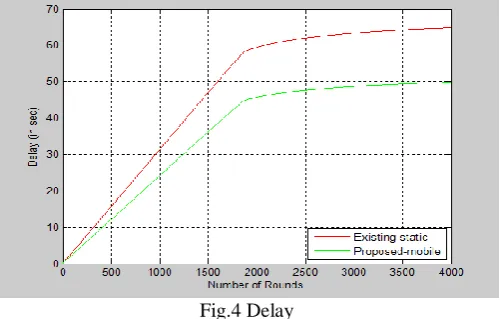
3. Delay: It is the amount of time taken by the nodes to transmit the data packets.
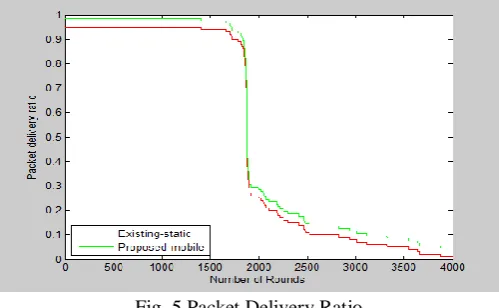
4. Packet delivery ratio: It is the ratio between the number of packets received and the number of packets sent.
Fig.2 Energy Consumption
Fig. 2 shows the energy consumption of both existing and proposed approaches with same number of rounds where proposed approach use mobile sink with media access and chain-based routing shows less energy consumption, which is approximately 13% less than existing approach Ad-ATMA with static sink with increasing number of rounds.
Fig.3 Throughput
Fig. 3 shows the throughput achieved in both existing and proposed approaches where proposed approach shows more throughput, which is nearer to 1000 bits/sec with respect to increasing number of rounds.
Fig.4 Delay
ISSN(E): 2277-128X, ISSN(P): 2277-6451, DOI: 10.23956/ijarcsse/V7I8/0117, pp. 100-105
Fig. 5 Packet Delivery Ratio
Fig. 5 shows packet delivery ratio in both existing and proposed approaches where PDR in proposed is close to 1 in initial rounds and then decreasing when nodes are becoming dead.
VI. CONCLUSION AND FUTURE WORK
Mobile WSNs have enhanced performance over static wireless sensor networks because of the mobility in sink node. In static WSNs, the nodes closer to the sink always lose their energy first, thus causing the overall network to “die". This paper presents a chain based energy efficient routing scheme which is using mobile sink and media access approach for mobile WSN which adds feature to existing approach based on static nodes, static sink and Ad-ATMA MAC schedules to support for mobility and also reduces the energy consumption of the network resources in each round. Simulation results show that proposed scheme outperforms existing approach in terms of energy consumption, throughput, delay and packet delivery ratio. As in future work, we have planned to make all the sensor nodes mobile with mobile sink to further improve the efficiency of routing scheme in MWSNs.
ACKNOWLEDGMENT
I owe my special thanks to Maninder Singh, Assistant Professor, Department of Computer Science, Punjabi University, Patiala, who helped and guided me for this work. His encouraging remarks from time to time greatly helped me in improving my skills.
REFERENCES
[1] Yun, Y. and Y. Xia, “Maximizing the lifetime of mobile wireless sensor networks with mobile sink in delay-tolerant applications,” Mobile Computing, IEEE Transactions On, 9(9): 1308-1318, 2010.
[2] Liang, W., J.Luo and X.Xu, “Prolonging network lifetime via a controlled mobile Sink in mobile wireless sensor networks,” in Global Telecommunications Conference,2010 IEEE,pp:1-6.
[3] Hiren Kumar Deva Sarma, Avijit Kar, rajib Mall, “Energy efficient routing protocol for mobile wireless sensor network with node and sink mobility,” in Sensors Applications Symposium(SAS),2011 IEEE.
[4] Sen,F.,Q.Bing and T.Liangrui, “An improved energy-efficient pegasis-chain based routing protocol in wireless sensor networks,” in Fuzzy systems and knowledge discovery(FSKD), 2011 Eighth International Conference on,4:2230-2233.
[5] Andrew Munari, “Energy-Efficient Routing in Mobile Wireless Sensor Network using mobility predictions,”
IEEE 34 Conference on 20-23 OCT 2011
[6] Ray, S.S., Demirkol, I.Heinzelman, W.Rm, “Advertisement-based MAC protocol for wireless sensor network,” in proceedings of the 5 International Conference on Mobile Adhoc and Sensor Networks(MSN),2011,p.265-272.
[7] Md. Kowsar Hossain, Suprakash Datta, Jeff Edmonds, “Ad-ATMA : An Efficient MAC protocol for Wireless Sensor and Ad Hoc Networks,” 6th International Conference on Ambient Systems, Networks and Technologies, ISSN: 1877-0509, Vol: 52, pp: 484-491, 2015.
[8] Zareei, M., Taghizadeh, A., Budiarto, R, “Energy efficient contention-based MAC protocol for mobile wireless sensor networks,” in Computer Journal, 54(12), 1963-1972,2015.
[9] Akansha Verma, M.P.singh, jyoti prakash singh, Prabhat kumar, “ Survey of MAC protocol for wireless sensor networks,” Advances in Computing and CommunicationEngineering(ICACCE),2015,Internation-al Conference on 1-2 may,2015.
[10] Navid Haghighat, Mohammad Reza,Heydarinezhad, “Enhancement network lifetime with wireless sensor networks with mobile sink managed and improved routing and control power consumption,” On 2nd International conference ,2015
[11] Yongchang Yu and Yichang Song, “ An energy efficient chain-based routing protocol in wireless sensor network,” Computer Application and System Modeling(ICCASM),p:486-489,2015.
ISSN(E): 2277-128X, ISSN(P): 2277-6451, DOI: 10.23956/ijarcsse/V7I8/0117, pp. 100-105
[13] Shantala Devi Patil, Vijayakumar B P, “Clustering and routing in mobile wireless sensor networks: a review,”2016.
[14] Soumita Sen, Chandreyee Chowdhury, Sarmistha Neogy, “ Design of cluster-chain based WSN for energy efficient routing,” in Applied and Theoretical Computing and Communication Technology, 2016, 2 International Conference on 21-23 July 2016.
[15] Harish H Kenchannavar, Sandeep Beedakar, Umakant P Kulkarni, “Optimization routing techniques based on mobile sink to improve lifetime of mobile wireless sensor networks: a review,” in Energy Systems and Applications,2016 International Conference on 30 oct- 1 nov,2016.
[16] Mark Adam Perillo, “Energy Efficient routing schemes for Mobile Wireless Sensor Networks with Multiple Mobile sinks,”IEEE 2016,p:345-352.