AUSTRALIAN JOURNAL OF BASIC AND
APPLIED SCIENCES
ISSN:1991-8178 EISSN: 2309-8414 Journal home page: www.ajbasweb.com
Open Access Journal
Published BY AENSI Publication
© 2017 AENSI Publisher All rights reserved
This work is licensed under the Creative Commons Attribution International License (CC BY).
http://creativecommons.org/licenses/by/4.0/
To Cite This Article: Suhaila N. Mohammed and Loay E. George., Emotion Recognition Based on Texture Analysis of Facial Expressions Using Wavelets Transform. Aust. J. Basic & Appl. Sci., 11(5): 1-11, 2017
Emotion Recognition Based on Texture Analysis of Facial Expressions
Using Wavelets Transform
1Suhaila N. Mohammed and 2Loay E. George
1Assistant Lecturer, Computer Science Department, College of Science, Baghdad University, Baghdad, Iraq, 2Assistant Professor, Computer Science Department, College of Science, Baghdad University, Baghdad, Iraq,
Address For Correspondence:
Suhaila N. Mohammed, Baghdad University, Computer Science Department, College of Science, Baghdad, Iraq.
A R T I C L E I N F O A B S T R A C T Article history:
Received 18 January 2017 Accepted 28 March 2017
Available online 15 April 2017
Keywords:
Facial Emotion, Face Detection, Template Based Methods, Texture Based Features, Haar Wavelets Transform, Image Blocking, Neural Network.
Background: The interests toward developing accurate automatic facial emotion recognition methodologies are growing vastly and still an ever growing research field in the region of computer vision, artificial intelligent and automation. Auto emotion detection systems are demanded in various fields such as medicine, education, driver safety, games, etc. Despite the importance of this issue it still remains an unsolved problem Objective: In this paper a facial based emotion recognition system is introduced. Template based method is used for face region extraction by exploiting human knowledge about face components and the corresponding symmetry property. The system is based on texture features to work as identical feature vector. These features are extracted from face region through using Haar wavelets transform and blocking idea by calculating the energy of each block The feed forward neural network classifier is used for classification task. The network is trained using a training set of samples, and then the generated weights are used to test the recognition ability of the system. Results: JAFFE public dataset is used for system evaluation purpose; it holds 213 facial samples for seven basic emotions. The conducted tests on the developed system gave accuracy around 90.05% when the number of blocks is set 4x4. Conclusion: This result is considered the highest when compared with the results of other newly published works, especially those based on texture features in which blocking idea allows the extraction of statistical features according to local energy of each block; this gave chance for more features to work more effectively.
INTRODUCTION
Due to the rapid development of technologies, it is being required to build a smart system for understanding
human emotion (Ruivo et al., 2016). There are different ways to distinguish person emotions such as facial
image, voice, shape of body and others. Mehrabian explained that person impression can be expressed through words (verbal part) by 7%, and 38% through tone of voice (vocal part) while the facial image can give the largest rate which reaches to 55% (Rani and Garg, 2014). Also, he indicated that one of the most important ways to display emotions is through facial expressions; where facial image contains much information (such as, person's identification and also about mood and state of mind) which can be used to distinguish human inspiration (Saini and Rana, 2014).
Facial emotion recognition is an active area of research with several fields of applications. Some of the significant applications are: feedback system for e-learning, alert system for driving, social robot emotion recognition system, medical practices...etc (Dubey and Singh, 2016).
Kushwaha, 2016). Many approaches have been introduced for building and developing facial expression systems. Most of these approaches include three primary stages: (1) image preprocessing and face region detection, (2) facial feature extraction and representation, and (3) facial expression classifier (Kandemir and Ozmen, 2013).
In order to recognize class label for a given pattern, there is a need to extract suitable information from the pattern and produce feature values. Feature information is generated in two ways: (1) Appearance based features that using color or texture information from face region to infer the facial expression, and (2) Geometry based features in which the geometric relationship between certain key points (fiducial points) on the face is calculated when making its decision (Gosavi, 2015).
The appearance-based classification methods use features that appear temporarily in the face during any kind of facial expression (for example: the presence of specific facial wrinkles, bulges, forefront and the texture of the facial skin in regions surrounding the mouth and eyes). Transforms filters, such as Haar wavelets and integral image filters, are applied to ROI region, which either forms the overall face area or specific parts of the face region, to extract feature vector (Verma and Sharma, 2013).
In 2011, Thai et al. (Thai et al., 2011) have proposed facial based emotion recognition system. In
preprocessing stage, Canny filter is used for local regions detection. Then, each of local region’s features is presented based on Principal Component Analysis (PCA). Finally, Artificial Neural Network (ANN) is applied for facial expression classification. Japanese Female Facial Expression (JAFFE) database is used for testing and the best tests results up on the seven basic emotions gave accuracy equal to 85.7%.
In 2011, Novakovica et al. (Novakovica et al., 2011) have used Principal Component Analysis (PCA) for
feature selection and dimensionality reduction in input data and neural network to classify the given facial image into one of the basic categories of facial expressions. Simulation experiment results showed that the use of PCA and neural networks in emotion recognition using JAFFE database, gave a recognition rate of approximately 85% when testing six emotions.
In Das (Das, 2014) proposed a person independent facial expression recognition system through using the modified Active Shape Model (ASM) to extract 68 landmark points from the face. These points are used to segment face region into seven sub-regions. After that each of these sub-regions is effectively represented by Census Transformation (CT) that based on feature histogram. Support Vector Machine (SVM) classifier with exponential chi-square weighted merging kernel was used to assign a weight based on the importance of each sub-region for final classification purpose. The proposed method was evaluated on JAFFE database using the seven basic emotions. The experimental results showed that the recognition rate of this approach was 86.3%.
In 2016, Sim and Cho (Sim and Cho, 2016) have proposed facial recognition system in which “Haar-like” feature was used for face detection, then Local Binary Pattern (LBP) Histogram and Canny edge detection were used for Feature Extraction. The extracted feature vector is then supplied to ANN in order to classify it to certain emotion type. 30 data items of specific expressions of anger, happiness, and expressionless (neutral) was selected from JAFFE dataset for system accuracy measurement and the attained recognition rate was 75%.
In this paper, texture based features are generated using Haar wavelets transform for emotional class identification in which these features are extracted from each block of each band of Haar wavelets result, this gave an effective role on increasing the system ability for recognizing the correct emotion for the inputted facial image.
The Proposed System:
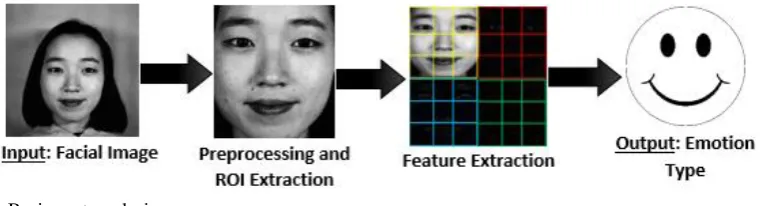
The proposed system consists of three primary stages which are: preprocessing and region of interest (ROI) extraction, feature extraction, and classification stage. Figure (1) shows the basic stages that composed the system.
Fig. 1: Basic system design
After that, the allocated face region is passed into Haar wavelet transform to convert it into scale-shift sub-bands; each sub-band contains certain texture information about certain face region. Then, each sub-band of Haar transform is portioned into NxM blocks and certain statistical features are extracted from each block to assemble the final feature vector. Finally, ANN has been used in classification stage to give the classification result of the system.
Preprocessing and ROI Extraction Stage:
To extract the face region from whole facial input image, the image must be passed through many steps which are based on some image processing methods; and as the following:
Firstly, the shadow that is resulted from bad lighting is reduced by subtracting the input image from its smoothed variant (i.e., the image that is resulted after applying mean filter of size 11x11).
The result of subtraction step involves noise of slat type, so that, mean filter is applied again for noise reduction purpose. Mean filter blurs the input image; this blurring is useful for background texture removable.
Smoothed image range is stretched to be within [Gmin, Gmax] range where
Where: μ, σ are the mean and standard deviation values, respectively. Stretching process is done using contrast stretching method; i.e., by applying the following equation:
Finally, the binary version of the stretched image is generated through using threshold value (T) to split pixels' values to be either 0 (background region) and 1 (foreground region) and as following equation:
To detect face region, the template based method is used to achieve this goal. The final binary image must be segmented into isolated segments before searching about the pattern that represent face region. The seed filling technique which belongs to region growing type of segmentation methods is used to divide the binary image into isolated regions based on pixels' values (pixels' colors); in which the set of connected pixels with same color and extended within bounded region is considered as an isolated segment.
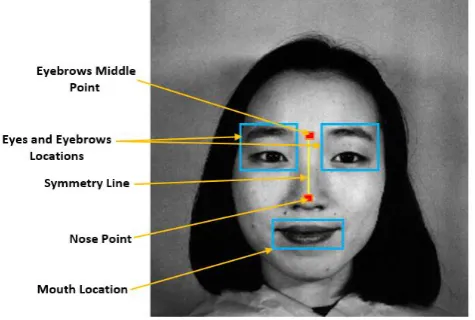
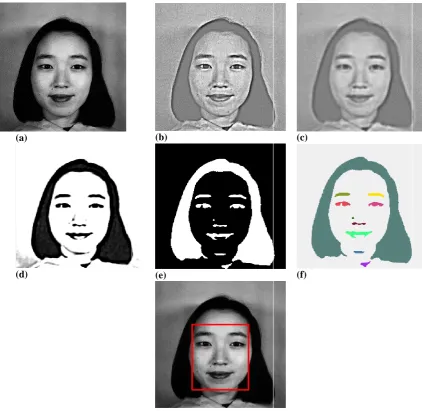
Finally, the knowledge-based method for allocating face region in a single face image is applied. This method requires extraction of facial components (such as eyes, nose, mouth, etc.) which are based on human face morphology and symmetry property (i.e., the face always contains two eyes and one mouth) to determine the face region accurately. Figure (2) illustrates the face pattern that used in face detection step. Face region is then determined by searching for face template within resulted segments and then extracting the final face region. Figure (3) shows an example for preprocessing steps' outputs, respectively.
Feature Extraction Stage:
In this stage, the features required to recognize different facial expressions are determined. The features must have high discrimination ability to classify a particular emotion. The number of features used to achieve high classification decisions must be as small as possible.
(a) (b) (c)
(d) (e) (f)
(g)
Fig. 3: Preprocessing and face region detection steps' results
In the proposed system, texture based features are extracted from face region through using wavelets transform. Feature extraction stage is composed of three primary steps: (i) Haar wavelets transformation, (ii) feature vector generation, and (iii) feature vector normalization.
Haar Wavelets Transformation:
Discrete wavelet transform (DWT) is a mathematical tool that has a great interest in the field of image processing due to its good features. The introduction of DWT had improved some specific applications of image processing by replacing the existing traditional tools with this new mathematical transform by exploiting wavelets characteristics. Some of these characteristics are:
(1) It allows image multi resolution representation in a natural way because more wavelet sub bands are
used to progressively enlarge the low frequency sub bands;
(2) It supports wavelet coefficients analysis in both space and frequency domains, thus the interpretation of
the coefficients is not constrained to its frequency behavior, and we can perform better analysis for image vision and segmentation; and
(3) For natural images, the DWT achieves high compactness of energy in the lower frequency sub bands,
which is extremely useful in applications such as image compression (Goyal and Aggarwal, 2012).
level wavelet decomposition are shown in Figure (4.b) (Singh and Kushwaha, 2016).
(a) (b)
Fig. 4: DWT bands; (a) one- level wavelet decomposition, (b) two- level wavelet decomposition
The Haar wavelet is a certain sequence of rescaled "square-shaped" functions which together form a
wavelet family. The Haar wavelet's mother wavelet function (t) can be considered as (Goyal and Aggarwal,
2012):
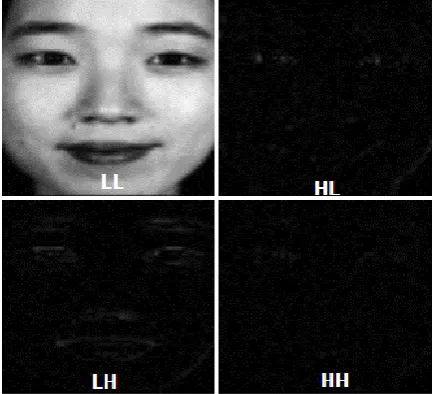
Haar wavelets transform with one level is applied on the detected face region to decompose it into four sub bands and extract the texture features as shown in Figure (5).
Fig. 5: Haar wavelets (with one level) result
Feature Vector Generation Step:
To generate feature vector with emotion recognition ability, the following steps were applied:
Each band of wavelets transform is divided into NxM blocks (as shown in Figure 6 where each sub band is divided into 3x3 blocks).
Fig. 6: Blocking idea, with 3x3 blocks
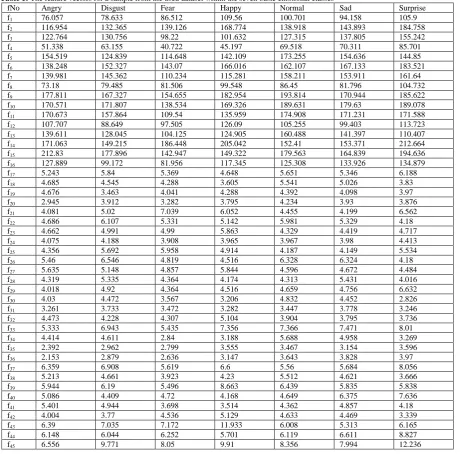
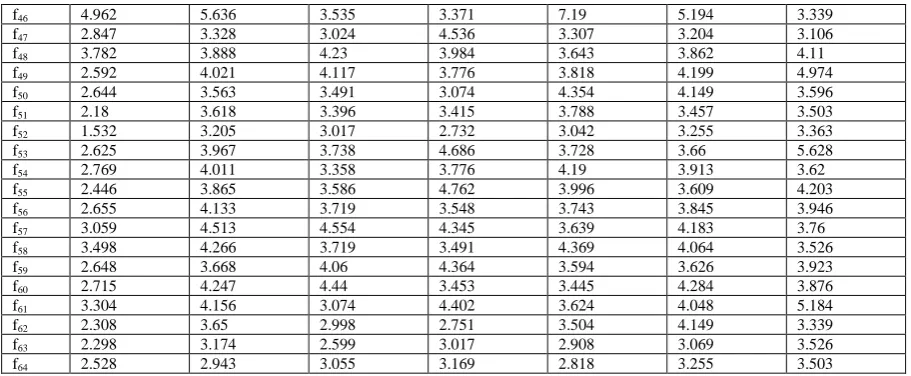
Table 1: The feature vectors for a sample from the used dataset within the seven basic emotional classes
fNo Angry Disgust Fear Happy Normal Sad Surprise
f1 76.057 78.633 86.512 109.56 100.701 94.158 105.9
f2 116.954 132.365 139.126 168.774 138.918 143.893 184.758
f3 122.764 130.756 98.22 101.632 127.315 137.805 155.242
f4 51.338 63.155 40.722 45.197 69.518 70.311 85.701
f5 154.519 124.839 114.648 142.109 173.255 154.636 144.85
f6 138.248 152.327 143.07 166.016 162.107 167.133 183.521
f7 139.981 145.362 110.234 115.281 158.211 153.911 161.64
f8 73.18 79.485 81.506 99.548 86.45 81.796 104.732
f9 177.811 167.327 154.655 182.954 193.814 170.944 185.622
f10 170.571 171.807 138.534 169.326 189.631 179.63 189.078
f11 170.673 157.864 109.54 135.959 174.908 171.231 171.588
f12 107.707 88.649 97.505 126.09 105.255 99.403 113.723
f13 139.611 128.045 104.125 124.905 160.488 141.397 110.407
f14 171.063 149.215 186.448 205.042 152.41 153.371 212.664
f15 212.83 177.896 142.947 149.322 179.563 164.839 194.636
f16 127.889 99.172 81.956 117.345 125.308 133.926 134.879
f17 5.243 5.84 5.369 4.648 5.651 5.346 6.188
f18 4.685 4.545 4.288 3.605 5.541 5.026 3.83
f19 4.676 3.463 4.041 4.288 4.392 4.098 3.97
f20 2.945 3.912 3.282 3.795 4.234 3.93 3.876
f21 4.081 5.02 7.039 6.052 4.455 4.199 6.562
f22 4.686 6.107 5.331 5.142 5.981 5.329 4.18
f23 4.662 4.991 4.99 5.863 4.329 4.419 4.717
f24 4.075 4.188 3.908 3.965 3.967 3.98 4.413
f25 4.356 5.692 5.958 4.914 4.187 4.149 5.534
f26 5.46 6.546 4.819 4.516 6.328 6.324 4.18
f27 5.635 5.148 4.857 5.844 4.596 4.672 4.484
f28 4.319 5.335 4.364 4.174 4.313 5.431 4.016
f29 4.018 4.92 4.364 4.516 4.659 4.756 6.632
f30 4.03 4.472 3.567 3.206 4.832 4.452 2.826
f31 3.261 3.733 3.472 3.282 3.447 3.778 3.246
f32 4.473 4.228 4.307 5.104 3.904 3.795 3.736
f33 5.333 6.943 5.435 7.356 7.366 7.471 8.01
f34 4.414 4.611 2.84 3.188 5.688 4.958 3.269
f35 2.392 2.962 2.799 3.555 3.467 3.154 3.596
f36 2.153 2.879 2.636 3.147 3.643 3.828 3.97
f37 6.359 6.908 5.619 6.6 5.56 5.684 8.056
f38 5.213 4.661 3.923 4.23 5.512 4.621 3.666
f39 5.944 6.19 5.496 8.663 6.439 5.835 5.838
f40 5.086 4.409 4.72 4.168 4.649 6.375 7.636
f41 5.401 4.944 3.698 3.514 4.362 4.857 4.18
f42 4.004 3.77 4.536 5.129 4.633 4.469 3.339
f43 6.39 7.035 7.172 11.933 6.008 5.313 6.165
f44 6.148 6.044 6.252 5.701 6.119 6.611 8.827
f46 4.962 5.636 3.535 3.371 7.19 5.194 3.339
f47 2.847 3.328 3.024 4.536 3.307 3.204 3.106
f48 3.782 3.888 4.23 3.984 3.643 3.862 4.11
f49 2.592 4.021 4.117 3.776 3.818 4.199 4.974
f50 2.644 3.563 3.491 3.074 4.354 4.149 3.596
f51 2.18 3.618 3.396 3.415 3.788 3.457 3.503
f52 1.532 3.205 3.017 2.732 3.042 3.255 3.363
f53 2.625 3.967 3.738 4.686 3.728 3.66 5.628
f54 2.769 4.011 3.358 3.776 4.19 3.913 3.62
f55 2.446 3.865 3.586 4.762 3.996 3.609 4.203
f56 2.655 4.133 3.719 3.548 3.743 3.845 3.946
f57 3.059 4.513 4.554 4.345 3.639 4.183 3.76
f58 3.498 4.266 3.719 3.491 4.369 4.064 3.526
f59 2.648 3.668 4.06 4.364 3.594 3.626 3.923
f60 2.715 4.247 4.44 3.453 3.445 4.284 3.876
f61 3.304 4.156 3.074 4.402 3.624 4.048 5.184
f62 2.308 3.65 2.998 2.751 3.504 4.149 3.339
f63 2.298 3.174 2.599 3.017 2.908 3.069 3.526
f64 2.528 2.943 3.055 3.169 2.818 3.255 3.503
Feature Normalization Step:
If the features are of different scales then the large scaled features will override the features of small scale and prevent them from participating, significantly, in final classification decision. So, performing the normalization process is very important since the feature vector that is proposed in this system contains features of different scales. The normalization process is done through applying flowing equation (Cowan, 2013):
Where, μ & σ are the mean and standard deviation of all classes' samples, fr is the raw value of a specific
feature before normalization, and fn is the normalization result. Table (2) shows the mean and standard deviation
values of each feature within all emotional classes.
Table 2: Mean and standard deviation values of feature vector within all classes
fNo μ σ fNo μ σ
f1 89.81769 18.89546 f33 5.808004 0.95848
f2 134.9484 26.07044 f34 4.593112 0.96363
f3 123.6944 29.90117 f35 3.132928 0.424511
f4 66.93924 22.13704 f36 3.321405 0.73042
f5 157.3608 23.82414 f37 5.855473 1.068198
f6 151.6115 18.51557 f38 5.156853 0.835957
f7 134.8428 25.80167 f39 5.467602 1.025594
f8 98.8828 20.21427 f40 4.9887 0.902043
f9 191.0449 17.32839 f41 4.526886 0.762457
f10 183.2038 14.27383 f42 4.522194 0.651938
f11 154.6823 23.43038 f43 6.983904 1.53834
f12 124.0142 23.09002 f44 6.421633 1.189106
f13 150.9992 19.53583 f45 8.551916 1.232238
f14 181.1815 17.62733 f46 5.583135 1.45291
f15 189.8678 27.70782 f47 3.425482 0.786481
f16 133.862 23.09843 f48 4.286271 0.742482
f17 4.874906 0.647705 f49 3.686437 0.423837
f18 4.701339 0.702805 f50 3.646062 0.53481
f19 4.330125 0.562435 f51 3.293926 0.569037
f20 4.023401 0.683892 f52 3.097864 0.671609
f21 4.718923 0.934417 f53 3.731645 0.688536
f22 5.780051 0.755463 f54 3.909842 0.567234
f23 4.783207 0.587479 f55 3.479375 0.509947
f24 4.245031 0.5194 f56 3.437732 0.491929
f25 4.542833 0.932703 f57 3.696339 0.661959
f26 5.214406 0.634191 f58 3.764776 0.50395
f27 4.861217 0.666192 f59 3.635839 0.609164
f28 4.583667 0.608402 f60 3.631148 0.586989
f29 5.386118 0.758532 f61 4.104847 0.614304
f30 4.53977 0.929042 f62 3.629863 0.688491
f31 3.930825 0.969338 f63 3.265 0.693972
Classification Stage:
In this stage, the extracted feature pattern should be classified to an appropriate class. Since each class has more than one feature template, and the number of emotion classes is limited; the neural network classifier is adopted as proper classification tool; because it has good dynamic data clustering abilities, and high robustness against partial input variability.
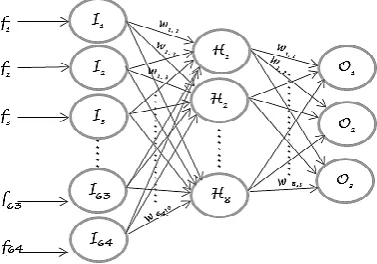
The feed forward neural network with three layers was used in the proposed system. The number of nodes in input layer is equal to the number of features extracted during the feature extraction stage; taking into consideration the total number of used features is 64. The output is represented using binary coding; that is three output bits have been used to encode the index numbers of facial emotion classes [0...7]. The number of nodes in output layer is 3, as shown in Figure (7). The type of activation function used is the tangent hyperbolic function to weighting the input to hidden nodes and the sigmoidal function used to update the hidden signal output that sent to output nodes.
The applied classification process stage was passed through two phases: (i) training step and (ii) testing step. Training a neural network is the process of finding a proper set of weights' values for neural network nodes which makes it capable of making classification decisions very close to target values. The most common algorithm used to train feed-forward neural networks is called back-propagation. The supervised learning had been used for training purpose. A set of feature patterns belong to all classes was used for enrollment of the neural network.
In testing step, the trained neural network is tested using the training and testing set of the extracted feature vectors. The aim of conducted test is to assess the system performance.
Fig. 7: Feed forward model of neural network
Experimental Results:
In this section, the results of some conducted tests are presented and discussed to evaluate the performance of the established system. In addition, a part of the tests was directed to explore the effects of the involved system parameters on the overall system performance. The programming language C sharp (Microsoft Visual Studio 2008) was utilized to develop the programs.
The dataset used for training and testing the system that proposed in this paper is Japanese Female Facial Expression (JAFFE) public dataset. It consists of 213 gray scale images for 10 Japanese female models, obtained in front of a semi reflective mirror. The samples have been downloaded from the standard reference
database (Michael et al., 1998) in which a seven different facial expressions, such as neutral (NE), happy (HA),
angry (AN), disgust (DI), fear (FE), sad (SA) and surprise (SU) are taken for each subject. Each female has posed from two to four times for each expression. Each image has been rated on 6 emotion adjectives by 60 Japanese subjects. The images were taken at the psychology department in Kyushu University. JAFFE dataset images are of tiff format with 8 bits/pixel (bit depth), and the size of each image is 256x256 pixels taken with resolution 100 dpi.
The weights of neural network are adjusted using the training dataset. The learning was performed first using all dataset samples to check maximum neural network classification ability. Then a sub-set of images was used as training set in order to test the system performance; here a subset of the overall database images was used as training material. The used training set consists of about 75% samples taken, randomly, from each class, and the remaining samples have been treated as testing samples.
Table 3: The optimal ANN configuration that selected when testing it with feature vectors that resulted from different blocks number along with RR for each case.
Number of blocks in X-axes
Number of blocks
in Y-axes RR ANN configuration
1 1 59.72 % HL= 14, LR= 0.1, Mom= 0.1, Ep=4000
1 2 82.46 % HL= 15, LR= 0.1, Mom= 0.4, Ep=4000
2 1 83.89 % HL= 14, LR= 0.1, Mom= 0.6, Ep=4000
2 2 94.79 % HL= 15, LR= 0.1, Mom= 0.4, Ep=4000
1 3 91.47 % HL= 14, LR= 0.1, Mom= 0.1, Ep=4000
2 3 97.16 % HL= 11, LR= 0.2, Mom= 0.2, Ep=4000
3 1 94.79 % HL= 15, LR= 0.1, Mom= 0.3, Ep=4000
3 2 96.68 % HL= 15, LR= 0.2, Mom= 0.9, Ep=4000
3 3 99.05 % HL= 10, LR= 0.2, Mom= 0.6, Ep=4000
4 1 94.79 % HL= 14, LR= 0.1, Mom= 0.6, Ep=4000
4 2 98.58 % HL= 10, LR= 0.2, Mom= 0.6, Ep=4000
4 3 99.53 % HL= 12, LR= 0.2, Mom= 0.3, Ep=4000
4 4 100 % HL= 8, LR= 0.2, Mom= 0.4, Ep=4000
As shown in Table (3) the system has recognition ability equal to 100% when learning it with all dataset samples and using number of blocks 4x4 (i.e., with number of features equal to 64 features)
Fig. 8: The effect of blocks number on RR
Table (4) shows the confusion matrix that resulted when learning the system with 75% randomly selected samples from each emotion class and using the resulted neural weights for testing system recognition ability. The best RR was 90.05% with HL=8, LR=0.1, Mom=0.2 and Ep=4000. Figure (9) shows the error flow chart that is resulted from training the neural network.
Table 4: Confusion matrix for the distribution of samples within emotion classes
Class AN DI FE HA NE SA SU
AN 93.3% 0% 6.25% 0% 3.45% 0% 0%
DI 3.33% 86.2% 3.13% 0% 0% 0% 0%
FE 0% 6.9% 81.3% 0% 6.9% 6.67% 0%
HA 0% 0% 0% 96.8% 3.45% 0% 3.33%
NE 0% 0% 6.25% 3.23% 86.2% 0% 0%
SA 3.33% 3.45% 3.13% 0% 0% 90% 0%
Fig. 9: Error flow chart that resulted when training the neural network
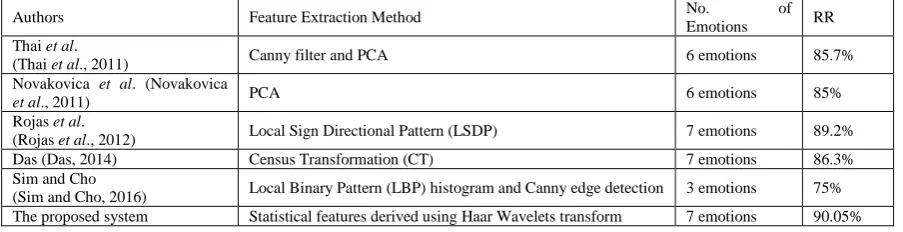
Table (5) shows the results of comparison that is made with some other researches related to person independent environment and applied on JAFFE dataset. The results listed in the table indicate the outperformance of the proposed system.
Table 5: Comparison of recognition rate with some other person's independent systems on JAFFE dataset
Authors Feature Extraction Method No. of
Emotions RR
Thai et al.
(Thai et al., 2011) Canny filter and PCA 6 emotions 85.7%
Novakovica et al. (Novakovica
et al., 2011) PCA 6 emotions 85%
Rojas et al.
(Rojas et al., 2012) Local Sign Directional Pattern (LSDP) 7 emotions 89.2%
Das (Das, 2014) Census Transformation (CT) 7 emotions 86.3%
Sim and Cho
(Sim and Cho, 2016) Local Binary Pattern (LBP) histogram and Canny edge detection 3 emotions 75% The proposed system Statistical features derived using Haar Wavelets transform 7 emotions 90.05%
Conclusions And Future Work:
In this paper a facial based emotion recognition system has been proposed. Template based method was used for face region detection through building a facial pattern and searching for it within the inputted image (after applying pre-processing steps up on it), when a match is found then this region is considered as face region (ROI). To extract texture based features from the extracted face region, Haar wavelets transform was used for image domain transformation and for producing wavelets sub-bands labeled LH, HL and HH those represent the finest scale wavelet coefficients (i.e., detail images) and the sub-band LL corresponds to coarse level coefficients (i.e., approximation image). Blocking idea allows the extraction of statistical features according to local energy of each block; this gave chance for more features to work more effectively through focusing on the texture that each emotion could make within the facial components and reflecting that on the proposed system effectiveness. The normalization step that applied on all elements of the feature vector has significant impact on the recognition ability of the proposed system. This normalization prevents the features having small scale from being overridden by high scaled ones. Neural network classification method has a great effect on emotion recognition task due to its ability to work with partial input variability that has more than one template. The test results showed the effectiveness of the proposed system where it gave a recognition rate equal to 100% when training it with all dataset samples and 90.05% when training the system with part of the dataset samples and then testing system ability using the generated weights. As a future work, texture features can be combined with geometric based features to assemble hybrid based features with more accurate recognition ability through improving the feature vector that proposed in the system to contain features generated by using geometrical measurements such as the distances between facial components, angles conveyed among facial components, etc. This improvement will increase the recognition ability of the system. Beside that another form of classifiers can be used rather than feed forward neural network classifier, for example: multilayer neural network, support vector machine, fuzzy classifier, etc. and their effects on the system accuracy can be studied.
REFRENCES
Das, D., 2014. Human’s Facial Parts Extraction to Recognize Facial Expression. International Journal on Information Theory (IJIT), 3(3): 65-72.
Dubey, M. and L. Singh, 2016. Automatic Emotion Recognition Using Facial Expression: A Review. International Research Journal of Engineering and Technology (IRJET), 3(2): 488-492.
Gosavi, V., 2015. Review Paper on - Emotion Recognition. International Journal of Latest Trends in Engineering and Technology (IJLTET), 5(1): 213-220.
Goyal, N and M. Aggarwal, 2012. Implementation of Image Compression Using Fast Wavelet Transform Using Haar and Daubechies Wavelets. IOSR Journal of Engineering (IOSRJEN), 2(11): 18-24.
Kandemir, M and G. Ozmen, 2013. Facial Expression Classification with Haar Features, Geometric Features and Cubic Bézier Curves. IU-JEEE, 13(2): 1667-1673.
Michael, J.L., A. Shigeru, K. Miyuki and G. Jiro, 1998. Coding Facial Expressions with Gabor Wavelets. 3rd IEEE International Conference on Automatic Face and Gesture Recognition, pp: 200-205.
Novakovic, J., M. Minic and A. Veljovic, 2011. Classification Accuracy of Neural Networks with PCA in Emotion Recognition. Theory and Applications of Mathematics & Computer Science, 3(1): 11-16.
Rani, J and K. Garg, 2014. Emotion Detection Using Facial Expressions: A Review. International Journal of Advanced Research in Computer Science and Software Engineering, 4(4): 465-467.
Rojas, J.A., A.R. Rivera and O. Chae, 2012. Facial Expression Recognition Based on Local Sign Directional Pattern. IEEE, pp: 2613-2616.
Ruivo, J.P.P., T. Negreiros, M.R. Barretto and B. Tinen, 2016. A Model for Facial Emotion Inference Based on Planar Dynamic Emotional Surfaces. (IJARAI) International Journal of Advanced Research in Artificial Intelligence, 5(6): 45-54.
Saini, R and N. Rana, 2014. Facial Expression Recognition Techniques, Database & Classifiers. International Journal of Advances in Computer Science and Communication Engineering (IJACSCE), 2(2): 15-20.
Sim, S and J. Cho, 2016. Expression Recognition Based on Artificial Neural Network Using Error Back propagation Learning Algorithm. International Journal of Applied Engineering Research, 11(2): 820-823.
Singh, N and V. Laxmi, 2014. Review: Audio Noise Reduction Using DWT Technique with Hard and Soft Threshold. International Journal of Software and Web Sciences (IJSWS), 10(1): 28-31.
Singh, R and S. Kushwaha, 2016. Analysis and Recognition of Facial Feature Expressions. International Journal of Advanced Research in Computer Science and Software Engineering, 6(4): 315-329.
Thai, L.H., N.D.T. Nguyen and T.S. Hai, 2011. A Facial Expression Classification System Integrating Canny, Principal Component Analysis and Artificial Neural Network. International Journal of Machine Learning and Computing, 1(4): 388-393.