Learner Autonomy: The Role of Motivation in
Foreign Language Learning
Hui-ju Liu
Department of English, Da-Yeh University, Changhua, Taiwan
Abstract—Among the many learner variables that may influence language learning, autonomy is a very unique
one because it involves learners being responsible for their own learning. In the current study, autonomy is operationally defined as a construct comprising three components: sense of responsibility, engagement in learning activities, and perceived ability. This study aimed to provide insights into the construct and gain a further understanding of its relationship with motivation among students learning English as a foreign language. The sample included university freshmen who were non-English majors and were taking required English classes at the time of the study. The results suggested that participants possessed a satisfactory level of autonomy when asked about their perceptions of responsibility, whereas they tended to possess an unsatisfactory level of autonomy regarding engagement in learning activities inside or outside the classroom. In addition, the results indicated that students of all three proficiency levels tended to perceive their ability as being mediocre. Significant differences in all three aspects of learner autonomy were observed for participants with different motivation levels. Furthermore, the findings establish that motivation and autonomy had a high level of positive correlation. Engagement frequency of learning activities had the strongest association with motivation, followed by perceived ability and responsibility. Finally, the results revealed that motivation effectively contributed to predicting autonomy, accounting for a relatively high amount (50%) of variance in the dependent variable.
Index Terms—language learning, autonomy, motivation, English proficiency
I. INTRODUCTION
Learning a second language has often been considered a complicated process because of various factors that may affect both the linguistic and nonlinguistic outcomes of learners (Noels, Clément, & Pelletier, 1999). Some of the factors are affective variables (e.g., motivation), whereas others are cognitive variables (e.g., learning strategies) (Arnold & Brown, 1999). The importance of individual differences associated with language learning has been recognized in numerous studies. Modifying instructions according to the individual requirements of language learners and enabling learners to become more motivated is an educational goal that should be integrated into learning activities inside and outside the classroom. Moreover, researchers such as Benson (2001 book) have indicated that students should learn to adjust to a learner-centered learning approach because education is gradually shifting away from the traditional authority-oriented mode (Chen, Chen, & Lee, 2008; Egel, 2009; Sakai, Takagi, & Chu, 2010; Yu, 2005).
The aim of this study was to investigate comprehensively the association between motivation and autonomy, two variables that have been found to be closely related (Deci & Ryan, 1985; Liu, 2012 eFLT). Ushioda (1996) defined autonomy as “being involved in and taking responsibility for one’s learning in all its aspects,” and motivation as “taking charge of the affective dimension of that learning experience” (p. 2).
II. REVIEW OF RELATED LITERATURE
A. Foreign Language Learning Motivation
According to Masgoret and Garder (2003), a motivated learner “expends effort, is persistent and attentive to the task at hand, has goals, desires, and aspirations, enjoys the activity, makes attributions concerning success and/or failure, is aroused, and makes use of strategies to aid in achieving goals.” As maintained by Oxford and Shearin (1996), motivation is a crucial determinant of the extent to which learners are actively involved in learning a second or foreign language. Extensive studies have been undertaken to examine the role of motivation in language learning because not only instructors but also researchers have considerable interest in this crucial variable. In addition, various attempts have been made to define motivation by applying different models and theories, such as the socioeducational model (Gardner, 1985, 1988; Gardner & Smythe, 1975), expectancy–value theory (Wigfield & Eccles, 2000; Wigfield, Eccles, & Rodriguez, 1998), and self-determination theory (Deci & Ryan, 1985; Ryan & Deci, 2000a, 2000b).
influence motivation in the language learning process. Integrativeness can be measured according to attitude toward the target language group, interest in foreign languages, and integrative orientation. Attitude toward the learning situation can be assessed through attitude toward the language course and teacher. Motivation in this model is composed of three components: (1) effort expended to achieve a goal, (2) desire to learn the language, and (3) attitude toward the task of learning the language (Tremblay & Gardner, 1995).
The other influential motivation theory is the self-determination theory. Ryan and Deci (2000a, 2000b) conceptualized motivation on a continuum from the lowest to the highest levels of self-determination, with amotivation and intrinsic motivation at opposite ends. Furthermore, from the lower end to the higher end, four more extrinsic motivation levels can be distinguished, namely, external regulation, introjected regulation, identified regulation, and integrated regulation (Noels, Clément, & Pelletier, 1999; Noels, Pelletier, Clément, & Vallerand, 2000; Otis, Grouzet, & Pelletier, 2005; Ryan & Deci, 2000b). Intrinsically motivated learners may determine to participate in an activity for pure interest, enjoyment, and satisfaction, whereas extrinsically motivated learners act for utilitarian benefits such as passing an exam.
Csizér and Dӧrnyei (2005) conducted a large-scale study, evaluating the internal structure of motivation by using structural equation modeling to analyze the data of 4765 Hungarian elementary school-aged children. The researchers examined the interrelationships among seven motivational components: instrumentality, attitude toward the target language speakers or community, cultural interest, vitality of the target language community, perceived influence of significant others, and linguistic self-confidence. The results established that integrativeness, the original concept proposed by Gardner, was the most crucial factor in the theoretical framework. Attitude toward the target language speakers or community and instrumentality were found to be the two antecedents of integrativeness. On the basis of the results, Csizér and Dӧrnyei redefined integrativeness as the “Ideal [Second Language] Self” (p. 30). In addition, they provided a new definition of motivation: “the desire to achieve one’s ideal language self by reducing the discrepancy between one’s actual and ideal selves” (p. 30).
Considerable efforts have been exerted in exploring the relationship between motivation and other language learning-related variables, such as academic performance (Gardner & MacIntyre, 1991; Liu, 2010; Masgoret & Gardner, 2003; Schmidt, Boraie, & Kassabgy, 1996) and learning strategy use (MacIntyre & Noels, 1996; Okada, Oxford, & Abo, 1996; Oxford & Nyikos, 1989; Schmidt & Watanabe, 2001). Positive connections between motivation and the abovementioned variables have been consistently found in existing studies. For instance, to afford insights into motivation, Schmidt, Boraie, and Kassabgy (1996) constructed a 100-item questionnaire for measuring student motivation, preference for instructional activities, and learning strategies. According to data collected from 1554 adult learners of three proficiency levels, the results revealed a three-dimensional model that may account for 85% of the variance of motivation, namely, a model comprising affect (intrinsic motivation), goal orientation (extrinsic motivation), and expectancy (positive thinking). The construct of motivation was related to preferences for certain instructional activities, learning strategies, and language proficiency. Oxford and Nyikos (1989) demonstrated that motivation is the most influential factor affecting strategy use; learners with high motivation used various strategies more frequently than did learners with low motivation. Similarly, in a study conducted by Lan and Oxford (2003) on a sample of 379 elementary school children in Taiwan, the degree of liking English, an indicator of learning motivation, strongly affected the choice of learning strategy, followed by gender and language proficiency. In another study conducted in Taiwan involving ability-grouped university students, Liu (2010) concluded that there is a moderate and significant correlation between student listening proficiency and English as a foreign language (EFL) motivation (r = .40). In addition, there is a slightly lower correlation between student reading proficiency and motivation (r = .37).
B. Autonomy and Language Learning
Benson (2001) considered autonomy as the capacity to “take control of one’s own learning” (p. 47). Over the past few decades, autonomous learning has been considered crucial for several reasons. First, assisting students to become more effective and independent learners it is an educational goal for teachers (Smith, 2008). Second, language education is shifting toward a learner-centered approach (Benson, 2001; Ciekanski, 2007; Egel, 2009; Sakai, Takagi, & Chu, 2010; Sims, 2012; Ushioda, 1996), particularly when there is easy access to multimedia resources to help learners learn independently outside the classroom. Third, autonomy is considered a fundamental human need that can enhance learners’ intrinsic motivation (Little, 1989, 2007; Spratt, Humphreys, & Chan, 2002).
According to Ryan and Deci (2000a), to foster intrinsic motivation, the basic needs to feel related, competent, and autonomous must be supported. Autonomy enables learners to gain the experience of being self-determined rather than being controlled. Ushioda (1996) contended that “without motivation, there is no autonomy” (p. 40). The association between autonomy and motivation in language acquisition has been recognized by many researchers, such as Fukuda, Sakata, and Takeuchi (2011) and Ushioda (1996). Dickinson (1995) claimed that autonomy can reinforce motivation. Zhou, Ma, and Deci (2009) distinguished between “autonomous motivation” and “controlled motivation,” revealing the importance of autonomy in motivating Chinese children (p. 492). In a study exploring relations among language anxiety, motivation, autonomy, and proficiency among university students in Taiwan, Liu (2012) established that autonomy and motivation are strongly correlated. Although motivation had a high level of association with language proficiency, autonomy was the best predictor of language proficiency among the studied variables.
reported that more motivated language learners tended to engage in more autonomous learning practices outside class. In an investigation conducted in Hong Kong, university students’ perceptions of their responsibilities, activities inside and outside the classroom, decision-making abilities in learning English, and their motivation levels were measured. The results not only supported the positive relation between autonomy and motivation but also revealed that a lack of motivation may debilitate the development of learner autonomy.
Pu (2009) examined autonomous learning and its relationship with motivation in a web-based computer-assisted language learning context in southern China. The participants comprised students from five universities. Findings of the study revealed that autonomous learning capacity was strongly linked to motivation in the technology-based English classroom. Although the results indicated an intermediately high level of autonomous learning capacity and a medium level of motivation among the participants, Pu suggested that students require more guidance from teachers to learn more effectively in the new nontraditional environment.
C. Research Questions
This study provided a comprehensive examination of the relationship between learner autonomy and motivation. The major research questions addressed include the following: (1) What is the general profile of learner autonomy among the students of different proficiency levels? (2) Do students with varying motivation levels differ significantly regarding learner autonomy? (3) Is motivation a significant predictor of learner autonomy? If it is, how much does it contribute to the prediction of autonomy? The findings of this study can be a crucial reference for EFL teachers and promote more effective and independent language learning among EFL students.
III. METHODOLOGY
A. Participants
The sample comprised 150 first-year university students (70 men and 80 women) who were non-English majors enrolled in a regular private university in Central Taiwan. They all participated in an English proficiency placement test before taking required English four-skill courses. Two classes of students from three ability levels were recruited to participate in the study: 45 basic-, 53 intermediate-, and 52 advanced-level students.
B. Instruments
A 26-item Chinese version of a motivation scale adopted by Liu (2012) was used to measure the participants’ motivation in the present study. The scale was adapted from the Attitude/Motivation Test Battery by Gardner (1985) and consisted of three subscales: attitude toward learning English (nine items), motivational intensity (eight items), and desire to learn English (nine items). All items were scored on a 6-point Likert scale ranging from 1 (strongly disagree) to 6 (strongly agree). The internal consistency reliability index for the complete scale was .90.
A 43-item questionnaire based on the instruments developed by Chan, Spratt, and Humphreys (2002) and adapted by Üstünlüoğlu (2009) was used to measure learner autonomy in the present study. The 5-point Likert-type Chinese version was developed by Liu (2012) and consisted of three sections: sense of personal responsibilities (1, not at all; 2, a little; 3, some; 4, mainly; 5, completely), frequency of engaging in both extracurricular and in-class activities (1, never; 2, rarely; 3, sometimes; 4, often; 5, always), and a self-evaluation of personal decision-making ability (1, very poor; 2, poor; 3, OK; 4, good; 5, very good). Students rated their responses to each item on the 5-point Likert scale. The alpha coefficient for the complete scale was .89.
C. Data Analysis
To depict the general profile of autonomy among students of different proficiency levels, descriptive statistics of the autonomy scale and subscale scores categorized into three ability levels were computed. To determine whether learner autonomy varied substantially according to language motivation levels, a one-way multivariate analysis of variance (MANOVA) was conducted on the autonomy (1) overall scale, (2) subscale, and (3) individual item scores. To ascertain the relationship between autonomy and motivation, Pearson’s product–moment correlations of all overall scale and subscale scores of the related variables were obtained. Finally, a stepwise multiple regression analysis was conducted on the data to assess the predictive power of motivation on learner autonomy.
IV. RESULTS AND DISCUSSION
and intermediate-level students. The top three items with the highest scores for the two groups of students were (1) deciding how long to spend on each learning activity (Item 9), (2) deciding what to learn outside class (Item 12), and (3) compelling oneself to work harder (Item 5). For advanced-level students, nine items (75% of the items in this subscale) had an average score exceeding 3.5, with the highest scores for Item 2 (4.37, ensuring that one would make progress outside English class), Item 5 (4.35), and Item 12 (4.27).
TABLE 1
MEANS AND STANDARD DEVIATIONS OF AUTONOMY SCORES BY STUDENTS AT DIFFERENT PROFICIENCY LEVELS
Note. Basic = Basic English proficiency level; Intermediate = Intermediate English proficiency level, Advanced = Advanced English Proficiency Level; Overall = Autonomy Overall Scores
TABLE 2
MEANS AND STANDARD DEVIATIONS OF STUDENT RESPONSES TO INDIVIDUAL ITEMS ABOUT LEARNER AUTONOMY
By contrast, although participants showed a satisfactory level of learning autonomy when asked about their perceptions of responsibility, they tended to have an unsatisfactory level of autonomy regarding their engagement in learning activities inside and outside the classroom. For basic-level students, engagement in learning activities was limited. Of the 21 items on this subscale, only two item scores exceeded 3.5 (Items 21 and 25), and 16 item scores were below 2.5. For intermediate-level students, the situation was similar; 15 item scores were below 2.5, only three item scores exceeded 3.0 (Items 21, 25, and 30), and 10 item scores were below 2.5. The frequency of involvement in learning activities was improved for the advanced-level students, who showed a mediocre level of autonomy. However, only three item scores exceeded 3.5 (Items 21, 25, and 30). The three autonomous English learning activities that seem to be the favorite activities for Taiwan EFL students were (1) listening to English songs, (2) watching English movies, and (3) taking notes while listening to the teacher. Regarding the decision-making ability of the learners, the results showed that students of all three proficiency levels tended to perceive their ability as being mediocre. None of the items scored above 3.5. In summary, the results suggested that the students had a satisfactory sense of responsibility and perceived an average level of ability; however, students generally lacked motivation to spend more time on learning activities autonomously.
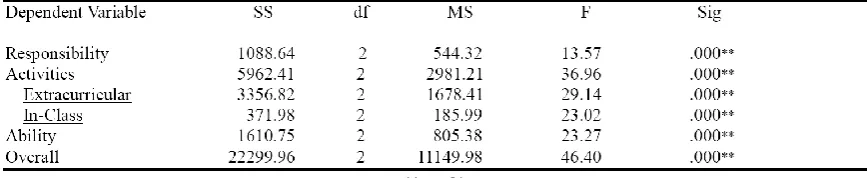
To ascertain whether autonomy significantly varied according to the level of motivation, participants were grouped into three levels according to their scores on the motivation scale. Students in the lowest level accounted for the bottom 25% of the score distribution, and students in the highest level accounted for approximately the top 25%. The remaining 50% of the students were in the middle. Table 3 presents the distribution of students in the three motivation levels. MANOVA results of the motivational effect on autonomy scores are listed in Table 4.
TABLE 3
DESCRIPTIVE STATISTICS OF STUDENTS WITH DIFFERENT DEGREES OF LEARNING MOTIVATION
Significant differences in learner autonomy were found for all scale and subscale scores of students with different motivation levels. In addition, follow-up test results indicated that students with a high level of motivation scored significantly higher on all autonomy scale and subscales than did those with an intermediate or a low motivation level. Similarly, students with a medium motivation level had significantly higher autonomy scores than did those with a low motivation level. All differences were highly significant. The results revealed a close association between motivation and autonomy, corroborating the findings reported by Spratt, Humphreys, and Chan (2002) and Pu (2009).
TABLE 4
MANOVATEST RESULTS OF DIFFERENCES IN AUTONOMY BY STUDENTS AT DIFFERENT MOTIVATION LEVELS
**p < .01
Table 5 shows the greatest differences in the three aspects of autonomy between students at two ends of the motivation scale. Comparison of the subscale scores at the two motivation levels indicated that only five items had average scores exceeding 3.5 (42%) at the low motivation level, and 11 items had average scores above 3.5 (92%) at the high motivation level. The results revealed that regarding learner perception of responsibility, the students with the two motivation levels differed the most significantly in (1) deciding the objectives of the English course, (2) enhancing personal interest in learning English, (3) ensuring that personal progress is made during English lessons, and (4) evaluating personal learning. For example, although only 18.4% of the low-motivation students perceived that enhancing their own interest in learning English was mainly or entirely their own responsibility, 65.8% of the high-motivation students answered “mainly” or “completely” to this item.
according to Item 29, 81.6% of the low-motivation students never or rarely asked the teacher questions when they did not understand, whereas only approximately half as many students (40%) responded to this item in the same manner. None of the students with low motivation frequently or always asked questions, whereas 23.7% of the students with high motivation frequently or always asked questions. The results suggested that students generally have insufficient motivation to engage in autonomous learning activities. For low-motivation students, only one item scored above 3.5 (Item 21, listening to English songs) and for high-motivation students, only three items scored above 3.5 (Item 21; Item 25, watching English movies; and Item 30, taking notes during English lessons). The results were inconsistent with those reported by Üstünlüoğlu (2009), who indicated that even though Turkish freshmen did not perceive responsibility for their learning, most of them occasionally engaged in autonomy-related learning activities. The findings were similar to those reported by Chen (2014), that EFL freshmen in Taiwan do not frequently spend time on learning activities. Chen found that the frequency of engaging in learning activities outside class was significantly related to both intrinsic and extrinsic student motivation. The EFL environment in Taiwan is traditionally a teacher-centered and examination-oriented learning environment that can negatively affect learner motivation. Lack of opportunities to practice English and little sense of achievement can lower the level of participation in learning activities.
Finally, 50% of the items received average autonomy scores in the medium range for both low- and high-motivation students. However, 50% of the items received scores in the poor autonomy range for low-motivation students, whereas the other half received scores in the satisfactory autonomy range for high-motivation students. Students at opposite ends of the motivation scale appeared to have the most distinct differences regarding perceived ability in (1) selecting learning materials outside class, (2) deciding on learning objectives outside class, (3) selecting learning materials in class, and (4) deciding what should be learned next. All differences were highly significant (Table 5). For example, when students were asked to evaluate their ability to decide what they should learn next in English, only 7.9% of the students at the lower end of the motivation scale selected “good” or “very good”, whereas almost 50% of the students at the higher end of the motivation scale selected “good” or “very good.”
TABLE 5
PERCENTAGES OF TOP FOUR MEAN DIFFERENCES IN AUTONOMY SUBSCALE SCORES BETWEEN STUDENTS AT LOW- AND HIGH-MOTIVATION LEVELS
the student effort exerted on learning the language.
TABLE 6
CORRELATIONS BETWEEN AUTONOMY AND MOTIVATION FOR THE FULL SAMPLE
Note. Total1 = Overall Autonomy Score; Total2 = Overall Motivation Score ** p < .01
Finally, to gain a more comprehensive insight into the relationship between autonomy and motivation, stepwise multiple regression analysis was performed on the data (Table 7). The regression model using motivation as the predictor was found to be highly significant (F = 73.13, p < .01). The results suggested that two motivation components, the desire to learn a language and attitude toward learning a language, contributed significantly to the prediction of learner autonomy, accounting for a relatively high amount (50%) of the variance in the dependent variable. In short, all statistical analyses established that motivation plays an imperative role on affecting learner autonomy in learning a language. The results are consistent with many previously reported results, such as those by Oxford and Shearin (1994) and Ushioda (1996), that motivation plays a significant part in effectively learning a target language. Students probably will not become autonomous learners if they are unmotivated (Fazey & Fazey, 2001; Fukuda, Sakata, & Takeuchi, 2011; Scharle & Szabό, 2000).
TABLE 7
RESULTS OF MULTIPLE REGRESSION MODEL FOR PREDICTING LANGUAGE LEARNING AUTONOMY BY MOTIVATION
Model:
R
2= .50; AdjustedR
2=.49; F (2, 147) = 73.13; ** p < .01V. CONCLUSION AND IMPLICATIONS
This study aimed to investigate the learner autonomy of EFL students in Taiwan and the role motivation plays in influencing the construct. The main findings indicate that first, the students appeared to have a satisfactory sense of responsibility for their own learning; however, they were insufficiently motivated to accomplish autonomous learning activities inside or outside the classroom. The situation tended to improve when students had higher language proficiency. Second, there were significant differences in all the three dimensions of autonomy at different motivation levels. With greater motivation, students were able to achieve a higher level of autonomy. Furthermore, motivation and autonomy were highly, positively correlated. Motivation contributed to half of the variance in autonomy, serving as a strong predictor for and an indispensable factor influencing the degrees of learner autonomy. As Spratt, Humphreys, and Chan (2002) claimed, motivation must be promoted before autonomy can be developed and exercised.
Several implications of the research findings must be acknowledged. First, although students were generally aware of and accepted their responsibility for learning, they tended to lack motivation to engage in learning activities. According to Schmidt, Boraie, and Kassabgy (1996), various factors, such as personal goals, success expectations, confidence, and language ability, can influence student motivation to learn, as can teaching materials, methods, and styles (Dӧrnyei, 1994). Liu (2010) indicated that because opportunities to interact with native English speakers and practice the target language in the EFL context are limited in Taiwan, unsatisfactory learning outcomes can contribute to a “vicious cycle” affecting motivation in the learning process (p. 7). Pu (2009) suggested that when learners are more involved in decision making, their motivation possibly improve. Although enhancing motivation can be extremely challenging for EFL teachers, nurturing and maintaining motivation is imperative. In fact, motivating students to become more independent life-long learners should be the ultimate goal of language teachers.
charge of their own learning to be “ideal” (p. 193). Although there has been a shift toward learner-centered orientation in pedagogic practice (Aliweh, 2011; Ciekanski, 2007; Egel, 2009), few teachers will disagree that students still require occasional guidance and support. Students need guidance to enable them to set goals, make choices, or develop interest in various learning tasks, and to be more actively involved in learning activities. Moreover, teachers must be aware of the progress made or difficulties encountered during autonomy-related learning activities so that immediate and appropriate support can be offered. In addition to playing the role of an instructor, teachers can play the role of a “facilitator” or “counselor” (Scharle & Szabό, 2000, p. 5).
Third, there is a potential to develop a higher level of autonomy among the learners. As Little (2007) and Snodin (2013) maintained, learning autonomy is not innate, but requires support from others and practice (Benson, 2001; Chang, 2007). Chan (2003) suggested that autonomy “grows out of the individual’s acceptance of his or her own responsibility for learning” (p. 33). Because students in the current study primarily had a satisfactory sense of responsibility, a satisfactory foundation for developing autonomous learning has been built among the students; however, they still must learn to take greater control of their learning. Teachers typically play a dominant role in the classroom in the Taiwan EFL context. More encouragement from teachers and more task-based activities inside or outside the classroom are necessary for students to become more autonomous learners.
ACKNOWLEDGEMENT
I am extremely grateful to the Ministry of Science and Technology, Taiwan, for funding this research project (contract no. MOST 103-2410-H-212-010). Moreover, I thank the instructors who generously assisted with data collection and all the students who willingly participated in this study.
REFERENCES
[1] Aliweh, A. M. (2011). The effect of Electronic portfolios on promoting Egyptian EFL college students’ writing competence and autonomy. Asian EFL Journal, 13(2), 90-132.
[2] Arnold, J., & Brown, H. D. (1999). A map of the terrain. In Jane Arnold (Ed.), Affect in language learning (pp.1-24). Cambridge, UK: Cambridge University Press.
[3] Benson, P. (2001). Teaching and researching autonomy in language learning. London: Longman.
[4] Chan, V. (2003). Autonomous language learning: The teachers’ perspectives. Teaching in Higher Education, 8(1), 33-54. [5] Chan, V., Spratt, M., & Humphreys, G. (2002). Autonomous language learning: Hong Kong tertiary students’ attitudes and
behaviours. Evaluation and Research in Education, 16(1), 1-18.
[6] Chang, L. Y.-H. (2007). The influences of group processes on learners’ autonomous beliefs and behaviors. System, 35, 322-337.
[7] Chen, C.-W. (2014). A study of language learning motivation, anxiety, and out-of-class learning activities of regular and vocational high school students (Unpublished Master’s thesis). Da-Yeh University, Taiwan.
[8] Chen, P.-F., Chen, P.-C., & Lee, M.-Y. (2008). An empirical study on cultivating young EFL learners’ autonomy through Internet-assisted language teaching. Studies in English Language and Literature, No. 22, 81-90.
[9] Ciekanski, M. (2007). Fostering learner autonomy: Power and reciprocity in the relationship between language learner and language learning adviser. Cambridge Journal of Education, 37(1), 111-127.
[10] Csizér, K., & Dӧrnyei, Z. (2005). The internal structure of language learning motivation and its relationship with language choice and learning effort. The Modern Language Journal, 89(1), 19-36.
[11] Deci, E. L., & Ryan, R. M. (1985). Intrinsic motivation and self-determination in human behavior. New York: Plenum. [12] Dickinson, L. (1995). Autonomy and motivation: A literature review. System, 23(2), 165-174.
[13] Dӧrnyei, Z. (1994). Motivation and motivating in the foreign language classroom. The Modern Language Journal, 78(3), 273-284.
[14] Egel, İ. P. (2009). Learner autonomy in the language classroom: from teacher dependency to learner independency. Procedia Social and Behavioral Sciences, 1, 2023-2026.
[15] Fazey, D. M. A., & Fazey, J. A. (2001). The potential for autonomy in learning: Perceptions of competence, motivation and locus of control in first-year undergraduate students. Studies in Higher Education, 26(3), 345-361.
[16] Fukuda, S. T., Sakata, H., & Takeuchi, M. (2011). Facilitating autonomy to enhance motivation: Examining the effects of a guided-autonomy syllabus. Electronic Journal of Foreign Language Teaching, 8(1), 71-86.
[17] Gardner, R. C. (1985). Social psychology and second language learning: The role of attitudes and motivation. London: Edward Arnold Publishers.
[18] Gardner, R. C. (1988). The socio-educational model of second-language learning: Assumptions, findings, and issues. Language Learning, 38(1), 101-126.
[19] Gardner, R. C., & Lambert, W. E. (1959). Motivational variables in second-language acquisition. Canadian Journal of Psychology, 13(4), 266-272.
[20] Gardner, R. C., & MacIntyre, P. D. (1991). An instrumental motivation in language study: Who says it isn’t effective? Studies in Second Language Acquisition, 13, 57-72.
[21] Gardner, R. C., & Smythe, P. C. (1975).Second language acquisition: A social psychological approach. Research Bulletin, 332. (ERIC DOC ED 163 754)
[23] Little, D. (1989). Learner autonomy: Drawing together the threads of self-assessment, goal-setting and reflection. Retrieved July 11, 2011, from http://archive.ecml.at/mtp2/Elp_tt/Results/DM_layout/00_10/06/06%20Supplementary%20text.pdf. [24] Little, D. (2007). Language learner autonomy: Some fundamental considerations revisited. Innovation in Language Learning
and Teaching, 1(1), 14-29.
[25] Liu, H. J. Motivation to Learn in the Ability-Grouped Foreign Language Classroom. Taipei: Crane Publishing Co., Ltd., 2010. [26] Liu, H. J. (2012). Understanding EFL undergraduate anxiety in relation to motivation, autonomy, and language proficiency.
Electronic Journal of Foreign Language Teaching, 9(1), 123-139.
[27] MacIntyre, P. D., & Noels, K. A. (1996). Using social-psychological variables to predict the use of language learning strategies.
Foreign Language Annals, 29(3), 373-386.
[28] Masgoret, A.-M., & Gardner, R. C. (2003). Attitudes, motivation, and second language learning: A meta-analysis of studies conducted by Gardner and Associates. Language Learning, 53(1), 123-163.
[29] Noels, K. A., Clément, R., & Pelletier, L. G. (1999). Perceptions of teachers’ communicative style and students’ intrinsic and extrinsic motivation. The Modern Language Journal, 83(1), 23-34.
[30] Noels, K. A., Pelletier, L. G., Clément, R., & Vallerand, R. J. (2000). Why are you learning a second language? Motivational orientations and self-determination theory. Language Learning, 50(1), 57-85.
[31] Nunan, D. (1997). Designing and adapting materials to encourage learner autonomy. In Benson & Voller (Eds.), Autonomy and independence in language learning (pp. 192-203). London: Longman.
[32] Okada, M., Oxford, R. L., & Abo, S. (1996). No all alike: Motivation and learning strategies among students of Japanese and Spanish in an exploratory study. In Rebecca Oxford (Ed.), Language learning motivation: Pathways to the new century.
(Technical report #11, pp. 105-119). Honolulu: University of Hawaii, Second Language Teaching and Curriculum Center. [33] Otis, N., Grouzet, F. M. E., & Pelletier, L. G. (2005). Latent motivational change in an academic setting: A 3-year longitudinal
study. Journal of Educational Psychology, 97(2), 170-183.
[34] Oxford, R. L. (1990). Language learning strategies: What every teacher should know. Boston, MA: Heinle & Heinle.
[35] Oxford, R. L., & Nyikos, M. (1989). Variables affecting choice of language learning strategies by university students. Modern Language Journal, 73(2), 291-300.
[36] Oxford. R., & Shearin, J. (1994). Language learning motivation: Expanding the theoretical framework. The Modern Language Journal, 78(1), 12-28.
[37] Oxford, R. L., & Shearin, J. (1996). Language learning motivation in a new key. In Rebecca Oxford (Ed.), Language learning motivation: Pathways to the new century (Technical Report # 11, pp. 121-144). Honolulu: University of Hawaii, Second Language Teaching & Curriculum Center.
[38] Pu, M. (2009). An investigation of the relationship between college Chinese EFL students’ autonomous learning capacity and motivation in using computer-assisted language learning. Unpublished doctoral dissertation. University of Kansas.
[39] Ryan, R. M., & Deci, E. L. (2000a). Self-determination theory and the facilitation of intrinsic motivation, social development, and well-being. American Psychologist, 55(1), 68-78.
[40] Ryan, R. M., & Deci, E. L. (2000b). Intrinsic and extrinsic motivations: Classic definitions and new directions. Contemporary Educational Psychology, 25, 54-67.
[41] Sakai, S., Takagi, A., & Chu, M.-P. (2010). Promoting learner autonomy: Student perceptions of responsibilities in a language classroom in East Asia. Educational Perspectives, 43, 12-27.
[42] Scharle, Á., & Szabό, A. (2000). Learner Autonomy: A guide to developing leaner responsibility. Cambridge: Cambridge University Press.
[43] Schmidt, R., Boraie, D., & Kassabgy, O. (1996). Foreign language motivation: Internal structure and external connections. In Rebecca Oxford (Ed.), Language learning motivation: Pathways to the new century. (Technical report #11, pp. 9-70). Honolulu: University of Hawaii, Second Language Teaching and Curriculum Center.
[44] Schmidt, R., & Watanabe, Y. (2001). Motivation, strategy use, and pedagogical preferences in foreign language learning. In Z. Dӧrnyei & R. Schmidt (Eds.), Motivation and second language acquisition (Technical report #23, pp. 313-359). Honolulu: University of Hawaii, Second Language Teaching and Curriculum Center.
[45] Sims, J. (2012). Perceived changes in the English language ability of freshmen at a university in Taiwan. Pan-Pacific Association of Applied Linguistics, 16(1), 33-54.
[46] Smith, R. (2008). Key concepts in ELT: Learner autonomy. ELT journal, 62(4), 395-397.
[47] Snodin, N. S. (2013). The effects of blended learning with a CMS on the development of autonomous learning: A case study of different degrees of autonomy achieved by individual learners. Computers & Education, 61, 209-216.
[48] Spratt, M., Humphreys, G., & Chan, V. (2002). Autonomy and motivation: Which comes first? Language Teaching Research, 6, 245-266.
[49] Tremblay, P. F., & Gardner, R. C. (1995). Expanding the motivation construct in language learning. The Modern Language Journal, 79(4), 505-520.
[50] Ushioda, E. (1996). Learner autonomy 5: The role of motivation. Dublin: Authentik.
[51] Üstünlüoğlu, E. (2009). Autonomy in language learning: Do student take responsibility for their learning? Journal of Theory and Practice in Education, 5(2), 148-169.
[52] Wigfield, A., & Eccles, J. S. (2000). Expectancy-value theory of achievement motivation. Contemporary Educational Psychology, 25, 68-81.
[53] Wigfield, A., Eccles, J. S., & Rodriguez, D. (1998). The development of children’s motivation in school contexts. Review of Research in Education, 23, 73-118.
[54] Yu, C.-F. (2005). Soochow’s self-directed learning website for two general English courses. Soochow Journal of Foreign Languages and Literature, 20, 111-140.
[55] Zhou, M., Ma, Wei, J., & Deci, E. L. (2009). The importance of autonomy for rural Chinese children’s motivation for learning.