European Journal of Physical Education and Sport Science
ISSN: 2501 - 1235 ISSN-L: 2501 - 1235 Available on-line at: www.oapub.org/edu
doi: 10.5281/zenodo.1481977 Volume 5 │ Issue 1 │ 2018
COMPARATIVE STUDY OF MULLIGAN (SNAGS) AND
MAITLAND MOBILIZATION IN NECK PAIN
Abdullah Al Shehri1,
Shabana Khan2,
Sharick Shamsi3i,
Sami S. Almureef4
1Dr., Director of Physiotherapy Department,
Prince Sultan Military Medical City, Riyadh, Saudi Arabia 2Physiotherapist,
Prince Sultan Military Medical City, Riyadh, Saudi Arabia
3Dr., Senior Physiotherapist,
Prince Sultan Military Medical City, Riyadh, Saudi Arabia
4Senior Physiotherapist,
Prince Sultan Military Medical City, Riyadh, Saudi Arabia
Abstract:
Objectives: Comparative Study of Mulligan (SNAGs) and Maitland’s Mobilization in
Neck Pain. Design: Randomized Control Trial. Methodology: A total of 50 patients
were included as per pre define inclusion and exclusion criteria and randomly assigned into two groups each having 25 patients. Group A was given conventional therapy (Active, Isometrics exercises, moist hot packs) plus SNAG while Group B was given conventional therapy (Active, Isometrics exercises, moist hot packs) plus Maitland’s mobilization for 4 weeks, 3 sessions per week one session per day. The patient’s outcome measures were assessed by visual analog scale, NDI (Neck disability Index) and Goniometry for Cervical Range of Motion. Pre and post treatment values were recorded for comparison of results. Results: Results revealed that means and S.D of
both group were clinically significant but statically the Group of patients treated with
conventional therapy plus SNAGS managed pain (pre=4.25±1.6, post=2.35±0.3), NDI (pre= 15.81±2.5, post= 8.18±1.7) and range of motion (flexion pre=48.9±8.9, post=53.9±4.9, extension pre=55±4.1, post=63.9±3.1, Rt side flexion pre=38.5±2.1, post=43.1±2.0 and lt. side flexion pre=38.5±2.1, post=43.6±1.8, Rt side rotation pre= 61.7±6.3, post=65.7±5.5) lt. side rotation pre=60.5±3.01, post=67.6±3.5) is not better than group of patient treated with conventional therapy plus Maitland’s mobilization in terms of pain (pre=4.27±1.5,
post=1.73±0.19), NDI (pre=17.1±3.31, post=8.10±1.10) and range of motion (flexion pre=48.5±4.7, post=56.7±6.5,extension pre=57.1±4.8, post=67.9±3.9, Rt side flexion pre=35.6±2.9 post=43.1±2.2, lt Side flexion pre=38.1±2.1, post=42.5±2.0, Rt side rotation
pre=58.5±5.5 post=67.1.±5.4, lt Side rotation pre=59.6±5.6, post=67.7±4.3. Conclusion: The
result of study suggests that both SNAG and Maitland’s improves the symptoms of Neck pain. Better improvement was shown by Maitland’s group than SNAGs group. Based on these results Maitland mobilization with conventional therapy should be the treatment of choice for Neck pain rather than SNAGs with conventional therapy.
Keywords: SNAGs, neck pain, Maitland’s, exercise
1. Introduction
The neck pain is a common cause of disability and health problem in the general
population1. Neck pain is one of the common musculoskeletal problems. Neck Pain can
be caused by the stress over the musculoskeletal system due to postural disorders and may also be associated with other causes such as intervertebral disc herniation, nerve compression, or fracture2,3. Prevalence of Neck pain is reported to range from 43% to
66.7%, which increases along with aging3. Study conducted by March et al., on
individuals over 65 years of age, the prevalence of NP was found to be 38.7%4.
According to Rajesh Gautam et al, 2014 the prevalence of neck pain is 13% and life time prevalence of 50 % Neck pain is a common problem in our society and, at any given time, affects about 10% of the general population. Estimates of the prevalence of chronic
neck pain vary5. Each year, 27% to 48% of workers suffer Non Specific Neck pain6.
Non-specific neck pain usually resolves within days or week, but can reoccur or become chronic5.
Mulligan is one of the mobilization techniques that can be applied in case of NP. Being an important treatment tool used by most of the manual physical therapists, Mulligan mobilization techniques (MMTs) include several methods such as sustained
natural epiphyseal glides (SNAGs) and natural epiphyseal glides that target the spine3,5.
An immediate improvement in pain-free range of motion (ROM) in the involved joints is reposted as a result of applying this treatment approach7,8. Maitland’s techniques
involve the application of passive and accessory oscillatory movements to spinal and vertebral joints to treat pain and stiffness in 5 grades5,9. Maitland also prescribes
stretching techniques to deal with muscle spasm5,10,11. Manual therapy is frequently a
common approach to diminish neck pain which has been suggested to be an effective
one as well by a number of clinical guidelines12. Variety of procedures is used in manual
therapy related to the musculoskeletal structures for treating mechanical pain. It includes soft tissue therapies, such as the many types of massage, focal soft tissue therapy, such as trigger point therapy, shiatsu, acupressure, mobilisation, manipulation, and manual traction13. Central postero anterior mobilisation is a technique that is
achieved by applying a force on a vertebral segment in a postero anterior direction
apophyseal glide (SNAG) technique and central postero anterior (CPA) mobilisation
produces sympathoexcitatory effects that aimed at gaining range and reducing pain14.
The primary object of this study is to investigate the outcomes of neck pain treatment and establish if Maitland central postero anterior (CPA) mobilisation is more effective than Mulligan SNAG mobilisation in reducing neck pain.
2.Material and Methods
The study was designed as Randomized Control Trial and has two groups Group A was given conventional therapy (Active, Isometrics exercises, Moist hot packs) plus SNAG while Group B was given conventional therapy (Active, Isometrics exercises, Moist hot packs ) plus Maitland’s Mobilization. It was conducted at Physical Therapy Department of Prince Sultan Military Medical City, Riyadh, Saudi Arabia.
2.1 Inclusion criteria5,14,17:
Age group between 30-50 years.
Patient with primary complaint of non-specific neck pain.
Pain of sufficient intensity (greater than 2 out of 10 on numerical pain scale) to
permit clinically worthwhile effect to be demonstrated.
Pain and stiffness for at least 2 weeks
Pain aggravated by movement
Willingness to adhere to treatment and measurement regimes.
2.2 Exclusion criteria5,14:
Osteoporosis.
Weight loss, fever, history of malignancy.
Inflammatory arthritis (AS).
Structural abnormality effecting neck.
Patient taking anticoagulants.
Neck pain due to trauma
Previous fracture
A total of 50 patients were included as per inclusion criteria. Patient was randomly assignment into two groups A and B with 25 patients in each group. Pain, Range of motion and Neck disability were assessed by Numerical pain rating scale, Universal goniometer and Neck disability Index (NDI). Sessions were given 4 weeks, 3
sessions per week one session per day to both groups15. Home plan consisted of exercise
therapy.
2.3 Mulligan SNAG technique
Patient’s received SNAGs as described by Mulligan16. The participant, in the sitting
application of the glide, the participant should stay symptom free and is instructed to stop moving if any PAIN is produced. This movement was repeated for 10 times (fig. 1).
After mobilization subject had to perform same exercises as conventional group17.
Figure 1: SNAGs technique
2.4 Maitland CPA technique
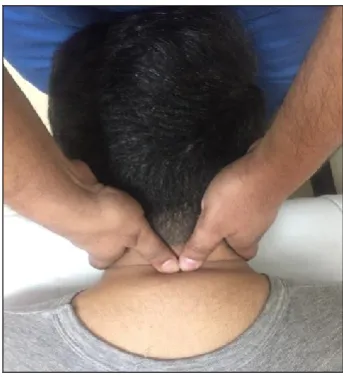
The patient lying in prone and the therapist stood at the head of the patient. His thumbs were placed in opposition at the level of the facet of the hypo mobile cervical vertebra and a unilateral posteroanterior (PA) oscillatory pressure was applied using Grade II and Grade III Maitland's manual therapy techniques. This oscillatory mobilization was performed at a frequency of 2 Hz for 2 min and repeated 3times. The rest time between each mobilization was 1 min18 (fig-2). After mobilization subject had to perform same
exercises as conventional group.
2.5Maitland’s grades of oscillatory mobilizations19:
Grade 1: Small amplitude movement performed at the beginning of motion.
Grade 2: Large amplitude movement performed within the range.
Grade 3: Large amplitude movement performed up to the limit of the range.
Grade 4: Small amplitude movement performed at the limit of range.
Grade 5: High velocity thrust performed at the limit of the range.
2.6 Treatment procedure for Conventional therapy5,15:
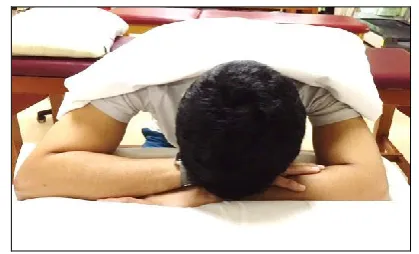
Moist Hot pack: All subjects received MHP in sitting position for 15 minutes on cervical region with head resting on table with a pillow (Figure 3).
Figure 3: Moist hot pack application procedure
Active exercises: 10 repetitions in all direction in pain free range.
Isometrics: 5-10 seconds brief but maximum contraction each held for 5-16 seconds for flexors, extensors, side flexors and rotators.
2.7 Data Analysis
Data was analyzed with SPSS 20. Outcome measures were calculated as mean and standard deviation and compared by using paired and independent sample t-test. P-value ≤ 0.05 was taken as significant. The study was approved by PSMMC Ethical Review Committee and Physical Therapy Department of PSMMC. Informed consent was taken from all patients before enrollment in the study to assure willingness, adherence, confidentiality of information and to aware the patients about all procedure and interventions.
3.Results
In this study, 50 patients participated with a mean age of 45.55±13.30 in group A and 45.65±14.40 in Group B ranging from 30 to 50 years.
Table 1: Mean and SD of age between group A and B
Group A (N=25) Mean±SD
Group B (N=25) Mean±SD
3.1 Mean reduction in VAS
Both groups had clinically significant difference in pre Rx to Post RX values as p values
for group A and B were p=0.06 and p=0.005 respectively.
Table 2: Mean reduction in VAS values between group A and B.
Mean and standard deviation at pre RX, Post RX with p values
Groups Pre RX Post RX Pre R
x to Post RX
Mean±SD P value
Group A (N=25)
Mean±SD 4.25±1.6 2.35±0.3 2.36±0.74 0.06
Group B (N=25)
Mean±SD 4.27±1.5 1.73±0.9 4.31±1.20 0.005
3.2 Disability Index of the Subject
Table 3: Neck Disability Index of the Subject
Group Pre RX Post RX Pre Rx to Post RX
Mean±SD p value
Group A (N=25)
Mean±SD 15.81±2.5 8.18±1.7 2.56±0.84 0.05
Group B (N=25)
Mean±SD 17.1±3.31 8.10±1.10 5.31±1.19 0.005
3.3 Mean reduction in ROM
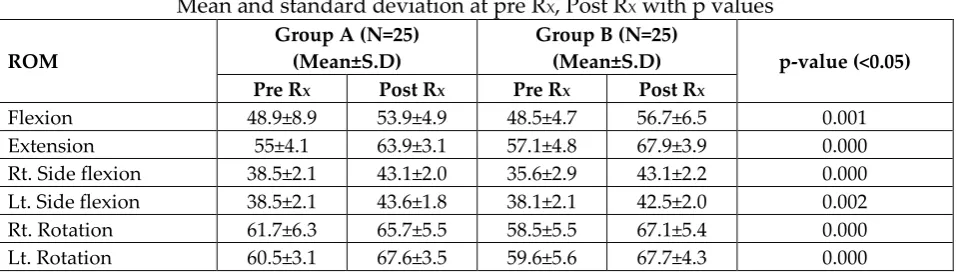
Both groups had significant difference in pre Rx to Post RX p=0.000 respectively.
Table 4: Mean reduction in ROM values between group A and B.
Mean and standard deviation at pre RX, Post RX with p values
ROM
Group A (N=25) (Mean±S.D)
Group B (N=25)
(Mean±S.D) p-value (<0.05) Pre RX Post RX Pre RX Post RX
Flexion 48.9±8.9 53.9±4.9 48.5±4.7 56.7±6.5 0.001 Extension 55±4.1 63.9±3.1 57.1±4.8 67.9±3.9 0.000 Rt. Side flexion 38.5±2.1 43.1±2.0 35.6±2.9 43.1±2.2 0.000 Lt. Side flexion 38.5±2.1 43.6±1.8 38.1±2.1 42.5±2.0 0.002 Rt. Rotation 61.7±6.3 65.7±5.5 58.5±5.5 67.1±5.4 0.000 Lt. Rotation 60.5±3.1 67.6±3.5 59.6±5.6 67.7±4.3 0.000
4. Discussion
reduced in both groups, but comparison between groups showed that Group B was better than group A statistically.
Group B receiving Maitland Mobilization showed better improvement on VAS score (4.31) than group A received Mulligan SNAGs (2.36) after four weeks of treatment. This result is different from study (Tanveer et al. 2017) that found more improvement in group 1 received SNAGs (3.52) than group 2 received Maitland
Mobilization (2.36) and group 3 received conventional treatments (2.04)20. These
differences may result from our smaller number of subjects and differences of individual characteristics. In the previous study conducted by Rajesh Gautam et al. 2014 to compare Maitland and Mulligan mobilization techniques for neck pain and ROM, found that Mulligan mobilization was more effective than Maitland in improving neck pain, functional status of neck and ROM5. These results are consistent with study
(Inderpreet et al. 2013) that depicted decrease in pain intensity of neck with mean difference 3.58 for Maitland mobilization group, 3.2 for Mulligan mobilization group
and 3.50 for conservative group after three weeks treatment21.Another study by Keyur
M. Patel 2016 also supports our results, which concluded that Maitland mobilization is significant in reducing the patient symptoms when it compared with conventional therapy and SNAGs mobilization17. This indicates that Maitland approach is clinically
beneficial in treating chronic neck pain.
The improvement in the Mulligan group can be attributed to the neurophysiological effects found at the site of treatment and at areas remote to the local area of treatment. These effects include improved pain related measures like increased
pressure pain threshold and decreased visual analogue scale pain rating22. The
neurophysiological effects of mobilisation are important enough to cause a categorical and substantial change in how clinicians and scientists understand the benefits of mobilisation. Neurophysiological effects of central posteroanterior (CPA) mobilisation previously have been identified including immediate hypoalgesia and an increase in pressure pain thresholds. When joint tissue is strained at the limits of normal tissue extensibility, nociceptors (pain nerve receptors) are activated, causing a pain response. Mobilisation techniques could stimulate joint mechanoreceptors to decrease pain (neurophysiologic effect), and to stretch the joint tissues (mechanical effect). The oscillations may have an inhibitory effect on perception of painful stimuli by stimulating mechanoreceptors that block nociceptive pathways at the spinal cord or brain stem levels23.
For the ACROM, both groups improved significantly overall and Group B improved more on Extension, right side flexion and rotation. These results are consistent with studies that reported that mobilization applied to both the neck and spine at the same time improved cranial vertical angle and cranial rotation angle and research that showed that endurance exercise of the neck, stabilization exercise, and
4.1 Future recommendations:
A long duration of study with a proper follow-up can be done.
Future research is required to investigate the effect of joint mobilization and therapeutic exercise on the functional impairments caused by chronic neck pain using diverse subjects and intervention periods, and research on the persistence of the effect also needs to be conducted.
4.2 Conclusion
In this study, subjects were treated with Maitland mobilization plus conventional therapy, and Mulligan (SNAGs) mobilization plus conventional therapy in both groups respectively. Both mobilization techniques are clinically significant in reducing the subject symptoms. But Maitland mobilization is statistically significant in reducing the subject symptoms when it is compared Mulligan SNAGs mobilization.
About the Authors
Dr. Abdullah Al Shehri, hold PhD degree in Physiotherapy from USA, presently working as Director of Physiotherapy Department at Prince Sultan Military Medical City, Riyadh KSA. Dr. Abdullah published many articles in international journals as well as attended many national and international conference and workshops.
Mrs. Shabana Khan holds MPT (Sports Medicine) from Jamia Humdard University, Delhi India, presently working as Physiotherapist with Prince Sultan Military Medical City, Riyadh KSA. She worked as researcher with King Saud University, Riyadh KSA, as well; she worked as Lecturer with Raj Nursing and paramedical college Gorakhpur. She published more than 10 articles in different journals as well; she written a book also. She is reviewer of many journals. She is life time member of IAP and active member of SPTA.
Dr. Sharick Shamsi holds PhD in Physiotherapy from MVGU University Jaipur, India, presently working as senior physiotherapist with Prince Sultan Military Medical city, Riyadh, KSA. He published many articles in national and international journals as well as book. He is life time member of IAP and active member of SPTA.
Mr. Sami S. Almureef holds MPT in Physiotherapy (Ortho) from U.K, Presently working as senior physiotherapist with Prince Sultan Military Medical city, Riyadh KSA. He published many articles in international journals.
References
1. Pierre Côté, J. David Cassidy, and Linda Carroll, 2003. The epidemiology of neck
pain: what we have learned from our population based studies. J Can Chiropr Assoc. 47(4): 284–290.
2. T.T. Chiu, E.Y. Law, and T.H. Chiu, 2005, “Performance of the craniocervical
3. Oznur Buyukturan, Buket Buyukturan, Senem Sas, Caner Karart, Ismail Ceylan 2018, The Effect of Mulligan Mobilization Technique in Older Adults with Neck Pain: A Randomized Controlled, Double-Blind Study, Hindawi Pain Research and Management 1-7, doi.org/10.1155/2018/2856375.
4. L.M. March, A.J. Brnabic, J.C. Skinner et al. 1998. “Musculoskeletal disability among elderly people in the community,” Medical Journal of Australia, vol. 168, no. 9, pp. 439–442,
5. Rajesh Gautam, Jagdeep Kaur Dhamija, Amit Puri, 2014. Comparison Of
Maitland And Mulligan Mobilization In Improving Neck Pain, Rom And Disability, Int J Physiotherapy Res Vol 2(3):482-87.
6. Peter Rothfels, BEd, M.D., Asam, Craig Martin, M.D., Kukuh Noertjojo, M.D.
2010. What’s new in the literature: Nonspecific neck pain BCMJ, Vol. 52, No. 3, page(s) 123 Work Safe BC.
7. L. Exelby, Mulligan Concept 2002: its application in the management of spinal conditions, Manual therapy, vol. 7, no. 2, pp. 64–70.
8. B.R. Mulligan, Manual therapy NAGS SNAGS MWMS 2003 etc., Plane View
Services Ltd., Wellington, New Zealand, 5th edition.
9. Theralkald A.J. 1992 Effect of manual therapy on connective tissue. Phys Ther. 72(12):893- 902.
10.Maitland G.D., Bank K. Vertebral manipulation 2002. Butterworth Heinemann,
Oxford.
11.Maitland G.D., Peripheral manipulation1998, Butterworth Heinemann, Oxford.
12.McNair P.J., Portero P., Chiquet C., Mawston G., Lavaste F. 2007. Acute neck pain: cervical spine range of motion and position sense prior to and after joint mobilization. Manual Therapy 12(4):390-394.
13.Vernon H., Humphreys K., Hagino C. 2007 Chronic mechanical neck pain in
adults treated by manual therapy: a systematic review of change scores in randomized clinical trials. J Manipulative Physiol Ther 30:215-227.
14.Izquierdo Pérez H, et al., 2014, Is one better than another?: A randomized clinical
trial of manual therapy for patients with chronic neck pain, Manual Therapy, 1-7, http://dx.doi.org/10.1016/j.math.2013.12.002
15.Amr Almaz, Amira Hussin Draz, Kadray Honsy Battecha, Mohammed Mosaad,
2014, Effect of Ultrasound Combined with Conventional Therapy on Neck Pain, Function, and Disability in Patients with Cervical Spondylosis: A Randomized
Placebo-Controlled Trial, Journal of Musculoskeletal pain,199-205,
doi.org/10.3109/10582452.2014.907853.
16.Hearn A., Rivett D.A., Cervical SNAGs 2002: a biomechanical analysis. Manual
Therapy 7(2): 71–79.
17.Keyur M. Patel, Dr. M. Balaganapathy and Hinal M. Patel, 2016, Effect Of
18.Hamid Ali Rashid Hafeez Nasir, Danish Hassan 2015, Effectiveness of Cervical Mobilization and Cervical Traction in Management of Non Specific Neck Pain, Journal of Riphah College of Rehabilitation Sciences, 3(2): 80-85.
19.Shashank Ghai, Ishan Ghai 2014, Role of various mobilization maneuvers in the
management of low back pain, Research & Reviews in Bio Sciences, 8(10) 374-381.
20.Fahad Tanveer, Adnan Afzal, Muhammad Adeel, Sana Shahid and Maham
Masood 2017, Comparison of Sustained Natural Apophyseal Glides and Maitland Manual Therapy in Non-Specific Neck Pain on Numeric Pain Rating, Annals of King Edward Medical University, 23(4): 430-435.
21.Inderpreet K., Arunmozhi R., Umer A. 2013. Effect of Maitland vs Mulligan
mobilisation technique on upper thoracic spine in patients with non-specific neck pain-a comparative study. Int J Physiotherapy Res 1(5): 214-18.
22.Vicenzino B, Collins D, Benson H, Wright A 1998. An investigation of the inter
relationship between manipulative therapy-induced hypoalgesia and
sympathoexcitation. J Manipulative Physiol Ther.21:448–53.
23.Kumar A., Kumar S., Aggarwal A., et al. 2012. Effectiveness of Maitland
Techniques in idiopathic shoulder adhesive capsulitis. International Scholarly Research Network Rehabilitation, vol. 2012, Article ID 710235.
24.Ylinen J., Takala E.P., Nykänen M., et al. 2003. Active neck muscle training in the
Creative Commons licensing terms