Proceedings of the
12th International Workshop on Graph Transformation
and Visual Modeling Techniques
(GTVMT 2013)
Annotations on Complex Patterns
Paolo Bottoni, Francesco Parisi Presicce
14 pages
Guest Editors: Matthias Tichy, Leila Ribeiro
Managing Editors: Tiziana Margaria, Julia Padberg, Gabriele Taentzer
Annotations on Complex Patterns
Paolo Bottoni1, Francesco Parisi Presicce1
1Dipartimento di Informatica, “Sapienza” Universit`a di Roma, Italy
Abstract: Modelers of systems often want to isolate specific parts of a model to be treated as a whole, for example to protect them from accidental changes, to constrain them to specific policies, or to identify them as instances of a general pattern. In par-ticular, we study here the case in which these parts are annotated with information from some external model. In a previous paper, we have discussed the use of annota-tions on individual model elements, represented as nodes in a graph; in this paper we model annotation processes involving also annotations themselves or whole config-urations. To address the latter problem, we enrich the notion of graph by introducing a third sort of elements, called boxes, encompassing subgraphs, and associate them with annotations, too. We show how annotations on boxes support the modeling of complex policies, adapting the previous constructions for notation-aware rewrit-ing to include boxes. The paper illustrates these concepts on the concrete modelrewrit-ing scenario of an organisation with security and temporal annotations.
Keywords:Annotations, graph configuration, box.
1
Introduction
In system modeling, the need often arises to identify specific configurations within a complex model, and refer to them as a whole. In many cases, such configurations may involve a number of model elements which is not known a priori and which may vary dynamically. Such is the case with pattern-based modeling, especially of software systems, where several software patterns, usually relying on polymorphism, may be realised by arbitrary numbers of instances, as for example in the Strategy, Observer orDecorator patterns. While instances of patterns can be identified on the basis of the typical relations among their elements, constructs are needed to manipulate them as distinct individual model elements, persisting beyond their usage.
the need for composition could be restricted to a specific model. Such a mechanism has been defined in [BGL10], but is not immediately extendable to configurations defined on the fly.
This problem is particularly relevant in model-to-model transformation, in situations where the interest is in annotating configurations as a whole, so as to constrain the use of particular transformations only to elements in some configuration. We argue that the limitations of the graph-based modeling derive from the use of a single type of diagrammatic relation, connected-ness, which is not a transitive one. On the contrary, thecontainmentrelation, being transitive, naturally supports the representation of hierarchies, with the important property that removing a level of containment maintains the relation between the levels adjacent to the one removed.
In this line, we adopt an extension of the notion of graph by introducing boxes, which are elements including subgraphs and other boxes as well. Boxes are naturally organised in contain-ment structures, but can also be the source and target of edges. It is to be remarked, however, that boxes are not organised in a proper hierarchy, as box containment does not induce a partial order, since anti-symmetry is not required. This allows for configurations where boxes can be mutually contained into one another, without being identified.
Boxes were originally proposed in an informal way in [PP00], where they were calledloops. We give here a formalisation of them and set them in the framework of model annotation and transformation, by making them the target of annotation edges. In this way, we extend the definition of annotation in [BP12], and provide a formal characterisation of annotations of con-figurations, which, though hinted at there, was not completely developed.
Paper organisation.In Section2we formally define the required extension of graphs to con-tain boxes allowing structured arrangements of nodes and edges, as well as reference to entire subgraphs, while Section3introduces the running example of an organisational model annotated with temporal and security information. Section4presents the metamodel for annotation pro-cesses and formalises the notion of domain, and Section5illustrates the impact on the rewriting process of the combination of annotations and boxes referring to the running example. The paper ends with Sections6and7discussing related work and some concluding remarks, respectively.
2
Preliminaries
We adopt the framework of typed graphs, and we extend the usual notion of graph with elements of a new sort, calledboxes, allowing a nested structuring of graphs.
Definition 1 A (directed)graph with boxesis a tupleG= (V,E,B,s,t,cnt), where: (1)V andE
are sets of nodes and edges as in usual graphs; (2)Bis a set of boxes, such thatB∩(V∪E) =/0; (3) thesourceandtargetfunctionssandtextend their codomains toV∪B; (4)cnt:B→℘(V∪B) is a function associating a box with itscontent1 with the property that ifx∈cnt(b1) andb1∈
cnt(b2), thenx∈cnt(b2).
In the rest of the paper we refer to graphs with boxes asB-graphsor just graphs unless it is necessary to distinguish them.
1Here and elsewhere
Definition 2 Amorphism f :G1→G2 betweenB-graphs Gi= (Vi,Ei,Bi,si,ti,cnti)is a triple (fV :V1→V2,fE :E1→E2,fB:B1→B2) that preserves source, target and content function, i.e., fV∪B◦s1=s2◦fE, fV∪B◦t1=t2◦fE, and ifx∈cnt1(b), then fV∪B(x)∈cnt2(fB(b))for all
x∈V∪Bandb∈B, where fV∪Bis the (disjoint) union of fV and fB.
In a type B-graph T G = (VT,ET,BT,sT,tT,cntT), VT, ET and BT are sets of node, edge and box types, respectively, while the functions sT :ET →VT∪BT andtT :ET →VT∪BT
define source and target node- and box- types for each edge type, and the functioncntT :BT → ℘(VT∪BT)associates each type of box with the set of types of elements it can contain.
A B-graph Gistyped on a type B-graph T Gif there is a graph morphismtype:G→T G, withtypeV :V →VT, typeB:B→BT andtypeE :E →ET s.t. typeV(s(e)) = sT(typeE(e)) andtypeV(t(e)) =tT(typeE(e)). Moreover, givenb∈B,x∈V∪B, we have: x∈cnt(b) =⇒
typeX(x)∈cntT(typeB(b)), whereXisVorB, depending onx∈V∪B. A morphism f:G1→G2 between TG-typed graphs preserves the type, i.e. type2◦f =type1. Any type graph morphism
fT :T G1 →T G2 induces two functors, InclfT from the category ofT G1 typed graphs to that
ofT G2 typed graphs, andForgetfT in the opposite direction, in the obvious way. The result in
Theorem1is already stated in [PP00] without proof.
Theorem 1 [Category of B-graphs] All the B-graphs, typed over the same type B-graph T G, and all the type-preserving B-morphisms form a categoryGraphLTGclosed under pushouts and
pullbacks.
Proof sketch. It is sufficient to deal with the last component cnt of a B-graph, as the rest can be viewed as a graph where the set of nodes is distinguished intoV andB. The composition
f3=f1◦f2:G1→G3satisfies the additional property aboutcnt: ifx∈cnt(b1)then fV1∪B(x)∈
cnt2(fB1(b))since f1 is a morphism, and therefore fV3∪B(x) = (fV1∪B◦fV2∪B)(x)∈cnt3(fB3(b) = (fB1◦fB2(b))since f2is also a morphism and the content functioncntis ’transitive’ by definition.
Given a span of morphismsG1 f1
←G0 f2
→G2, we construct its pushoutG1 g1
→G3 g2
←G2in the usual way for the first five components, with morphismsgi:Gi→G3 preserving the sourcesi and target ti functions for i=1,2. To definecnt3 for G3, letb∈B3. Then, by construction, eitherb=g1(b1) =g1(f1(b0))andb=g2(b2) =g2(f2(b0))for somebi∈Bi andb0∈B0, or
b=g1(b1)for someb1∈B1 andb6=g2(b2)for anyb2∈B2(the third possibility reversing the roles of 1 and 2 is similar). In the first case,cnt3(b) =g1(cnt1(b1))∪g2(cnt2(b2)), while in the second casecnt3(b) =g1(cnt1(b1)). The ’transitivity’ property ofcnt3follows from that ofcnt1 andcnt2, while the universal property follows from the universal property of the union inSets.
Given a cospan of morphisms G1 g1 →G3
g2
←G2, we construct its pullbackG1 f1 ←G0
f2 →G2 in the usual way for the first five components. Forb0∈B0, we haveg1(f1(b0)) =g2(f2(b0))by construction and definecnt0(b0) ={x∈G0| f1(x)∈cnt1(f1(b0))∧f2(x)∈cnt2(f2(b0))}.
We adopt the DPO (Double PushOut) approach to graph transformation [EEPT06], extending it to allow rewriting on B-graphs. A DPO rule consists of three (B-)graphs, called left- and right-hand side (LandR), and interface graphK. Two injective morphismsl:K→Landr:K→R
through their common elements inK), modeling the deletion of the elements ofLnot inK, while pushout (2) adds the new elements, present inRbut not inK. Figure1also illustrates the notion ofnegative application condition(NAC), of the formn:L→N that a matchm:L→Gshould satisfy. A rule is applicable if there is no morphismq:N→Gsuch thatq◦n=m.
N q , , 6 = L n o o m (1) K (2) l o
o r //
k R m∗
Ci j
oi j
/ / = Pi ni , , = yi j
o
o oo xi L
m (1) K (2) l o
o r //
k R m∗
Goo f D g //H Goo f D g //H
Figure 1: DPO Direct Derivation Diagram for rules with NACs (left) and ACs (right).
We denote the application of the rule pon a matchm:L→GbyG⇒m
p Hand writeG⇒pH ifH can be derived from Gby applying pwith respect to some matchmforL inG. As with the traditional DPO approach to graph transformation, the existence of a morphismmfromLto
Gis not sufficient to guarantee the applicability of the rule. The matchm:L→Gmust satisfy the Gluing Conditions, which extend naturally the original ones: the Dangling Conditions must be satisfied by all edges, including those with a box as source/target entity, and the Identification Condition must be satisfied not only by edges and vertices, but also by boxes.
Theorem 2(Gluing Conditions) Given a rule p= (L←l K→r R)(a span of B-graphs and mor-phisms), and a morphism m:L→G, let IDmX ={x∈XL| ∃y∈XL[x6=y∧mX(x) =mX(y)]}with X=V,B,E, and DANGm={x∈VL∪BL| ∃e∈EG\mE(EK)[mV∪(B)(x) =sG(e)∨mV∪(B)(x) =
tG(e)]}. Then the pushout complement D existsiff: (1) DANGm⊆l(K), (2) IDmX ⊆lX(K).
Just as the traditional Gluing Conditions can be extended to B-graphs, it is easy to verify, by choosing as distinguished classM the injective B-morphisms, thatGraphLTG is an
HLR1-category, thus enjoying all the usual properties related to the Church-Rosser and Parallelism The-orems [EHKP90]. It is still open whether the equivalent of the Amalgamation and Concurrency Theorems hold. The proof that theHLR1 properties hold can be reconstructed by starting with the fact that typed graphs form anHLR1-category, and then completing it by noticing that the added component, the functioncnt, for the pushouts and pullbacks inGraphLTGis constructed using set union and set intersection and that the categorySetsisHLR1 as well [EHKP90].
Given T G-typed rules pi :Li li ←Ki
ri
→Ri, i=1,2, a rule morphism h:p1→ p2 is a triple
hX:X1→X2, withX=V,B,E, ofT G-typed morphisms withhR◦r1=r2◦hKandhL◦l1=l2◦hK. Anatomic constraintis a total morphism between typed attributed graphsc:P→C. A graph
G satisfies c, noted Gc, if for each match morphism m:P→ G there exists a morphism
y:C→Gs.t.y◦c=m. Ifc:P→Cis an atomic constraint, then¬cis also an atomic constraint, and G¬c iff G2c. We call negative atomic constraint2 an atomic constraint of the form
nP =¬iP :P→P, where iP is the identity morphism, andGnP iff @mP:P→G. We call
M(c) ={G|Gc}the set ofmodelsforc, and we work with consistent sets of constraintsC, i.e. T
ci∈CM(ci)6= /0. We use different types of morphisms depending on the domain and the
usage, both for constraints and rules. Aconstraint morphism k: ac1→ac2is defined in a way
similar to a rule morphism, i.e. it is a pairkX: X1→X2, X∈ {P,C}, ofT G-typed morphisms s.t. hC◦r1=r2◦hP. Figure1(right) shows that an atomic constraint can be associated with a rule as anapplication conditionAC, of the form{xi:L→Pi,{yi j:Pi→Ci j}j∈Ji}i∈I, for a match m:L→Gof the LHS of a rule, whereIandJiare index sets for eachi∈I. An AC is satisfied by
mif, for eachni:Pi→Gs.t.ni◦xi=m, there exists someoi j:Ci j→Gs.t.oi j◦yi j=ni. A NAC can also be seen as a particular case of AC where{yi j:Pi→Ci j}j∈Ji}=/0. Ageneral application condition(GAC) is a composition of nested constraints, together with a formula on their matches, built with the operators∃,∀,∧and∨. From this point on, aruleis a pair p= (r,ac)consisting of a span of morphismsr=L←l K→r R=π1(p)and a general application conditionac=π2(p).
3
Running example: security annotations on teams
We present the running model for this paper, discussing the use of boxes and annotations in the rewriting process with reference to an organisational domain in which members can access areas, and teams can be formed. Teams are represented as boxes which can include both members and areas. If a membermand an areaabelong to the same teamt, the access ofmtoais considered to be within the scope oftas well. We consider the annotation of this domain with contextual in-formation from two domains. The first, a security domain, is defined for simplicity as a collection of security levels which can be compared via a reflexive and transitive relation, calleddominates. The second domain provides temporal information, which is defined byperiodsexpressed with reference to a calendar model of time [BBF01]; a period corresponds to some recurrence in the calendar at some granularity level (e.g. dayTime,nightTime, orweekDays). Again, a period p1 can dominate a periodp2, if p1completely encompassesp2.
We consider annotation processes where security levels are associated with areas, members, or teams to establish constraints on access or on inclusion in a team, while calendar periods are associated with a model configuration, as represented by a box encompassing a graph, to give information on the current period. Calendar periods can also be used to annotate security annotations, denoting their periods of validity, thus realising a nested form of annotation.
The setting for the annotation process is summarised by the type graph in Figure2, presented as a UML class diagram, where stereotypes have been used to distinguish between types of box and types of nodes. Another set of stereotypes is used to identify the domain (organisational, security or temporal) from which the types originate, or to indicate that a node indicates the presence of an annotation. ThecntT function is such thatcntT(Conf) ={Member,Area,Team}
and cntT(Team) ={Member,Area}. The edges from the two annotation nodes indicate that
nodes of the organisation domain are annotated with domain elements from the security and temporal domains. Moreover, nodes representing security annotations can be in turn annotated with information from the temporal domain, to indicate the periods in which the annotation is valid. Indeed, the type graph depicted in Figure 2 is the outcome of a complex annotation process, where the organisational domain is first annotated with security information, and then the resulting domain is annotated with temporal information.
Figure 2: The type graph for the running example.
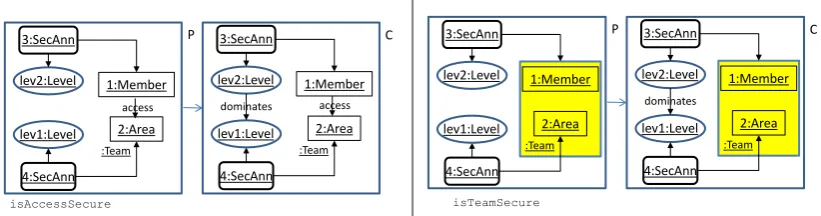
then the security level of the member must dominate that of the area. Similarly, the constraint
isTeamSecurein Figure3(right) requires that an area can be assigned to a team if the team
has the necessary authorisations to use the resources in the area, i.e. has a higher security level. An analogous constraint is defined for inclusion of members in a team.
C1
access
isAccessSecure
:Team P 3:SecAnn
1:Member
2:Area
4:SecAnn lev1:Level lev2:Level
dominates
C
:Team 3:SecAnn
1:Member
2:Area
4:SecAnn lev1:Level lev2:Level
access
:Team
C3 P 3:SecAnn
1:Member
2:Area
4:SecAnn lev1:Level lev2:Level
dominates
C
isTeamSecure
:Team 3:SecAnn
1:Member
2:Area
4:SecAnn lev1:Level lev2:Level
Figure 3: Security constraints on access (left) and teams (right).
We adopt a concrete representation derived from UML instance diagrams, where instances of the box sort are defined as rectangles surrounding their content, nodes from the organisation domain are usual instance rectangles, nodes representing annotations are rectangles with rounded corners, and nodes representing elements from the security and temporal domains are ovals. A box of typeTeamhas a yellow background, and a box of typeConfhas a pale green background3. When morphisms are involved, they are represented by the matching of numbers in the names of elements. Edges appearing in both graphs and associated with identified elements in the morphism are considered to be identified as well. We only show the types of edges from the various domains, the types of the annotation edges being easily inferrable.
We also show some of the rules by which graphs in the organisational domain can be formed, leaving details on the annotation process for Section5. RulesimpleAccessWithoutTeams
in Figure4(left) grants members access to areas when both members and areas are outside the scope of any team, while ruleteamAccessin Figure4(right) allows access within the scope of a single team. In this paper, since we deal only with non-deleting rules defined by injective morphisms, we only indicate theLandRcomponents of the rules, theKcomponent being equal
toL. Constants define concrete values for annotations. For the remaining rules, we assume that a NAC is always present excluding membership in some team, unless this is required, and that NACs prevent the application of rules where security information is required.
1:Member
2:Area L
1:Member
2:Area R
access
rule1
1:Member N1
:Team
simpleAccessWithoutTeams
2:Area N2
:Team
1:Member
2:Area L
access
3:Team
1:Member
2:Area R
3:Team
rule2
teamAccess
Figure 4: Rules for access for non-teamed elements (left) and within a team (right).
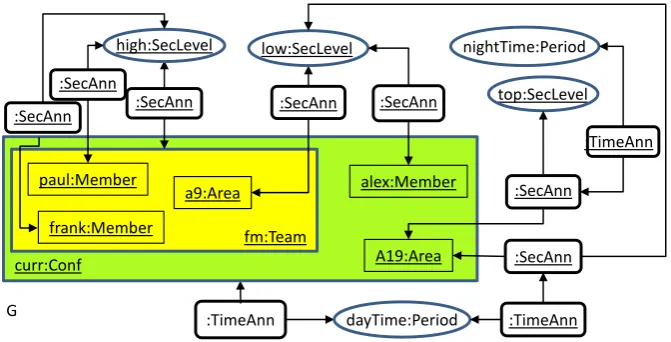
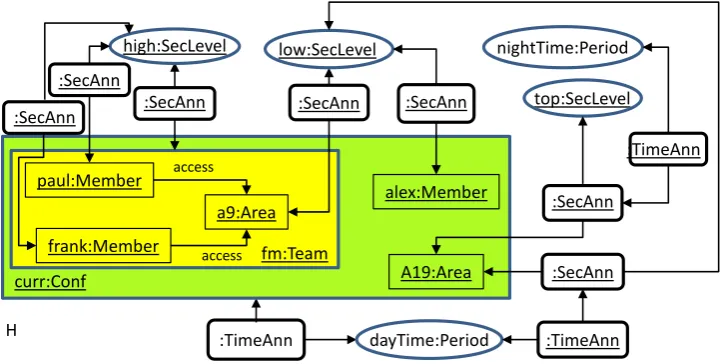
Figure5presents a snapshot of an organisation as a graphG, together with some annotations, with three members and two areas. Two members and one area are within a team, and security levels are associated with the area and with the team as a whole. Another area is annotated with two security levels, each valid during a different period. The whole graph is annotated to indicate that this snapshot is taken at daytime. We do not explicitly present the edges representing the
dominatesrelation between levels, which can be inferred from the names of the levels.
dayTime:Period :TimeAnn
G
paul:Member
a9:Area high:SecLevel
:SecAnn
frank:Member
alex:Member :SecAnn
:SecAnn
:TimeAnn A19:Area
:SecAnn low:SecLevel
:SecAnn top:SecLevel nightTime:Period
:TimeAnn
fm:Team
curr:Conf :SecAnn
:SecAnn
Figure 5: A snapshot of an organisation with security and temporal annotations.
4
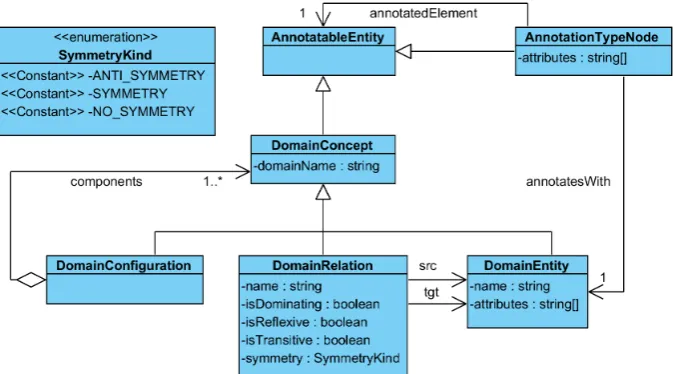
Annotatable elements
elements and domain entities; annotatable entities are either elements representing annotations
(AnnotationTypeNode) or elements representing some domain notion (DomainConcept).
We consider three types of domain concepts: entities, relations and configurations, recursively
composed of concepts. Constraints onAnnotationTypeNodeand the DomainConcept
maintain the notions of domain and of annotation consistent with one another. In particular, a domain configuration is composed of domain concepts, all belonging to the same domain, while an annotation relates a domain concept with an entity from a different domain. Note that a do-main concept can be annotated only with dodo-main entities, not with configurations. The notion of domain is induced from the notion of type graph, as per Definition3.
Figure 6: The extended metamodel for complex annotations.
Definition 3(Domain) Given a type graphT Gand a setC of constraints on it, adomainis the set of graphs typed, byT G, that satisfy all of the constraints inC.
This organisation allows the flexible annotation of subgraphs, besides individual nodes or edges, with domain elements. Moreover, theDomainConfigurationmeta-type realises a special form of the Composite pattern, one which admits cycles. With reference to the type graph of Figure2, we observe that<<Node>>types are instances ofDomainEntity, while
<<Box>>types are instances ofDomainConfigurationand<<Annotation>>types are
instances ofAnnotationTypeNode. Edge types in the type graph conform in the obvious way with the edge meta-types in the metamodel.
VA∪V2 in their domains and codomains, respectively. Hence, we allow only the use of nodes, and not of edges or boxes as values for the annotations, while any type of element from the application domain graph can be annotated (we do not consider edge annotation in this paper). Moreover,B0=B1∪Ba, whereBais a new set of nodes containing subgraphs ofG1, and associated with some node inA, i.e. boxes which are not part of the original model, but which are created to support some annotation. We do not present examples of boxes inBain this paper. The previous definitions oft0andcnt0are therefore enriched accordingly.
Since AnnotationTypeNode is a type of AnnotatableEntity annotations can be
nested. In particular, an annotation nodean1, connecting an elementxof a domainDwith some entityv1of a domainD1, can be annotated, through an annotation nodean2, with an elementv2 of a third domainD2. We require that nested annotations do not form cycles on domains. Such an annotation is interpreted as constraining the validity ofan1in the context denoted byv2.
5
Rewriting with annotations
We now discuss the impact of annotation processes on the original rules and constraints in the organisational domain by presenting a collection of rules derived from rulesteamAccess
and simpleAccessWithoutTeams (see Figure 4), as well as an extension of constraint
isAccessSecure(see Figure 3). Since we have rules withK=L, we use the construction
given in [BP12] for the SPO approach, that we summarise here. Hence, for a ruler:L→Rand a constraintc:P→C, whereRhas a non-empty intersectionZwithP, we build two graphsXand
Y and morphismsx: L→X andy:X→Y. Xcontains the elements inLand inP, without con-sidering elements added byRtoL, with potential duplicate elements identified throughrandZ, whileY integrates the elements inC, again with all the necessary identifications. The morphisms
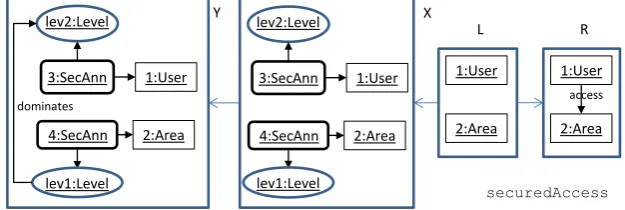
xandyare derived by requesting all compositions to commute. As an example, composing
con-straintisTeamSecureof Figure3(right) and rulesimpleAccessWithoutTeamsabove
produces rulesecuredAccessin Figure7, where we have left the NACs understood.
rule6
L
1:User
2:Area R
access 1:User
2:Area X
3:SecAnn 1:User
2:Area 4:SecAnn
lev1:Level lev2:Level
dominates
Y
3:SecAnn 1:User
2:Area 4:SecAnn
lev1:Level lev2:Level
securedAccess
Figure 7: ComposingsimpleAccessWithoutTeamsandisAccessSecure.
3:TimeAnn 4:Period :TimeAnn
P C
3:TimeAnn
4:Period 1:Member
2:Area
access
1:Member
2:Area
:Conf
access
isTimeConsistent
Figure 8: A temporal constraint on access.
1:Member
2:Area L
1:Member
2:Area R
access
4:TimeAnn 5:Period :TimeAnn
1:Member
2:Area
X Y
4:TimeAnn
5:Period 1:Member
2:Area
rule3
6:Conf 5:Conf
timedAccessArea
Figure 9: ComposingsimpleAccessWithoutTeamsandisTimeConsistent.
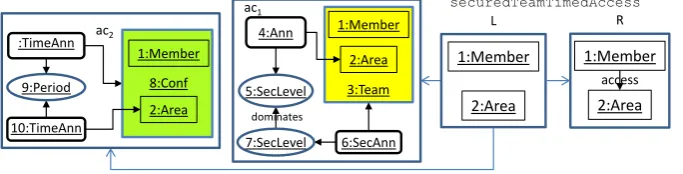
The combination of the two constraints above on one area gives rise to a conjunction of the corresponding application conditions, as exemplified by rulesecuredTeamTimedAccessin Figure10, whereac1 andac2 stand for the whole application conditions in Figures9and7.
rule5
ac2
ac1
1:Member
2:Area
L
1:Member
2:Area
R
access
securedTeamTimedAccess
1:Member
2:Area
3:Team
dominates
4:Ann
5:SecLevel
6:SecAnn 7:SecLevel
10:TimeAnn 9:Period :TimeAnn
1:Member
2:Area 8:Conf
Figure 10: Combining application conditions.
We now discuss how the progressive nesting of applications causes the modification of the rules derived from constraints. Figure11shows constraintisTimeSecurityConsistent, which extends constraintisAccessSecurewith a temporal annotation on the security anno-tation of an area, analogous to the one used to derive ruletimedAccessArea.
Then, we need to extend the application condition for rule securedTeamAccess. Let
(de-ECEASST
3:SecAnn 1:Member
2:Area 4:SecAnn
7:Level
8:Level P
access 5:TimeAnn 6:Period C 3:SecAnn 1:Member 2:Area 4:SecAnn 7:Level 8:Level access 5:TimeAnn
6:Period :TimeAnn
:Conf
isTimeSecurityConsistent
dominates
Figure 11: Extending security constraintisAccessSecurewith a temporal annotation.
fined byc1: P1→C1) andac2:Y1→Y2 be the morphism in the application condition derived
fromisTimeSecurityConsistent. The intersection betweenP1andY1is exactlyX. Then
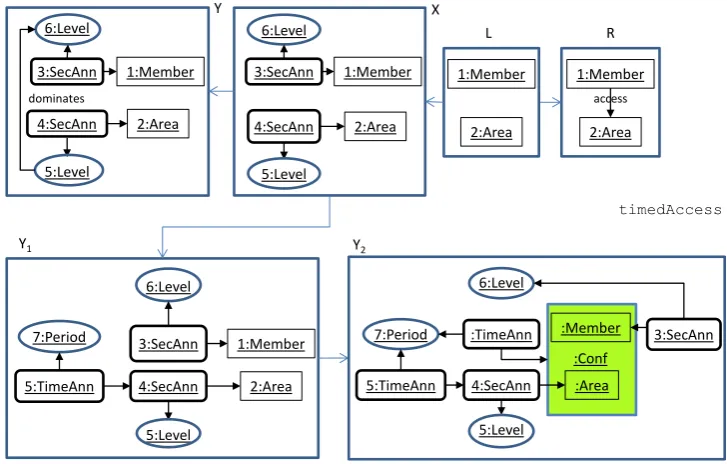
we transform the original atomic application condition into a general application condition re-sulting from the conjunction of the original case and the extended case, as expressed by the formula∀mX[∃mY∧ ∀mY1[∃mY2]], wheremZ,Z=X,Y,Y1,Y2, indicates the existence of a match
for the graphZwhich extends, according to the morphisms in the application condition, a match forLin the host graphG. The resulting rule,timedAccess, is shown in Figure12. rule7
3:SecAnn L 1:Member 2:Area R access 1:Member 2:Area 1:Member 2:Area 4:SecAnn 5:Level 6:Level X
3:SecAnn 1:Member
2:Area 4:SecAnn 5:Level 6:Level dominates Y
3:SecAnn 1:Member
2:Area 4:SecAnn 5:Level 6:Level Y1 5:TimeAnn 7:Period Y2 3:SecAnn :Member :Area 4:SecAnn 5:Level 6:Level 5:TimeAnn
7:Period :TimeAnn
]] 2 [ [ Y Y1 Y X
:Conf
timedAccess
Figure 12: Extending rulesecuredAccessafterisTimeSecurityConsistent.
For the host graph in Figure5ruletimedAccessis applicable on a match formed by mem-ber Alex and area 19, while rulesecuredAccessis applicable twice, to both members Frank and Paul, for area 9. Thanks to the transitivity ofcnt, also rulesecuredTeamTimedAccess
nor can Alex access area 9. Figures13and14show the resulting graphs.
G=>H (applicando rule7)
dayTime:Period :TimeAnn
H
paul:Member
a9:Area
high:SecLevel
:SecAnn
frank:Member
alex:Member :SecAnn
:SecAnn
:TimeAnn A19:Area
:SecAnn low:SecLevel
:SecAnn top:SecLevel nightTime:Period
:TimeAnn
fm:Team
curr:Conf
access :SecAnn
:SecAnn
Figure 13: The graphHgenerated by applying the rule of Figure12to the graphG.
G=>H (applicando rule4)
dayTime:Period :TimeAnn
H
paul:Member
a9:Area high:SecLevel
:SecAnn
frank:Member
alex:Member :SecAnn
:SecAnn
:TimeAnn A19:Area
:SecAnn low:SecLevel
:SecAnn top:SecLevel nightTime:Period
:TimeAnn
fm:Team curr:Conf
access
access
:SecAnn
:SecAnn
Figure 14: The graphHgenerated by applying twice the rule of Figure7to the graphG.
6
Related work
paper capitalises on this notion, allowing boxes to be annotated, thus constraining the possible transformations in graphs with annotations.
The study of families of diagrammatic relations and of their adequacy to modeling domains exhibiting specific relations has been conducted in [BG04] and [FB05].
The motivation for boxes is analogous to that for introducing Hierarchical Graphs in [DHP02]. These identify some specific types of hyperedges as containing entire graphs, and of multi-level graphs [PP95], where some nodes may hide some part of a graph at some level of abstraction. In this case, the resulting structure is not a strictly hierarchical one. The notion of views, realised through distributed graphs [GMT99], allows the composition of partial specifications of a model, not necessarily in a nested way, but considering levels of abstraction separately.
Boxes as proposed in this paper allow both the definition of hierarchies and the composition of different views, with elements which may belong to different hierarchies.
7
Concluding Remarks
We have presented an approach to enriching models of application domains with constraints coming from contextual domains through the use of annotations relating values from the latter one to model elements of the former one.
By extending the notion of graph to include boxes which can be source or target of edges (in particular, target of annotation edges), we extend the definition of annotation provided in [BP12], and provide here a formal characterisation of annotations of configurations, which was not com-pletely developed there but only hinted at. Boxes can be nested, allowing the construction of complex configurations. This extension allows modelers to express and reason about complex interplays among annotations exploiting elements from different domains. It is important to no-tice that boxes are a first-class modeling construct, independent of their content. Hence, two boxes can have the same exact content, without being identified or without being contained into one another. Conversely, two boxes can be mutually contained into one another, again sharing the same content, but maintaining possible independent evolutions. Finally, boxes can be used as place-holders for collections of elements yet to be defined. For example, teams can be formed and annotated before assigning members to them.
Among several aspects still to be investigated in details is the question of maintaining con-sistency with respect to annotations. In particular, if an annotated element is removed, than the corresponding annotations should be removed as well. This could be accomplished through units, with a preliminary removal of the annotation followed by a simple DPO rule. Also under investigation is the possibility of defining boxes within the SPO approach. In this case, repair actions could be used after removing an annotated node (and the annotation edge which had that node as a target) to remove the annotating node.
Bibliography
[BG04] P. Bottoni, A. Grau. A Suite of Metamodels as a Basis for a Classification of Visual Languages. InProc. VL/HCC’04. Pp. 83–90. IEEE CS, 2004.
[BGL10] P. Bottoni, E. Guerra, J. de Lara. A language-independent and formal approach to pattern-based modelling with support for composition and analysis. Information & Software Technology52(8):821–844, 2010.
[BP12] P. Bottoni, F. Parisi-Presicce. Modeling context with graph annotations.ECEASST
47, 2012.
[DHP02] F. Drewes, B. Hoffmann, D. Plump. Hierarchical Graph Transformation.J. Comput. Syst. Sci.64(2):249–283, 2002.
[DKH97] F. Drewes, H.-J. Kreowski, A. Habel. Hyperedge Replacement, Graph Grammars. Pp. 95–162. World Scientific, 1997.
[EEPT06] H. Ehrig, K. Ehrig, U. Prange, G. Taentzer. Fundamental Theory for Typed At-tributed Graphs and Graph Transformation based on Adhesive HLR Categories. Fun-dam. Inform.74(1):31–61, 2006.
[EHKP90] H. Ehrig, A. Habel, H.-J. Kreowski, F. Parisi-Presicce. From Graph Grammars to High Level Replacement Systems. In Graph-Grammars and Their Application to Computer Science. Pp. 269–291. 1990.
[FB05] F. Fondement, T. Baar. Making Metamodels Aware of Concrete Syntax. In Proc. ECMDA-FA. LNCS 3748, pp. 190–204. Springer, 2005.
[GMT99] M. Goedicke, T. Meyer, G. Taentzer. ViewPoint-Oriented Software Development by Distributed Graph Transformation: Towards a Basis for Living with Inconsistencies. InProc. RE’99. Pp. 92–99. IEEE CS, 1999.
[PP00] F. Parisi-Presicce. Which Graphs for Visual Modeling? In ICALP Satellite Work-shops. Pp. 383–386. 2000.