ISSN: 2278-3369
International Journal of Advances in Management and Economics Available online at: www.managementjournal.info
RESEARCH ARTICLE
The Impact of Personal Sales Choice on Banking Services
Oec. Marija Vukoja
Ph.D. on Faculty of Economic - University of Mostar, Mostar, Bosnia and Herzegovina.
Abstract
The purpose of this empirical research is to study and analyze the impact of personal sales choice on specific banking services. This sample included a total of 106 respondents and was staffed by clients of commercial banks in the Herzegovina-Neretva County. Starting from the issue and research objectives set, the main hypotheses is: H1: Personal selling has a positive effect on the selection of banking services. In order to achieve the objectives of research and test the main hypotheses, there are four additional hypotheses. For processing the collected dana, there is appropriate software-ski SPSS package applied. Data collected by the empirical research were processed with the use of more appropriate statistical methods: descriptive statistics, through the tabulation, calculating the average value, calculating the frequency of different responses and testing the reliability and validity of the applied measurement scales through CronbachAlpha coefficient. Suggested hypotheses were tested by multiple regression method. The results of the study confirmed the main and additional hypotheses and showed that personal selling has a significant positive impact on customers when choosing banking services.
Keywords: Personal sales, Banking services, Bank employees, Bank customers.
Introduction
The financial marketing service is becoming more competitive every day. At the time of such competition, banks become an example of highly complex system that offer a number of services to their clients, which requires significant financial investment.
The financial sector has experienced tremendous growth due to the increased number of companies offering financial services. The fact that the bank offers a service that is high quality, accessible and cost-effective does not need to mean much itself. In particular, the banks now operate in an environment that is influenced by the continuous technological development that is rapidly changing.
On that extremely dynamic and competitive market, the success of the bank is conditioned more by the quality of its market presentation, which should lead to the desired behaviour of consumers in the
process of selection and purchase of banking services. And not only that. The main objective of banks is to be more market-oriented,forcing them to create not only banking services that will be based on the needs and desires of consumers, but also such a marketing communications whose main goal in the beginning and the ending is only a consumer.
Thus, changes in consumer behaviour, caused by social changes and technological developments, resulted in the increasing demand for modified and completely customizable communication messages for
customers, so that personal selling
Review of Previous Research
In the specific context of services, Henning-Thurau [1]. showed that 'technical skills' of employees in the service industry (i.e. competence, knowledge and expertise) resulted in customer satisfaction, their committment and loyalty. The empirical research that was conducted by Jemutai Cheruiyot [2] investigated the impact of bank's personal sales performance and came to the conclusion that personal selling is extremely effective when selling banking products, which also resulted in a positive impact on customer loyalty.
Furthermore, in the study that was conducted by Guenzi and Georges [3] it has been proven that there is a positive relationship between the experience of the sellers and the customer trust in the seller.
The alleged competence should be an indicator of confindence in the client vendor [4] General conclusions that have been made [5] showed a positive relationship between attractiveness and sellers' confidence. Previous studies indicate the importance of sellers' attitude towards the clients in the service sector, and provest hat this orientation increases the efficiency of sales [6] Guenzi and Georges [3] confirmed the importance of customer trust in the seller.
The importance of trust in trade relations, especially in financial services in their works, is also emphasized by Gundlach and Murphy, [7] and Morgan and Hunt [8].
Personal selling can be defined not only as an activity to increase sales of products and services, but also as an 'instrument' for the positioning of goods and service sin the mind of customers [9] Personal selling has undergone radical changes over the last few years. Customers have a large amount of information, the demand for services increases, and therefore expectations are higher. The sellers, or the company's employees play a significant role in attracting customers and encourage them to choose the product/service.
According to Đokić, Pepur, Arnerić [10], the ratio of customer and employee in
particular, is becoming increasingly
important in the financial services industry. Therefore, it is important that the personality of employees is adjusted to
positive interaction and successful
cooperation. The personality of the bank's employees can determine their own satisfaction, and affect the relation between customer's satisfaction and the satisfaction due to provided services.
On modern large markets (including banking sector) the purchase is not just the deal. Moreover, employees should know the needs and desires of their customers much better than they are, and match them with their strategies. Personal selling has spread
beyond traditional selling to build
relationships with customers [11,12] Thus, the proper application of the personal sales can lead to increased sales, greater customer satisfaction and ultimately to higher sales of services.
Based on the aforesaid, we can conclude that the increase in sales of services is preceded by a selection of products or services from the client. When it comes to personal sales, great emphasis is placed upon continuous education of sellers who represent one of the most important tasks of managers [13] There are some individual characteristics of sellers that affect the sale, and these are: professionalism, honesty, flexibility and other interpersonal skills .
Research
The following work presents the results and conclusions of the research concerning the positive impact of personal sales to the customer's choice of certain banking services (loans, savings, current accounts and cards).
The Objectives of the Research
In this research special attention is added to customer's choice of certain banking services under the influence of personal sales in banks. Regarding to this, the aims of the research have been defined:
• To establish the existence of a positive link, i.e,. the impact of personal sales and the range of banking services
• To establish the existence of a positive link, i.e,.the impact of personal sales and the choice of banking loan services
• To establish the existence of a positive link, i.e,.the impact of personal sales and the choice of banking saving services
• To establish the existence of a positive link, i.e,.the impact of personal sales and the choice of banking current account services
• To establish the existence of a positive link, i.e,.the impact of personal sales and the choice of banking card services.
Starting from the problems of the study and a defined objective there is hypothesis, whose acceptance or rejection want to test the knowledge, obtained in the theoretical framework of the research.
H1: Personal Selling has a Positive Influence on the Selection of Banking Services
Based on the main hypotheses there are four additional hypotheses defined:
H1a: Personal selling has a positive influence on the selection of banking credit services
H1b: Personal selling has a positive influence on the selection of banking saving services
H1c: Personal selling has a positive influence on the selection of banking current account services
H1d: Personal selling has a positive influence on the selection of banking cards services
Research Methodology
Empirical research conducted in the area of Herzegovina-Neretva County during the month of August in 2016. The basic characteriation of the sample in this study, the quota (control variables: city and banking services) of 106 respondents, i.e. bank clients. Before testing defined
hypotheses by conducting regression
analysis, there will be tested the reliability and accuracy of the applied measurement scale.
Reliability measurement scale is tested by calculating CronbachAlpha coefficients. CronbeachAlpha coefficient, in recent years, is one of the most commonly used coefficients to determine the reliability of the measurement scale and also represents a measure of internal consistency of the set of items with values between 0 and 1. As CronbachAlpha coefficient is closer to value 1, it is more reliable measurement scale.
Regarding the criteria of reliability of the measurement scale, if the coefficient of reliability (including Cronbach Alpha coefficient) takes the value of 0.9, then reliablity can be considered excellent. When it takes the value of about 0.8, reliability can be considered very good, and if it takes the value of about 0.7, then the reliability is considered acceptable. In cases where the coefficient of reliability is less than 0.5, then it indicates the fact that more than a half of the observed variance may be due to random errors, that measurement sale of such a low reliability coefficient could not be considered reliable and should not be applied in further analysis. As a techinique of data collection for research purposes was used a survey method that focuses on interviewing clients on the B2C market.
Respondents were asked to express their degree of agreement or disagreement with the proposed statements. For claims that the respondents were offered, there has been applied Likert's scale with five degrees (so called, balanced scale) in which the average level ( 3) reffered to as neutral, and each side of the neutral degree has the same number of degrees in a positive and a negative way.
The questionnaire was structured in two parts. In the questionnaire, eight questions
were related to the demographic
characteristics of the respondents, while the variable of personal sales was assessed using 16 statement based on the four dimensions of personal sales for each observed type of banking. The first proposed dimensions of personal sales is informing the customer about specific products and services. Another proposed dimension of personal sales is to create interest of the buyer to purchase a particular product or a service. The third recommended dimension of personal sales is influence on the selection of certain products or services. The proposed fourth dimension is to create a positive attitude. In order to achieve the objectives of research and test the hypotheses to set up
and analyze the data, the appropriate software-ski package of SPSS is used.
The Results of the Research
In order to collect the data, there has been formed online questionnaire, where 139 respondents accessed the questionnaire, considering that 106 respondents fully completed the survey.
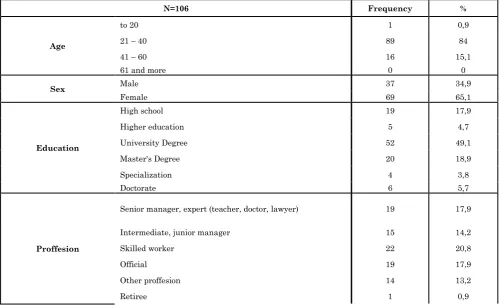
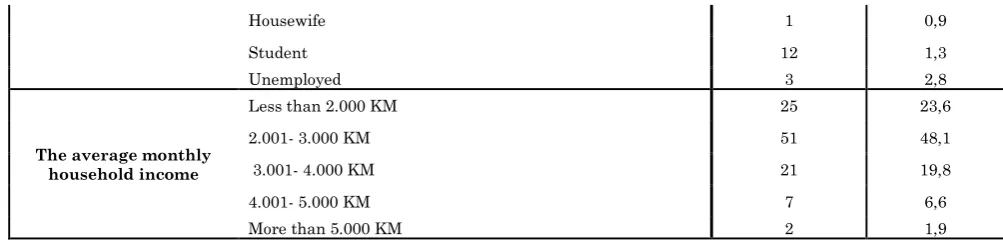
According to the conducted research, the total number of respondents randomly included 34.9% male respondents and 65.1% female respondents. In accordance with the above, it could be said that there is the changing trend of making a purchase decision and the use of banking services.
In the decision- making process when choosing banking services or products, besides men, there is increasing number of women. The results of the study showed that even 84% of respondents aged 20 to 40 years, were clients with whom the banks cooperate. As for the educational structure of respondents is slightly more than half, namely 52% with a university degree, 20% with a master's degree and 19% graduated
from high school. Demographic
characteristics of the sample are shown in Table 1.
Table 1: Demographic characteristics of the sample
N=106 Frequency %
Age
to 20 1 0,9
21 – 40 89 84
41 – 60 16 15,1
61 and more 0 0
Sex Male 37 34,9
Female 69 65,1
Education
High school 19 17,9
Higher education 5 4,7
University Degree 52 49,1
Master's Degree 20 18,9
Specialization 4 3,8
Doctorate 6 5,7
Proffesion
Senior manager, expert (teacher, doctor, lawyer) 19 17,9
Intermediate, junior manager 15 14,2
Skilled worker 22 20,8
Official 19 17,9
Other proffesion 14 13,2
Housewife 1 0,9
Student 12 1,3
Unemployed 3 2,8
The average monthly household income
Less than 2.000 KM 25 23,6
2.001- 3.000 KM 51 48,1
3.001- 4.000 KM 21 19,8
4.001- 5.000 KM 7 6,6
More than 5.000 KM 2 1,9
Source: research results
Before checking the hypothesis, there is previously tested the reliability and validity of used measurement scales. Based on the CronbachAlpha coefficient, shown in Table 2, it can be concluded that the applied
measurement scales for analysis of the of impact of personal sales, such as (loans, savings, current accounts and cards) has a confidence level that can be regarded as excellent.
Table 2: The level of reliability of measurement scales (CronbachAlpha coefficient), the mean value, variance and standard deviation for the entire sample
Measurement scale Cronbach's
Alpha Mean value Variance
Standard deviation
Personal selling 983 57,92 301,526 17,365
Source: research results
Descriptive Statistics for Variable Personal Selling
The research results in Table 3 show that the clients of the bank highly value the employees of the bank, considering the way of communicating manner, whether they are friendly, communicative, collaborative, ect. In addition to this, there is the highest average value of the statement that 'the employees of the bank directly affect the
selection of the banking services' (3.68) that is, to the banking card service with a standard deviation of the estimate number 1.239.
On the other hand, the results of the study show that, when it comes to taking out loans, clients consider bank employees to have minor role. The standard deviation for this assessment is 1,173.
Table 3: Descriptive analysis of variable personal sale
Personal Selling
Mean value
Standard deviation
1
LOAN-[Employees of these banks provide adequate information on banking services] 3,66 1.194
LOAN- [Employees of these banks generate interest for banking services] 3,51 1.173
LOAN- [Employees of the banks make a positive attitude for banking services] 3,55 1.212
LOAN- [Employees of the bank directly affect the selection of banking services] 3,65 1.196
2
SAVINGS- [Employees of these banks provide adequate information on banking services] 3,58 1.226
SAVINGS- [Employees of these banks generate interest for banking services] 3,58 1.234
SAVINGS- [Employees of the banks make a positive attitude for banking services] 3,59 1.193
SAVINGS- [Employees of the bank directly affect the selection of banking services] 3,55 1,18
3
CURRENT ACCOUNT-[Employees of these banks provide adequate information on banking services] 3,65 1.219
CURRENT ACCOUNT- [Employees of these banks generate interest for banking services] 3,62 1.215
CURRENT ACCOUNT- [Employees of the banks make a positive attitude for banking services] 3,65 1.227
CURRENT ACCOUNT- [Employees of the bank directly affect the selection of banking services] 3,67 1.232
4
CREDIT CARD- -[Employees of these banks provide adequate information on banking services] 3,67 1.263
CREDIT CARD- [Employees of these banks generate interest for banking services] 3,67 1.263
CREDIT CARD- [Employees of the banks make a positive attitude for banking services] 3,64 1,22
CREDIT CARD- [Employees of the bank directly affect the selection of banking services] 3,68 1.239
Source: research results
Multiple regression
After determining that the measurement scales possess an acceptable level of reliability and descriptive statistics, the
Table 4: Multiple regression for personal sales
ANOVAa Model Summarya
De
p
en
de
ntV aria ble
a
Model SumofSquares Df MeanSquare F Sig. R
R Square
Adjusted R Square
Std. ErroroftheEstimate
L
oan
1 Regression 38487,973 4 9621,993 83,879 ,000b
,877b ,769 ,759 10,710
Residual 11586,037 101 114,713
Total 50074,009 105
b. Predictors: (Constant), LOAN- [Employees of these banks provide adequate information on banking services], LOAN- [Employees of these banks generate interest for banking services], LOAN- [Employees of the banks make a positive attitude for banking services], LOAN- [Employees of the bank directly affect the selection of banking services]
S
avi
ng
s
1 Regression 41882,822 4 10470,706 91,273 ,000b
,885b ,783 ,775 10,711
Residual 11586,536 101 114,718
Total 53469,358 105
b. Predictors: (Constant), SAVINGS- [Employees of these banks provide adequate information on banking services], SAVINGS- [Employees of these banks generate interest for banking services], SAVINGS- [Employees of the banks make a positive attitude for banking services], SAVINGS- [Employees of the bank directly affect the selection of banking services]
Cur
re
n
t
acc
ou
nt 1 Regression 45295,493 4 11323,873 89,735 ,000b
,883b ,780 ,772 11,234
Residual 12745,385 101 126,192
Total 58040,877 105
b. Predictors: (Constant), CURRENT ACCOUNT-[Employees of these banks provide adequate information on banking services], CURRENT ACCOUNT- [Employees of these banks generate interest for banking services], CURRENT ACCOUNT- [Employees of the banks make a positive attitude for banking services], CURRENT ACCOUNT- [Employees of the bank directly affect the selection of banking services]
Cre
d
it
c
ar
d
1 Regression 55745,239 4 13936,310 179,735 ,000b
,936b ,877 ,872 8,806
Residual 7831,327 101 77,538
Total 63576,566 105
b. Predictors: (Constant), KARTICE-[Zaposlenici ove banke izravno utječu na odabir bankarske usluge], CREDIT CARD- [Employees of these banks provide adequate information on banking services], CREDIT CARD- [Employees of these banks generate interest for banking services], CREDIT CARD- [Employees of the banks make a positive attitude for banking services], CREDIT CARD- [Employees of the bank directly affect the selection of banking services]
Source: research results
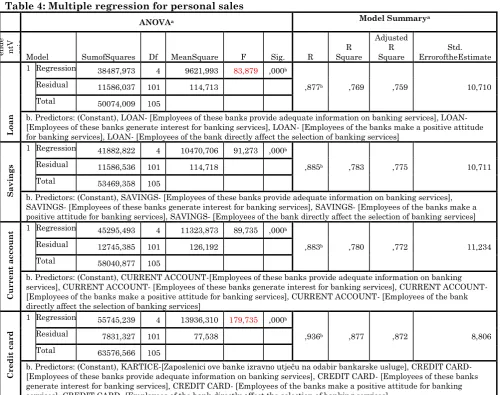
The results through multiple regression analysis clearly shows that personal selling has a positive effect on the selection of
banking services showing statistical
significance (p <0.001) for all dependent variables, that is, the observed four-banking services (credit, savings, current accounts and cards).
Survey results also indicate that the biggest impact on personal selling provides a choice of banking card. This clearly shows the predictors of service cards, where F is 179.735. Also, the combination of predictors significantly predict dependent variable of 87.2%. R2=0,872
On the other hand, the results show that the slightest impact of personal sales activity is to sell services, loans in banks, where F is 83,879.
The percentage of 75.9% clearly shows that the combination of predictors significantly
predict the dependent variable and the adjusted R2=0,759.
According to the results of testing hypotheses by means of multiple regression has come to the conclusion that the hypothesis is confirmed for all four of the observed banking services: credit, savings, current accounts and cards.
It is reasonable cause of these results to explain the fact that while selecting banking services, customers have most confidence in the information they obtain directly from the bank's employees. Thus, the bank employees play a significant role in the selection of banking services due to their behaviour, characteristics, and treatment of customers.
This, therefore represents the
results show that the bank's clients prove to have the highest confidence in human factor.
Conclusion
A review of the literature made for work purposes, as well as the results of the study point to the conclusion that personal selling has a positive effect on the customer in the selection of banking services for the observed four types of banking services: credits, savings, current accounts and cards.
Consequently, the main and subsidiary hypotheses of the research are confirmed. The results of this study indicate that the bank's clients in spite of unsurpassed technological development and a variety of communication instruments accompanied these developments and continue to consider personal sale when choosing banking services. This can be explained by the fact that the bank's customers still, however, most believe in the direct word of the seller.
The study confirmed the reliability of the
measurement scale, operability of
questionnaire, and the underlying
assumptions of the model, indicating the
validity of the full research. It is also necessary to point out to some limitations of this study. As many marketing research, this study is being addressed at a certain moment, more precisely in one month,in order to test clients whether bank employees have an impact on them when choosing individual banking services, which would over an extended period of time contributed to the greater reliability of the results.
Also, as another limitation that occurs in this study is certainly the small sample. Recommendations for further research, certainly involve the greater sample, the greater number of analyzed services, and even the involvement of other Western European countries. Such research would allow a comparison of results between the observed countries and eventually get a clearer picture of the impact on personal selling on a variety of private banking
services by a potential client.
References
1. Thorsten Hennig - Thurau (2004) "Customer orientation of service employees: Its impact on customer satisfaction, commitment, andretention", International Journal of Service Industry Management, 15(5):460-478.
2. Jemutai Cheruiyot R (2014) Integrated
marketing communication and performance of Kenya post and savings bank, 2014. source: http://ir-library.ku.ac.ke
3. Kotler P, Armstrong G (2010) Principles of Marketing. 13th (Global) ed. Boston: Pearson
Education, Inc.,.
4. Crosby L, Evans, KR, Cowles D (1990)
Relationship Quality in Services Selling: An
Interpersonal Influence Perspective,
American Marketing Association.
5. Swan JE, Bowers MR, Richardson LD (1999)
Customer Trust intheSalesperson: An
Integrative Review and Meta-Analysis of the Empirical Literature, Journal of Business Research.
6. Saxe R, Weitz B, The SOCO scale: A measure
of the customer orientation of sales people,
Journal of Marketing Research (pre-1986); Aug 1982; 19, 000003; ABI/INFORM Global
pg. 343, source:
http://warrington.ufl.edu/centers/retailcenter/ docs/papers/Saxe1982.pdf
7. Gundlach GT, Murphy PE (1993) “Ethicaland
legal foundations of relational marketing exchanges”, Journal of Marketing, 57:35-46.
8. Morgan R, Hunt SD (1994) The
Commitment-Trust Theory of Relationship Marketing, Journal of Marketing.
9. Moharam M, Shawky Y (2012) Measuring
the effects of personalized integrated marketing communication tools on the consumers intention to purchase credit cardsinthe private banking sectorin Egypt, American Academic i Scholarly Research Journal.
10. Đokić T, Pepur M, Arnerić J (2015) Utjecaj zadovoljstva zaposlenika na zadovoljstvo korisnika na tržištu financijskih usluga, Ekonomska misao praksa.
marketing perspective, Journal of the Academy of Marketing Science, 27(2):241-254.
12. Ingram TN, LaForge RW, Avila RA,
Schwepker Jr. CH, William MR (2004) Sales
Management: AnalysisandDecisionMaking
(5th Editioned.). USA: Thomson,
SouthWestern.
13. Boles JS, Babin BJ, Brashear TG, Brooks C (2001) An examination of the relationship between retail work environments, sales
personselling orientation-customer
orientation and job performance, Journal of
Marketing Theory and Practise 9
(Summer):1-13.