399
DIFFERENTIAL REGULATION OF GS-GOGAT GENE EXPRESSION BY PLANT GROWTH
REGULATORS IN
ARABIDOPSIS
SEEDLINGS
Milan Dragićević1,*, Ana Simonović1, Milica Bogdanović1, Angelina Subotić1, Nabil Ghalawenji1, Ivana Dragićević2
and Slađana Todorović1
1Institute for Biological Research “Siniša Stanković”, Department for Plant Physiology, University of Belgrade, Bulevar despota Stefana 142, 11060 Belgrade, Serbia
2Faculty of Biology, University of Belgrade, Studentski Trg 16, 11000 Belgrade, Serbia
*Corresponding author: [email protected]
Received: June 8, 2015; Revised: June 30, 2015; Accepted: July 6, 2015; Published online: August 21, 2015
Abstract: Primary and secondary ammonium assimilation is catalyzed by the glutamine synthetase-glutamate synthase (GS-GOGAT) pathway in plants. The Arabidopsis genome contains five cytosolic GS1 genes (GLN1;1 – GLN1;5), one nuclear gene for chloroplastic GS2 isoform (GLN2), two Fd-GOGAT genes (GLU1 and GLU2) and a GLT1 gene coding for NADH-GOGAT. Even though the regulation of GS and GOGAT isoforms has been extensively studied in response to various environmental and metabolic cues in many plant species, little is known about the effects of phytohormones on their regulation. The objective of this study was to investigate the impact of representative plant growth regulators, kinetin (KIN), abscisic acid (ABA), gibberellic acid (GA3) and 2,4-dichlorophenoxyacetic acid (2,4-D), on the expression of A. thaliana GS and GOGAT genes. The obtained results indicate that GS and GOGAT genes are differentially regulated by growth regulators in shoots and roots. KIN and 2,4-D repressed GS and GOGAT expression in roots, with little effect on transcript levels in shoots. KIN affected all tested genes; 2,4-D was apparently more selective and less potent. ABA induced the expression of GLN1;1 and GLU2 in whole seedlings, while GA3 enhanced the expression of all tested genes in shoots, except GLU2. The observed expression patterns are discussed in relation to physiological roles of investigated plant growth regulators and N-assimilating enzymes.
Key words:Glutamine synthetase; glutamate synthase; abscisic acid; kinetin; gibberellic acid
INTRODUCTION
The glutamine synthetase-glutamate synthase (GS-GOGAT) cycle provides an entry route for reduced inorganic nitrogen into all organic nitrogenous com-pounds in plants. GS (EC 6.3.1.2) catalyzes ATP-de-pendent ligation of ammonia and glutamate to yield glutamine, while GOGAT catalyzes the redox trans-fer of the glutamine amide group to α-ketoglutarate, forming two glutamate molecules. Apart from as-similation of ammonia from primary sources such as nitrate reduction, nitrogen fixation and ammonia uptake, the GS-GOGAT cycle is active during second-ary assimilation of ammonia derived from different metabolic processes such as photorespiration, amino acid catabolism and the phenylpropanoid pathway
Given the importance of the GS-GOGAT cycle in providing and recycling organic nitrogen, and the fact that nitrogen availability and its utilization ef-ficiency are limiting factors in plant productivity [1], the effort to understand the regulation and roles of various GS and GOGAT isoforms is not surprising. The key regulators of GS and GOGAT gene expres-sion are light, nitrate, ammonium, amino acids and sugars [4,8-11]. Recently, several classes of phytohor-mones, namely cytokinins, auxins and abscisic acid (ABA) have been implicated in the regulation of ni-trogen transport, assimilation and distribution [12], while evidence of the effects of gibberellins is mostly indirect [13-14]. Here we present a study of the ef-fects of four representative growth regulators on the expression of GS and GOGAT isoforms in Arabidop-sis seedlings grown in liquid culture.
MATERIALS AND METHODS
Plant growth conditions and growth regulator treatment
Arabidopsis thaliana ecotype Columbia (NASC ID: N60000) seedling liquid culture was established in vitro, as previously described [15]. The seedlings, cultivated for one month submerged in growth reg-ulator-free liquid MS medium [16] supplemented with 3% sucrose, were transferred to fresh medium containing varying concentrations (10-8, 10-7, 10-6 and
10-5 M) of 2,4-dichlorophenoxyacetic acid (2,4-D),
ABA, kinetin (KIN) or gibberellic acid (GA3). Plant harvesting was carried out 24 h after hormone ap-plication; roots and shoots were separated and stored at -70°C.
RNA Extraction and RT-qPCR
Total RNA was isolated from roots and shoots using Trizol (Invitorgen), quantified spectrophotometri-cally and its integrity was checked by gel electro-phoresis. For reverse transcription, 1 µg of total RNA was pretreated with DNase I (Fermentas) followed by reverse transcription using a RevertAid First Strand cDNA Synthesis Kit (Fermentas), with oligo-dT primers, at 42°C, according to the manufacturer’s instructions. Real-time PCR reactions were set with Maxima SYBR Green mix (Fermentas) using cDNA corresponding to 50 ng RNA and 0.3 mM primers (Table 1), in 25 µl total volume. The amplification was carried out on an ABI PRISM 7000 SDS thermal cycler (Applied Biosystems). The qPCR program in-cluded initial denaturation (95°C/10 min), 40 cycles of denaturation (95°C/15 s), annealing (58.5°C/20 s) and extension (72°C/30 s), followed by melting curve analyses. Standards for absolute quantification were prepared from PCR products purified by gel electro-phoresis and extracted with a GeneJET Gel Extrac-tion Kit (Fermentas) according to the manufacturer’s protocol. Constitutive expression of 18S rRNA was confirmed in parallel using the same poly(dT)18 -primed RT mixture [17].
Table 1. Sequences of primers used for qPCR.
gene GenBank forward (5ʹ→3ʹ) reverse (5ʹ→3ʹ)
GLN1;1 NM_123119 AGAAGTCATGCCGGGTCAGT GTCAGCAGTCTCGTGGTGTC
GLN1;2 NM_105291 ACGGGACACCATGAAACTGC GGCAGTGTCAACCGGTACAA
GLN1;3 NM_112663 TCGGCCCTGTTGAGGGTATT CACGTCCCACTCTCACTGAC
GLN1;4 NM_121663 GGAGTTCCAAGTCGGTCCCA CGGTTTGCCACACCCCATAA
GLN1;5 NM_103743 CATGCCTGGACAATGGGAGT CACCGATGCTCCACGATCC
GLN2 NM_122954 ATGCCTGGACAGTGGGAGTT GTCTCGTGCTTTCCGGTCAA
GLU1 NM_180432 CTTGTGGTCGTGTTGCTGGT CTCCAGCTTTGCCTCTAGCG
GLU2 NM_129687 CCCTGTTGGGAAGGTTGAGC TGACACCAAAACGCCCTGAG
GLT1 NM_124725 TCGAGCTGCGTTGAACCTTC CACTTGAGCAGACCCTCACG
RESULTS AND DISCUSSION
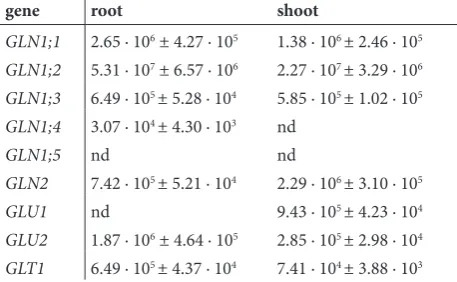
The expression data in control plants (Table 2) showed that the GS1 genes generally have slightly higher expression in roots compared to shoots, and that GLN1;2 transcripts are the most abundant in both tissue samples. The expression of GLN1;4 was be-low the detection threshold in shoots, while GLN1;5 transcripts were not detected in seedlings. These re-sults are consistent with previously published data for plants grown under ample nitrogen supply [4-5,15]. As expected, based on the proposed roles in photores-piration [8-11,18], the expression of the chloroplastic GLN2 was higher in shoots, while Fd-GOGAT GLU1 transcripts were found in shoots only. The GOGAT genes GLU2 and GLT1 were dominantly expressed in roots (Table 2). Previously it was shown that GLT1 is mainly involved in primary assimilation and remobi-lization of nitrogen [8, 19], while it was proposed that GLU2 encoded enzyme serves to supply a constitutive level of glutamate for the maintenance of a basal level of protein synthesis [8].
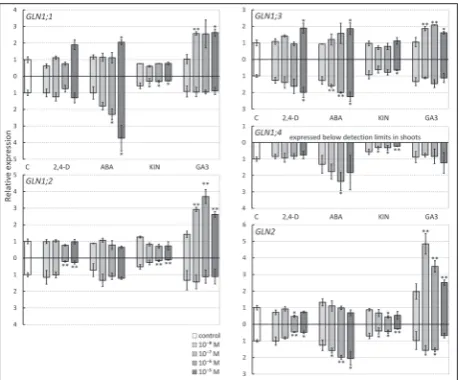
The tested plant growth regulators differentially modulated the expression of GS (Fig. 1) and GOGAT (Fig. 2) genes in roots and shoots. KIN had a higher impact on gene expression in roots, where significant repression was found for all GS and GOGAT genes, while the effect on expression in shoots was less pro-nounced, usually at higher KIN concentrations. This
result is consistent with the postulated role of cytoki-nins, which act in signaling routes that communicate the internal and external nitrogen status of the plant. Cytokinin synthesis is upregulated during N abun-dance, while high cytokinin levels cause suppression of N-uptake and primary assimilation [12,20].
Treatment with 2,4-D had a more pronounced effect on gene expression in roots, where it down-regulated the most abundantly expressed GS1 gene – GLN1;2, plastidic GLN2 (Fig. 1), as well as the two GOGAT genes – GLU2 and GLT1 (Fig. 2). The only gene whose expression was enhanced in both roots and shoots in the presence of high 2,4-D concentra-tions was GLN1;3. Based on this it can be concluded that 2,4-D and KIN have somewhat overlapping ef-fects on primary N-assimilation; however, 2,4-D shows higher specificity and less potency in the re-pression of GS1 gene exre-pression. Similar results were obtained when the effect of cytokinins and auxins on the expression of Arabidopsis root-type nitrate trans-porter genes (AtNRT) was evaluated [12]. Namely, trans-Zeatin showed non-selective repression of all root AtNRT genes, while the effect of indole-3-acetic acid was less pronounced and apparently selective.
Treatment with ABA significantly induced GLN1;1, GLN1;3 and GLU2 genes in entire seed-lings, as well as GLN1;4 and GLN2 expression in roots (Figs. 1 and 2). The most affected genes were GLN1;1, whose expression in roots was increased al-most 4-fold, and GLU2, which was induced 5.5-fold in shoots. Since ABA is considered one of the main hormonal regulators during abiotic stress responses [21], the ABA-responsive GLN1;1 and GLU2 genes can be considered as stress-responsive genes. Indeed, GLN1;1 is upregulated during cold [22] and salinity stress [23]. Furthermore, among all A. thaliana GS1 single knockout mutants, only GLN1;1ko had an in-creased stress sensitivity phenotype [22]. The role of GLU2 is not well defined, but it seems that GLU2 is involved neither in primary nitrogen assimilation nor in photorespiratory ammonium removal [8]. Interestingly, Arabidopsis abiotic stress expression maps [24] indicate that GLU2 transcripts accumu-late in shoots of plants under osmotic and salt stress.
Table 2. Absolute expression of GS and GOGAT genes in roots
and shoots of control (hormone untreated) plants. The values represent the average copy number per µg of total RNA for three biological repetitions (n = 3) of 10 plants each ± standard error (SE), nd – not detected.
gene root shoot
GLN1;1 2.65 · 106 ± 4.27 · 105 1.38 · 106 ± 2.46 · 105
GLN1;2 5.31 · 107 ± 6.57 · 106 2.27 · 107 ± 3.29 · 106
GLN1;3 6.49 · 105 ± 5.28 · 104 5.85 · 105 ± 1.02 · 105
GLN1;4 3.07 · 104 ± 4.30 · 103 nd
GLN1;5 nd nd
GLN2 7.42 · 105 ± 5.21 · 104 2.29 · 106 ± 3.10 · 105
GLU1 nd 9.43 · 105 ± 4.23 · 104
GLU2 1.87 · 106 ± 4.64 · 105 2.85 · 105 ± 2.98 · 104
Previously it was shown that during abiotic stress responses a large portion of Glu synthesized by the GS-GOGAT pathway is used for proline production [25], which is a common osmoprotectant.
GA3 treatment significantly induced the expres-sion of all studied genes in the shoots except GLU2, while its effect on expression in roots was minor or absent. This result indicates that GA3 does not regu-late primary assimilation of ammonium in roots, but is involved in ammonium (re)assimilation in shoots. Little is known about the effects of gibberellins on nitrogen metabolism. This class of hormones has been shown to induce the expression of cytosolic GS in pine [26] and to reduce glutamate content in Arabidopsis shoots [14], probably by stimulating its utilization for growth. In view of this, the observed stimulation of GS and GOGAT expression in shoots by GA3 might serve to provide enhanced Glu produc-tion, to support gibberellin-stimulated shoot growth.
We have shown that the expression of GS and GOGAT genes in Arabidopsis seedlings grown sub-merged in liquid culture is comparable to literature data on the expression profiles of these isoforms in seedlings grown under standard conditions. We found liquid culture convenient for investigation of the effects of plant growth regulators on gene ex-pression in different organs of Arabidopsis seedlings, since this system allows for the uniform application of constant concentrations of the investigated sub-stances, without consideration of internal transport issues or concentration fluctuations imposed by foliar or other types of applications. All of the GS-GOGAT genes were found responsive to at least one of the four tested growth regulators, indicating that N assimilation is modulated not only by N supply, availability of carbon skeletons, light and other fac-tors broadly investigated in literature, but also by phytohormones. The results obtained concur well with the available literature data on the specific func-tions of different GS and GOGAT isoforms. The es-tablished system and the obtained results provide a good basis for further investigation into the role of phytohormones in the regulation of N assimilation.
Fig. 1. Expression of GS genes in growth regulator treated Ara-bidopsis seedlings. Relative expression (normalized to controls) of five A. thaliana GS genes (GLN1;1-1;4 and GLN2) in shoots (above the X axis) and roots (below the X axis) of plants treated with 10-8-10-5 M concentrations of growth regulators for 24 h: C – control; 2,4-D – 2,4-dichlorophenoxyacetic acid; ABA – abscisic acid; KIN – kinetin; GA3 – gibberellic acid. Expression of GLN1;5
is not shown because it was below detection limits in all samples. Means and standard errors (SE) are for three biological repetitions (n=3) of 10 plants each. Significant differences estimated using Student t test are indicated by *P < 0.05 and **P < 0.01.
Fig. 2. Expression of GOGAT genes in growth regulator treated
Arabidopsis seedlings. Relative expression (normalized to
Acknowledgments: This study was supported by Ministry of Education, Science and Technological Development of the Re-public of Serbia, Project ON173024.
Authors’ contributions: M. Dragićević and S. Todorović
contrib-uted equally to this work. A. Simonović, A. Subotić, S. Todorović and I. Dragićević conceived and designed the experiments. M. Dragićević, M. Bogradnović, N. Ghalawenji and S. Todorović performed the experiments. M. Dragićević, A. Simonović and S. Todorović analyzed the data. A. Simonović and S. Todorović contributed reagents/materials/analysis tools. M. Dragićević and A. Simonović wrote the paper.
Conflict of interest disclosure: The authors declare that they
have no competing interests.
REFERENCES
1. Lea PJ, Miflin BJ. Nitrogen Assimilation and its Relevance to Crop Improvement. In: Foyer HC, Zhang H, editors. Annual Plant Reviews 42. Oxford: Wiley-Blackwell; 2010. p. 1-40. 2. Betti M, García-Calderón M, Pérez-Delgado CM, Credali A,
Estivill G, Galván F, Vega JM, Márquez AJ. Glutamine Syn-thetase in Legumes: Recent Advances in Enzyme Structure and Functional Genomics. Int J Mol Sci. 2012;13(7):7994-8024.
3. Schmid M, Davison TS, Henz SR, Pape UJ, Demar M, Vin-gron M, Scholkopf B, Weigel D, Lohmann JU. A gene expres-sion map of Arabidopsis thaliana development. Nat Genet. 2005;37(5):501-6.
4. Ishiyama K, Inoue E, Watanabe-Takahashi A, Obara M, Yamaya T, Takahashi H. Kinetic Properties and Ammonium-dependent Regulation of Cytosolic Isoenzymes of Glutamine Synthetase in Arabidopsis. J Biol Chem. 2004;279(16):16598-605.
5. Lothier J, Gaufichon L, Sormani R, Lemaître T, Azzopardi M, Morin H, Chardon F, Reisdorf-Cren M, Avice J-C, Masclaux-Daubresse C. The cytosolic glutamine synthetase GLN1;2 plays a role in the control of plant growth and ammonium homeostasis in Arabidopsis rosettes when nitrate supply is not limiting. J Exp Bot. 2011;62(4):1375-90.
6. Guan M, Møller IS, Schjoerring JK. Two cytosolic gluta-mine synthetase isoforms play specific roles for seed ger-mination and seed yield structure in Arabidopsis. J Exp Bot. 2015;66(1):203-12.
7. Forde BG, Lea PJ. Glutamate in plants: metabolism, regula-tion, and signalling. J Exp Bot. 2007;58(9):2339-58. 8. Potel F, Valadier M-H, Ferrario-Méry S, Grandjean O, Morin
H, Gaufichon L, Boutet-Mercey S, Lothier J, Rothstein SJ, Hirose N, Suzuki A. Assimilation of excess ammonium into amino acids and nitrogen translocation in Arabidopsis thali-ana– roles of glutamate synthases and carbamoylphosphate synthetase in leaves. FEBS J. 2009;276(15):4061-76.
9. Thum KE, Shasha DE, Lejay LV, Coruzzi GM. Light- and Carbon-Signaling Pathways. Modeling Circuits of Interac-tions. Plant Physiol. 2003;132(2): 440-52.
10. Coschigano KT, Melo-Oliveira R, Lim J, Coruzzi GM. Arabi-dopsis gls Mutants and Distinct Fd-GOGAT Genes: Implica-tions for Photorespiration and Primary Nitrogen Assimila-tion. Plant Cell. 1998;10(5):741-52.
11. Oliveira IC, Coruzzi GM. Carbon and Amino Acids Recipro-cally Modulate the Expression of Glutamine Synthetase in Arabidopsis. Plant Physiol. 1999;121(1):301-10.
12. Kiba T, Kudo T, Kojima M, Sakakibara H. Hormonal con-trol of nitrogen acquisition: roles of auxin, abscisic acid, and cytokinin. J Exp Bot. 2011;62(4):1399-409.
13. Hudson D, Guevara D, Yaish MW, Hannam C, Long N, Clarke JD, Bi Y-M, Rothstein SJ. GNC and CGA1 Modu-late Chlorophyll Biosynthesis and Glutamate Synthase (GLU1/Fd-GOGAT) Expression in Arabidopsis. PLoS One. 2011;6(11):e26765.
14. Ribeiro DM, Araújo WL, Fernie AR, Schippers JHM, Muel-ler-Roeber B. Translatome and metabolome effects triggered by gibberellins during rosette growth in Arabidopsis. J Exp Bot. 2012;63(7):2769-86.
15. Dragićević M, Todorović S, Bogdanović M, Filipović B, Mišić D, Simonović A. Knockout mutants as a tool to identify the subunit composition of Arabidopsis glutamine synthetase isoforms. Plant Physiol Biochem. 2014;79:1-9.
16. Murashige T, Skoog F. A Revised Medium for Rapid Growth and Bio Assays with Tobacco Tissue Cultures. Physiol Plant. 1962;15(3):473-97.
17. Bogdanović M, Dragićević M, Tanić N, Todorović S, Mišić D, Živković S, Tissier A, Simonović A. Reverse Transcription of 18S rRNA with Poly(dT)18 and Other Homopolymers. Plant Mol Biol Report. 2013;31(1):55-63.
18. Kissen R, Winge P, Tran DHT, Jørstad TS, Størseth TR, Christensen T, Bones AM. Transcriptional profiling of an
Fd-GOGAT1/GLU1 mutant in Arabidopsis thaliana reveals a multiple stress response and extensive reprogramming of the transcriptome. BMC Genomics. 2010;11:190.
19. Konishi N, Ishiyama K, Matsuoka K, Maru I, Hayakawa T, Yamaya T, Kojima S. NADH-dependent glutamate synthase plays a crucial role in assimilating ammonium in the Arabi-dopsis root. Physiol Plant. 2014;152(1):138-51.
20. Sakakibara H, Takei K, Hirose N. Interactions between nitro-gen and cytokinin in the regulation of metabolism and devel-opment. Trends Plant Sci. 2006;11(9):440-8.
21. Tuteja N. Abscisic Acid and abiotic stress signaling. Plant Signal Behav. 2007;2(3):135-8.
22. Ji Y. The role of cytosolic glutamine synthetases in abi-otic stress and development in Arabidopsis thaliana. [dis-sertation]. [Saskatoon]: College of Graduate Studies and Research, University of Saskatchewan. 2011.
24. Kilian J, Whitehead D, Horak J, Wanke D, Weinl S, Batistic O, D’Angelo C, Bornberg-Bauer E, Kudla J, Harter K. The AtGenExpress global stress expression data set: protocols, evaluation and model data analysis of UV-B light, drought and cold stress responses. Plant J. 2007;50(2):347-63. 25. Brugière N, Dubois F, Limami AM, Lelandais M, Roux Y,
Sangwan RS, Hirel B. Glutamine Synthetase in the Phloem
Plays a Major Role in Controlling Proline Production. Plant Cell. 1999;11(10):1995-2011.