ISSN: 2347-7474
International Journal Advances in Social Science and Humanities
Available online at: www.ijassh.com
RESEARCH ARTICLE
Interaction between empowerment, economic activity and mother-child
bonding
Aristizabal LA
1*, Gurri FD
2, Molina D
3, Sanchez G
4El Colegio de la Frontera Sur in Mexico (ECOSUR).
*Corresponding Author: Email: [email protected]
Abstract
A log-linear analysis tested for the association between parental bonding, mother’s economic activity and empowerment in 152 mother-child pairs from five rural Maya communities in the Yucatan Peninsula, Mexico. Three groups of mothers, further classified as empowered or un-empowered, were compared. These were: women who did not participate in any income generating activities (TW), those who increased their participation in traditionally accepted income generating activities for women (WTI) and those who became full time wage earners at a new local assembly plant, a non-traditional income generating activity (WNTI). Empowerment significantly modified the association between occupation and parental bonding. There was an interaction effect between the three variables. Empowerment had a negligible effect on WNTI, it weakened the bonds of TW and it improved those of WTI. Results support previous observations the idea that in rural areas imported income generating activities create novel ecological conditions that increase the vulnerability of the women who participate in them and have a negative effect on their relationship with their children. They also show that an increase in culturally acceptable means of generating wealth will not in itself improve their well-being. To do so, women must also be empowered.
Keywords: Parental bonds, Empowerment, Economic activity, Maya communities, Globalization, Well-being.
Introduction
In rural areas of developing countries economic growth has increased women’s market participation and improved their working conditions [1, 2]. Today more women have access to loans [2-5] and wage labor options [6, 7]. Nevertheless, these changes haven´t necessarily improved mother infant relationships. When their new resources or activities are culturally incompatible with their family context, they have often lead to deteriorations in the mother’s and children’s well-being [8-19].
Explanations for this inverse relationship between maternal participation in income generating activities and child health may be grouped in two. Some argue that participating in new nontraditional income generating activities reduces the time women devote to childcare [20-22] and generates novel household environmental conditions that conflict with traditional parental strategies and concepts [23]. To others, the “opportunities” generated by development are not reflected in improvements in child welfare because they are not neutral. They usually take advantage of and perpetrate traditional gender
inequalities that worsen the mother´s ability to make adaptive choices [11, 12, 14, 18]
If the latter is true, female empowerment, in as much as it increases a woman´s ability to mitigate gender inequalities [24], should also give mothers the ability to reduce the negative impact that participating in income generating activities may have on child health. This should be the case for traditional income generating activities as well as for those promoted by global economic development. In this paper we tested if empowerment modified the outcome that a mothers’ economic activity could have on child health by using type of Emotional Bond [25] established between mothers and their children as a proxy for well-being.
when the child trusts his/her mother, who in turn is accessible to the infant when he/she finds adverse or threatening circumstances [29]. OB is considered an ideal adaptation [29-32] because children who establish this type of bond with their mothers or guardians tend to be affectionate, empathic, and feel secure around new surroundings. This bond also encourages a child’s autonomy and independence [33].
Children with absent or weak bonds (WB) are usually provided with little care and protection, and their emotional needs aren’t met. WBs have been associated with panic disorder with or without agoraphobia, generalized anxiety disorders, depressive disorders, personality disorders, and a dependency that increases the child’s vulnerability to any type of abuse including sexual abuse [28,34]. Finally, controlling parents who are intrusive, have excessive contact with their children, promote infantile expressions, and limit a child’s autonomous behaviors; establish a bond defined as over protection (OP0 [34]. Infants who establish this type of bonding may present eating disorders like anorexia, depressive disorders, panic disorder, and schizophrenia with frequent relapses [33, 35, 36].
The study was carried out with mother-child pairs from five rural communities that have been recently transformed by local and global economic development in the Yucatan Peninsula, Mexico. Three groups of mothers who were further classified as empowered or un-empowered were compared. These were: women who did not participate in any income generating activities who served as a control group, those who increased their participation in traditionally accepted income generating activities for women and those who became full time wage earners at a new local assembly plant known as “maquiladora”, a non-traditional income generating activity. No interaction effects were expected and an improvement in OBs was expected in empowered women in each group.
Changes in Calkiní and Halachó (Camino Real)
Until the first half of the twentieth century, the Maya peasant communities in the municipalities of Calkiní, and Halachó Campeche, Yucatan depended on traditional subsistence agriculture. In their traditional system, men cultivated the “milpa”, a polyculture that combines beans and squash with maize, and complemented it with hunting, gathering and fishing. Women worked around the house and contributed to family support with backyard produce which they
consumed or sold, and the making and selling of handicrafts [37-39]. With globalization, 20% of the local population abandoned the milpa and began to produce for the market in mechanized land [40]. Of the remaining 80% some adopted a mixed lifestyle that combined traditional agriculture with wage labor in the services sector and local maquiladoras, and some abandoned farming altogether.
Globalization also opened new opportunities for peasant women. Several government programs gave them access to credit, and contact with the cities opened a wider market for their traditional revenue sources: their handicrafts and backyard produce. Finally, the expansion of assembly plants, created a boom in non-traditional employment for women in the road connecting the capital cities of Merida and Campeche [41]. Between the years of 1997 and 2003, eight assembly plants established themselves in the municipalities of Calkiní, Tepakán, Campeche, Champotón, Hecelchakán, Bécal and tenabo. By 2011 they had employed 5048 people and at least 53.9% of them were women [42].
The above revealed the need to explore whether there is a statistically significant relationship between the type of occupation of Maya women and the emotional bond they established with their children. Likewise was intended to determine whether women empowerment generated some impact on that relationship. Methodology
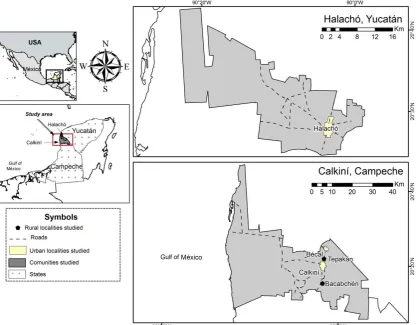
This project was carried out in the communities of Bacabchén, Becal, Halachó, Tepakán and Calkiní located in the Road connecting the cities of Campeche and Merida in the municipalities of Calkiní Campeche and Halachó Yucatan (Figure 1).
Sample
We interviewed women who complemented the family income with traditional productive activities such as handicrafts and selling backyard products in the local market [43-47]. With, globalization these women had increased the time spent in income generating activities as well as their personal income [48] and will be referred to in the text as women with traditional money making activities WTI.
Figure 1: Location map of the communities studied
before July 1, 1998 and will be referred to as women with nontraditional income generating activities WNTI. Finally, women who, despite the changes around them, did not modify their production activities were included. These were housewives and were considered "traditional women" TW.
To select the Mother Child pairs we applied the following criteria: The child had to be at least 12 years old. It is at this age that children have the cognitive capacity necessary to guarantee that their answers about their past are precise and reliable enough. The second one was that the mother had to be married to or live with the father of the child. This one had to be a peasant when the child was born. We chose peasants because we wanted to study the impact of development on the households of subsistence agriculturalists. Live in fathers were a condition to eliminate biases that presence or absence of a father could have on type of emotional bond established between mother and child, and the presence of a husband or male partner was insisted upon to avoid biases that being without a mate could have on a women’s empowerment. To begin fieldwork, all pertinent permits were obtained from local municipal, school and assembly plant authorities. The project and the protocols had been previously approved by the
Human Subjects equivalent of El Colegio de la Frontera Sur: the “Comité de Ética”. Children were approached first in the local high schools at Calikiní where all potential mother child pairs were chosen.After that, their mothers were visited at their own homes, at the local market or at the assembly plant. Those who met the criteria and accepted to form part of the project were included in the sample and an appointment was made to visit them at their own homes. During the second visit each of the mothers answered a 25 item questionnaire developed to measure empowerment in four action spheres(Table 1): an economic sphere, 5 Items, community participation ,5 Items, a family sphere ,7 Items, and an individual one,8 Items [49-50]. Each response was classified in a scale between 0 and 3 where 0 was considered less empowered and 3 most empowered. The numbers of each question were added. Women with total values below the 50th percentile were classified as "not empowered" and the rest were classified as "Empowered". It took an average of 35 minutes to apply this instrument.
the perception of behavior and attitude of parents in relation to the subject in its infancy stages and classifies the bonding into four types: 1. Optimal bonding OB 2. Absent or weak bonding WB, 3.Constriction bonding CB, and 4. Control without affection.
The PBI is considered a robust psychometric instrument used in both in clinical settings and for research [51] as an objective measure of parenting styles. This instrument has also been used in parallel to test the validity of other instruments such as the EMBU-I [51-53] the CAMIR [54] and the EPAA [55]. The Spanish version of the test has been validated in adolescents from Spain [56] and other Latin American countries [57].
The PBI consists of 25 statements, with two scales: One for Care (12 items) and another for Overprotection (13 items). Each item is scored with the Likert method in a scale from 0 to 3. The Care scale can reach a maximum of 36 points and Overprotection 39. For each item, adolescents were asked to pick the alternative that best described the relationship with her mother based on their memories until age 12. Children with Constriction bonding and Control without affection were classified as Overprotection (OP). To visualize the relationship between the variables of occupation, bonding and empowerment, contingency tables were made and a log-linear analysis was performed to measure the strength of association between variables [58-59]. Fisher [60] suggested this method when frequencies are low. The variables investigated by log-linear models are treated as "response variables" so that these do not distinguish between dependent and independent variables. The statistical significance of each association was obtained by calculating the Pearson Chi-square as well as the goodness of fit test for the model [61].
Results and Discussion
Table 1 shows the number of mothers and children interviewed in the towns of Bacabchén, Becal, Calkiní and Tepakán, Halachó Campeche and Yucatan. Fieldwork was from January to July 2011. Most of the sample consisted of mother-child pairs from Calkiní (76). Only four were from Bacabchén.
One hundred and fifty two mother-child pairs fitted the selection criteria. Forty-one women were housewives (TW), twenty-five women in addition to being housewives had an independent
Table 1: Number of mothers and children visited per community
Children
Comunity Mothers Male Female Total
Bacabchén 2 2 0 4
Becal 4 2 2 8
Calkiní 38 15 23 76
Tepakán 27 11 16 54
Halachó 5 2 3 10
Total 76 32 44 152
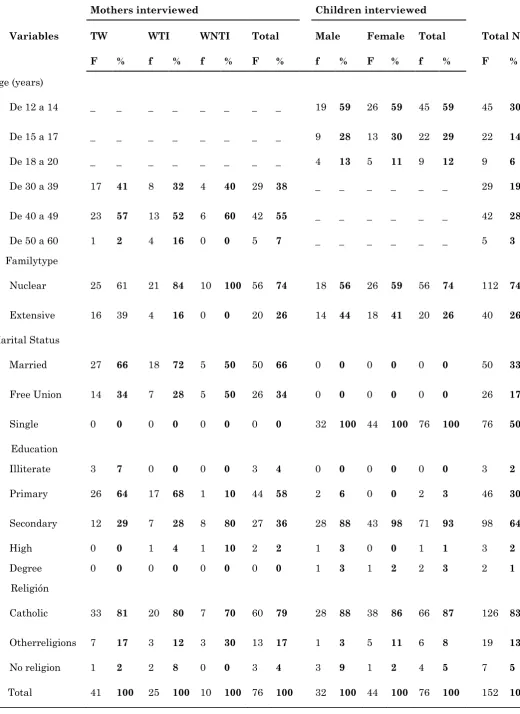
business that allowed them to generate their own income (WTI) and ten were salaried employees in the maquiladora "Calkiní Shirt Company" (WNTI) (Table 2). Housewives who met the criteria were chosen originally from the information provided by their children during the interviews in the local high schools. Most WTI were selected during interviews with all of the women who worked in the local market at Calkiní, and the “maquiladora” employees were chosen after talking to the head of human resources of the Calkiní Shirt Company”. The women of all three occupations were mostly between 40 and 49 years with children between the ages of 12 and 20. Thirty nine percent of the housewives lived in extended families, only 16% of those with their own business lived in this type of family and none of the women working in the factory lived in extended families.
Table 2: Sociodemographic characteristics of the study population by mother´s occupation
Mothers interviewed Children interviewed
Variables TW WTI WNTI Total Male Female Total Total N
F % f % f % F % f % F % f % F %
Age (years)
De 12 a 14 _ _ _ _ _ _ _ _ 19 59 26 59 45 59 45 30
De 15 a 17 _ _ _ _ _ _ _ _ 9 28 13 30 22 29 22 14
De 18 a 20 _ _ _ _ _ _ _ _ 4 13 5 11 9 12 9 6
De 30 a 39 17 41 8 32 4 40 29 38 _ _ _ _ _ _ 29 19
De 40 a 49 23 57 13 52 6 60 42 55 _ _ _ _ _ _ 42 28
De 50 a 60 1 2 4 16 0 0 5 7 _ _ _ _ _ _ 5 3
Familytype
Nuclear 25 61 21 84 10 100 56 74 18 56 26 59 56 74 112 74
Extensive 16 39 4 16 0 0 20 26 14 44 18 41 20 26 40 26
Marital Status
Married 27 66 18 72 5 50 50 66 0 0 0 0 0 0 50 33
Free Union 14 34 7 28 5 50 26 34 0 0 0 0 0 0 26 17
Single 0 0 0 0 0 0 0 0 32 100 44 100 76 100 76 50
Education
Illiterate 3 7 0 0 0 0 3 4 0 0 0 0 0 0 3 2
Primary 26 64 17 68 1 10 44 58 2 6 0 0 2 3 46 30
Secondary 12 29 7 28 8 80 27 36 28 88 43 98 71 93 98 64
High 0 0 1 4 1 10 2 2 1 3 0 0 1 1 3 2
Degree 0 0 0 0 0 0 0 0 1 3 1 2 2 3 2 1
Religión
Catholic 33 81 20 80 7 70 60 79 28 88 38 86 66 87 126 83
Otherreligions 7 17 3 12 3 30 13 17 1 3 5 11 6 8 19 13
No religion 1 2 2 8 0 0 3 4 3 9 1 2 4 5 7 5
Table 3 shows mother-child pairs by mother’s occupation, empowerment and type of bond established by the child mother pair. Bonding types were different between occupations, and this distribution differed between women who were empowered and those who were not. The most common bond established between TW and their children was OP. This bond was most common in both empowered (75%), and un-empowered TW (93%) but was 18% less frequent in the former. Amongst empowered women WB increased by as much as 13.6% with respect to the un-empowered TW, yet OB increased by only 4.6%.
Most un-empowered WTI were also over protective. Like TW empowerment reduced the
percentage of OP bonds but the change was much drastic (52% vs 18%) and in the opposite direction. Most empowered WTI established OB with their children. The differences are considerable, as many as 48% more empowered than an empowered WTI establish OBs yet only 4% more established WB.
Unlike TW and WTI, the most frequent bond established by WNTI was WB. It was followed by OP, and not a single WNTI mother established OBs. Empowerment did not change this distribution but as with TW and WNTI it reduced the number of women who established OP bonds with their children. Empowered WNTI had 4% more mother child pairs with WB.
Table 3: Table of Frequencies between occupation, type of mother child bond and empowerment
Type of Bond
Un-empowered Empowered
Occupation WB OP OB Total WB OP OB Total
F % f % f % f % F % f % f % F %
TW 1 3.4 27 93 1 3.4 29 71 2 17 9 75 1 8 12 29
WTI 2 14 11 79 1 7 14 56 2 18 3 27 6 55 11 44
WNTI 2 67 1 33 0 0 3 30 5 71 2 29 0 0 7 70
Total 5 11 39 85 2 4 46 61 9 30 14 47 7 23 30 39
Table 4 shows the results of the log linear models that test the significance of the associations presented in Table 3. The associations between occupation and type of bond, and between type of bond and empowerment are significant. There isn´t any association between occupation and empowerment. Empowerment, however, significantly affects the association between type of bond and occupation (X2 = 15,634 and α = 0.004793). Finally, type of bond and empowerment are significantly affected by mother´s occupation (X2 = 26,002 and α = 0.00374).
All women interviewed believed that their expectations and obligations towards their children had changed, and that their husband’s milpa did not generate enough to satisfy the new demands.
Table 4: Statistical associations between occupation, type of mother child bond and empowerment
Model Df ΧPearson 2 Α
Occupation – type of
bond 4 1.830.743 0.001075
Occupation –
Empowerment 2 159.104 0.451347
Type of bond –
Empowerment 2 793.871 0.018886
Occupation – Type of
bond, Empowerment 8 15.634 0.04793
Type of bond - Empowerment,
“It’s no longer the same as it was before when he (her husband) worked in the milpa and the milpa
could provide food for the entire year”1
They all agreed that in the past girls were taught to tend a household and boys to work the fields. This, they believed, was no longer the case. Today, mother´s considered formal education as essential to their children´s future success regardless of gender. In almost all cases this success implied the abandonment of agriculture. In spite of this TW didn’t see the need for or felt unable to change their activities to supplement their family income:
…Since I was small ... I was taught to do this: wash, cook, make tortillas, takes care of the kids, and I have always done this. I was raised to do this and I have been doing it for the past 40 years.. .. I don´t know how to do anything else.At my age I am not going to start doing other things I don´t
know…., besides Raul (husband) doesn´t let me do
anything else. He says that I have to stay here at
home, that this is my place2
The domestic space of WTI is similar to that of TW. They care for their children, are married, continue to do their domestic chores and are identified as Catholic. Their businesses do not break traditional rules. They work in the local market and carry out traditional female activities in an opened mixed environment that does not exclude local male participation and it is under local control. Unlike TW, WTI acknowledged their husband’s inability to cover their children´s educational expenses and modified their lifestyles to compensate for it.
My husband never has enough for what is needed. Lately he is constantly saying that he doesn´t have
anything, that the weather is bad,…… and at the
same time the kids are always asking for one thing
or another from school….and what little we have
is not enough…., that’s why it was up to me to
work more and hard selling vegetables here (in the market), otherwise, who was going to see for Antonio’s (her son) schooling?….3
Like WTI, WNTI started working to meet their economic needs and those of their children. Many preferred the assembly plant to other economic endeavors because it represented a steady source
1
Testimony 42 year old woman from Calkiní, Campeche, April 19, 2011. Translated by the authors.
2 Testimony 48 year old TW from Tepakán, Calkiní, Campeche, May 23, 2011. Translated by the authors.
3
Testimony 39 year old WTI from Tepakán, Calkiní, Campeche, May 30, 2011. Translated by the authors.
of income. Some of them, however, saw in the factory an opportunity to do something different, and whether by themselves or with friends they abandoned the local sphere and became wage earners in a factory that restricts the entry of local people, that is outside local control and imposes its own schedules.
It was hard geting into the maquiladora ... I found out because I saw that a neighbor went out every morning so then I asked her what she was doing, and (she) told me she was working in the maquiladora. I was tired of being here (home) every day just watching the kids and sometimes
embroidering hipiles4, so I went to ask, to see if
maybe, and well I stayed there after all.5
The audaciousness of rural women who employ themselves in areas outside their local cultural traditions may be derived from and place them in disadvantageous domestic environments that may contribute to the high frequency of WB observed amongst them. Evidence of this vulnerability is suggested by the fact that a greater number of women working in the maquiladoras switched from Catholicism to another religion. According to Pierre [62] the most disadvantaged are the most likely to change religion, particularly when the switch provides them with a new social support network. Other traits could weaken their relationship with their children. For example, all of these women live in nuclear families. It has been shown, that nuclear families place mothers at a disadvantage in terms of the type of care they can provide affecting in turn bonds established between mother and child [63, 64].
This is exacerbated when the relationship with her partner is unstable and at least 50% of WNTI are not married but have “live in” partners, which, while it gives them greater independence, it doesn´t provide the stability found in marriage [42]. Finally, WNTIs have more years of formal education which probably makes them more autonomous, gives them greater possibilities of generating their own income and it is consistent with the observation that of the three groups these women were the most empowered [65-70].Unfortunately, in their case, empowerment did not improve the bond between them and their children. According to Gutman [30] as women generate access to other spaces empowerment can generate interests or needs that go beyond child care and household labor, reducing the time they spend with their children. In this study, however,
empowered WNTI had only a slight and insignificant greater number of WB than unempowered WNTI. Thus, while empowerment may have allowed access to or be the consequence of salaried labor in a “maquiladora” it hardly had any effect on bonding. In Calkiní, WBs were the result of participating in an activity that all the mothers agreed was too heavy and forced them to leave their household chores and child care in the hands of their elder sons and daughters or other family members who were not part of the domestic unit.
…I get up to leave every day before six in the
morning and I come back after seven in the evening and sometimes later ... so I have to leave the kids alone to fend for themselves, because if I don’t work who will feed them?. José’s money is
not enough..6
Overprotection is the type of bond established between TW and overprotecting children may be a way for TW to gain status within the household. Among Maya housewives a mother’s presence is considered essential for the emotional development of their child [71]. In Yucatan, mothers with young children or pregnant women receive special treatment and can expect support from their adult children, other children in the household and during the first 40 days post-partum they will even count with the support of higher ranking women [72-73]. Child care, therefore, not only defines the role of traditional Maya’n women but it can reduce their obligations in the household and give them status. These observations were also made by Pacheco in 1947, [43].
Not all housewives in a traditional Maya household, however, are of equal status and unlike lower status mothers; empowered women do not derive theirs from child care. Within the household, empowerment will be based on a woman´s ability to harness the help of co-resident lower status women. Empowered TW are elder women who can count with the help of their 10 year old or older daughters and daughters in law to carry out household chores and help with child care while they organize and distribute household resources [73-74]. Empowerment in our sample weakened the bonds that TW women established with their children. This could be because empowered TW must no longer over protect their children to gain status. An increase in WB with empowerment may respond to what Gutman [30]
6
Testimony 40 year old WNTI from Halachó, Yucatán, Jun 6, 2011. Translated by the authors.
argues happens with empowered “modern women” who gain control of and compete for spaces that distance them from direct childcare.
Over Protection was also the most common bond formed by un-empowered WTI, and a few more WTIs than TWs formed WBs. This was surprising given the observations of Chablé et al. [70], Agarwal [68], Deere León [75], Hawkes et al. [76], Hrdy [77], Reiches et al. [78] who suggested that income generating activities in traditionally accepted spaces should improve mother infant wellbeing. An improvement in type of mother infant bond was observed only in empowered WTIs, suggesting that traditional income generating activities will improve mother infant bonds only when women are secure enough, and have the authority to generate their own projects, control their income, their time and their surroundings.
It is truly noteworthy that only amongst WTI women did OB go from being the least common bonding type in un-empowered women, to being the most common amongst those empowered while amongst TW had the opposite effect and amongst WNTI it had none. The significance of this interaction effect suggests that the relationship between type of income generating activity and empowerment, with regards to infant well-being, is much more complex than as presented in the introduction. Both the effects of empowerment, and those of type of income generating activity on well-being are dependent but their interaction is context specific.
To WNTI empowerment allows them to leave their homes to generate needed income. This decision, however, reduces their control over domestic spaces, and weakens their bonds with their children by diminishing their influence on their emotional development; thus increasing their vulnerability as conflict with others rises for not fulfilling their culturally expected roles [79]. Empowerment amongst TW does not distance them from the domestic space since it’s their control of it that empowers them. Nevertheless, exercising this control distances them from child care weakening mother infant bonds. Finally, participating in traditional income generating activities increased WTI income without interfering with their roles as mothers and house wives. Improvements in mother child bonds, however, did not derive from their capacity to earn money in a culturally acceptable way, but on their ability to make their own decisions, control their own spaces and income.
The log-linear analysis did not find any significant association between occupation and empowerement. This contradicts suggestions by Folbre [65], Sen [66], Beneria and Roldán [67], Agarwal [68], Lont [69] and Chablé et al. [70]. Our result may be in part a consequence of small sample size since there is a tendency reversal between TW and WNTI. If this difference were significant, however, it would suggest that empowerment helped traditional women take a nontraditional occupation, and at least in this case it would not have contributed to well-being.
Conclusión
Several women who worked in the factory, as well as some of the children interviewed in the high schools at Calkiní lived in Tepakán, Bacabchén, Bécal, and Halachó, so these communities were added to the study. Originally, we had planned to represent each of the occupations by an equal number of mother-child pairs. Unfortunately, it was impossible to find 41 women with their own traditional business and an equal number working in the Calkiní Shirt Co. who met all the selection criteria.
Although today the number of women with their own business has grown in response to globalization and credit programs, we could only find 25 who had a child and their own business 12 years ago when the parental bond was formed. The sample of the maquiladora is the smallest for two reasons: As in most other maquiladoras [80] most women leave the job after two years. Second, the Calkiní Shirt Company began operations in
Calkiní only 15 years ago and preferred to hire single women. Very few women, who worked in the shirt factory 12 years ago, therefore, had a one year old child, lived with their husband and were able to tolerate the maquiladora´s working conditions for more than two years to be counted today in that group.
Our results support the idea that in rural areas imported income generating activities create novel ecological conditions that increase the vulnerability of the women who participate in them and have a negative effect on their relationship with their children. They also provide us with a cautionary tale against assuming universal consequences of female empowerment on infant child relationships and children´s well-being. Simply within Calkiní, empowerment had positive, negative and negligible effects on parental bonding. Finally, these results tend to demystify the impact of the promotion of culturally acceptable income generating activities on mother infant relationships and well-being [81-83]. They clearly show that it is not enough to provide women with culturally acceptable means of generating wealth, but that they must also become empowered even if this implies adopting responsibilities or positions that go beyond acceptable cultural mores.
Acknowledgement
Thanks to the Mayan women and their children, who collaborated in the development of this study and allowed us to approach an unknown reality.
References
1. Tzannatos, Z. (1999). “Women and labor market changes in the global economy: Growth helps, inequalities hurt and public policy matters”, en World Development, 27(3): 551-569.
2. Winter C (1994) “Working women in Latin America: Participation, pay, and public policy”, en The World Bank LAC Region Technical Department.
3. Kabeer N (1998) Money can’t buy me love? Re-evaluating gender, credit and empowerment in rural Bangladesh.IDS Discussion Paper 363. Brighton: Institute of Development Studies.
4. Hashemi SM, Schuler SR, Riley AP (1996) “Rural credit programs and women’s empowerment in Bangladesh” en World Development, 24(4):635-653. 5. Mayoux L (2001) “Tackling the down side: Social
capital, women’s empowerment and micro-finance in Cameroon”, en Development and Change 32:435-464.
6. Jejeebhoy SJ (1995) “Women’s education, eutonomy, and reproductive behaviour: Experience from four
developing countries” en International Studies in Demography, IUSSP. Oxford: Clarendon Press. 7. Malhotra A, Mather M (1997) “Do schooling and
work empower women in developing countries? Gender and domestic decisions in Sri Lanka”. Sociological Forum 12(4): 599-630.
8. Appendini K, De Luca M (2005) Cambios agrarios, estrategias de sobrevivencia y género en zonas rurales del centro de México: Notas metodológicas. México: Estudios Sociológicos, 13(3): 913-930. 9. Garikipati S (2008) “The impact of lending to
women on household vulnerability and womens empowerment: Evidence from India” en World Development, 36(12):2620-2642.
10.Goetz AM, Gupta RS (1996) “Who takes the credit? Gender, power, and control over loan use in rural credit programs in Bangladesh” en World Development, 24(1):45-63.
countries: models, methods, and policy. Baltimore, MD; Johns Hopkins University Press.
12.Kishor Sunita (1993) "May God Give Sons to All": Gender and Child Mortality in India. American SociologicalReview 58(2):247-65.
13.León M (1997) “El empoderamiento en la teoría y la práctica del feminismo” en León, M. (comp.) Poder y empoderamiento de las mujeres. Santa Fé de Bogotá, Colombia: Tercer Mundo Editores.
14.Pitt M, Shahidur R Khandker (1998) "The Impact of Group-Based Credit Programs on Poor Households in Bangladesh: Does the Gender of the Participant Matter?" Journal of Political Economy 106:958-99. 15.Rao V (1998) “Wife-abuse, its causes and its impact
on intra-household resource allocation in rural Karnataka: A ‘participatory’ econometric analysis”, en Krishnaraj, M.; Sudarshan, R.M. and Shariff, A. (eds) Gender, population and development. Delhi, Oxford y New York: Oxford University Press.
16.Rocca CH, Rathod S, Falle T, Pande RP, Krishnan S (2008) “Challenging assumptions about women’sempowerment: Social and economic resources and domestic violence among young married women”, en Urban South India Int J Epidemiol, 38:577-585.
17.Rubin G (1998) “El tráfico de mujeres: notas sobre la “economía política” del sexo”, en: Navarro M y Stimpson CR (comp) ¿Qué son los estudios de mujeres?. Venezuela: Fondo de Cultura Económica. Pp. 15-74.
18.Schoepf BG, Schoepf C (1987) “Food crisis and agrarian change in the eastern highlands of Zaire”, en Urban Anthropology, 16(1):5-37.
19.Townsend J (2002) “Contenido del empoderamiento: cómo entender el poder”, en Zapata, E.; Towsend, J, Rowlands J, Alberti P, Mercado M (eds) Las mujeres el poder. Mexico: Editorial Plaza Valdéz. Colegio de Posgraduados.
20.Daltabuit Godas M (1992) Mujeres mayas: trabajo, nutrición y fecundidad. Universidad Nacional Autónoma de México. Instituto de Investigaciones Antropológicas. México. D.F.
21.Tucker C (1986) The contributions of children to household production in an Andreancommnunity, tesis de maestria, Amherst, University of Massachusetts, Department of Anthropology. 22.Washbrook L, Gregg P (2005) 'The Effects of Early
Maternal Employment on Child Development in the UK ', CMPO Working Paper 03/070 (2003) published in Economic Journalvol 115, F48-80. Londres.
23.Cervera MD, Méndez RM (2006) “Temperament and ecological context among yucatecmayan children” en International journal of behavioral development, 30:326-337.
24.Pradhan B (2003) “Measuring empowerment: A methodological approach”, en Development, 46(2): 51-57.
25.Bowlby J (1990) El vínculo afectivo. 2nd. Reimp. Buenos Aires: Editorial Paidós.
26.Spitz R (1979) El primer año de vida, S. Paulo, MartinsFontes.
27.Garciandia JA, Torres NE (2000). Módulo Vinculo 1. Aspectos generales y vínculo de amor. Especialización en Prevención de Maltrato Infantil. Universidad Javeriana, Bogotá, Colombia.
28.Delgado MC, Oviedo M (2005) Nichos Fragmentados: Emergencia del Abuso Sexual Infantil. Neiva, Colombia: Editorial Surcolombiana. 29.Ainsworth M (1969) “Object relations, dependency
and attachment: A theoretical review of the infant-mother relationship”. In Child Development, 40, 969-1025 (Medline).
30.Gutman L (2009) La revolución de las madres. El desafío de nutrir a nuestros hijos. Argentina: Del nuevo extremo. Pp. 251.
31.Bowlby J (1969) Attachment and Loss, Vol. 1: Attachment, Hogarth Press and the Institute of Psycho-Analysis. London.
32.Cuadros Ferré I, Ordoñez Vera M (2006) La infancia rota: testimonios y guías para descubrir y tratar el abuso sexual infantil. Bogotá, Colombia: Editorial Normal S.A. Colombia. Pp. 184.
33.Parker G, Tupling H, Brown, LB (1979) “A parental bonding instrument”, en British Journal of Medical Psychology, 52: 1-10.
34.Melis F, Dávila MA, Ormeño V, Vera V, Greppi C, Gloger S (2001) “Estandarización del P.B.I. (Parental BondingInstrument), versión adaptada a la población entre 16 y 64 años del Gran Santiago”, en RevChilNeuro-Psiquiat, 39(2):132-139.
35.Parker G (1981) “Parental reports of depressives: An investigation of several explanations”, en Journal of Affect Disorders, 3:131-140.
36.Barkley R, Edwards GH, Robin AL (1999) Defiant Teens: A Clinician's Manual for Assessment and Family Intervention. New York: Guilford Publications.
37.Pérez A (1945) La agricultura milpera de los mayas de Yucatán. Enciclopedia Yucatanense, Volumen 6. Ediciones del Gobierno de Yucatán, México.
38.Hernández X, Levy S, Bello B (1995) “La Roza-Tumba-Quema en Yucatán” en Bello S Tacher (Eds.) La milpa en Yucatán, Tomo I. México, Colegio de Postgraduados.
39.Terán, S, Rasmussen C (1994) La milpa de los mayas. México: DANIDA.
40.Ku N (1990) Desarrollo agrícola y topología de productores en el ejido de Hecelchacán, Campeche. Tesis de Maestría. México, Colegio de Postgraduados.
42.Ben Loew (2011) Center for Marital and Family Studies. University of Denver, Colorado, Estados Unidos.
43.Pacheco Cruz S (1947) Usos, costumbres, religión y supersticiones de los mayas. Apuntes históricos conun estudio psicobiológico de la raza. Instituto Mexicana de Investigaciones Linguisticas. Mérida, Yucatán.
44.Tozzer AM (1966) “Landas Relación de las cosas de Yucatán. A traslation”, en Papers of the Peabody Museum of American Archaelogy and Ethmology, Cambridge, Harvard University Press, vol. 18. 45.Tinker I (1976) “The adverse impact of development
on women”, at Tinker, I. y M. Bronsen (comps.), Women and world development, Washington, Overseas Development Council.
46.Rodríguez Marquez, JR (2008) El rol de la mujer maya en la unidad doméstica y su impacto en los índices de peso talla en niños y niñas en Señor Municipio de Felipe Carrillo Puerto. Quintana Roo. Chetumal.
47.Bonfil P, Suarez B (2001) De la tradición al mercado. Microempresas de mujeres artesanas. México: Editorial GIMTRAP.
48.Fincher JL (1979) Rural women in Paraguay: The socio-economic dimension, Washington, AID.
49.García B, Oliveira O (2007) “Trabajo extradoméstico y relaciones de género: una nueva mirada” en Gutiérrez M.A. (comp) Género, familias y trabajo: rupturas y continuidades. Desafíos para la investigación política. Buenos Aires: CLACSO. 50.Rowlands J (1997) “Empoderamiento y mujeres
rurales en Honduras: Un modelo para el desarrollo”, en León M (comp) Poder y empoderamiento de las mujeres. Santafé de Bogotá, Colombia: Tercer Mundo Editores.
51.Márquez Caraveo ME, Hernández Guzmán L, Aguilar Villalobos J, Pérez Barrón V, Reyes Sandoval M (2007) “Datos Psicométricos del EMBU-I “Mis Memorias De Crianza” Como EMBU-Indicador de la percepción de crianza en una muestra de adolescentes de la Ciudad de México”. Revista Salud Mental, Vol. 30, No. 2.
52.Livianos Aldana L, Rojo Moreno L (2003) “Construct validity of retrospective perception of parental relating scales: EMBU and PBI”.PersIndivid Dif, 35:1707-1718.
53.Arrindell, Wa.; Gerlsma, C.; Vanderychen, W.; Hageman, W. and Daeseleire, T. (1998). Convergent validity of the dimensions underlying the parental bonding instrument (PBI) and the EMBU.PersIndividDif, 24:341-350.
54.Garrido L, Santelices MP, Pierrehumbert B, Armijo I (2009) “Validación chilena del cuestionario de evaluación de apego en el adulto CAMIR” en Revista Latinoamericana de Psicología, Vol. 41, Núm. 1, sin mes, 2009, pp. 81-98 Colombia.
55.Martínez Guzmán C, Núñez Medina C (2007) “Entrevista de Prototipos de Apego Adulto (EPAA): propiedades psicométricas de su versión en Chile”, InteramericanJournal of Psychology, Vol.41 No.3. 56.Vergara Maza FE (2005) “Validación de la versión
en español del Instrumento de Vínculos Parentales en adolescentes escolarizados y no escolarizados de los municipios Libertador y Rangel del Estado Mérida”. Tesis de especialización en Psiquiatría Infantil y Juvenil. Universidad Centroccidental “Lisandro Alvarado”. Barquisimeto, España.
57.Merino Soto C, Díaz Casapía M, DeRoma V (2004) Validación del inventario de conductas parentales: Un análisis factorial confirmatorio.7:145-162. Universidad de Lima. Lima, Perú.
58.Tabachnick BG, Fidell LS (1996) Using multivariate statistics (3rd ed.). New York: Harper Collins.
59.Agresti A (1996) “An Introduction to Categorical Data Analysis”, In John Wiley and Sons, Inc.
60.Fisher RA (1925) Statistical Methods for Research Workers.1ra Edición.Oliver and Boyd, Edinburg, Scotland.239.
61.Neyman J, Pearson ES (1931) “On the problem of k samples”.Bull. Acad. Polon. Sci. Lett. Ser. A, 3: 460-481.
62.Pierre B (2008) “Conversiones religiosas y redefinición de la etnicidad en el estado de Chiapas”, en Centro de estudios Mexicanos y Centroamericanos. México, D.F. Pags. 19-30.
63.Birdsall N, Mc Greeve, WP (1983) “Women, poverty and development”, en Buvinic, M., M.A. Lycette y W.P. McGreeve (comps.) Women and poverty in the Third World. Baltimore: The Johns Hopkins University Press
64.Howrigan GA (1988) “Fertility, infant feeding and change in Yucatán” en Le Vine, R.A.; Miller, P.M. y West, M.M. (eds.) Parental behavior in diverse societies.New directions for child development.No. 40. San Francisco: Jossey Bas. Pp. 37-50.
65.Folbre N (1982) Explotation comes home: A critique of the Marxiam theory of family labour. Cambridge J. Econ 6:317-329.
66.Sen AK (1990) “Cooperation, inequality, and the family”, en McNicoll G y Cain M (eds) Rural Development Review. Suplemento 15: s61-s76. 67.Beneria L, Roldán M (1992) Las encrucijadas de
clase y género, trabajo a domicilio, subcontratación y dinámica de la unidad doméstica en la ciudad de México. Colón Gómez J (Traductor). México: Fondo de Cultura Económica. El Colegio de México.
68.Agarwal, B (1994) A field of one’s own: Gender and land rights in South Asia. Inglaterra: Cambridge: Cambridge UniversityPress.
70.Chablé EMS, Gurri FD, Molina DO, Schmook B (2007) “Fuentes de ingreso y empoderamiento de las mujeres campesinas en el municipio de Calakmul, Campeche” en Política y Cultura. México, 28: 65-89. 71.Sodi MD (1981) Los Mayas: vida, cultura y arte a través de un personaje de su tiempo. Panorama Editorial, S.A. México D.F. Pp. 27-33.
72.Beyene Y (1989) From menarche to menopause: Reproductive lives of peasant women in two cultures. California: Setha M. Low, editor.
73.Gurri FD (1997) Regional Integration and its Effect on the Adaptability and Environment of Rural Maya Populations in Yucatan, Mexico. A Thesis presented in partial fulfillment of a PhD. Indiana University; Bloomington.
74.Franco Pellotier VM (1992) Grupo doméstico y reproducción social: parentesco, economía e ideología en una comunidad otomí del Valle del Mezquital. Colección Miguel Othón de Mendizábal. México: Ediciones de la Casa Chata Hidalgo y Matamoros, Tlalpan. 258 páginas.
75.Deere CD, León M (2000) “La importancia del género y la propiedad” en: Deere, C.D. y León, M. (eds) Género, propiedad y empoderamiento: tierra, estado y mercado en América Latina. Bogotá, Colombia: Tercer Mundo Editores. Facultad de Ciencias Humanas.
76.Hawkes K, O’Connell JF, Blurton NG, Alvarez H, Charnov EL (2000) “The grandmother hypothesis and human evolution” en Cronk L, Chagnon N, Irons W (eds) Adaptation and human behavior: an anthropological perspective. New York: Aldine de Gruyter. pp. 237-259.
77.Hrdy SB (2005) “Cooperative breeders with an ace in the hole” en Voland, E.; Chasiotis, A. y Schiefenhoevel, W. (eds) Grandmotherhood: the evolutionary significance of the second half of female life. New Brunswick: Rutgers University Press. pp. 295-317.
78.Reiches M, Ellison PT, Lipson S, Sharrock K, Gardiner E, Duncan LG (2009) “Pooled energy budget and human evolution”, Am J Hum Biol, 21:421-429.
79.Solé Parella (2004) Discursos sobre la Maternidad transnacional de las mujeres de origen latinoamericano residentes en Barcelona, en Actas IV Congreso sobre la Inmigración en España. Girona, 10-13 Noviembre.
80.Aguiar Paz MR (1992) La mujer obrera en la Industria Maquiladora de Yucatán. Un estudio de caso: “Industria Textil Maya”. Tesis para obtener el título de Licenciado en Ciencias Antropológicas en la especialidad de Antropología Social. Mérida: Yucatán, México.
81.Ainsworth M, Bell S, Stayton D (1975) "Infant-Mother Attachment and Social Development: Socialization as a Product of Reciprocal Responsiveness to signals", en M. Richards "The Integration of the Child into Social World", Cambridge University Press.
82.Redfield R, Villa Rojas A (1934) Chan Kom: A Maya Village. Washington: Carnegie Institute Publications.