International Journal Advances in Social Science and Humanities
Available online at: www.ijassh.com
RESEARCH ARTICLE
Swimming Ability and Anxiety among Female University Students
Tajul Arifin Bin Muhamad
*,Hasti Sattari
Faculty of Education, University Kebangsaan Malaysia, UKM BangiSelangor, Malaysia.
*Corresponding Author: Email: [email protected]
Abstract
Although high anxiety is common in female students, researches are scant concerning the role played by swimming ability on anxiety in female university students. The present study aims to show the positive effect of a swimming course on anxiety among female university students. Therefore, present study was designed to associate anxiety levels with swimming ability among female university students. 148 volunteers were included in the study and randomly assigned divided into two groups; one experimental and one control group. Anxiety levels were assessed prior to the training and then after 10 weeks of training. Spielberger‟s State -Trait Anxiety Inventory (STAI) was used to assess the anxiety level of subjects. The result confirmed a significant difference between the level of anxiety [t (139) =-4.30, P<0.05] between the experimental and the control group. According to the results of this study, swimming ability reduces anxiety levels among female university students. As a conclusion, a systematic and proper intervention program helps to decrease anxiety levels among students.
Keywords: Swimming ability, Anxiety, Female university students.
Introduction
Anxiety, as a condition characterized by apprehension, tension or uneasiness, anxiety stems from the anticipation of real or imagined danger [1,2].This typical feeling impresses practically every individual atvarious point in their lifetime. Nevertheless, anxiety can interfere with usual functions, if it becomes unrealistic and inordinate [3]. Physiological research suggests that after a certain point in a training period of time, there is a “point of diminishing returns anxiety”[1].Carmack et al. [4]; Katula et al. [5] and Binsinger et al. [6] believe that the outcome of physical exercise can considerably moderate anxiety level.
Avramidou et al. [7] found that swimming performance influences anxiety negatively and self-confidence positively. Berger and Owen [8] and Aşçı [9] reported that, a ten-week physical fitness program such as swimming training, was effective in reducing trait anxiety and strengthening the physical self-perceptions of female university students.Attending classes, taking tests, writing papers, can create considerable stress and decreases sleeping hours, causes lower attendance rates, drop out, emotional behaviors, alcohol abuse, use of illegal
drugs, violence, lack of interpersonal skills, make unrealistic demands on themselves and others, suffer from motivational problems, and lower grades that impede their success in university [10,11]. This type of lifestyle may directly contribute to high levels of anxiety [12,13].
Biggs [16], suggests a close association of deep learning strategies with active participation and social interaction in an “affective” setting. This affective domain of student learning is often left to chance by university educators, but the issue of student anxiety in an introductory subject, indeed any subject, warrants serious consideration. For new students, recognizing and addressing concerns about anxiety is critical in assisting them with their integration into the tertiary learning environment [15]. Many articles refer to student anxiety, but there have been few definitive studies conducted in this area [16].
According to some studies, sport training can significantly reduce anxiety level [4,5,6,17,18]. Additionally, some other studies have shown that anxiety decreased after swimming training [7-9].Moderately exhausting jogging produces a variety of desirable psychological changes that support runners reduced anxiety. These desirable changes have encouraged psychotherapists to recommend running to clients who are clinically anxious. Berger and Owen [8] believe that, swimmers are expected to be less tense or anxious. Physiological research suggests that after a certain point in a training period of time, there is a “point of diminishing anxiety” [1]. Training would be useful for swimmers who often swim several events in a particular session [19]. Tomas-Carus et al. [20] believe that, high levels of anxiety have been treated effectively using physical exercise training in water (swimming) as well as on dry land.
According to Berger and Owen [21], swimmers in their study, reported significantly less tension, anxiety, depression, dejection, anger, hostility, confusion, bewilderment, and more vigor-activity after exercising than before. Berger and Owen [8] believe that, swimmers are expected to be less tense or anxious. Tomas-Carus et al. [20] believe that, high levels of anxiety have been treated effectively using physical exercise training in water (swimming) as well as on dry land. Additionally, some other studies have shown that anxiety decreased after swimming training [7,9,21].
The report focuses on girls and not boys (other than for comparison where appropriate) for several reasons. First, with respect to sport and physical activity, girls have been neglected by researchers in the biomedical sciences, education, physical education and the social sciences [22]. Second, the prevalence of physical inactivity among women is higher than men [23, 24]. Next,
girls also exhibit unique physiological, emotional and social outcomes that merit special investigation [22].
In this study swimming ability refers to Breaststroke swimming ability. All subjects are able to swim independent and without fear, in the deep part of a swimming pool, after being trained. Gilchrist et al. [25] defined swimming ability based on the distance that respondents could swim without stopping. Student‟s swimming ability would be positively related to their water safety behavior. On the other hand, anxiety affects the ability to perform motor skills [19]. This study contributes with encouraging and motivating the physical educators and students to
practice physical activities particularly
swimming. Teaching and helping students generally reduces their anxiety levels [20].
Method
ParticipantsParticipants of this study consisted of 148 undergraduate female students from 20 to 30 years old and currently studying at the University Kebangsaan Malaysia (UKM). They were randomly divided in two groups, namely, experimental (74 subjects) and control (74 subjects) groups, but at the end, only 141 subjects‟ data were analysed (experimental group, 69 subjects and control group, 72 subjects). In this research, the sample size suggested 128 subjects (with each group having 64 subjects), obtaining a rate of 80% in the power test and an alpha value of 0.05, which was calculated using estimation G-power Software version 3.0.10.
The subjects were then randomly assigned into two groups, experimental and control group. All participants were healthy and had no medical problems. Two groups have been formed to study anxiety for students who passed the swimming course (experimental group) and students who did not have any knowledge about swimming (control group).Pre and post-test were administered to both the experimental and control group. Samples were randomly assigned to a control group, regardless of nothing.
Measures
Douglas and Craig [26],(2007) in conducting international research. The most common reason for translating questionnaires is to be able to field an instrument not available in the language required for fielding [27].
In this study 20 subjects were randomly assigned to fill the STAI for pilot of the study, before, collected the actual data. In addition, in STAI questionnaire, nine items (1, 3, 6, 7, 10, 13, 14, 16, and 19) and eleven positive items including (2, 4, 5, 8, 9, 11, 12, 15, 17, 18 and 20) were revealed [28]. Many studies found that alpha internal stability, which is always high [29].In the present study, the Cronbach alpha factor was 0.83.
Procedure and Exercise Protocol
The swimming course was held for two hours per session, covering 20 sessions in 10 weeks. During the swimming course, the experimental group learned how to get used to water and Breaststroke. Most of the students from experimental group learned would be able to swim without having difficulties at the end of lesson at the deep part of swimming pool. Since the novice must learn a variety of skills and strokes to swim continuously for 20 or more minutes, a swimmer's ability level may influence the degree of mood change [21]. Additionally, Berger and Owen [21] believed that with twice a week swimming training, both beginner and intermediate swimmers feel better mood and less anxiety after training swimming. As reported by Leith [30]; Rostad and Long [31]; and (Aşçı [9], exercise should be longer than eight weeks in order to enhance psychological benefits. Atousa [32] found 10 weeks individual and group training had effects on female students‟ mental health (reduction in depression).
The four main swimming styles are: front crawl, back crawl, breaststroke and butterfly [33, 34]. However, for propose of this study samples will only be taught the breaststroke. Breaststroke is believed to be the oldest of the four main swimming strokes. It is the only stroke where your arms and legs stay under the water for the entire time. Breaststroke is a popular beginner‟s stroke, because it can be swum with the head and face always out of the water. For faster breaststroke swimming, the face is placed in the water to the forehead during the glide phase. The head rises up and out with the shoulders to breathe, as the arm action and subsequent kick are performed. The basic body position is not as flat as all the other stokes, as the body slopes
down to the hips so that the feet remain underwater [34].
Statistical Analysis
The first step of data collection would be taking part of student to participate in the research study through the advertising. The data were collected on 148 healthy students‟ from all faculties of UKM but only 141 subjects‟ data were analysed (experimental group, 69 subjects and control group, 72 subjects). Meanwhile, these 69 subjects swam 25 meters or more at the end of 20 session of swimming course. Then they filled the questionnaire for post-test and earned the certificate. Moreover, those participate who were absent more than five sessions or unable to swim 25 meters without coach's help after 20 sessions were excluded. Consequently, three subjects in experimental group were excluded from the list. In addition, two of the students in the experimental group, cancelled their swimming course because of their ears surgery and sinusitis problem. Also, two subjects in the control group did not come and failed to fill the questionnaires for the post-test. Therefor, 7 subjects were eliminated from data analysis results.
After collecting data procedure, the data was analysed using SPSS. Independent-Sample t-test and Paired-Sample t-test were used for comparing anxiety between the experimental and control group before and after learning swimming from data given in the pre and post-test.
Results
The findings mentioned above are very important in reducing the anxiety levels of students by engaging in physical exercise like swimming. The mean age ± standard deviation (SD) was 23.35±1.75 years (range, 20–27 years) for the experimental group and that for the control group was 23.07±2.03 years (range, 20–28 years). The mean semester of the experimental group was 2.75 (SD .83, range 2-6) and for control group the mean was 2.96 (SD 1.05, rang 2-6). The participants were studying in various fields, including education, engineering, business, and human sciences.In this study the value is 0.80 for anxiety that suggests very good internal consistency reliability for the scale with these samples. Value above 0.7 is considered acceptable; however, values above 0.8 are preferable.
variables (Skewness and Kurtosis). The Skewness value provides an indication of the symmetry of the distribution. Kurtosis, on the other hand, provides information about the „peakedness‟ of the distribution. If the distribution is perfectly normal, that would obtain a skewness and kurtosis value of zero, but it is an uncommon occurrence in the social sciences (Pallant 2011). In Table 1, skewness and kurtosis values are giving information about the distribution of scores of anxiety for the pre-test and post-test in experimental and control groups.
The results of the independent-samples t-test, which was conducted to compare the anxiety scores of the experimental and control groups in the pre-test, were shown in Table 2. There was no
significant difference in scores for experimental group (n= 74, Mean = 39.80) and control group (n= 74, Mean = 41.90; t (146) = −1.55, p = 0.12, two tailed).
In addition, the variances for the two groups (experimental and control) were also different. In addition, as shown in Table 3, an independent-sample t-test was conducted to compare the anxiety scores for experimental and control groups in post-test. There was a significant difference between the scores of the experimental group (n= 69, Mean = 34.00) and the control group (n= 72, Mean = 40.95; t (139) = −4.30, p = 0.00, two tailed).
Table 1: Skewness and kurtosis of anxiety for the pre-test and post-test in experimental and control group
Experimental Control
Pre-test Post-test Pre-test Post-test
N Valid 74 69 74 72
Mean 39.80 34.00 41.90 40.95
SD 8.00 9.69 8.50 9.52
Minimum 23 21 22 24
Maximum 65 64 68 65
Skewness .05 .07 .21 .28
Kurtosis .38 .10 .63 -.31
Table 2: Independent samples t-test of Anxiety in the pre-test for experimental & control groups
Anxiety in Pre-test N Mean Independent samples t-test df p
Experimental 74 39.80
−1.55 146 .12 (p>.05)
Control 74 41.90
Table 3: Independent samples t-test of Anxiety in the post-test for experimental & control groups
Anxiety in
Post-test N Mean
Independent
samples t-test df p
Experimental 69 34.00
−4.30 139 .00 (p<.05)
Control 72 40.95
Table 4 shows, the paired-sample t-test of anxiety in experimental and control group. A Paired-sample t-test was conducted to evaluate the impact of swimming ability on anxiety of experimental group of female university students. There was a statistically significant increase in anxiety of pre-test (Mean = 39.62) to anxiety of post-test (Mean = 34.00), t (68) = 4.72, p= 0.00. On the other hand, a Paired-sample t-test was conducted to evaluate the impact of swimming
ability on anxiety of the control group of female university students. There was statistically no-significant change in anxiety of pre-test (Mean = 41.93) to anxiety of post-test (Mean = 40.95), t (71) = 0.94, p= 0.35, in control group.
Table 4:Paired-samples t-test of Anxiety in Experimental &Control Group
Anxiety Mean pre-test Mean test Post- Paired-samples t-test df p
Experimental 39.62 34.00 4.72 68 .00 (p<.05)
Control 41.93 40.95 .94 71 .35 (p>.05)
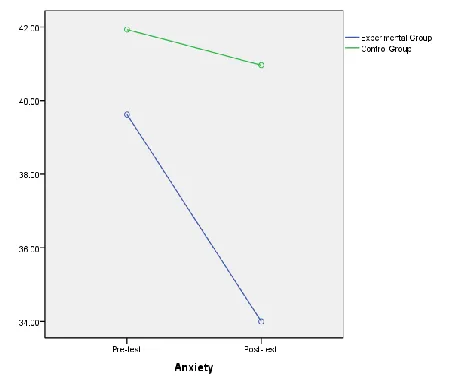
which might not seem disastrous until compared with the control group, which was around 42.00, anxiety mean. However the anxiety level in the experimental group began declining sharply from pre-test to post-test and reached 34.00. The control group means also decreased slowly to 41.00, from pre-test to post-test. The major conclusion is that, anxiety level in the experimental group significantly decreased from pre-test to post-test, while in the control group it actually reduced, but without any significant difference. On the other hand, there is a significant difference between the two groups of female students (experimental and control) in terms of anxiety.
Fig.1: General linear model of anxiety in pre and post-test for experimental and control group
Discussion
The present study aims to show the positive effect of a swimming course on anxiety among female university students. According to Ziara [36] the fear of drowning is one of the main causes of anxiety while learning swimming. Researches show that identification of stimuli that occur while swimming makes it more difficult to recognize the actual cause of anxiety, especially since the issue is more complicated. The negative emotions, including anxiety, delay the process of learning how to swim [35]. Thus the students can accordingly overcome and reduce their anxiety,
when they learn how to swim; they even specify that learning how to swim is an activity that reduces anxiety. Similar results can be found in the studies of Sawane and Gupta [37] and Bahrke and Morgan [38].
The results gained from the control and experimental groups, indicated that their anxiety levels showed the same characteristics at the beginning of the research. The mean of the anxiety scores of control group decreased from 1.99 to 1.95, while that of the experimental group decreased from 1.90 to 1.50. The idea that swimming had a positive effect on the experimental group was supported by this result. It also supported the presumption that continuous anxiety reduction results from a planned physical exercise. The results showed that there was a significant decrease in anxiety level among the intervention respondents after the training program. The control group didn‟t show much significant changes.
Majzub and Muhammad [39], found that generally poor mental health could impede
performance and self-esteem. Therefore,
swimming is recommended as a vital activity for individuals with poor mental health. The effectiveness of a sport program requires not only a result-oriented program but also the athletes' perception and evaluation of the effectiveness of interventions by coaches and sports psychologists. Perception of ability and success by the athletes themselves is important because this perception commits athletes to train, participate in mental health education and be continuously involved in the program despite the absence of a coach and a psychologist. The integrated principles of biomechanics, physiology, and nervous system in coordinating movement need the involvement of psychological factors [40].
Conclusions
anxiety. In addition, the beginning of the anxiety level may have had a conclusive influence on further stages of the swimming learning process among the female students.
The study of the swimming training and the level of swimming ability reveal a negative effect on anxiety. Finally, the observed learning progress in the swimming ability of female university students also reduced the average anxiety level.
In addition, a variety of psychological factors may affect the anxiety during swimming learning process. Any number of other events may have occurred during this period that influenced students‟ attitudes and cause the decrease of anxiety as well as otherpossible confounding or contaminating factors.
This study is likely to have implications for improving one important effect of swimming which is reducing anxiety. This study and supported by previous studies by Sugano and Nomura [41] found that, the state of anxiety decreased significantly after water exercise programs such as stretching, walking, jogging, muscle strengthening and relaxation in the water and swimming, compared with pre-exercise scores. Swimmers in a study of Berger and Owen [21], reported significantly less tension-anxiety, depression dejection, angerhostility, confusion -bewilderment, and more vigor-activity after exercising than before. According to Sawane and Gupta [37] endurance exercises like swimming, have reduced anxiety and therefore, systematic swimming lesson targeting all university students is vital for enhancing not only their physiological but also their psychological well-being [40].
References
1. Auweele YV (1999) Psychology for Physical Educators. European Sport Psychology Association, European Network of Sport Sciences in Higher Education: Human Kinetics.
2. Liukkonen J (2007) Psychology for physical educators: Student in focus. European Sport Psychology Association: Human Kinetics.
3. Nieman DC (2010) Exercise testing & prescription. Human Performance Lab at Appalachian State University in North Carolina.: McGraw-Hill Education.
4. Carmack CL, Moor C, Boudreaux E, Amaral-Melendez M, Brantley PJ (1999) Aerobic fitness and leisure physical activity as moderators of the stress-illness relation. Annals of Behavioral Medicine 21(3):251-257.
5. Katula JA, Blissmer BJ, Mcauley E (1999) Exercise intensity and self-efficacy effects on anxiety reduction in healthy, older adults. Journal of Behavioral Medicine 22(3):233-247.
6. Binsinger C, Laure P, Ambard MF (2006) Regular extracurricular sports practice does not prevent moderate or severe variations in self-esteem or trait anxiety in early adolescents. Journal of Sports Science and Medicine, 5:123-129.
7. Avramidou E, Avramidis S, Pollman R (2007) Competitive anxiety in lifesavers and swimmers. International Joumal of Aquatic Research (1):108-117.
8. Berger BG, Owen DR (1987) Anxiety reduction with swimming: Relationships between exercise and state, trait, and somatic anxiety. International Journal of Sport Psychology, 18(4):286-302.
9. Aşçı FH (2003) The effects of physical fitness training on trait anxiety and physical self-concept of female university students. Psychology of Sport and
10.Vredenburg K, O'Brien E, Krames L (1988) Depression in college students: Personality and experiential factors. Journal of Counseling Psychology 35(4): 419.
11.Haines ME, Norris MP, Kashy DA (1996) The effects of depressed mood on academic performance in college students. Journal of College Student Development 37(5):519-526.
12.Doris BM, Hirsch E, Sommer W, Williams A (1992) Student mental health needs: Survey results and implications for service. Journal of American College Health 41(1):3-10.
13.Akandere M, Tekin A, Vespor MÜBE, Okulu Y, Turkey AI (2002) The effect of physical exercise on anxiety. The Sport Journal 5(2).
14.Ramsden P, Moses I (1992) Associations between research and teaching in Australian higher education. Higher Education 23(3):273-295.
15.Chan A, Lee MJ, Exploring the use of podcasting to address preconceptions and alleviate pre-class anxiety amongst undergraduate information technology students. In DHR Spennemann & L. Burr (Ed.), Good Practice in Practice: Proceedings of the Student Experience Conference . Wagga Wagga, NSW, Citeseer. 2678:59-71.
16.Roiter K, Petocz P (1996) Introductory statistics courses-a new way of thinking. Journal of Statistics Education 4(2):233-243.
17.Blumenthal JA, Williams R, Needels TL, Wallace AG (1982) Psychological changes accompany aerobic exercise in healthy middle-aged adults. Psychosomatic Medicine, 44(6):529.
19.Page S, Sime W, Nordell K (1999) The effects of imagery on female college swimmers‟ perceptions of anxiety. The Sport Psychologist, 13(4): 458-469. 20.Tomas-Carus P, Gusi N, Häkkinen A, Häkkinen K,
Leal A, Ortega-Alonso A (2008) Eight months of physical training in warm water improves physical and mental health in women with fibromyalgia: a randomized controlled trial. J Rehabil Med 40(4):248-252.
21.Berger BG, Owen DR (1983) Mood alteration with swimming--swimmers really do" feel better". Psychosomatic Medicine, 45(5):425-433.
22.United States Public Health Service , NCFCDP, Health Promotion, President's Council on Physical Fitness Sports 1996. Physical activity and health: A report of the surgeon. New York: Jones & Bartlett Learning.
23.Yates T, Davies M, Gray L, Webb D, Henson J, Gill J, Sattar N, Khunti K (2010) Levels of physical activity and relationship with markers of diabetes and cardiovascular disease risk in 5474 white European and South Asian adults screened for type 2 diabetes. Preventive medicine 51(3-4):290-294. 24.Park S, Cho MJ, Cho SJ, Bae JN, Lee JY, Park JI,
Kim JY, Lee DW, Hong JP (2011) Relationship between physical activity and mental health in a nationwide sample of Korean adults. Psychosomatics 52(1):65-73.
25.Gilchrist J, Sacks JJ, Branche CM (2000) Self-reported swimming ability in US adults, 1994. Public health reports, 115(2-3):110.
26.Douglas SP, Craig CS (2006) On improving the conceptual foundations of international marketing research. Journal of International Marketing 14(1):1-22.
27.Harkness JA, Schoua-Glusberg A (1998) Questionnaires in translation. ZUMA-Nachrichten Spezial 3:87-127.
28.Spielberger, CD (1977) State Trait Anxiety Inventory for adults. 94061 (202).
29.Kabacoff RI, Segal DL, Hersen M, Van Hasselt VB (1997) Psychometric properties and diagnostic utility of the Beck Anxiety Inventory and the
State-Trait Anxiety Inventory with older adult psychiatric outpatients. Journal of Anxiety Disorders 11(1):33-47.
30.Leith LM (1994) Foundations of exercise and mental health.Toronto: Fitness Information Technology.
31.Rostad F, Long B (1996) Exercise as a coping strategy for stress: a review. International Journal of Sport Psychology 27(2):197-222.
32.Atousa GD (2009) The effect of ten weeks individual and group training on the level of depression in female students of Islamic Azad University Ahvaz branch. Procedia-Social and Behavioral Sciences 1(1):2637-2641.
33.Crossingham J, Walker N, Rouse B (2002) Swimming in Action. Melbourne: Crabtree Publishing Company.
34.Gifford C (2008) Swimming. London Evans Brothers.
35.Pallant J (2011) SPSS. Australia: Allen & Unwin. 36.Ziara W (2005) Relationships between progress in
acquisition of swimming skills and anxiety level in ten-year-old children. HUMAN: 93.
37.Sawane MV, Gupta S.S (2013) Efficacy of yoga and swimming in reducing anxiety: A comparative study. EBSCOhost 6(1):20-24.
38.Bahrke MS, Morgan WP (1978) Anxiety reduction following exercise and meditation. Cognitive therapy and research, 2(4):323-333.
39.Majzub R, Muhammad TA (2010) Goal orientation, attention styles and anxiety of junior golfers in Malaysia. Procedia-Social and Behavioral Sciences 9:583-588.
40.Muhamad B, Arifin T, Sattar H, Abadi FH, Haron Z (2013) The effect of swimming abilityon the anxiety levels of female college students. Asian Social Science 9(15).