ESCos, ESPs & Small Business:
A Model for Efficiency
Jon Wellinghoff, EESI
John L. King III, Aspen Systems Corporation Mark Bailey, DOE Rebuild America Jerry Lawson, EPA ENERGY STAR Small Business
ABSTRACT
This paper describes concepts for the implementation of energy efficiency upgrades in existing small businesses. One concept described is an e-commerce based model involving a new collaboration of participants. Those participants would include a private, independent energy services company (ESCo), a competitive provider of electricity or energy service provider (ESP), the U. S. Environmental Protection Agency’s (EPA) ENERGY STAR Small
Business Program, and the U. S. Department of Energy’s (DOE) Rebuild America Program. This concept is a variant of an earlier concept developed by Aspen Systems Corporation of Rockville, Maryland, which they call OPUSSM, and which they have also piloted under the name of the Wraparoundsm program for small business owners.
It is the hypothesis of this paper that a Small Business Energy Efficiency Implementation Model (SBEESM) described here, like OPUSSM, can deliver energy efficient system upgrades to a large share of the nation’s 5.7 million existing small business facilities profitably and effectively. Such a program would in turn assist EPA and DOE in furthering the national goal of carbon emission reduction while improving the profitability of the nation’s small business sector.
This paper is not intended as an endorsement of either the SBEESM or OPUSSM model by either the EPA or the DOE, but reflects the interest of those entities in cooperating with the private sector in developing any effective tool for the delivery of energy efficiency services.
Background
The EPA ENERGY STAR program defines small businesses as any business with total
facilities of 100,000 square feet or less. This commercial segment of our economy is comprised of professional offices (doctors, dentists, lawyers, and accountants), service industry (restaurants, hair salons, insurance, real estate), small retailers, and small manufacturing and warehouse industry. The nation’s 5.7 million small business facilities account for more energy consumption than all large commercial and industrial facilities combined. (E-Source, 1999). As a percentage of the economic sector, small businesses employ 52% of the private workforce and provide 51% of the private sector output (SBA, 1999).
Despite a prominent place in this country’s economy, both in terms of sheer numbers as well as in the sense that small businesses can truly be described as being the cradle of innovation in the US economy, the small business sector has been all but ignored by the
energy services industry. This is evident from a review of the client base of the largest ESCos.1 Those suppliers of energy efficiency measures (EEMs) typically target institutional (schools and hospitals), governmental, and large commercial customers. The primary reasons the small business customer has little or no access to efficient energy systems are high transaction costs for providers of energy services to this market, difficulty in financing improvements for leased premises, and lack of capital and information on the part of small business owners.
A recent paper (Lee et al. 1999)focuses on this problem. The paper is based on the results of a study conducted by PG&E. In the paper, the authors found the following about this key customer segment:
1. Small nonresidential customers constitute an extensive, largely untapped market for energy efficiency services:
• Many utilities have hundreds of thousands of small nonresidential customers, and this market has been largely under-served in the past.
• Opportunities for high efficiency products occur through distinct market events, including replacement, on burnout, remodeling, and renovation, and retrofits
• Energy efficiency opportunities are dominated by possible lighting and HVAC improvements. Purchases of such equipment constitute about 5 to 10 percent of the existing stock each year. However, no complete assessment of the opportunities in this market is available.
• Many of these customers have positive attitudes toward energy efficiency and many are aware of energy-efficiency opportunities and interested in understanding their energy usage.
• A large proportion, however, have not implemented even the most common efficiency upgrades
• Dependable energy supply and services are considered essential needs.
2. Significant barriers impede small nonresidential customer efficiency upgrades: • First-cost is a significant consideration for these customers.
• These customers often don’t consider energy costs to be a significant concern; many consider energy costs to be “fixed;” and potential utility savings may be relatively small in dollar terms.
• Small nonresidential customers lack the resources to assess energy efficiency opportunities.
• These customers are often unaware of non-utility energy efficiency services providers and are skeptical of information from such providers.
• Most small nonresidential customers lease their space and they and their building owners believe that they are unlikely to capture the benefits of efficiency upgrades.
1 ESCos websites reviewed included Enron Energy Systems, Duke Energy Solutions, CMS Viron,
3. Needs of these customers vary:
• Many barriers for this overall customer group are more serious for the smallest members of the group (i.e., those with demands less than 100 kW and, especially, less than 20 kW). • Institutional customers find financing and contractor selection to be large barriers.
• Single-site “mom and pop” customers have more limited resources to consider energy efficiency than customer who are part of a chain or franchise.
• Customers may be more or less likely to consider energy efficiency depending on the reason they are purchasing new equipment (e.g., emergency replacements versus planned renovation).
The research also made some further findings regarding trade allies and utilities, and made some recommendations relative to future program offerings. In summary the additional findings relative to trade allies were:
1. Trade allies play a crucial role in the small/medium market: Contractors most often maintain customers’ equipment, and thus have leverage in recommending equipment. Contractors believe they can make the case for efficiency equipment if armed with effective information and their message is reinforced by a trusted third party.
2. There are substantial differences across trade allies: Contractors typically specialize. There are few if any “energy efficiency contractors”. Their awareness of utility programs is limited. ESCOs and similar groups primarily focus on large customers. In some end use markets, like HVAC, distributors and dealers can be instrumental in changing the market. 3. Providing energy-efficiency services to small nonresidential customers is a challenge for
providers: Sales are difficult. Marketing costs are high. The skills needed are at variance with their typical business culture.
The findings related to utilities were, in summary:
1. Utilities face special challenges as their role changes: Program funding levels are reduced. Customers traditionally have come to expect coordinated and linked energy efficiency services from the utility. Dramatic changing roles of utilities has disrupted customer expectations. Startup delays, funding uncertainties, etc., have made it difficult for utilities to continue to implement these programs.
2. The small nonresidential market has special needs: Taken as a whole, it is a “mass market”, yet few attempts have been made to apply mass-marketing techniques. While information on the characteristics of these customers exists, it is historically underutilized in formulating tailored program strategies. Reaching and serving these customers is costly.
Finally, the study made four key recommendations relative to the configuration of a program offerings to deliver energy efficiency to the small/medium nonresidential market. These are:
1. Develop and convey a Simple, Mass Market Message (with appropriate targeting) • Consider establishing a single, statewide “brand name” for a range of programs. • Implement an integrated mass marketing strategy.
• Identify and characterize key market segments and conduct targeted marketing. 2. Minimize the Hassle:
• Programs must significantly reduce participants’ net hassle and transaction costs. • Consider consolidating the offerings.
• Simplify and clarify the M&V requirements.
3. Improve Efforts to Help Customers Move from Intent to Action
• Approaches should be tailored to the type of event that can lead to an efficiency upgrade. • The audit process should be leveraged to more lead to efficiency improvements and aid
end users in finding and selecting trade allies.
• Consider the use of third party product labeling and provider certification. 4. Establish Clear, High-Level Goals and Policies.
• Assess the small nonresidential market to determine how its unique characteristics affect the feasibility of and best approaches for transforming the market.
• Establish strategic goals and tactical objectives along with a realistic time horizon • Provide increased program certainty.
The OPUS
SMModel
Aspen Systems Corporation’s staff had arrived at many of the same conclusions earlier, and Aspen has, beginning in 1996, configured and launched a service offering, called OPUSSM
which was specifically designed to overcome the market barriers as Aspen knew them. It turns out that the design of OPUSSM
is ideally matched against the issues raised by and the recommendations made in the above referenced paper.
The following is a brief description of OPUSSM
: • The essence of the OPUSSM
program is to provide a third party “owner’s representative” for the small business customer. Under the OPUSSM service, an OPUSSM representative works with the customer to provide the initial audit, measure identification, financial analysis, including utilization of available utility programs, presentation of audit recommendations to customer, selection of measures to implement, drafting of bid documents, issuance of bid requests, selection of contractor, negotiation of contract, supervision of construction, and commissioning. In short, the OPUSSM representative becomes the energy efficiency representative for the customer, and serves to navigate the technically, contractually and financially challenging course between intention and action. • In addition to creating an owner’s representative function, the OPUSSM program also features trade ally alignment. It enrolls a set of contractors (any qualified contractors desiring to participate may do so), who enroll as OPUSSM
suppliers, and who agree to work in the structured bid, contract, performance, payment, dispute resolution, and commissioning processes which OPUSSM features. The concept is to standardize all the business interactions with the participating contractors, to minimize the contractors’
transaction costs for the business, and to minimize the owners’ agent time needed to fully execute and manage the project.
• Finally, OPUSSM
features financial institution alignment. It enrolls a set of lenders to become OPUSSM
lenders, who are trained and oriented regarding the self-funding nature of loans for energy efficient equipment (the equipment generates positive cash flow for the borrower, in amounts sufficient to ensure the loan is serviced). These lenders agree to expedited loan application processes, for projects packaged by the OPUSSM
representatives.
Thus, the OPUSSM program is designed to exactly address the major market barriers noted in the PG&E paper. It is important to note that most of the components of OPUSSM
are not new. What is new is the OPUSSM
representative concept, and the combination of all the parts into an integrated service offering.
The Aspen OPUSsm program is predicated upon the belief that a well designed and managed energy efficiency upgrade in a small business setting will provide sufficient energy cost savings to amortize all of the costs of the upgrade. These costs include the initial energy survey, the installation costs, billing and financing costs, and the costs of managing the entire process. The term of the loan is as long as necessary to ensure that the owner’s cash flow is always positive.
A key objective of the OPUSsm program is to stimulate private entities in the marketplace to recognize that a profitable business opportunity exists for delivering efficient energy systems to small businesses, and encourage them to assume the responsibilities and risks associated with this business model. The ESCo, as described below, is an alternative vehicle for delivering the model via an owner’s representative to the small business community. As for furthering the goals of EPA and DOE, the SBEEsm Implementation Model described in this paper will provide a viable means for transforming the marketplace and tapping the immense potential for carbon reduction and urban renewal that is available through the upgrading of small business facilities.
A pilot demonstration of the OPUSSM model was conducted in North Carolina in 1999 under the name of WraparoundSM in cooperation with EPA’s ENERGY STAR Small Business Program and DOE’s Rebuild America Program, using a local community services agency as a stand-in for private sector third party owner’s representatives. Shortly after the pilot started, Hurricane Floyd inflicted severe damage upon many businesses in the pilot area and halted further implementation. However, Aspen is under contract to Silicon Valley Power to launch an OPUSSM service in the City of Santa Clara, California in the summer of 2000, and is negotiating with PG&E for a similar project in the Oakland/East Bay area.
The current Aspen model centers on third party entities who can profitably act as the small business customer’s representative. Currently, the OPUSSM model does not explicitly include Energy Service Companies (ESCos) or Energy Service Providers (ESP’s) as integral components of the model.
It is proposed that the services of the ESCo and ESP industries could be effectively utilized in a parallel model to the one being currently advocated by Aspen to provide an alternative path for achieving the goal of delivering energy efficient systems to this nation’s existing small businesses.
The ESCo Role
An ESCo, or Energy Services Company, is a business that develops, installs, and finances projects designed to improve the energy efficiency and reduce energy and maintenance costs for facilities. A key element of most ESCo projects is the ability to finance the cost of the project from the energy savings generated by the energy efficiency measures (EEMs) installed over a seven to ten year time period. In structuring projects with this financing model, the existing building owner maintains a positive cash flow, and requires little up front capital to upgrade energy consuming systems in their facility. This financing method is generally referred to as "performance contracting". The ESCo finances the procurement and installation of the EEMs based on ability of the EEMs to support an estimated level of energy savings which produce a payment stream to payoff the loan. The ESCo often guarantees the "performance" level of the EEMs, assuming the risk for non-performance.
ESCos generally act as project developers for a wide range of tasks where they assume the technical and performance risk associated with the project. Typically, they offer the following services:
• Develop, design, and finance energy efficiency projects • Install and maintain the energy efficient equipment involved • Measure, monitor, and verify the project’s energy savings
• Assume the risk that the project will save the amount of energy estimated to be saved from installing the EEMs
These services are bundled into the project’s cost and are repaid through the dollar savings generated.
ESCo projects are comprehensive, which means that the ESCo employs a wide array of cost-effective measures to achieve energy savings. These measures often include: high efficiency lighting, high efficiency heating and air conditioning, efficient motors and variable speed drives, and centralized energy management systems.
What sets ESCos apart from other firms that offer energy efficiency services, like consulting firms and equipment contractors, is the concept of performance-based contracting. When an ESCo undertakes a project, the company’s compensation, and often the project’s financing, are directly linked to the amount of energy that is actually saved.
Typically, the comprehensive energy efficiency retrofits inherent in ESCo projects require a large initial capital investment and offer a relatively long payback period. The customer’s debt payments are tied to the energy savings offered under the project so that the customer pays for the capital improvement with the money that comes out of the difference between pre-installation and post-installation energy use and other costs. For this reason, ESCos have led the effort to verify, rather than estimate, energy savings.
Most performance-based energy efficiency projects include the maintenance of all or some portion of the new equipment over the life of the contract. The cost of this ongoing maintenance is folded into the overall cost of the project. Therefore, during the life of the contract, the customer receives the benefit of reduced maintenance costs, in addition to reduced energy costs.
Traditionally, ESCos have not focused on serving the needs of small business customers unless that customer facility is part of a national or regional chain of facilities. ESCos possess sufficient resources to serve the small business market, but higher transaction cost and lower profit margins result in ESCos avoiding this market sector almost entirely. This assumption has been validated by experience in Colorado. There a “green energy” pilot program identified small businesses that were ready to proceed with energy efficiency upgrades utilizing a performance contract (i.e. pay for the installations from the utility bill savings), but no ESCos were willing to step forward to service those customers (Blank, 2000).
The challenge then becomes to design a program with low enough transaction costs and a high enough profit margin that it becomes economically attractive for the ESCo community to serve the unaffiliated small business customer. The key to a cost effective program design is the implementation of an e-commerce based delivery of energy efficiency services in a flexible and seamless manner. Just-in-time coordination of all aspects of the traditional ESCo business process will be required. Such coordination will depend upon using Internet based tools for the efficient delivery of the ESCo’s services to the target small business audience.
Other forces are in play that will have an impact on how ESCos conduct their business and what market sectors they serve. In the era of electric industry restructuring, it will be necessary for ESCos to reach beyond their historical client boundaries and discover new and inventive ways to keep a competitive edge. Challenges exist on how to provide energy services to new markets while forming strategic partnerships to achieve common goals.
In this context, a new model is proposed which would evolve from the traditional ESCo business line to meet the energy services needs of the unaffiliated small business customer.
The SBEE
SMModel
The key functional distinction between the SBEEsm model and OPUSsm is that SBEESM envisions an ESCo as the Owner Representative instead of a third party. This important distinction has the potential to reduce transaction costs, and increase penetration rates to certain classes of customers due to a more integrated seamless interface between the small business customer and a single service provider, the ESCo.
The model is made even more coherent with the inclusion of a competitive energy service provider or ESP for the financing of the energy efficiency upgrades. This feature replaces the traditional financial institution envisioned by the OPUSsm model, such as a bank, and provides financing instead through a procurement contract for the provision of electric service. The ESCo would associate (but not be affiliated) with a competitive ESP for this service.
ESPs are creatures of the rapidly moving electric deregulation landscape. They are either new entities or spin-offs of the traditional utility industry created to provide competitive electric energy services. These companies sell electrical energy competitively in those states where electric deregulation has been instituted. They bill for the electric energy provided to their customers. Some of these are also eagerly seeking new services to bundle
with the sale of electricity to integrate on the customer bill as a consolidated service offering. Given this relationship, they may provide an attractive vehicle for the financing and billing services necessary to deliver energy efficiency measures to small business. Most of the independent ESP’s do not have ESCo subsidiaries, but could benefit from the cross marketing possible with an ESCo sales team marketing on their behalf.
Under the model proposed here, an ESCo would team with an ESP to offer a small business customer energy efficiency upgrades that would be bundled with an energy services contract to provide electricity (three to five year maximum). The ESCo would act as the ESP’s marketing agent and the ESP would act as the ESCo’s billing agent.
The success of the ESP/ESCo relationship and thus the SBEEsm model itself depends on the development of the Internet based program infrastructure alluded to above. Fortunately, the ESP’s are generally attuned to conducting business via e-commerce. Some ESP’s such as Utility.com conduct business exclusively over the Internet. The ESCo partner will then need to ensure that it has the ability to establish an e-commerce driven program engine to develop the efficiencies necessary to make delivery of energy efficiency to small business profitable. The key to success of the model is for the ESCo to develop a standard marketing, procurement, installation, and financing program all integrated via internet technologies so that transaction costs can be minimized.
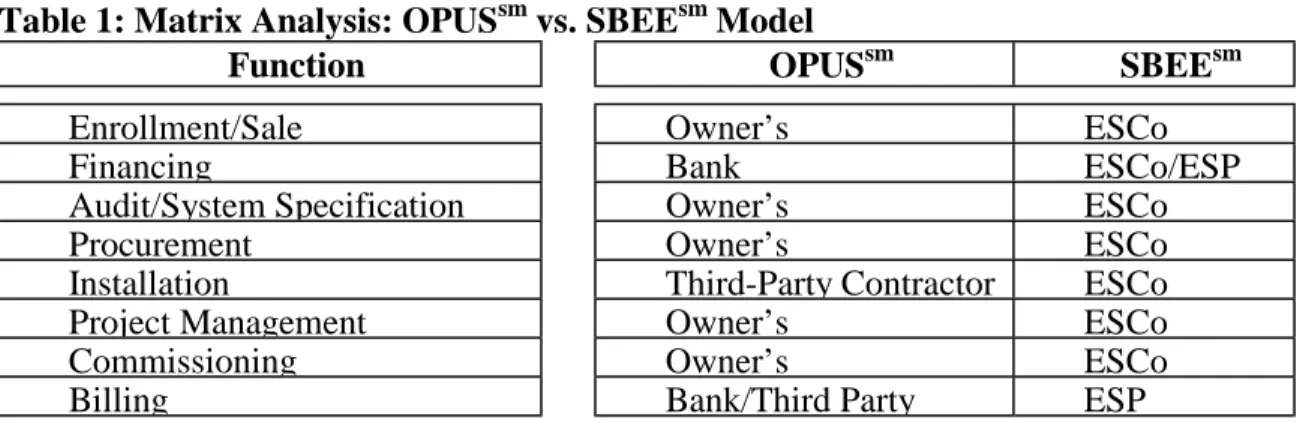
A matrix of the comparative features of the SBEEsm and OPUSsm models is depicted below.
Table 1: Matrix Analysis: OPUSsm vs. SBEEsm Model
Function OPUSsm SBEEsm
Enrollment/Sale Owner’s ESCo
Financing Bank ESCo/ESP
Audit/System Specification Owner’s ESCo
Procurement Owner’s ESCo
Installation Third-Party Contractor ESCo
Project Management Owner’s ESCo
Commissioning Owner’s ESCo
Billing Bank/Third Party ESP
The differences highlighted by the above matrix demonstrate two parallel models of a program with consistent objectives. The SBEEsm model is offered as a complement to the Aspen OPUSsm model for the purpose of providing EPA and DOE with diverse tools to achieve the same basic objective: maximizing participation by the nation’s small businesses in upgrading the efficiency of their energy consuming systems.
The SBEEsm model is designed to take advantage of two key parameters in the energy systems marketplace. The first factor is the existence of a fully developed energy service industry made up of energy service companies, or ESCos. These companies can provide the full range of services that the Owner’s Representative is intended to provide under the OPUSsm model.
As discussed above, these entities, although competently staffed to provide the full range of Owner’s Representative services for the SBEEsm program, typically do not service the need of small business customers (facilities <100,000 square feet) unless that customer
facility is part of a national or regional chain of facilities. Thus, the talent to provide Owner’s Representative services is present, but the willingness among ESCos to serve the small business market is not. The premise is that a vast pool of qualified “Owner’s Representatives” to participate in the SBEEsm program exists but is not currently being utilized. The challenge is to design a program attractive enough to entice this group to participate.
The second unique facet of the SBEEsm model takes advantage of the dynamic competitive transformation of the electric energy industry today. More and more states are moving to deregulate their electric industry. This practice provides customers, including the target market of small business customers, with the opportunity to choose their electric service providers. This choice includes not only choosing electricity, but also the choice of a metering and billing service.
The SBEEsm model contemplates an alliance between the ESCo that markets the program and a competitive energy services provider (ESP) that will provide electric energy services—the electricity, billing, and metering—to the small business SBEEsm participant at a competitive rate.
The primary purpose of forming an alliance between the ESCo and the ESP is to provide a secured financial instrument in which the acquisition and installation of EEMs can be funded by the small business owner transparently on the electric bill. This eliminates the need for a separate contract, separately secured, that requires a periodic payment by the SBEEsm participant in addition to the electric bill. There is no bank loan to pay; only an electric bill.
This billing for energy efficiency upgrades on the electric bill facilitates the transaction for the small business owner, and reduces participant paperwork—both initial and periodic. To the extent that participant disturbance can be reduced (the “hassle factor”), total program participation can be increased.
There are multiple benefits with the ESP/ESCo affiliation. The ESP has an incentive to form a liaison with the ESCo and provide billing services. As competitive energy services begin to be offered in various states, new companies will require marketing resources to sign new customers. The ESCo marketing the SBEEsm program to small businesses would act as the marketing agent for the ESP. This effort by the ESCo on the ESP’s behalf would lower the ESP’s marketing costs to reach that target market sector—the small business customer. Thus the SBEEsm model creates a relationship—the ESCo/ESP affiliation—where both parties benefit. The small business owner has fewer hassles, encouraging program participation. The ESCo has a vehicle to lower transaction costs and provide for financially secure billing of services provided. And the ESP has a means to augment its marketing resources to a desirable customer class.
Regardless of the model utilized, independence and customer interest must be maintained and conflicts of interest must be avoided for the program to achieve its goals. Thus the ESCo should not also manufacture a particular energy efficiency product. Further, the ESCo should have no direct financial interest in providing the electric energy services. The ESCO's primary objective must be to provide the small business owner with comprehensive, cost effective, energy efficiency upgrades. The ESCo must not be in the business of “pushing” particular product or a service other than the energy efficiency upgrades. Thus it is important that the ESCo be independent of the ESP, and only associated
for purposes of facilitating the financing and billing of energy efficiency upgrades for the customer.
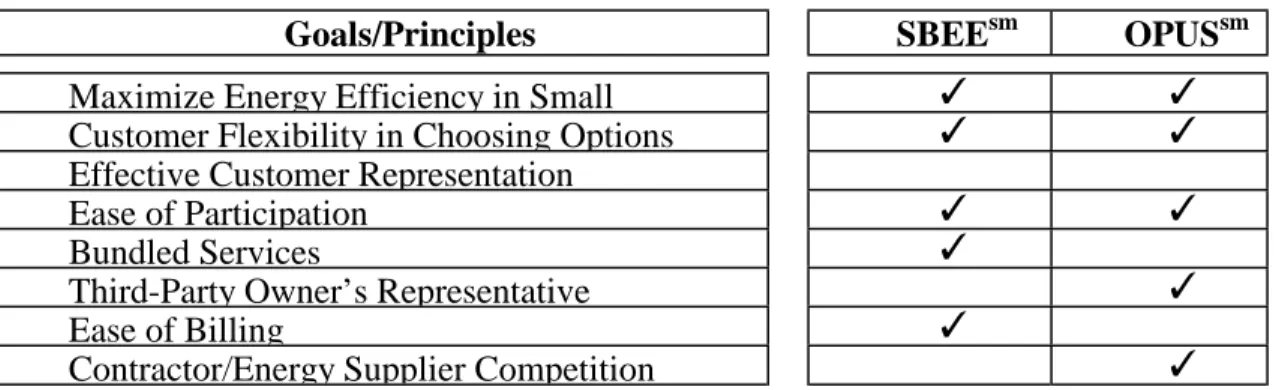
The SBEEsm model provides numerous benefits to target customers—the small business owner—while preserving the guiding principles of the original Aspen OPUSsm program. A checklist of the comparative facets of the two models is as follows:
Table 2: Checklist of Program Principles
Goals/Principles SBEEsm OPUSsm
Maximize Energy Efficiency in Small ✓ ✓
Customer Flexibility in Choosing Options ✓ ✓ Effective Customer Representation
Ease of Participation ✓ ✓
Bundled Services ✓
Third-Party Owner’s Representative ✓
Ease of Billing ✓
Contractor/Energy Supplier Competition ✓
Conclusion
As detailed above, there has been a longstanding gap between the need for a viable suite of energy efficiency upgrade services for small business customers and the successful delivery of such services. Although the barriers described in the Lee,et al paper continue to exist, the fact that Aspen Systems Corporation has launched its OPUSSM program, and now a parallel model (SBEESM) using ESCos and ESPs is being proposed, it is clear that the market is commanding a response.
While similar, each of these two models can serve a somewhat different niche within the small business customer market. As depicted in Table 2 above, customers who value hassle minimization, bundled services, and ease of billing will be attracted more to the SBEESM model. On the other hand, the OPUSSM model offers potential small business customers a third-party representative that may provide more independence, flexibility, and competitive pricing than the services offered under the SBEESM model.
While the OPUSSM model is currently more fully developed and is beginning to penetrate the market, the SBEESM variant, once developed, has the potential to serve a somewhat different niche, and to leverage the pre-existing infrastructure of the ESCo industry. Taken together, these two models have the potential to offer choices to overcome the longstanding market barriers to energy efficient upgrades in small facilities.
References
Small Business Administration (SBA), 1999 Profile. Washington, D.C.: Small Business Administration.
E-Source. 1999. The Forgotten Majority: Small Business, Hidden Opportunities. Boulder, Colorado: E-Source Corporation.
Lee, Allen, M. Rufo, T. Board, M. O’Drain. 1999. “Challenges of Upgrading the Energy Efficiency of Small Nonresidential Customers”, Proceedings, 10th Energy Services Conference, Tucson, AZ, December 6-10, 1999, pp. 333-344