Report on the Implementation of the
Performance Management and
Development System for Senior Managers
in the Free-State Province
Public Service Commission
June 2012
FOREWORD
Section 195 of the Constitution of the Republic of South Africa, Act 108 of 1996 states, amongst others, that “good human resource management and career-development practices, to maximize human potential, must be cultivated”. Thus the Public Service Commission (PSC) initiated a series of evaluations to assess the implementation of the Performance Management and Development System (PMDS) for the Senior Management Service (SMS) in various provincial administrations. This assessment began in the Eastern Cape in the 2005/6 financial year, followed by North West, the Northern Cape, Limpopo, the Western Cape, and this, the sixth in a series of provincial administration evaluations, assesses the Free-State.
The findings of the previous assessments showed various levels of non-compliance with the PMDS permeating across the provinces. This non-compliance could have serious implications in the non-achievement of the organisation’s objectives, thus leading to compromised service delivery.
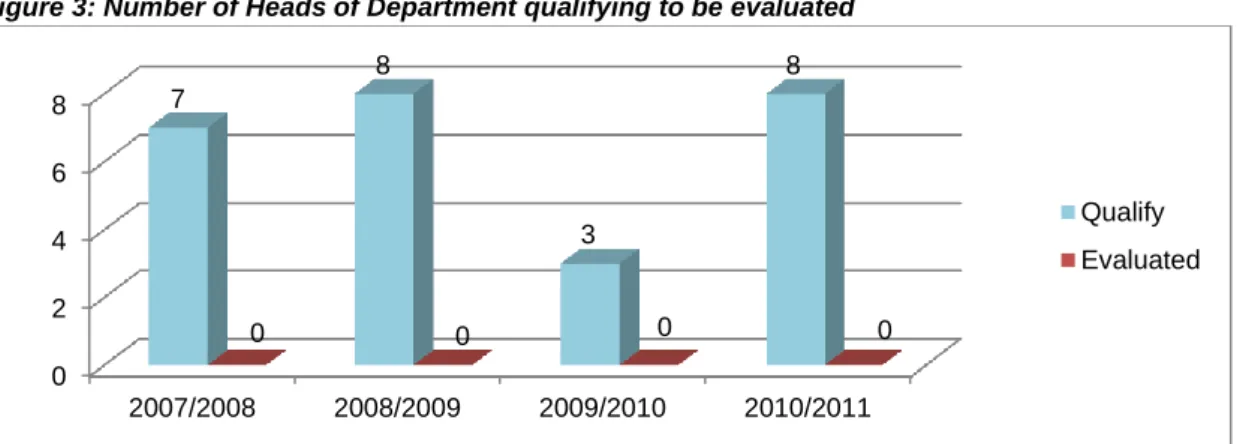
This assessment of the implementation of the PMDS in the Free-State Provincial Administration proved to be no different to what had been established in previous studies. In fact, the compliance rate with filing of Performance Agreements of Heads of Department1 was the lowest by the due date of 30 June 2011, representing only 8%, which led to an oversight visit by the Portfolio Committee on Public Service and Administration to the Free State in September 2011. Furthermore, the evaluation of Heads of Department have merely not taken place during the past two financial years (2008/9 and 2009/10). It must be noted, however, that the Director-General in the Free State Province has made a commitment to address the high levels of non-compliance and has in this regard, approached the Department of Public Service and Administration as well as the PSC to conduct relevant workshops with the SMS in respect of the PMDS. This report is therefore a critical vehicle for further dialogue in ensuring that the Free State Provincial Administration becomes compliant.
I trust that you find the findings and recommendations in this report insightful and useful in ensuring the PMDS is used as a management tool to improve public sector performance.
MR B MTHEMBU CHAIRPERSON
PUBLIC SERVICE COMMISSION
1
Public Service Commission. Technical Brief on the filing of Performance Agreements for Heads of Department for the 2011/12 financial year. August 2011.
TABLE OF CONTENTS
EXECUTIVE SUMMARY... v
CHAPTER ONE: INTRODUCTION ... 1
1.1 BACKGROUND ... 2
1.2 MANDATE OF THE PUBLIC SERVICE COMMISSION ... 2
1.3 OBJECTIVES OF THE STUDY ... 3
1.4 SCOPE OF THE STUDY ... 3
1.5 METHODOLOGY ... 3
1.6 LIMITATIONS OF THE STUDY ... 4
1.7 STRUCTURE OF THE REPORT ... 4
CHAPTER TWO: REGULATORY FRAMEWORK ... 5
2.1 INTRODUCTION ... 6
2.2 KEY PROVISIONS RELATING TO THE PMDS... 6
CHAPTER THREE: QUANTITATIVE FINDINGS AND ANALYSIS ... 9
3.1 INTRODUCTION ... 10
3.2 RESPONSE RATE OF DEPARTMENTS ... 10
3.3 PERFORMANCE AGREEMENTS SUBMITTED FOR ANALYSIS ... 10
3.4 ANALYSIS OF THE COMPLIANCE OF PAs WITH THE PMDS REQUIREMENTS ... 11
CHAPTER FOUR: QUALITATIVE FINDINGS AND ANALYSIS ... 16
4.1 INTRODUCTION ... 17
4.2 QUALITATIVE ANALYSIS OF RESPONSES BY SMS MEMBERS AND HR REPRESENTATIVES ... 17
CHAPTER FIVE: IMPLEMENTATION OF THE PMDS AMONGST HEADS OF DEPARTMENT (HoDs) ... 21
5.1 INTRODUCTION ... 22
5.2 MANAGEMENT AND FILING OF PAS OF HODS ... 22
5.3 THE EVALUATION OF HEADS OF DEPARTMENT ... 23
CHAPTER SIX: RECOMMENDATIONS AND CONCLUSION ... 27
6.1 INTRODUCTION ... 28
6.2 RECOMMENDATIONS ... 28
6.3 CONCLUSION ... 29
LIST OF TABLES Table 1: Number of SMS members per department ... 3
Table 2: Legislative requirements governing the Performance Management System of SMS members in the Public Service ... 6
Table 3: Questionnaires received from SMS members and HR representatives ... 10
Table 4: Performance Agreements submitted for analysis ... 11
LIST OF FIGURES
Figure 1: Percentages of PAs signed after 31 May per department ... 13 Figure 2: PAs submitted to the PSC ... 23 Figure 3: Number of Heads of Department qualifying to be evaluated ... 24
LIST OF ACRONYMS
BPP Batho Pele Principles
CMCs Core Management Criteria
COGTA Department of Cooperative Governance & Traditional Affairs DARD Department of Agriculture & Rural Development
DEDTEA Department of Economic Development, Tourism & Environmental Affairs
DHS Department of Human Settlements
DOE Department of Education
DOH Department of Health
DOP Department of the Premier
DPRT Department of Police, Roads & Transport
DPT Department of Provincial Treasury
DPW Department of Public Works
DSACR Department of Sport, Arts, Culture & Recreation
DSD Department of Social Development
EA Executing Authority
HR Human Resource
KPA Key Performance Area
KRA Key Result Area
M&E Monitoring and Evaluation
PA Performance Agreement
PMDS Performance Management Development System
PSC Public Service Commission
EXECUTIVE SUMMARY
1. INTRODUCTION
In 2002, the Department of Public Service and Administration (DPSA) introduced the Performance Management and Development System (PMDS) for the Senior Management Service (SMS) as an accountability framework necessary for planning performance, tracking progress of performance and reporting on performance outcomes. If properly implemented, the PMDS provides the means to promote accountability in helping to clarify roles and responsibilities, performance expectations and in addressing developmental needs, if so determined.
Given the above, the Public Service Commission (PSC) has been assessing the implementation of this important policy instrument in national and provincial departments and has conducted a similar study in five other provinces, where it was generally determined that departments had difficulty in complying with the basic provisions of the PMDS. Given the low levels of compliance in the Free State with annual filing of Performance Agreements (PAs) as well as observations that Heads of Department were not being evaluated in terms of the HoD Evaluation guidelines, it was decided to extend this study to the Free State Provincial Administration.
2. OBJECTIVES
The PSC, through the study aimed to assess:
compliance by SMS members with regards to the timeous completion and signing of their PAs, as determined by the regulatory framework;
the alignment of staff development plans to broad departmental strategic and operational plans;
the implementation and management of PAs within the context of the PMDS;
trends and challenges in the implementation of the PMDS by departments; and
best practices on the implementation of the PMDS for benchmarking.
3. METHODOLOGY
The study comprised all SMS members from all 12 departments in the Free State Provincial Administration. Three sets of questionnaires were utilized, namely one for HoDs; one for all SMS members, and one for Human Resource (HR) practitioners. The questionnaires sought to establish the participants’ level of understanding of the regulatory framework as well as their views on the value add of the PMDS in delivering enhanced services.
The PAs of members of the SMS were assessed to determine the level of compliance with the PMDS framework and well as alignment to the departmental strategic and operational plans.
4. LIMITATIONS
The following limitations were experienced during the study:
Despite numerous follow-ups, the required number of questionnaires was not received from all departments. Only the HoD from Education submitted the questionnaire distributed to HoDs.
Questionnaires had been partially completed in some cases which impacts on analysis.
Not all PAs of SMS members were submitted for analysis.
The Department of Public Works did not respond to the HR questionnaire.
5. FINDINGS
5.1 RESPONSE RATE BY DEPARTMENTS
A total of three hundred and fifteen (315) questionnaires were delivered to SMS members to complete for both the 2009/10 and 2010/11 financial years. Of these, only one hundred and twelve (112) were returned. This represents a response rate of 35.5%. The department of Public works failed to respond to requests for documentation.
Only one HoD, namely the Head of Department of Education, completed and returned the questionnaire for Heads of Department.
A total of eleven out of twelve departments responded to the HR questionnaire.
5.2 SIGNED PERFORMANCE AGREEMENTS SUBMITTED
The total number of SMS members in the Province was 315. Only 191 (61%) PAs for the 2009/10 financial year and only 194 (62%) PAs for the 2010/11 financial year were submitted for analysis. This could mean that some SMS members in the Province were employed without having concluded PAs for both financial years.
5.3 OVERVIEW OF AREAS OF COMPLIANCE OF PAs WITH THE PMDS
REQUIREMENTS
The following areas of non-compliance were found to be common in the PAs submitted for analysis:
5.3.1 Non-reflection of applicable Batho Pele Principles (BPPs) against Key Result Areas (KRAs) and Core Management Criteria (CMCs)
Seventy-five percent (75%) of the analysed PAs did not reflect the applicable Batho Pele Principles against the KRAs, whilst sixty-six percent (66%) did not reflect the applicable BPPs against the CMCs, as required. The implications of omitting BPPs are that SMS members may not be sensitive to client needs or may lack the required client focus.
5.3.2 Inclusion of Personal Development Plans (PDPs)
Twenty-three percent (23%) of the PAs analysed did not include PDPs. The PA template makes specific provision for inclusion of a personal development plan (PDP) for each SMS member. The purpose of the PDP is to ensure that the necessary interventions are made to improve productivity and to address an identified developmental gap in a purposeful plan with set timeframes. Addressing developmental gaps should have a positive impact on both the individual SMS member’s performance as well as performance of the organisation.
5.3.3 Timeous conclusion of Performance Agreements (PAs)
The Directive regarding paragraph 8.1 of Chapter 4 of the SMS Handbook on the PMDS for SMS members was amended as of 1 April 2009 to allow all senior managers to enter into PAs within the first two months of a new financial cycle, that is, by no later than 31 May of each financial year. A newly appointed SMS member is still required to enter into and sign the PA within three months of appointment. 72% of the senior managers in the Free State failed to conclude and sign their PA by 31 May, effectively not having a legal performance contracts for a number of months into the relevant financial year.
5.3.4 Dispute Resolution
The PMDS makes provision for a dispute resolution mechanism in the event that a disagreement emanates from the contractual obligations of parties to the agreement. In seventeen (4%) of the three hundred and eighty five PAs of the senior managers that were analysed, mechanisms for dispute resolution did not include the identification of a mutually acceptable person or a third party to deal with possible disputes which could arise out of one or all the aspects of a PA.
5.3.5 Inclusion of dates for performance reviews
Only 6 PAs out of 385 submitted over the two financial years did not include dates for performance reviews, representing 2%. The PMDS requires regular performance reviews and an annual performance appraisal. Reviews are important feedback sessions which provide the SMS member with feedback regarding their performance.
5.3.6 Performance Agreements that did not include work plans.
Twenty eight out of three hundred and eighty five PAs that were analyzed (7%) did not include workplans. These PAs are effectively futile as there would be no basis to establish whether the individual has achieved the outputs as indicated and by the due date. A further implication is that there can be no measurement of the PA contributing towards the achievement of the departmental strategic objectives.
5.4 OVERVIEW OF RESPONSES PROVIDED THROUGH QUESTIONNAIRES 5.4.6 Implementation of the SMS PMDS and the organizational support
thereof
Seventy nine percent (79%) of the SMS members indicated that the SMS PMDS had been fully implemented. However, the analysis of the questionnaires revealed that the PMDS had never been completely operational and that performance reviews and annual appraisals were largely not taking place. Only 18 (56%) SMS respondents stated that there was a unit or a person who assisted with the development and quality assurance of the PAs and that they had indeed received assistance or guidance from the HR components in completing their PAs. Fourteen (14) of the respondents (44%), mentioned that their departments had not designated a person or established a unit to assist SMS members, consequently, no such support or guidance was provided at all. It was further indicated that the assistance provided was only rendered on request and was not organized or structured.
5.4.7 Importance of concluding Performance Agreements
The findings suggest that although 100% of sampled SMS members regard entering into PAs as important, this is actually not the practice. As indicated earlier, only 191 (61%) PAs for the 2009/10 financial year and only 194 (62%) PAs for the 2010/11 financial year were submitted for analysis.
5.4.8 Training and development
Training assists to address job-specific developmental needs and gaps as well as training interventions that are identified in the PDPs. In some departments some responses showed that the PDPs of SMS members were not given priority, hence seventy six (76) of one hundred and twelve (112) SMS members (68%) had not received any training. Twenty one (18.75%) of the 112 respondents mentioned that training and development did not materialize as indicated in their PDPs. This is in contrast to the responses by the HR representatives, as 7 out of 11 reported that there was compliance in training.
5.4.9 Views of HR representatives and SMS members on the role of
Performance Agreements
All the sampled SMS members (100%) were of the view that the PA is still relevant as a performance management tool, although it is not properly implemented in the departments.
5.4.10 The use of PAs to support management processes
Responses in this regard show that some senior managers have recognized the importance of the PA as a management and developmental tool to enhance organizational efficiency and effectiveness, improve existing practices, promote accountability and maximize the achievement of service delivery results. In these instances compliance with the regulatory directives is welcomed as a benefit that adds value to the organization’s operations and management processes.
5.4.11 Views of SMS members on the current PMDS tool
The majority of SMS members and HR representatives indicated that the current system was still relevant; however proper implementation had to take place. In this regard, appropriate training, development and orientation should be provided on how to implement the system. The PAs should be properly aligned to departmental strategic goals and objectives. Monitoring and evaluation of the system was critical to ensure adherence with the SMS Handbook. They further indicated that the PMDS system is administratively burdensome and needed to be replaced by an electronic performance management system. The quarterly performance reporting system of the National Treasury should feature strongly in the assessment of SMS members and the focus should be on verifying performance outputs. It was further suggested that the system should include a compulsory quarterly assessment element linking the performance of SMS members to the compulsory performance assessment of the department
6. RECOMMENDATIONS
The PSC recommended the following:
6.1 Departments should prioritise the provision of training on the PMDS for all Senior Management Service members and Members of the Executive in the Free State as a matter of urgency to ensure that all role-players understand the system as well as their respective roles and responsibilities.
6.2. Departments need to ensure that Performance Agreements of HoDs and SMS members are concluded and signed by no later than 31 May of each year. In the case of HoDs, Performance Agreements should be filed with the PSC by no later than 30 June of each year. Newly appointed SMS members must conclude and sign their PAs within three months of appointment.
6.3 All qualifying HoDs must be evaluated in line with the PSC guidelines which are issued to departments on an annual basis.
6.4 EAs must ensure that strategic planning processes are concluded timeously and prior to the beginning of a new financial year, to enable SMS members to timeously conclude and sign their PAs by the stipulated due date.
6.5 Once Performance Agreements have been concluded, departments should ensure that regular performance reviews are conducted (that is, half-yearly and annual performance appraisals). This will ensure that regular feedback is
provided to SMS members with adequate space provided to address identified gaps prior to the end of a cycle.
6.6 Developmental needs and requirements of SMS members as reflected in the PDPs appended to their individual PAs, must as far as possible be met. 6.7 Performance management and development processes should be driven
from the highest level in every department and the EAs should be called to account for non-compliance as directed by Section 16A of the public service Act, 1994, as amended. The Legislature should be provided with regular reports on the management of the PMDS by departments including feedback on the critical issues raised by the PSC in this report.
1.1 BACKGROUND
In 2002, the Department of Public Service and Administration (DPSA) introduced the Performance Management and Development System (PMDS) for the Senior Management Service (SMS) as an accountability framework necessary for planning performance, tracking progress of performance and reporting on performance outcomes. This compulsory accountability framework outlines the processes and provides the templates to be used by the SMS member and enables tracking of individual performance towards attainment of the overall organizational goals. It helps to clarify responsibilities, priorities and performance expectations between the SMS members and their supervisors through the signing of the Performance Agreement (PA). The PA then creates a sound basis for administrative decisions that include managing performance, recognizing and addressing good and under-performance and ensuring accountability and delivery, when done properly.
Given the PSC’s role in the evaluation of performance of Heads of Department (HoDs) as well as monitoring and reporting on the filing of PAs of HoDs, the PSC has been extensively involved in monitoring the management of performance of senior managers. As part of promoting sound administrative leadership in the Public Service, the PSC decided to conduct a series of studies on SMS compliance with the PMDS in various provinces. These studies began during the 2006/2007 financial year in the Eastern Cape2, followed by the North West3, Northern Cape4, Limpopo5 and Western Cape6 Provincial Administrations. The overall findings over the years have been unsatisfactory and have shown that departments have had difficulties in complying with the basic provisions of the PMDS. Given the low levels of compliance in the Free State with annual filing of Performance Agreements (PAs) as well as observations that Heads of Department were not being evaluated in terms of the HoD Evaluation guidelines, it was decided to extend this study to the Free State Provincial Administration during the 2010/2011 financial year.
1.2 MANDATE OF THE PUBLIC SERVICE COMMISSION
Section 196(4)(b) of the Constitution of the Republic of South Africa, 1996, read in conjunction with Sections 9 and 10 of the Public Service Commission Act, 1997, mandates the PSC to investigate, monitor and evaluate the organization, administration and personnel practices of the Public Service.
In addition, section 196(4)(f)(iv) of the Constitution mandates the PSC to, of its own accord or on receipt of a complaint, advise national and provincial organs of state regarding personnel practices in the Public Service including those relating to the recruitment, appointment, transfer, discharge and other aspects of the careers of employees in the Public Service, which includes the management of performance.
2 Republic of South Africa. Public Service Commission. Report on Senior Management Service Compliance with
Performance Agreements in the Eastern Cape Provincial Administration. May 2007
3
Republic of South Africa. Public Service Commission. Report on the Implementation of the Performance Management and Development system for senior managers in the North West Province. January 2008
4
Republic of South Africa. Public Service Commission. Report on the Implementation of the Performance Management and Development system for senior managers in the Northern Cape Province. November 2008
5 Republic of South Africa. Public Service Commission. Report on the Implementation of the Performance
Management and Development system for senior managers in the Limpopo Province. April 2010
6
Republic of South Africa. Public Service Commission. Report on the Implementation of the Performance Management and Development system for senior managers in the Western Cape Province. February 2011
1.3 OBJECTIVES OF THE STUDY
The objective of the study was to assess:
compliance by SMS members with regards to the timeous completion and signing of their PAs, as determined by the regulatory framework;
the alignment of key performance areas (KPAs) to the vision, mission and strategic plans of departments;
the alignment of staff development plans with broad departmental strategic and operational plans;
the implementation and management of PAs within the context of the PMDS;
trends and challenges in the implementation of the PMDS; and
best practices on the implementation of the PMDS for benchmarking.
1.4 SCOPE OF THE STUDY
The study was conducted in the Free State Provincial Administration during 2011 and focused on the 2010/2011 financial year.
Table 1: Number of SMS members per department
NO DEPARTMENT NUMBER OF SMS
MEMBERS
1 Education 51
2 Social Development 17
3 Agriculture and Rural Development 20
4 Police, Roads and Transport 22
5 Health 50
6 Public Works 26
7 Cooperative Governance and Traditional Affairs 26
8 Human Settlements 11
9 Premier 31
10 Sport, Arts, Culture and Recreation 20
11 Provincial Treasury 20
12 Economic Development, Tourism and Environmental Affairs 21
TOTAL 315
Table 1 above represents the number of SMS members per department as at the end of July 2011, totaling three hundred and fifteen (315). The highest number of SMS members was in the Department of Education with 51 SMS members. The Department of Human Settlements had the lowest number of SMS members at 11.
1.5 METHODOLOGY
The study was divided into the following two phases:
Phase 1: Data Gathering
A list of all senior managers in the Free State was obtained from the provincial Personnel and Salary Administration System (PERSAL) to whom questionnaires were distributed for completion.
Three different sets of questionnaires were utilized to solicit quantitative and qualitative data for analysis: one for HoDs, one for SMS members and the other for the Human Resource (HR) practitioners. Each set of questionnaires sought to measure the participants’ level of understanding of the PMDS framework, the level of compliance with the regulatory framework, and their views on the relevance of the PMDS towards enhanced service delivery.
Departments were requested to provide copies of signed performance agreements entered into for the 2010/2011 financial year which would enable the PSC to assess the extent to which these PAs complied with the PMDS framework.
Phase 2: Analysis of Data
The returned questionnaires were analysed to establish the participants’ level of understanding of the requirements of the PMDS as well as the degree of compliance from individuals. This was followed by an analysis of PAs to verify compliance with the requirements of the PMDS prescripts and alignment with strategic plans.
1.6 LIMITATIONS OF THE STUDY
The following limitations were encountered during the study:
Out of 315 SMS members only 191 PAs for 2009/10 and 194 PAs for 2010/11 were submitted to the PSC for analysis.
Not all the questions in the questionnaires were responded to. For example, HR representatives did not indicate whether or not their departments had fully implemented the PMDS for SMS members. This hampered the analysis of some of the responses.
Only one HoD questionnaire was returned for analysis to the PSC.
Only 35,5% of the SMS members in departments responded by forwarding their completed questionnaires to the PSC (despite continuous telephonic follow-up).
Eleven (11) out of the twelve (12) departments returned the HR questionnaire to the PSC for analysis. The Department of Public Works did not respond at all to the HR questionnaire.
1.7 STRUCTURE OF THE REPORT
The report is structured as follows:
Chapter 2 Reflects the requirements of the regulatory framework,
Chapter 3 Provides a quantitative analysis of the findings of the study,
Chapter 4 Provides a qualitative analysis of the findings of the study,
Chapter 5 Outlines the implementation of the PMDS amongst Heads of
Department in the Free State Provincial Administration,
CHAPTER TWO: REGULATORY
FRAMEWORK
2.1 INTRODUCTION
This chapter outlines the legal and regulatory context underpinning the PMDS and illustrates key provisions relating to the PMDS as contained in the acts of parliament, regulations, policies and resolutions.
2.2 KEY PROVISIONS RELATING TO THE PMDS
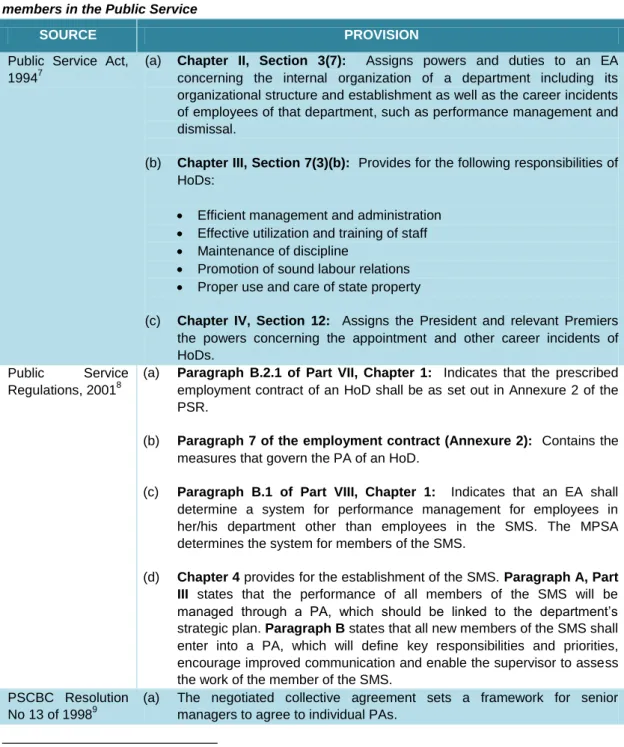
The implementation and management of the PMDS in the Public Service is guided by key legislative and policy provisions as summarized in Table 2 below.
Table 2: Legislative requirements governing the Performance Management System of SMS members in the Public Service
SOURCE PROVISION
Public Service Act, 19947
(a) Chapter II, Section 3(7): Assigns powers and duties to an EA concerning the internal organization of a department including its organizational structure and establishment as well as the career incidents of employees of that department, such as performance management and dismissal.
(b) Chapter III, Section 7(3)(b): Provides for the following responsibilities of HoDs:
Efficient management and administration Effective utilization and training of staff Maintenance of discipline
Promotion of sound labour relations Proper use and care of state property
(c) Chapter IV, Section 12: Assigns the President and relevant Premiers the powers concerning the appointment and other career incidents of HoDs.
Public Service Regulations, 20018
(a) Paragraph B.2.1 of Part VII, Chapter 1: Indicates that the prescribed employment contract of an HoD shall be as set out in Annexure 2 of the PSR.
(b) Paragraph 7 of the employment contract (Annexure 2): Contains the measures that govern the PA of an HoD.
(c) Paragraph B.1 of Part VIII, Chapter 1: Indicates that an EA shall determine a system for performance management for employees in her/his department other than employees in the SMS. The MPSA determines the system for members of the SMS.
(d) Chapter 4 provides for the establishment of the SMS. Paragraph A, Part III states that the performance of all members of the SMS will be managed through a PA, which should be linked to the department’s strategic plan. Paragraph B states that all new members of the SMS shall enter into a PA, which will define key responsibilities and priorities, encourage improved communication and enable the supervisor to assess the work of the member of the SMS.
PSCBC Resolution No 13 of 19989
(a) The negotiated collective agreement sets a framework for senior managers to agree to individual PAs.
7
Republic of South Africa. Department of Public Service and Administration. Public Service Act, 1994, as amended 8
Republic of South Africa. Department of Public Service and Administration. Public Service Regulations, 2001, issued in terms of section 41 of the Public Service Act, 1994, as amended
SOURCE PROVISION
(b) The agreement extends the signing of PAs from HoDs to all senior managers (level 13 – 16) and prescribes the following items to be included in a PA:
Key duties and responsibilities Output targets for the PA period Dates for performance reviews Dispute resolution mechanism
Date on which salary increments will come into effect and mechanisms for the management/ awarding of salary increases. Personal Development Plan
PSCBC Resolution 9 of 2000
This resolution extends Resolution 13 of 1998. It provides for the remuneration packages of senior managers/ professionals to be translated to a more transparent total cost-to-employer and an inclusive flexible remuneration package system.
Treasury
Regulations, 200110
(a) Departments must comply with the Treasury Regulations regarding strategic planning and budgeting. Part 3, Chapter 5 of the Treasury Regulations deals with strategic planning. The Guidelines provided by National Treasury state detailed and extensive outlines of what is required to effectively link departmental strategy to budgets. Departments need to budget for projected salary increases and financial rewards that may be allocated to members of the SMS based on framework determinations made by the MPSA.
(b) This chapter contains both advisory and mandatory elements. The latter has been designed so as to allow departments flexibility during the implementation process, while ensuring that there will be consistency across departments when assessing SMS members and deciding on monetary rewards.
Batho Pele White Paper, 199711
(a) Batho Pele is a deliberate strategy to instill a culture of accountability and caring by public servants. Public servants must become service orientated, strive for service excellence and commit to continuous service delivery improvement.
(b) The White Paper reflects government’s commitment to a citizen-centered approach to service delivery, anchored by the following eight Batho Pele principles: consultation service standards access courtesy information
openness and transparency redress
value for money Senior
Management Service Handbook12
Chapter 4 of the SMS Handbook deals with the process and requirements of performance management and development for members of the SMS. It is a directive by the Minister for Public Service and Administration in terms of Part III/B.3 of Chapter 4 of the Public Service Regulations, 2001.
9 Public Service Coordinating Bargaining Council’s Resolutions 13 of 1998 and 9 of 2000
10 Republic of South Africa. National Treasury. Treasury Resolutions, 2001, issued in terms of the Public Finance
Management Act, 1999
11
Republic of South Africa. Department of Public Service and Administration. White Paper on Transforming Public Service Delivery, 1997
12
The above requirements were considered and used as a basis for this study. Failure to adhere to any of the stated directives is considered non-compliance and reflected as such in this report.
CHAPTER THREE: QUANTITATIVE
FINDINGS AND ANALYSIS
3.1 INTRODUCTION
This Chapter provides quantitative findings on the assessment of the implementation of the PMDS for SMS members in the Free State. The findings are based on an analysis of the response rate of departments to questionnaires, PAs submitted for analysis and compliance with and implementation of the PMDS requirements.
3.2 RESPONSE RATE OF DEPARTMENTS
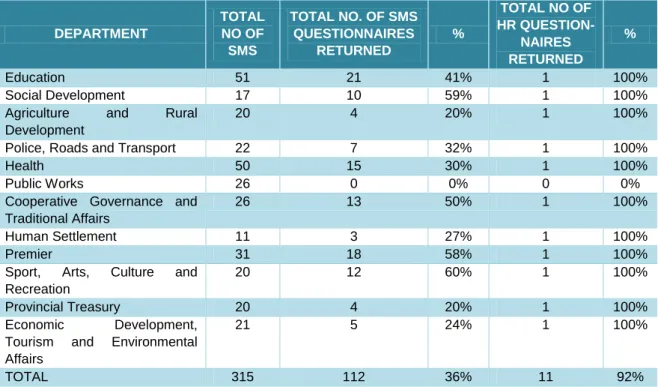
Of the 315 questionnaires distributed to SMS members, 112 were completed and returned for analysis to the PSC, representing a response rate of 35,5%. In the case of HR representatives 11 out of the 12 departments had completed and returned the questionnaires for analysis, a response rate of 82%.
Table 3: Questionnaires received from SMS members and HR representatives
DEPARTMENT TOTAL NO OF SMS TOTAL NO. OF SMS QUESTIONNAIRES RETURNED % TOTAL NO OF HR QUESTION- NAIRES RETURNED % Education 51 21 41% 1 100% Social Development 17 10 59% 1 100%
Agriculture and Rural Development
20 4 20% 1 100%
Police, Roads and Transport 22 7 32% 1 100%
Health 50 15 30% 1 100%
Public Works 26 0 0% 0 0%
Cooperative Governance and Traditional Affairs
26 13 50% 1 100%
Human Settlement 11 3 27% 1 100%
Premier 31 18 58% 1 100%
Sport, Arts, Culture and Recreation
20 12 60% 1 100%
Provincial Treasury 20 4 20% 1 100%
Economic Development, Tourism and Environmental Affairs
21 5 24% 1 100%
TOTAL 315 112 36% 11 92%
Table 3 above reflects the total number of questionnaires distributed to the SMS members and HR representatives per department relative to the actual number of questionnaires returned for analysis. The highest response rate was from the department of Sports, Arts and Culture at 60%, with no response from the Department of Public Works. Five of the twelve departments’ response rate was at 30% and lower.
3.3 PERFORMANCE AGREEMENTS SUBMITTED FOR ANALYSIS
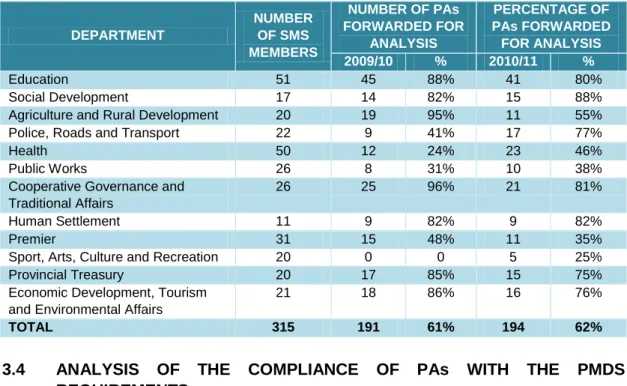
At the end of June 2011, there were 315 senior managers in the employ of the Free State provincial departments who were all requested to submit their PAs for the 2009/2010 and 2010/2011 financial years for analysis. A total of 191 PAs concluded in 2009/2010 (61%) and 194 PAs concluded during the 2010/2011 (62%) financial years were forwarded to the PSC for analysis. The Department of Sport, Arts, Culture and recreation failed to submit PAs for the 2009/2010 financial year. No reasons
were provided as to why all the requested PAs were not submitted. This could effectively mean that 38% of the senior managers employed in the FSPA had not entered into Performance Agreements for the 2010/2011 financial year. When compared to the response rate for the 2009/10 financial year, one can conclude that this is a generally accepted norm.
Table 4 below represents the number of Performance Agreements submitted for analysis against the total number of SMS members per department.
Table 4: Performance Agreements submitted for analysis
DEPARTMENT NUMBER OF SMS MEMBERS NUMBER OF PAs FORWARDED FOR ANALYSIS PERCENTAGE OF PAs FORWARDED FOR ANALYSIS 2009/10 % 2010/11 % Education 51 45 88% 41 80% Social Development 17 14 82% 15 88%
Agriculture and Rural Development 20 19 95% 11 55%
Police, Roads and Transport 22 9 41% 17 77%
Health 50 12 24% 23 46%
Public Works 26 8 31% 10 38%
Cooperative Governance and Traditional Affairs
26 25 96% 21 81%
Human Settlement 11 9 82% 9 82%
Premier 31 15 48% 11 35%
Sport, Arts, Culture and Recreation 20 0 0 5 25%
Provincial Treasury 20 17 85% 15 75%
Economic Development, Tourism and Environmental Affairs
21 18 86% 16 76%
TOTAL 315 191 61% 194 62%
3.4 ANALYSIS OF THE COMPLIANCE OF PAs WITH THE PMDS
REQUIREMENTS
This section provides an analysis of the extent of compliance amongst SMS members in concluding their Performance Agreements with the regulatory requirements.
Table 5: Compliance of SMS PAs with provisions of the PMDS requirements
Dep a rtme nt PAs tha t d id n ot ide nti fy KRA s PAs tha t d id n ot inc lu d e BP P in th e KRA s - 2 0 0 9 /1 0 PAs tha t d id n ot inc lu d e BP P in th e KRA s - 2 0 1 0 /2 0 1 1 PAs tha t d id n ot inc lu d e BP P in th e C M Cs - 2 0 0 9 /1 0 PAs tha t d id n ot inc lu d e BP P in th e C M Cs – 2 0 1 0 /1 1 PAs tha t d id n ot ide nti fy PDPs – 2 0 0 9 /2 0 1 0 PAs tha t d id n ot ide nti fy PDPs – 2 0 1 0 /2 0 1 1 PAs tha t d id n ot ide nti fy d a te s for Re v ie w s 2 0 0 9 /2 0 1 0 PAs tha t d id n ot ide nti fy d a te s for Re v ie w s -2 0 1 0 /2 0 1 1 PAs w he re M e di a tors a re no t id e nti fie d – 2 0 0 9 /2 0 1 0 PAs w he re M e di a tors a re no t id e nti fie d – 2 0 1 0 /2 0 1 1 PAs tha t d id n ot inc lu d e w ork pl a ns – 2 0 0 9 /2 0 1 0 PAs tha t d id n ot inc lu d e w ork pl a ns – 2 0 1 0 /2 0 1 1 Education 0 25 25 24 21 4 3 0 0 3 1 1 2 Social Development 0 10 13 11 12 11 10 1 1 0 0 11 9
Agriculture and Rural
Development 0 19 11 19 11 3 2 0 0 0 0 0 0
Dep a rtme nt PAs tha t d id n ot ide nti fy KRA s PAs tha t d id n ot inc lu d e BP P in th e KRA s - 2 0 0 9 /1 0 PAs tha t d id n ot inc lu d e BP P in th e KRA s - 2 0 1 0 /2 0 1 1 PAs tha t d id n ot inc lu d e BP P in th e C M Cs - 2 0 0 9 /1 0 PAs tha t d id n ot inc lu d e BP P in th e C M Cs – 2 0 1 0 /1 1 PAs tha t d id n ot ide nti fy PDPs – 2 0 0 9 /2 0 1 0 PAs tha t d id n ot ide nti fy PDPs – 2 0 1 0 /2 0 1 1 PAs tha t d id n ot ide nti fy d a te s for Re v ie w s 2 0 0 9 /2 0 1 0 PAs tha t d id n ot ide nti fy d a te s for Re v ie w s -2 0 1 0 /2 0 1 1 PAs w he re M e di a tors a re no t id e nti fie d – 2 0 0 9 /2 0 1 0 PAs w he re M e di a tors a re no t id e nti fie d – 2 0 1 0 /2 0 1 1 PAs tha t d id n ot inc lu d e w ork pl a ns – 2 0 0 9 /2 0 1 0 PAs tha t d id n ot inc lu d e w ork pl a ns – 2 0 1 0 /2 0 1 1 Transport Health 0 4 9 5 10 2 1 1 0 0 1 0 0 Public Works 0 8 11 8 11 5 4 0 0 0 0 0 0
Cooperative Gov and
Traditional Affairs 0 25 21 0 0 3 2 0 0 1 8 0 0
Human Settlement 0 9 9 1 0 1 2 0 0 0 0 0 0
Premier 0 14 11 15 11 5 4 0 1 0 0 0
Sport, Arts, Culture
and Recreation 0 N/A 0 N/A 0 N/A 2 N/A 0 N/A 0 N/A 0
Provincial Treasury 0 17 15 17 15 3 3 0 0 0 0 0
Econ Dev, Tourism and Environmental Affairs
0 3 4 3 3 2 3 0 0 1 0 2 3
TOTAL 0 141 145 110 109 41 46 5 1 6 11 14 14
PERCENTAGES 0% 74% 75% 58% 56% 21% 24% 2,6% 0,5% 3,1% 5,6% 7,3% 7,2%
3.4.1 Identification of Key Result Areas (KRAs) in PAs
In 100% of PAs scrutinized, the senior managers had included KRAs in their Performance Agreements. KRAs were devolved from the departmental strategic plans and as such signify the value-add of each SMS member towards the achievement of targets set in strategic and annual performance plans.
3.4.2 Non-reflection of applicable Batho Pele Principles (BPPs) against Key Result Areas (KRAs) and Core Management Criteria (CMCs)
The PMDS requires that applicable Batho Pele principles (BPPs) be incorporated into the KRAs and CMCs in the PA. Of the one hundred and ninety one PAs submitted for analysis for the 2009/2010 financial year, one hundred and forty one (74%) did not reflect the applicable Batho Pele Principles against the KRAs and of the one hundred and ninety four PAs submitted for analysis for 2010/11, one hundred and forty five (75%) did not reflect the applicable Batho Pele Principles against the KRAs.
Of the one hundred and ninety one PAs submitted for analysis for 2009/10, one hundred and ten (58%) did not reflect the applicable Batho Pele Principles against the CMCs and of the one hundred and ninety four PAs submitted analysis for the 2010/11 financial year, one hundred and nine (56%) did not reflect the applicable Batho Pele Principles against the CMCs. Besides being obligatory, the incorporation of the BPPs defines the manner in which the relevant services would be delivered and is meant to add value to the PA as a performance management tool.
3.4.3 Inclusion of Personal Development Plans (PDPs)
The PA template makes specific provision for inclusion of a personal development plan (PDP) for each SMS member. The purpose of the PDP is to ensure that the necessary interventions are made to improve productivity and to address an identified developmental gap in a purposeful plan with set timeframes. Addressing developmental gaps should have a positive impact on both the individual SMS member’s performance as well as performance of the organisation.
Out of the three hundred and eighty five PAs analysed for both financial years, eighty seven (23%) did not include PDPs. Furthermore, only nineteen PAs (5%) reflected the Khaedu Service Delivery Challenge, a programme which was made compulsory for all members of the SMS to embark upon. Analyses of the PDPs revealed that the identification of job-specific developmental needs linked to the realization of the core strategic objectives and goals of the departments are limited. Another common occurrence was that some managers repeated their developmental needs for both financial years that were assessed, effectively meaning that they had not been exposed to any training in the previous year.
3.4.4 Timeous conclusion of Performance Agreements (PAs)
The Directive regarding paragraph 8.1 of Chapter 4 of the SMS Handbook on the PMDS for SMS members was amended as of 1 April 2009 to allow all senior managers to enter into PAs within the first two months of a new financial cycle, that is, by not later than 31 May of each financial year. A newly appointed SMS member is still required to enter into and sign the PA within three months of appointment. Figure 1: Percentages of PAs signed after 31 May per department
Out of three hundred and eighty five (385) PAs submitted for analysis over the two financial years, two hundred and seventy nine (279) were entered into and signed after the 31st May due date. This implies that 72% of the senior managers had no performance contracts for a number of months in the relevant financial year. This has
0 10 20 30 40 50 60 70 80 90 100 DO E D SD DAR D DPR T DO H DPW CO GT A DHS DO P DSAC R DPT DE DT EA 63 76 90 27 18 31 97 82 65 0 85 81 59 71 40 73 42 4 20 9 23 20 30 5 2009/10 2010/11
a direct impact on performance review and development as essentially there would be no basis for performance reviews. Fifty nine (59), therefore having no PAs were not signed by either the relevant SMS members or the supervisors concerned, therefore having no binding status as a legal agreement. Two hundred and twenty three (223) PAs were not initialed by either the SMS member or the supervisor.
Figure 1 above shows that there has been an increase in compliance with the signing due date during the 2010/11 financial year, when compared to the 2009/10 financial year, and although this is encouraging, it is still not acceptable. As it is mandatory in terms of the SMS PMDS to annually enter into PAs, non-compliance should lead to disciplinary action being instituted against the parties concerned as stipulated in Section 16A of the Public Service Act, 1994, as amended. None of the studies conducted by the PSC in this regard have shown that this measure is utilized by departments, however, non-compliance should be viewed seriously and appropriate steps should be considered.
3.4.5 Dispute resolution
The PMDS makes provision for a dispute resolution mechanism in the event that a disagreement emanates from the contractual obligations of parties to the agreement. Failure to identify and agree on a mediator has negative consequences for the SMS member, which they only experience in the event that such a dispute does arise. Departments are discouraged from utilizing PSC Commissioners or the MPSA because of their oversight roles in the PMDS process. In seventeen of the three hundred and eighty five PAs of the senior managers that were analysed (4%), mechanisms for dispute resolution did not include the identification of a mutually acceptable person or a third party to deal with possible disputes which could arise out of one or all the aspects of a PA.
3.4.6 Inclusion of dates for performance reviews
Only 6 PAs out of 385 submitted over the two financial years did not include dates for performance reviews, representing 2%. The PMDS requires regular performance reviews and an annual performance appraisal. Reviews are important feedback sessions which provide the SMS member with feedback regarding their performance. As a minimum, two formal performance reviews should take place annually, preferably in the middle and at the end of the performance cycle. The late signing of PAs seriously compromises the intention of the mid-term performance reviews which is to assess performance over a six month period and will have an impact on the whole performance management cycle.
3.4.7 Performance Agreements that did not include work plans
The PMDS requires the content of the PA to clearly and directly devolve from and be related to the department’s strategic/operational plan and the workplans of the specific unit for the coming year. These workplans of specific units should be attached to the PAs as an annexure. Workplans enable SMS members to capture KRAs clearly with clear outputs / activities, indicators and target dates by which they will be held accountable.
Twenty eight out of three hundred and eighty five PAs that were analyzed (7%) did not include workplans. These PAs are effectively futile as there would be no basis to establish whether the individual has achieved the outputs as indicated and by the due date. Further implication is that there can be no measurement of the PA contributing towards the achievement of the departmental strategic objectives.
CHAPTER FOUR: QUALITATIVE FINDINGS
AND ANALYSIS
4.1 INTRODUCTION
A qualitative analysis of specific information obtained from SMS members and Human Resource representatives through questionnaires provided information on the perceived level of compliance with the PMDS. The information provided by some SMS members in the questionnaires was inadequate and lacked supporting comments. In this regard, only 35% of the senior managers had completed and returned their questionnaires to the PSC for analysis. The department of Sports, Arts, Culture and Recreation had the highest response rate in that 60% of the senior managers submitted questionnaires for analysis, whilst the department of Public Works failed to submit questionnaires, as reflected in Table 3 of this report.
4.2 QUALITATIVE ANALYSIS OF RESPONSES BY SMS MEMBERS AND HR
REPRESENTATIVES
The analysis is guided and directed by the following themes derived from the responses to the questionnaires filled out by the selected respondents:
Implementation of the SMS PMDS and the organizational support thereof
Importance of concluding Performance Agreements
Training and development
Views of HR representatives and SMS members on the role of Performance Agreements
The use of PAs to support management processes
Views of SMS members on the current PMDS tool.
4.2.1 Implementation of the SMS PMDS and the organizational support thereof
Analysis of the questionnaires in this regard showed different views. Eighty eight (88) of one hundred and twelve (112) SMS respondents (79%) indicated that the SMS PMDS had been fully implemented, whilst fourteen (14) of the SMS respondents (13%) were of the view that the SMS PMDS had not been not fully implemented in their departments. The rest of the respondents (8%) claimed that they did not know. Although performance agreements have annually been entered into by over 60% of the SMS members over the last 2 financial years, respondents were of the opinion that the system lacks credibility, fairness and transparency, there was no adherence to implementation dates and supervisors were simply clueless about management performance. They found it problematic that regular performance appraisals were not conducted during the year, but only at the end of the financial year and that the Performance Development Plans (PDPs) were not implemented.
Seventy eight of one hundred and twelve SMS members (70%) indicated that they did receive assistance when they first completed their PAs, whilst the remaining thirty three (30%) indicated that they had not received any assistance. This situation implies that there is a lack of an all-inclusive induction programme for newly appointed senior managers in these departments.
4.2.2 Importance of concluding Performance Agreements
One hundred and twelve (112) SMS members (100%) indicated that it was important to enter into Performance Agreements. The timeous conclusion of PAs remains a challenge for the majority of SMS members and their supervisors, hence only twenty eight (28) SMS members concluded their PAs by the due date and eighty three (83) SMS members concluded their PAs after the due date. The directive contained in Chapter 4 of the SMS Handbook clearly stipulates that all members of the SMS shall enter into PAs by the end of the first month of the new financial year, and newly- appointed SMS members must conclude their Performance Agreements within 3 months of assumption of duty. The main reason provided for PAs not being concluded timeously, is that senior managers were reliant on the strategic planning process, which usually happened after April or May of the new financial year.
4.2.3 Training and development
Training assists to address job-specific developmental needs and gaps as well as training interventions that are identified in the PDPs. In some departments some responses showed that the PDPs of SMS members were not given priority, hence seventy six (76) of one hundred and twelve (112) SMS members (68%) had not received any training. The following reasons were cited: budget constraints; late submission of PAs; PDPs not included in the Departmental HRD Plan; SMS members not being committed; and preference to attend to workload at the expense of undergoing training. Only eighteen (18) out of one hundred and twelve (112) SMS members (16%) indicated that they had participated in the Khaedu Service Delivery Challenge Programme which was compulsory for all SMS members.
4.2.4 Views of HR representatives and SMS members on the role of Performance Agreements
The HR representatives were of the view that the PA should entail more strict performance measures in all areas of responsibility, and that more emphasis should be placed on team performance as opposed to individual performance. They maintained that the PA is still a relevant tool to be used in the Public Service; however, it should not be used for compliance only, but also for the rigorous management of performance.
Senior managers agreed that the intention of the SMS PMDS was to link individual performance with the overall performance of the Department as an organization. Furthermore, the PMDS was intended as a management tool to pro-actively plan the performance targets of senior managers in line with the Annual Performance Plan and other legal mandates of the Department, and to monitor whether the actual performance of SMS members was in line with planned desired performance targets. Some of the respondents, however, were of the view that Performance Agreements were signed just for the sake of complying with prescripts. Most of the respondents had not been formally assessed on a quarterly or half-yearly basis as prescribed by the SMS PMDS.
4.2.5 The use of PAs to support management processes
Responses in this regard show that there are senior managers who have recognized the importance of the PA as a management and developmental tool to enhance organizational efficiency and effectiveness, improve existing practices, promote accountability and maximize the achievement of service delivery results. In these instances compliance with the regulatory directives is welcomed as a benefit that adds value to the organization’s operations and management processes. Whilst the views of SMS members varied considerably, there was consensus as far as the following aspects were concerned:
SMS members must first understand the purpose of the PAs, which should form the backbone of management processes, serve as a tool to unlock the required resources and must guide departmental delivery for the year under review.
In addition, the PAs should empower and provide the necessary support to managers to enable them to achieve individual and departmental objectives. The PAs were used to track progress with regard to the delivery of Key Result Areas vis-à-vis targets stipulated in the Annual Performance Plans (APPs) of departments.
These views commit the senior managers to be effective managers who can improve service delivery along the lines and principles of Batho Pele, focusing on the key deliverables and management criteria to achieve the ultimate strategic goals of the Department.
Although the HR representatives agree with the above view, they were of the opinion that most SMS members were not committed to the system, and did what was necessary for the sake of compliance and not for the overall benefits that proper management of performance would bring about.
4.2.6 Views of SMS members and HR practitioners on the current PMDS tool
The intention of the SMS PMDS is to link individual performance with the overall performance of the department as an organization. It is intended as a management tool to proactively plan the performance of SMS in line with the APP and other strategic plans of the department and to assess whether the actual performance is in line with the desired outcome. Performance agreements were signed for compliance reasons in the Free State. Even though they had set out review dates on the PA, respondents indicated that performance reviews were seldom done, even in respect of the final assessment.
The majority of SMS members and HR representatives indicated that the current system was still relevant; however, proper implementation had to take place. In this regard, proper training, development and orientation should be provided on how to implement the system. The PAs should be properly aligned to departmental strategic goals and objectives. Monitoring and evaluation of the system was critical to ensure adherence with the SMS Handbook. Both SMS members and the supervisors should commit themselves to ensuring compliance before signing the PA.
They further indicated that the PMDS system is administratively burdensome and needed to be replaced by an electronic performance management system. The quarterly performance reporting system of the National Treasury should feature strongly in the assessment of SMS members and the focus should be on verifying performance outputs. It was further suggested that the system should include a compulsory quarterly assessment element linking the performance of SMS members to the compulsory performance assessment of the department against mandatory quarterly reports to the Treasury.
CHAPTER FIVE: IMPLEMENTATION OF THE
PMDS AMONGST HEADS OF
5.1 Introduction
Chapter four of the Senior Management Services (SMS) Handbook13 outlines the requirements and the process of the Performance Management and Development System for senior managers, including the HoDs. It is a directive issued by the Minister for Public Service and Administration (MPSA) in terms of Part 111/B.3 of Chapter 4 of the Public Service Regulations, 2001. The MPSA has issued separate directives on the performance management of HoDs, and Cabinet adopted a framework for the evaluation of Heads of Department (HoDs) in April 2000, and in December 2002, Cabinet took the decision to make compliance with the Framework mandatory for all National and Provincial departments. The responsibility for the performance evaluation of HoDs was assigned to the Public Service Commission (PSC). This explains why the SMS Handbook provides for the issuing of guidelines for the performance evaluation of HoDs by the Office of the Public Service Commission (OPSC). Since 2000, the OPSC has issued annual guidelines for the performance evaluation process of HoDs. For the sake of completeness the Directives issued by the Minister for Public Service and Administration are included in the guidelines which also incorporate elements of the Performance Management and Development System for senior managers (PMDS) which came into effect from 01 April 2002 and were amended with effect from 01 April 2006. Additional amendments introduced through circular 1 of 2007 and the circular dated 11 September 2008 have also been incorporated.
5.2 Management and filing of PAs of HoDs
Signing of Performance Agreements by Heads of Department with their respective Executive Authorities (EA) is one of the pivotal mechanisms of improving institutional performance and accountability. One of the urgent key activities within Outcome 1214 requires 100% of Senior Managers to sign performance agreements. HoDs are expected to enter into Performance Agreements (PAs) with their Executive Authorities (EAs) by the 31 May and file them with the Public Service Commission (PSC) by 30 June annually. Newly appointed SMS members have to complete their PAs within the first three months of appointment.
The PA becomes the basis for accountability and should focus on a specific financial year. It also serves as the point of reference for the HoD and EA in the performance management cycle. The content of the PAs should clearly and directly devolve from the department’s strategic plan and other planning documents. The PSC maintains a database of PAs received for filing and assesses them in order to advise the EAs and HoDs on compliance and quality aspects. A standard checklist is used as a guide for assessing PAs to ensure that they are aligned with the relevant planning documents; conform to the performance management policy and the Guidelines for Evaluation of Heads of Department.
In terms of Section 16A of the Public service Act, 1994 as amended, non-submission or late submission of signed Performance Agreements to the PSC is construed as an act of misconduct. Other implications are that the HoD or Accounting Officer cannot
13The Department for Public Service and Administration. Senior Management Service Handbook. 2006. 14
be held accountable for non-performance if there is no agreement in place that depicts key priorities for implementation during the fiscal year. The HoD cannot further effectively enter into performance agreements with subordinates when his/her performance agreement has not been concluded as organisational performance has to be cascaded from the Accounting Officer to the entire staff. Late signing of Performance Agreements affect the whole value chain of performance evaluation/ appraisals and implies that implementation of outputs as contained in the tabled/ approved Annual Performance Plans happens outside of a formal agreement.
5.2.1 Compliance of the FSPA with the filing of PAs
Figure 2: PAs submitted to the PSC
Figure 2 above reflects the compliance rate of the Free State Provincial Administration, in filing Performance Agreements of Heads of Department for the past three years. For the 2009/10 financial year, none of the PAs had been submitted by the due date (0% compliance). Thereafter, 6 PAs out of 12 were received, representing a compliance rate of 50%. No reasons were forwarded to the PSC for not submitting the outstanding PAs. For the 2010/11 financial year, the FSPA registered a 0% compliance rate by the due date for submission of PAs to the PSC. In July, 10 PAs out of 12 were received (83%), with 2 outstanding, and once again, no reasons were forwarded for non-submission. For the 2011/12 financial year, the FSPA had attained a submission rate of 8% in that only one PA had been submitted to the PSC for filing by the due date of end June 2011. The Portfolio Committee on Public Services and Administration deemed it necessary to intervene and thereafter, nine other PAs were submitted to the PSC. This implies a submission rate of 83% as two PAs remain outstanding.
5.3 The evaluation of Heads of Department
Evaluations of Heads of Department are conducted in terms of the Framework for the Evaluation of HoDs, which was adopted by Cabinet in November 2000. The basis for the Framework is the Performance Management and Development System (PMDS) for Senior Managers. In terms of the Framework, the responsibility to evaluate HoDs resides with the relevant EA. The PSC issues annual guidelines which guide departments progressively through the evaluation process, stipulating timelines and mandatory elements. The performance of a member of the SMS is subject to quarterly reviews on the basis of the PA. These evaluations may be verbal if the performance of the SMS member is satisfactory. However, a minimum of two formal
0% 20% 40% 60% 80% 100% 2009/2010 2010/2011 2011/2012 0% 0% 8% 50% 83% 83% Due date After due date