DUI Program Overview. Ventura County’s Driving Under the
Influence (DUI) Program includes a First Offender and Multiple Offender DUI Program for those persons who have been arrested and convicted of a DUI. Across Ventura County, there are five program site locations: (1) Ventura, (2) Oxnard, (3) Conejo, (4) Fillmore, and (5) Simi Valley, each serving first and multiple DUI offenders. DUI offenders are sentenced to Ventura County’s DUI program based on the severity of intoxication at the time of arrest and whether the DUI is a first conviction. First time offenders are assigned to one of the following: a 12-‐hour education course, 3-‐month, 6-‐month, 9-‐month, or 12-‐month program. The multiple offender program is 18 months.Key components of the DUI program consist of the following: ü Enrollment and intake session
ü Educational sessions using the Prime For LifeTM curriculum
ü Group and individual counseling sessions
ü Completion of the Place of Last Drink (POLD) Survey ü Exit Interview documenting intended behavioral
changes
Study Overview and Methodology. As indicated above, one component of the Ventura County DUI programs
is the Exit Interview, administered by the DUI Program Counselor to their respective DUI program clients upon successful termination of the DUI program. EvalCorp Research and Consulting was asked to conduct anexploratory analysis of the Exit Interview data, and if possible, determine what impact the current DUI program curriculum has had on its participants.
In order to address the research questions posed for the exploratory analysis, EvalCorp obtained a random sample of Exit Interviews collected following implementation of the Prime For Life TM curriculum in late 2010. EvalCorp collaborated with Ventura County Behavioral Health (VCBH) staff to determine appropriate sample size and sampling strategy required for results to be generalizable to all DUI program clients. It was determined that the focus of the analysis would be program clients who were enrolled and successfully discharged between November 1, 2011 and October 31, 2012. This timeframe was selected, as it was one full year after the Prime For Life TM curriculum had been implemented, and allowed adequate time for program staff to have addressed and corrected any initial transitional implementation barriers. A representative sample from this population (consisting of 333 Exit Interviews) was identified and compiled for exploratory analyses.
DUI Program Participant Demographics.
To develop the sample to be used in the analysis, overall population data for clients who were successfully discharged from all five program sites between November 2011 and October 2012 were obtained and reviewed. Key demographics from
the larger population are presented to the left.
Exploratory Analysis
May 2013
Exit Interviews from Ventura County’s DUI Program Clients:
Summary of Findings
Key Demographics Across Sites
ü Average age was 34.
ü Majority (72%) of participants were male.
ü Participants were most often (87%)
Sample Demographics. A total of 333 surveys across all five program sites were obtained for exploratory
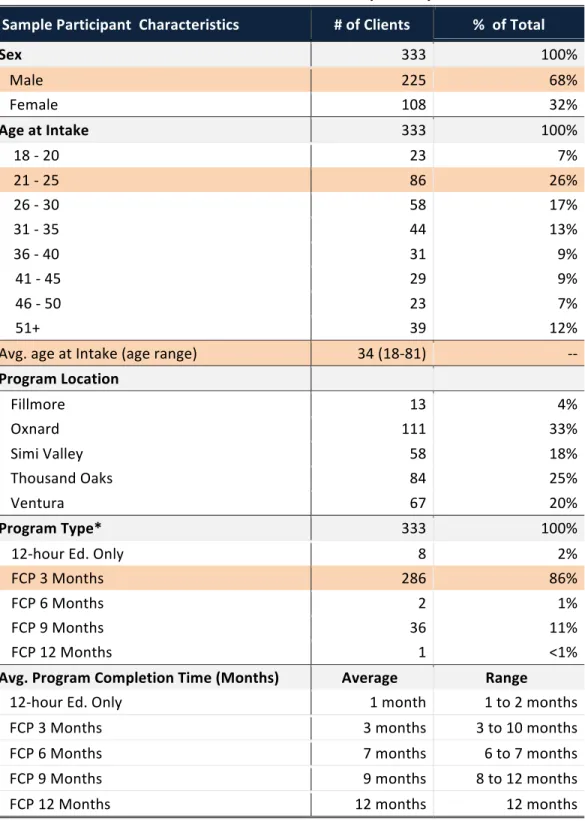
analyses, and the sample characteristics mirrored the larger population-‐level data. The sample only included clients from the First Conviction Program (FCP), as only one multiple offender was in the overall population data provided. As shown in Table 1, DUI program clients were predominantly male (68%) and the average age at intake was 34. The largest age group was comprised of those 21-‐25 years old (26%). Most clients participated in the
3-‐month program (86%) and attended the program at the Oxnard site (33%).
Table 1. Demographic Characteristics of Participants Selected for the Exit Interview Sample Analysis
Sample Participant Characteristics # of Clients % of Total
Sex 333 100%
Male 225 68%
Female 108 32%
Age at Intake 333 100%
18 -‐ 20 23 7% 21 -‐ 25 86 26% 26 -‐ 30 58 17% 31 -‐ 35 44 13% 36 -‐ 40 31 9% 41 -‐ 45 29 9% 46 -‐ 50 23 7% 51+ 39 12%
Avg. age at Intake (age range) 34 (18-‐81) -‐-‐
Program Location Fillmore 13 4% Oxnard 111 33% Simi Valley 58 18% Thousand Oaks 84 25% Ventura 67 20% Program Type* 333 100%
12-‐hour Ed. Only 8 2%
FCP 3 Months 286 86%
FCP 6 Months 2 1%
FCP 9 Months 36 11%
FCP 12 Months 1 <1%
Avg. Program Completion Time (Months) Average Range
12-‐hour Ed. Only 1 month 1 to 2 months
FCP 3 Months 3 months 3 to 10 months
FCP 6 Months 7 months 6 to 7 months
FCP 9 Months 9 months 8 to 12 months
FCP 12 Months 12 months 12 months
*FCP is an acronym for the First Conviction Program
Exit Interview Findings
DUI Program Exit Interviews are administered by DUI Program Counselors and consist of six primary questions. DUI Program clients are asked to describe changes in their alcohol/drug use behaviors as a result of participating in the program, their intentions not to drink and drive, and whether they have an “exit plan” (i.e., how they plan to follow through on their intentions). An additional two items on the interview are answered by the Counselor based on the client’s responses and participation in the program; these items are: (1) whether the client’s initial assessment interview indicated a need for further evaluation and (2) how they characterize the client’s behavior, attitude and motivation. Findings from the interview items are presented below.
Self-‐Identified Behavior Changes From DUI Program Participation
Identified Behavioral Changes Since Participating in DUI Program. Respondents were asked whether their behavior changed as a result of participating in the DUI program. Of the 330 who responded, 97% indicated that the program had influenced a positive change and 3% indicated the program did not influence a behavior change. A qualitative content analysis of responses resulted in four prevalent themes: (1) changed perceptions about alcohol and/or making more positive life decisions; (2) decreased or abstained drinking behavior; (3) no longer drinking and driving; and (4) learning about their mistakes from the program. Sample interview comments illustrating each of these emergent themes are provided below. The total number of responses across the four themes exceeds the total respondents, since some responses fell into multiple themes.
Changed perceptions about alcohol/making more positive life choices (n = 153)
ü Yes, has learned about and gained knowledge
about her/himself and relationship to alcohol.
ü Has learned about the dangers of a DUI and
it’s improved her/his life.
ü Has learned about the dangers and law
pertaining to impaired driving.
ü S/he sets limits.
ü Young client is very aware of future
consequences, and has made major changes in
habits.
ü Being more self-‐aware and addressing
depression by using appropriate meds.
ü Is more focused on making wise choices and
knowing the consequences.
ü Client believes s/he is more aware of
alcoholism and its effects because of PFL [Prime for Life].
ü Making better decisions.
ü Client is more thoughtful about not putting
her/himself in a situation where there would be a likelihood of driving impaired.
ü Client has seen how serious this is and what
could possibly happen.
ü Has made significant
changes to her/his thinking and drinking behavior.
Decreased or abstained drinking behavior (n = 121)
ü Has stopped drinking since arrest.
ü Client has reduced consumption.
ü Client indicates cutting back on alcohol intake
since the arrest.
ü Client has stopped taking Rx drugs linked to
her/his impaired driving.
No longer drink and drive (n = 71)
ü No longer drinks and drives.
ü Unwilling to drive under the influence.
Learned about their mistakes from the program (n = 15)
ü Client has learned her/his lesson.
ü Shared it’s been a financial burden and never
wants to return.
ü Has learned from her/his mistakes, wants no
more trouble.
ü Enjoyed listening to MCP stories and does not want to be like that.
97% of clients indicated positive behavior changes since participating in the program
Participation in DUI Program was viewed as a Positive Experience. Additionally, when respondents were asked if they viewed their experience in a positive manner, 97% indicated that their participation in the DUI Program was
a positive experience. Most respondents indicated that the program was a learning experience, and that it raised
their awareness about alcohol abuse and/or the dangers of drinking and driving, as illustrated by the following quotes:
ü “The whole situation has been stressful but I found the program
informative and I learned a lot.”
ü “It has improved me as a person. Am more knowledgeable and
more aware.”
ü “I’ve gained awareness of alcohol problems. Improved self-‐
esteem, was able to verbalize feelings and opinions in group.”
Respondents also indicated that the program helped them come to terms with their mistake, helped them see they were “messing up,” and enabled them to make positive changes in their lives.
Intentions Against Drinking and Driving
DUI Program Clients’ Intention Not to Drink and Drive. When DUI program clients were asked about their
current intention to not drink and drive, 98% of clients indicated that it was their intention not to drink and
drive. When asked to explain why, responses included the following:
ü Too much money to get a DUI.
ü It’s not safe and not worth it.
ü Current prevention plan is not to drink and
drive.
ü Scared to drink and drive. Lesson learned.
ü Aware of laws.
ü Realize the danger to human life. It’s not
worth it.
ü This has been a very exhausting experience
and I do not wish to experience it again or put my family through such an
inconvenience.
ü Will not drink and drive with any alcohol
use.
ü Making healthier choices.
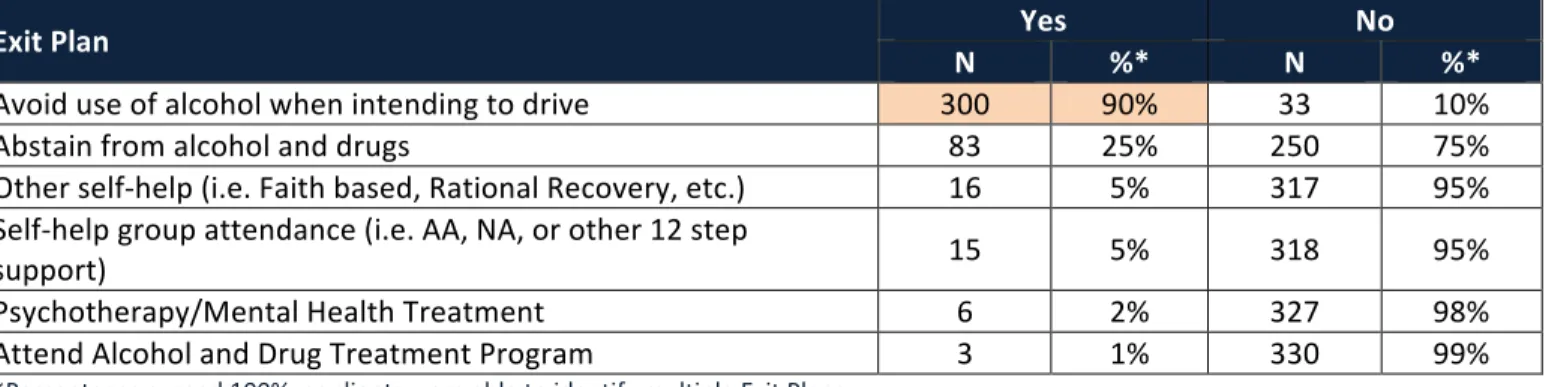
Exit Plans. The intention not to drink and drive is further supported by the exit plans identified by the program clients. DUI program clients were asked to indicate whether they intend to implement each of seven possible exit plan strategies in order to maintain their sobriety and avoid another DUI after completion of the program. As shown in Table 3, the majority of clients indicated that they plan to avoid the use of alcohol when intending to
drive (90%). Additionally, 25% stated they would abstain from using alcohol and drugs. The other types of exit
plans (i.e., other self-‐help, self-‐help groups, mental health treatment, and alcohol and drug treatment program) were each identified by 5% or less of the respondents.
Table 3. DUI Program Participants’ Intended Exit Plan to Maintain Sobriety and Avoid Another DUI Arrest
Exit Plan N Yes %* N No %*
Avoid use of alcohol when intending to drive 300 90% 33 10%
Abstain from alcohol and drugs 83 25% 250 75%
Other self-‐help (i.e. Faith based, Rational Recovery, etc.) 16 5% 317 95% Self-‐help group attendance (i.e. AA, NA, or other 12 step
support) 15 5% 318 95%
Psychotherapy/Mental Health Treatment 6 2% 327 98%
Attend Alcohol and Drug Treatment Program 3 1% 330 99%
*Percentages exceed 100%, as clients were able to identify multiple Exit Plans
“Gained awareness of alcohol problems. Improved
self-‐esteem -‐ was able to verbalize feelings and
DUI Counselor Completed Items
Client’s Initial Assessment Resulted in the Need for Further Evaluation. Counselors were asked whether the
client’s initial assessment interview resulted in the need for further evaluation. The need for further assessment is determined based on the results of the self-‐administered Michigan Alcohol Screening Test (MAST), a brief alcohol and drug-‐screening tool. If the client scores a five or higher on the MAST, DUI Counselors are required to refer the client to an outside agency for additional evaluation (e.g., treatment, AA). Of the 333 clients, 20% (n=66) were found to be in need of further assessment. Of these 66, a total of 42 clients accepted a referral for further evaluation. Two additional clients accepted referral to treatment at the time of the Exit Interview.
Assessment of Motivation for Change. DUI program counselors are asked to characterize the client’s behavior,
attitude and motivation into one of four categories at the end of the Exit Interview:
1. Engaged – has made significant changes to behaviors, is enrolled in treatment, 12 steps or other support
system in order to obtain and retain change in alcohol or other drug use behavior.
2. Pro-‐Social – motivated to succeed/actively seeks change in alcohol or drug use behavior.
3. Contemplative – sees need for change, but has done little to make those changes.
4. Pre-‐Contemplative -‐ not interested in changing behavior as it relates to alcohol and drug use.
In marking their responses, counselors take into account the client’s behavior, demeanor during participation in the DUI porgram, and responses on the Exit Interview items. Additionally, MAST scores are considered when completing the motivational attitude item on the Exit Interview. For example, if the client scored 10 or higher on the MAST (i.e., is considered a high-‐risk substance user), his/her drinking/drug use patterns are more difficult to change and as such would have a harder time addressing their drinking behaviors without outside assistance, thus influencing the final motivation attitude score assigned.
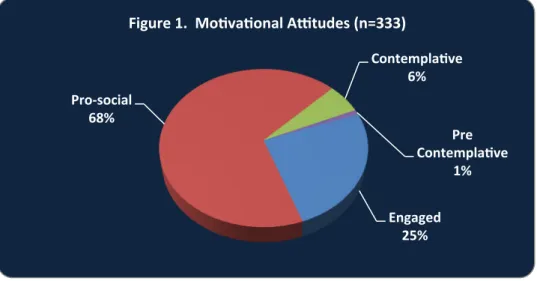
As shown in Figure 1, DUI program counselors most often identifed clients as exhibiting behaviors related to
pro-‐social behaviors (68%), inidicating that most clients appeared to be motivated to succeed and actively
seeking to change their alcohol and/or drug use behaviors. One in four (25%) DUI program clients were identified as engaged; 6% were identified as contemplative; and 1% were identifed as pre-‐contemplative.
Engaged 25% Pro-‐social 68% Contempla_ve 6% Pre Contempla_ve 1% Figure 1. Mo_va_onal A`tudes (n=333)
Summary
The multi-‐site exploratory analysis of Ventura County’s DUI Program Exit Interviews revealed that the program has multiple beneficial impacts on participants:
ü 97% of clients indicated their participation in the program resulted in a positive change in behavior.
ü 97% indicated their participation in the DUI Program was a positive experience.
ü 98% of clients indicated that their current intention, at the time of the Exit Interview, was not to drink
and drive.
ü 90% of clients indicated their Exit Plan was to avoid the use of alcohol when intending to drive.
ü DUI program counselors identifed the majority of clients as either “engaged,” having made significiant
changes to behavior (25%), or as “ pro-‐social,” actively seeking to change their alcohol and/or drug use behaviors (68%).
Given that the Prime for Life CurriculumTM is a key component of the DUI program, it is likely that positive
program effects are in part influenced by the curriculum content, along with the other elements of the program such as group and individual counseling sessions. Taken as a whole, these results suggest strong positive effects of the DUI program (including the Prime for Life CurriculumTM) on participants’ intentions, attitudes, and behavioral
plans relative to avoidance of future impaired driving.
This report was made possible through funding from Ventura County Behavioral Health Department, Alcohol and Drug Programs.