Quick and Easy Access to Measures of Text Complexity
Using the Lexile Framework for Reading
By Matt Copeland, Lexile Curriculum Specialist, MetaMetrics Inc. and
QUICK AND EASY ACCESS TO MEASURES OF TEXT COMPLEXITY USING
THE LEXILE
®FRAMEWORK FOR READING
As schools across the country continue their implementation of standards for college and career readiness, educators find themselves re-examining and reconsidering the complexity of
the texts they ask students to read. And rightly so. Research1 “makes clear that the complexity
level of the texts students read are significantly below what is required to achieve college and career readiness” (Coleman & Pimentel, 2012).
Likewise, parents understand the need to provide their students with the variety, quality, and volume of texts that will help them progress toward their personal college and career goals. Parents understand the importance of reading as a gateway skill that helps students build knowledge and understanding of the world around them that will be drawn upon throughout their lifetimes. Students must be able to comprehend and embrace a range of texts that cross genres, cultures, and eras and that also models the kind of thinking and writing they should aspire to in their own work as well.
To this end, new educational standards for college and career readiness “hinge on students encountering appropriately complex texts at each grade level to develop the mature language skills and the conceptual knowledge they need for success in school and life” (Coleman & Pimentel, 2012).
One of the questions most frequently asked is how educators and parents can find valid and reliable measures of text complexity to address this need. Luckily, there are a number of quick and easy methods an individual can use to find a Lexile® measure of a text. With this information, educators and parents can better match their students to texts with the appropriate level of complexity.
The Lexile Framework for Reading is an approach to reading and text measurement. There are two Lexile measures: the Lexile text measure and the Lexile reader measure. A text receives a Lexile measure by running it through the Lexile analyzer which utilizes a linguistic algorithm that examines the semantic and syntactic features of the text. The lower the Lexile text measure
the easier it is to read. For example, Frog and Toad Together (Lobel) is a 330L text, Charlotte’s
Web (White) is a 680L text, The Pearl (Steinbeck) is a 1010L text, and The House of the Spirits
(Allende) is a 1280L text. Lexile text measures are rounded to the nearest 10L. A student gets his or her Lexile reader measure from a reading test or program. For example, if a student receives an 880L on her end-of-grade reading test, her reader measure is 880L. Higher Lexile measures represent a higher level of reading ability. A Lexile reader measure can range from below 200L for early readers to above 1600L for advanced readers. More information about the
Lexile Framework for Reading can be found by visiting the following URL: http://www.lexile.
com/about-lexile/lexile-overview/
The Lexile Framework, which comprises the Lexile measures and Lexile scale, is not an instructional program any more than a thermometer is a medical treatment. But just as a thermometer is useful in informing medical care, the Lexile Framework is useful in informing a student’s reading development.
Among the convenient methods of finding a Lexile measure of a text and evaluating its level of complexity are the following:
• The “Find a Book” feature at Lexile.com;
• Websites of prominent booksellers Barnes & Noble.com and Amazon.com; • Online educational and research databases; and
“FIND A BOOK” AT LEXILE.COM
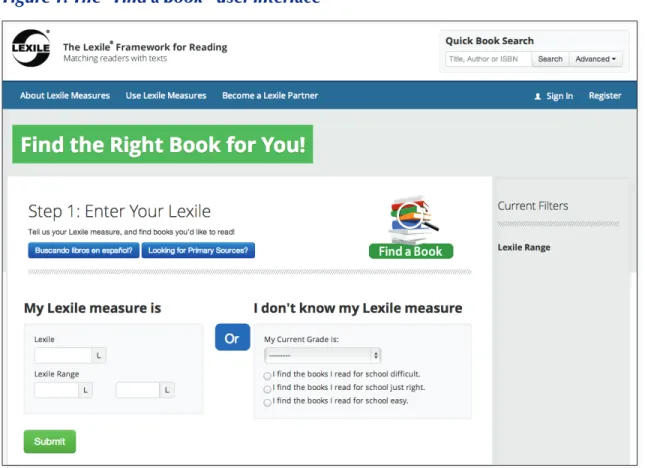
Visitors to the Lexile.com website have access to the “Find a Book” feature which will allow
them to quickly and easily identify a Lexile measure of a book. Figure 1 shows the user interface
for “Find a Book.”
For visitors who know the title, author, or ISBN of the text they are searching for, they
can use the quick book search feature located in the upper right-hand corner of the
screen (
Figure 2
). This quick search allows the user to locate the Lexile measure of a
text.
Figure 1: The “Find a Book” user interface
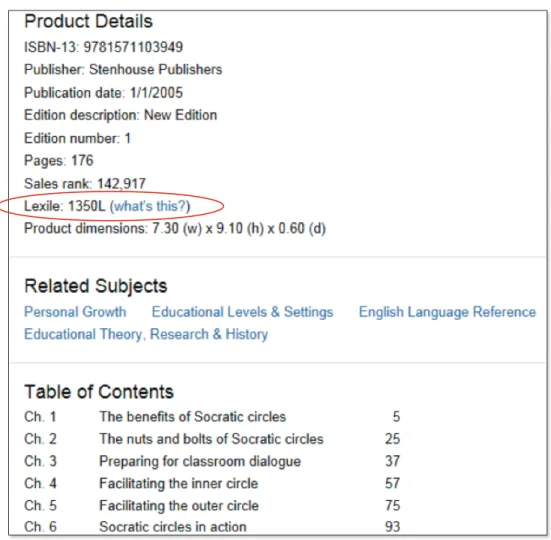
For example, if a visitor wanted to find a Lexile measure for Joseph Bruchac’s young adult biography of Jim Thorpe, she could simply type the title, author, or ISBN into the quick book search feature. From the results list, she could then click on the link to the book’s page and
quickly find the Lexile measure (circled in red in Figure 3).
The book detail page also includes quick links to be able to purchase the book from an
online bookseller, if desired, or locate the nearest library that has the book available
for check out.
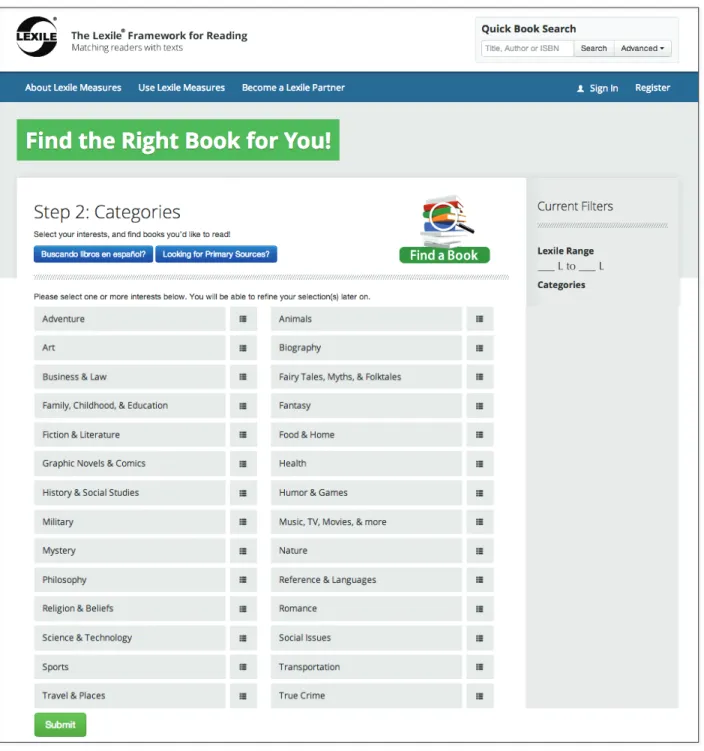
Additionally, visitors who may not know the precise text they are looking for can also
utilize the “Find a Book” feature to search for titles within a particular Lexile range. By
entering a Lexile reader measure or a Lexile range, visitors can search for new books
in one or more of 350+ categories and sub-categories (as shown in
Figure 4
on the
following page).
Figure 3: Book Detail Page for Jim Thorpe, Original All-American with the Lexile measure cir-cled in red
Figure 4: Interest categories on “Find a Book”
These results, too, report a Lexile measure for each title. Searches can even be saved and returned to at a later date for easy access.
Occasionally, there are titles that are not included in the “Find a Book” feature or shorter works that are not book length. For texts such as these, please consult the Lexile Analyzer section below.
WEBSITES OF PROMINENT ONLINE BOOKSELLERS
Major online booksellers like Amazon.com and Barnes & Noble.com provide Lexile measures for over 150,000 of their books. Barnes & Noble offers a Lexile wizard that allows users to build a custom book list based on their Lexile measure and interests. For more information on Lexile
measures and Barnes & Noble, visit www.lexile.com/using-lexile/barnes-noble/.
The Barnes & Noble website often lists a Lexile measure for titles in the “Product Details”
section of their webpages. Figure 5 shows an example of this idea with the Lexile measure
circled in red.
ONLINE EDUCATIONAL AND RESEARCH DATABASES
Finding Lexile measures for short, article length pieces is also fast and easy thanks to the many educational and research databases such as EBSCO®, Gale®, World Book®, and ProQuest®. Many states offer these databases free of charge to constituents living in their state. For a
complete list of available databases listed by state, please visit here.
The vast majority of the online databases are quite user friendly and operate in a similar fashion.
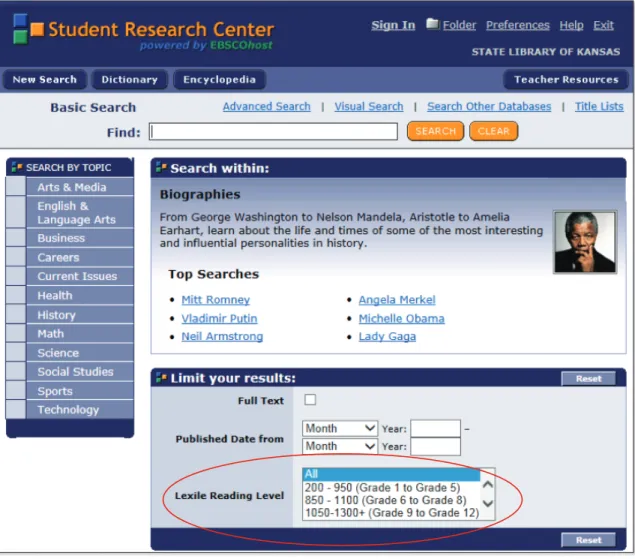
As an example, Figure 6 shows a screen shot of the user interface for Student Research Center
powered by EBSCO available from the state library of Kansas. Much like the “Find a Book” feature at Lexile.com, many of these online databases allow users to limit their results to an identified Lexile range.
Figure 6: The user interface for the Student Research Center powered by EBSCO with ability to limit search results to certain Lexile ranges circled in red
And once users have identified an article, many of these online databases also report a
specific Lexile measure for that particular text. For example, Figure 7 shows the bibliographic
information for a text available online. Here, too, the Lexile measure is circled in red.
THE LEXILE® ANALYZER
When educators or parents have an electronic copy of a text for which they cannot locate a Lexile measure, the Lexile Analyzer can provide an estimate measure. Access to the Lexile Analyzer is free for registered users. Initially, a person will have a 1000-word limit; however, she can also request access to the Professional Lexile Analyzer to measure longer pieces of text.
Before being analyzed, a text file requires preparation. There will likely be elements within a book or passage that should be removed, such as chapter headings and footnotes. Complete
Figure 7: Bibliographic information for an article from an online database with the Lexile measure circled in red
THE LEXILE® FRAMEWORK FOR READING
The Lexile Framework for Reading, developed by educational research organization MetaMetrics®, is an indispensable part of any child’s literacy development. Lexile measures take the guesswork out of connecting a child with appropriately challenging reading materials. More information regarding the Lexile Framework for Reading, including a six-minute
animated overview video, is also available at the following URL:
http://www.lexile.com/about-lexile/lexile-video/.
Regardless of the methods used to access a Lexile measure, educators and parents alike can make use of the Lexile Framework to ensure students are receiving regular practice with both the kinds and volume of complex text they need to grow as readers as they progress toward college and career readiness.
REFERENCES
ACT, Inc. (2006). Reading between the lines: What ACT reveals about college readiness in
reading. Iowa City, IA: Author.
Allende, I. (2005). The house of the spirits (Vol. 281). Random House Digital, Inc.
Chall, J. S., Conard, S., & Harris, S. (1977). An analysis of textbooks in relation to declining SAT scores. Princeton, NJ: College Entrance Examination Board.
Coleman, D., & Pimentel, S. (2012). Revised publishers’ criteria for the Common Core State Standards in English language arts and literacy, grades 3–12. Retrieved from the Common Core Standards Initiative at www.corestandards.org/assets/Publishers_Criteria_for_3-12.pdf
Hayes, D. P., Wolfer, L. T., Wolfe, M. F. (1996). Sourcebook simplification and its relation to the
decline in SAT-Verbal scores. American Education Research Journal, 33, 489-508.
Lobel, A. (1971). Frog and toad together. Harper.
Steinbeck, J. (1994). The pearl. Penguin.
White, E. B., & DiCamillo, K. (1952). Charlotte’s web. HarperCollins.
Williamson, G. L. (2006). Aligning the journey with a destination: A model for K-16 reading
MetaMetrics, founded in 1984, is an educational measurement and technology organization whose mission is to connect assessment with instruction. The company’s distinctive frameworks for English and mathematics bring meaning to measurement and are used by millions to differentiate instruction, individualize practice and improve learning across all levels of education.
MATT COPELAND is the Lexile Curriculum Specialist at MetaMetrics. A sixth-generation classroom teacher, Copeland most recently served as a Language Arts and Literacy Consultant for the Kansas State Department of Education where most of his work centered on the implementation of the Common Core State Standards (CCSS). Copeland has presented numerous workshops around the country on the topic of text complexity and the Common Core State Standards. Recognized as a 2006 Distinguished Kansan of the Year in Education, 2005 Milken National Educator and 2003 Kansas Master Teacher, Copeland is a sought-after presenter at local, regional and national conferences. He is the author of Socratic Circles: Fostering Critical and Creative Thinking in MIddle and High School. Copeland also served as president and executive board member of the Kansas Association of Teachers of English and co-edited the journal Kansas English. He taught high school English for nine years and is currently a part-time adjunct professor for the University of Phoenix. He holds both a bachelor’s degree and a master’s degree from the University of Kansas.
DAVID LIBEN is Senior Content Specialist of the Literacy and English Language Arts Team at Student Achievement Partners (SAP). David has over 40 years of experience in education. He has taught elementary, middle school and high school students in public and private schools as well as community college and teacher preparation courses in New York City and Vermont. David and his wife, Meredith, founded two innovative model schools in New York City. In 1985, they joined other teachers to found New York Prep, a junior high school in East Harlem. In 1991, David and Meredith founded the Family Academy. David served as the school’s Principal and lead curriculum designer for the first twelve years of the school. Since 2003, David has been consulting with many schools and districts, working with educators on how to teach students to learn independently from complex text. David helped work with the writing of the CCSS as