Data Center Design Guide
Overview and Status
Jon Haas
Data Center Design Guide Work Group Chair,
Technical Committee Chair, and Board Member
Intel Corporation
George Navarro
Data Center Design Guide Work Group Member
Eaton Corporation
Celebrating 5 Years of Leading the Industry to Resource Efficient IT
The Green Grid Forum 2012
Agenda
•
Charter and Scope
•
Organization
•
Status
•
Document Outline
•
Chapter Template
•
Current Document Status
Data Center Design Guide Charter
and Scope
•
Charter:
To provide the industry with a design guide
that identifies required instrumentation, efficiency and
power management capabilities to be used by
operators and designers to define requirements for,
and to build and operate, energy efficient data
centers.
•
Scope
Covers both existing (upgrades) and new facilities
Designing the Data Center architecture as a whole, not in
pieces
Includes facility equipment (power and cooling), ICT
equipment (servers, storage, networking), management
software and enterprise applications (instrumentation)
Celebrating 5 Years of Leading the Industry to Resource Efficient IT
The Green Grid Forum 2012
Core Tenets of the
Data Center Design Guide
•
Fully Scalable:
All systems/subsystems scale energy consumption and performance to use the
minimal energy required to accomplish workload.
•
Fully Instrumented:
All systems/subsystems within the datacenter are instrumented and provide real
time operating power and performance data through standardized management
interfaces.
•
Fully Announced:
All systems/subsystems are discoverable and report minimum and maximum
energy used, performance level capabilities, and location.
•
Enhanced Management Infrastructure:
Compute, network, storage, power, cooling, and facilities utilize standardized
management/interoperability interfaces and language.
•
Policy Driven:
Operations are automated at all levels via policies set through management
infrastructure.
•
Standardized Metrics/Measurements:
Energy efficiency is monitored at all levels within the datacenter from individual
subsystems to complete datacenter and is reported using standardized metrics
during operation.
A guide for the standardization and evolution of key
capabilities
DC Design Guide: Logical Divisions
ICT Equipment
Facilities
Power
Cooling
Compute
Storage
Network
Management
Infrastructure
Celebrating 5 Years of Leading the Industry to Resource Efficient IT
The Green Grid Forum 2012
Organizational Status
Data Center Design Guide WG Chair: J. Haas Mgmt. Infra-structure Sub WG Chair: J. Woodbury Facilities Integration Sub WG Chair: TBD Compliance and Interoperability Sub WG Chair: TBD Liaison Committee CSCI, DMTF, ECMA, SNIA…. Technology and Strategy WG Chair: M. Patterson Data Center Power Sub WG Chair P. Lembke Data Center Thermal Mgmt. Sub WG Chair: T. HarveyOpportunities exist to participate and influence
To be created Existing IJKK SWG Chair: H. Takagi EMEA SWG Chair: TBD Application Instrumentation SWG Chair: TBD Networking SWG Chair: K. Bross W/CSCI Storage SWG Chair: Robert Mason Compute SWG Chair: H. Barass
Current Status
•
First draft is available for review and comment
Introduction and Overview,
Management (balloted and approved)
Power (balloted and approved)
Thermal (balloted and approved)
Japan Regional Considerations (balloted and approved)
EMEA Regional Considerations (drafted and in ballot)
Compute (drafted and in ballot)
Storage (drafted and in ballot)
Networking (drafted and in ballot)
•
Equipment profiles for Facility Equipment created
Celebrating 5 Years of Leading the Industry to Resource Efficient IT
The Green Grid Forum 2012
Document Outline
•
Introduction
Vision, goals, objective of the specification
Document organization
•
Architectural overview
•
Data center design philosophy
•
Management capabilities
Features, capabilities, correlating power to productivity, policy
implementation
•
Equipment chapters (share a common outline and format)
Facility equipment - power
Facility equipment – cooling
ICT Equipment – servers, storage, networking
Application software instrumentation (Next Revision)
Building facilities (Next Revision)
•
Regional considerations
Japan
EMEA
•
Operational implementation (Next Rev.)
•
External to the data center - power
sources, Smart Grid, etc. (Next Rev.)
•
Appendix
Glossary
List of acronyms
Reference documents
Celebrating 5 Years of Leading the Industry to Resource Efficient IT
The Green Grid Forum 2012
Chapter Outline
•
Introduction:
Discuss the goals and features for each category of
equipment in your group
•
Equipment description:
Provide a paragraph that defines the
equipment and how it is used
Refer to each of the six core tenets of the DCDG as a context for
discussing specific goals and features
•
Efficiency requirements: For each category of equipment, list
requirements with respect to three time periods: Current (2011),
2012 and beyond 2012
•
Profile information: features and capabilities
•
Reporting requirements: what and how
•
CIM Model and charts: measured and status info
•
Operational goals and applicable metrics: BKMs and
•
CIM over Ethernet
leverages past
Operations WG efforts
with DMTF
•
Initially we will need to
proxy from other
interfaces and transports
From and to existing
disparate management
consoles or devices
•
Eventually realizing
native implementation
over time
ICT Equipment
Facilities
Power
Cooling
Compute
Storage
Network
Management Infrastructure
Applications
Celebrating 5 Years of Leading the Industry to Resource Efficient IT
The Green Grid Forum 2012
CIM Model Diagram: UPS
Example
CIM Reporting Charts UPS
Example 1 of 2
Metered values (current)
Attribute Definition Units Notes
Input RMS Voltage Volts Per Phase RMS Current Amperes Per Phase Real Power Kilowatts Per Phase
Energy = Real Power
* Time Interval Kilowatts-hr
Per Phase
Frequency Hz
Output RMS Voltage Volts Per Phase RMS Current Amperes Per Phase Real Power Kilowatts Per Phase
Real Power * Time
Interval Kilowatts-hr
Per Phase
Frequency Hz Per Phase
System Temperature Degrees C Pressure PSI Liquid Level OK Logic High
Attribute Definition Units Notes
Ambient Temperature Degrees C Room
Humidity % Room True Power Factor Total Distortion Power Factor Per Phase
Celebrating 5 Years of Leading the Industry to Resource Efficient IT
The Green Grid Forum 2012
Status values (current)
Attribute Definition Units Notes
DC Input Recharging %
Discharging %
Low Logic High
Fully Discharged Logic High
ID Name/Model Text String
Manufacturer Text String
New status values (future)
Attribute Definition Units Notes
Location Physical location Datacenter Security Sensitivity
Floor # Security Sensitivity
Room # Security Sensitivity
Startup Boot time minutes Staging time
Serial Number Manufacturer ID alphanumeric
CIM Reporting Charts
UPS Example 2 of 2
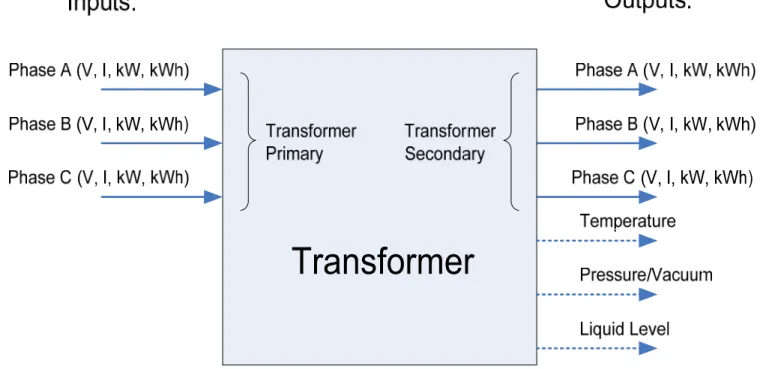
CIM Model Diagram
Transformer Example
Celebrating 5 Years of Leading the Industry to Resource Efficient IT
The Green Grid Forum 2012
CIM Reporting Charts
Transformer Example 1 of 2
Metered values
Attribute Definition Units Notes
Input RMS Voltage Volts Per Phase
RMS Current Amperes Per Phase
Real Power Kilowatts Per Phase
Energy = Real Power * Time
Interval Kilowatts-hr
Per Phase
Frequency Hz
Output RMS Voltage Volts Per Phase
RMS Current Amperes Per Phase
Real Power Kilowatts Per Phase
Real Power * Time Interval Kilowatts-hr
Per Phase
Frequency Hz Per Phase
System Temperature Degrees C
Pressure PSI
Raising the Bar on Capabilities
UPS example
Core Tenant: Scalability
•
Current status:
There is currently no standard for UPS scalability.
•
Proposed for 2012:
A UPS should be designed to add or remove
capacity in real time, so UPSes are always running at the optimal
efficiency point (without shutting down the load, hot scalable) or
automatically self-configuring.
•
Proposed for 2012+:
UPS efficiency curves should be as flat as
possible, operating efficiently at any load. This which allows data
centers to move away from modules. Efficiency should be 95% or
higher when operating between 25-75% load.
Celebrating 5 Years of Leading the Industry to Resource Efficient IT
The Green Grid Forum 2012
Liaisons and Collaborations
•
DMTF – Use of CIM, Profiles, Compliance and Interop
•
ECMA – Implementation of an International Standard
•
SNIA – Storage content and CIM profiles for storage
•
CSCI – Networking content
A coordinated, and orchestrated
approach to holistic DCM
Next Steps
•
Ballot remaining chapters and publish for Members
•
Post for public comments
•
Release a final first edition for implementation
•
Begin 2
ndedition chapters in 2012
•
Publish a 1.1 update in 2013
•
Complete 2
ndedition in 2014
Implementation and deployment will require
end user to pull for these new capabilities
Celebrating 5 Years of Leading the Industry to Resource Efficient IT
The Green Grid Forum 2012
Celebrating 5 Years of Leading the Industry to Resource Efficient IT
The Green Grid Forum 2012