ris_HP_wp_0511.indd 1 6/1/11 9:31 AM
POS: Technology in Transition
PRODUCED BY
®
SPONSORED BY
The point of sale is both the most basic and the most complex of retail technologies. It’s basic because it’s the mechanism for retailers’ most crucial business function – conducting transactions. The complexity has grown over the years, as the POS has transitioned from a point of sale to a point of service, coordinating and connecting with an ever-expanding array of store and headquarters-level systems as well as the networks supporting them and the databases feeding into them. “It wasn’t all that long ago that the POS terminal was purely a transactional device, automating the ringing up of sales,” write Lee Holman and Greg Buzek of IHL Group in the 2011 RIS Store Systems Study. “The trend over the past several years, however, has been for retailers to view it as the most important element of several clustered technologies residing at the core of the store.”
The POS is also becoming a tool for facilitating interactions, a key element of increasing customer engagement. “One of the most fundamental challenges a retailer has is to keep track of evolving consumer product preferences, desired modes of service, and potential cross-sell and upsell opportunities,” writes Greg Belkin in the May 2011 Aberdeen Group report Extended Points of Service: The Next Generation of Customer-Centric Retailing. “To accomplish this task at the store level, these organizations can take advantage of the traditional or mobile till to either collect information, or make use of existing information to enhance the customer experience (or both).”
0.0%
ris_HP_wp_0511.indd 2 6/1/11 9:31 AM
The increased importance of providing customer interaction capabilities at the POS is also reflected in the 2011 Store Systems Study. Asked about key functions for their next POS purchase, retailers’ top choice was CRM, coupon and loyalty management, picked by 69% of respondents, followed by inventory visibility at 40%. A new entry for this year, reading coupons off mobile screens, tied for third place with gift card/phone card activations at 37%, and “save the sale” functionality rounded out the top five at 35%.
Mobility, Cloud Reshaping pos ChoiCes
Not only are retailers requiring more from their point of service solutions, but the technology itself is in a state of rapid transition. For the first time, mobile technologies are presenting a practical, cost-effective alternative to traditional fixed POS devices. The increased availability and reliability of Software as a Service (SaaS) and cloud-based services offer retailers, particularly mid-tier retailers, new server and POS architecture options at both the store and enterprise levels. The combination of increased requirements and exciting new technologies is building retailers’ appetite for next-generation POS solutions. Increasingly, they are seeing a gap between what they would like their POS to do and what it is actually capable of doing.
“The challenge for retailers is how to operationally prepare for next generation consumer interaction in an environment where 60% consider their POS functionality sub par,” writes
Belkin. “For example, Aberdeen data finds that 41% of retailers are operationally pressured to achieve proper data integration between the POS and other business- or customer-facing systems.”
However, because a POS replacement is by definition a significant IT investment, retailers’ upgrade plans have traditionally been ruled by POS products’ lifecycle. Many retailers stick with POS systems as long as they continue to perform their primary functions reasonably well, using adaptations and work-arounds to meet changing business requirements.
aRe ReplaCeMent CyCles shoRtening?
According to IHL Group, which has carefully tracked retail POS spending for many years, “The POS market was due to slow down in 2008 and 2009, with a slight improvement in 2010, regardless of the economy. The driver here is the POS replacement cycle as opposed to how the industry as a whole is doing,” write Holman and Buzek in the 2011 Store Systems Study.
But the combination of the POS capabilities gap, rapid business and technological changes and an improving economy may create enough pressure to shorten POS replacement cycles. A key determining factor in any POS upgrade is whether the retailer’s IT budget is expanding or shrinking.
According to the 2011 Store Systems Study, among the 59% of surveyed retailers that plan to increase store IT spending,
FiguRe 1: it spend gRowth by RetaileR annual Revenue
IT Spend Growth by Retailer Annual Revenue
6%
5%
4%
3%
2%
1%
0
4.0%
2.5%
4.8%
5.9%
Enterprise IT Spend Average4.4%
2.2%
0.7%
0.9%
4.2%
Store IT4.6%
Spend Average3.6%
2.8%
Under $250 $250-$500$250-$500 $500 Million $1-$5 $5-$10 Over $10 Billion Million MillionMillion to $1Billion Billion Billion
Source: rIS/IHL Group 2011 Store Systems Study
PoS replacement plans are highly dependent on whether IT budgets are on the rise or falling, and by how much.
0
5
10
15
20
25
30
35
40
0
10
20
30
40
50
ris_HP_wp_0511.indd 3 6/1/11 9:31 AM
30% are planning a POS terminal upgrade within the next 12 Given the importance of IT budgets to POS upgrade plans, months. In contrast, 81% of retailers with flat or declining IT it’s interesting to note that mid-tier retailers are among budgets say their POS upgrade plans are two or more years those with the largest store IT spending growth plans (by
in the future. percentage, not actual dollar amounts). As seen in Figure
34% No pain, meets needs today and for several years
Low pain, meets needs now but won’t in future
Medium pain, meets needs now but at high cost
High pain, doesn’t meet needs and requires upgrade
14.6% 14.6% 17% 24.4% 36.6% 9.8% 26.8% FiguRe 2: pos pain points status
Hardware Software Source: rIS News, May 2011
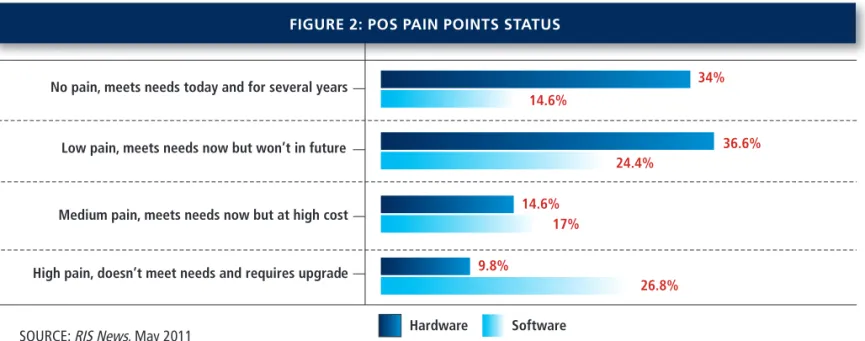
PoS hardware is currently causing less “pain” for retailers than software, although a sizeable percentage of retailers believe neither their hardware nor software will meet future needs.
FiguRe 3: top thRee pos pain points
Need to add mobile commerce functions Not aligned with future needs E-commerce divorced from store Hard to add functionalities/modules Slow to market with changes Hard to upgrade/update Poor support/maintenance Hard to make secure/PCI compliant High cost of operation
47.4% 39.5% 34.2% 34.2% 31.6% 26.3% 23.7% 21.1% 18.4% Source: rIS News, May 2011
Mobility integration is a top-of-mind concern, but retailers are also worried about the future flexibility and adaptability of their PoS solutions.
ris_HP_wp_0511.indd 4 6/1/11 9:31 AM 1, retailers with $250-$500 million in annual revenue are
planning to increase store IT spend by 4.2% in 2011, and those in the $500 million-$1 billion range are planning a 4.6% increase. In contrast, those in the $5-$10 billion range are increasing spend by 2.8%, and those above $10 billion are increasing spend by only 0.9%.
Recent RIS News research that is focused specifically on the POS provides a more detailed picture of retailers’
satisfaction levels with their current solutions as well as what they’re looking for in their next purchase.
Responding retailers are more satisfied with their POS hardware than software. As seen in Figure 2, more than one-third of respondents said their hardware was meeting their needs today and would for several years in the future, but only 14.6% said the same about their POS software. At the other end of the scale, more than one-quarter (26.8%)
FiguRe 4: pos upgRade plans
19.5%
Needs updating but no current plans
34.1%
Up-to-date (within last 2 years) Will update in 2012 14.6%
26.8% 4.9% Updating now
Will begin updating by end of 2011 Source: rIS News, May 2011
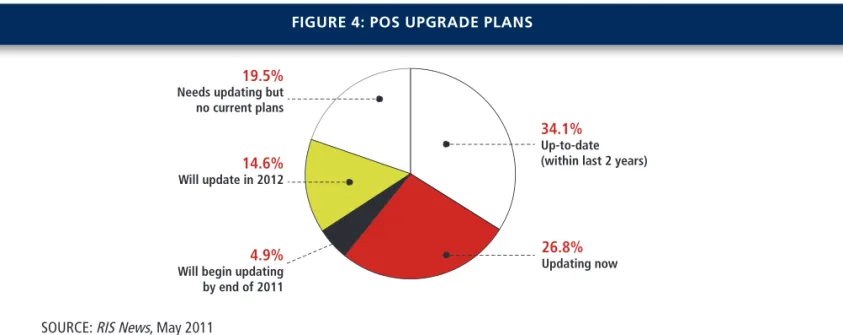
The traditionally long PoS replacement cycle means many retailers have already upgraded their systems, but nearly one-third are in the process of upgrading or plan to begin an upgrade this year.
FiguRe 5: iMpoRtanCe oF Ruggedized/Retail-haRdened pos
15.4%
No opinion
12.8% 43.6%
Ruggedized not a
Ruggedized a major factor determining factor
in POS selection
28.2%
Affordability a higher priority than ruggedized Source: rIS News, May 2011
The need for durability in the sometimes harsh retail environment makes ruggedized technology a determining factor for a sizeable group of retailers.
ris_HP_wp_0511.indd 5 6/1/11 9:31 AM of retailers said their POS software did not meet their needs
and required an upgrade, while only 9.8% expressed the same opinion about their POS hardware.
That’s not to say retailers foresee no problems with their POS hardware: 36.6% believe it won’t meet their needs in the future, while 24.4% said the same about their POS software.
seeking gReateR Flexibility
Figure 3 provides information on the specific “pain points” retailers are feeling with their POS systems. The rush to add a mobile component to in-store activity makes this the top-ranked pain point, but several other responses point to concerns about POS solutions’ future adaptability: “Not aligned with future needs” was the second-ranked pain point, chosen by 39.5% of respondents. Other responses included “Hard to add functionalities/modules,” (34.2%), “Slow to market with changes,” (31.6%) and “Hard to upgrade/update” (26.3%).
Given the range of causes for dissatisfaction, it’s not surprising that, as seen in Figure 4, just over 60% of retailers have either upgraded their POS within the past two years or are updating now. An additional 4.9% are planning to begin an update by the end of 2011.
Retailers recognize that their POS systems must be able to stand up to sometimes harsh environments: 43.6% of respondents identified a ruggedized or retail-hardened POS as a major factor in their POS selection, while 28.2% ranked affordability as a higher priority than a ruggedized solution.
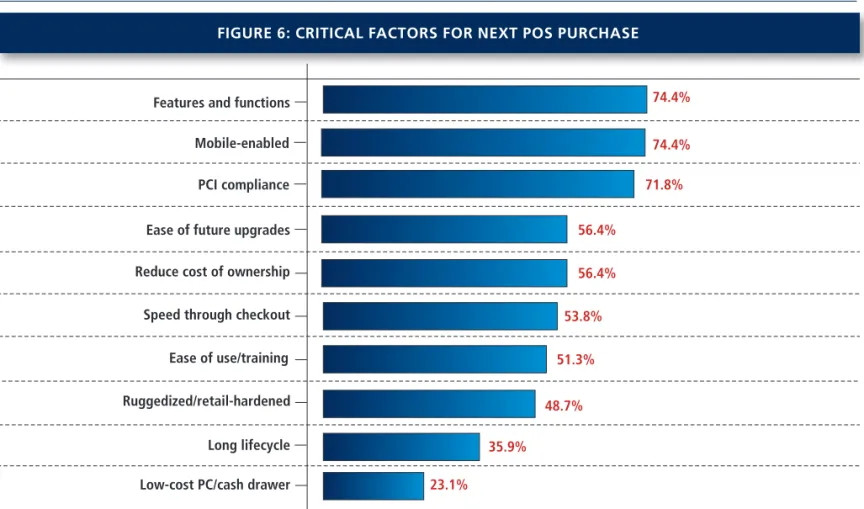
As noted elsewhere, the excitement around mobility has made it a top-of-mind factor for retailers’ next POS purchase. At 74.4%, mobile enablement edged out perennial “favorite” PCI compliance, chosen by 71.8% of retailers. (See Figure 6.)
FiguRe 6: CRitiCal FaCtoRs FoR next pos puRChase
Features and functions Mobile-enabled PCI compliance Ease of future upgrades Reduce cost of ownership Speed through checkout Ease of use/training Ruggedized/retail-hardened Long lifecycle Low-cost PC/cash drawer
74.4% 74.4% 71.8% 56.4% 56.4% 53.8% 51.3% 48.7% 35.9% 23.1% Source: rIS News, May 2011
In an indication that refresh cycles may be shortening, 56.4% of retailers identified “ease of future upgrades” versus the 35.9% who chose “long lifecycyle.”
ris_HP_wp_0511.indd 6 6/1/11 9:31 AM Other responses to this question indicate retailers’ desire
for POS solutions that will be able to handle fast-changing business conditions in the future: 56.4% chose both “Ease of future upgrades” and “Reduced cost of ownership,” a significantly larger number than the 35.9% that chose “Long lifecycle.”
CReating in-stoRe ConneCtions
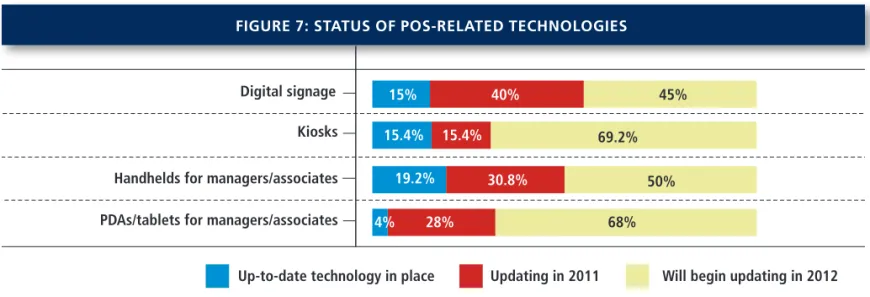
Figure 7 reflects the surge of interest in POS-related interactive store technologies such as kiosks and digital signage. While a relatively small percentage of respondents have up-to-date technology in these areas, that’s likely to change soon. A combined 85% of respondents will update their digital signage by 2012, and a combined 84.6% will update kiosks in the same time period.
Mobile technologies for managers and store associates are also on a strong growth path: a combined 80.8% of respondents will update handheld solutions by 2012, and a remarkable combined 96% will update PDA/tablet technologies in the same period.
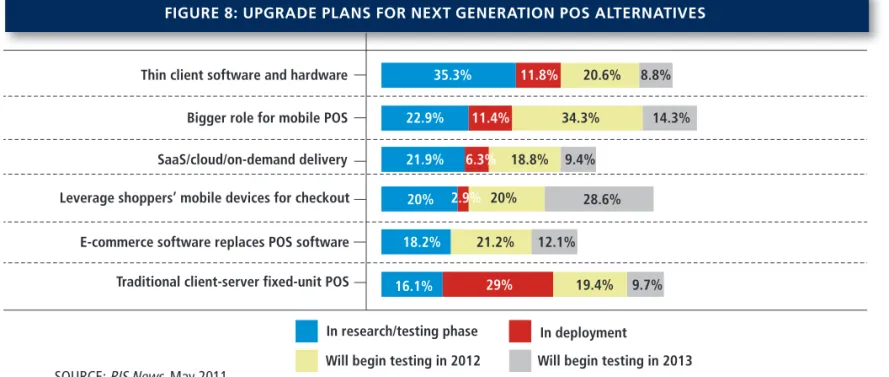
As the use of mobile devices increases, so do roles for mobile POS solutions. As seen in Figure 8, more than one-third (34.3%) of retailers are either testing out a larger role for mobile POS or are already in deployment. The same percentage are planning to begin testing out increased roles for mobile POS in 2012.
There’s a lower level of interest in leveraging shoppers’ own
mobile devices for checkout, perhaps due to the variety of mobile operating systems as well as transactional and data security concerns.
SaaS or cloud-based networks for POS are either being tested or deployed by a combined 28.2% of retailers, and another 18.8% say they will begin testing these solutions in 2012. Retailers’ desire for increased flexibility from their POS solutions is a good fit with these on-demand networks. A retailer could scale up for a store opening without having to make a significant investment in servers or needing to quickly add staff for installation, support and maintenance functions.
ConClusion
While any IT decision is important, the centrality and ubiquity of the POS raises the stakes for all the choices around these technologies. There’s also the multiplier effect: any POS purchase, or even a minor change, rapidly becomes a big deal due to the presence of multiple devices in multiple store locations.
However, as mobile devices come down in price while offering functionality that’s comparable to a fixed-unit POS terminal, and as on-demand networks become a practical alternative to server-based architectures, retailers may be able to find POS solutions with both the flexibility and functionality they need. They may be able to shorten refresh cycles so that their POS technology keeps pace with fast-changing business requirements rather than constantly playing catch-up. l 45% 15% 15.4% 19.2% 40% 15.4% 30.8% 28% 4% 69.2% 50% 68%
FiguRe 7: status oF pos-Related teChnologies
Digital signage Kiosks Handhelds for managers/associates PDAs/tablets for managers/associates
Up-to-date technology in place Updating in 2011 Will begin updating in 2012
Source: rIS News, May 2011
Mobile’s growth explains the strong future interest in handhelds and tablets, but digital signage and kiosks are also poised for impressive growth in 2012.
ris_HP_wp_0511.indd 7 6/1/11 9:31 AM -11.8% 35.3% 22.9% 21.9% 20% 18.2% 20.6% 8.8% 11.4% 34.3% 14.3% 9.4% 18.8% 20% 28.6% 12.1% 21.2% 19.4% 29% 9.7% 16.1% 6.3% 2.9%
FiguRe 8: upgRade plans FoR next geneRation pos alteRnatives
Thin client software and hardware Bigger role for mobile POS SaaS/cloud/on-demand delivery Leverage shoppers’ mobile devices for checkout
E-commerce software replaces POS software Traditional client-server fixed-unit POS
In research/testing phase In deployment
Will begin testing in 2012 Will begin testing in 2013 Source: rIS News, May 2011
More than one-third of retailers say they will begin testing out bigger roles for mobile PoS in 2012, and a combined 28.2% are either testing or deploying SaaS/cloud delivery systems.
METHODOLOGY
The rIS News custom research was conducted via an online survey in April and May 2011, with respondents limited to qualified
retailers. A total of 42 respondents completed the survey, although not every respondent completed all the survey questions.
Following is the breakdown of respondents’ annual revenues:
Less than $50 million...
21.1%
$50 million-$250 million...
18.4%
$250 million-$500 million...
15.8%
$500 million-$1 billion...
15.8%
Greater than $1 billion... 28.9%
about hp
HP creates new possibilities for technology to have a meaningful impact on the retail, grocery and hospitality industries. The world’s largest technology company, HP brings together a portfolio of solutions for in-store and back-office operations which include point of sale, digital signage, self-service kiosks, mobility, servers and self-services. HP’s retail solutions deliver retail-hardened platforms and peripherals that withstand the demands of today’s retail environments. Retailers also benefit from the deep and broad partnerships HP has developed with leading technology provides to the industry, such as independent software vendors and value-added resellers, to help grow your business in an increasingly competitive market. HP brings innovation and reliability with its industry-leading point of sale solutions and peripherals. For more information about HP and its innovative point of sale technologies, visit www.hp.com/go/pos.