School Administration Programs
2009-2010
SCHOOL ADMINISTRATION PROGRAMS
School administration programs are designed to prepare educational leaders who have the knowledge, skills, and dispositions to promote the success of all students. While specific course requirements vary from institution to institution, they are focused on enabling graduates to be able to
• facilitate the formation, articulation, and dissemination of a school or district vision of learning supported by
the school community;
• promote and maintain a positive school culture for learning, by promoting effective instructional programs,
applying best practices to student learning, and designing and implementing comprehensive professional growth programs for staff;
• manage organizational operations and resources in a way that promotes safe, efficient, and effective
learning environments;
• collaborate with families and other community members, responding to diverse community interests and
needs, and mobilizing community resources;
• understand the larger political, social, economic, legal, and cultural context of schools; and advocate for all
students.
During the 2009-10 academic year, 13 institutions are currently approved to offer programs leading to graduate level licensure in school administration. Others are completing the approval process of program revision. The institutions are:
Appalachian State University
UNC-Chapel Hill
Western Carolina University
East Carolina University
UNC-Charlotte
Wingate University
High Point University
UNC-Greensboro
Winston-Salem State Univ
NC Central University
UNC-Pembroke
NC State University
UNC-Wilmington
Quality of Students Entering the Programs
Institutions with approved school administration programs seek to recruit and retain quality students who reflect the diversity of the state and nation. They work closely with their college/university graduate admission offices and area school systems to promote their programs. Brochures and other promotional materials are routinely distributed. A number of institutions offer off-campus programs designed to bring programs to prospective school administrators.
School Administration Program Admission Requirements
School Administration Program admission requirements vary from institution to institution. Most require prospective students to have a prescribed grade point average and to earn a satisfactory score on a standardized examination such as MAT or GRE. Many require references; a number require a writing sample (essay).
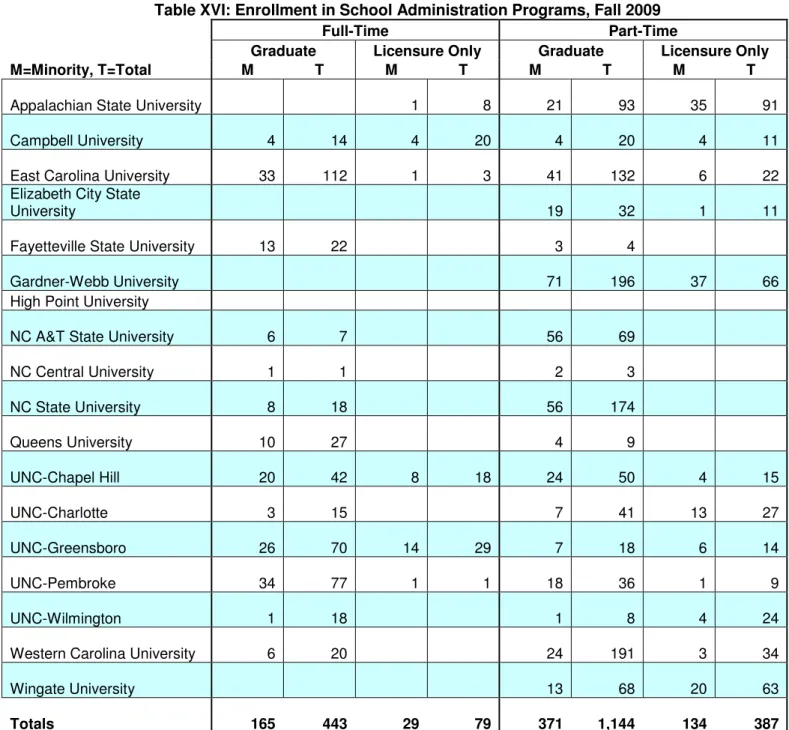
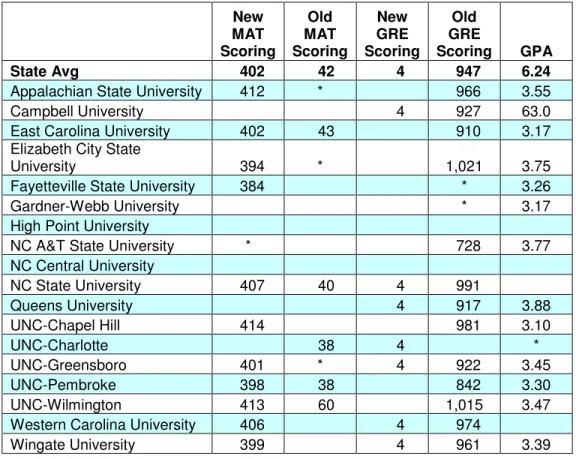
Table XVI summarizes the Fall 2009 enrollment in school administration programs. These data were provided by the institution. Table XVII summarizes admission test results. These data were provided by the institutions for students reported as admitted to their programs. Column 1, New MAT Scoring, reflects the scoring rubric ranging from 200-600, while column 2 reflects old scores based on the 0-100 rubric. Column 3 reflects new GRE analytical writing score which ranges from 0-6, while column 4 reflects verbal and quantitative scores combined (each ranging from 200-600).
Table XVI: Enrollment in School Administration Programs, Fall 2009
Full-Time Part-Time
Graduate Licensure Only Graduate Licensure Only
M=Minority, T=Total M T M T M T M T
Appalachian State University
1 8 21 93 35 91 Campbell University 4 14 4 20 4 20 4 11 East Carolina University
33 112 1 3 41 132 6 22 Elizabeth City State
University 19 32 1 11 Fayetteville State University
13 22 3 4 Gardner-Webb University 71 196 37 66
High Point University
NC A&T State University
6 7 56 69 NC Central University
1 1 2 3
NC State University
8 18 56 174 Queens University 10 27 4 9 UNC-Chapel Hill 20 42 8 18 24 50 4 15 UNC-Charlotte 3 15 7 41 13 27 UNC-Greensboro 26 70 14 29 7 18 6 14 UNC-Pembroke 34 77 1 1 18 36 1 9 UNC-Wilmington 1 18 1 8 4 24 Western Carolina University
6 20 24 191 3 34 Wingate University 13 68 20 63 Totals 165 443 29 79 371 1,144 134 387
Table XVII: School Administration Program Admission Data
New MAT Scoring
Old MAT Scoring
New GRE Scoring
Old GRE
Scoring GPA
State Avg 402 42 4 947 6.24
Appalachian State University 412 * 966 3.55 Campbell University 4 927 63.0 East Carolina University 402 43 910 3.17 Elizabeth City State
University 394 * 1,021 3.75 Fayetteville State University 384 * 3.26 Gardner-Webb University * 3.17 High Point University NC A&T State University * 728 3.77 NC Central University NC State University 407 40 4 991 Queens University 4 917 3.88 UNC-Chapel Hill 414 981 3.10 UNC-Charlotte 38 4 * UNC-Greensboro 401 * 4 922 3.45 UNC-Pembroke 398 38 842 3.30 UNC-Wilmington 413 60 1,015 3.47 Western Carolina University 406 4 974 Wingate University 399 4 961 3.39 * Less than five test takers. Results not reported.
QUALITY OF STUDENTS COMPLETING THE PROGRAMS
School administration programs are designed to prepare educational leaders who have the knowledge, skills, and dispositions to promote the success of all students. To this end, candidates are required to complete defined programs of study which include significant internship experiences. These experiences are expected to provide opportunities for synthesizing and applying knowledge and practicing skills through substantial, sustained, standards-based work in real settings, planned and guided cooperatively by the institution and school district personnel. The progress of candidates in completing program requirements is monitored and the competence of candidates is assessed throughout the program of study.
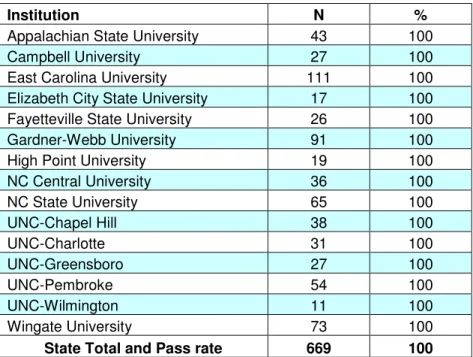
To be licensed as a school administrator, candidates must satisfactorily complete the School Leaders Licensure Assessment (SLLA) exam. A score of 155 is required to pass the exam.
Table XVIII: Performance of MSA Program Completers on the School Leaders Licensure Assessment
Institution N %
Appalachian State University 43 100 Campbell University 27 100 East Carolina University 111 100 Elizabeth City State University 17 100 Fayetteville State University 26 100 Gardner-Webb University 91 100 High Point University 19 100 NC Central University 36 100 NC State University 65 100
UNC-Chapel Hill 38 100
UNC-Charlotte 31 100
UNC-Greensboro 27 100
UNC-Pembroke 54 100
UNC-Wilmington 11 100
Wingate University 73 100
State Total and Pass rate 669 100
EMPLOYMENT AND PROGRAM SATISFACTION
To determine the satisfaction with school administration programs of individuals who have completed the programs and their employers, a survey was distributed to recent school administration program completers employed in the public schools of North Carolina and their employers. Respondents were asked to rate their satisfaction with the program in general, their preparation to use technology to support the instructional program, their preparation in instructional leadership, and their preparation to assist teachers in meeting the needs of diverse learners.
On a 4.0 scale, ratings by program completers ranged from 3.00 (overall quality) to 3.25 (instructional leadership). Employer ratings ranged from 3.21 (instructional leadership) to 3.49 (overall quality).
Table XIX summarizes the results of the survey of program completers and their employers. Because of the budget restrictions, surveys were not mailed. Instead, the survey was available electronically and emails were used to reach respondents. In addition to the emails sent by DPI to principals, teachers, central office staff (Beginning Teacher Program Coordinators), NCASA and NCAE also sent emails to their members encouraging them to complete the on-line surveys. Despite efforts to encourage respondents to complete the surveys, the response rate was low and this year results are reported at the state level but not the institutional level. Individual institutional responses will be carried forward to next year's report.
Table XIX: Survey Results School Administration Programs
Number Responding
Overall
Quality Technology
Instructional Leadership
Diverse Learners
Completers 4 3.00 3.25 3.25 3.25
REWARDS AND SANCTIONS School Administration Programs
If schools are to succeed, they must be staffed with quality professionals. The quality of teacher education programs is a significant factor in determining the quality of the teaching profession. Because of this, programs should be assessed on a regular basis. One key method of assessing program quality is found in the Teacher Education Program Approval process. This process requires on-site reviews of teacher education programs by trained teams of professionals at least every seven years. To assist in carrying out this process and in assessing the on-going quality of teacher preparation, a Performance Report will be issued for each North Carolina college or university with an approved teacher education program. Data from the program approval process and the IHE Performance Report will be used to reward and sanction programs as required by the Excellent Schools Act.
Masters of School Administration Programs (MSAs) must:
(a) Maintain annually a passing rate of at least 70% on the SLLA exam. (b) Receive annually positive ratings (3 or 4) from at least 70%
of graduates and employers responding to surveys (c) Exhibit direct and ongoing involvement with the public schools.
An MSA program shall be designated as "Low Performing" if:
(a) It does not meet 2 of the above 3 criteria in a single year; or
(b) It does not meet the same 1 of the above 3 criteria twice in three years; or (c) It does not meet any 1 of the above 3 criteria for 3 consecutive years
The public disclosure of the IHE Performance Reports serves as a means of rewards/sanctions itself, as institutions seek to attract students and garner alumni support. Further sanctions are described below.
Any criterion that the institution does not meet will require a written plan to NCDPI detailing the actions that will be taken to correct the deficiency(ies); technical assistance will be available through the Teacher Education Section. The reports will be reviewed by the SEC, which may recommend further action (e.g., sending a team to campus; requiring additional information, etc.) If an institution is designated "Low-Performing," on two consecutive
assessments, the Department will conduct an on-site review of the program. The results of this review will be reported to the SBE and may result in closure of the licensure program.
A "rule of 5" will be applied to Praxis II and survey data; I.e., data with an "N" fewer than 5 will not be reported. Data will be banked until a minimum of 5 scores or responses are recorded and then reported.
SURVEYS OF SCHOOL ADMINISTRATION PROGRAMS COMPLETERS AND EMPLOYERS
I am employed as a:
NC Public School Principal
NC Charter School Principal NC Private School Principal Principal Outside NC
NC Public School Asst Principal Other
If 'Other' selected, please provide a brief description:
Please use the following scale to answer questions 1-4:
A. Strongly AgreeB. Agree C. Disagree
D. Strongly Disagree
1. I am satisfied with the quality of my MSA graduate program at (name of institution):
N/A A B C D
2. Satisfaction with preparation to use technology to support instructional program:
N/A A B C D
3. Satisfaction with preparation in instructional leadership:
N/A A B C D
4.Satisfaction with preparation to assist teachers in meeting the needs of diverse learners:
N/A A B C D .
Employer’s Survey for Master’s of School Administration Program
(name of completer)
is employed as a:
NC Public School Principal
NC Charter School Principal NC Private School Principal Principal Outside NC
NC Public School Asst Principal Other
If 'Other' selected, please provide a brief description:
Please use the following scale to answer questions 1-4:
A. Strongly AgreeB. Agree C. Disagree
D. Strongly Disagree
1. I am satisfied with the quality of (name of completer)’s MSA graduate program at (name of institution):
N/A A B C D
2. Satisfaction with preparation to use technology to support instructional program:
N/A A B C D
3. Satisfaction with preparation in instructional leadership:
N/A A B C D
4. Satisfaction with preparation to assist teachers in meeting the needs of diverse learners:
N/A A B C D .