3.7
Deployment Guide
Quest® Collaboration
This guide contains proprietary information protected by copyright. The software described in this guide is furnished under a software license or nondisclosure agreement. This software may be used or copied only in accordance with the terms of the applicable agreement. No part of this guide may be reproduced or transmitted in any form or by any means, electronic or mechanical, including photocopying and recording for any purpose other than the purchaser's personal use without the written permission of Quest Software, Inc.
If you have any questions regarding your potential use of this material, please contact: Quest Software World Headquarters
LEGAL Dept 5 Polaris Way Aliso Viejo, CA 92656 USA
www.quest.com
email: [email protected]
Refer to our Web site for regional and international office information.
TRADEMARKS
Quest, Quest Software, the Quest Software logo, Simplicity at Work, and Quest Collaboration Services are trademarks of Quest Software, Inc., and its subsidiaries. See http://www.quest.com/legal/trademarks.aspx for a complete list of Quest Software’s trademarks. Other trademarks are property of their respective owners.
Disclaimer
The information in this document is provided in connection with Quest products. No license, express or implied, by estoppel or otherwise, to any intellectual property right is granted by this document or in connection with the sale of Quest products. EXCEPT AS SET FORTH IN QUEST'S TERMS AND CONDITIONS AS SPECIFIED IN THE LICENSE AGREEMENT FOR THIS PRODUCT, QUEST ASSUMES NO LIABILITY WHATSOEVER AND DISCLAIMS ANY EXPRESS, IMPLIED OR STATUTORY WARRANTY RELATING TO ITS PRODUCTS INCLUDING, BUT NOT LIMITED TO, THE IMPLIED WARRANTY OF MERCHANTABILITY, FITNESS FOR A PARTICULAR PURPOSE, OR NON-INFRINGEMENT. IN NO EVENT SHALL QUEST BE LIABLE FOR ANY DIRECT, INDIRECT, CONSEQUENTIAL, PUNITIVE, SPECIAL OR INCIDENTAL DAMAGES (INCLUDING, WITHOUT LIMITATION, DAMAGES FOR LOSS OF PROFITS, BUSINESS INTERRUPTION OR LOSS OF INFORMATION) ARISING OUT OF THE USE OR INABILITY TO USE THIS DOCUMENT, EVEN IF QUEST HAS BEEN ADVISED OF THE POSSIBILITY OF SUCH DAMAGES. Quest makes no representations or warranties with respect to the accuracy or completeness of the contents of this document and reserves the right to make changes to specifications and product descriptions at any time without notice. Quest does not make any commitment to update the information contained in this document.
Quest Collaboration Services Deployment Guide Updated - July 2013
C
ONTENTS
About This Document . . . 1
About Collaboration Services . . . 1
Intended Use in Real-Time Environments. . . 1
Unified Messaging Environment for All Users . . . 2
Transparency for End Users . . . 2
Secure Solution . . . 2
Architecture and Functionality . . . 2
Collaboration Services Structure . . . 2
Data Synchronization . . . 3
The Synchronization Process . . . 5
Communication Among Forests. . . 8
Security . . . 8
Mail Forwarding . . . 8
Administrative Interface. . . 10
Before You Begin . . . 11
System Requirements . . . 11
Service Account Rights and Permissions. . . 12
SMTP Connectivity. . . 13
Service Mailbox. . . 13
Platform Considerations . . . 13
Recipient Update Service . . . 13
Choosing Between Free/Busy and Calendar Synchronization . . . 14
Public Folders . . . 15
Exchange 2007 Only . . . 15
Exchange 2010 Only . . . 15
Exchange 2013 Only . . . 15
Pre-Installation Planning . . . 16
Phase I: Planning . . . 16
Step 2: Plan Conflict Resolution . . . 17
Step 3: Plan Collaboration Services Configuration . . . 19
Phase II: Preparing Forests . . . 20
Step 1: Resolve Conflicts . . . 21
Step 2: Restructure the OU Hierarchy . . . 21
Step 3: Create Service Account . . . 21
Step 4: Dedicate a Server . . . 22
Step 5: Verify Free/Busy Accessibility . . . 22
Phase III: Deploying Quest Collaboration Services . . . 22
Step 2: Configure Collaboration Services . . . 27
Step 3: Publish Test Collections . . . 28
Step 4: Publish All Required Users . . . 30
Prepare for Use. . . 31
Collaboration Services Upgrade . . . 32
Preparing for a Manual Upgrade . . . 33
Performing the Manual Upgrade . . . 33
Preparing for an Automatic Upgrade . . . 34
Performing the Automatic Upgrade . . . 35
Monitoring the Upgrade . . . 36
Installation Checklists . . . 36
Pre-Installation Checklist . . . 36
Installation Checklist . . . 36
Prepare for Use Checklist . . . 37
Re-installing Collaboration Services. . . 37
Troubleshooting . . . 38
Service Account Minimum Rights and Permissions. . . 40
About Quest Software, Inc. . . . 42
Contacting Quest Software. . . 42
Contacting Quest Support . . . 42
About This Document
This document details the system requirements, required permissions, and other requirements for installing and using Collaboration Services. It also explains how to install, prepare, and upgrade the product.
This document also provides checklists for pre-installation and installation steps, and troubleshooting tips. For details, see “Installation Checklists” on page 36.
This document is intended for network administrators, consultants, analysts, and any other IT professionals using this product.
To learn how to configure and use Collaboration Services, refer to the Quest Collaboration Services User Guide.
About Collaboration Services
Security requirements may lead companies to isolate corporate directory data in separate forests. Quest Collaboration Services securely synchronizes Active Directory and Exchange data (such as users, groups, distribution lists, contacts, calendar, and free/busy information) between isolated forests in a
multi-forest/multi-organization deployment of Active Directory.
Collaboration Services provides a consolidated view of all collaboration processes, gives easy access to object management functionality, and assists corporate IT administrators in synchronizing data between separated forests. It can also be used on a continuous basis to reduce the costs and complexities associated with managing a decentralized, multi-forest network.
It can be deployed in a single company (for example, between divisions and subsidiaries) as well as between separate companies (partners, consultants, and vendors). Collaboration Services allows for granular and selective data synchronization, including global address list (GAL), free/busy and calendar information in Exchange 2003/2007/2010/2013.
Intended Use in Real-Time Environments
While Collaboration Services provides a rich platform to coordinated corporate Active Directory and Exchange data between sites, it is not intended to be a real-time system for coordinating this data. Collaboration Services uses the email system to send and receive packets through encrypted SMTP email. The transfer of Collaboration Services packets are subject to email systems traffic loading and the load on the Collaboration Services system itself.
Collaboration Services has numerous setting that can be applied to enhance and reduce the impact on the email system which is the primary transport for Collaboration Services data. Settings such as message limits, scheduling update hours to night time to reduce traffic on email system, and change scanning times for Active Directory and Exchange are configurable to the Administrator.
In addition, Collaboration Services use of packets requires a hand-shaking protocol to ensure that data sent between sites is received and displayed correctly. Packets that are missed are requested again and this can add to the load experienced by Collaboration Services.
Because of this, Collaboration Services is not a real-time system that updates Active Directory or Exchange data changes as soon as they are made.
Unified Messaging Environment for All Users
Collaboration Services enables users in separate forests to see each other in their Global Address Lists (GALs). Consequently, users do not have to manage complex personal address lists or remember addresses for employees in other forests. Administrators for each organization do not have to manually add contacts for other employees into the address books and keep their personal information up-to-date. In addition, Collaboration Services synchronizes calendar and free/busy information so that users in separate forests can see their colleagues’ or partners’ free/busy information and schedule meetings with them.
Transparency for End Users
Using Collaboration Services means a zero learning curve for users —they just keep using Microsoft Outlook in the typical manner.
Secure Solution
Collaboration Services is a secure directory, calendar, and free/busy data synchronization solution. It has the following benefits compared to other directory synchronization solutions:
• No trusts, VPN tunnels, or supplementary accounts between forests are required.
• You do not have to open directory access port (LDAP port) for outbound access to let other forests’ accounts query your directory and Exchange data.
• No forest uses any account from any other forest.
• Full administrative autonomy is preserved. The administrator of each forest chooses the objects and data from that forest that will be available in other forests, and what objects and data from other forests will be applied and available in his or her own forest.
• All Collaboration Services communication between forests is encrypted and signed.
• No security-related user data, such as security IDs (SIDs) or passwords, is ever transmitted or stored anywhere.
Architecture and Functionality
This section provides a high-level overview of the Collaboration Services architecture and functionality.
Collaboration Services Structure
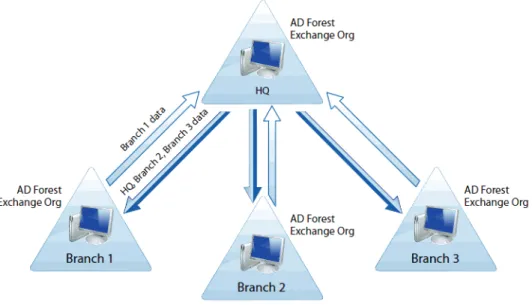
To achieve seamless inter-forest collaboration by providing a common GAL, Collaboration Services synchronizes the selected Active Directory objects between the selected forests using a “hub and spokes” architecture. The HQ forest is the hub, and the branch forests are the spokes.
This architecture optimizes synchronization traffic load balancing and makes deployment easy. Each forest participating in the collaboration sends its data to be published to the HQ forest, and the HQ forest distributes to each branch forest the data it requires. Thus, the HQ forest provides data distribution and manages the data flow between all collaboration partners.
Figure 1: Collaboration Services "hub and spokes" architecture
All forests that take part in collaboration are called synchronization partners.
The administrators of these forests can publish their data in one or more collections and subscribe to the collections published by other forests. When publishing a collection, a forest administrator can either allow the collection to be available by subscription to all synchronization partners, or allow only selected synchronization partners to subscribe to it.
Before a forest can be added to the collaboration structure, one instance of Collaboration Services must be installed on a server in any domain of the forest. This server is referred to as the Collaboration Services server.
Data Synchronization
Even though all data sent between forests is encrypted, Collaboration Services does not store or transmit to other forests any security-related user data, such as account SIDs or passwords. Only data required to provide inter-forest user collaboration is transmitted, such as object names and other attributes, email addresses, and group membership.
Collaboration Services is capable of synchronizing the following mail or mailbox-enabled objects and information:
• Users
• Distribution and security groups • Query-based distribution groups • Contacts
• Free/busy information • Calendar information
Each forest administrator decides which objects (and which of their attributes) should be published and added to the GAL in other forests after subscription, and whether the calendar or free/busy information of the published objects should be available for users in other forests.
Collections
To provide flexibility, the objects to be synchronized are grouped into collections—sets of objects and their attributes. You can either define the objects to be synchronized on per-container or per-group basis; or add groups, users, and contacts to collections explicitly.
Depending on your license type, you can create collections of mixed type, Active Directory-only collections, Calendar-only collections, and Free/Busy-only collections:
• In mixed collections, both Active Directory objects and their calendar or free/busy data are synchronized. As a result, collection objects are added to the common GAL in the subscribing forests, and objects’ calendar or free/busy information is also available in other forests.
• In Active Directory-only collections, only selected Active Directory objects are synchronized; their free/busy or calendar information data is not. As a result, collection objects are added to the common GAL in the subscribing forests, but objects’ calendar or free/busy information is not available.
• In Calendar-only collections, only the calendar information of the specified objects is synchronized (you can select to synchronize calendar date/time information, or all calendar details). As a result, collection objects themselves are not added to the common GAL in the subscribing forests, but objects’ calendar information is replicated over and matched to existing objects.
• In Free/Busy-only collections, only the free/busy information of the selected objects is synchronized. As a result, collection objects themselves are not added to the common GAL in the subscribing forests, but objects’ free/busy information is replicated over and matched to existing objects. Note that in this case you must either create objects to match free/busy information into manually or use some other directory object synchronization tool, such as Microsoft Identity Integration Server (MIIS), to synchronize Active Directory objects between all forests in the collaboration structure. Collaboration Services is able to match the free/busy data to the corresponding user or contacts created by any other software. Free/busy
information is matched to objects based on email addresses.
While mixed collections can provide for synchronization of Active Director and of either calendar or free/busy information, it is best practice to split collections into the following “only” types. This will provide minimal disruption during fault finding. For example, if you are required to delete a
Free/Busy-only collection due to issues, it is best to delete the collection and lose the free/busy data only and then to recreate it. The Active Directory only collection would still maintain the stubs objects. Deletion of the mixed collection would remove the Active Directory stubs as well as the free/busy data.
Note that mixed collections can provide for synchronization of either calendar or free/busy information, but not both. However, when you configure how the Calendar information should be handled on the subscriber side, you can select Always create mailbox option in the subscriber’s properties — in this case, the mail-enabled object on the subscriber side will be always created, and the calendar information will be presented as the corresponding free/busy.
The Synchronization Process
Two Way Synchronization
Two way synchronization is not possible in Collaboration Services. Two way synchronization would allow the subscribing side to change attributes to a publishing partner’s data and this would violate the security of Active Directory and Exchange. The administrator of the publication primarily controls the data and who can access it in the publication. Without this capability, synchronization security cannot be guaranteed. The same applies to subscriptions where the receiving partner decides which subscriptions to subscribe to.
Publication and Subscription
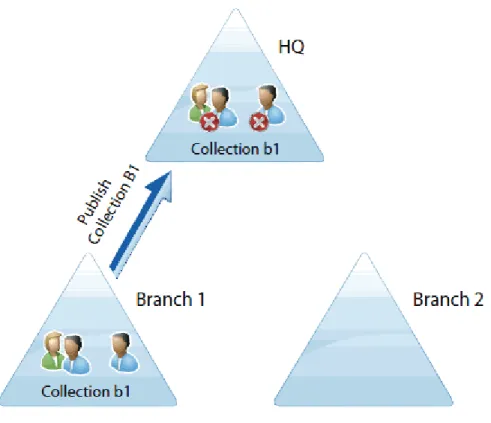
When a forest administrator publishes a collection, the collection becomes available for subscription to the forests specified by the publishing forest administrator.
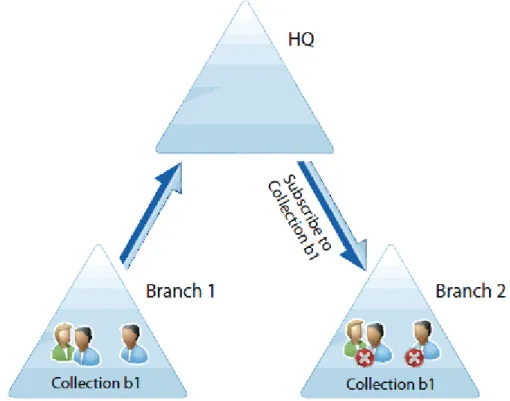
When another synchronization partner’s administrator subscribes to a collection, Collaboration Services creates a stub object (either by creating a new, disabled mail-enabled user account, group, or contact, or by reusing an existing object) for each member of the collection in Active Directory. (If calendar information is published for the collection's object, a mailbox-enabled user account is created and the mailbox is only initially created when there is calendar data to sync.
During this process, Collaboration Services automatically tracks synchronization conflicts and informs administrators, allowing quick resolution so that conflicts never affect users’ workflow.
If free/busy information was published for the collection’s objects, it is also applied on the Exchange server, but only as soon as the corresponding object is created in Active Directory.
Figure 2: Publication and synchronization process
Before a forest subscribes to a collection, the only information available for the forest’s administrator is the collection name, a short collection description provided by the collection creator, and the publishing forest’s description. A collection’s membership (that is, the objects it contains) is available only after its administrator subscribes to the collection. By subscribing to a collection, branch administrator can control which objects and attributes from a collection are applied to his or her forest on per object and
per-attribute basis.
The stub objects for each collaboration partner are created in the dedicated OUs (within the OU specified during the setup).
You can monitor the stub objects as follows:
• Using the Active Directory Users and Computers MMC snap-in (you need to select the Advanced Features from the View menu to be able to view this OU)
• Using Microsoft Outlook or Outlook Web Access to view their appearance in the GAL.
You can monitor the creation of free/busy and calendar information using Microsoft Outlook or Outlook Web Access.
Automatic Synchronization of Changes
The synchronization service performs periodic scans of the Active Directory and Exchange data in each forest to detect any modifications to objects free/busy or calendar information. If the modified objects or free/busy information belong to a published collection’s objects, the changes are collected. Thus, all changes made to the properties and free/busy or calendar information of a collection’s source objects (users, groups, and contacts) are tracked by Collaboration Services and all updates are automatically sent to the collection’s subscribers without requiring administrators to perform any actions. Incremental (delta) synchronization is used for sending updates, along with compression, resulting in very little bandwidth usage.
If some of the collection’s objects are deleted, their stubs will be automatically removed from all forests subscribing to the collection. If new objects fall into the synchronization scope (for example, new object is created in the published container), corresponding new stubs will be automatically created in all forests subscribing to the collection.
The HQ forest maintains a list of all collections that administrators can subscribe to, and distributes initial and update synchronization packets between subscribing branches. The synchronization data flow depends on which forest’s objects were modified:
• If HQ forest objects were modified, update data packets are sent to all branch forests that subscribe to the collections containing the modified objects.
• If the objects of a branch forest were modified, update data packets are first sent to the HQ forest and then are redistributed to the forests that subscribe to the collections containing the modified objects, as illustrated below:
Synchronized Groups
Collaboration Services supports synchronized groups: distribution groups whose membership is synchronized across all forests participating in collaboration. A group owner can add stub objects from other forests to any group. When a synchronized group is published to other forests, the group’s stub is created and its membership is re-calculated in every subscribing forest accordingly, with the original objects replacing the stubs.
Communication Among Forests
All the instances of Collaboration Services installed in different forests communicate with each other using SMTP, which is a native mail exchange protocol for Exchange servers. To reduce traffic, all synchronization data is compressed before it is sent. Then the data is put into regular email messages, which are encrypted, signed, and sent to other synchronization partners.
To provide guaranteed delivery, Collaboration Services maintains a service email message history list. All messages are stored until their delivery is confirmed by the synchronization partner. If message delivery is not confirmed within the specified time interval, the messages are re-sent.
Security
Collaboration Services provides a high level of security. A special dedicated Exchange mailbox in each forest is used for communication with other synchronization partners. All interactions between the services are encrypted.
Each synchronization partner has a password-protected public key file. The public key file (*.akf) contains the email address of the Collaboration Services mailbox used by the partner and the public key for data decryption.
The public key file of the HQ forest is generated during the installation of Collaboration Services in the HQ forest. When you install Collaboration Services in a branch forest, Collaboration Services prompts you for the HQ public key file. Installation of a new branch is impossible without the HQ public key file. After a branch is installed, the branch administrator needs to export and securely transfer the branch’s public key file to the HQ forest administrator, who can then register the branch in the collaboration structure.
Mail Forwarding
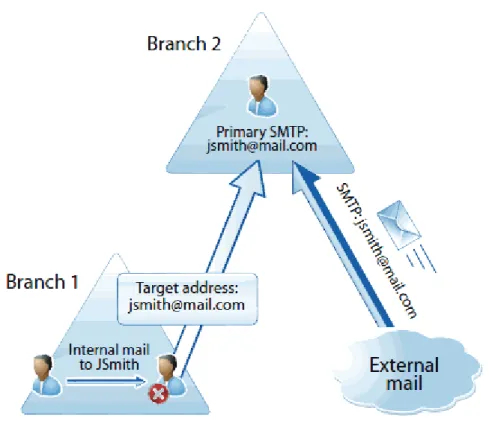
For each published object, Collaboration Services creates a stub object (disabled user account) in the forests that subscribe to the published object’s collection. For mail-enabled users and contacts included in the collection, the redirectors are already established, and therefore, Collaboration Services simply sets and populates the proxy addresses and the target address of the original object to the corresponding attributes of the stub object.
For mailbox-enabled users, Collaboration Services assigns the following addresses to each stub object: To enable group membership synchronization, you must publish the group with members, which is not the default setting. Be sure to select the Synchronize members option when publishing synchronized groups.
• The targetAddress attribute of the stub object is set according to the namespaces settings in the publishing forest. For more information, see the Namespaces Usage section of the Quest Collaboration Services User Guide.
• The primary SMTP address of the original object is assigned as a primary SMTP address of the stub object.
• The secondary SMTP addresses of the original object, if they exist, are assigned as secondary SMTP addresses of the stub object.
Figure 4: A user who wants to send a message to a user from another forest just selects the recipient (Collaboration Services stub) from the Global Address List (GAL) and sends the message. As soon as a message is sent, Exchange server verifies the targetAddress attribute value and redirects the message to the other forest.
External mail always comes directly to the original object and does not use the Collaboration Services stubs.
You need to have all necessary connectors established from your Exchange organization to the original object’s organization so Exchange server can redirect messages correctly.
Administrative Interface
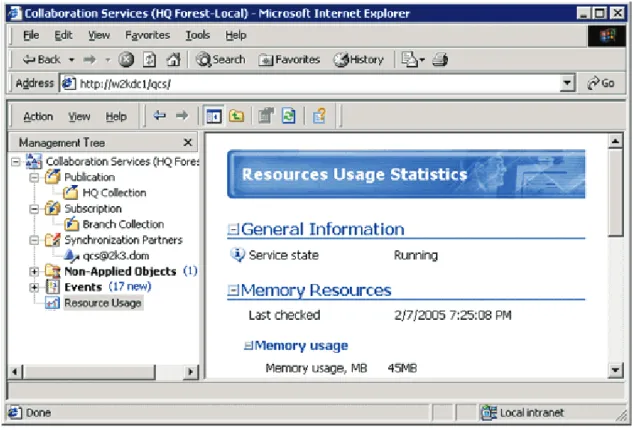
All Collaboration Services administration is performed through a web interface. Extensive statistics provided by the web interface help you track the synchronization activities and provide all the information needed for effective administration.
Before You Begin
This section describes what you need to do before installing Collaboration Services. The pre-installation checklist will also help with these preparations. For details, see “Installation Checklists” on page 36.
System Requirements
Exchange Server
Collaboration Services can establish secure collaboration between forests with the following messaging systems installed:
• Microsoft Exchange Server 2003 Service Pack 2 or later • Microsoft Exchange Server 2007 Service Pack 1 or later
• Microsoft Exchange Server 2010 Service Pack 3 Roll-up 1 • Microsoft Exchange Server 2013 Cumulative Update 1
Collaboration Services Server
One instance of Collaboration Services should be installed in each forest participating in the
synchronization. For performance reasons, in a production environment it is highly recommended you install Collaboration Services on a dedicated server (not holding any other roles such as file server, print server, Exchange server, or domain controller).
Ensure the target computer meets the following requirements:
Platform
• Intel x86-based computer
• Pentium III or higher. Multi-processor configurations are recommended for the HQ forest server in large deployments.
Memory
A minimum of 1 GB RAM is required; 4GB is recommended. Requirements for RAM depend on the total number of synchronized objects:
To use the free/busy synchronization option with Microsoft Exchange Server 2010, Service Pack 1 must be installed along with a configured public folder store. Without Service Pack 1 you will only be able to use the Active Directory and calendar synchronization options with Exchange 2010.
Exchange 2013 only supports Active Directory and calendar synchronization options.
Using faster processors and multi-processor configurations generally improves synchronization performance.
• 100,000 to 300,000 objects – 8GB • More than 300,000 objects – 16GB
Hard Disk Space
A minimum of 50GB of free disk space is required. Additional disk space requirements are as follows: • 10MB per every 1K of synchronized Active Directory objects
• 10MB per every 1K of synchronized free/busy objects or Calendar objects
Operating System
One of the following:
• Microsoft Windows Server 2003 Service Pack 2 or later • Microsoft Windows Server 2008
• Microsoft Windows Server 2003 R2 • Microsoft Windows Server 2008 R2 • Microsoft Windows Server 2012
Additional Software
Collaboration Services requires the following:
• Microsoft Exchange Server MAPI Client and Collaboration Data Objects 1.2.1 build 6.5.8309.0
• Microsoft Internet Explorer 8.0 or later • Microsoft Windows Installer 2.0 or later
• Collaboration Services supports the following Active Directory forest functional levels: Windows 2003, Windows 2008, Windows 2008 R2 and Windows 2012
Service Account Rights and Permissions
The account used as the service account should also be used to install and configure Collaboration Services. Ensure that the account has the following rights:
• Member of the Built-In Administrator group in all domains where Collaboration Services is installed
• Exchange Full Admin rights
• Member of the Local Administrators group on the computer where Collaboration Services is to be installed
Do not install Outlook or other MAPI clients on the same computer as Collaboration Services.
The full administrative rights for Exchange are different for each version. Refer to the Quest Support site (http://support.quest.com.) for the latest information on the required rights.
SMTP Connectivity
Collaboration Services instances communicate with each other using SMTP. It is recommended to establish SMTP connectors between the HQ and branch forests to optimize mail flow between synchronization partners. Please see the Microsoft Exchange Server documentation for details. If you use DNS to route mail, DNS servers in all forests must have Mail Exchanger (MX) records to correctly route mail between collaboration partners. For more information, please refer to the appropriate DNS documentation.
Service Mailbox
The Collaboration Services service requires a service mailbox, which will be used to exchange
synchronization data with other synchronization partners. A service mailbox should be created in each forest participating in the collaboration.
Platform Considerations
Recipient Update Service
With Collaboration Services version 3.6 and later, the RUS is enabled by default if Exchange 2007 or higher is detected in the Exchange environment. If not selected, published objects will not appear in the Global Address List.
You can also set up the mail flow using the Exchange smart host feature. This is useful if you install Collaboration Services in a test environment and do not want to set up and configure a DNS server. For more information, please refer to the appropriate Microsoft Exchange Server documentation.
Check the mail flow between all forests before deploying Collaboration Services by sending test emails between the HQ and branch service mailboxes in both directions. By doing this test, you can be sure all forests will be able to communicate with each other using the specified mailboxes. The test can be easily performed using, for example, Outlook Web Access (OWA).
Ensure anti-spam filters are configured appropriately in all forests. In the HQ forest, be sure to add all branches’ service mailboxes addresses to the safe senders list. In each branch forest, add the HQ forest service mailbox address to the safe senders list.
To prevent possible conflicts with Exchange RUS, you should disable the RUS option for Exchange 2003 or if you have a mixed environment.
Choosing Between Free/Busy and Calendar
Synchronization
Review the table below to determine what synchronization type best suits your environment.
[1] - Public folder store is mounted in the organization [2] - UseLegacyFB registry key is set for each Mailbox
[3] - Configuration of the Availability Service to set the Address Space (https://support.quest.com/Search/SolutionDetail.aspx?id=SOL42144) NR - Not Recommended
* For newer Outlook clients (Outlook 2007 and above) used with Exchange 2003, the UseLegacyFB registry key is needed for each user. However, Outlook 2010 ignores this key, and therefore you cannot connect to public folders using this method with Outlook 2010.
Free/Busy synchronization is typically faster than Calendar synchronization, but it requires that Public Folder storage be available and some configuration work in the Exchange 2007/2010 environment. For Exchange 2003, Calendar synchronization is not recommended.
OUTLOOK 2003 OUTLOOK 2007 OUTLOOK 2010 CALENDAR SYNCHRONIZATION
EXCHANGE 2003 NR NR NR
EXCHANGE 2007 [1] Yes Yes
EXCHANGE 2010 [1] Yes Yes
EXCHANGE 2013 No Yes Yes
FREE/BUSY SYNCHRONIZATION
EXCHANGE 2003 [1] [1][2] [1]*
EXCHANGE 2007 [1] [1][3] [1][3]
EXCHANGE 2010 [1] [1][3] [1][3]
Public Folders
Collaboration Services uses public folders to access free/busy information on the Exchange Server. Many organizations have these enabled, especially when there are legacy clients in use. However, on Exchange 2007/2010/2013 a public folder database is not created by default. If you plan to synchronize free/busy data, and you have not already done so, you will need to perform the following steps in order to complete your Collaboration Services installation.
To enable public folders
1. Create the public folder database.
2. Run the following command at the Exchange console to enable publishing of free-busy data to the public folders:
Add-AvailabilityAddressSpace -AccessMethod PublicFolder -ForestName <Source-Domain>
Exchange 2007 Only
If you have not installed a trusted certificate on IIS, you must disable SSL encryption on the public folders virtual directory.
Exchange 2010 Only
There is a known issue in Exchange 2010 which breaks its Availability Service's ability to read public folder data. This is fixed in Service Pack 1. If you are using free/busy synchronization with an Exchange 2010 server, you will require the Service Pack 1 update.
Exchange 2013 Only
In Exchange 2013 free/busy synchronization is not available or supported.
If you merge your organizations and are no longer using Collaboration Services, and you do not require public folders for any other purpose, you may remove them.
Pre-Installation Planning
This section provides general recommendations for deploying Collaboration Services. These
recommendations are based on the experience of deploying Collaboration Services at Quest Software. Quest has two separate Active Directory forests with an Exchange organization in each. Before
Collaboration Services was implemented, there was no automated mechanism to maintain collaboration between the two Exchange organizations. Administrators had to manually create contacts for
corresponding users and groups in the other forest per user requests. Moreover, end users in separate forests could not see their colleagues’ free/busy information and schedule meetings with each other. With Collaboration Service deployed, users in different forests collaborate seamlessly.
This section divides the process of deploying Collaboration Services into the following phases, and provides recommendations to help you complete each phase successfully:
• Phase I: Planning
• Phase II: Preparing Forests
• Phase III: Deploying Quest Collaboration Services
Phase I: Planning
Thorough planning is essential for a successful deployment. If Exchange and Active Directory are managed by separate teams, it is important that members of both teams from each forest participate in planning.
This section explains the directory information you need to gather and analyze before you start to prepare the environment and deploy Collaboration Services. The planning phase consists of the following general steps:
1. Gather information from all Active Directory forests that will participate in synchronization. 2. Analyze possible conflicts between manually created contacts or other objects and
Collaboration Services stub objects, and plan conflict resolution.
3. For each forest, choose the criteria for grouping objects into collections.
Step 1: Gather Directory Information
Begin by gathering and analyzing the following information from every Active Directory forest that will participate in synchronization:
Information about the objects that should be synchronized
Information required for conflict resolutionObjects to Be Synchronized
Contact the appropriate people in each forest to be synchronized and obtain the following information:
What objects (such as users, groups, and contacts) are to be synchronized
Approximate number of these objects
Placement of these objects in the forest’s organizational unit structureThis information allows you to estimate the initial synchronization time and helps you to design collections of objects.
Conflict Resolution Information
A conflict occurs when two or more objects from different forests have the same email address. Most conflicts are due to manually created contacts pointing to users in other forests. To avoid problems, you need to analyze information about the objects from all forests participating in Collaboration Services synchronization and then configure Collaboration Services to resolve conflicts automatically.
An administrator in each forest should gather and analyze data on the following attributes of all mail or mailbox-enabled users, groups, and contacts:
targetAddress
proxyAddresses
mail
mailNicknameStep 2: Plan Conflict Resolution
After you have information from all the forests, you can analyze it to plan conflict resolution.
Conflicting Email Addresses
When Collaboration Services creates a stub object, it verifies that no other object with the same address exists in the forest by querying the nearest Global Catalog. If the object already exists, Collaboration Services can take any of the following actions:
• Delete the conflicting object and create a stub object.
This method works for forests that have contact objects corresponding to another forest’s users or distribution groups. Deletion is the most straight-forward and recommended method to resolve conflicts, since it is the only option that can resolve conflicts between objects of different classes (for example, user and contact).
• Match the new object into the existing one.
This method works only if both the stub object being created and the conflicting object are of • Collaboration Services is not capable of automatically resolving conflicts when more than two objects
are in conflict. Resolving these conflicts requires administrator intervention.
• Information about every conflict found during synchronization is recorded in the Collaboration Services log.
In this method, the existing object is used as a stub for the duration of synchronization. The difference between this type of stub object and a regular stub object is that the object keeps its account state unchanged; for example, if the account was enabled, it remains enabled after Collaboration Services makes a stub of it.
• If Collaboration Services cannot resolve the conflict for a particular object automatically using the current settings, then the object is placed in the Non-Applied Objects queue, from which you can resolve the conflict by either approving the suggested action or configuring another action manually.
For example, a user can have active user accounts with the same email address in two or more forests. This probably means that user needs to access resources in both forests. If so, it is recommended not to delete the conflicting objects but to use matching. In this case, active accounts can be used as stubs, so the users will still be able to log on in multiple forests with Collaboration Services deployed.
When configuring the matching, you can choose the attribute synchronization direction on a per-attribute basis, so some or all attributes are synchronized from the published object to the object you are matching into. Attribute synchronization is useful if the user account is updated by the provisioning system in one of the forests and these changes need to be propagated to the same user’s accounts in other forests.
Figure 6: Attribute synchronization
If you have active user accounts of the same user in multiple forests but do not want to use matching for some reason, you can do one of the following:
• Exclude these accounts from Collaboration Services synchronization; since the user is represented in both Exchange organizations’ global address lists (GALs).
This method will be applied only to objects located in the OUs you specify, and to objects for which pre-matching rules were created.
• Delete the Exchange mailbox for all but one of the accounts. These accounts will still be enabled and used to access resources. Collaboration Services will create disabled stub user accounts for Exchange collaboration.
Other Conflicts
There can be other conflicts that are not detected and resolved by Collaboration Services automatically because the conflicting objects do not cause technical issues, but can confuse the end users. Examples include:
• Accounts that have different email addresses but correspond to the same user. If these accounts are synchronized, the GAL will have two entries for the same user.
• Namesakes in different forests. If user accounts with the same name are synchronized, two different users will appear in the GAL with the same name. You can use a Collaboration Services suffix mapper to add text descriptions to the stub objects’ display names to help avoid confusion. For more information, see the Mappers section in the Quest Collaboration Services User Guide.
Step 3: Plan Collaboration Services Configuration
Choose the HQ Forest
After you decide how conflicts will be resolved in each forest, you can plan the Collaboration Services configuration. The main decision will be which forest should serve as the headquarters (HQ) for Collaboration Services synchronization. Only one HQ forest can be set up in a Collaboration Services environment.
Consider the following criteria when selecting the HQ forest:
Synchronization Performance Considerations
To increase synchronization performance and reduce network traffic and HQ server load, choose the forest containing the most data to be synchronized.
Hardware Considerations
The HQ forest processes all synchronized data from all synchronization partners. Therefore, there is a higher data processing load on the HQ Collaboration Services server, which means higher hardware requirements.
Support Considerations
The HQ forest administrator will be a key person to help other partners in tuning performance and troubleshooting problems for the whole Collaboration Services structure.
The HQ forest role cannot be granted to any other forest after Collaboration Services has been deployed. To change the HQ forest, you will need to go through the deployment process again.
Object Selection
You must also consider how you will form object collections. This decision may require additional environment preparation. Collaboration Services allows both explicit and dynamic object selection. Dynamic object selection may be based on the following:
• Active Directory OU structure
If all the objects to be synchronized from a forest reside within the same OU or a few OUs, you can specify which types of objects should be synchronized from these OUs. This is the recommended method of object selection.
• LDAP filters
Use filters to narrow the scope of objects that belong to a collection. This option is available only if you organize your collection on a per-container basis. If you plan to use LDAP filters for object selection, create and test the filters in advance. You can use any utility that can perform LDAP searches to test a filter, such as Ldp.exe or Csvde.exe.
• Groups
User accounts and contacts that are members of a group can be published along with the group.
Mappers
Decide if you need mappers to customize Collaboration Services synchronization. For example, consider using mappers if:
• Different forests use different naming standards. A mapper can be used to create stub objects according to a forest’s naming standards.
• You would like to add a description to the stub objects’ display names.
Phase II: Preparing Forests
Before deploying Collaboration Services, you should prepare each forest as follows: 1. Take care of user objects that require manual conflict resolution.
2. Restructure the Active Directory OU hierarchy, if necessary. 3. Create accounts with the necessary permissions.
4. Dedicate a server for the Collaboration Services synchronization service. 5. Verify free/busy accessibility.
The nested groups and their members will not be published.
Most mappers can be used by both the administrator who publishes collection and the administrator who subscribes to it. For a detailed description of mappers and their usage, refer to the Mappers section of
Step 1: Resolve Conflicts
If you have identified any conflicts that cannot be resolved automatically, make sure to resolve them manually before you deploy Collaboration Services. In particular, it is recommended to remove all manually-imported contacts for user objects you are planning to synchronize with Collaboration Services.
Once there are no more conflicts, re-collect object information from all forests and analyze it again to ensure that the initial synchronization will go smoothly.
Step 2: Restructure the OU Hierarchy
Consider restructuring the OU hierarchy in the following cases:
• If you plan to automatically resolve synchronization conflicts by deleting the conflicting object or matching it.
These types of object resolution are applied to the specified OUs only. This allows you to put all potentially conflicting objects in the organization into the same OU and ensure that Collaboration Services affects only the objects in that OU.
• If you plan to create OU-based object collections.
In this case, you may need to move all OUs containing the objects to be synchronized to a single parent OU. This will simplify configuration of Collaboration Services collections and make it easy to add objects to or remove objects from the synchronization, as follows:
• To add an object to the synchronization, add the object to the appropriate container or create a new object in the container.
• To remove an object from the synchronization, delete it from or move it out of its container.
Step 3: Create Service Account
You should use one account per forest to act as the service account. This account will be used to: • Start the Collaboration Services service
• Retrieve object data from Active Directory and Exchange Server • Create and update stub objects
• Resolve conflicts according to the specified rules
Though Collaboration Services is capable of resolving conflicts automatically, the initial synchronization speed significantly decreases if the service must frequently resolve conflicts. It is recommended to resolve as many of them as possible before you start the synchronization.
Every service account must be mailbox-enabled, because its mailbox will be used by the Collaboration Services server for data exchange between the HQ and branch forests.
Step 4: Dedicate a Server
Collaboration Services can be installed on any computer in a forest. For performance reasons, it is highly recommended to install it on a dedicated server not holding any other roles such as file server, print server, Exchange server, or domain controller.
Ensure the server meets hardware and software requirements listed in the “System Requirements” on page 11.
Step 5: Verify Free/Busy Accessibility
Synchronized free/busy information is stored on the Exchange server keeping the free/busy public folder for the administrative group that contains Exchange server where the service mailbox resides.
If your Exchange deployment contains multiple administrative groups, free/busy information access between various groups must be obtained using either public folder referrals or free/busy folder replication. In fully functional production environments, one of these methods is usually already implemented and no further action is needed. Nevertheless, many customers have problems with access to free/busy information, so you should ensure that users from each domain are able to access the free/busy information located on the server that Collaboration Services will use.
Please see the appropriate Microsoft Exchange server documentation for more information on configuring free/busy information access between administrative groups.
Phase III: Deploying Quest Collaboration
Services
This section provides a sample scenario for installing and testing Collaboration Services, including the recommendations for the following procedures:
1. Install Collaboration Service 2. Initial configuration
3. Publication of test collections 4. Publication of all Users objects
Step 1: Install Collaboration Services
Install Collaboration Services on dedicated servers in each forest at least a week before the planned synchronization start date. This will give you time to exchange the public key files, troubleshoot any installation problems, configure Collaboration Services instances, and synchronize a test collection of users between forests.
The service mailbox will accept only authenticated packets from Collaboration Services service instances in another forest. All other email messages will be automatically deleted from the mailbox. Therefore, you cannot use any existing user mailbox for Collaboration Services.
To install Collaboration Services
1. Remove Outlook and ESM and download and install the latest MAPI CDO.
2. Install the Collaboration Services instance in the HQ forest. During the setup, the HQ public key file will be generated.
3. Securely transfer the HQ public key file to the branch forest administrators. Installation of branch forests is not possible without the HQ public key file.
4. Install Collaboration Services in each of the branch forests.
5. Log on to each branch forest’s administrative interface and export its branch public key file. 6. Securely transfer the public key files for all branches to the HQ forest administrator.
7. Log on to the HQ forest administrative interface and register all branches in the collaboration structure.
HQ Forest Installation
The first step in Collaboration Services deployment is to set up the HQ forest.
To set up the HQ forest
1. Using the setup account, log on to the computer where you want to install Collaboration Services and run the Quest Collaboration Services Installation Wizard.
Alternatively, you can run the installation from the command line using the runas command with the appropriate parameters.
2. On the Welcome screen, click Next.
3. Read and accept the license agreement and click Next.
4. Specify User Information, provide the license file, and then click Next. Before installing Collaboration Services you need to:
• Download and install the latest version of Microsoft Exchange Server MAPI Client and Collaboration Data Objects.
• Ensure that you do not have Outlook or other MAPI clients installed on the same machine that Collaboration Services is installed.
Exclude the installation folder %Program Files%\Quest Software\Collaboration Services and all sub folders from the virus scan software.
Carefully consider which forest will serve as the HQ forest, since the Collaboration Services structure can not be changed later without re-deployment.
5. Select which Collaboration Services features to install and either accept the default path for installation or specify a different folder, and then click Next.
6. Specify the credentials for the service account to be used to start the Collaboration Services service. Click Test to check whether the specified account has a valid mailbox, and click Next.
7. Specify the partner configuration options:
a) Choose the partner configuration. Since Collaboration Services is being deployed in the HQ forest, select the HQ option.
b) Supply the forest’s description. This description and the service mailbox address will be the only information about your forest available to the administrators of other forests. c) Select an Active Directory container to store the stub objects created by Collaboration
Services for purposes of mail redirection. For more information on how the stub objects are created and used, see the see “Mail Forwarding” on page 8.
d) Collaboration Services uses the Active Directory extension attributes to mark objects as synchronized and assign collection membership to them. Select any of the 15 extension attributes available. Ensure the selected attribute is not used by any other software. 8. Click Next.
9. Configure notification by specifying who is to receive email messages with all the errors and warnings generated by service.
10. Enter the email address of the recipient in the Send notifications to box (or click Browse to select it), and click Next.
Collaboration Services provides secure communication between forests by using data encryption and signing. Collaboration Services uses public key files, each containing a data encryption key and the SMTP address of the service mailbox for one forest.
11. On the Public Key page, configure the HQ Public Key by specifying a file name and location where the HQ public key file should be saved, and supply a password to protect the file. Click
Next.
It is not recommended to install Collaboration Services on a system volume.
The service account must be mailbox-enabled, and it must be a member of the Local Administrators group on the computer where you install Collaboration Services. The account’s mailbox will be used by the Collaboration Services server for data exchange between the HQ and branch forests. The address of this mailbox will be included in the HQ public key file.
The Service Account should have Full Control to the Active Directory container specified in Step 7c below.
The email address specified for receiving notifications can be changed using the Email sub-page of Logging page of the Collaboration Services Properties dialog box. For more information about notifications, refer to the Logging section of the Quest Collaboration Services User Guide.
All messages from HQ will be encrypted using the encryption key in the specified public key file. The HQ public key file is not created immediately; rather, it is automatically generated and saved upon setup completion, after the synchronization service is installed and started.
12. Click Next and wait while the wizard completes the installation of Collaboration Services to the HQ forest.
13. Click Finish to complete the wizard.
Branch Forest Installation
Once the HQ forest has been deployed, one instance of Collaboration Services should be installed in each branch forest.
To install Collaboration Services on a branch forest
1. Using the setup account, log on to the computer where you want to install Collaboration Services and run the Quest Collaboration Services Installation Wizard.
Alternatively, you can run the installation from the command line using the runas command with the appropriate parameters.
2. On the Welcome screen, click Next.
3. Read and accept the license agreement, and click Next.
4. Specify the user information, provide the license file, and then click Next.
5. Select which Collaboration Services features to install and either accept the default path for installation or specify a different folder, and click Next.
6. Specify the credentials for the service account to be used to start the Collaboration Services service. Click Test to check whether the specified account has a valid mailbox, and click
Next.
7. Configure the Partner by specifying the following:
After you complete the installation of Collaboration Services to the HQ forest, securely transfer the HQ public key file to the branch forest administrators so they can install an instance of Collaboration Services in their forests.
Installation of Collaboration Services to the branch forest is not possible without the HQ forest’s public key file.
It is recommended to close all Windows applications before running the setup.
It is not recommended to install Collaboration Services on a system volume.
The service account must be mailbox-enabled and must be a member of the Local Administrators group on the computer where you install Collaboration Services. The account’s mailbox will be used by the Collaboration Services server for data exchange between the HQ and branch forests. The address of this mailbox will be included in the branch public key file.
The Service Account should have Full Control to the Active Directory container specified in Step 7c below.
a) Choose the partner configuration. Since Collaboration Services is being deployed in the branch forest, select the Branch option.
b) Supply the forest’s description. This description and the service mailbox address will be the only information about your forest available to the administrators of other forests. c) Select an Active Directory container to store the stub objects created by Collaboration
Services for purposes of mail redirection. For more information on how the stub objects are created and used, see the see “Mail Forwarding” on page 8.
d) Collaboration Services uses the Active Directory extension attributes to mark objects as synchronized and assign collection membership to them. Select any of the 15 extension attributes available. Ensure the selected attribute is not used by any other software. 8. Click Next.
9. Configure Notifications by specifying who is to receive email messages with all the errors and warnings generated by service.
10. Enter the email address of the recipient in the Send notifications to box (or click Browse to select it), and click Next.
Collaboration Services provides secure communication between forests by using data encryption and signing. Collaboration Services uses public key files, each containing a data encryption key and the SMTP address of the service mailbox for one forest.
11. On the Public Key page, click Browse to specify the HQ forest public key file location and provide the password for this file. Click Next.
12. Click Next and wait while the wizard completes the installation of Collaboration Services to the branch forest.
13. Click Finish to complete the wizard.
The email address specified for receiving notifications can be changed using the E-mail sub-page of Logging page of the Collaboration Services Properties dialog box. For more information about notifications, please refer to the Logging section of the Quest Collaboration Services User Guide.
As soon as Collaboration Services is deployed to the branch forest, export the branch public key file and securely transfer this file to the HQ forest so its administrator can register the installed branch forest in the collaboration structure. For details, see “Prepare for Use” on page 31.
Using the ACS Users and ACS Administrators Groups
When Collaboration Services is installed on a server, two local groups are automatically created: • ACS Users members can view configuration and the current statistics information, but are not
allowed to modify any settings.
• ACS Administrators members have full control over Collaboration Services configuration. Use these groups to restrict access to Collaboration Services configuration and make the statistics information available to appropriate people in your organization.
Test Local Access
To open Collaboration Services interface on the computer where the service is installed
• Select Start | Programs | Quest Software |Collaboration Services.
Step 2: Configure Collaboration Services
Once a Collaboration Services instance is installed in each forest, you need to configure each instance to fit your environment.
Use the synchronization settings to fine-tune the interaction between Active Directory, Exchange, and Collaboration Services instances, and the connectivity between the synchronization partners. To open the Collaboration Services Properties dialog box, select the Collaboration Services node in the
management tree and Properties from its shortcut menu.
Set up Conflict Resolution Rules
You can choose either automatic or manual conflict resolution:
• In most cases, you can configure the service to resolve the conflicts automatically. To do that, select and configure the desired conflict resolution method.
• Alternatively, you can choose to resolve conflicts manually, which is quite convenient during product testing. Just wait for a conflicting object to appear in the Non-Applied Objects queue, and then either approve the conflict resolution actions suggested by Collaboration Services or choose a custom conflict resolution action.
Check Namespace Settings
Carefully check the namespace settings after deployment. During the setup, Collaboration Services automatically populates namespaces with values from the Exchange organization’s recipient policies. Using the wrong namespaces may result in incorrect mail forwarding or an inability to create the stub objects at all. Refer to the Quest Collaboration Services User Guide for more information on using namespaces.
If Collaboration Services is installed on a domain controller, ACS Users and ACS Administrators will be created as domain local groups.
Step 3: Publish Test Collections
Once the Collaboration Services instances are configured in each of the forests, you can publish a test collection from each forest. The test collections should be published a week before publishing all users objects.
When creating the test collections, you should specify the same synchronization type you are planning to use with regular collections. Depending on your license type, you can create collections of mixed type, Active Directory-only collections, and calendar or free/busy-only collections. For descriptions of these types, see the Collections section of see “Data Synchronization” on page 3.
Synchronization Settings
By default, the Active Directory synchronization intervals are configured so that Collaboration Services does not impose too much load on Active Directory. To make test collections objects update faster, you can set the Collaboration Services to the "Synchronize Now" mode, so that all timeouts are reduced to the minimum on both publisher and subscriber. To do that, select the Publication node and click Synchronize Now. This mode automatically turns off in 2 hours.
Alternatively, you can reduce all timeouts manually. Use the options on the Synchronization page and its sub-pages of the Collaboration Services Properties dialog box.
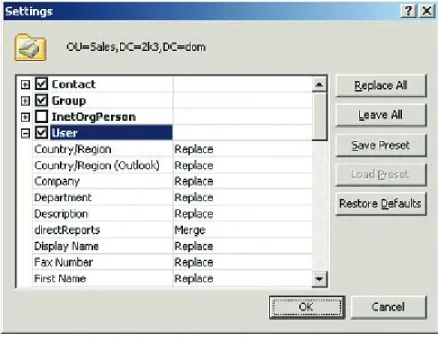
When creating collections, you can select the attributes that should be published to the other forests. A predefined set of attributes have been pre-selected for each type of object. The following can also be synchronized:
• Minimum: Only object attributes required to create a valid mail-enabled or mailbox-enabled Active Directory object are published.
• All Attributes: All object attributes (except security–related attributes) are published. • Add Attributes: Add object attributes to the default attributes to be published.
You can also individually select the attributes to be published for each object class by expanding the object listed in the wizard.
Object Selection
Several users from each forest should be included in the test collections. It is recommended that you explicitly specify 5–10 users in the collection settings.
• To test automatic conflict resolution, include a couple of conflicting users in the test collection by manually creating conflicting contacts or user accounts to match into on the subscriber side.
A Collaboration Services administrator in each branch and in the HQ forest must subscribe to the test collections manually in order for the collection objects to be applied to their forests.
Each explicitly-specified object is added to a collection using the object's distinguished name (DN), but the DN is converted to an object GUID during the first collection membership scan. As a result, moving such an object to another OU will changes its DN but will not actually remove the object from the collection.
• To test group membership synchronization between forests, make a few stub objects from another forest members of the group that you publish. You can use the Active Directory Users and Computers snap-in to do this.
• To test free/busy or calendar synchronization, be sure that test users have their free/busy or calendar information populated.
Monitoring
Verify that the stub user accounts are created in the proper location, and that users are published in the Exchange GAL. The stub objects for each collaboration partner are created in the dedicated OUs (within the OU specified during the setup).
You can monitor the stub objects as follows:
• Using the Active Directory Users and Computers MMC snap-in (you need to select the Advanced Features from the View menu to be able to view this OU).
Or
• Using Microsoft Outlook or Outlook Web Access to view their appearance in the GAL.
You can monitor the creation of free/busy and calendar information using Microsoft Outlook or Outlook Web Access.
You can also use Collaboration Services statistics and events to view the current state of the service and the synchronization status. The following Collaboration Services statistics sections will be most helpful when monitoring the initial synchronization:
• Publication shows overall information about all published collections, as well as detailed information for every collection.
• Subscription shows the overall information about all collections your forest is subscribed to, as well as detailed information for every collection.
• The Synchronization Partners shows the information on quotas; the time, result, and status of the transport service’s last operation; and detailed information for every synchronization partner, including its status.
Testing
Once the stub user accounts are created, the corresponding users appear in each Exchange
organization’s GAL. However, you cannot consider the test collection successfully published until you test the mail flow between the Exchange organizations.
To verify that users can collaborate, send a test message to a stub user created by Collaboration Services. Make sure the user in the other forest receives the email and is able to reply.
With the default synchronization settings, it may take up to half an hour for test objects or updates to be replicated to another forest. Use the "Synchronize Now" mode to reduce this time to a few minutes.
Emails coming from the other forest appear as if it were sent by a user in the same Exchange organization.
Verify that the calendar or free/busy information is applied and available to all users from both the current and other Exchange administrative groups.
Modify several properties of the test user accounts included in the collection and their calendar or free/busy information (if it was published), and make sure the changes are replicated to other forests. For example, you can add or change a description or a phone number.
If you have chosen to automatically resolve conflicts, pay particular attention to the following:
• The stub object created by Collaboration Services has the x.500 directory address of the initial conflicting object. This is to ensure that other users can reply to the old email messages from the user represented by this stub. Verify that you can answer an old email from such a user. • The stub object created by Collaboration Services is automatically included in the same groups
as the initial conflicting object. Verify group membership, and try sending an email to a group that includes such a user.
• Stub group objects created by Collaboration Services preserve membership of the original conflicting group objects. If you have included any groups in the collection, verify that the group membership is preserved.
• The attribute synchronization for objects you choose to use matching for is working as expected.
Step 4: Publish All Required Users
After you verify that the test collection is synchronizing properly for several days, you can start synchronization for all users. You can either create new collections, or edit the test collection settings to include all users.
Settings
If you have manually changed the default timeouts when publishing the test collection, do not forget to adjust the options back to the recommended values.
You may want to fine-tune the interaction between Active Directory, Exchange, and Collaboration Services instances using the synchronization settings. The default settings are good for most
environments; however, you may want to optimize them for your own environment. For example, if your Active Directory data is updated rarely, you can increase the Query AD for changes value. Or you may want to restrict Active Directory and Exchange server access during the busiest production hours by using scheduling.
When creating a collection, either proceed with the All attribute preset (it is selected by default), or individually select the attributes to be published for each object class, depending on your requirements.
If you have multiple large collections, it is recommended to publish them one by one to improve overall synchronization speed. That is, publish the first collection and wait until the initial synchronization is over for all subscribing forests, and then publish the next collection. This can be achieved by first creating all collections in a disabled state and then enabling them one by one as necessary.