Knowledge Management in Delivering Customer
Oriented Services in Public Sector
Sanda Zaharova1, Kristine Zelmene2 1Riga Technical University
2Riga Technical University
Abstract. Today in response to the changes in global economy, growing customer demands and increasing IT possibilities the public sector adapts approaches that have proven to be successful in business environment. Many private companies have successfully implemented customer relationship management strategies and are starting to use knowledge management applications to improve the quality and efficiency of customer service. The paper addresses the question whether the knowledge management approach that has proven to be successful in business environment is applicable to the provision of public sector services. The answer to the question is based on research of academic and business literature, as well as experience gained from participation in Riga1 municipality e-city project.
1
Introduction
Knowledge management (KM) has recently attracted significant attention in business environment as a powerful tool to increase corporate competitiveness by means of more efficient governance of companies’ information assets. KM has to be treated as operating philosophy rather than a specific application category, which is applicable to all business process areas of the company [2]. Customer service and support has proven to be the area where the application of knowledge management models and tools demonstrate most significant and tangible benefits for companies. Integration of knowledge management and customer relationship management (CRM) clearly shows high synergy potential and is becoming a hot issue both in business and academic circles [1].
Today the public sector faces major challenges arising from the emergence of information society. Under the logo of e-government projects governments and municipalities are implementing modernization programs to meet new requirements of society. Along with e-democracy and efficiency improvement initiatives governments and municipalities around the world are implementing CRM projects
aimed at increasing the accessibility and quality of public services employing the experience of private sector in this area.
The paper addresses the question whether and to what extent the application of knowledge management methods in the customer service area that have proven to be successful in business environment are applicable to the public sector. The answer to the question is based on the research of available academic and business studies in this area as well as experience gained from participation in Riga municipality e-city project.
2
Knowledge Management and CRM in the Private Sector
Knowledge management is an ample concept and, unfortunately, lacks a commonly accepted definition. In this paper the authors will define KM as a process of identifying, capturing, retrieving, sharing, and evaluating intellectual and knowledge-based assets through which organizations generate business value. Most often, generating value from such assets involves contribution of employees, departments and even other companies to the common effort aimed at devising the best practices. It is important to note that while KM is often facilitated by IT, technology by itself is not KM. The examples of application categories that could imply knowledge management approaches are:
− web portals and content management tools;
− document repositories;
− search engines;
− data warehouse and business intelligence tools;
− expert systems (case-based reasoning);
− workflow systems;
− collaboration and groupware systems;
− natural language queries processing systems;
− images handling systems.
The early adopters of knowledge management initially have been global, multinational companies. Because of the market force and the need to become more competitive by bringing more value to their customers, companies had an urge to exploit more effectively one of the most valuable assets: the knowledge. Thanks to the natural driving force – competitiveness, companies had been investing and developing complicated knowledge management systems that supported their business needs. These systems supported collecting, capturing and disseminating knowledge in the most effective way.
As stated previously, KM has to be perceived as an operational philosophy that could add value to all areas of a company’s operation. Meanwhile, there is a consensus among business analysts, academic researchers and business people that customer relations, service and support are the areas where the application of KM could bring most significant tangible and intangible benefits to company. Knowledge management is playing an important role in numerous aspects of comprehensive
customer relationship management initiatives. Enterprises that incorporate KM processes as part of their CRM initiatives have a higher probability of success than those that do not. [3]
From a CRM perspective, many CRM processes (service, sales and marketing) clearly rely on knowledge resources. This can be illustrated by the following examples:
− knowledge about the product use or service quality;
− knowledge about customer behavior and preferences, customer relationship history;
− sales personnel knowledge, such as best sales practices and customer care details;
− market intelligence and analytics, such as market growth statistics, market structure and trends, driving forces, forecasting;
− business partner knowledge, such as the complementary services and products of interest to customers;
− knowledge of and about business processes - how and why processes are designed and interact;
− knowledge of contracts or partner agreements;
− skills and competencies of employees;
− expectations, needs and aspirations of employees.
Integration and eventual synergies of KM and CRM concepts can be analyzed using process-oriented approach [1]. According to this study knowledge flows in CRM processes can be classified into three categories:
− Knowledge for customers is required in CRM processes to satisfy knowledge needs of customers. Examples include knowledge about products, markets and suppliers;
− Knowledge about customers is accumulated to understand motivations of customers and to address them in a personalized way. This includes customer histories, connections, requirements, expectations, and purchasing activity;
− Knowledge from customers is knowledge of customers about products, suppliers and markets. Within interaction with customers this knowledge can be gathered to feed continuous improvement, e.g., service improvements or new product developments.
The practical experience of application of KM in CRM shows that KM brings real competitive advantage for the companies. By employing knowledge technologies, the companies that focus on quality, customer intimacy and revenue generation, reap the greatest competitive advantage. According to the AMR Research report [4] where large service and support organizations were interviewed, effective knowledge management system utilization has resulted in several benefits. Through the use of knowledge management, companies become more competitive in their service because of the increase in cost effectiveness, quality, and customer intimacy. Nearly all companies gained return on investment from implementing knowledge management systems within the first year. Companies achieved considerable cost reductions because of the increase in service quality. Mainly they have succeeded because of the self-service increase, reductions in call center activities and increase in call efficiency. Through the use of knowledge management and its underlying
processes, companies are determining the internal deficiencies and learning what a customer needs to get the most. Customer segmentation allows companies to get closer to those who are more valuable for the company and gain more knowledge about their customers, which makes possible to increase customer intimacy and improve the service.
The result achieved by the companies through applying the knowledge management approach has proved that investments in KM initiative are bringing tangible benefits to companies. The question is whether the knowledge management approach can be applied in the public sector in a similar manner as applied in business environment and what are the requirements for doing that.
3
Public and Private Sector Services: Similarities and
Differences
In response to the emergence of information society that is characterized by rapid development and accessibility of information, changes in global economy, as well as growing demands of society, the public sector all over the world is undergoing major changes. Public institutions, within the framework of e-government, introduce operational principles and models successfully approbated in private sector: customer centric service delivery model, multi-channel service delivery strategy, usage of remote and electronic service delivery channels, streamlining of business processes, outsourcing, output based budgeting, performance measurement etc.
Improvement of accessibility and quality of public service, as well as efficiency of public organizations is the central theme of e-government initiatives. Government and municipalities are trying to use CRM methods and tools that proved to be successful in private sector to improve public sector services, too [8].
Trying to answer the question how, and if at all, the best practices of knowledge management in CRM, are adaptable to public sector, we should understand the similarities and differences between service provision in the public and private sector.
The main differences to be pointed out include:
− The drivers of services improvement in business environment are profit and competition that pursue companies improve their performance in creative and continuous manner. In public sector the objective of the public institution is provision of the so-called public goods (wealth, which is distributed without using market mechanism as a result of democracy process) by effective use of the assigned public resources (budget);
− As opposed to the business sector, public sector services are for the main part determined by the legislative norms. “Creativity” of public sector institutions in defining the their services is very limited;
− Public sector services are often obligatory/ compulsive (e.g., tax payments, fines, etc.).
− In both cases customer-centric service delivery model (known as one-stop shop) could be applied. According to this customer service and support model, we can distinguish front-office and back-office activities;
− In general, the process of customer service in public and business sector is the same. In both cases the process starts with a customer request followed by processing, and then customer receives service.
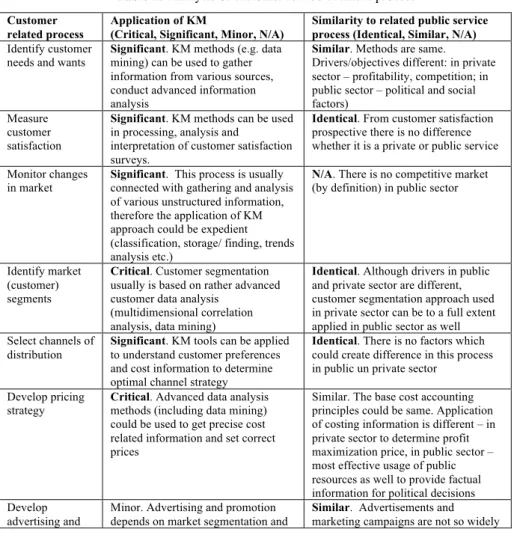
In order to understand the similarities/differences between public and private sector customer related processes we selected the key customer service related processes (slightly modified) from universal business process classification scheme defined in GlobalBestPractices®2, assessed their relevance to public sector, as well as evaluated applicability of KM:
Table 1. Analysis of customer related business process
Customer related process
Application of KM
(Critical, Significant, Minor, N/A)
Similarity to related public service process (Identical, Similar, N/A)
Identify customer
needs and wants Significantmining) can be used to gather . KM methods (e.g. data information from various sources, conduct advanced information analysis
Similar. Methods are same. Drivers/objectives different: in private sector – profitability, competition; in public sector – political and social factors)
Measure customer satisfaction
Significant. KM methods can be used in processing, analysis and
interpretation of customer satisfaction surveys.
Identical. From customer satisfaction prospective there is no difference whether it is a private or public service Monitor changes
in market
Significant. This process is usually connected with gathering and analysis of various unstructured information, therefore the application of KM approach could be expedient (classification, storage/ finding, trends analysis etc.)
N/A. There is no competitive market (by definition) in public sector
Identify market (customer) segments
Critical. Customer segmentation usually is based on rather advanced customer data analysis
(multidimensional correlation analysis, data mining)
Identical. Although drivers in public and private sector are different, customer segmentation approach used in private sector can be to a full extent applied in public sector as well Select channels of
distribution
Significant. KM tools can be applied to understand customer preferences and cost information to determine optimal channel strategy
Identical. There is no factors which could create difference in this process in public un private sector
Develop pricing
strategy Criticalmethods (including data mining) . Advanced data analysis could be used to get precise cost related information and set correct prices
Similar. The base cost accounting principles could be same. Application of costing information is different – in private sector to determine profit maximization price, in public sector – most effective usage of public resources as well to provide factual information for political decisions Develop
advertising and
Minor. Advertising and promotion depends on market segmentation and
Similar. Advertisements and marketing campaigns are not so widely
2 Global business processes best practice and benchmarking organization is currently owned by
promotion strategies
customer preferences information (indirect application of KM tools)
spread in public sector (although theoretically could be used) Develop sales
forecast Significantas well as market trends information . Usage of historical data is essential to produce correct sales forecasts. Business intelligence methods could be used for this purpose
Similar. Forecasting methods could be the same. Demand drivers are different in public and private sector
Sell to customers through a field sales force
Significant. Information about services, as well as sales process and best practices knowledge is essential to streamline and ensure consistent sales quality. Knowledge base, customer information/relations data bases, business intelligence tools could be applied
Similar. Probably, sale of public service sounds unusual, but from the process perspective, activities of a customer and service provider resulting in agreement of service delivery could be treated as sale.
This channel is not widely spread in public sector, but exists in some areas, (e.g. social help)
Sell to customers through retail operations
Significant. Same as above Similar. One stop agencies (customer service centers) in public sector in some way could be treated as retail outlets
Sell to customers through the Internet
Significant. Same as above Identical. In general, the principles of remote service delivery through internet are the same (user authentication, web forms, security etc.)
Sell to customers through direct marketing
Significant. Same as above Similar. Although direct marketing methods are not so widely used in public sector, theoretically there is no obstacles for application of this approach also to the public sector Manage
wholesalers, retailers, and distributors
Significant. Detailed historical data are important to introduce flexible and customized terms in relations with sales partners. Multidimensional analysis, data mining methods could be used for this purpose
Similar. Public-private partnership or service delivery outsourcing agreements in some way could be treated as an intermediary in private services value chain
Manage customer orders
Minor (In general it is very transactional process. To some extent KM could be used to gather/analyze process knowledge and best practice
Similar. Orders equivalent in case of public service is public service request Deliver service to
customers
Critical. Process knowledge base, as well as information sharing and collaboration tools are crucial to this area
Identical. From the process perspective there is no difference whether it is public or private service Ensure quality of
service
Significant. Service quality information collection is important to introduce relevant process controls
Identical. Same as above Bill customer Minor. Process knowledge and best
practice database could be used in this process
Identical. If the public service is paid, there is no difference
Provide customer post-sales service (support)
Critical. Service knowledge and support information is necessary to provide support. Knowledge bases, collaboration, customer self-service support tools can be successfully applied here
Similar. Some of public services could contain activities, which could be similar to post-sales service in private sector (e.g. construction supervision) Respond to Critical. User inquiry classification Identical. From the process
customer inquiries
and dispatching greatly depends on systematized knowledge about customer case histories, problem solution etc. It is the area, where knowledge bases, collaboration tools, customer information/relation data bases could be successfully used
perspective there is no difference whether it is public or private service
It can be concluded from the analysis above that there are no significant differences in customer service processes in private and public sector, and, at least from theoretical aspect, KM methods used i private sector can be successfully applied in delivery of public services in government institutions and municipalities.
4
Experience of Riga e-city project – Reality Check
The authors of the paper had the opportunity to participate in the implementation of Riga municipality e-city project. The experience and observations we have gained therefrom are helpful in answering the question whether the knowledge management practice, used in business environment, is applicable in public services delivery, and if not, what should be done to assure successful knowledge management process in the public sector.
Responding to the challenges of emerging information society Riga City Council initiated an e-city project. According to Riga e-city project strategy [12], the project was positioned not as an IT, but as an integrated municipality modernization project by means of IT and modern organizational principles aiming at achievement of the following goals:
− Improving the quality and accessibility of services;
− Electronic service delivery;
− Increasing the level of adequacy of municipal decisions to public interests;
− Ensuring the transparency and effectiveness of the municipal spending;
− Enhancing efficiency of municipal institutions.
As follows from the e-city goals, the improvement of public services delivery is considered to be the central theme of the project. Project strategy and related project documents define a comprehensive action plan to re-engineer the municipality service delivery function and achieve the following:
− Definition of services; introduction and measurement of services quality standards;
− Implementation of service delivery improvement projects in municipality institutions;
− Establishment of a centralized front-office structure (a network of customer service centers);
− Establishment of a call center;
− Development of a municipality portal and implementation of electronic service delivery;
− Implementation of a CRM system;
− Measurement of customer satisfaction;
− Introduction of remote customer authentication methods ensuring security and privacy;
− Applying public and private partnership in service delivery.
Currently the designing of specific solutions of the new service delivery model, as well as implementation of the first pilot projects (electronic service delivery of several services, introduction of centralized CRM system, optimization of internal processes by means of workflow system, definition and standardization of services, setting quality standards etc) are in the process. As a part of specific solutions usage, various KM applications are implemented: structured municipality services information (knowledge base), on-line searchable legislative and internal document repository etc. Introduction of extensive customer database, customer service process knowledge base, on-line customer learning system are under consideration.
Although in many of these solutions KM related methods and applications are used on the basis of our experience we can say that KM related issues are not the first priority question in Riga e-city project. In the current stage of project the key challenges are of more strategically-organizational nature:
− Municipality has a fragmented organizational structure, and often from the customers’ point of view is seen as a bunch of departments rather than one institution; usually a customer acts as ‘courier’ among municipality departments and institutions;
− Municipality services are not properly defined and described; customers do not know what kind of services they can receive from municipality; there are no service quality standards and key performance indicators defined;
− Service delivery process, as well as the best practice is not documented; only the personnel involved is aware of the service delivery, customer support processes and the best practice; the knowledge about services for a large part is not documented;
− Despite of the recent establishment of a centralized front-office institution (centralized customer service center), due to the total lack of formalized service process, it can provide only general information about municipality services; the centralized front-office does not accept service inquiries and customers still have to visit several municipality institutions to receive the service;
− Front-office activities are not separated from back-office activities; functional departments are performing both front-office and back-office functions;
− Weak collaboration between different departments and municipal institutions; where several structural units are involved in the delivery of the service, information between the institutions is exchanged through the official paper correspondence.
Although there are many examples of successful implementation of customer centric service delivery models in municipalities (e.g., Vienna municipality), we can assume that other municipalities to some extent face similar challenges [13], namely introduction of customer-centric, multi-channel service delivery models. In reality it
means a major municipality business process re-engineering and internal culture change. In this area, the public sector is considerably lagging behind the private sector.
. Taking into account that application of KM in some way can be considered as a fine-tuning of customer service organization, we assume that the application of KM in public service delivery today is not reaping the expected benefits. KM definitely has a significant role in the achievement of e-government goals [9], but, in our opinion, KM initiatives will become a priority in a couple of years when the basic CRM implementation projects will be completed.
We can define the following requirements as a precondition for successful application of KM in public sector service provision yielding tangible benefits:
− Public institution is organizing its functions in the form of provision of public services;
− Customer service and support processes are defined and documented;
− Public services are defined and documented, quality standards and key performance indicators are set;
− Introduction of outcome-based, service-oriented budgeting and management;
− Services are provided by means of multiple service delivery channels; advantages of remote (e.g. telephone) and electronic (internet, digital TV) channels are utilized;
− Introduction of customer-oriented, continuous-learning internal culture.
5
Conclusions
Our analysis of academic and business reports as well as Riga e-city project experience allows us to conclude the following:
1. There are no theoretical obstacles for employment of KM in public sector CRM implementation, improving quality and efficiency of public services gaining similar benefits as in the private sector.
2. Employment of KM allows standardization and automation of customer service and support processes, as well as introduction of customer-centric universal front-office service delivery model in public sector institutions. It could bring the following benefits:
− improved and more consistent public service quality;
− more accessible services, aligned with customer preferences (channel selection possibility);
− more streamlined and efficient customer service process;
− relief of the skilled personnel from routine customer service work, thus enabling them to focus on more value-added activities;
3. In general, the public sector is lagging behind the private sector in applying modern customer-centric service methods and currently is focusing on the implementation of CRM initiatives providing basic CRM functionality.
4. Extensive application of KM in the provision of public services is not widespread yet; it could become a common practice as soon as CRM implementation initiatives are successfully completed.
5. Overall, KM has to be considered an important building block in the improvement of public services and successful realization of e-government initiatives in the government institutions and municipalities.
References
1. Henning Gebert, Malte Geib, Lutz Kolbe, Gerold Riempp, Towards Customer Knowledge Management: Integrating Customer Relationship Management and Knowledge Management Concepts, Institute of Information Management, University of St. Gallen, St. Gallen, Switzerland
2. Eriksen, L., Knowledge Management is an Operating Philosophy, Not an Application Category. AMR Research, February, 2002
3. Kathy Harris, Esteban Kolshy, James Lundy, The Case for Knowledge Management in CRM, Gartner Inc., April, 2003
4. Marc McCluskey, Knowledge Management: The Competitive advantage is not the cost reduction, AMR Research, September 02, 2003
5. Marc McCluskey, Jim Murphy, Knowledge Management Brings Competitive Advantage to Service and Support, AMR Research, October 20, 2003
6. GlobalBestPractices ®, http://www.globalbestpractices.com/
7. David J. Skyrme, Public Sector- Public Knowledge, Ark Group, December 2003
8. Steve Bittinger, Customer Relationship Management in E-government, Gartner Inc., September 2001
9. Helen Baxter, Visions for Knowledge Enhanced Public Sector Unveiled, Knowledge Board, August 2002
10.Fernand Schmetz, Introduction to KM in the Public Sector, Knowledge Board, October 2002
11.White Paper, Knowledge Management Best Practices, Primus Knowledge Solutions, December 2002
12.E-city strategy of Riga City Council, Ivars Solovjovs, Sanda Zaharova, Kristine Zelmene, Leonids Paturskis, Ilze Pruse, Ainars Andersons, Riga City Council, 2003
13.UK local government Pathfinder projects. http://www.lgolpathfinder.gov.uk/ 14.Local E-Government Now: Worldwide View. SOCITM, I&DA, September 2002.