Chapter 7
Distributed Daily Scrum
Meetings
“Many attempts to communicate are nullified by saying too much.”
—
Servant Leadership, Robert Greenleaf.The daily scrum provides the heartbeat for the sprint. It is the time each day when the scrum team gets together for just 15 minutes and each team member responds to three simple questions (Schwaber, 2002):
[bl] What did you do yesterday? [bl] What are you going to do today? [bl] Do you have any blockers?
While the idea is simple, keeping everyone focused on just the three questions can be a
significant challenge. Humorous videos on YouTube show just how bad a collocated daily scrum can be (Scrum Masters 2, 2006). Distributed communication makes the daily scrum even more challenging because communication through teleconference or some other channel is not as effective as being face-to-face. Many of subtleties of facial expression and body language are missing when meetings are held through teleconferences and to a lesser degree with Video conferencing.
Combine inefficient communication channels with conducting a meeting with members who are in different countries and the inherent difficulties can cause the daily scrum heartbeat to become irregular and impact the health of the team.
Ming Zhi Xie, an agile testing specialist with IBM Software Group’s lab in Beijing, China shared his team’s early experience with Scrum:
We would have liked to take part in the daily scrums, but with our teams 12 hours apart it would have meant team members in China would be on the phone at 10:00 o’clock at night or team members in North Carolina would be on the phone at 3:00 o’clock in the morning. Neither was a good long-term solution. Separating into two local teams was unrealistic because of skills. We clearly needed an alternative.
As scrum is “the art of the possible,” this chapter talks about how to answer the three questions and provides some tested techniques for conducting effective daily scrum meetings with distributed teams (Schwaber, 2002).
Using the three questions effectively
To make the Daily Scrum useful to everyone, it is important that team members understand the purpose behind the three questions they need to answer in the meeting. It is also important they provide responses that bring value to the rest of the team.
Answering the three questions
Here is an example where John, a fictional team member answers the three questions of the daily scrum meeting:
Yesterday: I started writing the code to load information into the database. Today: I’m going to handle some of the data issues that cropped up yesterday. Blockers: I have no blockers.
On the surface, it appears John is answering the daily scrum questions, but how much value are these answers providing to the rest of the team. His responses are brief and resemble someone providing a status report but the daily scrum meeting is not a status meeting. It is an opportunity for a team to get together to find ways to help one another and to make sure the team as a whole is able to continue making progress.
Before the daily scrum meeting, everyone needs to examine how their current work impacts other team members or identify who can help them resolve an issue. During the meeting, they need to communicate any relevant information to the rest of the team.
Key Point:
Team members should communicate information that brings value to others on the team. They should also try to identify team members that can help them resolve their issues.
Here’s a better response that where John provides the same basic information but adds some more information to provide added value to the team:
Yesterday: I started writing the code to load user information into the database. I’ve discovered that some of the international addresses in the sample data provided by Company ABC do not meet the format we had expected. Mary, I think you are going to run into the same problem with the code to import the data into the label printing module. We can get together off-line to discuss. Today: I’m going to rewrite the module based on the sample data.
Blockers: It looks like these is a problem with the constraints we put on the tables and we may need to update the design.
Coordinating the team daily
The daily scrum meeting allows team members to communicate, coordinate their efforts and possibly revise their plans daily based on the answers of the others. Using our example above, John clearly states Mary may run into the same problem that he faced when working with the sample data. This may change Mary’s plans for the day, because now she needs to get with John to discuss this. The plans of another team member may also change to address the blocker that he identified.
Key Point:
Priorities can change daily. The daily scrum meeting provides a daily synchronization point for the team and allows them to revise their plans regularly.
Committing to the team
The daily scrum meeting is where team members make verbal commitments to the team. When they state what they are going to do today, they are making a verbal commitment to the rest of the team. The next day, when they state what they did yesterday, it is an opportunity for the rest of the team to verify they met their commitments.
The daily scrum creates peer pressure on two fronts:
[bl] To complete work that is blocking the progress of other team members.
[bl] To create a sense of accountability within the team, in the case where team members do not deliver on the tasks they committed to the previous day
The daily scrum keeps team members accountable as they will eventually need to justify themselves to the rest of the team if they continually do not deliver on their commitments.
Key Point:
Team members are making a verbal commitment to their team when they state what they are going to do today.
Verifying Progress
The two first questions allow the scrum master to test the focus of the team. The team always needs to be working on stories coming out of the product backlog.
The ScrumMaster also wants to know if the team is completing the work they planned to complete during the sprint. If estimates are expanding or new tasks come up, there will be an impact on the burndown chart. The Scrum Master should question team members that are doing work that is not helping the team make progress towards the sprint goals.
Key Point:
Tasks not opening and closing regularly are an early sign the team may be going off track.
When team members are not showing regular progress on their tasks for the sprint, it is usually a sign of outside distractions having an impact on their work for the sprint. These may be
meetings, task assignments for work outside the sprint or requests from others. It is important for team members to identify these distractions in the daily scrum so the Scrum Master can help reduce or remove them. Steffan Surdek shares this story:
Once, I was working on a team with tight deadlines and some of the team members that were on the critical path were regularly getting requests from another group to provide them with information. When I learned of these interruptions, I directed these team members to redirect the next question my way before taking any action on it. After they forwarded me the next question, I replied to the other team and let them know they were interfering with the deliverables of these team members. I also told them they should come through me in the future for such requests and I would redirect their queries to someone who would be available to help them.
Key Point:
Team members not showing regular progress may be facing outside distractions the scrum master should reduce or remove.
Resolving Blockers
The daily scrum allows team members to identify blockers they are facing that are preventing them from making progress on their work for the sprint. Sutherland states there are different kinds of blockers a team may face:
[bl] Software or technology not showing up at the right time. These may be dependencies across teams or groups. The Scrum Master or the team may not be able to resolve this. The management team may need to step in.
[bl] Meetings irrelevant to the scrum team. Here again, the Scrum Master may not be able to fix this, but it is the Scrum Master’s role to recognize it and bring it to the attention of the management team.
[bl] Hard technical problems often slow things down. The team can often fix this, but at times, management must bring in other resources.
Blockers may create new issues that may in turn become new tasks or user stories in the backlog. These may force the team to change the current plan.
Sutherland also states that it is important for the scrum master to create a list of blockers and assign them to the team or to managers. A major responsibility of the Scrum Master is to
manage, prioritize, and assure this impediment backlog is burning down. The Scrum team should expect management to help work the impediment backlog. Removing bottlenecks is the fastest way to improve productivity.
Key Point:
The Scrum Master should create a list of blockers and assign them to team members or managers. The Scrum Master should also ensure the team is burning through the blocker list.
Daily Scrum Logistics
Scrum encourages collocated teams to meet in the same room at the same time every day for the daily scrum. To adapt this meeting to work in a distributed environment, the first step is for the team to decide how to best conduct it.
The distribution level will have an impact on how to conduct the daily scrum meeting.
Conducting the daily scrums when team members are in the same time zone and speak the same language is much simpler than for a team with spread in multiple countries and time zones, having many different languages and cultures.
Collocated part-time teams may have some members that are telecommuters who are within driving distance of a traditional office. These team members may select not to commute into the office to meet for the daily scrum. While there is significant advantage for them to commute for longer meetings with active brainstorming and collaboration, the daily scrums can be just as effective through teleconference. Collocated teams may not meet in the same office each day, but they should set up a routine by using the same teleconference number and dialing in at the same time.
Distributed teams with overlapping work hours should find a time during the overlapping hours to meet every day at the same time and on the same teleconference number for the daily scrum. Sirsidynix (Sutherland, Viktorov, Blount, & Puntikov, 2007) shows teams can successfully combine the daily scrum of a collocated and a remote Scrum team.
Distributed teams with no overlapping work hours have the biggest challenge because they are scheduling a 15-minute meeting at a time outside the normal working hours of some team members.
Daily Scrums–No Overlapping Work Hours
Teams can use five different methods to deal with distributed daily scrums where the team has members with no overlap in their work hours:
[bl] Daily scrums through documentation [bl] Liaison Approach
[bl] Alternating meeting times [bl] Share the pain
[bl] Group instant messaging
Each solution has pros and cons the Scrum Master and team should consider in deciding how to conduct their daily scrum meetings.
Daily Scrums through Documentation
Perhaps the least effective way of handling distributed daily scrums with no overlap in workday is scheduling the daily scrum during a time when most—but not all—team members can meet.
With this approach, team members who cannot meet as scheduled document their answers to the three questions in a wiki, through e-mail or in a document the team can access.
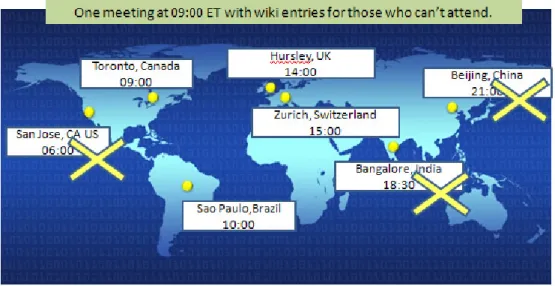
Figure 6-1 shows an extreme example of a team distributed in locations from San Jose, CA in the United States to Beijing China. If the team adopts a single daily scrum meeting that is 9:00 a.m. in the morning in Toronto, Canada, the meeting will likely be outside standard working hours for the team members in San Jose, Bangalore and Beijing. Such a team might try to compensate by having all team members document their answers to the three questions.
Figure 6-1.
Single meeting time that works for both members
The primary advantage to this approach is that it can be better for sustainable pace. And it inconveniences no one since nobody is meeting outside their normal working hours,. However, there are several cons with this approach:
[bl] This approach is not interactive. Those who cannot attend do not have the opportunity to hear directly from other team members or to get quick comments from them on their answers to the three questions.
[bl] Members who do not take part in the daily scrum may feel less part of the team. [bl] Team members who do not verbally commit may not feel the same commitment to deliver. The daily scrum is a verbal commitment in front of peers that helps to put pressure on the team to meet their commitments.
[bl] Miscommunication because the documentation might not be clear and might need some clarification for the team to understand.
Pros Cons
[bl] Better for sustainable pace [bl] No inconvenience
[bl] Loss of information due to indirect communication
[bl] Adversely impacts “whole team” experience
[bl] Lessens accountability through peer pressure
Table 6-1.
Summary of Pros and Cons for using a single meeting time approach Key Point
When having have daily scrums with some members typing in their responses to the questions, it is important to have the Scrum Master express their written comments out loud. The team should address their issues quickly, just as the blockers of those attending the meeting in person.
The Liaison Approach
Another approach to conducting daily scrums with distributed teams with no overlapping work hours is to conduct two different daily scrums and to have a liaison attend both. Each meeting is at a time that is convenient for half of the members of the scrum team. The liaison, commonly the Scrum Master, verbally shares the information from the other team with the team they are meeting with.
Figure 6-2 shows an example of a team that holds two different daily scrum meetings each day. The first meeting is at a time convenient for the half of the team in the more western time zones. The second meeting is at a time convenient for the other half of the team in the more eastern time zones. The Scrum Master serves as a liaison attending both meetings and verbally presenting the notes from the half of the team that is not present.
Figure 6-2.
Liaison Approach using two different daily scrum meetings
The advantage to this approach is that it helps with sustainable pace. No one other than the liaison is meeting outside their normal working hours. This can also help the whole team to have
visibility into each others' efforts, though the team cannot address questions or blockers brought by team members who are not present immediately.
Possibly the worst side of this approach is that it is not the ideal method of communication. This can be a bit like a childhood game called "telephone" where one person tells a story to a second, the second tells it to a third person and so on. At the end of the chain, the story told is rarely the same as the story told by the original storyteller. The story told by the liaison will be similar, but not the same as the story told by the team member. To deal with this issue, some teams have each group record their daily scrum responses. The Scrum Master can then play back the responses from one half of the team when meeting with the other half of the team.
The team can also splinter into two factions which would likely negatively impact the ability of the team to work together as a whole team.
Another consideration in taking this approach is that, unless there is a rotation in the role, there can be an impact to the liaison's work-life balance.
Pros Cons
[bl] Better for sustainable pace [bl] Some degree of visibility into each member’s tasks
[bl] Liaison might present the wrong information
[bl] Possible splintering of team into factions
[bl] Negative impact on liaison’s work-life balance
Table 6-2.
Summary of Pros and Cons for the Liaison Approach
Some teams improve the liaison approach by having the whole team meet for the daily scrum at least occasionally. Gregg Gibson, IBM System and Technology Group’s Management Module Firmware organization reports many teams within his organization tried both the “Liaison” and the “Sharing the Pain approach” described later in this chapter:
We are finding that even with the liaison approach it is helpful to get the entire team in a meeting at least occasionally. Otherwise the team devolves into multiple teams that don't always work together effectively.
Key Point
When using the liaison approach consider rotating the liaison responsibilities to reduce the burden on any one person.
Alternating Meeting Times
A third approach to scheduling daily scrums where members of the team have no overlap in work hours is to alternate meeting times. With this approach, the team holds one daily scrum during the normal workday for part of the scrum team and holds the other daily scrum during the normal work hours of the other part of the scrum team.
Ling, a scrum team member in Beijing, worked on a scrum team with members in Austin, TX and Raleigh, NC:
Our team was meeting daily at 12:00 p.m. Eastern Time. For me, in Beijing, it was after midnight. I often could not attend the daily scrums. The team later decided to switch to alternating meeting teams so I could attend at least part of the time in person.
Figure 6-3 shows a team that alternates their meetings between two different times. One meeting is most convenient for team members in Toronto, Sao Paulo, and Hursley. The other is more convenient for team members in Hursley, Zurich, Bangalore and Beijing.
Figure 6-3.
Alternating meeting times approach
The advantage of this approach is everyone has an opportunity to attend during their normal working hours at least every other day. Unlike the approach of having a fixed time always outside working hours for some team members, every team member has an opportunity to attend at least part of the time.
Additionally, some team members may be comfortable meeting outside traditional working hours. That may allow them to meet daily, rather than every other day. Figure 6-3 shows the given schedule of alternating meeting times would possibly allow team members in Toronto, Zurich and Hursley to meet daily while other members may only join in every other day.
Again, because the whole team does not meet daily, the team may not get the full benefit of the daily scrum.
Key Point
When meeting at alternating times, have teams members who cannot take part in the meeting log their responses to the three questions. At the meeting, have the Scrummaster or a team member read the written responses from absent team members.
When using the “Alternating Meeting Times” approach, the team should check with everyone to make sure that they have the ability to call into the meeting outside their working hours.
Elizabeth Kumau, a test expert with IBM Test Services, gives this experience:
Some of my team members in India have to stay in the office or go to the office at night to attend meetings scheduled outside their normal working hours. Out of 4 team members, only one has home connection access.
Sharing the Pain
A fourth approach—the one that most closely aligns with the spirit of co-located Scrum—is to have the team members share the pain. With this approach, the team works together to share the
pain associated with being part of a distributed team. They select a time to meet that is best for the team as a whole.
While sharing the pain may not sound like a great solution for the team, flexible work hours can be a benefit both to the employer and to the scrum team members. Matt, a Scrum Master with IBM Sales and Distribution describes the advantage of working flexible hours:
I had to be on a 15-minute daily scrum at 7:00 p.m, after my normal workday. However, I also had the flexibility to attend my daughter’s father-and-daughter lunch at school, which was on the other side of town. Working with a global team isn’t always the most convenient, but I appreciate getting to be there for my kids’ special events.
The best way to carry out this approach is to ask each member of the team the following questions:
[bl] What times are best for you to meet? [bl] What times are you willing to meet? [bl] What times are off-limits?
Everyone considers the possibility of working outside their traditional work hours. The resulting daily scrum time is the time that works best for the entire team as a whole.
Elizabeth, a Scrum Master with IBM Quality Software Engineering, talks about a case where asking the three questions would have been helpful:
I have learned to always ask the team what will work for them. Some of us are morning people, so a 5:00 a.m. meeting may not be a problem. Others are not available until 10:00 a.m., but 9:00 p.m. is not a problem for them. I was working with a team that had members in Hyderabad, India and Saint John, Canada. I assumed—always a bad idea—the team I was working with in India was working on their local time. At the end of a 3 a.m. meeting to show my support for global teaming, they politely asked why I had called the meeting so early. Oops! They were working on Eastern Time! Now, I always ask the three questions: when is the best time, when are you available and when is off-limits?
The advantage to the approach of sharing the pain is the whole team is taking part in the daily scrum each day and the time selected for the meeting has the whole team sharing the pain. Everyone hears directly from the other team members, so there is less of a chance of confusion than the team might have with other methods.
However, not everyone may like working outside their normal working hours. When using this approach, the team should have the flexibility to take some time off from their normal working hours to compensate.
Pros Cons
[bl] Whole team takes part in each day
[bl] Everyone hears directly from team
[bl] Team can discuss blockers and remove them
[bl] Some may not like working outside normal work hours
immediately
[bl] Team is better able to hold one another accountable
[bl] Flexibility in work schedule Table 6-3.
Summary of Pros and Cons for Sharing the Pain Key Point
Thomas Starz, with IBM Software Group at the Boeblingen, Germany lab sets his alarm when attending daily scrums outside his normal working hours. “Otherwise, it is easy to forget and miss a 15-minute meeting.”
Group Instant Messaging Approach
A fifth approach is using an instant messaging tool with group chat capabilities. At a regular time every day, the Scrum Master invites all team members to a group chat to have them answer the three daily scrum questions.
This approach works with collocated or collocated part-time teams as well as distributed teams with overlapping work hours. The benefit is that by creating a transcript of the chat session, it creates a set of notes the Scrum Master can send to all team members via e-mail or post on a wiki. Another benefit is team members can type as much information as they want in the chat session. The approach allows team members not fluent in the language to prepare their text ahead of time and paste it into the group chat
Doing the daily scrum this way can be rather chaotic depending on how the Scrum Master conducts the meeting. There are two ways to approach it. The first allows all team members to type in their answers to the three questions and post them in the chat whenever they are ready. The Scrum Master sorts through stuff the answers each member provides and asks clarifying questions. This approach can make the discussions that happen in the chat difficult to follow because other team members may be posting their comments during a discussion. The second way is to conduct the chat session like a teleconference and have the Scrum Master go around each participant in the chat and ask them for their answers to the Daily Scrum questions. There are multiple other cons to using this approach:
[bl] Team members are not face-to-face in the same location. While there is convenience in having team members attend the meeting from their desk, there is a loss in nonverbal
communication. There may not be the same commitment level felt by team members when they are not committing verbally.
[bl] Team members may not be paying close attention during the group meeting. When in a group chat, it is much easier for team members to detach themselves from the meeting with no one realizing it.
[bl] The Scrum Master may not be fully engaged in the meeting. Beware of times the Scrum Master is conducting the daily scrum while doing something else at the same time. In such cases, it impacts the entire team because the facilitator of the meeting is not paying close attention and helping remove blockers.
[bl] The daily scrum works best when it occurs at the same time every day. This helps create a routine the team can get into. When the Scrum Master starts the meetings at different times every day, instead of the scheduled time, it gives a mixed message to the team about how
important the meeting is. Before taking part in a group chat, people typically wait for the meeting invitation to arrive before engaging, if it does not appear, they will focus on their work instead and forget about the meeting.
When a team meets in the same location every day, it creates a routine for the team as well as accountability for the meeting to start at the scheduled time. Manmohan Singh a Scrum Master in IBM, shares the following story about the evolution of the daily scrum meeting in his team:
In the early days of our daily scrum meetings, I often had to remind team members to come to the meeting. There was lot of inertia in the team because we were transitioning from traditional waterfall to Agile. After a few months, the meeting became part of the daily routine of the team because team members found value in the meeting. I believe conducting the daily scrum meetings at a fixed time every day instilled the habit of attending the scrum in the team and today the team meets daily at the scheduled time in the conference room. When I am absent that day, a senior developer or QA member starts the meeting, takes the scrum notes and then communicates the blockers and issues to the entire distributed team. This is a clear signal of my team starting to turn into a self-organizing team.
I find the real value of the scrum meeting is the verbal communication that occurs between team members. Often, when a team member verbally updates the whole team on his tasks,
dependencies and issues, others participants have new information related to the tasks and everyone benefits from this. We also have cases where a team member has a dependency or an issue and someone else on the team immediately has the information on how to address the issue. This is a great way for us to unblock the team quickly.
Pros Cons
[bl] Whole team takes part in each day
[bl] Team can discuss blockers and remove them immediately
[bl] A transcript of the chat can easy become a set of notes for the meeting
[bl] May be easier for non-language speakers because it’s written instead of verbal
[bl] No face-to-face communication, the team loses all nonverbal communication [bl] No guarantee everyone is paying attention to the chat session
[bl] No guarantee the scrum master is paying attention to the chat session. [bl] Full accountability for the meeting occurring at the same time every day is fully on the Scrum Master
[bl] Can be chaotic depending on how the team conducts the meeting
Table 6-3.
Summary of Pros and Cons for Group Instant Messaging Group approach
Regardless of which model the team selects for their daily scrums, the team has an opportunity to reevaluate the decision at the end of each sprint. During the review, the team can discuss whether they should consider adopting a different model to improve their performance.
Teleconference Tips for Distributed Daily Scrum
After the team decides on the times that they will meet for the daily scrum, they will start attending the daily scrums through a teleconference. And, while the general teleconference tips presented in [Chapter 2] apply for the daily scrum meeting, the team will find there are some special nuances to the daily scrum.
The distributed daily scrum is unlike the other scrum meetings in the daily scrum is not a brainstorming, collaborative working session. Instead, it is a brief, intense 15 minutes with members’ one-by-one answering questions. This section offers tips to help teams to be more effective with the daily scrum.
Removing Side Conversations
Side conversations during the daily scrum are a distraction during a co-located daily scrum, but they are even more problematic during the distributed daily scrum. Side conversations introduce two main problems for the distributed team:
[bl] Increased distraction. Background noise can be distracting on a teleconference. If the quality of the teleconference or phone lines is already making it difficult to hear everyone, background noise and other voices can make listening even more difficult.
[bl] Exclusion. If the scrum team is a new team just beginning to learn to work together, if there are issues between team members, or if there are new members on the team, background discussions can cause members on the phone to feel excluded.
Side conversations can be problem where part of the team meets in one room and other members have dialed in to the teleconference using separate phone lines as shown in Figure 6-4.
Figure 6-4.
Scrum team with collocated and remote team members
One method to prevent side conversations is to have all members dial into the teleconference. Each person dialed in is immediately in an equal position to everyone else. Everyone is speaking directly into the phone, which can make it easier for everyone on the team to hear the
conversation. And, verbal side conversations are less of a problem.
Of course, to promote teaming and to give everyone a chance to speak without disruptions, members of the team and the Scrum Master should help to end any side conversations quickly.
Keeping the Team Engaged
Distributed team members who have teleconferenced into the daily scrum can become detached and distracted by other tasks.
Unfortunately, most of us have heard the clicking in the background as one person types away on an e-mail message while another team member is diligently answering the three questions. Most of us who work as part of a distributed team have ourselves had distractions at one time or another by an e-mail message, an instant message or some other tasks in the middle of the daily scrum. Some of us have also heard the ever-popular excuse of “I was on mute” from a team member called on unexpectedly scrambling to think of a response.
Because the daily scrum is an intense 15 minutes, it is especially important for team members to remain actively engaged during the call. If necessary, close down applications, step away from the machine, turn on a screen saver, or just commit to stay focused.
Possibly the best way to stay engaged and to make sure that others on the team stay engaged is to make the time as valuable as possible for the team. Bill Krebs, a coach with IBM Quality
Software Engineering suggests:
To help your team members to find value in your responses, focus on the three A’s of the scrum meeting:
[bl] Awareness. Build awareness of what the team is working on.
[bl] Advertising. Advertise for collaboration.
[bl] Attack blockers. The team and Scrum Master should strive to fix all blockers within 1-hour of the daily scrum.
Facilitating the Meeting
Facilitating a daily scrum meeting can be more challenging for the Scrum Master
working with a distributed team.
On collocated teams, members are able to read body language and use body language to show a speaker they are taking the meeting off track. The distributed Scrum Master and team members have to rely on other techniques.As an example, the Scrum Master with a co-located team starts with the person on their left and goes around the room asking for responses to the three questions. In a distributed environment, as individuals come into the call, they will identify who they are. The Scrum Master then calls each person and asks for their response. They may respond in the order they arrived at the
teleconference or the Scrum Master may choose to call on each person. One team member reported:
Early on, we experimented with having the team members go in alphabetical order by name, so the Scrum Master wouldn’t have to call on individuals. We found it to be distracting and much less efficient than just having the Scrum Master call on people.
Another example is a case where the Scrum Master is trying to move on from one team member to the next. In a co-located environment, the Scrum Master can turn their body to the next team member when someone is being too verbose or elaborating beyond the responses to the three
questions. By teleconference, this technique is not available. Instead, the Scrum Master is likely to have to interrupt the speaker verbally. While this would be rude in other cases, verbally interrupting can help the team to more efficiently use the daily scrum time.
Using a technique for getting people to focus on just the three questions and to streamline their responses can help to prevent having to interrupt. One technique presented by Bill Krebs of IBM Quality Software Engineering is to focus on the “top two”:
I like to ask teams to give two headlines of what they did yesterday, two headlines of what they are going to do today and any blockers. This helps to keep them from getting into too much detail about how they did the work.
Taking Daily Scrum Notes
Notes are typically not taken during the daily scrum, the team must only log the blockers. However, when working with a distributed team it can be helpful to have the notes available in a common location. Wikis that allow multiple users to write at the same time can be a good repository for daily scrum notes. Regardless of the archiving tool used, it is easier for the team to use a single, common archive.
Having the notes available in a common location allows those not able to attend the daily scrum to share their tasks with others and provides them with a way to learn about the tasks of other team members.
Taking notes for the daily scrum can also help distributed teams that are dealing with language difficulties. For those who are using their second language on the teleconference, having the text prepared earlier can help them to state their responses. And, it can help others who are using the primary language of the meeting to understand what they are saying.
Dealing with Language Barriers
The daily scrum is an intense meeting with rapid communication. When a distributed team uses a language that is not the first language of all participants, communication becomes more difficult. While one-on-one meetings and interactive meetings provide opportunities for those members using their second language to ask questions, translation on the daily scrum call can create significant delays.
[bl] Use a chat session. The person who is having difficulty can ping one of the team members who is not speaking to get clarification.
[bl] Set a longer time-box for the daily scrum. Scrum is about the team working together effectively. If the team is consistently unable to complete the daily scrum in 15 minutes due to translation, set a time-box that works for the team and stick to it. This is not an excuse to poorly manage the daily scrum, but instead a way of handling a language barrier. Matt Ganis shared the following story:
One of our Scrum teams had a daily 15-minute scrum scheduled between team members in India and the US. We quickly found that 15 minutes was not enough time to resolve issues or come to a common understanding on what we were discussing. We decided that since the Daily Scrum was the one time the team was sure to talk during the day (due to time zone issues) that it would make sense to expand the duration to 45-60 minutes. The first part of the meeting we did a
traditional standup meeting followed by a more detailed discussion of issues and plans to address the "blockers".
Recognizing Local Holidays and Local Schedules
When working with distributed teams, it is also important to make sure the team is aware
of the
schedules worked by the various team members. Some locations work Sunday through Thursday, rather than Monday through Friday.Different locations may also have different holidays. The team should be aware of all holidays that might impact the work, rather than just the holidays for their location.
Tools to Help with Distributed Daily Scrum
Because the daily scrum is such a short meeting and focuses on verbal responses to three questions, there is little need for tools. However, a chat tool, wiki or other repository and a full duplex phone can be helpful.
Chat tools can be a distraction for some team members, but they can also be valuable in cases where a team is having language issues. The person who is having difficulty understanding someone’s responses can ask questions through chat without disrupting the daily scrum. The team may want to cut and paste or save the chat transcript to a wiki for future reference. A wiki or other repository can be helpful for sharing daily scrum notes. Notes can be helpful in communicating with team members who are unable to attend a given daily scrum as discussed earlier in this chapter.
If part of the team is calling in from a conference room and using a speakerphone, it should be a should be full duplex phone. With half duplex phones, only one speaker can be heard at a time, either the team members in the room or an individual dialed into the teleconference separately. If someone goes on and on without pausing, it can be impossible to interrupt their monologue. With only 1-2 minutes granted for each person, this can be a major obstacle to hearing every team member within 15 minutes. Fortunately, the telephone buttons will still work while the person is speaking, so the Scrum Master or a team member can push a button to get the person’s attention. But, this is not ideal. Invest in a full-duplex phone if possible.
Videoconferencing tools offer mixed results. From performance issues to setting the camera so everyone is visible to the time needed to set up the daily scrum, videoconferencing today may be more of a headache than it is worth. There are, however, teams that have had success with using a wide-angle Web camera for the daily scrums.
Summary
The first step to running effective daily scrums is to decide the meeting days and times for the team. The distribution level has an impact on how challenging the daily scrums will be for the
team. Collocated teams with members that telecommute part-time, can successfully engage in the daily scrum by calling into the meeting. Geographically distributed teams with an overlap in work days can set up a time to meet daily during their standard workday. Teams with no overlap in their work days are the most challenging to schedule.
There are four different approaches that teams can take to dealing with no overlap in workday. The model that more closely aligns provides the same benefit as co-located teams is the model of “sharing the pain.”
Once the team begins conducting distributed daily scrums, they will discover some issues related to the unique points of the daily scrum (for example: brevity, intensity and one-way
communication pattern). To be productive, the team and Scrum Master will need to remove side conversations, effectively facilitate the daily scrum, use notes where necessary, overcome language barriers, and recognize local schedules and holidays.
Tools are less of an issue with the daily scrum. A chat tool can help to overcome language barriers, the team can use a wiki or another repository to store notes and a full-duplex phone can help when some of the team members meet in the same conference room.
Discussion Questions
1.
Are all of your team members able to take part in the daily scrum? If not, what
changes can you make to include everyone?
2.
What can your team do to make the distributed daily scrum meetings more
effective for all team members?
Works Cited
Schwaber, K. (2002). Agile Software Development with Scrum. Upper Saddle River: Prentiss Hall.
Scrum Masters 2. (2006, December 4). Retrieved November 10, 2008, from YouTube: http://www.youtube.com/watch?v=B3htbxIkzzM
Sutherland, J., Viktorov, A., Blount, J., & Puntikov, N. (2007). Fully Distributed Scrum: The Secret Sauce for Hyperproductive Outsourced Development Teams. HICSS'40, Hawaii International Conference on Software Systems. Waikoloa: University of Hawai'i at Manoa. Jeff Sutherland (2006, June 3rd). Why the three questions in the daily scrum meeting. Retrieved July 2nd, 2009, from Jeff Sutherland’s web site: http://jeffsutherland.com/scrum/2006/06/why-three-questions-in-daily-scrum.html