O R I G I N A L A R T I C L E
Open Access
Fed-batch production of MCL-PHA with elevated
3-hydroxynonanoate content
Xuan Jade Jiang
1†, Zhiyong Sun
1, Juliana A Ramsay
1*†and Bruce A Ramsay
2†Abstract
With no inhibition ofβ-oxidation,Pseudomonas putidaKT2440 produces medium-chain-length poly(3-hydroxyalkanoate) (MCL-PHA) with approximately 65 mol% 3-hydroxynonanoate (HN) from nonanoic acid. Production of PHA with higher HN content and an adjustable monomeric composition was obtained using acrylic acid, a fatty acidβ-oxidation inhibitor, together with nonanoic acid and glucose as co-substrates in fed-batch fermentations. Different monomeric compositions were obtained by varying the feeding conditions to impose different specific growth rates and inhibitor feed concentrations. At a nonanoic acid: glucose: acrylic acid feed mass ratio of 1.25: 1: 0.05 and a specific growth rate of 0.15 h-1, 71.4 g L-1biomass was produced containing 75.5% PHA with 89 mol% HN at a cumulative PHA productivity of 1.8 g L-1h-1.
Keywords:PHA; Fed-batch; Acrylic acid;Pseudomonas putida;β-oxidation inhibition
Introduction
Poly(3-hydroxyalkanoates) (PHAs) are a family of bio-degradable, and non-cytotoxic biopolyesters produced from renewable resources. Certain types of PHAs, such as poly(3-hydroxybutyrate-co-3-hydroxyvalerate) (P(HB-HV)) and poly(3-hydroxybutyrate-co-3-hydroxyhexano-ate) (P(HB-HHx)), have been recognized as substitutes for petroleum-based thermoplastics in various appli-cations and have been or are planned to be produced commercially (Philip et al. 2007; Poirier et al. 1995).
In contrast to short-chain-length PHAs (SCL-PHAs) such as HV) and SCL-MCL-PHAs such as P(HB-HHx), medium-chain-length PHAs (MCL-PHAs) are thermoplastic elastomers with a much higher elongation-to-break (Van der Walle et al. 2001). They also have lower melting temperatures, are less crystalline and crystallize more slowly (Gagnon et al. 1992; Gross et al. 1989; Marchessault et al. 1990). Most bioreactor scale produc-tion of MCL-PHAs have used structurally related MCL carbon substrates, such as octane (Hazenberg and Witholt 1997), nonanoic acid (Sun et al. 2007), and oleic acid (Lee et al. 2000). Although Liu et al. (2011) and Chung et al. (2011) effectively showed MCL homopolymer production
by extensive deletion of genes in theβ-oxidation pathway, this approach does not allow tailored control of the mono-meric composition. We have recently demonstrated that using a combination of a PHA structurally related sub-strate (e.g. nonanoic or octanoic acid), a structurally unre-lated substrate (e.g. glucose), and a fatty acid β-oxidation inhibitor (e.g. acrylic acid), a series of poly(hydroxynona-noate-co-hydroxyheptanoate) (PHN) with adjustable 3-hydroxynonanoate (HN) content (69 to 96 mol%) or poly (3-hydroxyoctanoate-co-3-hydroxyhexanoate) (PHO) with adjustable 3-hydroxyoctanoate (HO) content (88 to 98 mol%) can be produced (Jiang et al. 2012). It was also demon-strated that the PHA thermal and mechanical properties improved as the amount of the dominant monomer increased. Substrate utilization efficiency also improved with a yield of fatty acid to PHA conversion as high as 0.91 g g-1. These results were produced in chemostat but this cultivation technique is not used commercially. In order to be of commercial interest, this novel approach to MCL-PHA production must be shown to be applicable to fed-batch culture.
The objective of this study was to develop a metho-dology for controlling the monomeric composition of MCL-PHA in efficient fed-batch fermentations. Specific-ally, the production of PHN copolymers with different HN content was investigated by controlling the specific growth rate and theβ-oxidation inhibitor concentration in * Correspondence:[email protected]
†Equal contributors 1
Chemical Engineering, Queen's University, Kingston, ON K7L 3N6, Canada Full list of author information is available at the end of the article
the feed. The study also employed glucose and nonanoic acid co-feeding to meet the requirements of both cell growth and PHA accumulation, respectively.
Materials and methods
Microorganism and growth medium
Pseudomonas putida KT2440 (ATCC 47054) was main-tained on nutrient agar plates at 4°C. The inoculum medium for all fermentations contained per liter: (NH4)2SO4 4.70 g, MgSO4· 7 H2O 0.80 g, Na2HPO4· 7 H2O 12.00 g, KH2PO4 2.70 g, nutrient broth 1.00 g, glucose 9.00 g. The initial culture medium contained per liter: (NH4)2SO44.70 g, MgSO4· 7H2O 0.80 g, Na2HPO4· 7H2O 18.0 g, KH2PO4 4.05 g, trace element solution 10 mL. The trace element solution contained per liter: FeSO4· 7H2O 10.0 g, CaCl2· 2H2O 3.0 g, ZnSO4· 7H2O 2.2 g, MnSO4· 4H2O 0.5 g, H3BO3 0.3 g, CoCl2· 6H2O 0.2 g, Na2MoO4· 2H2O 0.15 g, NiCl2· 6H2O 0.02 g and CuSO4· 5H2O 1.00 g. Nonanoic acid (98%, Spectrum Chemicals) was fed separately in its pure form as it is im-miscible in aqueous media. Acrylic acid (Sigma-Aldrich) was added to a glucose (99.5%, Sigma-Aldrich) solution of 240 g L-1. Feeding ratios of nonanoic acid (NA), glucose (G) and acrylic acid (AA) at 1.25: 1: 0.01 and 1.25: 1: 0.05 (w/w) were tested. Nitrogen was provided as 14% (w/v) ammonia solution and also served as the base for pH con-trol. In case of nutrient depletion, supplemental solutions of trace elements with the above composition and a phosphate solution containing 36 g L-1 Na2HPO4· 7H2O and 8.1 g L-1 KH2PO4 were prepared. Antifoam 204 (Sigma-Aldrich) was added to nonanoic acid (1% v/v) and manually injected through a sterile septum when required.
Fermentation conditions
The inoculum was grown in three 500 mL shake flasks (100 mL medium in each flask) at 28.0 ± 1°C and 200 rpm overnight. The first two fermentations were conducted in a 7 L MBR stirred tank bioreactor (Bio-reactor-AG, Switzerland) with a 5 L working volume. The third fermentation was done in a 5 L Minifors bioreactor (Infors-HT, Bottmingen, Switzerland) with a 3 L working volume. The cultivation temperature was 28.5 ± 1°C and the pH was controlled at 6.85 ± 0.05 using 14% (w/v) ammonia solution. Dissolved oxygen was measured with an Ingold polarographic probe and maintained above 30% air saturation by adjusting the agitation speed and the mixture of air and oxygen flow via mass flow controllers to a total gas flow at 1 vvm. The dissolved oxygen data were acquired by a LabVIEW 6.1 (National Instrument) program. Nonanoic acid and glucose feeding was controlled via separate peristaltic pumps by the LabVIEW program based on the mass of each reservoir.
Substrate feeding and control methods
The specific growth rate was controlled at 0.25 h-1 or 0.15 h-1 by exponentially feeding the carbon sources to be the growth-limiting nutrient. It was estimated that 1 g L-1biomass would be produced from 1.6 g L-1total carbon sources in the initial fermentation medium. The cumulative mass of carbon substrates St(g) to be fed at time t (h) was calculated based on exponential cell growth (Xt, g) expressed in the Equation below.
St¼ Xt YX=C¼
X0 YX=C⋅e
μt−1
ð Þ ð1Þ
where X0(g) is the estimated biomass at the beginning of the feeding; μ(h-1) is the desired specific growth rate; andYX/Cis the yield (g g-1) of biomass from the mixture
of carbon substrates which was 0.66 g g-1, experimen-tally determined from continuous fermentation by feed-ing nonanoic acid, glucose and acrylic acid at a mass ratio of 1.25: 1: 0.05 at a specific growth rate of 0.25 h-1 (Jiang et al. 2012).
The mass of each carbon source required at time t was calculated according to the pre-defined ratio of the two substrates as follows:
St−NA¼St⋅fNA ð2Þ
St−G¼St⋅fG ð3Þ
The feeding ratio of nonanoic acid to glucose in this study was 1.25: 1 (w/w). Therefore, the mass fraction of nonanoic acid (fNA) and that of glucose (fG) in the total carbon source were 0.56 and 0.44, respectively.
Exponential substrate feeding began after a lag phase of approximately 5 h. Fermentations with a specific growth rate of 0.25 h-1were conducted only under expo-nential feeding. However, in an effort to avoid nonanoic acid and acrylic acid overfeeding, exponential feeding at 0.15 h-1was conducted for 23.3 h before changing to a constant feed rate of 8 g L-1h-1.
Analytical procedures
phenol-hypochlorite method (Weatherburn 1967). Acrylic acid was assayed by Hewlett-Packard GC equipped with a Cabowax®-PEG column after acidification with one tenth volume of 2 N hydrochloric acid (Qi et al. 1998).
PHA content and composition in the dry biomass samples were determined by methanolysis in 2 mL chlo-roform and 1 mL methanol which contained sulfuric acid (15% v/v) as acidifying agent and benzoic acid (0.2% w/v) as internal standard at 100°C for 4 h. After which, 1 mL distilled water was vigorously mixed on a
Fisher Vortex and left overnight for phase separation. OneμL of the chloroform phase was injected into CP3900 Varian GC at a split ratio of 20. The injector and detector were maintained at 250 and 275°C, respectively. The oven heating profile was: initial 90°C for 0.5 min, 5°C min-1 to 95°C and hold for 0.5 min, 30°C min-1to 170°C and hold for 2.5 min. The PHA standard was prepared by acetone extraction and methanol precipitation followed by three cycles of extraction and precipitation, as de-scribed by Jiang et al. (2006) and the monomeric
Feeding time (h)
6 9 12 15 18
Monomer comp
ositi
on (mo
l %
)
60 70 80 90 100
HN HHp
6 9 12 15 18
Bi
omass concentration (g
L
-1)
0 10 20 30 40 50
PHA content (%
)
0 10 20 30 40 50 60 70
Biomass PHA
6 9 12 15 18
Other resi
dua
l nutri
ents (
g
L
-1)
0 2 4 6 8 10
Residual nonano
ic aci
d (g L
-1)
0.0 1.5 3.0 4.5 6.0 7.5 9.0
Resi
d
ua
l acrylic acid (g L
-1)
0.00 0.02 0.04 0.06 0.08 0.10
PO4 NH4
Glucose Nonanoic acid Acrylic acid
(a)
(c) (b)
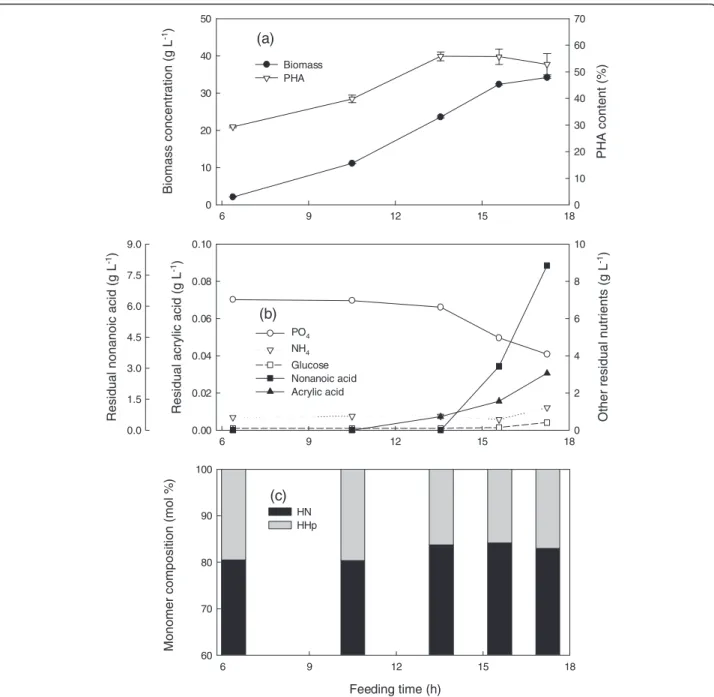
Figure 1Cultivation ofP. putidaKT2440 by feeding nonanoic acid, glucose and acrylic acid at a mass ratio of 1.25: 1: 0.01 and a specific growth rate of 0.25 h-1in fed-batch fermentation at 28.5 ± 1°C, pH 6.85 ± 0.05, DO > 30%.Fermentation data(a)and(b), polymer composition(c). Foam was controlled by manual injection of antifoam 204 in 1% (v/v) nonanoic acid as required.
composition characterized by GC and proton nuclear magnetic resonance at room temperature in a Bruker Avance 200 spectrometer using deuterated-chloroform containing 20 mg mL-1 PHA.
Results
Co-feeding nonanoic acid, glucose, and acrylic acid at a mass ratio of 1.25: 1: 0.01 and aμof 0.25 h-1
Co-feeding nonanoic acid (NA), glucose (G), and acrylic acid (AA) at a mass ratio of 1.25: 1: 0.01 and a specific growth rate of 0.25 h-1 produced 34 g L-1 dry biomass containing a maximum of 56% PHA (Figure 1a). Phosphate
and ammonium were controlled at levels that had been previously shown to be sufficient but not inhibitory to cell growth (Sun et al. 2007). Before 13.6 h, nonanoic acid and glucose concentrations were very low, indicating that the carbon source was the only limiting factor (Figure 1b). Uncontrollable foaming occurred at 15.8 h, accompanied by accumulation of acrylic and nonanoic acids in the reactor but glucose was entirely consumed. During the early stages of cultivation, the PHA contained 81 mol% HN which increased slightly to 84 mol% (Figure 1c), much more than the 65 mol% HN produced without acrylic acid.
Feeding time (h)
0 2 4 6 8 10 12 14
Mo
n
omer comp
ositio
n (mol %
)
60 70 80 90 100
HN HHp
0 2 4 6 8 10 12 14
Biomas
s
co
nce
ntratio
n (g L
-1)
0 5 10 15 20 25
P
HA co
nte
nt
(%
)
0 20 40 60 80
Biomass PHA
0 2 4 6 8 10 12 14
Oth
er
resid
u
a
l n
u
trie
nts (
g
L
-1)
0 2 4 6 8 10
R
e
s
idua
l nonan
oic acid
(g
L
-1)
0.0 0.5 1.0 1.5 2.0 2.5 3.0
Resid
u
al
acrylicacid (g L
-1)
0.00 0.02 0.04 0.06 0.08 0.10
PO4
NH4 Glucose Nonanoic acid Acrylic acid
(a)
(b)
(c)
Co-feeding nonanoic acid, glucose, and acrylic acid at a mass ratio of 1.25: 1: 0.05 and aμof 0.25 h-1
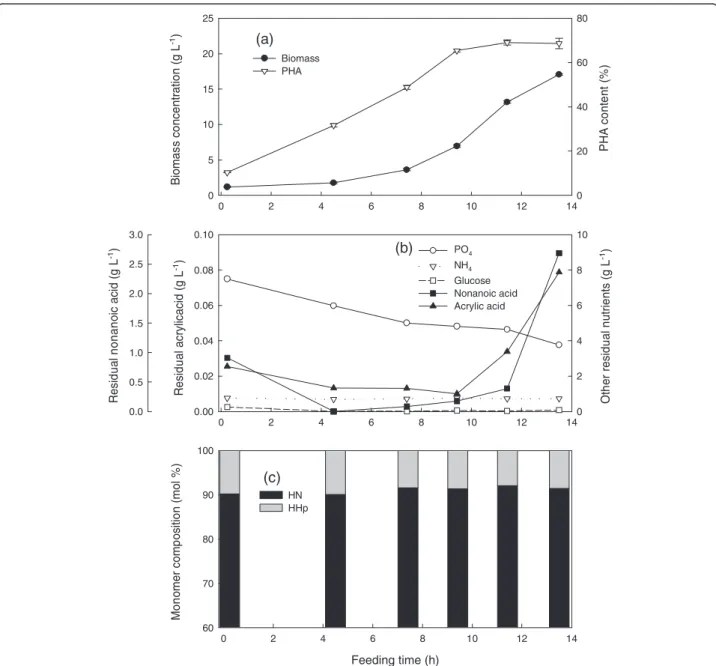
In an attempt to further increase the HN content, the culture conditions were kept the same as above except that the amount of acrylic acid was increased by a factor of five. The results were similar to what is shown in Figure 1 except that the residual nonanoic acid and acrylic acid accumulated earlier (starting at 12.4 h instead of 15.8 h). Again, there was uncontrollable foaming and only 17 g L-1 final biomass was produced (Figure 2a, b).
However, the PHA content increased from 56 to 64% with about 90 mol% HN (Figure 2c).
Co-feeding nonanoic acid, glucose, and acrylic acid at a mass ratio of 1.25: 1: 0.05 and aμof 0.15 h-1
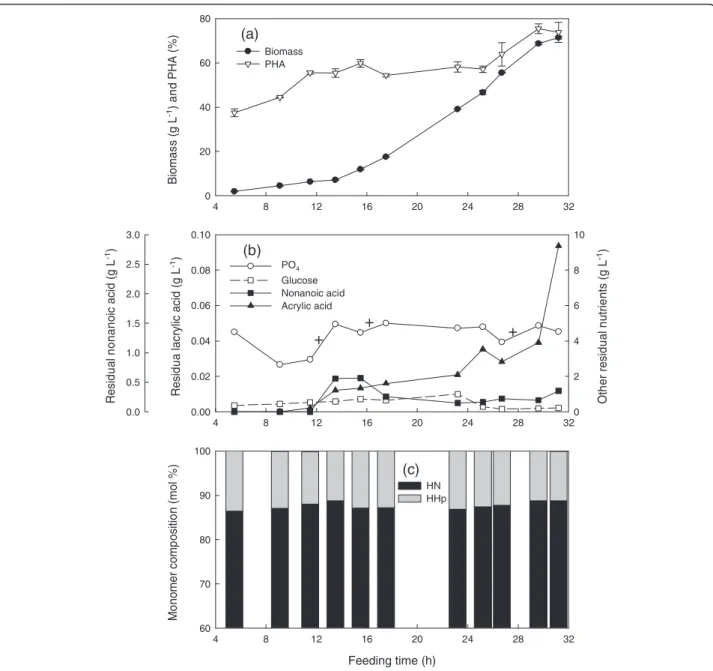
In order to avoid both acrylic acid and nonanoic acid accumulation, the feeding program was adjusted to achieve a lowerμof 0.15 h-1at a NA: G: AA feeding ratio of 1.25: 1: 0.05 for the first 23.3 h followed by a constant feed rate of 8 g L-1 h-1. Under these conditions, a final biomass
4 8 12 16 20 24 28 32
Oth
er resid
u
al n
utrie
nts (
g
L
-1)
0 2 4 6 8 10
Resid
u
al n
o
n
a
n
oic acid
(g
L
-1)
0.0 0.5 1.0 1.5 2.0 2.5 3.0
Resid
u
a lacrylic acid
(g
L
-1)
0.00 0.02 0.04 0.06 0.08 0.10
PO4
Glucose Nonanoic acid Acrylic acid
4 8 12 16 20 24 28 32
Biomas
s (g L
-1) a
n
d
PHA (%
)
0 20 40 60 80
Biomass PHA
Feeding time (h)
4 8 12 16 20 24 28 32
Mo
nomer comp
ositio
n
(mol %
)
60 70 80 90 100
HN HHp
+
+
+
(a)
(b)
(c)
Figure 3Cultivation ofP. putidaKT2440 by feeding nonanoic acid, glucose and acrylic acid at a mass ratio of 1.25: 1: 0.05 and a specific growth rate of 0.15 h-1in fed-batch fermentation at 28.5 ± 1°C, pH 6.85 ± 0.05, DO > 30%.Fermentation data
concentration of 71.4 g L-1was achieved (Figure 3a). The PHA content increased in two steps, from 0 to 59.8% follo-wed by a 10 h plateau, until the change to a constant feed rate when there was a second increase from 58.1 to75.5%.
There was constant foaming from the beginning of the fermentation. This became more severe at 12 h. At this time, the phosphate (20 mL) and trace element solutions (30 mL) were added. Antifoam was added dropwise and the foam disappeared after about 30 min. Phosphate was maintained at non-limiting levels while ammonium was automatically controlled to be in the range of 1 ~ 1.5 g L-1 (Figure 3b) as in the previous two fermentations. The glu-cose concentration was always slightly above zero. There was a slight increase in the nonanoic acid concentration between 12 h and 16 h, but its concentration dropped after 16 h and remained below 0.5 g L-1until near the end of the fermentation. Despite a supply of 1 vvm pure oxy-gen, the dissolved oxygen dropped to zero at 29.6 h and remained there for the duration of the fermentation. PHN containing about 88 mol% HN was obtained.
Comparison of the three fed-batch fermentations
Regardless of the acrylic acid concentration, feeding to maintain a specific growth rate of 0.25 h-1produced the same biomass trend (Figure 4) until foaming occurred, ending the fermentations. However, at a lower specific growth rate (0.15 h-1), higher biomass and PHA content were eventually achieved. While cumulative PHA pro-ductivity (PHA in g L-1 divided by total fermentation time) increased more quickly at a higher specific growth rate, the highest cumulative productivity of 1.8 g L-1h-1 was obtained with a combination of the higher acrylic acid concentration and lower growth rate (Figure 5).
Discussion
Control of the monomeric composition of MCL-PHA in a fed-batch fermentation using a β-oxidation inhibitor is novel and challenging. Bacterial cultivation using fatty acid substrates in the presence of acrylic acid has been shown to produce poor growth and MCL-PHA accumulation both in our chemostat studies (Jiang et al. 2012) and in the literature (Huijberts et al. 1994; Qi et al. 1998; Ward and O’Connor 2005). This is because β-oxidation is the only mechanism of energy production from aliphatic fatty acids. Thus, the strategy of co-feeding a carbon and en-ergy source (glucose in this study) and a PHA precursor (nonanoic acid in this study) is essential to obtain a high cell density with high PHA content.
As the acrylic acid concentration increased in the co-substrate feed, at the same feed rate (μ = 0.25 h-1), the accumulation of MCL-PHA increased as well as the pro-portion of HN monomers from 65 mol% (no acrylic acid) to greater than 92 mol% (at NA: G: AA = 1.25: 1: 0.05) (Table 1). In an earlier study (Jiang et al. 2012), we showed that increasing HN monomers had no signifi-cant effect on the weight average molecular weight but did affect thermal and mechanical properties. The increase in the HN content probably reflects increasing β-oxidation inhibition with the increasing acrylic acid concentration. Fed-batch fermentation was able to obtain the same inhibition as chemostat cultivation as demon-strated by the similar monomeric composition and cumu-lative PHA productivity (Table 1) at the same growth rate (μ=0.25 h-1) and NA: G: AA feeding ratio (1.25: 1: 0.05). However, in contrast to a continuous or batch cultivation where nutrients and other additives are either at steady state concentrations or gradually consumed, substrates in
Feeding time (h)
0 4 8 12 16 20 24 28 32
Biomass concentration (g L
-1)
and PHA content (%)
0 20 40 60 80
X (NA:G:AA=1.25:1:0.01, µ=0.25h-1) X (NA:G:AA=1.25:1:0.05, µ=0.25h-1) X (NA:G:AA=1.25:1:0.05, µ=0.15h-1) PHA (NA:G:AA=1.25:1:0.01, µ=0.25h-1)
PHA (NA:G:AA=1.25:1:0.05, µ=0.25h-1) PHA (NA:G:AA=1.25:1:0.05, µ=0.15h-1)
fed-batch fermentations may accumulate if they are con-sumed more slowly than the feed rate. Accumulation of toxic substances could be harmful since it may lead to cell death and uncontrollable foaming. About 3 ~ 4 g L-1 of nonanoic acid (Sun et al. 2006) and as little as 0.1 g L-1 acrylic acid are toxic to P. putidaKT2440. In this study, the use of acrylic acid is even more challenging since nonanoic acid accumulation was accelerated by β-oxidation inhibition and occurred very quickly as seen in the two fermentations at the higher feed rate (μ= 0.25 h-1). At a lower feed rate (μ = 0.15 h-1 followed by linear feeding), although there were two minor foaming events at 12 and 23 h accompanied by a noticeable but lower level of nonanoic and acrylic acid accumulation, foaming was controllable. This resulted in a longer fermentation with much higher biomass production (71.4 g L-1), higher MCL-PHA accumulated (75.5%) with high HN content (about 89 mol%) and the best MCL-PHA
productivity (1.8 g L-1 h-1) and yield of PHA from NA (0.78 g g-1) (Table 1). This may be improved fur-ther by using a decaying substrate feeding strategy (Maclean et al. 2008).
Whether it is metabolized or not, acrylic acid con-sumption was linearly related to cell growth, in a man-ner similar to nonanoic acid consumption (Figures 1, 2 and 3). Since it is continuously taken up by the cells, the feeding of acrylic acid should be proportional to cell growth in order to impose a constant level of inhibition and thus a constant PHA monomeric composition. The combination of an appropriate concentration of the β-oxidation inhibitor and a growth rate which avoids toxic accumulation of both nonanoic and acrylic acid enhanced growth and PHA accumulation as well as controlled the monomeric composition. This is the first report of the use of a β-oxidation inhibitor in high-cell-density fed batch production of MCL-PHA.
Feeding time (h)
4 8 12 16 20 24 28 32
Cumulative PHA productivity (g L
-1 h -1)
0.0 0.3 0.6 0.9 1.2 1.5 1.8
NA:G:AA=1.25:1:0.01, µ=0.25 h-1 NA:G:AA=1.25:1:0.05, µ=0.25 h-1 NA:G:AA=1.25:1:0.05, µ=0.15 h-1
Figure 5Cumulative PHA productivity inP. putidaKT2440 under nonanoic acid and glucose co-feeding at the presence of acrylic acid in fed-batch fermentations.
Table 1 Comparison of fermentations producing PHN usingP. putidaKT24404
Specific growth
rate (h-1)
NA:G:AA1
feeding ratio (w/w/w)
Fermentation type
Biomass
(gL-1)
PHA (%)
HN (mol%)
HHp (mol%)
Yx/c2
(g g-1)
YPHA/NA2
(g g-1)
Cumulative PHA
productivity3
(g L-1h-1)
Reference
0.25 1:1:0 Fed-batch 71.0 56.0 65.0 35.0 0.62 0.66 1.4 Sun et al.2009
0.25 1.25:1:0.05 Chemostat 5.8 51.7 91.3 8.7 0.66 0.61 0.7 Jiang et al.2012
0.25 1.25:1:0.01 Fed-batch 34.3 55.7 84.3 15.7 0.62 0.68 1.2 This study
0.25 1.25:1:0.05 Fed-batch 17.1 64.4 92.2 7.8 0.53 0.68 0.8 This study
0.15 1.25:1:0.05 Fed-batch 71.4 75.5 88.9 11.1 0.62 0.78 1.8 This study
1
NAnonanoic acid,Gglucose,AAacrylic acid,HN3-hydroxynonanoate,HHp3-hydroxyheptanoate.
2
YX/Cyield of biomass from total carbon substrate,YPHA/NAyield of PHA from nonanoic acid. 3
Calculated as PHA in g L-1
divided by total fermentation time.
4
Competing interests
The authors hold a patent partially based on the paper (US pat no. 8273852).
Authors’contribution
XJJ carried out fermentations and analyses, XJJ, ZS, JAA and BAA were involved in data presentation, interpretation and writing of manuscript. All authors read and approved the final manuscript.
Acknowledgements
This research was supported by the Natural Science and Engineering Research Council of Canada, Xerox Research Center of Canada, and a McLaughlin Scholarship and Queen’s Graduate Award to XJ Jiang.
Author details
1Chemical Engineering, Queen's University, Kingston, ON K7L 3N6, Canada. 2
Polyferm Canada Inc., RR1, Harrowsmith, ON K0H 1V0, Canada.
Received: 26 July 2013 Accepted: 24 August 2013 Published: 29 August 2013
References
Chung AL, Jin HL, Huang LJ, Ye HM, Chen JC, Wu Q, Chen GQ (2011) Biosynthesis and characterization of poly(3-hydroxydodecanoate) by ß-oxidation inhibited mutant ofPseudomonas entomophilaL48. Biomacromolecules 12:3559–3566
Clesceri LS, Greenberg AE, Eaton AD (1999) Standard methods for the examination of water and wastewater, 20th edn. American Public Health Association, Washington, DC
Gagnon KD, Lenz RW, Farris RJ, Fuller RC (1992) Crystallization behavior and its influence on the mechanical properties of a thermoplastic elastomer produced byPseudomonas oleovorans. Macromolecules 25:3723–3728 Gross RA, Demello C, Lenz RW, Brandl H, Fuller RC (1989) Biosynthesis and
characterization of poly(beta-hydroxyalkanoates) produced byPseudomonas oleovorans. Macromolecules 22:1106–1115
Hazenberg W, Witholt B (1997) Efficient production of medium-chain-length poly (3-hydroxyalkanoates) from octane byPseudomonas oleovorans: economic considerations. Appl Microbiol Biotechnol 48:588–596
Huijberts GNM, Derijk TC, Dewaard P, Eggink G (1994) C-13 nuclear-magnetic -resonance studies ofPseudomonas putidafatty-acid metabolic routes involved in poly(3-hydroxyalkanoate) synthesis. J Bacteriol 176:1661–1666 Jiang X, Ramsay JA, Ramsay BA (2006) Acetone extraction of mcl-PHA from
Pseudomonas putidaKT2440. J Microbiol Methods 67:212–219 Jiang X, Sun Z, Marchessault RH, Ramsay J, Ramsay B (2012) Biosynthesis and
properties of medium-chain-length polyhydroxyalkanoates with enriched content of the dominant monomer. Biogeosciences 13:2926–2932 Lee SY, Wong HH, Choi JI, Lee SH, Lee SC, Han CS (2000) Production of
medium-chain-length polyhydroxyalkanoates by high-cell-density cultivation of
Pseudomonas putidaunder phosphorus limitation. Biotechnol Bioeng 68:466–470
Lever M (1972) New reaction for colorimetric determination of carbohydrates. Anal Biochem 47:273–279
Liu Q, Luo G, Zhou XR, Chen GQ (2011) Biosynthesis of poly(3-hydroxydecanoate) and 3-hydroxydodecanoate dominating polyhydroxyalkanoates by
β-oxidation pathway inhibitedPseudomonas putida. Metabolic Eng 13:11–17 Maclean H, Sun Z, Ramsay J, Ramsay B (2008) Decaying exponential feeding of
nonanoic acid for the production of medium-chain-length poly(3-hydroxyalkanoates) byPseudomonas putidaKT2440. Can J Chem 86:564–569 Marchessault RH, Monasterios CJ, Morin FG, Sundararajan PR (1990) Chiral poly
(beta-hydroxyalkanoates) - an adaptable helix influenced by the alkane side-chain. Int J Biol Macromol 12:158–165
Philip S, Keshavarz T, Roy I (2007) Polyhydroxyalkanoates: biodegradable polymers with a range of applications. J Chem Technol Biotechnol 82:233–247
Poirier Y, Nawrath C, Somerville C (1995) Production of polyhydroxyalkanoates, a family of biodegradable plastics and elastomers in bacteria and plants. Biogeosciences 13:142–150
Qi Q, Steinbuchel A, Rehm BH (1998) Metabolic routing towards
polyhydroxyalkanoic acid synthesis in recombinantEscherichia coli(fadR): inhibition of fatty acid beta-oxidation by acrylic acid. FEMS Microbiol Lett 167:89–94
Ramsay BA, Saracovan I, Ramsay JA, Marchessault RH (1991) Continuous production of long-side-chain poly-beta-hydroxyalkanoates byPseudomonas oleovorans. Appl Environ Microbiol 57:625–629
Sun Z, Ramsay JA, Guay M, Ramsay BA (2006) Automated feeding strategies for high-cell-density fed-batch cultivation ofPseudomonas putidaKT2440. Appl Microbiol Biotechnol 71:423–431
Sun Z, Ramsay JA, Guay M, Ramsay BA (2007) Carbon-limited fed-batch production of medium-chain-length polyhydroxyalkanoates from nonanoic acid byPseudomonas putidaKT2440. Appl Microbiol Biotechnol 74:69–77 Sun Z, Ramsay JA, Guay M, Ramsay BA (2009) Enhanced yield of medium-chain
-length polyhydroxyalkanoates from nonanoic acid by co-feeding glucose in carbon-limited, fed-batch culture. J Biotechnol 143:262–267
Van der Walle GAM, De Koning GJM, Weusthuis RA, Eggink G (2001) Properties, modifications and applications of biopolyesters. Adv Biochemical Eng Biotechnol 71:263–291
Ward PG, O’Connor KE (2005) Bacterial synthesis of polyhydroxyalkanoates containing aromatic and aliphatic monomers byPseudomonas putidaCA-3. Inter J Biol Macromol 35:127–131
Weatherburn MW (1967) Phenol-hypochlorite reaction for determination of ammonia. Anal Chem 39:971–974
doi:10.1186/2191-0855-3-50
Cite this article as:Jianget al.:Fed-batch production of MCL-PHA with elevated 3-hydroxynonanoate content.AMB Express20133:50.
Submit your manuscript to a
journal and benefi t from:
7Convenient online submission
7Rigorous peer review
7Immediate publication on acceptance
7Open access: articles freely available online
7High visibility within the fi eld
7Retaining the copyright to your article