The Roles Of Task Complexity, Working Memory, and Task Modality in L2 Development: A Review of Empirical Studies
Zihan Geng
Texas A&M University, [email protected] Li-Jen Kuo
Texas A&M University, [email protected]
Abstract
With the promotion of interactive tasks in educational contexts, researchers in second language acquisition have evaluated the effectiveness of task-based language teaching (TBLT). More recently, cognitive demanding variables in tasks have drawn a lot of attention, and the contradictory predictions on learners’ L2 production of Robinson’s Cognition Hypothesis and Skehan’s Trade-off Hypothesis even further promote more research on this topic. As working memory (WM) also plays a critical role in cognitive demands, researchers begin to investigate the interactive influence of task complexity and WM in recent years. An additional variable being neglected by most researchers is task modality. Findings of recent research have provided evidence for the influential role of the mode in learners’ L2 production. The purpose of this article, therefore, is to review the theoretical framework and previous studies involving these variables, and to provide insights for future research.
Introduction
Over the past a few decades, tasks have been viewed as a primary component of second language instruction. A burgeoning area of research on task-based language teaching (TBLT), therefore, has been conducted by either comparing TBLT with other language teaching
approaches or by investigating TBLT itself in terms of task feature, interaction in tasks, and learner factors. The findings of previous research tend to advocate the effectiveness of TBLT in second language acquisition (SLA) (e.g., Ellis, 2003; Skehan, 1996; Van den Branden, Bygate, & Norris, 2009; Willis & Willis, 2008). More recently, the focus of research on TBLT has been switched to the impact of task feature and the influence of learner factors on language learning. Specifically, task feature and learner factors in terms of task complexity and working memory (WM) respectively have been drawing more and more researchers’ and educators’ attention in recent years. As both task complexity and WM fall into the cognitive dimension, and WM has been viewed as one of the primary cognitive factors affecting second language (L2) learning (e.g., Baralt, 2010; Goo, 2012; Kormos, 2011; Kormos & Trebits, 2011; Mackey, Philp, Egi, Fujii, & Tatsumi, 2002; Revesz, 2012), it is necessary to take WM into consideration while exploring the effect of task complexity. However, to date, very few studies have examined the interactive effects of task complexity and WM on learners’ L2 production.
Another element that may also affect learners’ L2 production would be the modality of task performance. A few researchers have noticed the potential impact of this factor and begun to explore whether there is significant difference in learners’ L2 production across modalities (i.e. oral or written) (e.g., Kormos & Trebits, 2012; Yuan & Ellis, 2003).
Drawing on the lack of research on the interactive effects of task complexity and WM on Learners’ L2 production and the fact that the influence of WM might be mitigated depending on the mode of task performance (Payne & Whitney, 2002), the present study aims to investigate the role of task complexity and working WM in both oral and written task performance.
In the subsequent literature review, we first provided a brief introduction on TBLT with its goals and distinct features. After that, the more specific concept, task complexity, was
influences second language acquisition. Finally, we compared and emphasized the differences between speaking and writing in language learning along with empirical findings.
Literature review Task-based language teaching (TBLT)
“TBLT was developed as an alternative to traditional methods such as grammar
translation, the Audiolingual Method or present – practice - produce” (Ellis & Shintani, 2014, p. 134). Traditional language teaching methods, like present – practice – produce (PPP), focus primarily on developing learners’ linguistic competence. Whereas, being viewed as a strong version of communicative language teaching (CLT), which aims to develop learners’
communicative competence, TBLT is utilized to develop both learners’ linguistic competence (i.e. acquire a new language) and interactional competence (i.e. use the target language) through the performance of tasks (Ellis & Shintani, 2014).
Ellis (2003) summarizes various definitions of tasks and defines tasks as “activities that call for primarily meaning-focused language use” (p. 3). Ellis also proposed criterial features of a task, which helps to distinguish tasks from exercises (i.e. activities primarily require
form-focused language use): (1) a task is a workplan; (2) a task should have a primary focus on
meaning; (3) a task should involve real-world process of language use; (4) A task should involve any of the four language skills; (5) A task should engage cognitive processes; (6) a task should have a clear defined communicative outcome. These criteria ensure that while performing a task, learners treat language as a “tool” rather than an “object”.
Regarding the authenticity of a task, Willis and Willis (2008) suggested three different levels. The higher the level is, the “more” authentic a task would be.
Level 1: it provides opportunities for learners to produce meanings that will be useful in the real life.
Level 2: it engages learners produce discourse that commonly used in daily conversations. Level 3: it involves activities occurring in the real world.
Task complexity and L2 production
As discussed above, Willis and Willis’ (2008) authenticity model is corresponding to Robinson’s (2001, 2007b) Cognition Hypothesis, in which it is stated that “tasks should be designed and sequenced for learners on the basis of increases in their cognitive complexity” (Robinson, 2007b, p. 193). In relevant to the impact of task complexity, Robinson predicted that as the task complexity increases along resource-directing variables, which is discussed later in this section, more complex and accurate utterances would be found in learners’ L2 production. This prediction is based upon the hypothesis that learners are able to access to multiple and non-competitional attentional resources. The higher level of cognitive demanding would lead to more attention to the linguistic form which results in greater linguistic complexity and higher accuracy. However, another cognitive demands model - Skehan’s (1998, 2009) Trade-off Hypothesis – provides a different view on the effect of task complexity. It was asserted that learners’ attentional resources are limited and the attention would be first drawn to the meaning rather than linguistic forms. Therefore, the more complex a task is, the more attention would be drawn to the meaning leaving less attention to form, which leads to low complexity and accuracy in L2 production. Even if one of the aspects increases, for example, complexity, the other would decrease.
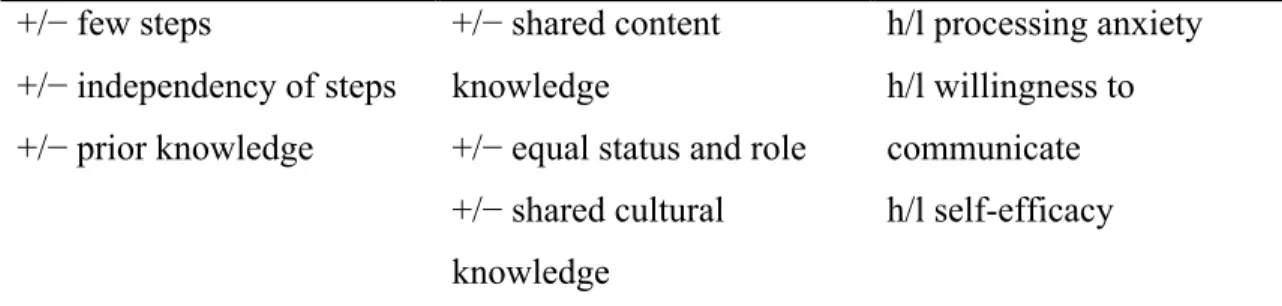
Previous empirical studies on task complexity have generally fallen into three dimensions: resource-directing (e.g., Kormos, 2011; Revesz 2011; Robinson, 2007b), resource-dispersing (e.g., Hsu, 2015), and the mix of the two (e.g., Gilabert, 2007).
Task Complexity (Cognitive factors)
Task Condition (Interactive Factors)
Task Difficulty (Learner factors) (Classification criteria: cognitive demands) (Classification procedure: information-theoretic analyses) (Classification criteria: interactional demands) (Classification procedure: behavior-descriptive analyses) (Classification criteria: ability requirements) (Classification procedure: ability assessment analyses) (a) Resource-directing variables making cognitive/conceptual demands
(a) Participation variables making interactional demands
(a) Ability variables and task-relevant resource differentials
+/− here and now +/− few elements −/+ spatial reasoning −/+ causal reasoning −/+ intentional reasoning −/+ perspective-taking
+/− open solution +/− one-way flow +/− convergent solution +/− few participants +/− few contributions needed
+/− negotiation not needed
h/l working memory h/l reasoning
h/l task-switching h/l aptitude
h/l field independence h/l mind/intention-reading
(b) Resource-dispersing variables making
performative/procedural demands
(b) Participant variables making interactant demands
(b) Affective variables and task-relevant state-trait differentials
+/− planning time +/− single task +/− task structure
+/− same proficiency +/− same gender +/− familiar
+/− few steps
+/− independency of steps +/− prior knowledge
+/− shared content knowledge
+/− equal status and role +/− shared cultural knowledge
h/l processing anxiety h/l willingness to communicate h/l self-efficacy
Figure 1. The Triadic Componential Framework for task classification (Robinson, 2007a)
The majority of previous research on task complexity has been conducted along resource-directing variables. For example, Robinson (2007b) examined the effect of task complexity on L2 interaction, uptake (i.e. student’s immediate response to the interlocutor’s corrective feedback), and perception of task difficulty with 42 EFL learners. In the study, Robinson manipulated task complexity along [+/- reasoning] through a picture-narration task. The results showed that tasks requiring more complex reasoning significantly promoted interaction and uptake. Revesz (2011) also manipulated [+/- reasoning] together with [+/- few elements] to explore its impact on interaction and L2 production. The results suggested that as the task complexity increased, significantly more language learning opportunities (i.e. linguistic interaction), higher accuracy and lexical diversity was found in learners’ L2 production. However, the participants also demonstrated lower syntactic complexity in the more complex tasks, which is partly in accordance with the Trade-off Hypothesis.
In another study evaluating the role of task complexity, Kormos (2011) manipulated [+/- causal reasoning] in a story-telling task, in which the participants were required to complete two written narrative tasks one after the other. The [+/- causal reasoning] was achieved through a cartoon description task, which only required simple information transmission, and a picture-story task, in which the participants had to tell a picture-story out of six unrelated pictures. The results provided strong support to the Cognition Hypothesis that higher level of task complexity triggered more L2 lexical, syntactic and morphological development.
whether there was planning time provided during the task. The study employed story-telling tasks, in which the complex group had nearly no time (0.5 minutes) to prepare their L2 production while the simple group owned 10 minutes for the preparation. The results of the study demonstrated higher accuracy and grammatical complexity in the L2 production of the complex group. Whereas, the simple group achieved more fluent and lexically varied language.
Research has also been conducted looking into the impact of two variables covering both resource-directing and resource-dispersing. Gilabert (2007) investigated learners’ L2 production along [+/- planning time] and [+/- here-and-now]. Forty-eight EFL college students participated in the study. Four groups with various cognitive demanding levels were administrated: planned here-and-now, unplanned here-and-now, planned there-and-then, unplanned there-and-then. The results suggested that planning time was not a significant factor on learners’ structural
complexity and accuracy while it did have great influence on lexical complexity and fluency. In terms of the impact of [+/- here-and-now], Gilabert found that in more complex tasks, learners demonstrated lower fluency and lexical complexity but higher accuracy. There was no
significant impact on structural complexity.
In sum, though the general findings tend to be more compatible with the Cognition Hypothesis, the role of task complexity remains enigmatic. Just as highlighted in Revesz (2011), the predictions of the Trade-off Hypothesis are also attested when some specific aspects of task performance are controlled. The mixed findings suggest the need for further exploration on the effects of task complexity and also other potential factors (e.g., individual difference that may moderate the influence of task complexity).
Working memory, task complexity and L2 development
Before moving on to the research relevant to the role of WM in L2 development, the definition of WM and its components are distributed in the following discussion. WM is defined as “… a limited capacity system, which temporarily maintains and stores information, supports human thought processes by providing an interface between perception, long-term memory and action” (Baddeley, 2003, p. 829). Baddeley and Hitch (1974) proposed the multicomponent model of working memory involving a central executive system (i.e. a general information processing controller), and two subsidiary systems: a phonological loop (i.e. temporarily storing phonological information) and a visual-spatial sketchpad (i.e. storing and processing visual and spatial information). Later, in Baddeley (2000), an episodic buffer holding and integrating information, was added into the model. With respect to the area of SLA, WM has been evaluated in terms of the phonological loop, often measured by immediate serial recall of numbers or words, and its general simultaneous storage and processing function measured by span tasks (Baddeley, 2003; Baralt, 2010).
Empirical evidence has provided insights on the significance of WM on a variety form of learning, such as language comprehension. Higher WM learners were found to be better at vocabulary development, writing, reading, and listening. (Linck, Osthus, Koeth, & Bunting, 2014)
In order to elucidate the relationship between WM and SLA, a growing body of research studies witness the implication of WM in L2 processing. A recent meta-analysis of 79 studies on WM and SLA has shown the robust effects of WM - “WM is positively associated with both L2 processing and proficiency outcomes, with an estimated population effect size (ρ) of .255” (Linck et al., 2014, p. 861). The covariate analyses demonstrated even larger effect size for the executive control and the verbal measure of WM.
In the specific area of SLA, researchers have also been devoted to evaluate the potential impact of WM in L2 interaction (e.g., Goo, 2012; Mackey, Philp, Fujii, Egi, & Tatsumi, 2002; Revesz, 2012), L2 production (e.g., Gilabert & Munoz, 2010; Kormos, 2011; Kormos & Trebits, 2011; Niwa, 2000), and L2 development (e.g., Baralt, 2010; Kim, Payant, & Pearson, 2015).
(L1) and L2 listening span tasks. The findings revealed that high-span learners achieved more noticing and more English question development compared with low-span learners.
In another study, Goo (2012) examined the interactive effects of WM and recasts (i.e. correcting learners’ erroneous utterance by providing the correct form, without metalinguistic explanation), and metalinguistic feedback (i.e. explaining the linguistic rules) on the learning of the English that-trace filter. The results indicated that WM significantly predicted the
effectiveness of recasts but not metalinguistic feedback on the acquisition of that-trace filter. Revesz (2012) also investigated the relation between WM and corrective feedback (i.e. recasts) on L2 development. Ninety beginner-level EFL learners participated in this study. Phonological short-term memory was assessed with a digit span task and a nonword span task. The complex WM was measured with a reading span task. An additional variable in this study is the mode of task performance. Revesz employed both oral and written tests to measure the participants’ L2 development. The findings showed that learners with higher reading span (the complex WM) achieved more development on the written tests, while the ones who had higher digit and nonword span (the phonological loop) performed better on the oral test. Revesz attributed the results to the mode of the tests that the oral assessments tended to measure
procedural knowledge while written assessments were more conductive to the use of declarative knowledge.
In regards L2 production, Gilabert and Munoz (2010) inquires into the relationship between WM and English language attainment and performance. Moderate correlations were found between WM and lexical complexity only in the high-proficiency group. Gilabert and Munoz interpreted the result by relating it to Mizera (2006) that WM seemed to be most influential at later stages of acquisition as beginning learners “may need to use more cognitive resources to store intermediate products between conceptualization and formulation than advanced learners” (Gilabert & Munoz, 2010, p.37). However, this interpretation could not be applied to the findings of Kormos and Safar (2008), in which a weak to moderate correlation between WM and speaking ability was found in beginning learners.
synchronous computer-mediated communication (SCMC) can form the same cognitive
mechanism as it is in a face-to-face (FTF) spontaneous conversation, and therefore, SCMC could indirectly improve learners’ L2 oral proficiency. The researchers distinguished executive
function and phonological capacity of WM. Both findings reveal the correlation between WM and learners’ L2 oral output, and also suggest the beneficial role of SCMC in reducing memory load for, especially, low-proficiency learners. The difference is that Payne and Whitney (2002) only found association between phonological capacity and language gains, whereas Payne and Ross (2005) showed the major impact of executive function.
Despite of the substantial research studies on WM, very few have related WM to task complexity, which also manipulates cognitive demands in task performance and language
development. Kormos and Trebits (2011) examined the role of WM on learners’ L2 performance in various task complexity levels. Similar to the design of Kormos (2011), the researchers also employed the cartoon description task (simple version) and the picture-story task (complex version). Learners’ WM was evaluated through the backward digit span test. Kormos and Trebits found that only in the low complex task, a significant impact of WM on syntactic complexity was found. The researcher interpreted the finding that although the picture narration task seemed to be more complex, there might also be higher attentional demands on students in the cartoon description task as they had to follow the given story line with their limited linguistic resources. The results also demonstrated that low backward digit span students produced shorter clauses in the cartoon description task (simple), which implied that higher WM might help students
produce more complex sentences in specific tasks.
Negative influence of higher WM on learners’ oral fluency was found in Niwa (2000) in more complex narrative tasks, which suggests that higher WM individuals tend to primarily distribute their attention to the reasoning and linguistic aspects of the task.
to benefit the most in the study. Kim et al. interpreted the results by drawing on the Cognition Hypothesis that learners in the complex group were pushed to process information and make decision simultaneously, which requires higher WM capacity. The high cognitive demanding fostered noticing and the subsequent linguistic development. The study adds insights into the role of WM in task complexity dimensions and suggests that lower WM learners may not benefit as much in higher cognitive demanding tasks and therefore individual differences, such as WM, should be considered in classroom task design.
In relation to technology mediated language acquisition, Baralt (2010) explored the role of task complexity and WM in L2 development in both the face-to-face (FTF) and online
computer-mediated communication (CMC) modes. The findings suggested that WM did not play a significant role between task complexity and the production knowledge development whereas it did associate with the development of the receptive knowledge in the simple group and only in the FTF mode.
The mixed findings, either in a FTF mode or in an online condition, warrant more research into the interaction between WM and task complexity. Some other potential factors, such as age and language proficiency, should also be taken into consideration in future research. Spoken and written task performance
Research in TBLT has generally focused on speaking tasks. However, Modality has also been proposed to be a manipulation of source-directing demands in task complexity as the nature of writing fosters opportunities for learners to process and focus on the linguistic aspects of the language compared to speaking (Kormos, 2014). Even though writing does not necessarily indicate unlimited time, writers somewhat have less pressure than speakers who need to divide their attention between conceptualizing the information and linguistically encoding it
simultaneously (Yuan & Ellis, 2003). On the contrary, writing enables learners to plan and encode their messages separately, which seems to be less relevant to WM.
The various cognitive loads involved in oral and written processes could also be
resources. The process of writing is completed through planning, translating, and reviewing (Kellogg, 2001). All three processes are interactive and are built upon resources of WM. Therefore, although both speaking and writing involve three processes, the ways of functioning in terms of cognitive demanding are quite different.
With regard to task performance, oral performance includes oral narration and FTF oral interaction. Written performance involves written narration and CMC interaction. Previous studies indirectly evident that online chatting taking the form of writing, may be more beneficial for learners with low WM compared with a FTF oral mode (Payne & Whitney, 2002).
To date, only a handful of studies with inconsistent findings have addressed how the mode of performance impacts learners’ L2 production. Granfeldt (2008) conducted a study with French learners and found greater lexical diversity and higher accuracy in speaking than in writing in more complex tasks. No effect had been revealed on syntactic complexity. Kuiken and Vedder (2011) explored the influence of task complexity and the mode of task performance on learners’ L2 production. The findings confirmed the role of the mode of performance that in more complex tasks, learners produced more syntactically complex language in writing, but there was no significant difference on lexical diversity. In contrast, Kormos and Trebits (2012)
demonstrates that more complex tasks induced higher lexical variety in writing but the
performance was similar in terms of syntactic complexity. In Tavakoli (2014), more syntactically complex output was found in the simpler writing tasks than in the speaking tasks.
seems particularly relevant for the encoding and revision of more advanced grammatical structures, such as feminine gender agreement” (p. 348).
Conclusion
References
Baddeley, A. (2000). The episodic buffer: a new component of working memory?. Trends in cognitive sciences, 4(11), 417-423.
Baddeley, A. (2003). Working memory: looking back and looking forward. Nature reviews neuroscience, 4(10), 829-839.
Baddeley, A. D., & Hitch, G. (1974). Working memory. In G. H. Bower (Ed.), The psychology of learning and motivation: Advances in research and theory (Vol. 8, pp. 47 – 89).New York, NY: Academic Press.
Baralt, M. (2010). Task complexity, the Cognition Hypothesis and interaction in CMC and FTF environments (Unpublished doctoral dissertation). Georgetown University, Washington, DC.
Ellis, R. (2003). Task-based language learning and teaching. Oxford: Oxford University Press. Ellis, R., & Shintani, N. (2014). Exploring language pedagogy through second language
acquisition research. NY: Routledge.
Gilabert, R. (2007). The simultaneous manipulation of task complexity along the planning time and +/− here-and-now dimensions: Effects on L2 oral production. In M. del Pilar García-Mayo (Ed.), Investigating tasks in formal language learning (pp. 44 – 68). Clevedon, UK: Multilingual Matters.
Gilabert, R., & Muñoz, C. (2010). Differences in attainment and performance in a foreign language: The role of working memory capacity. International Journal of English Studies, 10(1), 19-42.
Granfeldt, J. (2008). Speaking and writing in L2 French: Exploring effects on fluency, accuracy and complexity. In A. Housen, S. van Daele, & M. Pierrard (Eds.), Proceedings of the conference on complexity, accuracy and fluency in secondlanguage use, learning and teaching (pp. 87–98). Brussels, Belgium: Koninklijke Vlaamse Academi.
Goo, J. (2012). Corrective feedback and working memory capacity in interaction-driven L2 learning. Studies in Second Language Acquisition, 34(3), 445-474.
1-Kim, Y., Payant, C., & Pearson, P. (2015). The intersection of task-based interaction, task complexity, and working memory. Studies in Second Language Acquisition, 37(3), 549-581.
Kellogg, R. T. (2001). Competition for working memory among writing processes. The American Journal of Psychology, 114, 175–191.
Kormos, J. (2011). Task complexity and linguistic and discourse features of narrative writing performance. Journal of Second Language Writing, 20(2), 148-161.
Kormos, J., & Sáfár, A. (2008). Phonological short-term memory, working memory and foreign language performance in intensive language learning. Bilingualism: Language and cognition, 11(2), 261-271.
Kormos, J., & Trebits, A. (2011). Working memory capacity and narrative task performance. In P. Robinson (Ed.), Second language task complexity: Researching the Cognition
Hypothesis of language learning and performance (pp. 267 – 286). Amsterdam, the Netherlands: Benjamins.
Kormos, J., & Trebits, A. (2012). The role of task complexity, modality, and aptitude in narrative task performance. Language Learning, 62(2), 439-472.
Kuiken, F., & Vedder, I. (2011). Task performance in L2 writing and speaking: The effect of mode. In P. Robinson (Ed.), Second language task complexity: Researching the
Cognition Hypothesis of language learning and performance (pp. 91–104). Amsterdam: Benjamins.
Kuo, L. - J. & Anderson, R. C. (2008). Conceptual and methodological issues in comparing metalinguistic awareness across languages. In K. Koda and A. Zehler (Eds.), Learning to read across languages (pp. 39-67). Mahwah, NJ: Lawrence Erlbaum Associates.
Levelt, W. J. M. (1992). Accessing words in speech production: Stages, processes, and representations. Cognition, 42, 1–22.
Mackey, A., Philp, J., Egi, T., Fujii, A., & Tatsumi, T. (2002). Individual differences in working memory, noticing of interactional feedback and L2 development. In P. Robinson (Ed.), Individual differences and instructed language learning (pp. 181-208). Philadelphia: John Benjamins.
Mayer, R. E. (1996) Learners as information processors Legacies and limitations of educational psychology's second metaphor. Educational Psychologist, 31, 151-161.
Mizera, G. J. (2006). Working memory and L2 oral fluency (Doctoral dissertation) University of Pittsburgh.
Niwa, Y. (2000). Reasoning demands of L2 tasks and L2 narrative production: Effects of individual differences in working memory, intelligence, and aptitude (Unpublished master’s thesis). Aoyama Gakuin University,Tokyo, Japan.
Ozfidan, B., & Burlbaw, L. (2017). Development, Validation, and Application for a Bilingual Education Curriculum in Turkey. Eurasia Journal of Mathematics, Science &
Technology Education, 13(10), 6559-6569. doi.org/10.12973/eurasia.2017.01092a Ozfidan, B., Machtmes, K., & Demir, H. (2014). Socio-cultural Factors in Second Language
Learning: A Case Study of Adventurous Adult Language Learners. European Journal of Education Research, 3 (4), 185-191. doi. 10.12973/eu-jer.3.4.185
Payne, J. S. & B. M. Ross (2005). Synchronous CMC, working memory, and L2 oral proficiency development. Language Learning & Technology 9, 35–54.
Payne, J. S., & Whitney, P. J. (2002). Developing L2 oral proficiency through synchronous CMC: Output, working memory, and interlanguage development. Calico Journal, 20(1), 7-32. Revesz, A. (2011). Task complexity, focus on L2 constructions, and individual differences: A
classroom‐based study. The Modern Language Journal, 95(s1), 162-181.
Revesz, A. (2012). Working memory and the observed effectiveness of recasts on different L2 outcome measures. Language Learning, 62(1), 93-132.
Robinson, P. (2007a). Criteria for grading and sequencing pedagogic tasks. In Maria del Pilar GarciaMayo (ed.), Investigating Tasks in Formal Language Learning (pp. 7–27). Clevedon: Multilingual Matters.
Robinson, P. (2007b). Task complexity, theory of mind, and intentional reasoning: Effects on L2 speech production, interaction, uptake and perceptions of task difficulty. International Review of Applied Linguistics in Language Teaching, 45, 193–213.
Robinson, P. (2011). Second language task complexity, the cognition hypothesis, language learning, and performance. In P. Robinson (Ed.), Second language task complexity: Researching the Cognition Hypothesis of language learning and performance (pp. 3 – 38). Amsterdam, the Netherlands: Benjamins.
Skehan, P. (1996). A framework for the implementation of task-based instruction. Applied linguistics, 17(1), 38–62.
Skehan, P. (1998). A cognitive approach to language learning. Oxford, UK: Oxford University Press.
Skehan, P. (2009). Modelling second language performance: Integrating complexity, accuracy, fluency, and lexis. Applied Linguistics, 30(4), 510-532.
Tavakoli, P. (2014). Storyline complexity and syntactic complexity in writing and speaking tasks. In H. Byrnes & R. M. Manchón (Eds.), Task-based language learning—Insights from and for L2 writing (pp. 217–236). Philadelphia/Amsterdam: John Benjamins.
Van den Branden, K., Bygate, M., & Norris, J. M. (2009). Task-based language teaching: A reader. Amsterdam: John Benjamins.
Willis, D., & Willis, J. (2008). Doing task-based teaching. Oxford: Oxford University Press. Yuan, F., & Ellis, R. (2003). The Effects of Pre‐Task Planning and On‐Line Planning on
Fluency, Complexity and Accuracy in L2 Monologic Oral Production. Applied linguistics, 24(1), 1-27.