The Effect of Interactive Read-alouds on Language Learners’ Development of Writing Skill
Mehrak Rahimi*, Fahimeh Farjadnia
Department of English, Faculty of Humanities, Shahid Rajaee Teacher Training University, Tehran, Lavizan, 1678815811, Iran Corresponding Author: Mehrak Rahimi, E-mail: [email protected]
ABSTRACT
The aim of the current study was to investigate the effect of interactive read-alouds on Iranian English as a foreign language (EFL) learners’ development of writing skill. To attain such a goal, forty-six high-school students were selected and sampled as the experimental (n=23) and control (n=23) groups. The writing section of Key English Test (KET) was used as the pretest to assess participants’ entry-level writing ability. Reading was taught to the experimental group using interactive read-aloud technique while the control group received conventional silent reading instruction through a three-phase cycle of pre-reading, reading, and post-reading. Writing was taught to both groups through a seven-phase process of pre-writing, writing, response-providing, revising, editing, post-writing, and evaluating. After the treatment, the writing section of KET was used as the posttest to explore both groups’ improvement in writing. The data were analyzed by a one-way analysis of covariance (ANCOVA). The result revealed a significant difference between the experimental and control groups’ writing ability after controlling for the entry-level writing in favor of the experimental group. The findings of the study underscore the application of integrated skills pedagogical paradigm in language instruction and support the proposition that oracy and literacy are indispensably interrelated and have complementary role in language acquisition.
Key words: Reading, Aloud, Interactive, Writing, EFL
INTRODUCTION
Reading comprehension is an essential skill for both first and second language learning. While reading in one’s first lan -guage (L1) constructs literacy skill, it plays a crucial role for EFL learners as the source of comprehensible input (Eskey, 2005). Reading is viewed as one of the most important lan-guage skills as it not only opens doors to understanding other people’s ideas and perspectives, but also improves readers’ imagination and critical thinking skills.
Reasons to get students read in English classes vary. Pri-marily, “extensive exposure to linguistically comprehensible written texts can enhance the process of language acquisi-tion” (Richards & Renandya, 2002, p. 273) and leads to a better learning outcome. Further, reading is a good model and material for writing; it functions as a motivator for in-class oral discussion about a certain topic; and is a mean-ingful context for presenting new words and grammatical structures (Cunningworth, 1995). Also, reading promotes independent and self-directed language learning as it is a key component of lifelong learning (Carrell & Grabe, 2002; Dreyer & Nel, 2003). It is suggested that learning English is a natural by-product of reading and the process of learn-ing enhances if learners read comprehensible English texts (Barnett, 1989; Nuttall, 1996). Therefore, one main goal of teaching reading in English language teaching (ELT) is
Published by Australian International Academic Centre PTY.LTD.
Copyright (c) the author(s). This is an open access article under CC BY license (https://creativecommons.org/licenses/by/4.0/)
http://dx.doi.org/10.7575/aiac.ijalel.v.8n.3p.5
helping learners enjoy reading and gain automaticity and independence for reading unfamiliar and authentic texts.
Coincidental with the development of psychological per-spectives, the way the printed and aural data are processed has inspired heated debates among language educationists and researchers during the last decades. The journey from behaviorism and cognitivism to functionalism and interac-tionism has had a huge effect on the development of different types of approaches and strategies to teach receptive skills in EFL classes. As for reading, at first reading comprehension was viewed to be a passive skill or a process that basically involves decoding linguistic elements, and comprehension was equal to the efficient accumulation of these basic lexical and structural units. However, more active role for readers in processing the written text has been proposed in recent years by the emergence of sociocultural views towards language and language learning. In this framework, the dynamic in-teraction between the reader and the text is underscored and meaning construction takes place when the reader utilizes his/her background knowledge and experience of the topic as well as the structural and lexical clues of the text. As a result, meaning does not exist in the text, but is created and resides in the mind of the reader.
It is suggested that with children or language learners who are expanding their vocabulary stocks and literacy ARTICLE INFO
Article history
Received: January 11, 2019 Accepted: March 18, 2019 Published: May 31, 2019 Volume: 8 Issue: 3 Advance access: April 2019
skills, the process of interactive reading be done orally. In-teractive reading-aloud is one line of research dealing with collaborative learning within the framework of social con-structivism (Powell & Kalina, 2009; Brown, 2007). It is simply defined as “storybook reading in which children are actively involved, asking and answering questions and are making predictions rather than passively listening” (Powell, & Kalina, 2009, p. 2). In the process of reading-aloud stu-dents are first encouraged to read and then they are provided with the feedback in the process of reading and conversing with the teacher or peers. The teacher and the class act as a catalyst by helping students gain or activate the necessary background knowledge, remember or learn important words or structures, deploying different types of reading strategies especially asking and answering questions, and arousing their interest and motivation to read and finish a text.
Reading stories together in an interactive way makes the reading process more attractive and motivating for students. Also, integrating literature into the cycle of teaching makes students interested in the foreign culture and increases their linguistic awareness. The reasons for reading stories to stu-dents is abundant: increasing the interest and motivation to read, building listening skills and strategies, improving stu-dents’ imagination and critical thinking, expanding vocabu-lary stock, creating an enjoyable learning atmosphere in the classroom, and changing passive readers to active partners of an interesting conversation. Benefits of stories in language classes are evident in the literature as well. Reading and listen-ing to stories is an effective teachlisten-ing tool to improve teacher effectiveness and the quality of teaching (McDrury & Alterio, 2003) and can help students overcome their problems with un-derstanding difficult concepts (Sadik, 2008). Telling or being told stories helps students to gain better communication skills and develop their listening and reading comprehension while enjoying the class time (Huffaker, 2004). Integrating stories into the curriculum can promote students’ concentration (Mo-stafazadeh, 2010) and motivation (Groce, 2004), and lower their learning anxiety (Rahimi & Soleymani, 2015).
While there is an almost rich review of literature on the role of interactive read-alouds in teaching language arts, and improving oracy and motivation in L1 education, there is a dearth of research on the role of this technique in improving learners’ language skills in EFL setting. The purpose of the current study is thus to integrate interactive read-alouds into teaching writing to lower-intermediate language learners through reading stories and examine the effect of such in-struction on the development of their writing skill. The study is specifically designed to find an effective and joyful way to make teaching writing as a process less laborious for lan-guage teachers and less tense and more attractive for foreign language learners. The main research question of the present study is:
Does interactive reading-aloud have any significant ef -fect on the development of language learns’ writing?
Reading-while-listening
Reading and listening are called the receptive skills of lan-guage as both involve similar cognitive processes initiated
by visual and/or auditory stimuli (Otto & Richard, 1970) and ending with comprehension/understanding of a message. The principles of information processing, involvement of cognitive layers of the brain, applying decoding strategies, and reconstructing message are almost the same in both skills.
The very first step of both reading and listening compre -hension is decoding the message by performing bottom-up processing of linguistic information, and to focus on every details of the language input. This data-driven, text-based, and “stimulus-driven” (Howard, 1983, p. 291) type of in-formation processing is usually contrasted with top-down, meaning-based and “conceptually-driven” (Howard, 1983, p. 292) processing of information. Language learners are required to have certain amount of topic familiarity to be integrated with the input in order to make sense of what they are processing. The background knowledge or schema is “a structure in semantic memory that specifies the general or ex -pected arrangement of a body of information” (Caroll, 2008, p. 176). Schemata are created in human’s memory based on their previous experiences with the world and people and are constantly made or modified by new experiences. Activat -ing an appropriate proportion of schemata helps people to not only understand the text faster and more effectively but to predict what exists in the rest of the message. Schemata construction and automation has been suggested to consid-erably affect the cognitive load of learning tasks and help language learners do familiar tasks more fluidly with less effort (Sweller, Van Merrienboer, & Paas, 2019).
Due to these advantages, many researchers have overem-phasized the priority of top-down processing over bottom-up processing particularly in cognitive psychology. However, it is noteworthy to mention that comprehension depends on the integration of both bottom-up and top-down process-es as when the knowledge of the listeners or readers is not sufficient on one level, they rely on the information avail -able at another level to compensate what they cannot pro-cess (Peterson, 2001). Furthermore, relying on one of these processes separately would hinder comprehension or lead to misunderstanding.
In spite of the above-mentioned similarities between reading and listening comprehension, certain differences ex-ist between the two skills. Full details of such differences are described by Olejink (1987) as follows:
listener cannot. Finally, a listener cannot skim or preview the message he is to hear to discover if it suits his puprose; he must expose himself to the entire message, whereas a reader can selectivey concentrate on those sections of print which are most suited to his puprose (p. 278).
Due to the relationship between reading and listening, the experts’ attention has been drawn to methods of teaching reading with listening such as story-reading and interactive read-alouds. Helping learners to read and listen simultane-ously in a meaningful way is one of the main benefits of reading-while-listening (Day & Bamford, 1998).
Interactive reading-aloud is a form of reading-while-lis-tening in which learners actively interact with the teacher or peers through asking and answering questions (Ouellette, 2006). Interactive reading-aloud gives an opportunity to teachers and students to interact with each other in the pro-cess of reading that is conventionally done silently and indi-vidually. The students are engaged in meaning construction and exploration of how reading process takes place (Barren-tine,1996). In this process, teacher reads a story from the printed text, while sometimes s/he stops to ask questions, answer students’ questions, or give explanations that help students remember what happened in the story, predict what may come next, or associate a time that something similar to that event happened to them (Paul, 2011).
Read-aloud helps students construct the required knowledge for successful reading and develop their vocab-ulary and comprehension (Press et al., 2011). It is “an ef-fective way to introduce students to the joy of reading and the art of listening … while developing their vocabularies, experiential backgrounds, and their concepts of print and story” (Fisher, Flood, Lapp, & Frey, 2004, pp. 8-9). One advantage of teaching in this way for teachers is that they can show students how reading strategies such as predicat-ing, visualization, and making judgments can be applied in reading a text (Scharlach, 2008) and how the written and spoken language are different (Hedrick & Pearish, 2003). Also, teaching reading by read-alouds helps learners focus on longer chunks of language (Amer, 1997), enjoy both reading and listening, optimize their cognitive process-ing, and understand the message faster and sooner with less cognitive load. In doing so, students are engaged in an ongoing dialogue with others, when they can speak out their insights, understandings and misunderstandings; and express any questions they have about the text topic and meaning, while the teacher clarifies ambiguities with his/ her way of expression, facial gesture, tone of voice, and interaction with students.
Reading and Writing
Under the influence of communicative language teaching, research on teaching language skills has focused on integrat-ed instruction where four macro language skills are taught integratively to promote meaningful use of language in com-munication. This approach is also reflected in the way in -structional materials are designed and presented in the form of meaning-focused input and output where activities of four macro skills are appropriately interwoven (Nation, 2008).
As for reading and writing, the two skills entail a common core of knowledge and similar cognitive processing (Koon, 2008), “mutually reinforce each other and, therefore, pro-mote learning when they are integrated in classroom activ-ities” (Giesen, 2001, p. 5). Comprehensible and meaning-ful input provided in reading materials can influence the way meaningful output is created through writing process by retrieving information once processed (Krashen, 1984; Nation & Macalister, 2010). Research on teaching the two skills together indicates that “reading and writing instruc-tion can be usefully combined” (Shanahan, 2006, p. 177) and writing could be improved by extra readings (Koon, 2008) as there is interplay between the achievement lev-els of reading and writing skill (Stotsky, 1984). Based on Travers (1990, pp. 59-60) readers and writers share five kinds of knowledge when they compose including infor-mation knowledge (knowledge of the world, the schemata, the construction system), structural knowledge (the struc-ture of the discourse), transactional knowledge (knowl-edge of communication), aesthetic knowl(knowl-edge, and process knowledge (knowledge of strategy deployment). It is also suggested that the quantity and quality of reading before writing can influence the way learners write (Giesen, 2001) suggesting that the degree of comprehension while reading leads to more coherent and organized texts (Travers, 1990, p. 61). A few instructional models such as read-like-a-writ-er approach (Spandel, 1996) have combined reading and writing in a way that large quantities of written texts are presented to students to aid them to write about a certain topic and make them more successful writers. In this way they become aware of the underlying components of writ-ing process, write more confidently about a specific topic, and overcome their fears and anxieties of writing in a for-eign language.
METHOD Participants
Forty-six grade 10 high-school students participated in the study. They were all female and ranged in age between 15 to 16. The participants were randomly assigned into experi-mental (n=23) and control (n=23) groups.
Instrument
Parts 6-9 of Key English Test (KET) were used as the pre- and posttests. Parts 6-8 include 20 items and demand a combination of reading and writing skills and Part 9 is a test of continuous writing. The details of the focus of each part of the test are as follows (KET Content and Marking, p. 12):
Part 6 Reading and writing down words (focus on vo-cabulary and spelling).
Part 7 Reading and writing down words (focus on struc-ture and vocabulary).
Based on KET scoring guideline, one mark is given for each correct answer in Parts 6-8. There are five marks for Part 9 and the written material is corrected based on criteria such as the clarity of the communicated message and errors in spelling or grammar. To estimate the reliability of Parts 6-8, KR20 was used and the reliability index of the test was found to be 0.92. Inter-rater reliability for Part 9 was found to be .89.
The Materials
As interactive reading aloud instruction is based on story-telling, 10 interesting stories from children’s literature were selected. The readability indices of the texts were calculated and the texts that were up to 25% above the current level of students’ reading ability were included in the experiment. The texts were reviewed by two English teachers for appro-priacy of the topic and content.
Procedure
Both control and experimental groups participated in KET that assessed their entry-level writing ability prior to the study. The experimental group received interactive read-ing-aloud treatment according to Fisher et al.’s lesson plan (2004) in ten 45-minute sessions. The treatment was based on a three-phase cycle of dialogic reading, role-play and dis-cussion. The steps are as follows:
1. The teacher starts with fluent oral reading of the texts in the classroom.
2. The teacher animates new words, expressions, and the events in the whole process of reading-aloud.
3. The teacher pauses in some parts of the reading-aloud and asks critical questions from the learners. She helps the students to interact with each other focusing on the text and the questions.
4. The students connect this kind of reading-aloud to inde-pendent reading and writing.
The control group received conventional silent read-ing instruction consistread-ing of pre-readread-ing, silent-readread-ing and post-reading. The reading starts with a preparation
section where the teacher introduces the topic of the passage and gives some helps on vocabulary and gram-mar. Then the students read the texts silently for the gist of meaning. At the end, the teacher asks some compre-hension questions.
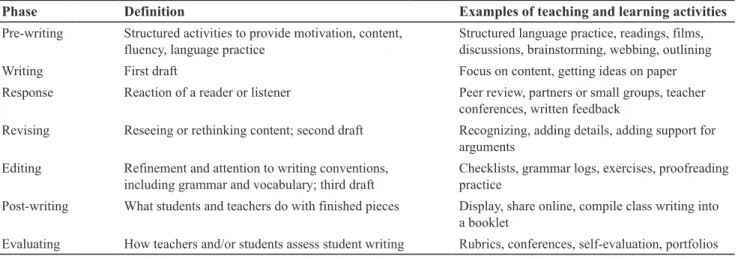
Writing was taught to both groups through a seven-phase process of pre-writing, writing, response-providing, revis-ing, editrevis-ing, post-writrevis-ing, and evaluating (Weigle, 2014). Phases of the writing process are depicted in Table 1.
RESULTS AND DISCUSSION
In order to answer the research question of the study and investigate the effect of interactive reading-alouds on partic-ipants’ development of writing, a one-way Analysis of Cova-riance (ANCOVA) was used. Participants’ scores on writing pretest were used as the covariate in this analysis.
As Table 2 shows, the result of ANCOVA revealed a significant difference between two groups in writing posttest [F (1, 43) =20.1; p=.000; partial eta squared=.319]. The result of descriptive statistics (Table 3) revealed that the experimental group outperformed the control group in the posttest, indicating that interactive reading aloud in-struction has caused a higher level of writing ability among the experimental group in comparison to the conventional reading instruction.
The finding corroborates evidence from other studies on the relationship between listening and reading from one hand, and reading and writing from another. It is suggest-ed that for elementary and pre-intermsuggest-ediate students who just learn to read and write, listening can be an important help for developing language and communication skills. Students who are not good at reading prefer to learn by listening rather than by reading and skillful readers usually prefer reading to listening when they learn new concepts (Clark, 1977). When students are trained to comprehend by listening to certain types of genres, the learned skills and strategies will transfer to reading (Sticht, 1972). This is referred to as transferring of comprehension skills meaning that “one’s ability to listen, then, can enhance one’s ability to read, which, in turn, can enhance one’s ability to revise
Table 1. Phases of the writing process
(Adapted from California State University, Stanislaus, n.d, as cited in Weigle, 2014, p. 227)
Phase Definition Examples of teaching and learning activities
Pre-writing Structured activities to provide motivation, content,
fluency, language practice Structured language practice, readings, films, discussions, brainstorming, webbing, outlining
Writing First draft Focus on content, getting ideas on paper
Response Reaction of a reader or listener Peer review, partners or small groups, teacher conferences, written feedback
Revising Reseeing or rethinking content; second draft Recognizing, adding details, adding support for arguments
Editing Refinement and attention to writing conventions,
including grammar and vocabulary; third draft Checklists, grammar logs, exercises, proofreading practice Post-writing What students and teachers do with finished pieces Display, share online, compile class writing into
a booklet
which, finally, has significant implications for the produc -tion of coherent discourse” (Clark, 1977, pp. 87-88). This improvement would then be reflected in both speaking and writing products.
The finding of the study shows how oral and written language skills are interrelated and can have mutual ef-fects on each other in improving literacy. More specifical -ly, however, this finding underscores the fact that reading and writing can be taught integratively. “Reading and writ-ing are intimately connected and …. one cannot easily be taught without the other” (Weigle, 2014, p. 226). However, it should be noted that if good reading/writing skills are go-ing to be developed, writgo-ing instruction cannot be replaced by reading instruction and vice-versa (Shanahan, 2006). As a result, in EFL classes where teachers do not have enough time to spend on teaching writing (both mechan-ics and process), combining writing with reading can be a helpful teaching method. Further, as students become more interested to write when their teachers use indirect meth-ods of writing (Hirvela, 2004), the tedious job of writing process can be eased by listening to stories via the medi-um of reading texts. Research on writing shows that going through the process of writing from planning to submitting the final product is very difficult for EFL learners and most of the time they develop negative attitudes towards writ-ing classes (Rahimi & Miri, 2015). As the findwrit-ing of this study shows, integrating learner-centered and interactive techniques into writing instruction can increase students’ motivation and ability to write. It is known that writing and reading skills are “complementary elements of literacy rather than separate, discrete skills” (Weigle, 2014, p. 226) and the problems students have with writing can be traced back to the problems they have with reading (Peck, 2005). In order to integrate reading in writing instruction and help language learners write better, the teachers can engage students in active understanding of the text and its struc-ture by reflecting and discussion (Peck, 2005). One way to do that, as the finding of this research showed, is through interactive reading-alouds. Another important point to be considered here is the effect of story-reading and
listen-ing on students’ improvement of writlisten-ing skill. Spandel and Stiggins (1996) believe that apart from its aesthetic val -ue, exposing students to literature influences their writing quality by reading and loving others’ work before they start to compose their own texts. Reading good literature can impact students’ writing skill and the writing tasks teachers expect from their students depends on the type of models the teacher has provided them with as “the writing class-room is built on the foundation of literature” (Spandel & Stiggins, 1996, p. 10).
CONCLUSIONS
The current study examined the impact of interactive read-alouds on EFL students’ writing. The findings revealed that teaching reading with read-while-listen can have a signifi -cant effect on the development of students’ writing ability. This finding bears valuable implications for EFL materials developers to incorporate story reading into the curriculum and let students enjoy the whole process of reading while their reading/writing/listening abilities are developing. It also suggests to EFL teachers to change the boring and si-lent atmosphere of teaching reading to an interactive and energetic process by utilizing interactive reading aloud instruction. Mingling storytelling and listening with read-ing and writread-ing will make the language class an enjoyable and unforgettable experience for students that will lead to more durable learning. In addition, integrating interesting and appropriate topics of discussion (here stories/narrations of printed texts) based on which students can develop their writing skills, may reduce negative attitudes of writing pro-cess among EFL learners and help them become more skill-ful writers.
REFERENCES
Amer, A. (1997). The effect of the teacher’s reading aloud on the reading comprehension of EFL students. ELT Jour-nal, 51, 43-47.
Barnett, N. A. (1989). More than meets the eye: Foreign language reading. Englewood Cliffs, NJ: Prentice-Hall Regents.
Barrentine, S. (1996). Engaging with reading through inter -active read-alouds. Reading Teacher, 50(1), 36-43. Brown, H. D. (2007). Principles of language learning and
teaching. New York: Pearson Education. Table 2. The result of ANCOVA
Source Type III Sum of Squares df Mean square F Sig. Partial ES
Corrected model 752.9 2 376.46 17.5 0.000 0.449
Intercept 851.0 1 851.09 39.6 0.000 0.479
Writing
pretest 48.58 1 48.587 2.26 0.140 0.050
Group 433.1 1 433.10 20.1 0.000* 0.319
Error 924.0 43 21.489
Total 3014. 46
Corrected total 1676. 45
Table 3. Descriptive statistics of writing posttest
Group Mean SD
Control group 1.4783 1.855
Caroll, D. W. (2008). Psychology of language (5th ed). US:
Thomson Wadsworth.
Carrell, P. L., and Grabe, W., (2002). Reading. In N. Schmitt (Ed.), An introduction to Applied Linguistics (pp. 233-250).London: Arnold.
Clark, I. L. (1977). Listening and writing. Retrieved from https://wac.colostate.edu/jbw/v3n3/clark.pdf
Cunningworth, A. (1995). Choosing your course book. UK: Macmillan Heinmann.
Day, R. R., & Bamford, J., (1998). Extensive reading in the second language classroom. Cambridge, England: Cam-bridge University Press.
Dreyer, C., & Nel, C. (2003). Teaching reading strategies and reading comprehension within a technology-en-hanced learning environment. System, 31, 349-365. Eskey, D. (2005). Reading in a second language. In E.
Hin-kel (Ed.), Handbook of research on second language teaching and learning (pp.563-580). Mahwah, NJ: Law-rence Erlbaum.
Fisher, D., Flood, J., Lapp, D., & Frey, N. (2004). Interactive read-alouds: Is there a common implementation practic-es. The Reading Teacher, 58(1), 8-17.
Fitzgerald, J., & Shanahan, T. (2000). Reading and writing relations and their development. Educational Psycholo-gist, 35, 39-50.
Giesen, L. (2001). Activities for integrating reading and writing in the language classroom (Unpublished mas-ter’s thesis), School for International Training, Brattle -boro, Vermont.
Groce, R. D. (2004). An experiential study of elemen-tary teachers with the storytelling process: Interdis-ciplinary benefits associated with teacher training and classroom integration. Reading Improvement, 41(2), 122.
Hedrick, W.B., & Pearish, A.B. (2003). Good reading struction is more important than who provides the in-struction or where it takes place. In P.A. Mason and J.S. Schumm (Eds.), Promising practices for urban reading instruction (pp. 6-24). Newark, DE: International Read-ing Association.
Hirvela, A. (2004). Connecting reading and writing in sec-ond language writing instruction. Ann Arbor: Universi-ty of Michigan Press.
Howard, D. (1983). Cognitive psychology: Memory, lan-guage and thought. NY: Macmillian
Huffaker, D. (2004). Spinning yarns around the digital fire: Storytelling and dialogue among youth on the inter -net. Information Technology in Childhood Education Annual, 1, 63-75.
Key English Test 5. (2010). Cambridge University Press. KET content and marking. Retrieved from www.Cambrdige.
org
Koon, H. (2008). The reading-writing connection: An inves-tigation of the relationship between reading and writing quality across multiple grades and three writing dis-course modes (Unpublished doctoral dissertation), Uni-versity of North Carolina, US.
Krashen, S. (1984). Writing: Research, theory and applica-tions. Oxford: Pergamon Institute of English.
McDrury, J., & Alterio, M. (2003). Learning through story-telling in higher education: Using reflection and experi -ence to improve learning. London: Kogan Page. Mostafazadeh, F. (2010). Storytelling: A new clinical educa
-tion method. Research in Medical Teaching, 2(2), 53-58. (In Persian).
Nation, P. (2008). The four strands. International Journal of In-novation in Language Learning and Teaching, 1(1), 2-13 Nation, P., & Macalister, J. (2010). Language curriculum
de-sign. UK: Routledge.
Nuttall, C. (1996). Teaching reading skills in a foreign lan-guage. Oxford: Heinemann.
Olejink, S. (1987). Factors affecting the relationship be -tween listening and writing. Reading Horizons, 18(4), 277-281.
Otto, W., & Richard, S. (1970). Administering the school reading program. Boston, Houghton Mofflin.
Ouellette, G. (2006). What’s meaning got to do with it: The role of vocabulary word reading and reading compre-hension. Journal of Educational Psychology, 98(3), 554-566.
Paul, R. (2011). Eight simple rules for talking with pre-schoolers. Teaching Young Children, 4(2), 13-15. Peck, R. (2005). The reading-writing connection. In R.
Ol-ness (Ed.), Using literature to enhance writing instruction (pp. 1-9). Newark, DE: International Reading Association. Peterson, P.W. (2001). Skills and strategies for proficient lis -tening. In Celce-Murcia, M. (Ed.), Teaching English as asecond or foreign language (pp. 87-101). US: Heinle and Heinle.
Powell, K. C., & Kalina, C.J. (2009). Cognitive and social constructivism: Developing tools for an effective class-room. Education, 130(2), 241-250.
Press, M., Henenberg, E., & Getman, D. (2011). Nonfiction read alouds: The why of and how to. The California Reader, 45(1), 36-43.
Rahimi, M., & Miri, S. S. (2015). Technology use and ac -ceptance among pre-service teachers of English as a Foreign Language: The case of a Learning Management System and an educational blog. In J. E. Aitken (Ed.), Cases on communication technology for second lan-guage acquisition and cultural learning (pp. 87-107). US: IGI Global.
Rahimi, M., & Soleymani, E. (2015). Digital Storytelling. Tehran: Rash Publication.
Richards, J. C., & Renandya, W. A. (2002). Methodology in language teaching: An anthropology of current practice. Cambridge: Cambridge University Press.
Sadik, A. (2008). Digital storytelling: A meaningful technol -ogy-integrated approach for engaged student learning. Educational Technology Research and Development, 56, 487-506.
Scharlach, T. D. (2008). START comprehending: Students and teachers actively reading text. The Reading Teacher, 62(1), 20-31.
Spandel, V. (1996). Seeing with new eyes: A guidebook on teaching and assessing beginning writers. Portland: Northwest Regional Educational Laboratory.
Sticht, T.G. (1972). Learning by listening, language compre-hension and the acquisition of knowledge. NY: Freedle. Stotsky, S. (1984). Research on reading/writing relation -ships: A synthesis and suggested directions. In M. J. Jen-sen (Ed.), Composing and comprehending (pp. 7-22). Urbana: National Council of Teachers of English. Sweller, J., Van Merrienboer, J. J. G., & Paas, F. (2019).
Cognitive architecture and instructional design: 20 years
later. Educational Psychology Review. Retrieved from https://doi.org/10.1007/s10648-019-09465-5
Travers, R. R. (1991). The connection between reading and writing: Theoretical foundations and some techniques. Retrieved from https://periodicos.ufsc.br/index.php/ fragmentos/article/download/2131/4089