ISSN: 2147-611X
www.ijemst.com
The Pre-service Science Teachers’ Mental
Models for Concept of Atoms and
Learning Difficulties
Seyit Ahmet Kiray
Necmettin Erbakan University
To cite this article:
Kiray, S.A. (2016). The pre-service science teachers’ mental models for concept of atoms
and learning difficulties.
International Journal of Education in Mathematics, Science and
Technology, 4
(2), 147-162. DOI:10.18404/ijemst.85479
This article may be used for research, teaching, and private study purposes.
Any substantial or systematic reproduction, redistribution, reselling, loan, sub-licensing,
systematic supply, or distribution in any form to anyone is expressly forbidden.
Authors alone are responsible for the contents of their articles. The journal owns the
copyright of the articles.
Volume 4, Number 2, 2016
DOI: 10.18404/ijemst.85479
The Pre-service Science Teachers’ Mental Models for Concept of Atoms
and Learning Difficulties
Seyit Ahmet Kiray
Article Info
Abstract
Article History
Received: 12 June 2015
The purpose of this study is to reveal the preservice science teachers' difficulties about the concept of atoms. The data was collected from two different sources: The Draw an Atom Test (DAAT) and face-to-face interviews. Draw an atom test (DAAT) were administered to the 142 science teacher candidates. To elaborate the results, the researcher conducted face-to-face interviews with 15 students. The students’ drawings were analyzed and grouped into eight different categories. These categories were: 1- Rutherford atomic model, 2- Bohr atomic model, 3- Probability orbit model, 4- Probability model, 5- Electronium model, 6- Electronium orbit model, 7- Orbital model, and 8- Wave orbit model. Based on the results, the Bohr atomic model was the most drawn model by the students while probability atomic model, the wave orbit model, and Electronium orbit model were the least drawn. Moreover, the study demonstrated that the pre-service science teachers had difficulty in grasping atom, electron cloud, and orbital concepts as well as the atom models, the probable nature of quantum physics, and wave-particle duality.
Accepted: 21 December 2015
Keywords
Atomic models Understanding atom Mental models Learning difficulties
Introduction
One of the most important parts of science education is to create an understanding of scientific concepts; therefore, the number of studies concerning the students’ comprehension of scientific concepts have increased (Adbo & Taber, 2014). Atom is one of these scientific concepts. Because of atoms’ abstract nature, models are used to teach the concept of atoms. Atomic models are an important part of science instruction at all levels, from primary school to university (McKagan, Perkins, & Wieman, 2008), yet the students still have difficulty in understanding and learning the concept of atoms (Park & Light, 2009). Students’ opinions about the concept of atoms are consistent with the epistemological development of atom in the historical process (Özgür & Bostan, 2007). The historical evolution of the atomic concept can give clues about the reasons why it is hard for the students to comprehend the concept of atoms (Tsaparlis & Papaphotis, 2009).
Theoretical Framework
another dimension to understanding the microscopic world of atoms. De Broglie defined the electron as a wave. His model was in tune with the Bohr’s model that treated the electrons as particles. According to De Broglie, the electrons moved like waves in such a way that the electrons match with the same radius of the orbits (McKagan et al., 2008). Schrodinger created a mathematical equation for the standing wave that accompanied to the electrons. Schrodinger, also, showed the three-dimensional probability distribution, introduced the idea of orbitals, and came up with the orbital atomic model (Muller & Wiesner, 2002). Especially, the “solar system”, “planetary system,” and “orbit” models that the concept of geostationary orbit assigned to the electrons became history, and the most famous theory, Modern Atomic Theory, which is still the most popular model, was discovered.
Based on the modern atomic theory, the possibility of finding an electron’s location around a nucleus only can be mentioned. Determining the location and momentum of the electron at the same time is not possible. Based on this fact, electron cloud model is developed. In this study, the electron cloud model is considered under three different categories. The first one is the probability model, which was adapted from the Budde, Niedderer, Scott, and Leach (2002)’s study. The second model is the Electronium model. This model was also adapted from the Budde et al. (2002)’s study, yet the attributed meaning of the concept of “electronium” was limited to a different image of an electron cloud. The third model is the orbital model. The concept of orbit from the Bohr atomic model is replaced with the concept of orbital in the Modern atomic theory. The term orbital is coined for the locations that have a high possibility of finding electrons. In this study, the orbital model was adapted from the study of Müller and Wiesner (2002) and Harrison and Treagust (1996). Even though many models and ideas emerged during the process of historical development of the atom concept, the literature showed that the students were still not clear about it.
Tsaparlis and Papaphotis (2002) determined that the majority of the students were confused with the concept of orbitals in the modern atomic model and the concept of orbit in the Bohr atomic model. Their study revealed that the students failed to understand the probabilistic nature of atomic orbitals. Harrison and Treagust (2000) demonstrated that the students found it difficult to differentiate the concept of “electron shell” from the “electron cloud.” Taber (2001) also pointed out a similar situation. According to Taber, the students tend to use the orbital, orbit, and shell concepts interchangeably. Nakiboglu, Karakoc, and Benlikaya (2002) revealed that the students used the Solar system model or the Bohr Atomic model to explain the structure of an atom. Yildiz (2006) observed similar findings to Nakiboglu et al. (2002)’s study. They found that the students used the old atomic models because they could not construct the structure of the Modern Atomic Model in their minds. As a result, students connected wrong meanings to the concepts they use when explaining these models.
Some students have difficulty in understanding the electronic structure of atoms (Keigan & Rubber, 1993), and the majority of the students consider an electron shell as an envelope that protects the atom (Harrison & Treagust, 1996). Some of the students considered the electron cloud as the area between orbits (Cokelez & Yalcin, 2012). Cervellati and Perugini (1981) conducted a study with the secondary school students, and they found that the students expressed the concept of orbital as the empty part around the nucleus, the energy level, orbit, and mathematical wave function. Tsaparlis and Papaphotis (2009) indicated that when the students learn the concept of orbital, they make the mistake of generalizing multi-electron orbitals in other atoms to a single-electron hydrogen atom. They reported that the students did not know the probabilistic nature of the orbitals. The studies also revealed that the students had difficulty to learn the quantum-mechanical model of the atom because the probability of finding the electrons on the orbitals was not shown as undetermined boundaries without clear lines (Taber, 2005).
Method
The purpose of this study is to reveal the pre-service science teachers’ mental models and learning difficulties about the concept of atoms. To accomplish this purpose, the study was conducted with the pre-service science teachers in April and May of 2014 and 2015 at a university in Turkey. The data was collected in two years.
Participants
Topics in Physics (technological applications of physics). Moreover, they took Fundamentals of Chemistry 1, Fundamentals of Chemistry 2, Analytical Chemistry, Organic Chemistry, and Special Topics in Chemistry (technological applications of chemistry).
Data Collection Instruments
Two different methods were used to collect data in this study: The Draw an Atom Test (DAAT) and the face-to-face interviews.
Draw an Atom Test (DAAT)
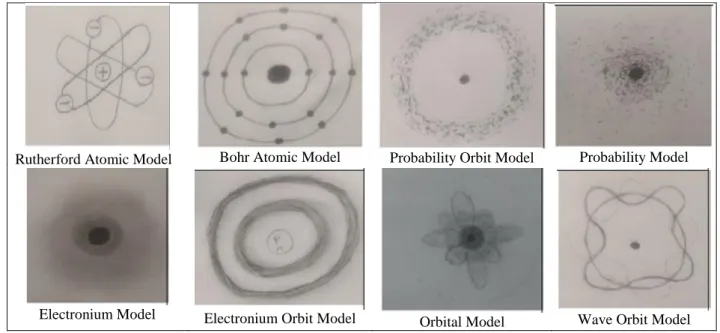
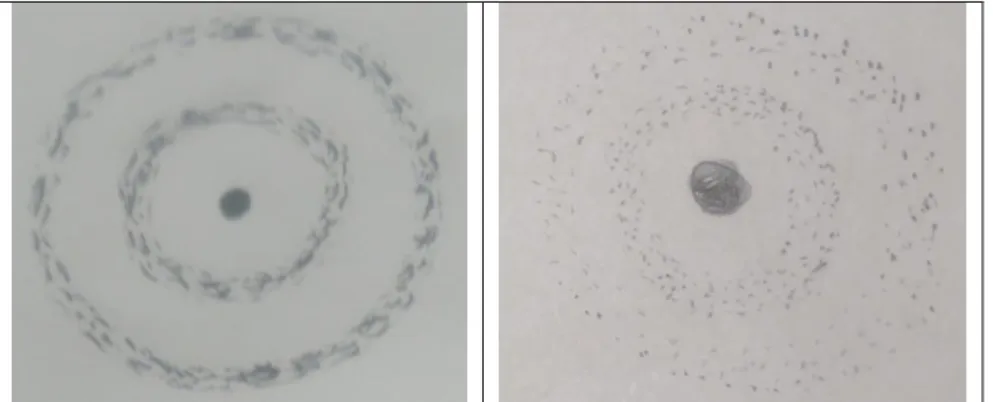
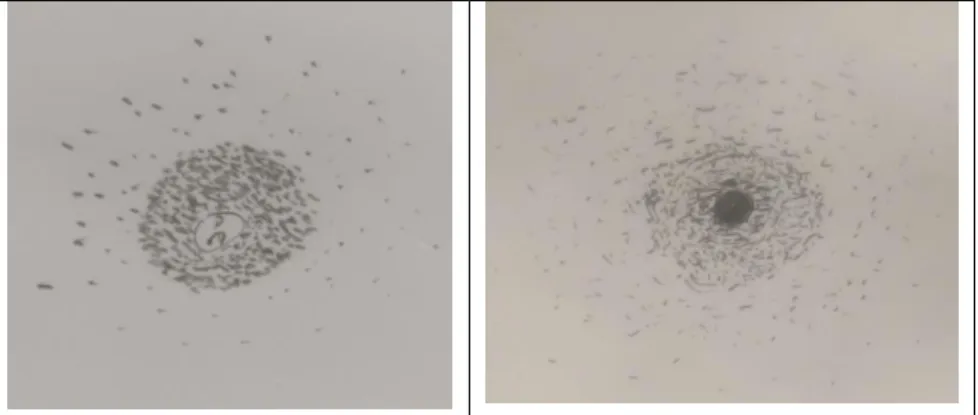
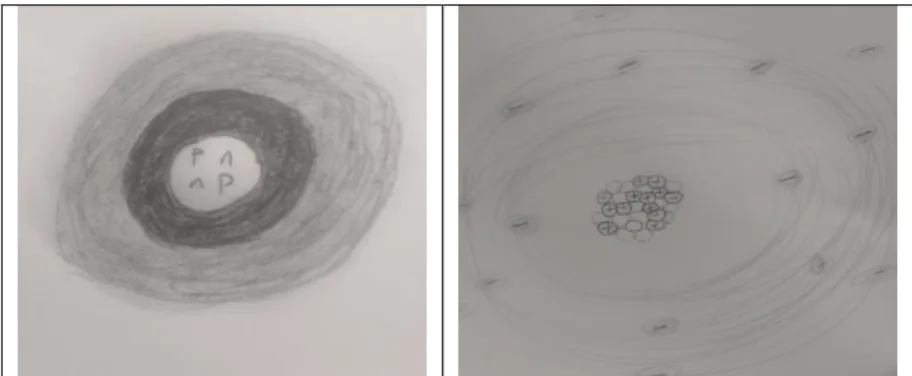
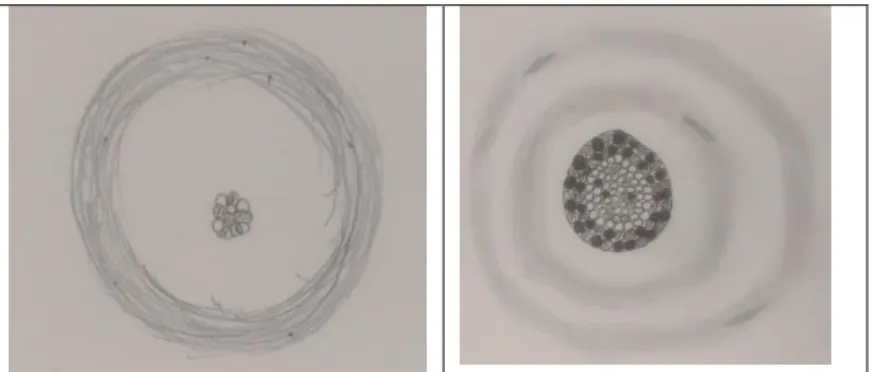
Cardak (2009) and Dikmenli (2010) used the drawing technique used in this study to collect data in order to determine students' misconceptions related to water cycle and cell division. Their instrument was adapted and improved for the concept of atoms, and it was called Draw an Atom Test (DAAT) in this study. The students were asked to draw their concept of an atom on a piece of paper. The students’ drawings were analyzed based on the categories in Figure 1.
Figure 1. Examples of the students’ model drawings
Coding Procedure
The students' drawings were categorized based on the studies in the literature. The categories were named in accordance with the images from the following studies: The Rutherford and Bohr atomic models from the Ozgur and Bostan (2007) and Cokelez and Yalcin (2012)’s work; the probability model and Electronium model from the Budde et al. (2002)’s work; the probability orbit model and wave orbit model from the Petri and Niedderer (1998)’s work; and the orbital model from the Harrison and Treagust (1996)’s work and Muller and Wiesner (2002)’s work. Also, the Electronium orbit model was named based on the Electronium model and probability orbit model.
To code, all drawings were numbered starting from 1 up to 142. The numbers were called as DAAT number. All paper numbers were entered in a column in an Excel file in the form of DAAT1, DAAT2, …., DAAT142 while all categories were entered in the rows. Then, two different science teachers entered the number “1” for the right group based on the predetermined categories in the Excel file. Figure 1 below shows the eight categories that were determined based on the literature. In addition to these eight categories, a ninth category was created; the ninth category was called as “hybrid (mixed) atomic model”, and it included the drawings that did not fit in the Figure1 categories.
Rutherford Atomic Model Bohr Atomic Model Probability Orbit Model Probability Model
Interviews
The interviewees were chosen from the students who took the DAAT test and drew atom images. Even though thirty-five students were interviewed, only fifteen students’ interviews were included in this study. Three students drew the Bohr atomic model; one student drew the Rutherford atomic model; one student drew the probability orbit model; two students drew the probability model; three students drew the Electronium model; one student drew the Electronium orbit model; one student drew the orbital model; three students drew wave orbit model.
Reliability and Validity of Data Collection Instruments
To determine the reliability of the DAAT test, two science teachers, and the researcher scored the collected data based on the designated categories. Later, the researcher calculated the correlation coefficient between the two teachers’ scores. The correlation coefficients were 0,92 and 0,89 respectively.
The interview protocol was reviewed by a physics teaching assistant and an associate chemistry professor. Based on their feedback, the protocol was revised and finalized. The main question was asked to all students. Depending on their answers, the probe questions were asked.
Main question:
Why did you draw the atoms like this? Can you explain it to me?
Probe questions:
1. I see ellipses that are placed a certain distance from the positive charges in the nucleus and the ball-shaped circles on these circles in your drawings. What are the meanings of these lines?
2. I see points that you created by the tip of your pencil. What is the meaning of these points?
3. I see a lot of points that you created with the tip of your pencil and placed a certain distance in your drawing. What is the meaning of these points?
4. I see nested circles in your drawing. What is the meaning of these circles?
5. I see that there are light and dark areas around the nucleus in your drawing. What is the meaning of these different tones?
6. I see fuzzy areas around the nucleus and written “e” symbols on these areas in your drawing. What is the meaning of this drawing?
7. I see fuzzy areas around the nucleus and written (-) symbols in these areas in your drawing. What is the meaning of this drawing?
8. I see different figures that go out and extending outwardly in your drawing. What is the meaning these circle-shaped and pear-circle-shaped drawings?
9. I see shapes similar to sea waves that have a certain distance from the nucleus in your drawing. What is the meaning of these wave-like drawings?
Data Collection Process
Before the study, the students received a white paper and a pencil. The students were asked to draw an atom on the white paper with pencil. This process took twenty minutes until they completed the DAAT test. The semi-structured interviews were conducted individually; the interviews lasted approximately 5-15 minutes. All students answered the main question; depending on their drawings, they replied a probe question. To allow the students to elaborate on their answers, some of the students had to respond to the extra questions that were not included in the original interview protocol.
Data Analysis
Findings
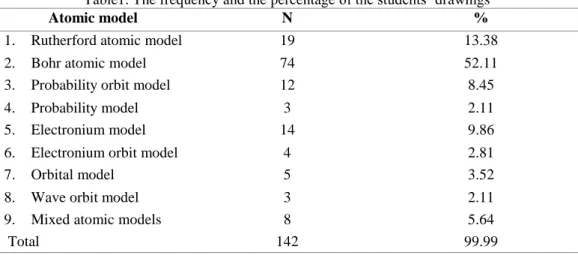
The data in this study were obtained using two methods: the atom drawings and face-to-face interviews. Table 1 presents the frequency and the percentage of the students’ drawings.
Table1. The frequency and the percentage of the students’ drawings
Atomic model N %
1. Rutherford atomic model 19 13.38
2. Bohr atomic model 74 52.11
3. Probability orbit model 12 8.45
4. Probability model 3 2.11
5. Electronium model 14 9.86
6. Electronium orbit model 4 2.81
7. Orbital model 5 3.52
8. Wave orbit model 3 2.11
9. Mixed atomic models 8 5.64
Total 142 99.99
Table 1 shows that nearly half of the students (52.11%) drew the Bohr atomic model. Following this model, the Rutherford model (13.38%) which is the historically oldest model, was drawn in this study. The Rutherford model was followed by the Electronium model (9.86), which was the most preferred model within the scope of the modern atomic theories, and it was placed third in the most preferred models. The Electronium model was followed by the probability orbit model (8.45%). On the other hand, the orbital atom model (3.52%) was one of the quite a few drawn atomic models as well as the wave orbit model (2.11%) and probability model (2.11%). Approximately 5% of the drawings were not included in either of any category, so they were included in the “Mixed Atomic model” category. The mixed atomic model category includes the atomic model drawings that differ from each other and the atomic model drawings that are not relevant to any real atomic model. As a result, only the first eight categories were analyzed, and the mixed atomic model drawings were excluded from the study.
Rutherford Atomic Model
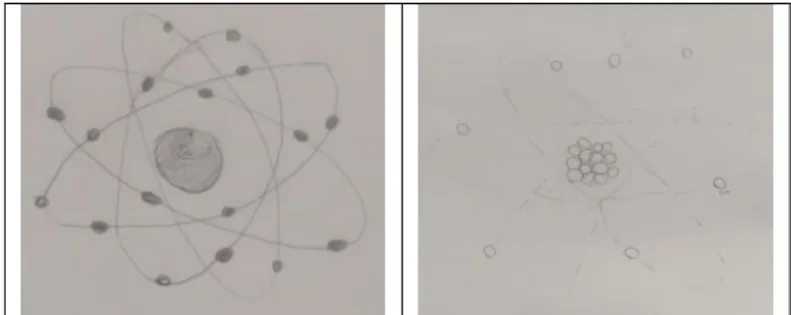
The Rutherford atomic model is historically the oldest model, and it has lost its validity. However, 13.38% of the students chose to draw this model in this study. Figure 2 shows two examples of the students’ drawings. The study showed the effects of the media on students’ drawings since the Rutherford atomic model is mostly displayed in the media (e.g., television, news, etc.) as an atomic model. The interviews revealed that the students drew this model because they associated the concept of atoms with it. Student1 was one of the five students who were invited for an interview. The view of Student 1, which is similar to the other students who drew this model, is given below.
Researcher: Why did you draw the atoms in this way? Can you describe me your thought? Student 1: mmm…I drew an atom.
Researcher: I see ellipses that are placed a certain distance from the positive charges in the nucleus and the ball-shaped circles on these circles in your drawings. What is the meanings of these lines?
Student 1: They are protons, electrons, and orbits.
Researcher: Why do you think that the atoms are shaped like this?
Student 1: Well… It first came to my mind this way. In fact, all atoms are drawn in this way on television… In daily life, I always see atoms like that… I guess that is why.
Researcher: Could you give me an example?
Figure 2. Examples of the students’ Rutherford atomic model drawings
Bohr Atomic Model
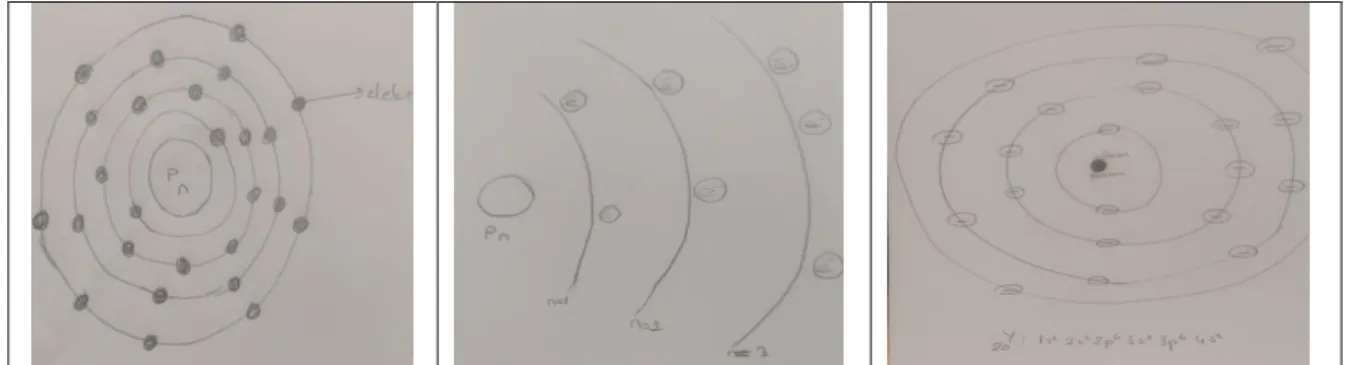
Even though the Bohr atomic model has lost its validity, it was the most preferred atomic model among students (see Figure 3). The popularity of the model can be explained by the presentation of the model in the textbooks or on the internet and by the use of the model to teach chemical bonding in schools. Some students also stated that the Bohr atomic model was useful to describe the atom related incidents. The following conversation shows the opinions of Student 2 who drew the Bohr model.
Researcher: Why did you draw the atoms like this? Can you explain it to me? Student 2: Because I think the atoms look like this.
Researcher: I see ellipses that are placed a certain distance from the positive charges in the nucleus and the ball-shaped circles on these circles in your drawings. What are the meanings of these lines?
Student 2: Yes, they are protons and electrons. It is the internal structure of an atom. When I was interning at a school, the school’s science teacher used this model to teach chemical bonding. The students learned nicely. I also found it to be useful. Atoms already are shown in the science textbooks and on the science websites… Even though there are other models in the textbooks, I do not think they make sense. This model is the one which makes more sense. I do not believe that the others can explain the chemical bonding subject.
Researcher: You mentioned the other atomic models in the textbooks. What are they? Or are there any atomic models that you learned when you were at college?
Student 2: Yes, the electron cloud model was explained in the modern physics class, but I did not think it was a useful model for science teachers. The chemical bonding subject was taught in the 7th- and 8th- grades. This subject can be only explained by the model I drew. Otherwise, how can I explain covalent bonding and molecules?
The energy levels are another reason that the Bohr model is commonly preferred. Notably, some students think that the model explains how objects emit heat and light when their energy level increases. The views of Student 3 who used the Bohr atomic model were given below.
Researcher: Why did you draw the atoms like this? Can you explain it to me?
Student 3: If we had a chance to enlarge atoms at a level that an eye can see, we would see the atoms exactly like this. Of course, electrons would not be able to stand still like in this drawing. They rotate around the nucleus. Sometimes they change their orbits.
Researcher: How can they change their orbits? Could you describe a little bit more?
Student 3: Sure. I think the best side of this model is the explanation of how warmed bodies emit light and heat. For example, the electric stoves or lamps we use in our homes... When we press a button, we give energy to the environment. Atoms’ electrons jump up to the next orbit when they receive energy. These atoms want to return to their original orbit. Herein, they need to get rid of the extra energy. They give out this extra energy as heat and light. Therefore, we are warmed and lit… All issues are relevant to the increase and decrease of the energy of the electrons... They level up to the next orbit when their energy level increases; they go back to their old orbits when their energy decreases.
Researcher: Why did you draw the atoms like this? Can you explain it to me? Student 4: Of course. I showed the distribution of electrons in an atom.
Researcher: You scribbled 1s2,2s2,2p6,3s2,3p6…under your drawing. What does it mean? Could you explain it to me?
Student 4: These numbers show how many electrons can be found in an orbit. Researcher: Can you elaborate on that? Could you give me an example?
Student 4: Of course. For example, 1s2 is the first orbit. “1” is the name of the orbit. “s” is the name of the orbital. “2” also shows how many electrons can be found at the orbital in this orbit. Here, we understand that there can be no more than 2 electrons in the first orbit. 2s2,2p6 demonstrates the second orbit. “s” and “p” are the name of the orbitals. “2” and “6” are the total number of electrons that can be found in this orbit. We understand that there can be eight electrons in this orbit. The third orbit also carries 8 electrons, similar to the second orbit.
Researcher: What are the shapes of orbitals that you mentioned?
Student 4: Spherical. For instance, we draw a sphere for 1s2. We draw two arrows—an arrow pointing upward and an arrow down-facing in it. They represent the two electrons. We draw four spheres for 2s2, 2p6 because each sphere takes two electrons. These spheres were orbitals. That’s one orbital always takes two electrons.
Researcher: Is there any other orbitals you know? Student 4: Yes. There are also d and f orbitals. Researcher: What do their shapes look like? Student 4: Likewise, spherical.
Figure 3. Examples of the students’ Bohr atomic model drawings
Probability Orbit Model
The probability orbit model is a synthesis of the modern atom theory and Bohr atomic model. The students who drew this model insist on using the concept of orbits in the Bohr model (see Figure 4). Moreover, they do not reject “the probability of finding electrons” in the modern atomic theory. The probability orbit model emerges as a synthesis. Because this synthesis is an effective method to teach chemical bonding in primary school, the students prefer the mixture of two models. The opinions of Student 5 about this inference are as follows.
Researcher: Why did you draw the atoms like this? Can you explain it to me?
Student 5: Of course. It is the modern atomic model…that’s the electron cloud model. These points show the high probability of where the electrons are located.
Researcher: I see a lot of points that you created with the tip of your pencil and placed them a certain distance in your drawing. What is the meaning of these points? Why did you leave space between these points and the nucleus?
Student 5: Atoms mostly consist of space. The famous scientist Bohr imagined the atom like this. Of course, the electron cloud model had not existed at that time. He thought atoms like sun and planets. Researcher: What is the difference between this model and the Bohr model? Can you explain it to me? Student 5: The orbits in the Bohr atomic model are shaped as lines. So, the orbits that the electrons are moving are drawn with a clear line. According to the current electron cloud model, the place of the electrons cannot be determined, but it can be guessed… of course, when guessing, there are orbits… The orbits are not just lines. Electrons can be either above or below that orbit.
Researcher: Why do you think the range between at the top and bottom of the orbit is so narrow? Isn’t there any possibility that the electrons are located right in the nucleus?
Researcher: Why do you think like that?
Student 5: Because I remembered the covalent bonding. If it were the way you said, there would not be such a thing like covalent bonding.
Researcher: Can you elaborate on that? Why not is there covalent bonding?
Student 5: Let’s think water. The hydrogen atoms in water molecules use an electron jointly with the electrons in the last orbit of oxygen. Therefore, if it is as you described, there can be no orbit…If there is no orbit, there is no covalent bonding. So, water does not occur. That’s why there are orbits. Only, we can say that the electrons can’t move on a line. They can be little on or slightly below this line. Of course, they make a rotational movement. So, the location of electron can’t be known.
Figure 4. Examples of the students’ probability orbit model drawings
Probability Model
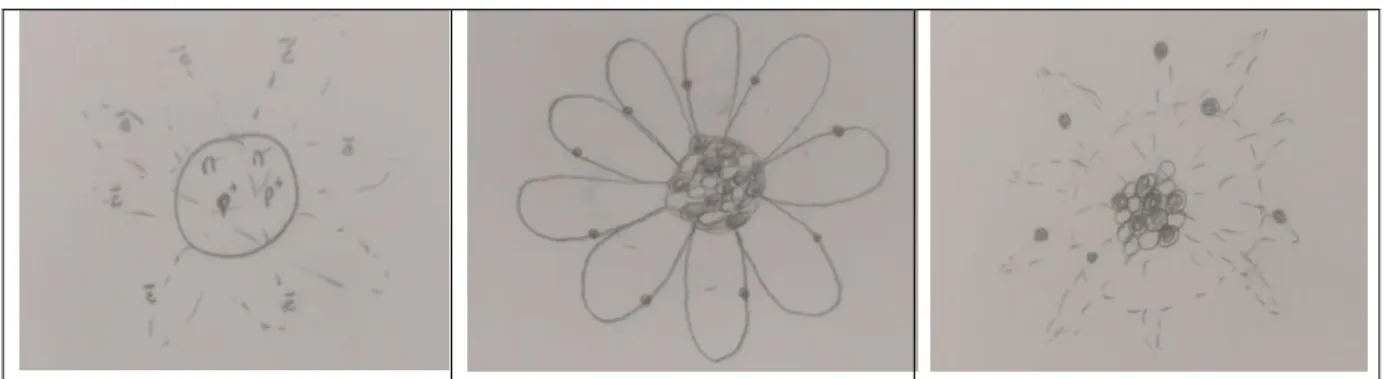
Interestingly, the least drawn model was the probability atomic model. The students who preferred the model thought of electrons as particles (see Figure 5). Simultaneously, even though they brought the model, they did not exactly know what their drawing meant, and they used faulty reasoning. The opinions of Student 6 who drew the probability model by trying to apply the concept of the orbit to the model are shown below.
Researcher: Why did you draw the atoms like this? Can you explain it to me? Student 6: Of course. An atom has a nucleus in the center. There are electrons around.
Researcher: I see that you placed points at a certain distance from the nucleus by using the tip of your pencil in your drawing. What is the meaning of them?
Student 6: These points represent the electrons.
Researcher: Why did you think the electrons like these points?
Student 6: The electrons as particles are tiny, so I drew them as the points.
Researcher: In your drawing, the points are dense around the nucleus, yet the density reduces away from the nucleus. Why did you draw like this?
Student 6: Because…there are more electrons around the nucleus. The number of electrons decreases when they get away from the nucleus.
Researcher: Can an atom have that many electrons?
Student 6: Yes, sometimes. But not always. So, I see this electron cloud picture everywhere; these dots are the electrons. The number of the electrons decreases when they depart from the nucleus because of the less nucleus’ electromagnetic force. The number of the electrons increases around the nucleus because of the electromagnetic force. Of course, it does not have to have one proton in the center. There may be more protons. So, we should not think like there is only one proton. When there are more protons, the number of electrons must be a lot…
Researcher: Well, do you think the electrons move or stand still in this way?
Student 6: This is just a picture taken at a time. In fact, they rotate around the nucleus like the black holes. The center is dark; the darkness declines slowly outward from the center. This dark mass rotates with center around the center.
Researcher: How do these points move? In which direction?
Student 7 is one of the students who drew the probability model. Student 7 also seems to think of the electrons as particles; moreover, the student attributed a false meaning to the electron cloud and thought that the electrons move in a nebulous structure around the nucleus. The opinions of Student 7 are below given.
Researcher: Why did you draw the atoms like this? Can you explain it to me?
Student 7: Here, there is a nucleus in the center and the electron cloud around the nucleus. Researcher: Can you describe me the electron cloud? Where is the electron cloud in this drawing? Student 7: The points in these areas are the electron cloud. When electrons get together, it looks like an image of a cloud.
Researcher: Does each point represent a different electron?
Student 7: Yes. Each of these points represents an electron in an atom. When you look at them from outside, it looks like a nebula.
Researcher: Why did you show the electrons as points?
Student 7: The electrons are the particles that have a mass and charges… Of course, we can’t see with naked eye. They are tiny. They are smaller than my drawings… I can’t draw smaller than these small sphere-shaped particles. That’s why I demonstrated the electrons as points.
Figure 5. Examples of the students’ probability model drawings
Electronium Model
In this study, the Electronium model is the most preferred one among the electron cloud sub-models; 10% of the students drew the model (see Figure 6). However, the interviews revealed that the students usually drew the model by guessing because none of the interviewees were able to explain the model correctly. The study showed that the students used their reasoning. Even though their drawings had similarity, the attributed meanings to each drawing were different from each other.
Student 8 who drew an atom based on the Electronium model confused the concept of the electron cloud with clouds in the sky. Student 8 who related the electrons to the electron charges in the rain clouds clarified his opinions below.
Researcher: Why did you draw the atoms in this way? Can you explain it to me?
Student 8: The last atomic model is the electron cloud, so I drew an atom in accordance with the latest model.
Researcher: I see that there are light and dark areas around the nucleus in your drawing. What is the meaning of these different tones?
Student 8: They are the electron cloud. I tried to draw clouds.
Researcher: Can you explain me the characteristics of this cloud you tried to draw?
Student 8: An electron cloud consists of electrons; the dark-colored cloud includes many electrons… There are more electrons in areas close to the nucleus, so, these areas are darker compared to the outer areas. The cloud's color gets lighter when moving away from the nucleus.
Student 8: …mmm…there are also electric charges in clouds in the sky. Before the rain, the clouds are completely electrically loaded. Thunder and lightning are caused by these loads. Both the electron cloud and rain clouds in the sky contain electrical loads.
Researcher: Well, how does an electron cloud occur?
Student 8: …mmm… I do not know. I guess it has been around the nucleus since it is created. The electron cloud hides the nucleus...Probably, it makes harder to find the location of nucleus… actually, I really do not know… but there is a cloud, I am sure, the electrons move in this cloud. Thus, I guess the electrons move in a cotton field-shaped nebula structure…
Some of the students put (-) signs or (e) letters into the surrounding areas of the nebula nucleus (see Figure 6). Student 9 who drew this way think that the electron cloud is created by a large number of electrons. The opinions of Student 9 are shared below.
….
Researcher: I see there are (-) signs in the dark area. What does this mean? Student 9: These are the electrons that form an electron cloud.
Researcher: Well, how do the electrons form the electron cloud?
Student 9: A large number of electrons begin to rotate around the nucleus. When viewed from outside, the cloud looks slightly darker in the areas which are close to the nucleus because there are more electrons in that areas. At the outside areas, the distance between electrons increases, but there are still many electrons. The areas where the electrons are squeezed look dark while the areas where there is more distance between the electrons have a lighter color.
Some of the students who drew the electron cloud model believe that this image occurs because the electrons act like waves. Student 10’s views on this issue are as follows.
….
Researcher: How does this nebula image occur? Can give explain it to me?
Student 10: mmm…I have not thought it before, but…because the reason can be that the electrons act like waves. I think this is how quantum physics emerged. Because the electrons act like waves, the modern atom theory was discovered…so, such an image may occur because it is a wave…I have never thought this before. We learned that…we learned it as the electron cloud model, but I have never thought like this before. It is because of the features of the waves.
Researcher: Can you elaborate? What type relationship is there between the wave feature and the area colors?
Student 10: During the Physics3 labs, we created shadows of water waves under a ripple tank. There were dark and light areas. We drew these areas with dark and light colors on our lab scrapbook. Electrons are a wave. Therefore, the bright areas can be light colors while the intense areas can be dark. I know it is important that electrons are the waves. This characteristic is owned by waves. That’s why I think.
Figure 6. Examples of the students’ Electronium model drawings
Electronium Orbit Model
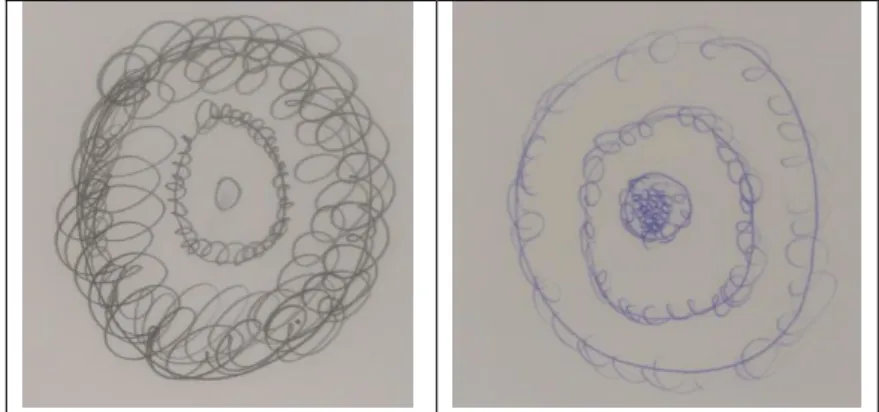
atomic model and electron cloud model. When drawing the atoms based on this model, the students drew orbits by either smearing or scribbling with a finger. They believe that there are electron orbits under these drawings.
The difference between this model and probability orbital model is that in this model, the nebula image of orbits is created by drawing lines and distributing them with a finger while the nebula image of orbits is formed by drawing dots with the tip of a pencil in probability orbital model. Student 11 expressed his opinions as below.
Researcher: Why did you draw the atoms like this? Can you explain it to me?
Student 11: Let me explain. Once, it was thought that the electrons would rotate on a certain and linear trajectory around the nucleus. Electrons move on a certain line. Just like the planets move around the sun on a stable orbit…but modern atomic theory exposed that it was not true. The electrons cannot move in a straight line. It is not possible to determine an electron’s location…they can be either below or above the line. However, it moves in close to the line. It has a path, but it is not clear…
Researcher: Why did you choose to paint a thick ring with the pencil?
Student 11: I drew a cloud, which is an electron cloud. The way the clouds in the sky condensate the electron clouds condensate in certain places in orbits. Electrons may be anywhere in this cloud. We do not know their locations in the cloud. They are constantly moving.
Researcher: How does this cloud form?
Student 11: The electrons create it by themselves. The electrons move very fast; therefore, when viewing from outside, it looks like there are millions of them. In fact, there are only two electrons in the first orbit. These two electrons make a fast rotational movement; a person who sees it from outside sees that area as a nebula because of this quick movement. Only there are two electrons… Of course, the electrons do not follow a straight trajectory rotate. They draw millions of circles. My drawing is an image of a combination of these millions of circles.
Figure 7. Examples of the students’ Electronium orbit model drawings
Orbital Model
The orbital model is one of the sub-model of the electron cloud model. The study showed that the students who drew this model did not fully master the concept of orbitals, and they could not abandon the notion of orbit (see Figure 8). The students’ model drawings were limited to the "s" and "p" orbitals. All students who drew this model were interviewed; all of them had the misunderstandings about the moving electrons on the so-called orbital. According to these students, the electrons follow differently-shaped orbits instead of the circular-shaped orbits. However, the idea that the electrons follow a trajectory still maintains the presence. The opinions of Student 12 who drew this model are given below.
Researcher: Why did you draw the atoms like this? Can you explain it to me?
Student 12: The search I did was the reason I drew atom this way; I have never seen it at school…. When I was preparing for a presentation with my three team members, we saw it on the Internet. We were very surprised when we saw the shapes of the orbitals. We would have never thought that the orbitals would be in this shape. We did a little bit research, but it was quite a complex topic… Frankly, we did not completely get it, but I memorized the orbitals’ shapes.
Researcher: Can you explain your drawing to me?
electrons. Let’s think an atom with 5 electrons. It becomes 1s22s22p1. So 5. The electron has to rotate in
the p orbital.
Researcher: How do electrons move in the “s” orbital?
Student 12: On the outer surface of the sphere...or follows the circle. Researcher: Can electrons move out of the lines you drew?
Student 12: No. The electrons must move in certain orbits...If [electron] is placed in the s orbital, it has to go in a circular orbit; if it is put in the p orbital, it has to move in similar trajectory flower petals.
Figure 8. Examples of the students’ orbital model drawings
Wave Orbit Model
Wave orbit model is one of the least drawn atomic models. Figure 9 shows examples of the students’ drawings. The students in this category believe that the electrons act like waves, not like particles. The interviews with these students revealed that one of the misunderstandings is the belief of the electron acting like a wave in the wave-particle duality controversy. Student 13 who is one of the students that drew this model thinks that the electrons only act as waves.
Researcher: Why did you draw the atoms like this? Can you explain it to me?
Student 13: In my drawing, I drew moving electrons as water waves… Electrons behave like waves when they move. This is a very fast wave…This move occurs at the speed of light. Electrons, actually, are energy packages…They spread like waves…In fact, they move around the nucleus.
Researcher: What is the direction of this wave movement? How do they move around the nucleus? Student 13: Of course, they form a circle around the nucleus ultimately…but they form this circle by moving as waves…in the final analysis, even it is a wave, they need to protect their orbits…They move like waves in an orbit.
Another misunderstanding is related to the wave-particle duality. Student 14 who drew the wave orbit model thinks of the electrons as an object that stands on waves. The student assumes that the electrons form a substance in the shape of a nebula, and they move on that nebula.
Researcher: Why did you draw the atoms like this? Can you explain it to me?
Student 14: Yes. We learned waves in the Physics 3 course. Also, we learned that the discovery of electrons’ wave movement led to quantum physics in the Modern Physics course… Here, I drew the electrons’ movement by quantum physics.
Researcher: Can you explain me the electrons’ wave movement, according to quantum physics? Student 14: Of course. Electrons are actually on the move in an electron cloud... The latest model is the electron cloud…Certainly, the movement of the cloud is wavy. Electrons move on these waves…because of the wave movement, a cloud-like appearance occurs.
Researcher: The electron itself is a wave, is not it?
Student 14: Of course, not. A wave accompanies by the electrons. Electrons move in or on this wave. Researcher: Well, does this wave movement have a direction?
Student 14: They rotate around the nucleus in a circular form. Electrons move up and down to protect their orbits.
Researcher: What do you mean by the orbits of the electrons?
The students who drew this model, also, believe that the electron cloud is formed as a result of the movement of electrons as waves. The opinions of Student 15 are given below.
Researcher: Why did you draw the atoms like this? Can you explain it to me? Student 15: I took a picture of the latest model and drew…
Researcher: Can you explain me the latest atomic model?
Student 15: The electron cloud model is the most recent atomic model. Researcher: What exactly is the electron cloud model?
Student 15: Before, it was discovered that the electrons pull away as waves. Later, when these waves were looked through an electro-microscope, a cloud image occurred. When the waves are intertwined, the gap disappears, which looks like clouds in the sky. Actually, the latest model came up after the discovery of the electrons’ wave movement. It is still valid. The electron cloud model.
Researcher: Do these waves have a certain direction?
Student 15: … well, what I mean by direction… It will move around the nucleus; of course in circles…but the gaps between disappear due to wave movement. A cloud is formed.
Figure 9. Examples of the students’ wave orbit model drawings
Discussion
The study revealed that the majority of the students drew the two oldest models – Bohr atomic model and Rutherford atomic model – when viewed from a historical perspective. The study’s findings are consistent with the Nakiboğlu, Karakoç, and Benlikaya (2002) and Yıldız (2006)’s finding of that the students preferred the old models. The main reason that the students drew the Rutherford model was the popularity of the model, as Cokelez and Yalcin (2012) found in their study. Although the Rutherford model was prevalent in students' drawings, the Bohr atom was more preferable.
In this study, the Bohr atomic model is the most dominant model among the students, which is similar to the other studies in the literature. The studies conducted by Papaphotis and Tsaparlis (2008) and Çökelez and Yalçın (2012) showed that the students’ mental model of the Bohr atomic model is a more dominant model than the other atomic models. Tsaparlis and Papaphotis (2009) stated that the students prefer the Bohr atomic model because it is concrete and straightforward. The students insist on using initially learned the Bohr model although they learn the quantum-mechanical atomic model. While the Bohr atomic model is proven to be scientifically wrong, the model is still utilized to explain many atom-related events. The modern atomic theory brings a new explanation of the atom, yet the Bohr atomic model is still preferred to teach some of the chemical activities when teaching chemistry. Even, the practicing scientists still use the Bohr atomic model to solve easy problems; therefore, it is important to teach students the Bohr atomic model (McKagan et al., 2008). This study presented the main reason the students prefer the Bohr atomic model as the use of this model to explain many chemical and physics events (e.g., chemical bonding), which is parallel to the studies in the literature. It seems that the Bohr atomic model's concept of orbit has an impact on the learning the other atomic models.
Lichtfeld (1992) and McKagan et al. (2008), believe that learning this dominant model creates barriers to learning the quantum nature of atoms. The findings support that the Bohr atomic model is an obstacle to learning the quantum character of the atom, as Fischler and Lichtfeld (1992) and McKagan et al. (2008) claimed. Even though quantum physics rejects the concept of orbit, the students tend to habituate this notion into the atom's quantum nature. The concept of orbit also affects how the students use the concept of orbitals.
The students who preferred the orbital model abandon the orbicular pattern; however, they believe that the electrons follow a constant trajectory although the trajectory may have different visual patterns, such as a flower petal. As Papaphotis and Tsaparlis (2008) noted, the students tend to associate the concept of orbit with the concept of orbitals. The Taber (2005)’s study with Physics students revealed the students’ tendency to think of quantum physics mechanically. The students with this mindset believe that the electrons rotate around the nucleus in certain and stable orbits. The Taber (2005)’s findings are supported by the students in this study who drew the Orbital model, which they indicate that the orbits have stable, certain, and linear trajectories. In this study, another finding related to the concept of orbital is that some of the students transfer the electron configuration concept to the Bohr atomic model. Under most of the Bohr atomic model drawings, the students adapt the distribution of the electrons in orbitals to the number of electrons in orbit. The other finding supports the idea that learning the Bohr atomic model prevents learning the quantum nature of the atoms, as Fischler and Lichtfeld (1992) and McKagan et al. (2008) claimed. A similar transfer shows itself with the electron cloud concept.
The students who drew the probability orbit and Electronium orbit models are aware of the electron cloud. However, they try to integrate the concept of orbit from the Bohr model to these models. The students who drew these models think that electron cloud model is made up drawing slightly wider circles rather than drawing a nonlinear trajectory in the Bohr atomic model. They believe that these circles as a range that the electrons move around. Based on the results, the students who drew the probability orbit and Electronium orbit models assume that the electrons appear to move in chaos, but they still rotate in a fixed orbit around the nucleus. In addition, Cokelez and Yalcin (2012)’s study indicated that the students could not distinguish the electron cloud concepts from the notion of orbit. This study confirms the Cokelez and Yalcin (2012)’s findings of the electron cloud model.
The other finding is that the electron cloud is mistaken for the clouds in the sky. Some of the students incline to make an analogy between the electron cloud model and clouds in the sky. In particular, these students attempt to establish a relationship between the electrical charges in the thunder and lightning events and the electrons in the electron cloud. This finding is similar to the Harrison and Treagust (1996)’s findings in which the students compared the electron clouds to the clouds in the sky. Along with the electron cloud misconception, some of the students who drew the electron cloud following the probability and Electronium models also mistakenly consider each point as the particles that form a stable cloud in their drawings. These students do not realize that their drawings reflect the probabilistic nature of quantum physics because they associate the electron cloud model with the concrete concept of cloud in the sky. Similarly, the students who drew the electron cloud are confused with the old discussion about the electrons’ wave-particle duality.
This study discovered that the students who drew the probability model and probability orbit model are likely to think of the electrons as particles while the students who drew Electronium model, Electronium orbit model, and wave orbit model are likely to think of the electrons as waves. The students’ views about the electrons are similar to the wave-particle duality, which is similar to the historical process. The emerging findings of this study are consistent with Tsaparlis and Papafotis (2002)’s findings related to the electrons’ wave-particle duality of classical physics.
Conclusion
References
Adbo, K., & Taber, K. S. (2013). Developing an Understanding of Chemistry: A case study of one Swedish student's rich conceptualisation for making sense of upper secondary school chemistry. International Journal of Science Education, 36(7), 1107-1136. doi:10.1080/09500693.2013.844869
Budde, M., Niedderer, H., Scott, P., & Leach, J. (2002). 'Electronium': a quantum atomic teaching model. Physics Education, 37(3), 197-203. doi:10.1088/0031-9120/37/3/303.
Cardak, O. (2009). Science students' misconceptions of the water cycle according to their drawings. Journal of Applied Sciences, 9(5), 865-873.
Cervellati, R., & Perugini, D. (1981). The understanding of the atomic orbital concept by Italian high school students. J. Chem. Educ, 58(7), 568. doi:10.1021/ed058p568
Çokelez, A., & Yalcin, S. (2012). The Analysis of the Mental Models of Students in Grade-7 Regarding Atom Concept. Elementary Education Online,11(2), 452-471.
Dikmenli, M. (2010). Misconceptions of cell division held by student teachers in biology: A drawing analysis. Scientific Research and Essay, 5(2), 235-247.
Erten, S., Kiray, S.A., & Sen-Gumus, B. (2013). Influence of scientific stories on students ideas about science and scientists. International Journal of Education in Mathematics, Science and Technology, 1(2), 122-137.
Fischler, H., & Lichtfeldt, M. (1992). Modern physics and students’ conceptions. International Journal of Science Education, 14(2), 181-190. doi:10.1080/0950069920140206
Harrison, A. G., & Treagust, D. F. (1996). Secondary students' mental models of atoms and molecules: Implications for teaching chemistry. Science Education, 80(5), 509-534.
Harrison, A. G., & Treagust, D. F. (2000). Learning about atoms, molecules, and chemical bonds: A case study of multiple-model use in grade 11 chemistry. Science Education,84(3), 352-381.
Justi, R., & Gilbert, J. (2000). History and philosophy of science through models: some challenges in the case of 'the atom'. International Journal of Science Education, 22(9), 993-1009. doi:10.1080/095006900416875 Matthews, M. R. (2007). Models in science and in science education: an introduction. Sci & Educ, 16(7-8),
647-652. doi:10.1007/s11191-007-9089-3
McKagan, S. B., Perkins, K. K., & Wieman, C. E. (2008). Why we should teach the Bohr model and how to teach it effectively. Physical Review Special Topics - Physics Education Research, 4(1). doi:10.1103/physrevstper.4.010103
Marton, F. (1981). Phenomenography: Describing conceptions of the world around us. Instructional Science, 10, 177-200.
Marton, F. (1986). Phenomenograpy: A research approach to investigating different understandings of reality. Journal of Thought, 21, 28–49.
Müller, R., & Wiesner, H. (2002). Teaching quantum mechanics on an introductory level. Am. J. Phys, 70(3), 200. doi:10.1119/1.1435346
Nakiboğlu, C., Karakoç, Ö., and Benlikaya, R. (2002). Öğretmen adaylarının atomun yapısı ile ilgili zihinsel modelleri. Abant İzzet Baysal Üniversitesi Eğitim Fakültesi Dergisi, 2(4), 88-98.
Özgür, S. (2007). The comparison between epistemological analyze of atom concept and students' misconceptions on the topic. Physical Sciences, 2(3), 214-231.
Papaphotis, G., & Tsaparlis, G. (2008). Conceptual versus algorithmic learning in high school chemistry: the case of basic quantum chemical concepts. Part 2. Students’ common errors, misconceptions and difficulties in understanding. Chem. Educ. Res. Pract, 9(4), 332-340. doi:10.1039/b818470b
Park, E. J., & Light, G. (2009). Identifying Atomic Structure as a Threshold Concept: Student mental models and troublesomeness. International Journal of Science Education, 31(2), 233-258. doi:10.1080/09500690701675880
Petri, J., & Niedderer*, H. (1998). A learning pathway in high‐school level quantum atomic physics. International Journal of Science Education, 20(9), 1075-1088. doi:10.1080/0950069980200905
Stefani, C., & Tsaparlis, G. (2009). Students' levels of explanations, models, and misconceptions in basic quantum chemistry: A phenomenographic study. J. Res. Sci. Teach, 46(5), 520-536. doi:10.1002/tea.20279
Taber, K. S. (2001). Building the structural concepts of chemistry: some considerations from educational research. Chem. Educ. Res. Pract, 2(2), 123-158. doi:10.1039/b1rp90014e
Taber, K. S. (2004). Learning quanta: Barriers to stimulating transitions in student understanding of orbital ideas. Science Education, 89(1), 94-116. doi:10.1002/sce.20038
Tsaparlis, G., & Papaphotis, G. (2009). High‐school Students' Conceptual Difficulties and Attempts at Conceptual Change: The case of basic quantum chemical concepts. International Journal of Science Education, 31(7), 895-930. doi:10.1080/09500690801891908
Yildiz, T. H. (2006). lköğretim ve Ortaöğretim Öğrencilerinin Atomun Yapısı ile İlgili Zihinsel Modelleri (Unpublished doctoral dissertation). Balıkesir Üniversitesi, Balikesir, Turkey.
Author Information
Seyit Ahmet KirayNecmettin Erbakan University Ahmet Kelesoglu Education Faculty, Konya, Turkey