THE EVOLUTION OF GERMAN ASYLUM POLICY: BALANCING HUMANITARIAN OBLIGATIONS WITH DOMESTIC PRESSURES
Elizabeth Marissa Lyons
A thesis submitted to the faculty of the University of North Carolina at Chapel Hill in partial fulfillment of the requirements for the degree of Master of Arts in the Department of Political
Science, Concentration TransAtlantic Studies
Chapel Hill 2018
© 2018
ABSTRACT
Elizabeth Lyons: The Evolution of German Asylum Policy: Balancing Humanitarian Obligations with Domestic Pressures (Under the direction of Robert Jenkins)
This thesis analyzes the modification of asylum policy by the Federal Republic of Germany in the face of mass migration. It argues that the German experience shows that states prioritize protecting state sovereignty over adhering to humanitarian obligations by examining two litmus tests in the history of German asylum policy: first, the response to German Unification and the wars in the former Yugoslavia; and second, the reactions to the Arab Spring and the Syrian Civil War.
ACKNOWLEDGEMENTS
TABLE OF CONTENTS
LIST OF FIGURES ... viii
LIST OF ABBREVIATIONS... ix
CHAPTER 1: INTRODUCTION ... 1
CHAPTER 2: APPROACHES TO GERMAN ASYLUM POLICY ... 4
CHAPTER 3: BASIC TERMINOLOGY AND DEFINTIONS ... 8
3.1 Refugees, Asylum Seekers, and Migrants ... 8
3.1 International Refugee Policy ... 10
3.1 Differentiating Immigration and Asylum Policy ... 11
CHAPTER 4: GERMAN ASYLUM POLICY, 1949 - 1993 ... 13
4.1 Article 16 ... 13
4.2 Sociopolitical Context ... 16
4.3 Population Boom: Responding to Mass Influx ... 18
4.4 Economic Effects of Mass Migration ... 20
4.5 Rise of Far Right Groups: The “Foreigner Problem” ... 22
4.6 Political Response: Institutional Debate ... 23
4.7 Article 16a: The Asylum Compromise ... 26
4.8 Effects of New Provisions: Protecting German Sovereignty ... 29
CHAPTER 5: BETWEEN THE CRISES: THE ADOPTION OF EU POLICY, 1993 - 2015 ... 31
5.2 The Common European Asylum System ... 32
5.3 The Dublin Regulations ... 34
CHAPTER 6: THE SECOND LITMUS TEST: RESPONSE TO THE MIDDLE EAST... 36
6.1 Background Facts and Figures ... 36
6.2 Angela Merkel: The Face of the Refugee Crisis ... 38
6.3 Abandonment of the CEAS ... 40
6.4 Political and Public Response to the Suspension of Dublin ... 41
6.5 Changing Attitudes towards Immigration in Germany ... 44
6.6 Rise of the Far Right ... 45
6.7 Exclusionary Approach Triumphs... 46
6.7.1 Temporary Border Controls ... 46
6.7.2 Policy Response: Asylum Packages ... 47
6.7.3 Restricting Migration at the EU Level: EU-Turkey Deal ... 48
CHAPTER 7: DISCUSSION AND CONCLUSION ... 50
LIST OF FIGURES
LIST OF ABBREVIATIONS
AfD BAMF CEAS CDU CSU DM EC EU
EURODAC GDR RSD SPD UNHCR
Alternative for Germany
Federal Office for Migration and Refugees Common European Asylum System Christian Democratic Union in Bavaria Christian Social Union
Deutsche Marks European Community European Union
European Dactyloscopy German Democratic Union Refugee Status Determination Social Democratic Party of Germany
CHAPTER 1: INTRODUCTION
Since the end of the Cold War, Germany has faced two litmus tests in regards to
immigration policy- one in the early 1990s, in response German reunification and the outbreak of war in the Balkans, and a second test in the early 2010s, in response to the violence in the Middle East. With each case came its own set of challenges, particularly in regards to asylum. In both scenarios, Germany initially attempted to oblige by international humanitarian standards while adhering to its own domestic pressures, but this effort quickly failed. The Federal Republic could not balance a liberalized asylum policy constrained by domestic pressures manifested in economic turmoil, right wing groups, and political parties, and in the end, policy defaulted to restrictive measures. This process of shifting from liberal to restrictive measures can be explained by analyzing the discourse and institutional framing of various policies and policy makers in response to the overwhelming numbers flooding through the borders.
In 2015, the economy proved resilient to the mass influx of asylum seekers, but it was the sheer number of arrivals that changed perception of immigration. Germany, whose asylum policy was heavily grounded in EU policy through the Common European Asylum System, was now faced with walking the line between addressing its internal political pressures- including the rise of right-wing groups and pressures from political groups- while promoting stronger,
cooperative EU policy. German Chancellor Angela Merkel was a key actor in changing policy, and faced pushback from within her own political party.
However, under the face of extreme immigration pressures in the 1990s and 2010s, Germany retreated from these commitments and imposed stricter asylum measures, reflecting the political strength of domestic pressures to restrict migrant flows. The inclusive approach was first seen in the post-war Basic Law, which offered liberal rights to asylum seekers. It was also seen in the Merkel government’s initial response to the 2015 migration crisis, when it suspended application of the Common European Asylum System rules regarding asylum
application. However, the inclusive approach was abandoned under domestic political pressures resulting from extreme asylum pressures in the 1990s and 2010s. This thesis argues that despite strong commitments to humanitarian policies in Germany, governments have responded to strong domestic political pressure for restrictive measures in the face of extreme migration pressures.
To provide support of the claim that domestic pressures will trump humanitarian
asylum seekers, which will provide clarification on labels commonly misused in public discourse and media.
Following the definition of terms, this thesis will provide a historical summary of policy institutionalized from the years following the end of World War II to the first litmus test in 1993. It will chronologically analyze the several factors, including right wing groups and institutional debates, that influenced the amendment of the Basic Law to more restrictive measures. The next section will outline the institutional context of EU policy during the years following the
amendment of the Basic Law and before the next liberalization of asylum policy in 2015. After establishing this framework, this work will present evidence for the reasons behind why EU policy failed and why Germany made quick decisions to open its borders before almost
CHAPTER 2: APPROACHES TO GERMAN ASYLUM POLICY
Joppke (1997) presents the argument that states maintain their sovereignty1 in the face of international human rights commitments in regards to asylum policy. He analyzes the asylum policies of the United States, Germany, and Britain to debunk the two notions: one, that state capacity to control immigration is declining, and two, that the increased presence of international human rights policies is able to restrict the ability of states to determine migration flows into and out of borders. In fact, when confronted with external pressures such as mass migration, Joppke argues that Germany, like all other Western states when faced with large asylum numbers, will “forcefully reassert its sovereignty” (Joppke 1997, 283). Germany protected its sovereignty by
charging the way for a harmonized European asylum policy, one that would transfer humanitarian obligations away from state control and to a shared, supranational level.
Post and Niemann (2007, 2) argue that in regards to German asylum policy, there are three main factors that can be analyzed to explain how the state balanced its domestic policy with its international obligations. Joppke’s argument can be supported by analyzing Germany’s decision making process through the application of these three factors: discourse, institutional set-up/context, and exogenous and functional pressures.
Discourses have been described as institutions that “guide political action by denoting appropriate or plausible behavior in light of an agreed environment” (Post and Niemann 2007, 4). In other words, discourse frames how communication is perceived, and shapes what and how concepts are given meaning and why. Language is the central element through which policy frames come to be (Post and Niemann 2007, 5). Examples of such discourse include official documents, parliamentary debates, speeches, and major media. Discourse is molded by the institutional context and functional and exogenous pressures, explained below.
The institutional context describes how certain actors and discourses gain a stronghold, while some fail to gain traction in the decision-making sphere. As the institutional structure shapes how certain actors are able to gain access, they in turn can promote certain policy over others. At the EU level, this process takes the form of how decisions are made (voting
structures) and how involved certain member states are in the decision making process at the supranational level. At the domestic level, this process is demonstrated in the division of powers between the strong governing entities, including the Chancellor, the Federal Foreign Office, the Ministry of the Interior, and political parties (Post and Niemann 2007, 5).
(“Asylum shopping”). When the Schengen Agreement and the Dublin Convention were finalized, they addressed this concern of asylum shopping. Exogenous pressures, on the other hand, are factors that originate outside of the institutional set-up. In the case of Germany, the exogenous factor it faced was the large influx of asylum seekers and migrants during both the early 1990s and the early 2010s.
In the context of this paper, the two most notable exogenous factors presented by Post and Niemann are illustrated through the two waves of extraordinary migration that resulted from wars outside of EU borders- that is, the former Yugoslavia and the Middle East, through the Arab Spring and the Syrian conflict. In 2015, Germany was confronted with another exogenous pressure through the breakdown of the institutional framework of the Common European Asylum Policy in other EU Member States. When faced with “huddled masses,” Germany would utilize exclusionary policy, such as safe third countries, as a means to neutralize
international obligations without explicitly violating them, an example of Post and Niemann’s functional pressure (Joppke 1997, 295).
them travelling through. Geddes and Scholten argue that the creation of the EU and its
subsequent human rights treaties and policies provided a way for Germany to bring its policies in line with international standards while curbing flows of asylum seekers and responding to
domestic pressures at the same time.
CHAPTER 3: BASIC TERMINOLOGY AND DEFINITIONS 3.1 Refugees, Asylum Seekers, and Migrants
As defined by the United Nations High Commissioner for Refugees (UNHCR), a refugee is any person who “owing to well-founded fear of being persecuted for reasons of race, religion, nationality, membership of a particular social group or political opinion, is outside the country of his nationality and is unable or, owing to such fear, is unwilling to avail himself of the protection of that country; or who, not having a nationality and being outside the country of his former habitual residence as a result of such events, is unable or, owing to such fear, is unwilling to return to it” (UNHCR 2010).
To be classified as a refugee, individuals must go through the process known as Refugee Status Determination (RSD). An individual flees the country of persecution and claims asylum or refuge in another country, typically a neighboring country, therefore becoming an asylum seeker. Asking for asylum is asking for the right to be recognized as a refugee, a classification that includes legal protection and material assistance (International Organization for Migration 2018). There are two primary entities than determine RSD, governments of reception countries and the United Nations High Commissioner for Refugees, a process that all refugees must go through. All refugees begin as asylum seekers, yet not all asylum seekers will be granted refugee status.
universally agreed upon definition. Human trafficking and smuggling are two examples of irregular migration. Because of the ambiguity of the term, it is often used interchangeably with terms such as clandestine migration, illegal migration, and undocumented migration (Morehouse and Blomfield 2011, 4). However, ‘illegal migration’ and ‘undocumented migration’ often take on political tones, and can be utilized negatively in political discourse to negatively depict migration.
3.2 International Refugee Policy
In July 1951, the Convention Relating to the Status of Refugee was drafted and signed by the United Nations Conference of Plenipotentiaries. The Conference consisted of representatives from twenty-six states: Australia, Austria, Belgium, Brazil, Canada, Colombia, Denmark, Egypt, France, Federal Republic of Germany, Greece, Holy See, Iraq, Israel, Italy, Luxembourg,
Monaco, Netherlands, Norway, Sweden, Switzerland (the Swiss delegation also represented Liechtenstein), Turkey, United Kingdom of Great Britain & Northern Ireland (UK), United States of America, Venezuela, and Yugoslavia (UNHCR, 2010). The governments of Cuba and Iran were represented by observers, but not delegates. This piece of policy took precedence from the 1948 Universal Declaration of Human Rights, particularly Article 14, which recognized the right of an individual to seek asylum in another country. At the time it was created, the 1951 Convention was the most importance international policy relating to refugee protection in circulation (UNHCR, 2010). This Convention created the standard definition of the term “refugee,” laid down the basic minimum rights for the treatment of refugees, and codified the rights of refugees at the international level. The Convention was then updated by the 1967 Protocol Relating to the Status of Refugees that expanded the geographical and temporal restrictions for classification, of which Germany also signed and ratified (UNHCR, 2010).
Article 33 exception state that the principle of non-refoulement cannot be claimed by a refugee “whom there are reasonable grounds for regarding as a danger to security of the country in which he is, or who, having been convicted by a final judgment of a particularly serious crime,
constitutes a danger to the community of that country” (UNHCR, 2010). Germany was adamant about holding firm to the principle of non-refoulement, despite UNHCR’s exception claim. Courts battled over the interpretation of this policy, summating in a 1983 court case where the Federal Administrative Court rejected this interpretation by UNHCR, and upheld their own definition of non-refoulement (Bosswick 2000, 44).
3.3 Differentiating Immigration and Asylum Policy
Although asylum policy is one facet of immigration policy, the two terms cannot be used interchangeably as States treat asylum seekers differently than other migrants, as bound by international conventions and obligations. The 1951 Geneva Convention Relating to the Status of Refugees protects the rights of individuals to make a legitimate claim to entry and protection in another country (Schuster 1998, 9). Since Germany was one of the first signatories of this Convention, it has been bound by this obligation for nearly sixty-five years. Bound by international policy, Germany takes on the responsibility of protecting groups of non-citizens from persecution. Immigration policy, however, encompasses a much wider group of
non-citizens who migrate to Germany for other reasons, particularly for economic or familial reasons. As Schuster argues, there is a small group of ‘genuine asylum seekers’ out of a very much larger group of asylum applicants, who are in reality economic migrants. These migrants have
leading up to the 1993 and 2015 policy reforms, Germany faced large influx of migrants- asylum
and non-asylum included.
It is important to note the differences in immigration and asylum to clarify much of the
misconceptions and misunderstandings regarding the two terms. In contrast to migrants,
refugees are unable to return home if they wish, for fear of persecution. There is an international
commitment towards protecting those who are fleeing violence, yet no such commitment exists
for migrants, who voluntarily move from one place to another. Asylum seekers pose a
juxtaposition between the two terms. Applying for asylum is a temporary process, resulting in
one of two classifications: refugee, accompanied by international protection, or migrant, absent
of such protection. This paper will focus on the those applying for asylum as traditionally there
are larger numbers of asylum applicants than there are those granted refugee status. This
definition of terms will be important in understanding public discourse as although many asylum
seekers became refugees and are, through public opinion, legally granted the right to live and
work in Germany, there are also large groups of asylum seekers denied refugee status that remain
CHAPTER 4: GERMAN ASYLUM POLICY, 1949 – 1993
To better understand how German asylum policy evolved from a liberal stance to a more restrictive approach, it is helpful to analyze the discourse and institutional framework of policy and policy makers from the origin of the German constitution to its amendment. The following chapter will examine, in a chronological manner, the sociopolitical context present before reunification, followed by the economic, public, and political response to the mass population influx in 1990. It will conclude by analyzing how the amendment to the Basic Law, Article 16a, was shaped by not only the compromise between conservative and liberal political parties, but by the introduction of the issue of asylum at the European level.
4.1 Article 16
The Basic Law (Grundgesetz), or German Constitution, was adopted in May 1949 by the Parliamentary Council with the purpose of limiting executive powers following decades long totalitarian rule in Nazi Germany. The Parliamentary Council (Parlamentarischer Rat) debated between 1948 and 1949, a key period of mass migration in post-war Germany, and through public meetings in Bonn and Rhein on 23 May 1949, created policy prioritizing the protection of human rights across German Länder (Bosswick 2000, 44). The Basic Law promulgates policy opposite to that present during the Third Reich, first and foremost through the defining of basic human rights.
on. These basic principles could only be changed with a two-thirds majority in both the
Bundestag and the Bundesrat1 (Schuster 1998, 174). Paragraph 2 of Article 16 of the Basic Law protects any and all asylum seekers, through “Every politically persecuted individual has a right to asylum” (Marshall 1992, 124). According to Lambert et al. (2008, 26), Article 16(II)(2) was established without thoughts towards an “innovative and unique set of legal obligations” regarding domestic asylum law. Instead, the law was established to grant protection in
accordance with international policy at that time, namely international refugee law (Lambert et al. 2008, 26). The 1948 Universal Declaration of Human Rights mandates that “everyone has the right to seek and to enjoy in other countries asylum from persecution,” yet lacks criteria and leaves decision making up to the discretion of the states, protecting state sovereignty (Kivistö 2014, 62). The only piece of international legislation that Germany was obligated to protect was the principle of non-refoulement, or the returning of a person to an area where he or she is at risk of violence or persecution (Kivistö 2014, 63). As asylum procedures had not been legally laid out by the 1948 Declaration, the only obligation that Germany had to follow was to protect the subjective right of a political offender to not be expelled (Lambert et al. 2008, 26).
Germany’s asylum policy went above and beyond traditional norms- it transferred the right of states to approve or deny asylum into the right of the individual to be protected from
1The legislative process in Germany operates through two chambers, the Bundestag, “Federal Assembly,” and the Bundesrat, “Federal Council.” The Bundestag, the lower house, is the main federal parliament body in Germany and is composed of directly elected officials. The
persecution. It was simple, straightforward, and left open-ended for a reason, as explained by Christian Democratic Union member Hermann von Mangoldt:
“If we include limitations [on the right of asylum], the police at the border can do as they will. I this case, the constitutional preconditions for the right to asylum have to be examined first. This examination is in the hands of the border police. This makes the right to asylum absolutely ineffective. We have our experiences from the last war, namely with Switzerland. We can only preserve the right to asylum with a clear and simple rule: persons persecuted for political reasons enjoy the right to asylum” (Bosswick 2000, 44).
At the time the Parliamentary Council commenced, there were seventy members, selected by parliaments all across West Germany. One specific member was Ludwig Bergsträsser, a member of the Social Democratic Party (SPD) who had faced political exile during the War (Kivistö 2014, 67). Bergsträsser introduced the idea of protecting the right of asylum to the Council, pulling from research conducted in the 1920s and 1930s that expulsions were becoming an “increasingly common practice of European nation states toward unwanted foreigners,” without effort being made to distinguish refugees from other migrants (Kivistö 2014, 67). Bergsträsser was echoed by another SPD and Parliament member, Carlo Schmid, who
emphasized the importance of courts in determining whether an applicant was a political refugee or not and should be protected from extradition. Schmid argued in 1948: “Granting asylum is always a question of generosity, and if one wants to be generous, one has to risk helping the wrong people. This is the other side of the coin, and this is at the same time probably constitutes the dignity of such an act” (Kivistö 2014, 68).
In contrast to Bergsträsser and Schmid, the General Editorial Committee (Allgemeiner Redanktionsausschuß) advocated to limit the right to asylum to only Germans, arguing that the
(CDU) voiced similar opinions, fearful about the ramifications of adopting such a broad asylum
policy. Both feared that accepted fascists from Italy and other countries could undermine the
democratic values of Germany, and that those who fought against democracy in their home
countries would carry over that mentality into Germany (Kivistö 2014, 71).
In the end, the SPD proved victorious, with other drafts containing more restrictive
policy facing rejection by the Council. Discourse was dominated by historical experience but
became manifested in the political arena. SPD members such as Schmid and Bergsträsser, in
conjunction with CDU members such as von Mangoldt were able to win a two-thirds majority,
outvoting other CDU opponents. The duty to protect political refugees was motivated by authors
who had experienced their own form of persecution and expulsion in Nazi Germany, only to be
faced by closed borders in surrounding states (Kivistö 2014, 73). By offering a short yet
ambiguous clause, and opting not to clearly define “politically persecuted,” the article could be
used to protect a variety of persons in a variety of situations.
4.2 Sociopolitical Context
Following the end of World War II, the Federal Republic of Germany instituted a
constitutional right to asylum opposite to that of policy present during the Holocaust. For over
forty years, West Germany guaranteed protection to any person fleeing political persecution.
This right was sealed into the German constitution in 1949 with Article 16 of the Basic Law,
right of asylum. In the wake of its Nazi past, the right of asylum became “not the right of the state to grant asylum, to be held against the persecuting state, but the right of the persecuted
national-socialist policies, Germany instituted a de-facto open door policy for asylum seekers, a policy that remained in place until 1993.
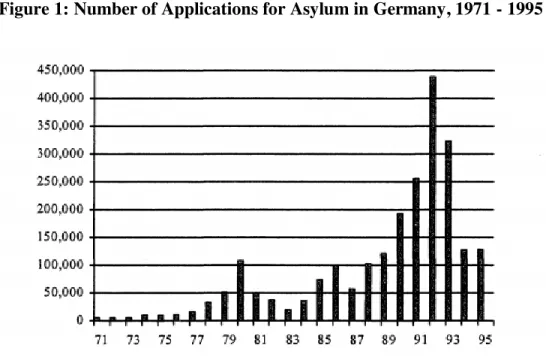
Germany’s open door policy toward asylum seekers made it a destination of refuge for decades. Following a political coup in Turkey in 1980 and the declaration of martial law in Poland a year later, West Germany saw its first peak in asylum claims, reaching upwards of 200,000 between 1979 and 1981 (Institute for Migration Research and Intercultural Studies 2015, 4). This number increased again less than a decade later in response to the anti-Sikh riots in 1984 and the Iran-Contra affair in the fall of 1986 (Institute for Migration Research and Intercultural Studies 2015, 4). The influx of political asylees in the 1980s, protected under Article 16 of Basic Law, instigated federal and state governments to attempt to introduce mechanisms to reduce asylum claims. Taking from Post and Niemann, these political asylees serve as examples of an exogenous pressure that Germany faced over a decade before it changed its constitution.
Figure 1: Number of Applications for Asylum in Germany, 1971 - 1995
4.3 Population Boom: Responding to Mass Influx
Influenced by both the Nazi past sentiment and the strength of the Social Democratic Party, Germany was one of the last countries of the European Economic Community to restrict its asylum policy. Other countries had already begun to put restrictive amendments into their legislation in the 1980s and early 1990s, leaving Germany as one of the few that had very few hurdles to jump to gain refugee status2 (Post and Niemann 2007, 14). With the introduction of Schengen in 1985, countries of the European Economic Community were beginning to open their internal borders, for the purpose of promoting free movement of persons and trade. In reality, the implementation of Schengen actually created strain for Germany in regards to immigration. With a borderless Europe, those countries who still had a more liberal asylum policy in place were attractive hubs for asylum seekers. The issue of “asylum shopping” began
to make its way into the headlines (Institute for Migration Research and Intercultural Studies 2015, 6). This population boom serves as the exogenous pressure which forced institutional response.
Germany spent the majority of the early 1990s juggling the influx of three different populations- reunified Germans formerly living in the German Democratic Republic, ethnic Germans from Central and Eastern Europe claiming citizenship in Germany, and asylum seekers fleeing from the Social Federal Republic of Yugoslavia. With the fall of the Iron Curtain in 1989, followed by the absorption of East Germany in October 1990, the Federal Republic of Germany was immediately faced with millions of migrants flooding the borders. In 1989,
2 The United Kingdom, Belgium, Italy, and Denmark introduced carrier sanctions (penalizations toward transporters for facilitating the entry of a person into that country without proper
377,055 ethnic Germans crossed over from Central Europe. In 1990, that number had risen to 379,073 (Bosswick 2000, 47). Following the disintegration of the Soviet Union, hundreds of thousands of ethnic Germans, known as Aussiedler, were arriving in the unified republic, an unprecedented number that Germany was not prepared to absorb. These ethnic Germans were protected by Article 116 of the Basic Law which detailed that ethnic Germans could enter Germany and claim full citizenship rights (Schuster 1998, 172). This population did not share the same language or culture as its neighbors, creating varying social and economic challenges (Schuster 1998, 198). The Eastern Lander, already struggling economically and socially
compared to their western counterparts, received nearly one-fifth of the estimated 400,000 ethnic Germans along with Jewish migrants from the Soviet bloc (Ireland 1997, 555). These migrants were not asylum seekers; recently freed from communist rule, they were migrating east for either economic reasons, to reclaim citizenship through Aussiedler, or other reasons, including family reunification. However, they were not refugees as defined by the 1951 Geneva Convention.
In the wake of unification lurked the wars in the former Socialist Federal Republic of Yugoslavia. Beginning in 1991, the numbers of asylum seekers arriving in Germany started to gradually increase, predominantly in response to the outbreak of violence in the Social Republic of Yugoslavia. In 1992, Germany faced an all-time high of 438,191 asylum applications
with a rise of xenophobia, particularly in the Eastern Lander. From a political standpoint,
opposing forces in government were forced to agreement due to an increase in violence.
4.4 Economic Effects of Mass Migration
One domestic factor contributing towards the decision to introduce restricted asylum
procedures in 1993 was the economic crisis following the end of the Cold War. This economic
crisis can be illustrated through the budgetary impact, strain on the welfare system, housing
shortage, and an increased unemployment rate.
Ethnic Germans who returned to the Lander from the Soviet Union had the same access
to public benefits as did any other German citizen. As constituted in Article 16 of the Basic
Law, these Germans could claim full citizenship rights (Schuster 1998, 172). As a result,
Germany saw a massive increase in public costs. In 1991, private and public investment in East
Germany amounted to 83 billion Deutsche Marks (DM), 7 percent of total GDP of 2,807 billion
DM (Ganssmann 1993, 84). This number may seem small, but when contrasted with the East
German total GDP of 183 billion, it is quite a large feat. As Ganssmann questions- “which
country could boast investments amounting to 44 percent of GDP?” (1993, 84). In addition, the annual budget deficit increased from around 10 billion DM in 1989 to 90 billion DM in 1991 as
West Germans were investing large sums of money to address far lower standards of living and
issues of unemployment in the East (Ganssmann 1993, 85).
From 1989 to 1992, GDP in West Germany declined by nearly 30 percent, with West
Germany transferring nearly four to five percent of its GDP per year on the east (Hunt 2006, 4).
corresponding to the relative population of each. Eastern Germany took responsibility for about 20 percent of the asylum claims (Ireland 1997, 555).
In addition, the nation was struggling with normalizing former East Germany, which came along with high levels of homelessness and unemployment. From 1988 to 1991, the housing deficit in Germany increased from 1 million to nearly 2.5 million. Subsequently, nearly 1 million were left homeless, an uptick from the 40,000 before reunification (Schuster 1998, 200). Strained by the 20 percent resettlement quotas, eastern Lander leadership seized control of everything from “gymnasiums, town halls, club halls, and vacant state-owned housing, even windowless air-raid shelters,” (Joppke 1997, 279). The economy in Germany was also strained by the large unemployment rates, numbers that were particularly high in the Eastern Lander. An estimated 900,000 (12 percent) were unemployed in the Eastern Lander (Schuster 1998, 199). This number could actually have been higher, give the number of employment programs masking the real rate of unemployment, including part-time work, job-creation schemes, early retirement and retraining programs (Schuster 1998, 199). Although reunification seemed to have promised economic stability and social cohesion, in the interim, it actually placed more strain on the welfare system of the state.
indeed “genuine refugees,” but were able to access public benefits during the time they awaited
their final decision, the asylum population was robbing millions of deutschmarks from Germany,
money that could be allotted towards German citizens who had a legitimate right towards
benefits. As CDU chairman Klaus Landowsky proclaimed, “It is not acceptable that foreigners
roam the streets, begging, cheating, and stabbing people, and then when they are arrested,
because they shout ‘Asylum,’ are supported by tax payers” (Schuster 1998, 200).
4.5 Rise of Far Right Groups: The “Foreigner Problem”
The economic effects of unification, most notably the steep increase in unemployment,
was said by Chancellor Kohl among other to put foreigners and Germans in competition for jobs
and housing, generating the so-called “foreigner problem” (Ireland 1997, 543). Any third
national, asylum seeker included, was competing with East Germans for public resources after
unification, making it easier for migrants to be portrayed “even more directly in the role of
competitors” (Ireland 1997, 544). This problem contributed to the rise of xenophobia in the
1990s, resulting in numerous attacks by the far-right across Germany. The platform of the far
right groups in regards to immigration centered around completely replacing Article 16 to grant
asylum to only those who are “really persecuted,” with all others to face deportation. (Schuster
1998, 202). These Neo-Nazis groups argued for immigration restriction for “economic interests,
cultural rights, national sovereignty, and self-determination of the native population” (Bosswick
2000, 46). These Neo-Nazis also argued for the closure of borders to prevent illegal immigration,
and public opinion reflected this sentiment as discourse revolved around the belief that asylum
seekers were part of the root cause for the uptick in crime, unemployment, and the housing
between 1991 and 1992 across much of the East Lander; In 1991 alone, there were 1,255
reported attacks against immigrants in the newly unified state, a number that increased to 2,277
in 1992 (Bosswick 2000, 48).
In September 1991, hostels in Hoyerswerda, a district town in Saxony, a former state of
the Eastern Lander, were attacked. Groups of neo-Nazis hailed stones and rocks, forcing many
African and Vietnamese immigrants to be bussed out and taken to an army base away from the
town (Kinzen 1991). In August 1992, a gang of neo-Nazis spent nearly four days heaving stones
and Molotov cocktails at a hostel of asylum seekers in Rostock-Lichtenhagen, another East
Lander district (Schuster 1998, 201). Rostock-Lichtenhagen served as the central reception
center for asylum claims in the state of Mecklenburg-Western Pomerania, and was home to
many Sinti, Roma, and Vietnamese workers. Labeled as the “most violent xenophobic riot in the
history of postwar Germany”, the incident was anything but halted by the police (Grimm 2012).
Police officials quickly retreated and became part of the crowd, invoking an image to any
foreigner- immigrant, asylum seeker, guest worker- that they were not welcome in Germany.
Less than two months after the attacks in Rostock, three Turkish women were killed in an
arson attack in Mölln, a town in the Western Lander of Schleswig-Holstein in November 1992.
Six months later, in May 1993, neo-Nazis in Western Lander North Rhine-Westphalia burned the
home of a Turkish family to the ground, killing five people (Kinzer 1992).
4.6 Political Response- Institutional Debate
Kohl, the chairman of the Christian Democratic Union (CDU), was in favor of more
restrictive asylum policy and held that a reduction in the number of asylum seekers was key in
discourse framed the overwhelming numbers as a threat to the economy and safety of the
Republic. Following the outbreak of violence, Kohl was forced to declare a state of emergency
(Schuster 1998, 202). Subsequently, these attacks were framed by member of the CDU/CSU to
be a justified response to the mass abuse of the asylum system and the large number of “bogus”
asylum seekers walking the streets of Germany creating havoc on the economy. The numbers of
‘true’ asylum seekers (those who had been granted refugee status) were not a danger to
Germany, but the response to the large numbers of ‘bogus’ asylum seekers were creating a
feeling of unrest and dissatisfaction across Lander, resulting in the large amount of attacks
against these groups (Schuster 1998, 202). As Edmund Stoiber, the Interior Minister for Bavaria
and leading politician in the Christian Social Union, wrote in 1992: “The abuse of the right to
asylum is creating unrest and anger in the population, and thereby the basis for toleration of the
extremists, which they would not otherwise enjoy” (Schuster 1998, 202). One report from Der
Spiegel, a German news magazine, commented that “the most urgent problem facing the
Chancellor is how to rescue Germany from the world’s refugees” (Schuster 1998, 202).
In contrast to the CDU, Social Democrats (SPD) were resistant to changing the
constitutional right to asylum. Discourse regarding asylum for the SPD revolved around
upholding German values. Herta Daubler-Gmelin, deputy chair of the SPD, described the right
to asylum as an “inalienable piece of social democratic identity” (Schuster 1998, 205). Departing
from such Article 16 would constitute a rejection of one of Germany’s cornerstone values, being
a safe haven for refugees, and a rejection of social democratic identity (Green 2001, 94). In
November 1992, supporters of the SPD and the protection of the Basic Law marched the streets
off Art.16,” “The Right to Stay is a Human Right,” and “Deportation is Murder” (Schuster 1998, 207).
In 1992, the SPD held 33.5 percent of the seats in the Bundestag. As a two-thirds
majority was needed to amend articles in the constitution and the SPD was necessary to exceed
that threshold, the party proved to be an influential player. Only after facing pressures to put an
end to the violent attacks and address the concern over the welfare issues- rise in unemployment,
housing deficit, stress on welfare benefits did the SPD agree to amend the Constitution (Schuster
1998, 202).
The introduction of a common European asylum policy also influenced the SPD’s willingness to amend Article 16. As Joppke argues, “Because the European Union was obviously unwilling to go the German way, Germany had to follow Europe” (1997, 281).
Germany had on multiple occasions proposed for other nations to follow-suit and adopt its liberal
asylum policy, but its efforts proved unsuccessful.3 By harmonizing Germany policy to that of
the European Union, Germany was not retracting its policy and moving backward but
prioritizing Europeanization, cooperation with member states, and therefore moving forward,
without sacrificing its own values present from the post-Nazi era. With the intent that other
nations would share more of the responsibilities of processing cases, Germany was more willing
to restrict its policy. Germany only agreed to adjust Article 16 after the EU set forth plans to
harmonize asylum policy. By giving up some of its sovereignty to that of the European Union
through EU policy, Germany was actually re-gaining sovereignty in regards to asylum, ending
the decades-long ambiguous, open-ended policy where any and all political refugees could travel and claim asylum in Germany.
4.7 Article 16a: The Asylum Compromise
Conservative leadership argued for the reforming of Article 16 as it was a “practical necessity” that would simultaneously be able to protect the core of Article 16 (2) while also preventing the abuse of the asylum process, evident in low approval numbers (Dickinson 2004, 62). In contrast, liberal elites like the SPD argued for preserving the original policy, for fear that
amending it would symbolize Germany turning its back on its moral obligation to victims of persecution. The debate pitted two viewpoints against each other: historical humanitarian
obligations vs. evolving reality of mass influx. As much as the SPD argued for keeping the policy intact, it could not ignore a changing reality: low asylum approval numbers, an increase in
violence against migrants, and a strained welfare system (Dickinson 2004, 63).
From the standpoint of the governing party, the attempts to limit the constitutional right to asylum protected in Article 16 were tied to creating free movement among EU member states
from the very beginning (Lavanex 2001, 857). In a report by the Standing Conference of Interior Ministries of the Lander from 1984, nearly a decade before the reform, the abolition of border
controls would make a revision of Article 16 necessary. A year later, CSU Federal Minister of the Interior Friedrich Zimmermann argued that, if internal border checks were removed, an amendment of Article 16 must be addressed (Lavanex 2001, 857). The need to include the
asylum issue in legislation is also reflected in the two different versions of the Schengen
Agreement. The first version, drafted in 1985 and signed off on by Chancellor Kohl, focused on
would create free and expanded trade and strengthen member state economies; in this draft, asylum was not mentioned once. Five years later, when the second draft was introduced, only one of the 142 articles addressed the introduction of free movement; 36 articles addressed
immigration and asylum (Lavenex 2001, 858).
In order to change the German Constitution, a two-third majority vote is required in both
houses of the German Parliament, the Bundestag (lower house) and the Bundesrat (upper house). Since a two-thirds majority could not be reached with just the CDU/CSU coalition alone, the advocates for restricting Article 16 needed support from the SPD. SPD faced pressures to adjust
its stance from three sources. For one, local-level communities who were responsible for processing asylum applications and integrating approved applicants were pressuring SPD
leadership on the basis that they were overwhelmed (Dickinson 2004, 76). Second, the SPD was on the brink of the 1994 German federal election, and needed the asylum issue absent from the
media before public debates began. With the large number of attacks against migrants (asylum seekers included) between 1991 and 1993, the party wanted this issue of the asylanten to be resolved to prevent any further violence (Bosswick 2000, 49). Finally, the SPD and the
CDU/CSU agreed that the core of Article 16 (2)- “Every politically persecuted individual has a right to asylum”- would remain intact, but it would be followed by a series of exclusions and restrictions, particularly the addition of “safe countries” (Bosswick 2000, 50).
In December 1992, only weeks after three Turkish women were killed in Mölln, the CDU/CSU and the SPD were able to come to an agreement on amending the constitution, known
constitutional policy in more similar terms to that of international policy, specifically that of “safe countries”.
With Article 16a came the introduction of same third country entry, meaning that an asylum application could be rejected if that applicant travelled to Germany through a “safe
country.” The list of safe countries was taken from international policy, specifically from countries where the Geneva Convention or the European Convention on Human Rights4 was already in place. This list included members of the European Council, the Council of Europe, and countries guaranteeing the application of the United Nations Convention relating to the Status of Refugees and the European Convention for the Protection of Human Rights and Fundamental Freedoms (Hailbronner 1993, 161). Applicants from other countries where these conventions were not in place were subject to approval from the Bundesrat. Germany also included a subsequent list of safe third states, including Austria, the Czech Republic, Finland, Norway, Poland, Sweden, and Switzerland (Hailbronner 1993, 162). Therefore, since all countries surrounding Germany fall under these categories, the only way to legitimately enter Germany for asylum would be by sea or by air. This policy was a way to curb “asylum
shopping” from asylees and put stricter guidelines on immigration.
A second amendment to Germany’s constitutional asylum policy was the introduction of safe countries of origin. These countries, determined by the Bundesrat, are countries that do not practice political persecution or inhuman or degrading treatment of their citizens (Hailbronner
1993, 163). The first list of safe countries included Bulgaria, Gambia, Ghana, Poland, Senegal,
the Slovak Republic, the Czech Republic, and Hungary. Since 1993, the countries in Africa have
been removed from the list, in reaction to political upheavals in that region. This mandate
specifically effected immigrants from former communist territories, including Poland and
Hungary, who despite release from communist regimes, were still facing economic barriers.
However, it aimed to put more responsibility on surrounding states to process asylum claims and
alleviate some of the pressures on Germany to process the mass majority of cases across Europe.
4.8 Effects of New Provisions: Protecting German Sovereignty
The ratification of the German constitution to curb the essentially open-door asylum
policy brought the issue of German protection to the forefront. As Germany started to restrict
the qualifications for asylum seekers, neighboring countries began to follow suit. In countries
like Switzerland and the Netherlands, the number of asylum seekers increased (Hailbronner
1993, 167). In reaction, the Netherlands adopted the Amendment of the Dutch Aliens Act of
1993, a policy that mirrors that of Article 16a.
Despite its attempt at curbing immigration, the provisions of Article 16a did not always
function as intended. For one, the “safe country” rule was not always effective. In many cases,
third states (or transit states) refused to take back asylum seekers, and proving first country entry
was difficult due to lack of proof that the applicant had entered Germany from a safe third
country. Through the enforcement of the 1951 Geneva Convention granting protection from
persecution, Germany was unable to deport these applicants back to either their home country or
asylum- such as those members of the CoE- these asylum seekers would travel through to
Germany who would accept these applications.
To the satisfaction of domestic actors, the number of asylum applicants in Germany
decreased following the passage of Article 16a. Beginning in 1994, the number of asylum
applications dropped to around 100,000 per year, a figure less than one half of the number of
applications in 1991 and less than one quarter of those in 1992 (Mayer 2016, 2). Between 2005
and 2010, asylum application numbers decreased to fewer than 50,000 per year. These low
numbers can be contributed to the ending of the wars in the former Yugoslavia in 2001 as well as
the containment of asylum applications in Eastern Europe with the safe country procedure from
Article 16a as well as the introduction of the Common European Asylum Policy in 2005. Volker
Klepp, deputy Commissioner for Foreigners’ Affairs, claimed less than three years after Article
16a came into effect that “asylum was no longer regarded as a problem- the situation had been
dealt with” (Schuster 1998, 209). However, as the protests and civil wars in the Middle East
started to ramp up in the early 2011, Germany once again began to face a crisis of asylum, this
CHAPTER 5: BETWEEN THE CRISES: THE ADOPTION OF EU POLICY, 1993-2015 When analyzing the development of German asylum policy, the impact of introducing the issue of asylum at the supranational level must be taken into consideration. The following
section will introduce three key European Union policies that impacted the border control and
processing of applicants in the Federal Republic- the Schengen Agreement, the Common
European Asylum System, and the Dublin Regulations. These pieces of legislation illustrate the harmonization of German and EU policy while also setting up the institutional context for the
crisis in the early 2010s.
5.1 The Schengen Agreement
The Schengen Agreement was signed in June 1985 in an effort to abolish internal border checks and allow for free movement between five members of the European Economic
Community at that time- Belgium, France, West Germany, Luxembourg, and the Netherlands.
The Agreement was followed by the Schengen Convention in 1990, a meeting initially intended to establish policy allowing “every EU citizen to travel, work, and live in any EU country
without any special formalities” (European Commission, 2018). At the same time, Schengen
also aimed to strengthen external security through Member State cooperation. The Schengen Agreement was incorporated into EU law through the signing of the Treaty of Amsterdam in
With the abolishment of internal border controls came the rise of “internal security risks,”
leading to an increased focus on securing the external border of the EU (Thielemann and
Armstrong 2013, 149). Therefore, Frontex, the European Border and Coast Guard Agency, was established in 2005 to coordinate border security efforts between Member States, promoting
shared responsibility, and increased police presence at external borders. Another facet of
Schengen that increased security measures was the implementation of the Schengen Information
System (SIS). This system was the first supranational database within Europe that opened up communication channels between Member States about the travel of third-country nationals entering within the Schengen border (Kasparek 2016, 61).
The Schengen Agreement remains one of the first pieces of legislature aimed at
devolving Member State control to the supranational level, while promoting intergovernmental cooperation through shared border protection. As argued by Kasparek (2016, 61), “mobility and
freedom of movement with the Schengen Area were counter-balanced by a reinforced border
with third countries.” The Schengen Agreement became the foundation for European migration policy as it initiated the creation of the Dublin Agreement and subsequently the Common European Asylum policy, both key cornerstones of asylum policy.
5.2 The Common European Asylum System
Over a decade before the CEAS came into effect, Chancellor Kohl was advocating for a
comprehensive asylum policy at the EU level. With the large numbers of asylum seekers flooding through German borders as an indirect result of unification, Kohl was searching for
2001, 99). In 1992, 78 percent of asylum seekers in the EC-121 submitted applications for asylum in Germany. In 1994, Germany made a proposal to the European Council to temporarily redistribute asylum applicants based on Member State population, size of territory, and GDP per capita, but it was rejected (Hatton 2005, 7). It was only when the issue of asylum became tied to the Schengen Agreement did the EU being to make progress towards regulating free movement (Hatton 2005, 8).
The Treaty of Amsterdam (1997) stated that the European Council was to adopt, within five years, detailed measures on asylum, including processing procedures, qualification
standards, and reception standards, in accordance with the 1951 Geneva Convention Relating to the Status of Refugees and the 1967 Protocol Relating to the Status of Refugees (Kaunert and Leonard 2012, 9). This series of measures took the form of a harmonized asylum policy at the supranational level. Since 2005, Germany had been bound by the Common European Asylum System, a system of regulations and directives intended to alleviate some of the pressures on countries who were accepting higher numbers of refugees and set minimum standards for all EU member states for the treatment of all asylum seekers and applications. These standards are manifested in five pieces of legislation (Institute for Migration Research and Intercultural Studies 2015, 7):
1) Qualification Directive (2004/83/EC): harmonization of the common criteria for the recognition of asylum seekers and for the rights of recognized refugees and persons with subsidiary protection status
2) Reception Conditions Directive (2013/33/EU): standards for the social conditions of reception centers, accommodations, and care of asylum seekers
3) Asylum Procedures Directive (2013/32/EU): standards of safeguards and access to a fair and efficient asylum procedures
4) Dublin III Regulation (2013/604/EU): determination of which EU Member State is responsible for receiving asylum applications
5) Eurodac Regulation (2013/603/EU): creation of a EU-wide database of fingerprints from asylum applicants accessible by all Member States
5.3 The Dublin Regulations
One of the most important reforms to asylum policy in the European Union stemmed
from the 1990 Dublin Convention. Entering into force in September 1997, the Dublin
Convention established two main policies: a common framework for determining which Member
State would be responsible for processing an application, and assurance that only one State can
process each application (Hatton and Williamson 2006, 273). The Dublin Regulation prevents
the issue of “asylum shopping” across EU States and regulates the process for transferring
individuals who apply for asylum in a secondary country back to their initial point of entry
(Brekke and Brochmann 2015, 147). The Dublin Convention was revised in 2003, and again in
2013, attempting to address some of the inefficiencies present in previous drafts, including how
to process family reunification cases, minors and dependents, crisis management, and the rights
of asylum seekers (Morgades Gil 2015).
The Dublin Regulations were created in response to the Schengen Agreement, an
example of a functional pressure. When the Schengen Agreement was created and internal
borders were relaxed, asylum seekers could enter through an external country such as Greece and
travel through to Germany, who was more attractive for asylum seekers due to its higher welfare
benefits, opportunities for employment, etc., a process known as “asylum-shopping.” This
possibility was considered a “threat to the system,” and a mechanism needed to be implemented
to prevent more attractive countries, like Germany, from being overwhelmed with high
were not coincidentally both signed within the same month- a domino effect was at play. By
opening up an internal market, Member States were faced to harmonize asylum policy to prevent any one such state from facing overwhelming numbers of asylum applications beyond its
capacity.
Between 1993 and 2015, Germany’s policy framework made an effort to harmonize with
that of the EU, predominantly in response to the emergence of a common asylum policy within the European Union. When the Treaty of Amsterdam came into force in 1999, it introduced the
issue of addressing asylum policy at the supranational level. Areas of asylum and refugee policy became “communitized” areas of policy, meaning that the asylum application process would no
longer remain solely in the hands of member states. Instead, the asylum process would function through cooperative work between member states and adherence to international agreements, including the Geneva Convention Relating to the Status of Refugees and the European
Convention on the Protection of Human Rights and Freedoms (Institute for Migration Research
and Intercultural Studies 2015, 6). These efforts were made in the hopes of creating an “area of
CHAPTER 6: THE SECOND LITMUS TEST: RESPONSE TO THE MIDDLE EAST
Following with the claim made by this thesis that in the face of mass migration numbers,
states will resort to more restrictive measures over humanitarian obligations, the following
chapter will dive deep into the second crisis of asylum in Germany, occurring two decades after
the first. This section will study how Germany, led by Chancellor Angela Merkel, decided to
abandon its commitment to EU policy in favor an open-door policy reflective of its
pre-unification measures. It will continue by demonstrating how discourse within right wing
political groups, Merkel’s own coalition, as well as her opposition party, were able to reverse
Merkel’s stance and implement restrictive measures once again. It will conclude by detailing these restrictive measures, supporting the claim that sovereignty takes precedence over obliging
by international policies.
6.1 Background Facts and Figures
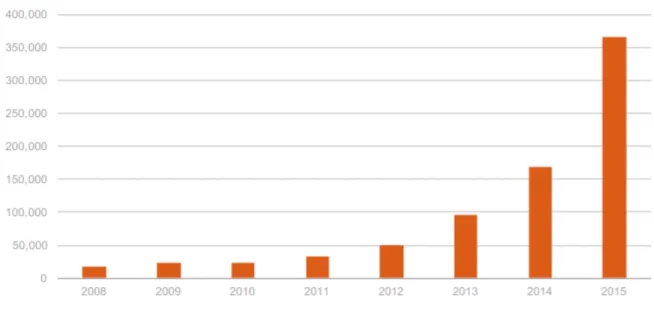
Before 2010, the numbers of asylum applications in Germany remained below 30,000,
consistently averaging around 25,000 applications per year (UNHCR Asylum Trends 2013).
Beginning in 2010, however, the Federal Republic of Germany began to see increasing numbers
of asylum seekers make their way into Germany. Between 2010 and 2011, this number jumped
near the 40,000 range, and in 2012, jumped even higher to nearly 65,000, a 41 percent increase
from the previous year (UNHCR Asylum Trends 2014). This increase can be attributed to the
Spring particularly impacted Syrians, Afghanis, Iranians, and Iraqis, who made their way into the EU, reflective in high asylum numbers.
Beginning in 2013, the number of applicants estimated at 109,580, a 70 percent increase from 2012. The following year, Germany received 173,100 new asylum applications,
predominantly from those in the Middle East, becoming the single largest recipient of new asylum claims among the European Union (UNHCR Asylum Trends 2014, 2). This increase in 2014 was a nine-fold increase from the 19,200 applications reported in 2007(UNHCR Asylum Trends 2014, 9). With the outbreak of violence in Syria, over one million Syrians, Kurds, Iraqis, Eritreans, Somalis, and Afghanis among others made their way from the Middle East into Germany to claim asylum. In the first six months of 2015, Germany received 218,221
applications for asylum, with 44,417 of those applications being made by Syrians alone (Blumen 2016, 41). In the entirety of 2015, nearly 1.1 million migrants entered Germany, but only 476, 649 filed for asylum (Mayer 2016, 3).
From a demographic standpoint, the majority of asylum applicants who received high recognition rates- and therefore were granted asylum in Germany- were Syrian (96 percent recognition rate, Iraqis (88.6 percent recognition rate), Kurds and Palestinians (80.2 percent), and Eritreans (92.1 percent). Afghani applicants had lower chances of being granted asylum- 47.6 percent- with Pakistanis falling significantly lower, leveling off at 9.8 percent (Mayer 2016, 3). Pakistanis had significantly less recognition rates as German leadership believed that although the countries did not deem the status of “safe country of origin,” that there were safer regions in
Figure 2: Pending Asylum Applications in Germany
Source: Mayer 2016, 3
6.2 Angela Merkel: The Face of the Refugee Crisis
In the first half of 2015, Germany, led by long-term Chancellor Angela Merkel,
attempted to abide by EU legislation. However, as other countries were beginning to close their
borders, Germany was facing two pressures: an increased reporting of refugee fatalities across
the southern and eastern parts of the EU, and neighboring countries closing their borders,
pushing populations toward the Republic for refuge.
Before Germany opened its borders in September 2015, a series of images of refugees
facing fatality on their journey towards asylum ran rampant across the internet. Merkel herself
was televised during interactions with various refugees. Only July 16, Merkel was faced with
the issue of deporting 14-year-old Reem Sahwil, an asylee from Palestine, who was facing
deportation after coming to Germany for surgery (Mushaben 2017, 97). Sahwil, who arrived
Germany for protection. Merkel stated “politics is sometimes hard. You’re right in front of me
now and you’re an extremely nice person. But you also know in the Palestinian refugee camps
in Lebanon are thousands and thousands and if we were to say you can all come…we can’t
manage it” (Connolly 2015). Over a month later, on August 27, Merkel learned that 71 refugees
had been found asphyxiated in a sealed truck on an Austrian highway, attempting to be smuggled
across the border (Mushaben 2017, 97).
Merkel was at a crossroads. Since the beginning of her political career, she had drawn on
German values and identity in various speeches, one of integration and hospitality for those
fleeing persecution, illustrated particularly in her famously coined phrase: “Wir schaffen das”
(We can do it). Simultaneously, Merkel was the de facto face of the European Union, linking
German’s well-being with the well-being of the EU (Matulovic 2016, 51). Her initial response
to the hundreds of thousands of asylum seekers migrating across Europe was to reform Dublin
and engage with countries that were already affected by large influxes of refugees, including
Turkey, Lebanon, and Jordan: “It is unacceptable that Greece and Italy should have to carry the
burden alone because they have the geographical location that they do and the refugees land in
them” (Jones 2017). Merkel proposed a redistribution model that would relieve countries of first
entry- Greece and Italy- from having to process such large numbers. However, as Germany
pushed for stronger European cooperation, other countries were retreating in the opposite
direction. Hungary began to progressively close its borders with Serbia in June, followed by
Croatia in October. Other countries, such as Poland and the Czech Republic refused to accept
the European Commission’s plan to distribute 120,000 people from over-burdened Italy and
Merkel fought hard to focus on the success of the European Union in absorbing the mass influx instead of Germany alone as a sovereign state.
The progression towards the suspension of Dublin II Regulation began a series of cryptic decisions made by the Federal Office for Migration and Refugees (BAMF). On August 21, the Agency released internal guidelines for suspending Dublin for Syrian refugees. Four days later, the same agency issued an “obscure, bureaucratic message” that indicated an
exception for Syrians crossing into Germany, therefore violating Dublin: “We are not enforcing
Dublin procedures for Syrian nationals at the present time” (Calamur 2015). Merkel responded
by stating that this tweet had caused a “misunderstanding” and that EU law would remain in
effect (Thomas et al. 2015). However, thousands of Syrians were already on the move towards Germany, with an estimated 20,000 arriving through Munich’s central train station in the first
weekend of September (Mushaben 2017, 97).
6.3 Abandonment of the CEAS
The Dublin System failed to take its intended effect in 2015. The Dublin III Regulation, which called for the registration of asylum seekers in the first country of entry, was instituted to prevent so-called “asylum shopping,” in which asylees could submit applications in numerous EU states (Havlová and Tamchynová 2016, 86). If Dublin had functioned as intended in 2015, Greece, Italy, Hungary, and Bulgaria would have processed the vast majority of asylum
applications. As evident in the 1.1 million asylum seekers in Germany and nearly 200,000 in Sweden, Dublin was not functioning as intended.
Greece, had been absorbing steadily increasing arrival numbers for years before 2015, largely in
part due to the consequences of the Arab Spring in 2011. These countries were already struggling
to stabilize their economy, and failed to provide adequate processes and housing set forth by the
Common European Asylum System (CEAS) (Mayer 2016, 5). Therefore, Germany struggled
with the concept of returning applicants back to Greece because the conditions were so poor, a
decision that could have resulted in a “humanitarian catastrophe” (Mayer 2016, 7).
The Schengen Area allows for the movement of over 400 million travelers per year
across EU member states without internal border checks, for both EU and non-EU nationals alike
who are legally allowed on EU territory. In 2015, the freedom to travel was utilized extensively
by refugees who, due to the ineffectiveness of Dublin and Frontex, were able to travel through
external borders and subsequently through inland countries to Germany. As Germany borders
nine other countries, there were numerous points of access for asylum seekers. Hundreds of
thousands of unregistered refugees were passing through Greece and Italy to apply for asylum in
more welcoming countries such as Germany and Sweden. As Berlin’s Interior Minister stated in
the wake of the crisis:
"There continue to be shortcomings in the protection of the EU's external borders, as well
as a significant amount of illegal migration within the Schengen zone…A complete return to a
Schengen zone without border checks will only be possible once the overall situation allows it"
(“Germany extends border controls” 2015).
6.4 Political and Public Response to the Suspension of Dublin
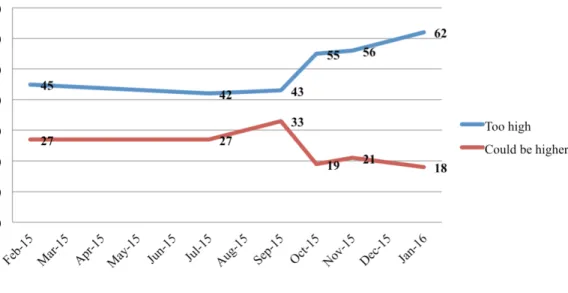
In the beginning of September 2015, discourse in Merkel’s camp was hauntingly similar
without limits. As Merkel stated the same month, the “right to political asylum has no limits on
the number of asylum seekers” (Blumen 2016, 47). Initially, Germany’s decision to suspend
Dublin was supported domestically- people in Munich lined the streets to welcome crowded
trains of refugees from Budapest (Blumen 2016, 45). With media reports of child fatalities from
Greece to Austria, domestic discourse initially embraced the “We can do it!” slogan of Merkel;
however, that sentiment quickly faded as political actors began to push back. This is evident in
political discourse from actors across all of the major political parties, particularly the CDU,
CSU, and SPD, in Germany.
After suspending Dublin, Merkel overrode several domestic actors to keep the borders of
Germany open. Vice Chancellor Sigmar Gabriel (SPD), initially supported Merkel’s decision to
absorb nearly 500,000 asylees per year, but later withdrew his comments in favor of a more
restrictive asylum policy (Blumen 2016, 30). Merkel also superseded domestic pressures from
within her own coalition, including Federal Interior Minister Thomas de Maizière, Bavarian
Prime Minister Horst Seehofer, and conservative state interior ministers, all of whom were
pushing for border restrictions; Merkel responded “If we now start to apologize for showing a
friendly face in emergency situations, then it is no longer my country” (Blumen 2016, 48).
In the weeks following, the political discourse in Germany painted a dichotomous
picture: Merkel vs. everyone else. Particularly, Merkel faced pushback from Seehofer, head of
the CSU, the sister party to Merkel’s Christian Democratic Union. Seehofer, like Merkel, called
for the sharing of refugee amongst EU member states and better control of EU borders through
the strengthening of Frontex, but was firm on his position to reduce the number of refugees that
Bavaria would accept, to the point of refusing to accept his state’s federally mandated refugee
ministers, in agreement with SPD leadership and the head of the federal police, called on Merkel to introduce border controls (Blumen 2016, 49).
Discourse in the opposition camp from Merkel, both at the domestic and international level, circled around costs and securitization of refugees (Blumen 2016, 50). The securitization of refugees occurs when migration, or in this case asylum, is politicized and presented as a security threat to Germany (Léonard 2010, 231). On the domestic front, political actors including Seehofer among others, utilized the increasing reports of violent outbreaks as a security threat and economic strain among the reception centers as risk of German economic stability. CSU leadership painted the terrorist attacks in Paris in November as evidence that Germany was also at risk of such a tragedy and needed to take precautions to prevent such an incident. In addition, nearly 500 assaults occurred by “North-African looking men” during New
Years’ Eve 2015 in Cologne and Hamburg, among other cities (Mushaben 2017, 98). The
Bavarian finance minister argued for the closing of Germany’s borders if the EU failed to protect
its external borders, and even went so far to threaten Merkel with closing Bavarian’s borders, an open rebuke to the federal system (Blumen 2016, 53). In late September, Seehofer invited Viktor Orbán, the openly anti-immigrant Prime Minister of Hungary, to a CSU conference. This decision sparked controversy amongst German popular opinion, as Orbán was known for
rejecting Merkel’s policies and refusing the EU’s distribution plan for 120,000 refugees (Blumen
2016, 51). Less than a month after the conference, Orbán closed Hungary’s border to Croatia.