Use of a Dual-Antigen Rapid Diagnostic Test to Screen
Children for Severe
Plasmodium falciparum
Malaria in a
High-Transmission, Resource-Limited Setting
Ross Boyce,1 Raquel Reyes,2 Michael Matte,3 Moses Ntaro,3 Edgar Mulogo,3 and Mark J. Siedner4
Divisions of 1Infectious Diseases and 2General Medicine & Clinical Epidemiology, University of North Carolina at Chapel Hill; 3Department of Community Health, Mbarara University of Science & Technology, Uganda; and 4Department of Medicine, Harvard Medical School, and Massachusetts General Hospital, Boston
Background. In rural areas, many patients with malaria seek care at peripheral health facilities or community case management programs. While this strategy is effective for the management of uncomplicated malaria, severe malaria necessitates prompt detec-tion and referral to facilities with adequate resources.
Methods. In this prospective, observational cohort study, we assessed the accuracy of a dual-band (histidine-rich
pro-tein-2/pan-lactate dehydrogenase [HRP2/pLDH]) rapid diagnostic test (RDT) to differentiate uncomplicated from severe malaria. We included children aged <12 years who presented to a rural clinic in western Uganda with a positive HRP2 or HRP2/pLDH RDT. We estimated the test characteristics of a dual-antigen (HRP2+/pLDH+) band positive RDT compared to World Health Organization–defined clinical and laboratory criteria to detect severe malaria.
Results. A total of 2678 children underwent testing for malaria with an RDT, and 83 (9.0%) satisfied criteria for severe malaria. The sensitivity and specificity of a HRP2+/pLDH+ result for severe malaria was 97.6% (95% confidence interval [CI], 90.8%–99.6%) and 75.6% (95% CI, 73.8%–77.4%), respectively. An HRP2+/pLDH+ result was significantly more sensitive (97.6% vs 68.7%, P < .001) for the detection of severe malaria compared to algorithms that incorporate screening for danger signs.
Conclusions. A positive dual-antigen (HRP2/pLDH) RDT has higher sensitivity than the use of clinical manifestations to detect severe malaria, making it a promising tool in the triage of children with malaria in low-resource settings. Additional work is needed to operationalize diagnostic and treatment algorithms that include dual-antigen RDTs to avoid over referral.
Keywords. malaria; severe malaria; rapid diagnostic tests; community case management.
Each year millions of children are infected with Plasmodium falciparum malaria, and approximately 300 000 die from mani-festations of severe disease [1]. In Uganda, like much of sub-Sa-haran Africa, malaria is a leading cause of child mortality and has historically accounted for nearly half of inpatient pediatric deaths [2, 3]. Many who suffer from severe malaria, however, do not reach a health facility, and thus a large proportion of deaths take place outside the formal healthcare sector [4–6].
Patients may initially seek care at peripheral health facilities that are staffed by health workers with only basic training in malaria case management. In Uganda, these level II and level III facilities may lack the requisite infrastructure to perform microscopy or other tests that may yield evidence of severe malaria (Table 1) [7, 8]. Malaria-endemic countries have also increasingly adopted community case management strategies,
which provide for malaria diagnosis and treatment by lay mem-bers of the community outside of health facilities [9, 10].
While these programs improve access to care [11], community health workers and peripheral health centers are not equipped with the laboratory infrastructure (eg, lactate and bicarbonate testing) required to diagnose severe malaria. Instead, providers are instructed to refer suspected cases to a higher level of care [12, 13]. The decision to refer, however, depends on the per-formance of a detailed physical exam and the identification of abnormal clinical signs, which may not be recognized by ancil-lary staff and lay health workers [14, 15].
One advance in rapid diagnostic test (RDT) technology is the development of assays that combine different antigens on a single membrane. Some reports suggest that the pattern of antigen band positivity can provide a semiquantitative estimate of P. falciparum parasite density [16–18], with dual-antigen band-positive tests signifying higher parasite densities. Given the association between higher levels of parasitemia and severe malaria [19], we hypothesized that dual-band positive tests may help discriminate between uncomplicated and severe malaria among children in rural Uganda.
Our objective in this prospective, observational study was to evaluate the validity of a dual-antigen RDT as a screening Received 8 May 2017; editorial decision 20 June 2017; accepted 30 June 2017; published
online August 24, 2017.
Correspondence: R. M. Boyce, Division of Infectious Diseases, University of North Carolina at Chapel Hill, 130 Mason Farm Road, Chapel Hill, NC USA 27599 ([email protected]). Clinical Infectious Diseases® 2017;65(9):1509–15
DOI: 10.1093/cid/cix592
STANDARD
tool for severe malaria and compare its performance to stand-ard, clinical-based diagnostic criteria. Our overarching goal was to identify a low-cost, easy-to-interpret method for detecting severe malaria and guide referral decisions in community-based fever management programs and at peripheral health centers in resource-limited settings where microscopy and advanced lab-oratory capacity are not routinely available.
METHODS
Study Setting
The Bugoye Level III Health Center in the Kasese District of western Uganda serves a rural population of approximately 50 000 residents. Clinical officers, nurses, midwives, and labora-tory technicians employed by the Ugandan Ministry of Health staff the health center. The climate in Bugoye permits year-round malaria transmission marked by semiannual transmis-sion peaks typically following the end of the rainy seasons [20].
Study Design
The RDTs for Severe Malaria study was a prospective, observa-tional cohort study of patients with a parasitological diagnosis of malaria conducted from May 2015 to November 2015. Study staff recorded demographic information, clinical history, and vital signs on all individuals who presented to the outpatient department. Health facility staff, typically nurses and clinical officers, performed clinical evaluations of all patients in accord-ance with local protocols. Individuals with fever (axillary tem-perature ≥38oC) or other symptoms suspicious for malaria as
determined by the attendant provider were eligible for inclu-sion. Individuals aged >12 years and those who presented with-out a caregiver were excluded.
The health center laboratory staff performed initial testing for malaria using the Standard Diagnostics 05FK60 Malaria Ag
P.f/Pan RDT assay (Hagal-Dong, Korea). The RDT, which has been prequalified by the World Health Organization (WHO), is an antigen detection test with 3 bands signifying the control, the histidine-rich protein-2 (HRP2), and the pan-lactate dehydro-genase (pLDH) antigens [21, 22]. The presence of a single HRP2 line (herein referred to as a HRP2+/LDH– result) denotes infec-tion with P. falciparum, whereas a unique pLDH line (herein referred to as HRP2–/pLDH+) indicates infection with 1 or
more of the other Plasmodium species. The presence of a pos-itive HRP2 line together with a pLDH line (HRP2+/pLDH+) indicates an infection with P. falciparum or a mixed-species infection. RDTs for the study were obtained directly from the manufacturer, stored in the original packaging at room temper-ature, and used prior to the expiration date. We included partic-ipants with at least 1 single-band positive RDT in this analysis.
Study staff with training in laboratory medicine prepared thin and thick blood smears for all children with a positive RDT result. Children with a negative RDT were defined as not having severe malaria and did not undergo further testing, except for the 15% of individuals who underwent microscopy for the purpose of quality control. Smears were fixed with methanol and stained in 10% Giemsa. Microscopists who had undergone validation testing (Shoklo Malaria Research Unit) and were blinded to the RDT results reviewed all slides in accordance with WHO/Tropical Disease Research guidelines [23]. Two independent microscopists read all slides. A third, senior microscopist reviewed slides when there were discrepancies between the first 2 reads in the presence of parasitemia, species identification, or differences (>10%) in parasite density. Dried blood spots were obtained from a subset of participants over a 1-month period, and real-time polymerase chain reaction (PCR) was performed to assess the accuracy of microscopy [24].
Hemoglobin levels were measured using the Hemocue Hb 201+ analyzer (Brea, California), while serum chemistry and venous blood gas values were obtained using the Abbott iStat analyzer (Princeton, New Jersey) with the CHEM8+ and CG4+ cartridges. Estimates of hemoglobinuria were made using a UroColor 11 dipstick urinalysis assay (Standard Diagnostics, Hagal-Dong, Korea). All point-of-care tests were calibrated daily by study staff and performed in accordance with the man-ufacturers’ instructions.
Patients with any positive RDT result were treated by health center staff in accordance with local standards of care. We recorded treatment and disposition plans, including admission to the inpatient ward and referral to higher-level facilities.
Statistical Analyses
Data were double-entered into Microsoft Excel (Redmond, Washington) and analyzed with Stata 12.1 (College Station, Table 1. Study Criteria for Severe Malaria Required Plasmodium falciparum Parasitemia on Microscopy and Any One of the Following
Impaired consciousness Blantyre coma score <3 for children aged <5 years or Glasgow coma score <11 for children aged >5 years Metabolic acidosis Plasma bicarbonate of <15 mmol/L or venous plasma lactate >5 mmol/L
Hypoglycemia Blood or plasma glucose <40 mg/dL (<2.2 mmol/L)
Severe anemia A hemoglobin concentration <5 g/dL in children aged <12 years and <7 g/dL in adults together with a parasite count >10 000/uL Kidney injury Plasma or serum creatinine >3 mg/dL and blood urea nitrogen ≥20 mg/dL
Pulmonary edema Oxygen saturation <92% on room air with a respiratory rate >30/min Abnormal bleeding Hemoglobinuria of ≥4+ on dipstick urinalysis (250 red blood cells)
Shock Systolic blood pressure <70 mm Hg
Texas). We summarized patient characteristics and compared them between those with HRP2+/pLDH– and HRP2+/pLDH+ results using Student t test for continuous variables and Pearson χ2 test for categorical variables. Parasite densities were
log-trans-formed and reported as geometric means.
For our primary analysis, we assessed the validity of the dual-antigen RDT to detect severe malaria in children aged <12 years. To do so, we defined severe malaria in accordance with the guidelines for research and epidemiological studies [4]. We used the threshold of 250 000 parasites/μL (approximately 5%) to define hyperparasitemia. We defined abnormal bleeding as the presence of gross hemoglobinuria (4+ on urinalysis). These criteria are outlined in Table 1.
We estimated the sensitivity, specificity, and negative and positive likelihood ratios for a HRP2+/pLDH+ result (vs a HRP2+/pLDH– result) to identify severe malaria. Using our estimated sensitivity and specificity results and a range of severe malaria prevalence from 1% to 30%, we then assessed the nega-tive (NPV) and posinega-tive predicnega-tive values (PPV) of the tests. We repeated these analyses restricted to children aged <5 years. We performed sensitivity analyses of these estimates by liberalizing thresholds for a number of criteria that define severe malaria.
Finally, we evaluated the test characteristics of the RDT for the detection of severe malaria in comparison to clinician impressions, which comprise key physical exam findings often termed “danger signs” (eg, impaired consciousness, shock, aci-dotic breathing) in the setting of P. falciparum parasitemia, as used by the health center clinical staff under routine conditions [4]. We recorded disposition plans (eg, discharge, admit, refer) as a surrogate marker for the presence of such danger signs. We
also evaluated the test characteristics of the RDT compared to a “bedside exam,” which we defined as the presence of outward clinical manifestations of severe malaria according to the cri-teria listed in Table 1 (eg, impaired consciousness, pulmonary edema, seizures) prior to a confirmed parasitological diagnosis or other laboratory-based evidence of severe malaria.
Ethics Statement
The institutional review boards of Partners Healthcare, the University of North Carolina at Chapel Hill, the Mbarara University of Science and Technology, and the Uganda National Council for Science and Technology provided ethical approval of the study. Written informed consent was obtained from all study participants.
RESULTS
Diagnostic Testing and Clinical Manifestations
A total of 2701 children aged <12 years presented with a clin-ical history and/or symptoms concerning for malaria. Baseline characteristics of the study cohort are shown in Table 2.
RDT results were available on 99.2% (2678/2701) of patients, nearly half (1248/2678, 46.6%) of whom displayed at least 1 positive antigen band. The HRP2+/pLDH+ result was the most common, accounting for 67.8% of all positive results, while an isolated HRP2 band (HRP2+/pLDH–) was seen in 30.7%, and a single pLDH band (HRP2–/pLDH+) in less than 2% of positive results. Of those participants with any positive RDT result, 75% (936/1248) chose to pursue additional diag-nostic testing in the study protocol and were subsequently included in the analysis.
Table 2. Baseline Demographic and Clinical Characteristics Stratified by Rapid Diagnostic Test Result
Baseline Characteristic All HRP2+/pLDH– HRP2+/pLDH+ P Value
Patients (n, %) 2678 383 (14.3) 846 (31.6) —
Age, y (median, IQR) 5 (2–8) 6 (3 - 9) 6 (3–9) .79
5–12 1438 (53.2) 246 (64.2) 545 (64.4) .95
<5 1263 (46.8) 137 (35.8) 301 (35.6)
Male sex (n, %) 1331 (50.2) 190 (50.0) 438 (52.4) .44
Days since symptom onset (median, IQR) 2 (2–3) 3 (2 - 3) 2 (2 - 3) .001
Reported symptoms (n,%)
Fever 2192 (81.2) 351 (91.6 794 (93.9) .16
Cough 1443 (53.4) 214 (55.9) 381 (45.0) <.001
Rhinorrhea 719 (26.6) 105 (27.4) 185 (21.9) .03
Arthralgias/Myalgias 316 (11.7) 52 (13.6) 135 (16.0) .28
Diarrhea 408 (15.1) 43 (11.2) 114 (13.5) .27
Convulsion 43 (1.6) 5 (1.3) 20 (2.4) .22
Vital signs (n, %)
Febrile 474 (18.2) 57 (15.5) 262 (31.9) <.001
Tachycardic 464 (18.3) 64 (17.4) 543 (31.0) <.001
Hypotensive/Shock 79 (3.3) 8 (2.2) 24 (3.0) .45
Pulmonary edema 60 (2.6) 7 (1.9) 21 (2.7) .45
Text in bold represents measures that define criteria for severe malaria.
Nonparticipants were younger (median age 4 vs 7 years,
P < .001) and more likely to have a HRP2+/pLDH– RDT result (31.1% vs 12.3%, P < .001) than participants included in the study. There were similar rates of fever (31.3% vs 29.4%, P = .56), tachycardia (26.3% vs 30.9%, P = .15), hypoxia (12.6% vs 8.7%,
P = .06), hypotension (2.9% vs 2.6%, P = .8), and reported sei-zures (3.2% vs 1.7%, P = .13) between those included and those not included. Rates of admission (29.9% vs 25.3%, P = .21) and referral (1.1% vs 0.3%, P = .19) were also similar.
Using microscopy as the reference standard, the overall sen-sitivity of the RDT for the diagnosis of P. falciparum malaria was 98.2% (95% confidence interval [CI], 96.8%–99.0%). The spec-ificity was 89.1% (95% CI, 85.9%–91.7%) for HRP2+/pLDH+ results and 52.1% (95% CI, 47.3%–57.0%) for HRP2+/pLDH– results (P < .001). Among the subset of samples that underwent parallel real-time PCR (n = 112), slide reading demonstrated a high degree of agreement (κ = 0.94). Plasmodium falciparum
accounted for 95.4% of infections, while Plasmodium malar-iae, Plasmodium ovale, and mixed P. falciparum accounted for 2.3%, 1.2%, and 1.2% of infections, respectively, as determined by microscopy.
Results of blood and urine testing to assess for severe malaria are shown in Table 3. Those with HRP2+/pLDH+ results had significantly higher levels of parasitemia compared to indi-viduals with HRP2+/pLDH– results (geometric mean, 13 051 parasites/μL vs 1126 parasites/μL, P < .001). All cases above the clinically relevant threshold of 100 000 parasites/μL and all 17 cases of hyperparasitemia were observed in the HRP2+/ pLDH+ group.
Severe Malaria
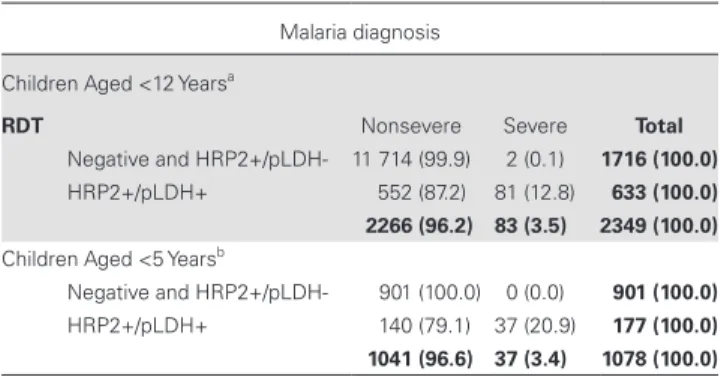
A total of 83 (9.0%) children with a positive HRP2 or HRP2/ pLDH RDT satisfied criteria for severe malaria. The sensi-tivity and specificity of a HRP2+/pLDH+ result for severe malaria was 97.6% (95% CI, 90.8%–99.6%) and 75.6% (95% CI, 73.8%–77.4%), respectively (Table 4). Two children with single-antigen HRP2+/pLDH– results met criteria for severe malaria. One had pulmonary edema, tachycardia, elevated lactate (2.5 mmol/L), and a parasite density of 10 087/μL, while another had shock (systolic blood pressure 61 mm Hg), elevated lactate (2.3 mmol/L), and a parasite density of 21 208/μL.
Using a severe malaria prevalence of 3.5% (83/2349) among all children who presented for testing, a HRP2+/pLDH+ result demonstrated a near-perfect NPV for the diagnosis of severe malaria (99.9%, 95% CI, 99.5%–99.9%) and a PPV of 12.8% (95% CI, 10.4%–15.7%). These estimates were robust to ranges of severe malaria prevalence from as low as 1% to as high as 30% (Supplementary Table 1).
When we restricted the analysis to children aged <5 years (Table 4), the proportion of children with severe malaria increased to 14.0% among those with a positive RDT. All 37 cases of severe malaria were identified by a HRP2+/pLDH+ RDT, with a resulting sensitivity of 100% (95% CI, 86.6%– 100.0%), PPV of 20.9% (95% CI, 15.3%–27.8%), and NPV of 100% (95% CI, 99.5%–100.0%).
In multiple sensitivity analyses, we found that changes in the diagnostic criteria for severe malaria resulted in the identifi-cation of more cases but did not significantly impact the high
Table 3. Laboratory Results for Patients With Confirmed Plasmodium falciparum Parasitemia Stratified by Rapid Diagnostic Test Result
Characteristic HRP2+/pLDH– HRP2+/pLDH+ P Value
Patients (n, %) 77 579 —
Microscopy results
Parasitemia (geometric mean, 95% CI) 1126/μL (686–1849) 13 051/μL (11 201–15 208) <.001
Density >10 000 (n,%) 13 (16.3) 340 (59.4) <.001
Density >100 000 (n,%) 0 (0.0) 81 (14.1) <.001
Hyperparasitemia 0 (0.0) 17 (3.0) .12
Gametocytes (n, %) 5 (5.8) 33 (5.7) .99
Anemia
Hemoglobin (mean, 95% CI) 11.5 g/dL (11.3–11.7) 11.0 g/dL (10.8–11.1) <.001
Hb <5 g/dL (n,%) 0 (0.0) 2 (0.4) 1.00a
Hb <7 g/dL (n,%) 0 (0.0) 21 (3.8) .09
Hypoglycemia (n,%) 0 (0.0) 2 (0.4) 1.00a
Kidney injury (n, %) 0 (0.0) 0 (0.0)
-Metabolic acidosis (n,%)
Lactate (mean, 95% CI) 1.73 mmol/L (1.52–1.94) 2.18 mmol/L (2.08–2.27) .001
Lactate >5 mmol/L 0 (0.0) 13 (2.6) .19
HCO3 (mean, 95% CI) 23.2 mmol/L (22.6–23.9) 22.6 mmol/L (22.2–22.9) .20
HCO3 < 15 (n,%) 0 (0) 8 (1.6) .61a
Hematuria (n,%) 0 (0) 11 (2.1) .22
Text in bold represents measures that define criteria for severe malaria.
sensitivity and NPV of the RDT, as all additional cases were identified in the HRP2+/pLDH+ positive group (Supplementary Table 2).
The use of clinical findings to identify severe malaria among those with a positive RDT result had relatively poor diagnostic validity compared to a HRP2+/pLDH+ test. The combination of a positive HRP2 RDT and the clinical criteria for severe malaria had significantly lower sensitivity (57/83, 68.7% vs 81/83, 97.6%,
P < .001) but higher specificity (90.5% vs 75.6%, P < .001) com-pared to the multiple-antigen RDT. The most common manifes-tations of severe malaria in cases missed by the clinical criteria were lactic acidosis (10, 38.5%), hyperparasitemia (7, 26.9%), and metabolic acidosis (6, 23.1%). The geometric mean level of parasitemia in the missed cases was not statistically different from those identified using the bedside criteria (P = .32).
Similarly, clinician impression and disposition decisions had poor diagnostic performance. Clinicians identified and made appropriate plans for admission or referral in only 40 of 76 cases of severe malaria. The sensitivity of clinical decision making was 52.6%, (P < .001 compared to HRP2+/pLDH+ RDT) and the specificity was 81.6% (P < .001).
Using HRP2+/pLDH+ results to trigger referrals for micros-copy and parenteral antimalarials, however, would result in more than twice as many referrals as current protocols in wide-spread use, which incorporate HRP2 RDTs and the bedside criteria, but would identify an additional 23 (27.7%) cases of severe malaria. Notably, when this analysis was restricted to children aged <5 years (Table 5), we found that the HRP2+/ pLDH+ RDT alone performed with significantly higher sensi-tivity (100.0% vs 83.8%, P < .001) and similar specificity (86.6% vs 89.1%, P = .08) compared to the combination of screening with a HRP2 RDT and clinical exam. Additionally, the increase in the number of referrals was small (n = 33, 3.1%, P = .05).
DISCUSSION
A positive dual-antigen (HRP2+/pLDH+) RDT result has high sensitivity (97.6%) and NPV (99.9%) for the detection of severe malaria among Ugandan children aged <12 years. The assay was more sensitive than current protocols that use clinical measures to distinguish uncomplicated malaria from severe malaria and does not require a detailed physical exam. These test character-istics along with the low cost, wide distribution, and ease of use in the absence of laboratory infrastructure make it a promising screening tool to guide triage algorithms at peripheral health centers and to guide referral decisions in community-based fever management programs in resource-limited settings.
The relatively poor sensitivity of clinical symptoms and the clinical impression of health center staff to detect severe malaria was unexpected. More than half (16/26, 61.5%) of the cases missed by clinical scoring had severe lactic or metabolic acido-sis, which has been associated with neurological involvement and increased mortality [25–29]. In contrast, the dual-band RDT result correctly identified all but 1 case of acidosis as well as all patients with hyperparasitemia.
When used to examine the study population of children aged <12 years, the assay was relatively nonspecific, and our results suggest that adoption of an algorithm based on dual-antigen RDTs would trigger significantly more referrals to health facili-ties than existing protocols (Table 5). The relatively low specific-ity of the assay might require alternate algorithms appropriate to local context in order to avoid overburdening fragile health-care systems. Yet among children aged <5 years, in whom the Table 4. Test Performance of 2-Antigen Band Rapid Diagnostic Test for
the Diagnosis of Severe Malaria Among Children
Malaria diagnosis
Children Aged <12 Yearsa
RDT Nonsevere Severe Total
Negative and HRP2+/pLDH- 11 714 (99.9) 2 (0.1) 1716 (100.0)
HRP2+/pLDH+ 552 (87.2) 81 (12.8) 633 (100.0)
2266 (96.2) 83 (3.5) 2349 (100.0) Children Aged <5 Yearsb
Negative and HRP2+/pLDH- 901 (100.0) 0 (0.0) 901 (100.0)
HRP2+/pLDH+ 140 (79.1) 37 (20.9) 177 (100.0)
1041 (96.6) 37 (3.4) 1078 (100.0)
Abbreviations: CI, confidence interval; HRP2/pLDH, histidine-rich protein-2/pan-lactate dehydrogenase; NPV, negative predictive value; PPV, positive predictive value; RDT, rapid diagnostic test; SENS, sensitivity; SPEC, specificity.
aSENS: 97.6% (95% CI, 90.8%–99.6%), SPEC: 75.6% (95% CI, 73.8%–77.4%), NPV:
99.9% (95% CI, 99.5%–100.0%), and PPV: 12.8% (95% CI, 10.4%–15.7%).
bSENS: 100.0% (95% CI 86.6–100.0%), SPEC: 86.6% (95% CI 84.3–88.5%), NPV: 100.0%
(95% CI 99.5–100.0%), and PPV: 20.9% (95% CI 15.3–27.8%).
Table 5. Test Characteristics of Various Algorithms for the Diagnosis of Severe Malaria Among Children in Resource-Limited Settings
Diagnostic approach Referred (n, %) Sens (%) Spec (%) NPV (%) PPV (%)
Children Aged <12 Years
Clinical impression 211 (23.3) 52.6 81.6 94.8 21.1
Bedside exam 997 (42.1) 68.7 58.9 98.1 5.7
HRP2 RDT+ and bedside
exam 273 (11.6) 68.7 90.5 98.7 20.9
HRP2+/pLDH+ RDT 633 (27.0) 97.6 75.6 99.9 12.8 Children Aged <5 Years
Clinical impression 90 (36.4) 60.0 66.8 92.4 20.0
Bedside exam 722 (66.9) 83.8 33.8 98.3 4.3
HRP2 RDT+ and bedside exam
144 (13.4) 83.8 89.1 99.4 21.5
HRP2+/pLDH+ RDT 177 (16.4) 100.0 86.6 100.0 20.9
prevalence of severe malaria was higher, this strategy demon-strated high sensitivity (100.0%) and fair specificity (86.2%) for the detection of severe malaria. The PPV of 20.9% suggests that approximately 1 in 5 referred children would have severe malaria, which is similar to the number of referrals produced by current protocols. Further studies are needed to validate and operationalize diagnostic and treatment algorithms that incor-porate the dual-antigen RDT.
The strengths of our study include the large sample size, com-prehensive laboratory analysis, and comparison to “real-world” clinically based diagnoses. Our study also has a number of limitations. First, we used expert microscopy rather than PCR as the reference standard for RDT accuracy, which may have resulted in a small misclassification bias. However, quality con-trol testing on a subset of our results comparing microscopy to PCR demonstrated excellent agreement (κ = 0.94) between the 2 methods. Additionally, false-negative microscopy results were likely due to low levels of parasitemia, which is less commonly associated with severe malaria.
Second, our overarching goal was to identify a low-cost tool for detecting severe malaria and for guiding referral deci-sions in community-based fever management programs and at peripheral health centers where microscopy and advanced laboratory capacity are not routinely available. However, our study was conducted at a level III health center with the ability to diagnose and manage severe malaria. Thus, the study popu-lation may not be directly generalizable to more peripheral sites. However, to account for this, we assessed the NPV and PPV of the assay across a range of severe malaria prevalence estimates.
Additionally, we conducted the study in a setting of P. fal-ciparum predominance, where non–P. falciparum infections account for an extremely low proportion (3.5%) of infections. Therefore, our findings, which rely on a pan-LDH antigen to provide a semiquantitative estimate of parasite density, are not generalizable to areas where other Plasmodium species are common.
Finally, we had a higher rate of study nonparticipation among younger children whose parents may have declined additional testing once the RDT results were known. However, we found little evidence in differences in clinical status between those who did and did not participate, partially mitigating this concern.
CONCLUSIONS
A dual-antigen RDT that detects HRP2 and pan-pLDH has high sensitivity for the detection of severe malaria in an area of high transmission and P. falciparum predominance, making it a promising tool in the triage of children with malaria in similar low-resource settings. The test was particularly sensitive among children aged <5 years. Notably, the RDT demonstrated signifi-cantly higher sensitivity for the detection of severe malaria than commonly used clinical criteria. Given the imperfect specificity of a dual-band positive assay, however, further work is needed
to validate and operationalize diagnostic and treatment algo-rithms so as not to overwhelm referral networks.
Supplementary Data
Supplementary materials are available at Clinical Infectious Diseases online. Consisting of data provided by the authors to benefit the reader, the posted materials are not copyedited and are the sole responsibility of the authors, so questions or comments should be addressed to the corresponding author.
Notes
Author contributions. R. B. and M. S. conceived the study, collected
the data, participated in the design of the study, performed the statistical analysis, and drafted the manuscript. R. R., M. M., M. N., and E. M. helped collect the data and draft the manuscript. All authors, external and internal, had full access to all of the data (including statistical reports and tables) from the study and take responsibility for the integrity of the data and the accuracy of the data analysis. All authors read and approved the final manuscript.
Acknowledgments. We thank the clinical staff and patients of the
Bugoye Health Centre. Additionally, we acknowledge Drs Jonathan Parr, Jonathan Juliano, and Steve Meshnick for their editorial input on manu-script drafts.
Financial support. This work was supported by the Harvard Global
Health Initiative and Thrasher Research Fund to R. M. B. Standard Diagnostics provided the rapid diagnostic tests for the study at no cost. Abbott Point of Care provided the iStat analyzers and the associated car-tridges to the study. M. J. S. receives support from the National Institutes of Health (K23MH099916). E. M., M. N., and M. M. received grant support for this work from Abbott Point of Care.
Disclaimer. Neither Standard Diagnostics nor Abbott Point of Care had
any role in the design or conduct of the study or preparation of the manuscript.
Potential conflicts of interest. All authors: No reported conflicts of
interest. All authors have submitted the ICMJE Form for Disclosure of Potential Conflicts of Interest. Conflicts that the editors consider relevant to the content of the manuscript have been disclosed.
References
1. World Health Organization. World malaria report. Geneva: World Health Organization, 2016.
2. Uganda Ministry of Health. Uganda Health System Assessment 2011. Kampala, Uganda and Bethesda, MD, 2012.
3. Marsh K, Forster D, Waruiru C, et al. Indicators of life-threatening malaria in African children. N Engl J Med 1995; 332:1399–404.
4. Severe Malaria. Trop Med Int Health 2014; 19(Supp S1):7–131.
5. Greenwood BM, Greenwood AM, Byass P, et al. Mortality and morbidity from malaria among children in a rural area of the Gambia, West Africa. Trans R Soc Trop Med Hyg 1987; 81:478–86.
6. Mudenda SS, Kamocha S, Mswia R, et al. Feasibility of using a World Health Organization-standard methodology for sample vital registration with verbal autopsy (SAVVY) to report leading causes of death in Zambia: results of a pilot in four provinces, 2010. Popul Health Metr 2011; 9: 40.
7. Achan J, Tibenderana J, Kyabayinze D, et al. Case management of severe malar-ia—a forgotten practice: experiences from health facilities in Uganda. PLoS One 2011; 6:e17053.
8. Nankabirwa J, Zurovac D, Njogu JN, et al. Malaria misdiagnosis in Uganda— implications for policy change. Malar J 2009; 8:66.
9. Smith Paintain L, Willey B, Kedenge S, et al. Community health workers and stand-alone or integrated case management of malaria: a systematic literature review. Am J Trop Med Hyg 2014; 91:461–70.
10. World Health Organization. Rapid Access Expansion Programme (RAcE). Available at: http://www.who.int/malaria/areas/rapid_access_expansion_2015/ en/. Accessed 31 July 2017.
11. Ajayi IO, Nsungwa-Sabiiti J, Siribié M, et al. Feasibility of malaria diagnosis and management in Burkina Faso, Nigeria, and Uganda: a community-based observa-tional study. Clin Infect Dis 2016; 63:245–55.
12. World Health Organization. Handbook: IMCI integrated management of child-hood illness. Geneva: World Health Organization, 2005.
14. Chinbuah MA, Abbey M, Kager PA, et al. Assessment of the adherence of com-munity health workers to dosing and referral guidelines for the management of fever in children under 5 years: a study in Dangme West District, Ghana. Int Health 2013; 5:148–56.
15. Namagembe A, Ssekabira U, Weaver MR, et al. Improved clinical and laboratory skills after team-based, malaria case management training of health care profes-sionals in Uganda. Malar J 2012; 11:44.
16. Richter JGK, Muller-Stover I, Hoppenheit B, Haussinger D. Co-reactivity of plas-modial histidine-rich protein 2 and aldolase on a combined immuno-chromo-graphic-malaria dipstick (ICT) as a potential semi-quantitative marker of high
Plasmodium falciparum parasitaemia. Parasitol Res 2004; 94:384–5.
17. Van der Palen M, Gillet P, Bottieau E, Cnops L, Van Esbroeck M, Jacobs J. Test characteristics of two rapid antigen detection tests (SD FK50 and SD FK60) for the diagnosis of malaria in returned travellers. Malar J 2009; 8:90.
18. Gatton ML, Rees-Channer RR, Glenn J, et al. Pan-Plasmodium band sensitivity for Plasmodium falciparum detection in combination malaria rapid diagnostic tests and implications for clinical management. Malar J 2015; 14:115. 19. Gonçalves BP, Huang CY, Morrison R, et al. Parasite burden and severity of
malaria in Tanzanian children. N Engl J Med 2014; 370:1799–808.
20. Yeka A, Gasasira A, Mpimbaza A, et al. Malaria in Uganda: challenges to control on the long road to elimination: I. Epidemiology and current control efforts. Acta Trop 2012; 121:184–95.
21. World Health Organization. Prequalification of In Vitro Diagnostics Programme. SD BIOLINE Malaria Ag P.f/Pan and SD BIOLINE Malaria Ag P.f/Pan POCT. Geneva: World Health Organization, 2016. Report No.: PQDx 0030-012-01.
22. World Health Organization. Malaria rapid diagnostic test performance, results of WHO product testing of malaria RDTs: round 3 (2010–2011). Geneva: World Health Organization, 2012.
23. World Health Organization. Research Malaria Microscopy Standards Working Group (2015). Microscopy for the detection, identification and quantification of malaria parasites on stained thick and thin films. Geneva: World Health Organization, 2015.
24. Murungi M, Fulton T, Reyes R, et al. Improving the specificity of Plasmodium falciparum malaria diagnosis in high-transmission settings with a two-step rapid diagnostic test and microscopy algorithm. J Clin Microbiol 2017; 55:1540–9.
25. Taylor TE, Borgstein A, Molyneux ME. Acid-base status in paediatric Plasmodium falciparum malaria. Q J Med 1993; 86:99–109.
26. Krishna S, Waller DW, ter Kuile F, et al. Lactic acidosis and hypoglycaemia in chil-dren with severe malaria: pathophysiological and prognostic significance. Trans R Soc Trop Med Hyg 1994; 88:67–73.
27. Dzeing-Ella A, Nze Obiang PC, Tchoua R, et al. Severe falciparum malaria in Gabonese children: clinical and laboratory features. Malar J 2005; 4:1. 28. Idro R, Ndiritu M, Ogutu B, et al. Burden, features and outcome of
neurologi-cal involvement in acute falciparum malaria in Kenyan children. JAMA 2007; 297:2232–40.
29. Cserti-Gazdewich CM, Dhabangi A, Musoke C, et al. Inter-relationships of car-dinal features and outcomes of symptomatic pediatric Plasmodium falciparum