Value Analysis of CM Professional Certifications for Newly
Graduated CM Students
Christopher John Coglianese
Cal Poly, San Luis Obispo San Luis Obispo, California
The construction industry has a staggering amount of professional certifications available to those who want to prove experience and expertise. There is usually a financial reason behind this. The more certifications a person has, the more likely he will be promoted and be paid more. As Cal Poly seniors entering the job market, they share these same incentives, and luckily there are plenty of certifications available to them. However, there are too many to choose from and some are too expensive. The question then lies, which certifications should graduating seniors spend their resources on? To answer this simple question, an industry wide survey was issued to professionals with careers no older than ten years. The reason behind this was to establish a similarity between those being surveyed and graduating seniors with little experience in their careers. Specifically, those completing the survey were asked if certifications have had a positive impact on their career, if certifications were required by their companies, and were asked to rank eighteen entry-level certifications achievable for graduating seniors with no professional experience. The results of the survey provide keen insight from relatable industry professionals on whether graduating seniors entering the construction industry should spend their efforts earning certifications, and if so, which ones.
Key Words: professional certifications, entry-level, industry, construction, graduating seniors
Introduction
The world of construction is marked by various professionals working together to finish a project. Because of the fragmentation of the industry's multidisciplinary nature, a level of trust and professionalism must be established. However, unlike the professions listed above, construction managers are not required to have a license. The industry has accomplished in establishing a level of trust among peers by making recognizable certifications that verify the knowledge and expertise of the individuals who have acquired them. Bratton and Hildebrand’s (1980, p. 23) definition of professional certifications is that they are “the process by which a professional organization or an independent external agency recognizes the competence of individual practitioners.”
Not only do certifications exist in the construction industry, but also licenses. Professional licenses are typically required in order to practice a certain profession such as medicine, law, architecture, and engineering. These requirements are in place because they protect public health and financial stability (Engineering Certification Task Force, 2006). Certifications, on the other hand, are not required to practice a profession, but are similarly meant to verify one’s competence and expertise. This leaves the purpose and interpretations regarding certifications up in the air. The respect and credibility alters from certification to certification meaning that some certifications hold better value than others.
The difference between a professional certification and a professional license is that licenses are typically run by a governing entity while certifications are granted by third party entities (Supan, 2010). Because certifications are run by third party entities, the service has grown considerably. There now exists a vast amount of professional
There are numerous reasons to get a certification in a topic of construction. These reasons can be a requirement for a desirable position, a salary boost, or prestige among your peers (Bruce, Gebken, Strong, 2010).. These reasons even extend to graduating seniors entering the construction industry with no experience.
With the proliferation of professional certifications, many students entering the industry become overwhelmed and confused about which certifications they should spend their time and money on. The purpose of this study will be to highlight which certifications professionals in the construction industry find valuable and impactful early in one’s career. The graduating senior will have a better knowledge on which certifications he or she should pursue to positively impact his or her career. Although there have been studies focused on analyzing the perceptions and opinion on industry professionals and academia alike (El Debs, Shaurette, and Behart, 2016), or only focusing on three certifications (Bruce, Gebken, and Strong, 2010), this study will be different in that it will focus solely on the industry perspective of only eighteen certifications. All eighteen certifications require no years of experience; therefore, students with no experience in the field are capable of acquiring them.
Methodology
A survey was circulated attempting to gain qualitative information on the thoughts and perceptions on professional certifications. The qualitative information would be analyzed to see which particular certifications hold a strong impact on an individual's career. Because the study is aimed at assisting and providing insight to graduating seniors going into the construction management labor market, respondents of the survey had no more than ten years of experience. The reason behind this was to establish a level of relevance and relatability between the respondents and the seniors who are graduating.
The survey was sent out through the Cal Poly Construction Management department’s list of contacts who have volunteered to take senior project surveys. Because the population was to have no more than ten years of experience, the sample size was rather low being only thirty-five respondents. Nevertheless, keen insights were gained through the survey.
The questions asked revolved around gaining information on the sector of the industry the respondent works in, which region, and how long the respondent has been working professionally. The respondent was asked if his or her particular company required certifications. The respondent was asked if certification had an impact on their careers and asked to rate a total of eighteen certifications deemed achievable for an individual with no professional experience. The respondent was to rate these certification base on how valuable the certification is to a graduating senior entering the construction management field. The question is opinion based; therefore the data collected is to be qualitative. The last bit of qualitative information was gained by directly asking which certification the
respondent believes every graduating senior should have upon entering the job market. The purpose behind this as to catch or highlight a certification overlooked during research.
The objective of the survey is to…
● Gain insight on he thoughts and perceptions of the construction industry regarding professional certifications.
● Analyze the benefits certifications have had on the careers of the respondents. ● Analyze the potential benefits certifications can have for graduating seniors.
● Inform graduating seniors to which certifications are worth spending their resources on.
The study received back a total of thirty-five responses. Based on the reponses, there exists a larger variety among the region the company is located and what sector of the construction industry these companies are located in. However, both questions received back showed similar rates in the sense that about half of the respondents worked for a commercial general contractor (54.29%) and about half of the respondents worked in Northern California (51.43%).
As stated above, most respondents work for companies located in Northern California followed by Southern California. Respondents that answered with “Other” typically worked for companies that are involved in more than one location.
Figure 2
: This graph illustrates which sector of the construction industry the respondent's
company is involved in.
Commercial general contractors appear to have the highest sample size in this survey (54.29%) followed by “Other” (17.14%). This is important to note because those who responded with “Other” were involved in a variety of sectors or a combination of the sectors listed. These sectors that are not listed are professional services/construction management, development, and marine construction.
Figure 3
: This graph illustrates how many years of experience the respondent has in the
construction industry.
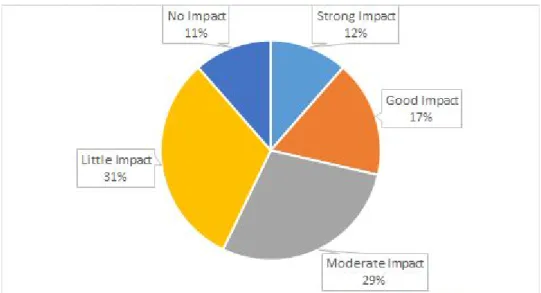
Figure 4:
This graph illustrates the perceived impact certifications have had on the careers of the
respondents.
The majority of respondents believe that certifications have had little to moderate impact on their career. However, the same amount of respondents found that certifications hold a strong impact as those who found that certifications hold no impact.
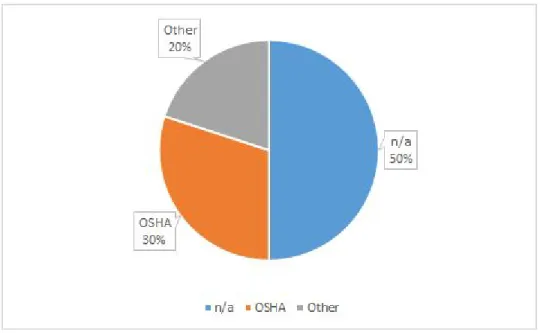
Figure 5:
This pie chart illustrates the proportions of companies that require certificates
Figure 5
: This figure illustrates the perceived value of ten out of the eighteen certifications
Because the names of some of the certifications were so long, they were cut off. The ones that were cut off were Certified Workforce Planning Professional (CWWP), Qualified SWPPP Practitioner (QSP), and Qualified SWPPP Developer. When observing this figure, the viewer is advised to take note of sections with light blues and or red. Light blue indicates that the certification holds good value, and the color red indicates that the certification holds exceptional value.
The results of this section of data collection display a high value placed on OSHA training. A strong majority believed that OSHA training holds a good or exceptional value. Another certification related to workplace safety that had considerable value is First Aid Training. Therefore, the first impression when viewing this figure is that the industry places a high value to certifications regarding workplace safety.
Two other certifications of notable value are the Qualified SWPPP Practitioner (QSP) and the Qualified SWPPP Developer (QSD). These certifications are designed to demonstrate one’s ability to create and implement a stormwater pollution prevention plan. This displays an emphasis the construction industry places on preventing jobsite pollution.
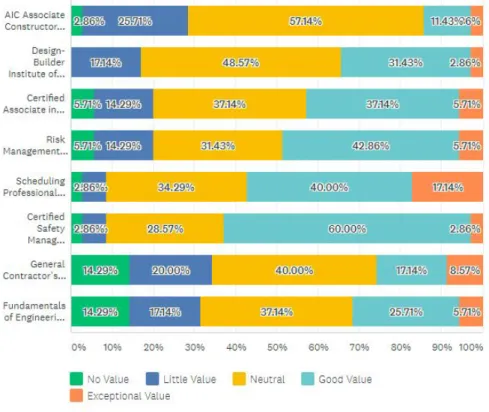
Figure 6
: This figure illustrates the perceived value of eight out of the eighteen certifications
Certified Safety Manager (NASP-CSM), General Contractor's License, and Fundamental of Engineering (NCEES-FE).
According to figure 6, the most valuable certification to have as a graduating senior entering the construction industry is the Certified Safety Manager certification. This relates back to the findings of figure 5 that the
construction industry places a high value on certifications regarding workplace safety. A certification that is found to have mostly neural to little value is the AIC Associate Constructor certification.
Conclusion
Many professional certifications exist, each demonstrating an individual’s level of expertise in a subject regarding construction. The typical belief is that the more certifications an individual has the more likely he will have a successful career. According to the results of the survey, however, most respondents believe certifications to have moderate or little impact on their careers. With that in mind, nine of the thirty companies required their employees to at least have OSHA training. This supports the data from the evaluation graphs. OSHA 10, OSHA 30, and First Aid training were valued highest by the respondents. This displays an emphasis placed on a culture of safety among the construction industry. The construction industry is the most dangerous industry, and worker safety poses a great financial and ethical risk among construction companies. The suggestion that any certification regarding jobsite safety would be the wisest investment for someone entering the construction industry.
The next wisest investment would be SWPPP training to earn the Qualified SWPPP Practitioner/Developer. These two certifications are regarded with good value according to the construction industry. The reason behind this is possibly a contractual need for many jobs to have a stormwater pollution prevention plan; therefore, anyone with these certifications becomes an immediate asset to a company.
It is important to not that most of the respondents of the survey worked for companies located on the west coast; therefore, there is a lack of data on the opinions from industry professionals on the east coast. Further research may be conducted comparing the views and opinions on certifications between industry professionals on the west coast versus those on the east coast.
Also, further research must be conducted into implementing more safety and SWPPP certifications into Cal Poly’s curriculum. If a feasibility analysis were to be establish a possible and realistic plan to do so, Cal Poly should seriously consider it. Forcing graduating seniors to have these certifications would improve the program and the careers of their students.
References
Bratton, B., & Hildebrand, M. (1980). Plain Talk about Professional Certification. Instructional Innovator, 25(9), 22-24.
Bruce, Richard D., Ph.D., LEED-AP, Gebken, Richard J., Ph.D., & Strong, Shawn D. Comparing Credentials in the
Building Design and Construction Community: CPC, LEED-AP, and DBIA. Springfield, MO: Missouri State
University. Print.
El Debs, Luciana C., Shaurette, Mark, & Benhart, Bradley. Professional Certifications in Construction Industry: A
Engineering Certification Task Force. (2006). Integrating Certification & Licensing for Engineering and Related
Specialists. Annapolis, MD: Council of Engineering and Scientific Specialty Boards.
Olsen, Darren A., JD, Taylor, J. Mark, PhD, JD, & Holk, Jenna. (2011). Do Professional Credentials Supported by
ASC Member Schools Focus on Those Most Likely to Enhance a Students’ Professional Development? Auburn,
Alabama: Auburn University. Print.