BIA EDUCATION RESEARCH BULLETIN, YEAR 1977
Vol. 5, No. 1, January 1977
Recommendations for the Improvement of Science and Mathematics 1 Educationfor American Indians
Rayna D. Green and Janet W. Brown
A Study of Native Elders and Student Needs 13
Arthur W. Blue
The Effect of Extended Wait-Time on Selected Verbal Response 22 Characteristics of Some Pueblo Indian Children
Wayne Allen Winterton Vol. 5, No. 2, May 1977
Bilingual/Bicultural Law-Related Curriculum at Ramah Navajo 24 High School
Tom Cummings
Beyond Indian Education – Multicultural Education 30
Dale Little Soldier and Leona M. Foerster
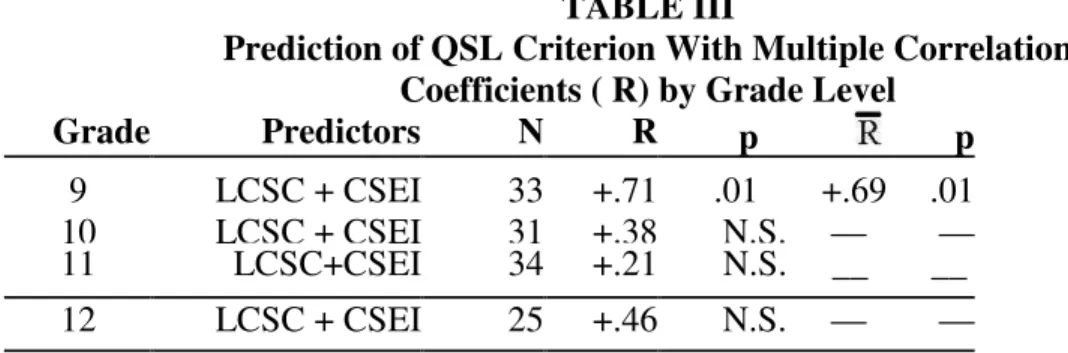
Self-Esteem and Locus of Control as Predictors of Indian Student 36 Attitude Toward School
James C. Martin
Factors Involved in Job Satisfaction Among Teachers in the Bureau 41 of Indian Affairs School System on the Navajo Reservation
Frederick D. Smith
Vol. 5, No. 3, September 1977
A Brief Introduction to the Bibliography of Language Arts Materials 52 for Native North Americans (1965-1974)
G. Edward Evans and Karin Abbey
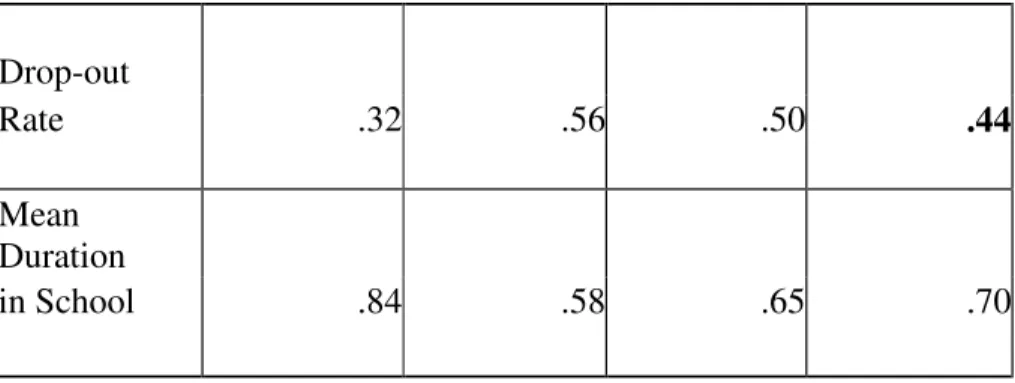
An Intervention Process Designed to Recognize and Prevent School 64 Dropouts in an American Indian Boarding School
T. Brent Price, Max L. Baty and Paul A. Nutting
Reading Levels for High School Graduates 71
RECOMMENDATIONS FOR THE IMPROVEMENT OF
S C I E N C E A N D M A T H E M A T I C S E D U C A T I O N F O R
A M E R I C A N I N D I A N S b y
Rayna D. Green and Janet W. Brown
INTRODUCTION TO THE PROBLEM
Of all minority groups in the United States, American Indians are the most poorly represented in the natural sciences, the health sciences and mathematics, yet native peoples are the most needful of any minority group of improvement in the status of their health, education, and social welfare. Indian health needs are generally well-known, as are the grim facts of Indian underachievement in education, but other needs beyond basic health care delivery and education exist in plenty. The necessity for more Indian professionals in all fields and for economic development throughout the native world tie the major areas of concern together. Most land-based Indians are in a serious struggle for the retention and development of the land they own, and in that struggle lies a potential for economic development which can change health care and education patterns for the better. Thus, native engineers, geologists, hydrologists, resource planners and managers, conservationists, foresters, agronomists, aquaculture specialists, chemists, geneticists, animal husbandry spe-cialists, botanists — all are needed for resource development, management, and planning on Indian lands. And Indian teachers and programs in these fields are needed to raise the general educational level of native people, as well as to provide training for meaningful career options for all Indians, rural, urban, land-based and not.
publication, An Inventory of Programs in Science for Minority Students, 1960-1975, describes these programs and places them in the perspective of nationwide efforts for minorities in these fields.3 There are programs in engineering, medical sciences, resource development, and career counseling. Some are university level degree courses; some are summer enrichment programs; some are adult training projects. A few are sponsored by the universities (often with federal or other outside financial assistance), others by industry, tribes, state governments and urban Indian councils.
These programs have begun to address the complex problems of changing the pattern of Indian under-representation in the sciences and technical fields. They account for most of the current students of science. Most of these programs, however, are in engineering and the biomedical sciences. At present there are no identified special pro-grams for American Indians in physics, chemistry, computer science, or the geological sciences, though a proposal for a physics program is under development at a major state university.
These programs are generally small in enrollments, and, in any case, not impacted on by the number of Indian professionals which also remains small. Among those who have identified themselves as holding a terminal degree in their field are less than one hundred in medicine, two hundred in engineering, five hundred in nursing, and perhaps fifty in the biological and physical sciences.4 The number in allied health fields is not yet determined, but is probably under two hundred.
The continuing nature of the problem is underscored by the low numbers of science teachers and professors who are themselves Indian 5 and by the low number of current science students who intend to teach at any level.
AAAS PROJECT ON NATIVE AMERICANS IN SCIENCE
Having been made aware of the general nature of these problems by its Committee on Opportunities in Science and in particular by its advisory panel of Native American scientists, the American Association for the Advancement of Science (AAAS) made the improvement of science education for Native Americans a priority effort.6 In addition, the governing bodies of the Association recognized the contribution of Native Americans to science, engineering and medicine and urged the serious scholarly study of those accomplishments.7
institutions; and to collect and share with others the existing information on science education for Indian students.
At the heart of these activities lies the report on The Barriers Obstructing the Entry of American Indian Students Into the Natural Sciences. The intensive field interviews required for that study, two meetings of native advisors at the AAAS in Washington in 1976, and many other consultations with individuals and organizations, have led to the formulation of the recommendations in this report. Some of them are necessarily a call for further, more detailed assessment and planning, but we believe that the needs and the general outline of the remedies are clear. So also, in some instances, are the responsibilities clear. The following recommendations will serve as the basis for continuing discussion across the country of the practical need to improve science and mathematics education for Indian students, a discussion stimulated this year by the initial inquiries we have made.
RECOMMENDATIONS
The following recommendations have been grouped and focused at three different levels of education. A fourth group, more general, more policy-oriented and more national in scope, is aimed at responsible governmental agencies and professional and other organizations. In the discussion of educational needs, we have addressed o u r s e l v e s b o t h t o s p e c i f i c t yp e s o f p r o gr a m s a s w e l l a s t o characteristics we believe generally useful. The recommendations are based both on what appears to work and on what appears to be worth trying. And much of what is recommended in addition is based on extrapolation from what students say works for them and from what program staff say has the most success. The various indications posited in the synopsis of findings in The Barriers ... report have given the clue to the kinds of programmatic suggestions and statements of need given below, thus, much of the supporting evidence for each statement is to be found in that report. Examples of types of programs, program components or outreach are given here as example and as a stimulus for discussion.
PRECOLLEGIATE PROGRAM NEEDS
reiterated the need for counseling, not only for students, but also for their teachers, counselors and families, on the utility of science and the employment opportunities in scientific and technical fields.
The school systems themselves have primary responsibility in the areas discussed, but they are entitled to advice and assistance from public and private funding agencies and appropriate professional organizations.
Recommendations
1) An assessment of science and mathematics education in schools serving Indian students. Such an assessment should catalogue and evaluate offerings and productivity in predominantly Indian schools. They would be evaluated against the needs of the communities for informed citizenry and professional personnel. The assessment should take place in the regional areas administered by the Bureau of Indian Affairs (BIA), in tribally and other Indian-controlled school systems, and in other rural and urban systems heavily impacted by native populations. The Navajo science education assessment now being organized is an example of the necessary initiative. The BIA, tribes, and school boards of these systems bear the responsibility in this area, but they clearly should have the encouragement and support of federal programs that support education and the cooperation and advice of the professional associations with experience and interest in science and mathematics education, e.g., American Association for the Ad-vancement of Science, National Council of Teachers of Mathematics, National Science Teachers Association, American Association of Physics Teachers, National Association of Biology Teachers, et al.
2) Integration of essential characteristics of successful approaches to Indian education in science and mathematics. Even while the assessments are going forward, schools can begin to adapt to their own varying circumstances the approaches that give greatest promise of success:
Elementary Science Study (ESS), etc. On the secondary level it can be realized in work-study situations.
B. Bilingual science and math instruction. Bilingual techniques must be used where language retention is maximal, particularly on the elementary levels. Bilingual science and math instruction depends on the production of curriculum and native lan-guage scientific and technical dictionaries, and will have to be produced through the cooperation of scholars and members of the community. The bilingual education must not, however, be just a matter of translation, but one which involved genuine respect for the Indian culture and which takes into account the learner characteristics of native students. Teacher-training institutions must give attention, in both pre-service and in-service training, to attitudinal as well as linguistic matters.
C. Concentrated attention to math deficiencies. Mathematics competence has been identified by everyone consulted as absolutely essential, and at present, constitutes a primary barrier to general and science-specific education. Two approaches will be helpful. First, the techniques developed to overcome "math anxiety"8 should be explored for their applicability with Indian students, both male and female. They could be undertaken as part of individualized instruction or tutoring, or made part of regular mathematics courses. Second, individualized mathematics instruction and/or tutoring should be tried in a number of different settings. They may be particularly useful for beginning courses in general mathematics, algebra and geometry, but can later be adapted to trigonometry, calculus, etc. They may be especially useful when combined with tutoring and particularly helpful when students act as tutors. Standardized programs or programs developed for a particular situation can be used with expectations for improvement.
perience was post-secondary. Opportunity should be taken also by secondary school science educators to provide meaningful practical exposure to the scientific and technical world of work.
F. Academic and career counseling. According to The Barriers ... study, most Indian college students, in or out of science, feel that they have been their own counselors. Better career information, associated especially with academic counseling and the course selection process, could only be a plus. These should be separated from personal and especially disciplinary counseling and preferably vested in an Indian counselor or other person with whom native students can readily relate. Career counseling could usefully be combined with work-study programs developed in the community and summer career health/science enrichment programs available to students through universities or efforts funded by businesses and foundations.
G. Identification-recruitment programs. Secondary schools should accent responsibility for locating and placing Indian students in post-secondary programs in cooperation with state universities and community colleges and special science and technical programs in those institutions; tribal career development staff; Indian professional associations; parent-school committees; federal and Indian-controlled institutions; federal programs and agencies (Upward Bound, the Armed Services, Vista, etc.); and teaching, counseling and extracurricular personnel in the schools.
NEEDS AT THE COLLEGIATE LEVEL: PROFESSIONAL AND PREPROFESSIONAL TRAINING
Two valid generalizations from AAAS findings have special significance for college level programs to recruit Native Americans to scientific and technical fields (see the Inventory. . . and The Barriers. .. ). First, it is absolutely clear, if ever there were a doubt, that special programs, funded and organized to attract and support Indians into non-traditional fields, do work and are responsible for a large proportion of Indian enrollments in health and engineering. Second, for the science students interviewed in The Barriers . . . study, on-the-job experience — in the army, in hospitals, etc. - seemed to be the single most important career determinant. Efforts to increase the number of Indians entering non-traditional fields should capitalize on this knowledge.
The recommendations in this section are aimed toward the federal agencies that have, or could, support special programs and toward the higher education institutions that have large concentrations of Indian students and who must take on continuing responsibility for institutionalizing and supporting special programs. Among those, the ones that are predominantly Indian in their enrollment have special needs and mission. The recommendations should be heeded also by appropriate professional associations. Recommendations
students to non-traditional careers even in the absence of any role models or previous acquaintance with the profession, providing the programs are well designed, staffed and funded. They must not be allowed to die as so many special programs for minorities have, just when they are beginning to achieve their promise (see the Inventory . . . ). This means that (1) federal agencies, private foundations and corporations must maintain an adequate level of support and (2) the higher education institutions must themselves assume responsibility for continuing the experience their staffs have acquired.
2) Special programs must be established in fields where they do not now exist — in the physical sciences, in mathematics, in resources development. The operative programs are almost all in the health sciences and engineering, where they have been Stimulated and supported by the National Institutes of Health (NIH), and by selected private foundations and corporations. Other federal agencies that have responsibility in these areas (National Science Foundation (NSF), Energy Research and Development Administration (ERDA), U.S. Department of Agriculture (USDA), Environmental Protection Agency (EPA), et al.) must increase their roles in their fields. Private foundations and corporations in related industries must do their part. Professional associations must be advocates, advisors and assistants.
Into these programs must be integrated the kinds of techniques, discussed on the pre-collegiate level above, that show the greatest promise, most importantly meaningful work-study arrangement, culturally sensitive instruction and materials, mathematics anxiety therapy, and hands-on and individualized instruction. Cooperative, intern, and teaching assistant components should be structured into programs wherever possible, and they should attempt to develop affiliation on a regular basis with business, industry, government, state, local agency projects in the field to achieve maximum student identification with career options and work in the "real world." Like most successful biomedical sciences programs, mathematics and physical sciences programs should take a team-based approach along with an applied focus. In the physical sciences programs, mathematics instruction should be adapted for use in the specific field and applied to real rather than abstract problems ordinarily encountered in the field wherever possible. Physical sciences programs as well should be directed toward problem-solving, with heavy emphasis on contemporary Indian educational and resource and economic development needs. In natural resources and conservation fields, the most needed and least represented in program development, new programs should be based on Indian needs and problem-solving in applied situations.
of graduates and in-service trainees who can tackle science and math inadequacies of Indian students at the pre-collegiate level. Teacher and counselor training programs involved in preparation and in-service training programs of personnel for Indian communities must increase their emphasis on the utility and importance of math and science, and must develop knowledge and cultural sensitivity in trainees that will make them effective helpers in Native American communities. Training should take the form of a special area of focus in the general education degree or be a special program especially for minority/Indian students. Programs should be directed also to the "science literacy" of the community as well as toward general teacher education. Higher education institutions must be joined in this task by relevant professional associations (Natural Science Teachers Association (NSTA), American Personnel and Guidance Association (APGA), etc.).
5) The role of the predominantly Indian institutions in all of these endeavors must be sharpened and enlarged. This group includes three federal institutions, one religious-based school, and thirty-four tribal or local institutions. Most are new, are community or other two year colleges. Only a few offer anything in the way of science or demonstrate any special awareness of needs in the science and mathematics area. Others recognize the needs, but because of budgetary and personnel constraints are unable to implement a program. The Indian education associations and the scientific professional societies should play a role here in advocating the development of relevant math and science programs and in facilitating the meeting and planning necessary to enhancing their role and effectiveness.
NEEDS AT THE GRADUATE AND PROFESSIONAL LEVEL
Minority scientists and educators know from experience and from other explorations of the problem l 0 that the minority science students, including Indians, who enroll in graduate programs are, by definition, a specially self-selected motivated and able lot. In short, to have overcome so many barriers and to have gotten that far, they necessarily possess all of the usual attributes of academic success plus some others. At this level they may well need, however, four kinds of help: (1) financial support that comes from minimum economic guarantees, (2) psychological support from a sufficient number of fellow Indian students, and staff or community contacts to offset the train other Indians, or financial incentives in fellowship receipt or loan repayment should be tied to a period of service in or for an Indian community.
information must impinge on curriculum development and course content, the professional associations are the group to take responsibility.
5) Post-baccalaureate programs for Indian students should be developed by graduate institutions. These should be aimed at removing the deficiencies of an inadequate or other-field directed baccalaureate degree and preparing the student for graduate or professional training in science and other technical fields.
NEEDS TO BE ADDRESSED OUTSIDE THE EDUCATIONAL INSTITUTIONS
There are a number of needs — for information, coordination and cooperation — that are best addressed by organizations of Indian educators and scientists working with pertinent science and 'educational professional associations. There are, as well, major policy issues related to the increased participation of Indians in scientific, technical and biomedical fields where cooperative and advocacy roles with state and federal agencies must be undertaken by these various organizations.
Recommendations
1) A clearinghouse for information on math and science needs and programs in the Indian communities should be established and maintained. The exchange of information and contacts thereby established will constitute a network that can help to develop ties among Indian scientists and others sharing concern for the science education of native peoples, and to encourage the participation of Indian professionals in the participation of national scientific societies. AAAS has proposed in its current three-year plan, that its Project on Native Americans in Science serve this clearinghouse function, as well as feelings of isolation experienced by "the special few", (3) non-patronizing remedial assistance if it is necessary and asked for; and sometimes, (4) special additional course content that makes the professional or graduate training pertinent to community needs. Recommendations
as at the undergraduate level, but not all institutions can or need to develop them. The Minority Centers envisioned in the National Science Foundation Fiscal Year 77 Authorization Act are a good place to begin. In considering both guidelines for the program and subsequent grant applications, the needs of Indians must be made explicit. All too often those needs have been lost in "minority" programs (see the Inventory ... ).
3) Adequate financial aid must be available to graduate students. Existing federal educational aid programs (BIA) and other private ones underscore the great need of support of undergraduate students. If however, we seek to train significant members of Native American graduates in specialized fields, adequate financial support at the graduate level could be a major incentive. Indian communities and organizations must help funding agencies to identify areas and kinds of needs. Professional associations and graduate departments are perhaps best able to counsel on the fitness of existing programs for Native American needs. All fellowship programs must be reviewed for provisions which would inhibit Indians returning to school after employment, marriage and children, military service, etc. for these are the characteristics of many Indians currently in these programs (see The Barriers ... ). In funded programs which seek to impact on the long-range needs of Indian peoples, funding priority should be given to those students preparing to work in Indian institutions or to convening, advisory and advocacy functions which would further action on the recommendations below.
2) A consortium of persons in professional associations, federal agencies and programs that have interests and activities bearing on Indian science education and manpower development should be established. Through their sharing of information and contacts, they could achieve program cooperation and coordination which would enhance their collection effort. Examples of potential participants include persons from American Association for the Advancement of Science, National Academy Committee on Minorities in Engineering, National Science Foundation, National Institutes of Health, American Chemical Society, and American Association of Junior and Community Colleges.
3) A funding guidelines review should be undertaken by private foundations and federal funding agencies to determine priorities and needs for native science education and manpower development and to examine the applicability of present guidelines to Native American programs and needs. Funding organization and agencies such as the Fund for the Improvement of Post-Secondary Education, National Institutes of Health, National Science Foundation, Energy Research and Development Administration, as well as private foundations with minority programs should be involved in such a review.
Indian Engineers, Council of Indian Architects and Engineers.
5) Non-institutionally based programs or satellite programs, should be established to reach populations not ordinarily served by educational institutions. For instance, rural adult science education and literacy programs might be developed by the Department of Agriculture Extension Programs.
The Project on Native Americans in Science of the American Association for the Advancement of Science wants to identify Indian and non-Indian teachers who have taught science and/or math to Indian students, and who would be willing to share their experiences and ideas with us. In addition, we want to identify Indians with degrees (BS or BA and above) in scientific and mathematical fields (including agriculture, computer science, etc.) for the purposes of establishing a human resource book of Indian people in crucially needed fields. Please write Dr. Rayne D. Green, Director, Project on Native Americans in Science, 1776 Massachusetts Ave. N.W., Washington, D.C. 20036.
NOTES
1
See the exploratory study The Barriers Obstructing the Entry of American Indian Students Into the Natural Sciences (hereafter referred to as The Barriers ...) by Rayna Green, American Association for the Advancement of Science (AAAS), 1976. Recent data (1976) from the Bureau of Indian Affairs suggest that the enrollment is shifting away from education to other fields, but no major trend can yet be observed.
2
Data on Native American students collected for The Barriers.. . study at the Universities of New Mexico, Oklahoma, California (Berkeley), Washington, Southeastern Oklahoma State University, Northeastern Oklahoma A & M (Miami), Bacone College (Muskogee, Oklahoma), and Dartmouth College.
3
Shirley Mahaley Malcom, John Cownie, Janet Welsh Brown, An Inventory of Programs in Science for Minority Students, 1960-1975, (hereafter referred to as the Inventory . . .) AAAS Publication 76-R-10, 1976. The programs designed especially for Native American students and other, which may include Indians, have been excerpted and are available separately from the AAAS Project on Native Americans in Science under the title An Inventory of Projects and Programs in Science for American Indians.
4
Membership lists and identification programs of various Indian professional organization. A list of the organizations is available from the AAAS Project on Native Americans in Science.
5
7
A Resolution on Native American Contributions to Science, Medicine and Engineering, AAAS Council and Board, January 1975; Janet Welsh Brown, "Native American Contributions to Science, Engineering and Medicine," Science, v. 189 (4 July 1975): 38-40.
8
See Sheila Tobias, "Math Anxiety: What Is It and What Can Be Done About It?" MS Magazine (September 1976).
9
Carl lime, Culture Related Instructional Materials: Ethnoscience, A Brief History and Progress Report (1972); Concepts, Observations on Ethnoscience and Cultural Studies (1974), MSS, Many Farms High School, Arizona.
10
A STUDY OF NATIVE ELDERS AND STUDENT NEEDS
by Arthur W. Blue
The Senate Sub-Committee on Counseling (S.S.—C.C.) for Brandon University has petitioned to add a native Elder to the Counseling Staff in October, 1976. The S.S.—C.C. referred the problem of definition and need to a special sub-committee. This report is a practical answer to the S.S.—C.C.
The problem will be dealt with in three parts: 1) What counseling services are available to the native student on the campus of Brandon University, 2) What are the needs or problems of native students, and 3) Who would the native students prefer to seek assistance from for the problems.
The definition of an "Elder" as dealt with in this report is: an older person of native ancestry, who has a traditional point of view and is considered by the people of his group as wise. Such people have traditionally been the counselors in native communities where they service the youth as well as the adult. However, with the influx of education, industry and technology the native Elder has not been utilized by these institutions. It has generally been thought that the complexities of these institutions lies outside of the realm of experiences of the native Elder and a counselor associated with the institutions would more appropriately serve the needs of the native student.
Brandon University has developed a number of programs to meet the educational needs of native people for the Province of Manitoba. The I.M.P.A.C.T.E. program to train native people to become teachers was the first and has been followed by several other programs, C.O.R.E., P.E.N.T., B.U.N.T.E.P., Special Mature and the increase in general admission has brought a significant number of native students to the campus for part or all of their program.
These programs function with a number of special considerations generally including counseling and advising of the native students. Often the counseling offered by these special programs or projects is done by the personnel who have other duties such as the Director.
Brandon University has a Counseling Centre consisting of a full-time counselor and a part-time clinical psychologist, both fully qualified academically. Their services are available to the student body and, of course, include the native students.
The counseling services available to the native student at Brandon University range from the formal services of the Counseling Centre to the part-time services of program and project directors and personnel to the general counseling function of the university professor.
METHOD
This study will explore the counseling function of the Counseling Centre and the projects. The method adopted for this exploration was the interview. Members of a research class in Native Studies undertook to interview the counselors involved. These interviews were completed in October and November, 1976.
A questionnaire was used to obtain the views of the native students. This questionnaire was directed toward 1) the identification of the types of student problems as perceived by the students and 2) the person whom the student would prefer to assist him in its solution.
COUNSELING SERVICES AT BRANDON UNIVERSITY
Project Directors and staff who are engaged in counseling with native students all have advanced degrees; however, these degrees are in areas other than counseling.
Their counseling activities are generally supportive, often in the area of academic advising; however, all state they do some counseling of personal problems. Two project directors indicated that they spend most of their counseling time dealing with financial and marital problems. All agree that a native Elder would be valuable to deal with special problem areas. These areas as seen by the project counselors include: Cultural Traditions, Emotional, Spiritual, and "those they can not reach."
The Counseling Centre employs one full-time counselor who has a degree in religion and a half-time clinical psychologist. Their counseling load is heavy and problems range from academic advice to emotional disturbance. Both feel that the addition of a native Elder would be an alternative to the traditional university counseling
service.
NATIVE STUDENT QUESTIONNAIRE:
Demographic Data. The first portion of the questionnaire dealt with demographic data. Included in this portion of the questionnaire were such things as (1) age, (2) sex, (3) program, (4) home residence, i.e., Reserve, and (5) tribal affiliation.
The problems chosen represent, with some modification, the problems dealt with by the Mooney Problem Check List (Gordon and Mooney, 1950) and the FSI scale (Scott and Blue, 1973). The 18 problem areas chosen range from physical and mental health to financial problems and problems related to environmental change.
The purpose of this section was that of identifying the type of problems native students have. This is very important if we are to explore the use of native Elders in the counseling process.
Sampling Procedure. Brandon University has approximately 400 native students enrolled in 1976-1977 school year. Of this 400, about 300 are available to the main campus at Brandon.
For the purpose of this study it was decided that approximately 100 native students would be randomly chosen and administered the Student Questionnaire.
Coding Procedures. Once all the questionnaires had been administered and/or returned, the data was coded onto IBM cards for subsequent data analysis. All analyses were performed at the Computer Centre at Brandon University.
RESULTS
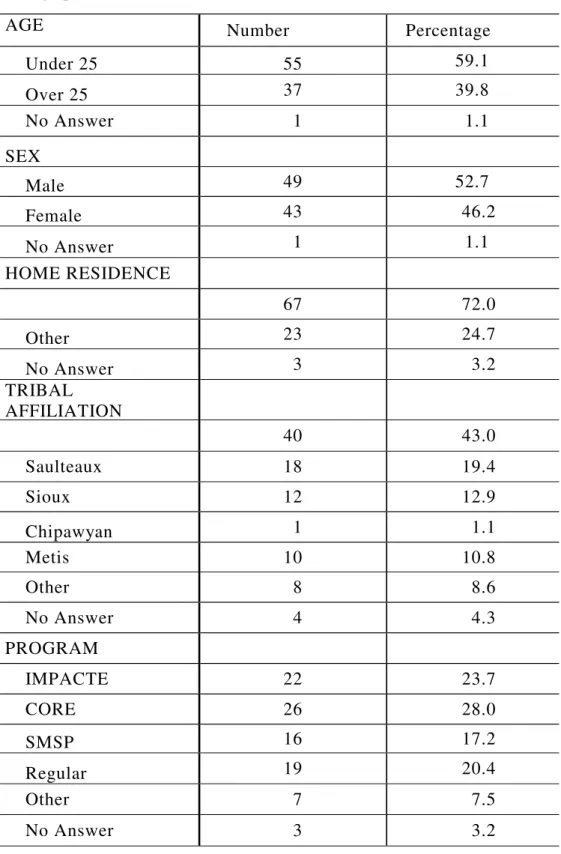
TABLE 1 Demographic Data
AGE Number Percentage
Under 25 55 59.1
Over 25 37 39.8
No Answer 1 1.1
SEX
Male 49 52.7
Female 43 46.2
No Answer 1 1.1
HOME RESIDENCE
67 72.0
Other 23 24.7
No Answer 3 3.2
TRIBAL AFFILIATION
40 43.0
Saulteaux 18 19.4
Sioux 12 12.9
Chipawyan 1 1.1
Metis 10 10.8
Other 8 8.6
No Answer 4 4.3
PROGRAM
IMPACTE 22 23.7
CORE 26 28.0
SMSP 16 17.2
Regular 19 20.4
Other 7 7.5
DEMOGRAPHIC DATA
The survey data indicates that the native population of students at Brandon University is 59.1%, 25 years old or younger, 52.7% are male and 72% have home residences on reserves.
Tribal affiliation is predominantly Cree (43%) followed by Saulteaux (19.4%), Sioux (12.9%), and Metis (10.8%). The programs represented are those which have students on campus at the time of the survey, (October and November, 1976), thus B.U.N.T.E.P. and P.E.N.T. are not represented. The programs are very evenly represented, i.e., between 17.2% for Special Mature and 28% for C.O.R.E.
STUDENT NEEDS AND PROBLEMS
TABLE 3
Problem Areas in which students would seek the Elder's help first and as second choice. ______________________________________________________________________
1st Choice
______________________________________________________________________ Home & Family
Cultural Religion Mental Health Alcohol Drugs
______________________________________________________________________ 2nd Choice
______________________________________________________________________ Social-Recreational
Dating and Sex
These problems seem to form a cultural-traditional group or deal with problems which have a cultural treatment component.
The area of Family shows no problem where the family is the first choice of assistance; however, there are several areas where the Family is second choice.
TABLE 4
Problem Areas in which native students would consult the Family as first and second choice. __________________________________________________________________________
Family
__________________________________________________________________________ 1st Choice
__________________________________________________________________________ None
__________________________________________________________________________ 2nd Choice
__________________________________________________________________________ Financial
Home and Family Environment Change
TABLE 5
Problem Areas in which native students would consult the University Counselor (1) as first and second choice.
________________________________________________________________________ University Counselor
________________________________________________________________________ 1st Choice
Financial Social-Recreational Study Skills Getting along with others
Housing School Authorities Plans for Future Environment Change
_______________________________________________________________________ 2nd Choice
________________________________________________________________________ Dating—Sex
Legal Authorities Drugs
________________________________________________________________________ (1) Counselor here includes the Counseling Centre and project counselors.
The Problem Areas where students would consult with others involved three areas — Physical Problems where the student would seek the advice of a physician, Legal Authorities where a lawyer is the most frequent choice, and Dating-Sex where the student indicates he would seek the assistance of his spouse.
The last section of the questionnaire asks for a definition of an Elder. Most students, i.e., 90%, classified an Elder as 1) an older person, 2) native, and 3) gifted with wisdom. There were few discrepancies and they seem to refer to a religious position.
A question asked the student to rate the effectiveness of the university Counseling Centre on a 5-point likert type scale, ranging from 1—Very poor to 5—Very good. The mean rating was 3.15 with a plus or minus of 0.63 indicating satisfaction with the service.
DISCUSSION
The interviews with personnel of the university, both projects, professors and Counseling Centre, indicated that there existed an area of problems for which they were unable to "reach" native students. One counselor described the area as emotional and spiritual, while others simply indicated difficulty in the counseling process. Considering the general rating of the Counseling Centre as above average, it seems apparent that the difference between the students' response and that of the counselors must be in the expecta-tions. Perhaps the counselors do well in those areas that students seek their assistance but that the counselor expects to perform in other areas which are reserved for more culturally traditional roles, i.e.. the Elder.
The results seem to indicate that for the native student there are two large areas of problems which seem to fall into the categories of 1) guidance and counseling and 2) cultural and emotional. The first area seems to be that area which the student seeks the assistance of the counseling services and the second area has been traditionally dealt with by the native Elder.
SUMMARY
The study presented here attempts to define and clarify the area of the native Elder in the university life of native students. The first part of the study looked at the counseling services offered by the university for the native student. It was found that three sources of counseling exist: 1) the general university professor, 2) the project personnel, and 3) the university Counseling Centre. In general, these people indicated a dissatisfaction with the counseling process with native students. However, in the Student Questionnaire the native students indicated above average satisfaction with the university Counseling Centre.
The problem areas reflect a structure which suggests that students seek assistance for guidance and urban related problems from university personnel and to the native Elder for cultural and traditional problems. The results clearly indicate a need to meet the problems in this area.
REFERENCES
Gordon, L.S. and Mooney, R.L. The Mooney Problem Check Lists. New York: The Psychology Corporation, 1950.
THE EFFECT OF EXTENDED WAIT-TIME ON SELECTED VERBAL RESPONSE CHARACTERISTICS OF
SOME PUEBLO INDIAN CHILDREN by
Wayne Allen Winterton, Ph.D. Department of Curriculum & Instruction
The University of New Mexico, 1976
This study investigated the effect of extended wait-time upon selected verbal response characteristics of Pueblo Indian children. The research sample consisted of students representative of the New Mexico Indian Pueblos of Acoma, Laguna, Santa Clara, and Taos.
Wait-time is defined as the length of time a teacher is prepared to (1) wait for a response after asking a question (Type I) and (2) wait for additional responses after receiving an initial response (Type II).
It was hypothesized that under conditions of extended wait-time: (1) the lengths of responses would increase, (2) the number of unsolicited but appropriate responses would increase, (3) the lack of responses would decrease, (4) the number of student-student compar-isons of data would increase, (5) the number of student initiated questions would increase, and (6) the number of verbal contributions from low-verbal students would increase.
Sixty-four students were selected and randomly assigned to sixteen groups of four. A lesson adapted from the Science Curriculum Improvement Study (SCIS) Unit — the Whirly-Bird System — was prepared and presented to the subjects. Eight of the groups received the lesson under typical (short) wait-time schedules and eight of the groups received the lesson under extended wait-time schedules. The presentation of the lessons was tape recorded and analyzed for wait-time and the six hypotheses were tested.
FINDINGS
Significant increases were found in the length of student responses and in the incidence of student-student comparison of data under extended wait-time. Positive gains were also recorded in the areas of increased verbal participation from low-verbal students and toward fewer student failures to respond under the longer wait-time schedule.
In addition, there was a tendency for students to contribute unsolicited but appropriate responses and to initiate questions under extended wait-time conditions.
CONCLUSIONS
IMPLICATIONS AND RECOMMENDATIONS
The findings from this study indicate both significant and positive relationships existing between some verbal response patterns of Pueblo Indian children and the extension of wait-time. The acquisition and refinement of English language skills requires the use of the language which takes place in greater quantity under conditions of extended wait-time. This has considerable significance for Indian education.
BILINGUAL/BICULTURAL LAW RELATED CURRICULUM AT
RAMAHNA VAJO HIGH SCHOOL by
Tom Cummings
INTRODUCTION
For 5 years, Ramah Navajo High School has researched, produced and taught a bilingual/bicultural law-related curriculum that emphasizes the pluralistic legal environment in which Navajo students exist. These students are members of the Navajo Nation as well as American citizens. They are affected by their own Navajo law ways, and by local, state and federal laws.
The Ramah Navajo community has tried to relate its own ideas about behavior and ways of problem solving to those of the dominant Anglo society. Navajo judicial officials and Anglo attorneys have attempted to codify Navajo law-ways.
Navajo students realize that both Navajo and Anglo law ways are relevant and worthy of regard. Navajo high school students are very different from Navajo adults reared in a traditional environment. As these students gain increasing understanding of both Navajo and Anglo concepts of law (especially dispute resolution) they can understand both, with increasing respect for the Navajo way. They will ask, "What works best for my People?" They will work to change institutions and alien ways of dispute-resolution that do not work for the Navajo people.
The Ramah Navajo High School bilingual/bicultural law-related curriculum is an introduction to the law ways, customary as well as formal, that are important as the Navajo people meet the problems of contemporary everyday life. Units on Consumer problems deal both with legal definitions of the rights and duties in a contractual relationship, and also with Navajo ideas about rights and duties in agreements of exchanges of livestock, goods, land, etc.
Units on Marriage explore the Navajo concepts of the rights and responsibilities of the husband and wife and compare these to the definitions imposed by state and tribal codes written by non-Navajo attorneys. Informal Navajo ways of dispute resolution are compared to Anglo methods of dispute resolution. The students participate in "moot courts" that pay equal attention to customary and to formal methods.
I. CONTENT AREAS
A. Consumer Education
families: 1. Goals:
a. To give the students a firm understanding of the Navajo people's traditional views of property, and to compare these to Anglo views, so that the students may act as sophisticated consumers in their own behalf and so that they may work with their parents for the future economic development of their Navajo communities.
b. To give the students a firm grasp of bargaining, contracting, and informal dispute resolution techniques so that they can use these in dealing with traders and car dealers without the aid of lawyers.
c. To show how the state and tribal courts can be used to get consumer protection in individual disputes.
d. To show how to use political strategies and community organization techniques to change legal and economic relationships with traders and car dealers in order to secure consumer protection for the Navajo people.
2. Problem situations
a. Navajo versus traders in various situations involving this monopolistic institution in the rural areas of Navajo land.
b. Navajo versus car dealers and town merchants. Within each relationship, there are specific elements that have their basis in both Anglo and traditional concepts of property. Chief among these are:
— Making of the contract — the bargaining experience.
— Money management — getting credit, understanding secured property, paying interest for credit.
— Dealing with disputes over fraud, shoddy goods, and other contract areas. — Warrantees, guarantees.
— Insurance. 3. Teaching strategies
Classes deal with specific disputes and encounters. Students are encouraged to identify with these situations by techniques such as role playing:
a. The class divides into small groups. Each group selects someone to go to a "trader" to pawn a necklace. Attempts by the "trader" to cheat the "consumer" are noted by the students. The "trader" speaks pidgin Navajo. A "car dealer" attempts to sell a "lemon," or have a student sign a blank contract. The students decide whether the "consumer" asks the correct questions or is misled. The stu-
are presented in tribal and state courts and how they are resolved. Commentaries and discussion questions guide the students and teachers. These cases provide materials for role playing situations.
c. Class participation in real community events is a third teaching strategy in consumer education:
1) Development of consumer cooperatives.
2) Use of a local credit union by class members. These projects involve participation with Navajo people from other parts of the reservation who have worked on cooperatives, as well as expert help from local banks, CUNA representatives, and DNA (Navajo legal aid). As students evaluate their own roles and those of the dispute resolvers, discussion follows:
a) What is law and what is a legal system? — Traditional Navajo law-ways and customs — Tribal sovereignty and jurisdiction
— State and Federal governments and the authority of their laws for Navajo people per the treaty of 1868
b) Types of law — Custom and culture: traditional law — Case law: the Anglo law codes — Statutory: how laws are made — Civil and criminal law
c) How problems are solved in courts and in traditional ways — Traditional ways of resolving disputes
— The roles of the informal dispute resolvers (clan leader, headman, or legal leader)
— The Court systems
— Federal, State, Tribal — The roles of judge and jury
— The roles of the lawyer and the lay advocate B. Law and the Family
The focus is upon property (both real and personal) and how it is used and transmitted within the Navajo family. The rights and responsibilities of the husband, wife and children in the clan and the extended matrilineal family are the focal points of Navajo law. They continue to be important as they conflict or agree with the Anglo law's definitions of family rights and duties. The Navajo student must understand how the law of Navajo society, of the state, and of the nation define how he is expected to relate to his family and clan in the Ramah Navajo community. Subtopics are:
1. Marriage, property disputes, sheep grazing permits: land use
2. Children: their rights and duties
3. Death in the family: inheritance and the law
traditional ideas of family rights and responsibilities are very confusing to young Navajos. The destruction of parental authority by boarding schools has created a gap that locally-controlled schools are only beginning to fill as parents reassume disciplinary responsibility for their youngsters. Parent-teachers play an important role in the classrooms as they are the experts who explain traditional Navajo laws in these areas.
C. Law and the Community
In the past, the Navajo people had special rules for dealing with the events that lead to injuries by or of other Navajos who were not their relatives. These rules of compensation (Naalyeeh) are like the private remedies in tort and criminal procedure as implemented through the tribal courts of today. The curriculum deals with the problems of obtaining justice in the tribal courts in cases where personal injury or property damage have occurred.
1. Topics
a. Getting relief: In the past, the court system on the Navajo reservation emphasized public sanctions and not ways that the courts could secure private damages for people with problems. Only recently has representation in tribal court for private actions become available. Confusion about how the court can be used and especially when the court will help individuals and when it will act on behalf of the tribe to punish wrongdoers is still widespread among both adults and young people.
With a focus on property damage and personal injuries, the curriculum explains how legal institutions relate to both Navajo and Anglo methods of problem solving outside of the family. The curriculum prepares students to help their parents and themselves get the help they need from the courts.
b. The rights of defendants: The second objective is to explain what students should do if arrested or served with a civil process in the tribal or state courts.
c. The rights of students: The third objective is to consider the rights and responsibilities of students. This allows students to act out situations that are of immediate concern to them.
2. Teaching strategies: The most difficult concepts of Anglo legal tradition (negligence, criminal intent, right against self-incrimination) have been incorporated into the tribal court system, but because these concepts are not interpreted through traditional means of righting injuries, the student and his parents have difficulty securing justice in the tribal courts. The roles of participants in the judicial process and the meanings of the terms used in cases are explored through both role-playing and the casebook approach.
II. CURRICULUM DEVELOPMENT
Other tribal groups wanting to create a comparative law-related curriculum should consider the following.
A. Preparatory
The initial work of the legal staff is to collect field data for the curriculum. 1. The local legal specialist working with the consulting attorney:
a. Brings together existing materials on traditional ways of dispute resolution.
b. Develops tools to accurately determine definitions and norms held relevant by the local people.
c. Interviews community leaders and legal service personnel with experience in the local area to compile specific cases of disputes that illustrate both conflicts and conformity of traditional local lay ways and Anglo law.
d. Reviews tribal court records to compile actual cases for inclusion in the curriculum. 2. Participating in the preliminary stage are: a consulting attorney, a local legal specialist, and the curriculum development specialist who helps to tailor the field study data to the immediate needs of the classroom.
3. The compilation of field research data and information from those active in dispute-resolution will lead to a second stage: materials gathered on local law ways are combined with basic materials gathered from Anglo common law. This includes presentations on how laws guide the many day-to-day events that occur when a dispute is placed into the local or Anglo dispute resolution process.
B. Specific Materials
1. Four-volume text that utilized the case method, setting forth disputes and commenting on how the parties to the disputes define the problems and resolve them. This text is supplemented by a series of videotapes, both in Navajo and in English, that deal with specific topics.
2. Materials produced by DNA (Navajo Legal Aid) and other outside sources.
3. Materials compiled from books, magazines, newspapers, etc. Relevant to the bilingual/bicultural law-related curriculum.
4. Role-playing, including participation in "moot court," presentations in both Anglo and traditional contexts. Preparation for this stage of learning takes place after the class fias had an opportunity to attend trials and customary dispute resolution procedures and after discussion of courtroom set-up, procedures, evidence, and the like.
5. The local legal specialist and the local language specialist develop a bilingual legal dictionary to be used as a teaching supplement.
C. Use of Outside Resources
1. Published and unpublished anthropological resources are used in the comparative legal approach.
2. Tribal judges, prosecutors, and other legal officers familiar with local disputes are interviewed during the field work. They are asked to make video tapes of discussions of their jobs and the workings of their institutions.
D. Evaluation
Comprehension of legal ideas will be evaluated by discussions with groups of students and local advocates. In these discussions the students will be asked to evaluate classroom procedures. Their comprehension of Anglo-American legal concepts expressed in the local language are reviewed by local advocates. Their progress in understanding how to cope with disputes in each subject area is reviewed through discussion of how cases might be resolved.
E. Staff Development
Staff development involves three distinct phases:
1. Training of the legal specialist in field study techniques to develop materials for use in the classroom.
2. Training of local advocates to give appropriate presentations in the classroom.
BEYOND INDIAN EDUCATION — MULTICULTURAL E D U C A T I O N
by
Dale Little Soldier and Leona M. Foerster
Indian education has arrived at long last. What we identify today as "Indian education" had its birth in the first major thrust of the federal government to provide supplementary funds for the education of Native American pupils. Known as the Johnson-O'Malley Act of 1934, this act enabled the Bureau of Indian Affairs to contract with states and local school districts for the improvement of Indian education. The rationale behind the Johnson-O'Malley (JOM) Act was that schools with large Indian enrollments from tax-exempt land areas of the districts are penalized in the financial ability to develop a d e q u a t e p r o gr a m s f o r a l l c h i l d r e n i n t h e d i s t r i c t w i t h o u t supplemental aid from JOM in addition to the state minimum guaranteed program. JOM funds were and still are used for general support purposes, transportation, school lunch programs, and special services to Indian children.
In 1952, Public Laws 874 and 815 were enacted to provide additional assistance to districts whose tax resources were limited due to the presence of non-taxable federal properties or operations on or near the districts. Yearly, local districts have been granted money from these three funding sources, JOM and the 1952 laws. However, accountability has been weak and it is not clear as to the amount of these funds actually used by local districts for special programs for Indian pupils. These funds may be paid into the general operating accounts of districts and utilized to support general education programs.
Title I of the Elementary and Secondary Act of 1965 provided federal funds for local school districts reporting a high concentration of low-income families in residence. These funds were earmarked for special programs for all classes of "disadvantaged pupils" in attendance, including disadvantaged Indian pupils. In 1970, 70% of all Indian pupils residing in public school districts were reported to be "disadvantaged," as determined by the provisions of Title I. However, according to the National Advisory Council on Indian Education, 1 in 1970 only one-fourth of the eligible Indian pupils were enrolled in special Title I programs. Moreover, the average expenditure per pupil for such programs was too low in most cases to make appreciable differences in pupil achievement feasible.
the first appointee. Finally, a National Advisory Council on Indian Education was created to advise the President on all matters relating to the education of Indians.
The target population of the Act included the approximately 270,000 Indian students of school age. About 70% of these pupils reside in the following eight states3 : Alaska, Arizona, California, Montana, New Mexico, North Carolina, Oklahoma, and Washington. Thus funding has been concentrated to a large degree in those states. In 1973, approximately half of the grants were under $10,000 and three-fourths under $20,000. Nevertheless, Title IV has had and is continuing to make a strong impact on Indian education.
Perhaps a brief summary of some of the salient problems in Indian education is in order. Most noteworthy seems to be the continuing high dropout rate of Indian students. The problem is well-documented in the literature and offers silent testimony to the fact that American education has largely failed its native population. Related to the high dropout rate are the problems of poor attendance, low achievement of Indian pupils, especially damaging in the language and math skills areas, and low motivation.
Lack of communication between home and school is another problem. It should be noted that communication is possible only if some mutual understandings exist. Thus the communication problem is not just a matter of contact and frequency, but of substance as well. Often there is a gap between the Indian and non-Indian communities which the school serves. This gap, in part, may be the product of distance, but additionally, is the result of lack of understanding, interest, and perhaps even prejudice.
Other problems include lack of curriculum relevance, inability of teachers to relate to Indian pupils and help build self-esteem and pride in these children, and the need for expanded guidance and counseling services. The number of Indian teachers and aides is on the increase but remains insufficient to meet the demands. Additionally, there appears to be a need for coordinating the efforts of school and community to improve health and social welfare services to Indian families in need.
In analyzing and assessing various Indian education programs, it appears that the curricula of many current programs include at least these three strands: (1) development of a positive self concept; (2) building a prideful identity and (3) skills development. Perhaps this is an overly simplistic model to use, but it may have some merit in helping tie together and pin down the nature and content of Indian education curricula. The three strands alluded to here are not by any means discrete. In implementing the curriculum, the three are interwoven in the processes and content of daily life within the classroom. Yet a look at each strand separately may help the reader focus on certain dimensions of the curriculum and provide some insight and understanding.
Obviously, any curriculum that is worth implementing must provide for the development of positive concepts of self. Yet until recently, this has been a component that has been given lip service but little attention by means of direct instruction to provide positive growth of self concept. Typically, economically disadvantaged students have suffered from low self esteem. In the case of the Indian student, add cultural differences to the poverty which many of these children endure, and it can be seen readily that self concept must be a fundamental thrust of any program for Indian pupils if that program is to be effective.
Both process and content have to be considered in developing strong, positive concepts of self. Activities specifically designed to enable pupils to build self awareness, to explore feelings, and to perceive themselves as unique and worthy individuals are important. Discussions, dramatic activities such as role playing and puppetry, and expressive activities such as art, music and movement may be employed. Positive feelings of self accrue as children are engaged productively in variety of activities which provide enough of a challenge to be stimulating but not overwhelming. Failures are bound to happen. But if the child has a backlog of successful experiences, he/she can deal with failure realistically and used these experiences as stepping stones for further growth. Unfortunately, in the past, failure experiences have been allowed to accrue for too many Indian pupils resulting in reinforcement of negative feelings of self, withdrawal, even hostility, and finally dropping out of school as early as possible.
contribution to the education of that community's most precious commodity — its children.
The second strand of the curriculum, building a prideful identity, relates closely with self concept. Whereas the latter helps the child view himself/herself as a worthy individual, prideful identity will enable the child to perceive himself/herself as a member of a worthy group. Indian people, like other minorities, have been the victims of discrimination and prejudice. Consequently, building a prideful identity is an extremely important component of any Indian education curriculum. Perhaps an example will be helpful.
Consider the Navajo (or Hopi, Sioux, Mandan, etc.) child entering school with little or no facility in standard English and limited contact with the world beyond his home and family. As he/she grows in experiences in the non-Indian world, unless these experiences build feelings that Navajos are worthy people, he/she will not feel proud to be a Navajo. For some pupils, most of the experiences with the non-Indian world take place in school, at least initially. Thus a heavy responsibility lies with the school as part of the larger society to show that it is good to be a Navajo and that Navajos play an important role in that society. This is accomplished in many ways.
Funded programs for Indian students include curriculum components such as history of the Indian tribe for which the program has been developed, language(s), legends, religion, medicine, and the like. Contributions of Indians to American society generally are included. The physical environment of the classroom should reflect the culture and lifestyle of pupils as should instructional materials whenever possible. For example, children can count objects, or models or pictures of objects, which are familiar to them such as cradle boards, baskets, rugs, as easily as they can birds, flowers and trees which may not exist in the child's world. The difference is subtle and yet important. Children can learn shapes from viewing the designs in Navajo rugs as easily (or more so) as they can using pictures of unfamiliar abstractions. Pictures and content in beginning reading materials can reflect the familiar before the child is exposed to the unfamiliar setting of non-Indian children who live in houses in the suburbs of the city. Parents of Indian pupils are utilized as important resources both in the planning and implementation of culturally relevant experiences. This is the kind of curriculum relevance that exemplary Indian education programs exhibit. Content and processes which reflect the child's culture should enable pupils to appreciate and value their legacy as Indians and build prideful identity so important for self actualization.
development of Indian pupils.
The three strands, then, self concept, prideful identity, and emphasis on skills, are found in model programs for Indian pupils. But isn't there a dimension that's missing — a strand that is crucial if Indian pupils are to participate fully in mainstream America? The writers feel there is. Why stop with Indian education? The logical extension of any program for Indian pupils is multicultural education.
Multicultural education is education for cultural pluralism. It compares and contrasts all people across racial and ethnic lines in a judgment-free atmosphere. Diversity is examined across cultures, studying the strengths and contributions of all peoples to the greater society. Further, multicultural education helps students view cultural differences as positive and promotes cultural pluralism as the ideal posture for society.
Indian students live and function in a multicultural society. It is like burying one's head in the sand to ignore the fact that for full participation in the larger society the Indian pupil will need to work effectively with non-Indians. The diversity to be found subsumed under the label "non-Indian" is exceedingly great. In the non-Indian world we find Anglo Americans, Black Americans, Mexican Americans, Asian Americans, German Americans, Irish Americans, Puerto Ricans, almost ad infinitum. The Indian student needs not only to understand himself/herself and the group of which he/she is a member, but also he/she must understand and respect the diversity which awaits when participating in the non-Indian world.
In the past, often the schools were able to erase enough of the child's heritage so that he/she had difficulty in surviving in the Indian world — enter the "marginal person" concept. The marginal person is a partially assimilated individual. He/she has lost enough of his/her heritage and cultural identity that the person no longer finds the original environment and life style comfortable. Yet, the individual is not equipped sufficiently for full participation in mainstream America. Certainly the type of Indian education programs discussed in this paper will be supportive rather than destructive of the child's world. But unless these programs enable students to cope with the pluralism characteristic of American society, there is a danger that programs will turn out students who will be prepared to function effectively only in the Indian world or a limited portion of the multicultural society of which we are all a part.