Content
Executive summary ... 4
1.0 Introduction ... 7
1.1. Social discussion ... 8
1.2. Scientific discussion ... 8
1.3. Research question ... 10
1.4. Guidance ... 10
2.0. Theoretical framework ... 11
2.1. Security network governance ... 12
2.1.1. Security networks ... 12
2.1.2. Network governance ... 13
2.2. Trust ... 17
2.2.1. An introduction to trust research ... 17
2.2.2. Trust inside (security) networks ... 17
2.2.3. What is trust? ... 18
2.2.4. The elements of trust ... 20
2.2.5. The three core components of trust ... 20
2.3 Building trust ... 22
2.4 A dynamic model for building trust ... 24
3.0. Methodology ... 27
3.1. Case Study design ... 27
3.2. Data collection methods ... 28
3.2.1. Desk study ... 28
3.2.2. Interviews ... 28
3.2.3. Document analysis ... 29
3.3. Data exploitation and assessment ... 30
3.3.1. Operationalization ... 30
3.4. Interview protocol ... 32
3.5 Coding scheme ... 33
3.6. Reliability and validity ... 34
3.6.1. Reliability ... 34
3.6.2. Validity ... 34
4.0 Analysis ... 36
4.1 Introducing the Joint-SOC network ... 36
4.1.3. Sharing information inside Cybersecurity networks... 39
4.1.4. Sub conclusion on governance and the relevance of trust building inside the Joint-Soc network ... 41
4.2. Components of Trust ... 42
4.2.1 Capabilities... 42
4.2.2. Benevolence ... 43
4.2.3. Integrity ... 44
4.3 The dynamic process of trust-building ... 45
4.3.1. Screening: The starting point of trust in security networks? ... 45
4.3.2. Building trust... 46
4.3.3. Cooperation as starting point ... 46
4.3.4. Third party relationship: Network closure and structural equivalence ... 47
4.3.5. The relationship between the trustor and the trustee ... 49
4.4. Combining all elements of the trust model ... 50
4.5. How is trust build inside security networks? ... 53
5.0. Reflecting, policy recommendations and future research ... 55
5.1. Reflection ... 55
5.2. Policy recommendations ... 58
5.3. Guidance for future study ... 59
Literature ... 61
Sources ... 65
Appendix ... 67
Interview protocol ... 68
Executive summary
Inside security networks information sharing is important and that requires trust. However, building trust inside security networks is underdefined and requires further study. The central question in this research is: How is trust build inside security networks? The main purpose of this research is, based on a holistic case-study of the Dutch Joint-SOC network, to provide insights in how trust develops inside a security network, following the works of Lambright (2010) and Mayer (1995). The security network that is researched in this thesis is the Joint-SOC network. This network consists of three Dutch governmental Security Operations Centers (SOC’s) and the Dutch National Cyber Security Center (NCSC-NL). The aim of this network is to improve the cybersecurity of the Dutch government through collaboration. Second, this thesis provides insights inside security network operations and will provide recommendations for security network practitioners.
integrity are the most important constructs. If one’s integrity is challenged it is very difficult to be trusted by others (Respondent four, 2018). Another finding is that benevolence is deemed important but does not necessarily have to mean that every party has the same interests. If there is a conflict in interests it should be discussed. The organizations inside the Joint-SOC network accept that other organizations have other interests, but it does not have to damage the trust relationship the parties have with each other (Respondent three, 2018). That is why it is important to create guidelines for cooperation and include this kind of agreements.
This research ends with new material for trust research to explore. It proposes an addition to the model created by Lambright et al (2010) for trust researchers, to look at trust and use it in a wider variety of networks, or other forms of collaboration. This research also adds to the works of Provan and Kenis (2008), Klijn & Edelenbos (2007) and Whelan (2015). For security network practitioners it shows in what way trust is built in a highly respected network. Building trust inside a security network starts with basic principles that should be adhered by all parties. Personal contact is the most important factor in building trust. When people meet each other and start to work together trust starts to build, in the Joint-SOC network the emphasis lies on the integrity and benevolence of the other parties whether or not trust strengthens.
1.0 Introduction
In today’s society the concept of security is widely debated, perceived, guaranteed or denied. Modern day headlines are filled with topics concerning security. Security topics traditionally consists of themes such as: Terrorism, warfare, policing and cybersecurity. Different actors across both public and private spheres collaborate to provide ‘security’ in these fields. This provision comes with an ordeal. Security itself is a contested concept which means that there is not a consensus about what security entails (Schäfer, 2013: p. 5). Different authors state that absolute security is not achievable, because it requires both the absence of fear and the absence of threats (Schäfer, 2013 & Whelan, 2015 & Zedner, 2009). Security is a field of operations without consensus about how the problem should be solved and through what means. The provision of security is also not easily divided into neat arrangements that will lead to more security and therefore could be classified as a ‘wicked problem’ (Whelan, 2015: p. 2). The field of security is also diverse in its problems, it ranges from local crime problems to civil war.
If we state that the provision of security is difficult, how does the government keep society safe? Several authors state that tackling ‘wicked problems’ or wildly complex problems requires collaboration (Roberts, 2000 & Krahmann, 2010 & Whelan 2015). This is also the case in providing security. Security actors, both private and governmental, need to cooperate to achieve a greater sense of security or diminish the threats that target society. Dupont describes these relationships between security actors as ‘security networks’ (Dupont, 2004: p. 76). Dupont argues that through the ages governmental organization shifted from hierarchical structures to a form of ‘nodal governance’. In this new form of organization, the government is cooperating with its partner organizations instead of steering them. Dupont introduced the term ‘security networks’ as a way of contributing to the literature on public sector networks (Dupont, 2004: p. 77). These security networks could contribute to achieving greater security, may it be objective or subjective security. Whelan argues that security networks are the answer to delivering complex products, however measuring performance of networks is also a complex undertaking on its own (Whelan, 2015).
Earlier in this introduction is stated that the field of security is broad. Of central importance to all aspects nowadays is cybersecurity. In this cyberdomain the need for more and better collaboration is consistently stated by researchers, governments and private actors. Public and private parties in the Netherlands created the National Cyber Security Strategy. One of the main points in this strategy is the need for more and better cooperation (NCSS, 2016: p. 2-3). The Cyber Readiness Index portrays the variety of such networks. Examples of such networks are Information Sharing Analysis Centers (ISAC’s), the International Watch and Warning Network (IWWN) and the Forum for Incident Response and Security Teams (FIRST) (Hathaway & Spidalieri, 2017: p. 23-25).
1.1. Social discussion
In the last few years cybersecurity has been more important than ever. In modern day society depends on the internet for our healthcare, money, groceries and general well-being. With the comforts from the technological advancements came also remarkable threats. In 2007 Estonia had presumably been attacked by the Russian government (Blank, 2008). In 2015 Ukraine’s power grid was turned off during an advanced cyberattack (Zetter, 2016). And it was only a year ago that WannaCry halted the Dutch harbor of Rotterdam (Verschuren, 2017). The Ministry of Justice and Security states in their National Security Agenda of 2018 that cybersecurity is of vital importance for National Security as well as economic advancement (Ministry of Justice and Security, 2018). In order to defend society of the advanced threats of tomorrow it is of vital essence to improve governmental cooperation. In this thesis there will be given a small insight in governmental cooperation on cybersecurity. This can contribute to the strengthening of governmental cooperation and might contribute to protecting society. Inside such cybersecurity networks trust is important, as it provides the grounds to share information. The more trust is present, the better and more sensitive information is shared amongst partner organizations.
1.2. Scientific discussion
Security networks are often also a form of a public network, because governmental actors work together to deliver complex products such as security. Dupont and Gill have identified the different types of security networks that could be formed. Security networks can be observed on multiple levels; local, national and transnational (Dupont, 2004). Whelan argues that networks can be observed either through structural or relational aspects. Structural aspects include the way a network is governed. Most public administrative research is focused on structural aspects of networks (Whelan, 2015 & Provan & Kenis, 2007). In networks exist also relational aspects which includes the relationship between different organizations in networks and how they behave in daily operations (Whelan, 2015: p. 3). Studying security networks is difficult because such networks are often closed for others. In the Netherlands the different departments of government collaborate with the National Cyber Security Center through the so-called Joint-Security Operation Centers network. The goal of this network is to intensify operational contacts, create a pool of security experts, share incident information and buy security products together (Joint-SOC, 2017). This is done to improve efficiency and effectivity in Security Operation Centers, as stated in the policy of the ministry of Interior and Kingdom Relations (Dutch Central Government, 2016). This ambition is in line with the problems uncovered by the Algemene Rekenkamer. The Algemene Rekenkamer stated that the only ministry that is in control of their ICT is the ministry of Social Works and that many other ministries need to improve their ICT organization (Financieel Dagblad, 2018). According to this research, nine ministries did not have their ICT-defenses in order. In the report is stated that the Tax and Administration Office needs urgent improvement (Hofs, 2017). Therefore, the Joint-SOC network proves as an interesting network to research, as it is situated amidst this field of different interests and would possibly require trust to function properly.
Trust is an interesting part of public administrative networks. Klijn et al argue that trust is vital in public networks, because trust can be used as a coordinating mechanism. Trust is important in public networks, and in security networks, because the level of uncertainty is high and working on contractual basis is often impossible (Klijn, Edelenbos & Steijn, 2010: p. 2). In addition to the statements by Klijn et al, Provan and Kenis (2008) state that trust is an essential factor in network effectiveness. How can trust be described and used in research? Trust is a concept that is often researched in business administration, economics and political science (Klijn et al, 2010 & Maloy, 2009: p.494). Trust itself serves different meanings, it could be described as a ‘state of feeling’, a certain idea that the other will treat you as a partner or even as a ‘social good’ (Maloy, 2009: p. 495).
1.3. Research question
This research will look into the security networks in the Dutch public domain of cybersecurity. In cybersecurity it will primarily focus on the relational aspects of building such networks. The following research question will be answered in this project:
In what way does trust develop in the Dutch public Joint-SOC security network? To answer the research question three sub-questions, need to be answered:
1. What are security networks? 2. What is trust?
3. How does trust develop inside the Joint-SOC network and what can we learn from that? The goal of this research
This research will provide insights in the way trust develops inside, mainly, public security networks. This research will fill a void that exists about trust in security networks in current security research. Both Whelan as well as Kleijn et al state that more research should be conducted on this topic, both from a public administrative view as a security perception, because there is more to discover about the way trust develops inside networks.
1.4. Guidance
2.0. Theoretical framework
In this theoretical chapter several important concepts will be discussed. Concepts that need to be explained to grasp the theoretical implications in this research. The first concept that will be elaborated is security networks and in what way they are governed. The notion or concept of ‘a network’, however, is quite convoluted – similar to public-private partnerships – and is approached in three different ways (Whelan, 2012). Firstly, the term network can be used as a metaphor to refer to relationships between actors (phrases such as ‘networked society’). Secondly, networks can be a method of analysis. In this approach the network is researched to see in what way the set of actors are connected. As such, the unit of observation are the actors, or nodes, in a particular network and their respective relationships. This is mostly done on a micro-level. Important factors are for example the density and centrality of the specific actor in the network. This approach is also called the “network analytical approach” (Provan & Kenis, 2008, p. 232). Thirdly, networks can be used to refer to a unit of analysis. In this approach the network is analyzed as a particular form of organization. Or the “network as a form of governance approach” (Provan & Kenis, 2008, p. 232). These last two approaches are most relevant to this study, as they could be used to characterize and asses the performance of networks.
2.1. Security network governance 2.1.1. Security networks
As portrayed in the introduction of this thesis the practice of security is diverse. It ranges from local crime prevention to combating terrorism. In public administration such themes will be regarded as ‘wicked problems’. Wicked problems cannot be divided into neat arrangements that can be solved with clear cut measures. In order to tackle these ‘wicked security problems’ security organizations have to work together. The collaboration between such security organizations are called ‘security networks’ (Whelan, 2017: p. 2). Dupont defines security networks as: ‘A set of institutional, organizational, communal or individual agents or nodes that are interconnected to authorize and/or provide security to the benefit of internal or external stakeholders (Dupont, 2004: p. 78).
Networks are used to study the way certain actors are networked or focusses on the form of the network itself, in which the network is a unit of analysis. Networks consist of several actors that are linked with one another. Actors in a network can be individuals, organizations or groups. Networks are used as a substitute for hierarchical governance and networks could provide in the flexibility of markets. Networks consists of two properties, structural- and relational properties. Structural properties include topics such as the design of the network, network size and the goal consensus between network members. Relational aspects of networks are based on the relationship between the actors in a network. Relational aspects can be divided into formal- and informal relationships. Especially informal relationships are deemed of great benefit to network performance (Whelan, 2017: p. 3).
2.1.2. Network governance
Whelan states that the relational aspects of security networks need more attention in current research. However, it is necessary to also consider the structural components of such networks, as they play an important role in the operations of such networks. Provan and Kenis (2008), in their theory of network governance, view networks as a variable and analyze different governance forms and the requirements for effectiveness of each form. Additionally, they argue that the management of, and management inside the network plays a huge role in handling the inherent tensions of each network governance form. In their view networks are groups: “Consisting of three or more legally autonomous organizations that work together to achieve not only their own goals but also a collective goal” (Provan & Kenis, 2008, p. 231). They define network effectiveness as: “The attainment of positive network-level outcomes that could not normally be achieved by individual organizational participants acting independently” (Provan & Kenis, 2008, p. 230). Provan and Kenis (2008) state that network governance forms can also be categorized along two dimensions. This is the extent to which network governance is brokered. One the one hand, networks may be governed solely by the actors that comprise that network. Actors in a network would interact with every other actor in a network to make decisions; resulting in a dense and highly decentralized form. On the other hand, networks may be deeply brokered. In this case the network is governed by one lead actor and the individual actors in the network do not interact as much with each other. In between those extremes is a form of network governance where a single actor controls key governance activities but leaves the rest up to the other actors that comprise the network. An alternate way of this structure is that those key governance activities are divided up to a subset of actors within the network (Provan & Kenis, 2008). A second dimension regarding governance is to what extent a brokered network is governed by internal or external actors. An externally governed network may be voluntary set up or may have been mandated by the government or another party (Provan & Kenis, 2008).
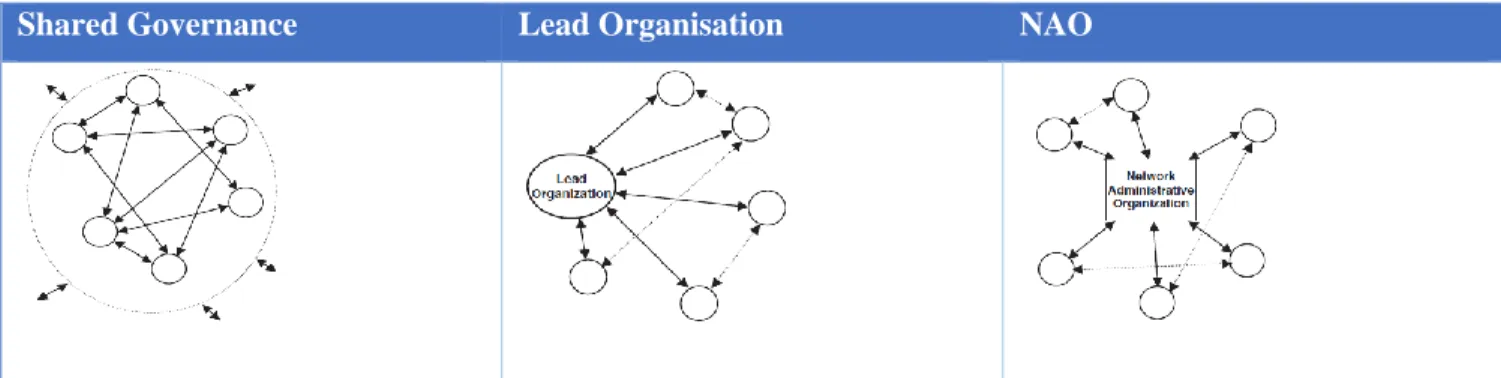
Figure 1. Forms of Network Governance
(Provan & Kenis, 2009: p. 447).
This observation leads to the typology of three different network governance forms: shared governance networks, lead organization-governed networks, and Network Administrative Organization (the NAO model) (see figure 1). Each form of governance has its own particular characteristics, structure, and strengths and weaknesses. Additionally, each governance form is faced with particular managerial tensions. These tensions are efficiency vs. inclusiveness, internal vs. external legitimacy, and flexibility vs. stability. How these tensions are managed is critical to network effectiveness, because the network forms inherently lean to a certain side of each tension (Provan & Kenis, 2008).
Shared governance network
A shared governance network is characterized by the fact that it is governed by the members of the network themselves, without any control by a separate entity. The actors that comprise the network make all the decisions themselves and manage network-level activities. While there is no specific actor assigned with administration, these kinds of activities can be designated to a subset of actors within the network. The strengths of this kind of network governance lies in the incorporation and involvement of all participating actors and its speed and adaptability to the needs of the network. Its weakness is its comparative inefficiency. It is a model that is best suited to a network that is comprised of a few number of members that can have face-to-face contacts. Accordingly, shared governance networks favor inclusion, internal legitimacy, and flexibility (Provan & Kenis, 2008; Kenis & Provan, 2009).
Lead organization network
own self-interest. The lead organization-networked governance model can be the result of a bottom-up process, but can also have been mandated by another party, such as the government. The tensions of the lead organization-networked governance form favor efficiency, external legitimacy, and stability (Provan & Kenis, 2008; Kenis & Provan, 2009).
Network administrative organization
A Network Administrative Organization (NAO) is a network governance form where a separate administrative entity, such as a governmental or a non-profit organization, is set up to function as a coordinator and manager for network-level activities. However, unlike the case in the lead actor governance model, the administrative entity does not have its own goals or needs. This administrative entity can be set up informally and formally, depending on the need for external or internal legitimacy. The strengths of this model are its legitimacy, tenability and, although to a lesser extent compared to shared governance, its efficiency. Its weaknesses are the fact that members of the network may become too reliant on the administrative entity and could adopt its bureaucratic tendencies. The tensions of the NAO governance form are a bit more balanced but lean more in the favor of efficiency, addresses both sides of legitimacy but in a consecutive method, and favor stability over flexibility (Provan & Kenis, 2008; Kenis & Provan, 2009). Apart from the categorization of network governance structures, an important part of Provan and Kenis’ theory (2008) is about the factors of success for networks. Or in other words, how the network can attain positive network-level outcomes (which was already defined as ‘the effectiveness of networks’). They state a successful adoption of one of these network governance forms is based on a number of structural and relational key factors.
Success factors governance models
2.2. Trust
2.2.1. An introduction to trust research
The concept of trust itself is interesting because it is covered in a wide array of sciences. Multiple authors argue that trust is a multi-disciplinary research topic. Trust can be related to different topics such as business innovation, organizational performance and inter-organizational relationships. A few applauded works in trust research are for instance (Fukuyama, 1995) on the basis of trust, Lane and Bachmann on the role of trust in organizational relationships (Lane & Bachmann, 1998) and Kramer and Tyler on trust in organizations (Kramer & Tyler, 1995). Trust research is inherently a study area focused on the individual according to Seppänen. Seppänen calls this ‘basic trust’ where for instance relationships between a parent and its children are researched. Trust in such research is about the goodwill of the trusted person. Later also the philosophy school started to investigate the concept of trust. The philosophy school argues that trust is a non-conscious state (Seppänen, 2008: p. 19-21). At a certain moment the scope of research shifted towards organizations and group level. This group level of trust will be examined in this part of the theoretical framework. What theories exist about the building and sustainability of trust?
2.2.2. Trust inside (security) networks
more important than inter-organizational trust. This statement is in contradiction with the works of many scholars (Whelan, 2015: p. 42). Whelan states that even though there is a strong institutional trust base, interpersonal and impersonal trust are very important, as stressed by his respondents (Whelan, 2015: p. 46). Is trust then the answer for new coordinating mechanisms that stimulate innovative decision-making? According to most literature and Edelenbos and Klijn it is. Trust as a coordination principle seems promising in settings where the relations between ‘partners’ is horizontal. Without rules and hierarchy another form of steering is needed, and trust can fill that gap. As Edelenbos and Kleijn argue: ‘We cannot organize all uncertainties in life through hierarchical power, direct surveillance or detailed contracts’ (Edelenbos & Klijn, 2007: p. 27). Goldsmith and Eggers take it one step further and state that trust is: ‘The bedrock of collaboration. Without it (trust), people will not collaborate or share knowledge (Goldsmith & Eggers, 2004: p. 119). This research will focus on the perceived trustworthiness. The perceived trustworthiness consists of three variables; perceived ability, perceived benevolence and perceived integrity.
2.2.3. What is trust?
If trust is a subject in many different research areas, it could also carry different meanings. Lane and Bachman (1998) state that trust is an expectation. Fukuyama argues that trust is the cement of society (1995). Other scholars argue that trust itself is a ‘container concept’ that is not different from rules or norms that form society (Edelenbos & Klijn, 2007: p. 29). Edelenbos and Klijn have observed three distinctive properties of trust:
- Trust is inherent to vulnerability. A person trusts the other to avoid opportunistic behavior against him and therefore is vulnerable.
- Trust is linked with risk. In situations with high risk it is argued that trust is necessary for any cooperation.
- Trust comes with expectations. Trust reduces unpredictability, complexity, and ambiguity in interaction because one can anticipate (some of) the behavior of the other actor (Edelenbos & Klijn, 2007: p. 29).
2.2.4. The elements of trust
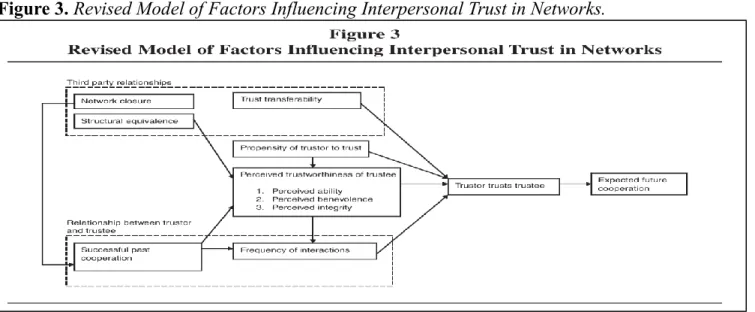
The previous chapter consists of a digest of trust research. From this literature analysis two characteristics of trust are observed; risk and interdependence. The question, what is trust? still stands after the previous chapter. The following part of this thesis will describe the model on trust created by Lambright, Mischen & Laramee which is the key focus point of this research. This model describes three main components of trust: Ability, benevolence and integrity. The model created by Lambright et al is portrayed below.
Figure 3.Revised Model of Factors Influencing Interpersonal Trust in Networks.
(Lambright et al, 2010: p. 78).
Lambright et al created a model whereby: ‘The trustor is putting herself in a position of vulnerability and taking a risk by placing trust in the trustee (Lambright et al, 2010: p. 66). In this model the trustor is the person or organization that puts their trust into the trustee, a person or another organization that receives the trust from the trustor. In the next section the model of Lambright will be further explained.
2.2.5. The three core components of trust
Lambright et al state, (2010) that trust research is an important part of different areas of research, such as management studies and psychology. However, trust research in public administration is limited, therefore they created the model pictured above, stating that it is a cross-disciplinary model useful for researching trust-building in networks (Lambright et al, 2010: p. 66).
trustor has towards a trustee, that could be of positive or negative nature (Lambright et al, 2010: p. 78). Second there is a certain perceived trustworthiness of the trustee. The model by Lambright et al loans three components from the distinguished work of Mayer. Mayer argues that authors interpret trustworthiness in different ways. Earlier is stated that trust is necessary when risky situations occur, and that trust is important because it is necessary in cases where interdependence exists. Mayer argues that these deliberations about trust make it difficult to research the subject and describes trust as follows: ‘The willingness of a party to be vulnerable to the actions of another party based on the expectation that the other will perform a particular action important to the trustor, irrespective of the ability to monitor or control that party (Mayer, 1995: p. 712). Mayer makes an important distinction and states that trust not necessarily means taking risk but is about the willingness to take risk.
Therefore, Mayer has examined the literature of trustworthiness and derived three main characteristics; Ability, benevolence and integrity. Ability, according to Mayer is: ‘That group of skills, competencies and characteristics that enable a party to have influence within some specific domain (Mayer, 1995: p. 717). Domains are important in considering one’s ability. Someone could be trusted for doing technical analyses, but not trusted with communicating with important network-partners (Mayer, 1995: p. 717-718). In a Yale study ‘perceived expertise’ was an important characteristic of the trustee. In most research abilities are described in a rather specific notion. Therefore, Mayer uses the construct of ability in a: ‘The task- and situation-specific nature of the construct (Mayer, 1995: p. 718).
The third construct of trustworthiness is integrity. Integrity is described by Mayer as: ‘The trustor's perception that the trustee adheres to a set of principles that the trustor finds acceptable (Mayer, 1995: p. 719). There could be different reasons why the trustor finds certain principles acceptable such as: ‘Consistency of the party's past actions, credible communications about the trustee from other parties, belief that the trustee has a strong sense of justice, and the extent to which the party's actions are congruent with his or her words (Mayer, 1995: p. 719). However, research showed that for researching trust it is more important to know whether the perceived level of integrity is high or low then to know why that perception is formed. In the literature, the term integrity tends to be used to refer to consistency, fairness and openness. Mayer argues that integrity is an interplay of above characteristics, whereby consistency alone is not enough to assign integrity to another person (Mayer, 1995: p. 720).
2.3 Building trust
The previous chapter displayed the model by Lambright et al and distinguished the different components of trust. These components are essential in the way trust is built inside (security) networks. However, the components of trust itself, ability, benevolence and integrity do not necessarily mean that trust is build. This chapter will draw out a small portion the literature on trust building and apply it to the model of Lambright et al.
generate a certain level of trust. However, it does not mean that if all characteristics of trustworthiness are ranked low or medium there is a low level of trust, it depends on the context in which the interaction takes place and the propensity of both the trustee as well as the trustor to trust (Mayer, 1995: p. 720-722).
Lambright et al argue that if one tries to conduct research on the concept of trust it is not enough to focus on the dyadic relationships inside an existing network. Other factors to consider are the third-party relationships and the relationship between the trustor and the trustee (Lambright et al, 2010: p. 79). Third party influences are made up of three components; network closure, structural equivalence and trust transferability.
- Network closure is: ‘The number of third parties who interact with both the trustor and trustee’ (Lambright et al, 2010: p. 68). When there is only a dyadic relationship between the trustor and the trustee, trust will not be spread among others. In a network where there are multiple actors it is possible that third parties derive trust from the successful cooperation of two other parties in the network.
- Structural equivalence is about the way the trustor and the trustee are similarly positioned inside a network and think the same about the other participants. The trustor and the trustee see each other as part of a subgroup and feel that both parties are interdependent. This could also lead to subgroups which does not benefit overall levels of trust inside networks.
- Trust transfer-ability is made up of the amount of parties that trust the trustee and are trusted by the trustor (Lambright et al, 2010: p. 68-69).
insight in the values and beliefs of the different parties inside a network. Successful past cooperation thus shapes the perceived trustworthiness and, in the end, impacts the trust the parties have in one another.
2.4 A dynamic model for building trust
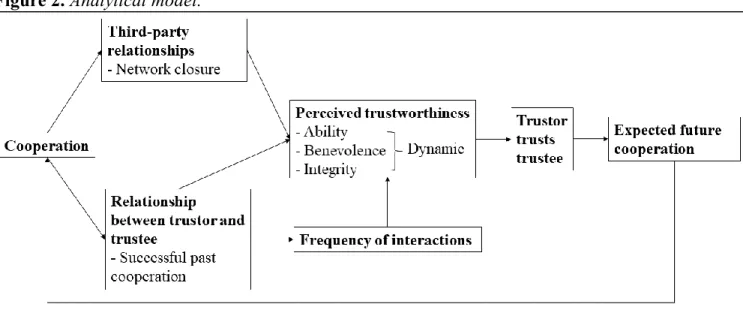
The previous section described the way the components of trust interact with each other. It also showed that inside inter-organizational collaboration several other constructs influence trust such as third-party relationships and the relationship between the trustor and the trustee. This chapter will alter the model of Lambright et al in order to fit inside the analytical framework of this research. Vangen and Huxham (2003: p. 12) created a model for building trust inside inter-organizational collaboration. They argue that trust builds in a cyclical manner. In the beginning of the collaboration there is little trust and it develops over time. The model created by Vangen and Huxham (2003) is out of the scope of this research but their idea of trust developing in a cyclical way is adapted in this research. The model by Lambright et al consists of several constructs that influence trust inside networks as described earlier in the theoretical framework. Below is the adapted model by author of this research portrayed. The model that is displayed below also connects with the works of Provan and Kenis (2008, 2009). As noted earlier, Provan and Kenis state that the key-factors of network governance are trust, number of participants, competencies and goal consensus. This mode zooms in on the aspect of trust. The other key factors also play a part in this model, which will be explained later on. This analytical model therefore also provides a deepening of the works of Provan and Kenis (2008) as the works of Mayer (1995) and Lambright et al (2010).
Figure 2.Analytical model.
Cooperation
Networks that consists of multiple organizations exist because different parties cooperate with each other. Cooperation is the starting point of this model, otherwise a network would be nonexistent. When building trust two components play an important part in influencing whether someone is perceived trustworthy or not, third party relationships and the relationship between the trustor and the trustee
Relationship between trustor and trustee
In the model above, is built on the ideas of Lambright et al (2010) that the relationship between the trustor and the trustee consists of successful past cooperation and the frequency of those interactions. Lambright et al (2010) argue that successful past cooperation positively influences the perceived trustworthiness of the trustee and the frequency of the interactions between the parties. The frequency of the interactions is both influenced by past successful cooperation as well as the level of perceived trustworthiness on the trustee. It is an important construct as it directly influences whether parties are trusted or not.
Third party relationships
Perceived trustworthiness, trust and future cooperation
3.0. Methodology
This chapter includes the methodology. In this chapter the used methods are displayed. First, the design of the study will be elaborated. Second, the concept of case-studies and the advantages and disadvantages of case studies method is discussed. Finally, the proposed gathering and data-analysis methods will be discussed.
3.1. Case Study design
This research will use a case study design. Case studies are sometimes regarded as the weaker sister in social science, but others point to it as: ‘In-depth, qualitative studies of one or a few illustrative cases’ (Berg, 2009: p. 317). The case study is according to Berg an: ‘Approach capable of examining simple or complex phenomenon, with units of analysis varying from single individuals to large corporations and businesses; it entails using a variety of lines of cation in its data-gathering segments and can meaningfully make use of and contribute to the application of theory’ (Berg, 2009: p. 317-318). Case studies are also a way to discover and can be a breeding ground for insights and hypotheses (Berg, 2009: p. 329). Case-studies are also very adaptive, which could be useful in this research. It is easier than with other methods to adapt to the situation. Although case studies prove to be very effective in looking at several smaller cases, they also pose some disadvantages. It could for instance be hard for the researcher to gain access to the data, because you have to ask hospitals their weaknesses that they would not throw out on the street so easily. Also, in case studies the external validity remains low. Case-studies are hard to duplicate and have a low generality. Yin argues that it is wise to use case study designs when the stated question is a ‘how’ question. Questions that are posed with a ‘how’ statement and questions that involve contemporary situations deserve a case study design. A case study, according to Yin: ‘Investigates a contemporary phenomenon within its real-life context, especially when the boundaries between phenomenon and context are not clearly evident’ (Yin, 2003: p. 9-13). In this research a phenomenon, trust, is researched in a contemporary setting given a ‘how’ question.
security networks in relation to trust. This group also has been chosen because of its interesting dynamics and dependence of trust on its own performance. This network is also chosen because the researcher is able access this security network and its members. Gaining access to security networks is not easy and therefore this research adds value to the scientific debate about trust. It took this researcher almost a year to gain access to the Joint-SOC network.
3.2. Data collection methods
This study is a single case-study and will work with interviews, documents and a desk study to ensure triangulation of data. In this chapter will be elaborated why these methods are chosen and how they fit in this research.
3.2.1. Desk study
The first step of analysis in this research is performing a desk study. During this desk study considerable literature on trust will be analyzed. Also, there will be research conducted on security networks in general. There are two reasons why this is important for this research. First, it is important because it ensures the researcher is acquainted with the concept of trust. Second it is important to be acquainted with security networks because it is the focus point in this research. The desk study also provides more information on security operation centers (SOC’S). This is both interesting because the network consists of SOC’s but also because SOC’s are a new phenomenon which are vital in securing the digital infrastructure.
3.2.2. Interviews
Doorewaard, 2007: p. 242). This research adds to the existing literature on trust because it’s starting point is a qualitative research. Most research on trust consists of quantitative methods. For this research I will interview people that represent the different organizations of the Joint-SOC network. This will include people from the following organizations: SSC-ICT, the Tax and Customs Administration, NCSC and Rijkswaterstaat. This research will only focus on the operational key figures inside this network. This is due to time constraints and the limitations of a master’s research but also due to the fact that interviewing these people is almost not achievable. The respondents I approached already stated that normally they do not cooperate with any interview or research due to time constraints and the large number of researchers apprehending them. Interviews are an important tool when researching trust. As trust is often used in personal networks, which are often not written down in formal arrangements. When approaching respondents, a problem that occurred was their available time, especially for the governance board. The interview schedule of this research was planned around June until August, this is proven to be an unfavorable time as most people are on holiday. The relatively few number of respondents is handled by putting extra attention to the literature review and document analysis.
3.2.3. Document analysis
3.3. Data exploitation and assessment
Interviews and document analysis are the methods used in this thesis. In this chapter of the methodology the conceptual model will be divided into constructs that are operationalized. After the most important concepts are operationalized follows the interview protocol and the coding scheme.
3.3.1. Operationalization
In this chapter several key concepts will be operationalized. First the propensity to trust will be operationalized. Then will trustworthiness be operationalized. Lastly ‘trusting’ will be operationalized
Concept Indicators Subindicators Specifications
Trustor: The network member that puts his trust in a trustee
Trustee: A network member that is trusted by another network member
Cooperation
Network closure To what extent does successful cooperation influence the opinion of others inside the network.
Do all parties follow the cooperation of the others carefully?
Structural equivalence To what extent do the parties in the network feel they share the same view on the network.
Successful past
cooperation Which ‘successfully’ parties worked have together to achieve a common goal in the past
Successful cooperation in this researched is interpreted as the achievement of a common goal, where it is up to the participating organizations to decide whether the outcome has been satisfactory.
Frequency of
interactions
An estimation of the interactions the different parties have on a regular basis
An estimation of the communication
parties. Whereby frequent interactions are described as between 1 or 2 meetings per week. And non-frequent interactions are around 1 or 2 meetings per month, or per two months.
Perceived
trustworthiness: When an individual believes that the other party can be trusted. This can be measured by checking how the trustor perceives the trustee(s) on his or her ability, benevolence and integrity inside the network.
The trustor perceives the trustee as someone with abilities.
The trustor believes that the trustee has skills that have an influence inside the network
Skills considered are: technical skills, relational skills,
communicational skills.
The trustor believes that the trustee has characteristics that have an influence inside the network
Characteristics are reliability and honesty.
The trustor perceives the
trustee as benevolent. The trustor believes the trustee will handle in the interest of both parties The trustor and trustee have an attachment towards each other The trustor perceives the
trustee as integer. The trustor believes that the trustee adheres to the same principles The trustor finds that the trustee is consistent in his or her actions
The trustor believes that the trustee is fair in his or her actions.
Trustor trusting a trustee The trustor states that he
There are frequent interactions between the trustor and the trustee Expected future
cooperation Both the trustee and the trustor acknowledge that they will continue to work together and continue their relationship in the future (or start new projects).
3.4. Interview protocol
This research will use a semi-structured interview. Therefore, there will be an interview protocol consisting of both open and closed questions. Inspiration for this interview protocol is taken from Colquitt et al who measured the same constructs of trust (Colquitt, Scott & LePine, 2007: p. 914).
Protocol:
1. What is your name and function inside your own organization? 2. What would you consider as your function inside the network? 3. How would you describe the Joint-SOC network?
4. How many interactions do you have with the network? 5. What drives you to participate in this network?
6. To what extent do you think that trusting each other is necessary in security networks? 7. Do you think party X, Y, Z is very capable to perform their actions in this network? 8. Do you think party X, Y, Z is known to be successful in their actions in this network? 9. Do you think party X, Y, Z are concerned with your welfare?
10. Do you think party X, Y, Z would act in your best interest? 11. Do you think party X, Y, Z has a strong sense of justice? 12. Do you think party X, Y, Z is consistent in his or her actions?
13. Could you state with which partners you would like to cooperate in the future? 14. To what extent are you satisfied with the operations of the Joint-SOC network?
3.5 Coding scheme
To interpret the answers given during the interview, a coding scheme will be used. The table below consists of the coding scheme.
Construct Codes Keywords
1.0 Network closure 1.1. Parties mention successful cooperation between other partners 2.0 Structural equivalence 2.1. Parties have the same view on the
network
2.2. Parties do not have the same view on the network
3.0 Successful past cooperation
3.1. Parties indicate at least one successful past cooperation
3.2. Parties do not mention successful past cooperation
4.0 Frequency of interactions 4.1. The number of meetings the parties have together
5.0 Perceived Trustworthiness 5.1. Perceived ability Abilities, Competences Skills, Characteristics 5.2. Perceived benevolence Loyalty, openness, caring,
receptivity, availability 5.3. Perceived integrity Fairness, consistency,
promise, fulfillment, reliability, value congruence, discreetness 6.0 Trusting one another 6.1 High levels of perceived
trustworthiness and frequent interactions
6.2 High levels of perceived trustworthiness and non-frequent interactions
6.3 Low levels of perceived trustworthiness and frequent interactions
6.4 Low levels of perceived trustworthiness and non-frequent interactions
7.0 Expected future cooperation 7.1 A statement is made on the continuation of the relationship.
8.0 Information about the structural aspects network 9.0 Other
3.6. Reliability and validity
This chapter will consist of how the researcher interprets the reliability and validity of this research. The next section will begin with a short introduction on reliability and validity for using these constructs in qualitative research.
3.6.1. Reliability
In quantitative research reliability is about having the opportunity to exactly replicate each research, both of the processes as well as the results. In qualitative research striving to exact replicability is though, if not impossible according to Leung (2015). Stenbacka takes this statement one step further and argues that if a qualitative study is scored by the criterion of reliability, the study itself is no good (Golafshani, 2003: p. 601). Leung proposes argues that some inconsistencies are tolerable in qualitative research and that the main point of reliability in qualitative research is consistency. In this research, consistency is created by following the model portrayed earlier in the analytical chapter. The model is the guideline for this research and should at all times be followed. Leung also states that consistency can be achieved by constantly checking the context and accuracy of the data received with fellow researchers or peers (Leung, 2015). During this research both the authors mentor and other peers contributed to this triangulation, steering back to the correct context. This ensures the reliability, or consistency, of this research.
3.6.2. Validity
4.0 Analysis
This part of the thesis will analyze the empirical findings from the document study and the interviews with the respondents. The first chapter of the analysis covers the founding of the network and focuses on the network structural components. The second chapter will look at trust and its main components; Abilities, benevolence and integrity. The third chapter will look at the broader model, its dynamic character and how this influencing building trust.
4.1 Introducing the Joint-SOC network
In 2014 and 2015, The Hague and the Netherlands were the hosts of two important summits. In 2014 the Nuclear Summit took place where 53 countries discussed how nuclear material and weapons could be kept from terrorist’s hands (NSS, 2014). In 2015 The Hague hosted the Global Conference on Cyber Space. A conference where leaders, policymakers, experts and other cyber experts: ‘Establish internationally agreed ‘rules of the road’ for behavior in cyberspace and create a more focused and inclusive dialogue between all those with a stake in the internet (governments, civil society and industry) on how to implement them (GCCS, 2015). International conferences like the GCCS require an immense operation to secure. The Dutch police stated that it was the most complex and extensive operation in their history (Politie Nederland, 2018). Such operations are focused on the physical domain of security but also on the cyberspace. Respondent one, the technical SOC lead of a governmental organization stated that these operations where the main motive to think about governmental cooperation between Security Operation Centers (Respondent one, 2018). The following description describes what a security operation center entails: ‘A security operations center (SOC) is a facility that houses an information security team responsible for monitoring and analyzing an organization’s security posture on an ongoing basis. The SOC team’s goal is to detect, analyze, and respond to Cybersecurity incidents using a combination of technology solutions and a strong set of processes. Security operations centers are typically staffed with security analysts and engineers as well as managers who oversee security operations’ (Lord, 2018). This chapter will shortly describe the Joint-SOC network and will focus on its structural components.
long-lasting cooperation. Not much later in this time-frame the National Cyber Security Centre joined this collaboration. Since then SSC-ICT, the Tax and Customs Administration, NCSC and Rijkswaterstaat form the core component of the SOC network (SSC-ICT, 2016). The Joint-SOC could be described as a ‘Grassroots’ movement. Whereby it was important that there would be collaboration on all fronts, with as most important target not to re-invent the wheel. Another important aspect of the Joint-SOC network is that there would be no competition. Respondent two, a senior security expert working at the Dutch National Cyber Security Centre stated that there should not be a competition in attracting new staff (Respondent two, 2018). If other parties comply with the accession guidelines of the Joint-SOC they can join the collaboration. Talks are involved with two other parties that are now in the process of joining the Joint-SOC network. The starting point of this network was rather informal.
However, it took a more formal turn later in the collaboration as is described in the Best Practice. In 2016 the minister from the Ministry of the Interior and Kingdom Relations created a new Strategic I-Agenda for the Dutch government. In this I-Agenda strategic decisions regarding topics such as digitizing primary processes, privacy and Cybersecurity are portrayed. The I-Agenda is updated every year. The CIO (Chief Information Officer) creates the I-Agenda in collaboration with the CTO- (Chief Technology Officer) and CIO-councils (Dutch Central Government, 2016, Dutch Central Government, 2008). In the 2016 version of the I-Agenda the Joint-SOC is described as an example of the improvement of operational collaboration, which also has been formalized (Dutch Central Government, 2016: p. 19). Respondent four, a technical SOC lead at a governmental organization, describes how the head of the National Cyber Security Centre, Hans de Vries, presented the Beste-Practice signed by all parties to the CIO-Rijk (Respondent 4, 2018). The Joint-SOC network is since then incorporated in the policy of the Ministry of Interior and Kingdom Relations.
weekly organized meeting where the state of the present is discussed and where solutions for collective problems are thought out. Important in this collaboration that the person that takes place in these meetings should always be the same representative of the organization involved. This collaboration results in a ‘Best Practice’, a living document, in which guidelines and helpful tips are portrayed for other governmental SOC’s to learn from (Joint-SOC, 2017). The Joint-SOC network could be described as an institutional network as mentioned by Dupont. A security network where several governmental agencies work together to achieve efficiency (Dupont, 2004). Although the Joint-SOC network’s ambitions lie beyond efficiency. The ambitions of the Joint-SOC network are to help governmental organizations acquire a SOC with a higher maturity level, benefiting the whole of the Dutch government. As respondent four states: ‘I strongly believe in this cooperation, because I think that we only win the cyberwar by working together’ (Respondent four, 2018).
4.1.2. The Joint-SOC Network and its network governance
By the analogy of network governance by Provan and Kenis (2008), the Joint-SOC network could be described as a participant-governed network. This section will explore the structural components of the network and will argue why this network is a participant governed network.
It is important to describe the structural components of the network, as it describes why certain aspects of the network are important. The Joint-SOC network could be described as a participant-shared governed network. Provand and Kenis state that when a network is participant-shared: ‘It is the collectivity of partners themselves that make all the decisions and manage network activities. Power in the network, at least regarding network-level decisions, is more or less symmetrical, even though there may be differences in organizational size, resource capabilities, and performance’ (Provan & Kenis, 2008: p. 235). This is also the case in the Joint-SOC network, where there are different organizations, all with other sizes, capabilities and performance, that work together to manage the network. In addition to that Provan and Kenis state that: ‘In theory, the network acts collectively and no single entity represents the network as a whole’ (Provan & Kenis, 2008: p.235). This is in line with the statement made by respondent four (2018), ‘You are not going to find a door with ‘Joint-SOC’ written on it.
One of the prerequisites of a participant-shared network to perform well, is a high density of trust in combination with both few participants and a clear goal consensus. The need for a high level of trust is confirmed by the respondents. Therefore, it is interesting to research trust inside a participant-shared governed network.
4.1.3. Sharing information inside Cybersecurity networks
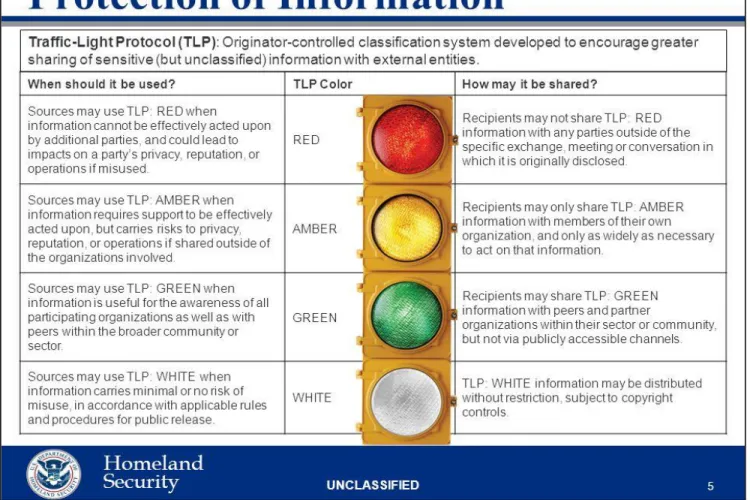
information’ and is ‘a set of designations used to ensure that sensitive information is shared with the appropriate audience. It employs four colons to indicate expected sharing boundaries to be applied by the recipient(s). TLP only has four colors; any designations not listed in this standard are not considered valid by FIRST (FIRST, 2018). The traffic light protocol knows the following definitions: TLP: RED = Not for disclosure, restricted to participants only.
TLP: AMBER = Limited disclosure, restricted to participants’ organizations. TLP: GREEN = Limited disclosure, restricted to the community.
TLP: WHITE= Disclosure is not limited (FIRST, 2018).
Figure 4. The Traffic Light Protocol.
(RPC First, Deciphering the Traffic Light Protocol (TLP), 2017).
4.1.4. Sub conclusion on governance and the relevance of trust building inside the Joint-Soc network
4.2. Components of Trust
This section will delve into the empirical data to distinguish how trust is build inside the Joint-SOC network. The first chapter will handle the different components of perceived trustworthiness. In this chapters each construct will be individually explored. In the chapter after this exploration the other factors will be considered. In the third and final chapter of this analysis the research question will be answered: How is trust build inside security networks?
4.2.1 Capabilities
Capability is about the way certain actors can influence others in the network. It is about competences, characteristics and abilities (Lambright et al, 2010). When talking about characteristics inside security networks respondent two describes it as: ‘I believe everyone is a professional here, who all carefully work with the sensitive information at their disposal.’ So, it could be stated that in security networks a capability that is necessary is being careful with sensitive information. In addition to that, respondent two argues that it is necessary that people do not want to know what other people are doing in detail, but do know what their area of interest is, so they can assist in their work with ‘need to know information’ (Respondent two, 2018). This is in line with Mayer’s statement on capabilities and trust ‘to influence in a specific domain’ (Mayer, 1995: p. 717) people do not necessarily need to be capable in everything but need to know about their part of the work. Most information in security networks is shared under the notion that the other party needs to know the information to do its work. Which is in contrast with ‘nice to know’ information that is nice to know but does not hold the other from doing his or her work correctly. How to handle information and know how to share information is a core competence of networking members in the field of Cybersecurity. Also taking responsibility for your actions when things go troubled generate trust. These ‘competences’ are strongly linked to the integrity of the trustee, as with integrity core components such as discreetness, fairness and promise are important (Lambright et al, 2010). But determining what fair and discreet is, is difficult, to determine such things is the input from all agencies in the network necessary (Respondent two, 2018).
Provan and Kenis (2008) are only needed on a low level. As both respondent one and two remark that organizations need a certain maturity level to meet the ascension guidelines in the first place. Since the organizations must meet the requirements the others believe that they possess the capabilities necessary to collaborate with the others. Trust in one’s capabilities therefore might be generated through ascension guidelines for a security network. In the Best Practice is written down which guidelines need to be followed to join the network (Joint-SOC, 2017). Therefore, it could be stated that inside the Joint-SOC network the capabilities of the parties are an important part of trusting another. As it is the starting point for joining the network in the first place (Joint-SOC, 2017). When the trust is started to be being build, respondent four states that it is necessary to hold on to the paperwork and other formal policies such as screening (Respondent four, 2018). The guidelines consist of the basic principles that should be adhered by a SOC wishing to join the Joint-SOC network. These basis for the principles of the Best Practice can be found in the works of Schniagl and Schoon from Noordbeek (Schniagl & Schoon, 2014).
4.2.2. Benevolence
networks do not possess high levels of trust. Inside the Joint-SOC network there is room for such thoughts, which could benefit overall levels of trust.
Another important part of benevolence is the availability of another. Respondent four states that building trust requires effort. This part of the effort is appearing at meetings because of the importance of face to face contact between members of a network. Respondent four described a network that became bigger and bigger whereby not all members had seen each other face to face. Respondent four lost his trust in this network for a moment and demanded the availability of all members during the meetings, which then was written down in the membership guidelines (Respondent four, 2018). In the Joint-SOC network coming to the two-weekly meetings is also very important, it shows that the person or organization is willing to put effort in the trust relationship with the other parties involved.
4.2.3. Integrity
Integrity and discreetness is also deemed the most important by respondent four. The respondent describes that: ‘If I share something with you under TLP: RED and I hear it from someone else who obtained the information from you, it is game over’ The exact outcome of this breach of trust on the relationship depends on the way the ‘offender’ handles the situation (Respondent four, 2018). It is important in the trust relationship how someone that breaks the rules treats his fellow network members. If the person does this in a respectful manner it could be that there is only a small amount of damage on the trust-relationship.
4.3 The dynamic process of trust-building
4.3.1. Screening: The starting point of trust in security networks?
who is cleared to a certain level has been independently audited to be able to have that information. And you can have trust in that (Whelan, 2015: p. 43). In addition to the screening other formal paperwork also benefits (or starts) the trust relationship inside security network. In the case of the SOC network the membership guidelines are also an institutional form of control. The Joint-SOC network is not the only security network that uses this mechanism, as it is also used in the Rijks-ISAC (Information Sharing and Analysis Center) (Dutch NCSC, 2016, Respondent three, 2018). In addition to that Whelan argues: ‘That no stronger foundations of impersonal trust exist in any network than those in the Field of national security because of these processes’ (Whelan 2015: p. 42).
4.3.2. Building trust
This chapter will demonstrate how trust is build inside security networks, along the model portrayed in the analytical chapter. This section will analyze the Joint-SOC network and look if the propositions made in the analytical chapter are valid. The model itself is presented here again for practical reasons.
4.3.3. Cooperation as starting point
Administration and SSC-ICT. They then came up with the idea to do it themselves the next year (Respondent four, 2018). However, if you start a collaboration, how do you start building trust? Respondent four states that it is important to start off in an informal setting and use humor when first working together: ‘It is a different situation when everyone takes a seat in a three-piece suit and his or her pencil perfectly aligned with the notepad, I believe it is better to take place in an informal setting where you interrupt the session to have a coffee break and have a chat at the coffee corner (Respondent four, 2018). This adds to the statement made by all respondents that in order to trust someone you have to meet him or her face to face. This is an interesting statement as most work in Cybersecurity involves computing, e-mail or chatting. Building trust in security network collaborations starts with meeting each other and looking in the eyes of the person in front of you. Whelan (2015) creates a distinction between ‘positional-trust’ and ‘relational-trust.’ Whelan describes relational trust as follows: ‘You have to work on your relationships. You have to make sure that when someone moves from a position that you know who is taking over, that you go and make contact; you can email people, you can talk to them on the phone, but nothing replaces looking them in the eyes and forming a personal relationship’ (Whelan, 2015: p. 41-42). The statements made by the respondents in this research confirm the statement made by Whelan (2015).
4.3.4. Third party relationship: Network closure and structural equivalence
inside the Joint-SOC network itself, but the reputation and successful actions of the Joint-SOC spread towards other governmental institutions. This could reassure the parties inside the Joint-SOC network that they are doing a good job and thus positively influence the level of trust the parties have in another. Interesting note is that if someone new, from an organization already in the network, joins he or she derives a certain amount of trust because she comes from an organization that is trusted (Respondent three, 2018). However, the person that is chosen to join the network should not be a new member of the organization it is working for, as he or she does not have learned the organization well enough to gain the same amount of trust (Respondent four, 2018).
4.3.5. The relationship between the trustor and the trustee
Next to third party relationships there is a certain relationship between the trustor and the trustee. According to Lambright et al (2010) this relationship is formed by the past interactions between the parties involved. Successful past cooperation leads to a higher frequency of current interactions and has a positive impact on whether a person or organization is trusted or not. In the case of the Joint-SOC network it could be observed that the initial cooperation was deemed successful. After that period the parties started to work together on a more frequent basis. As the section in this research about capabilities showed there is a lot of successful past cooperation in the Joint-SOC network. In addition to that there is also a high frequency of interactions, as respondent two notes that there is a meeting every two weeks and that they see each other on a more regular basis, depending on the situation at that time. Provan and Kenis (2008) argue that participant-shared networks are only effective when there is a lot of personal contact (Provan and Kenis, 2008: p. 234). Respondent four states that the amount of times they interact is also dependent on the situation. If times are busy and threats are imminent there are more interactions than if its silly season. The respondent argues that when something is going on they usually contact each other directly through a chat channel (Respondent four, 2018). Inside the Joint-SOC network there are many successful cooperation's to discover. They, for example, worked on the implementation of the VERIS framework for identifying incidents and sharing incident information (Best practice, 2017: p. 43, Respondent two & four, 2018, VERIS, 2018). Another fruitful collaboration is the DDoS tests organized by the Tax and Customs Administration each year. Where all parties come together to learn about the mitigation of Distributed Denial of Service Attacks (KPN, 2018 & Respondent four, 2018). Previous cases are examples of larger projects that are executed by the parties of the Joint-SOC. But they also work together on a looser basis. The SOC’s of Rijkswaterstaat and the Tax and Custom Administration work together on different incident cases, whereby the expertise of the organizations is used to help each other (Respondent four, 2018). Whelan (2015) argues that personal trust is dependent on frequent interactions over time. This seems to also be the case in the Joint-SOC network. There are a lot of interactions which contribute to the personal trust inside the network.
past cooperation also directly influences whether the other organization is trusted or not. As respondent two puts it: ‘In the basis everyone is granted with my trust. The trust I have in another person or organization can grow. That depends on how my relationship with the other develops and how I observe how things are handled’ (Respondent two, 2018). Respondent two argues that these kinds of observations are a reason for trusting someone and thus sharing information with other parties. Respondent two, also states that trust can be diminished in this way. It could be stated that unsuccessful past cooperationhas a negative influence on the perceived trustworthiness. This could be because the trustor ranks the capability, benevolence or integrity different than earlier in the cooperation. Respondent two also states that unsuccessful cooperation not necessarily lead to negative implications if they handle it ‘correctly’.
4.4. Combining all elements of the trust model