The Elements of Russia’s Soft Power: Channels, Tools, and Actors
Promoting Russian Influence in the Eastern Partnership Countries
Antoaneta Dimitrova, Matthew Frear, Honorata Mazepus, Dimiter
Toshkov, Maxim Boroda, Tatsiana Chulitskaya, Oleg Grytsenko,
Igor Munteanu, Tatiana Parvan, Ina Ramasheuskaya
This project has received funding from the European Union’s Horizon 2020 research and innovative programm e under grant agreem ent no. 693382.
Project acronym
:
EU-STRAT
Project full title
:
The EU and Eastern Partnership Countries
An Inside-Out Analysis and Strategic Assessment
Grant agreement no.:
693382
DOCUMENT
INFORMATION
Project
Project acronym:
EU-STRAT
Project full title:
The EU and Eastern Partnership Countries:
An Inside-Out Analysis and Strategic
Assessment
Grant agreement no.:
693382
Funding scheme:
RIA Research and Innovation Action
Project start date:
01/05/2016
Project duration:
36
Call topic:
INT-08-2015: The European Union and the
Eastern Partnership
Project website:
http://eu-strat.eu
Document
Deliverable number:
D5.3
Deliverable title:
Working paper analysing the ties, linkages
and actors that potentially strengthen
Russia’s influence on domestic discourses
in the EaP countries
Due date of deliverable:
31/07/2017
Actual submission date:
19/07/2017
Editors:
Minna Ålander, Sarah Pfaffernoschke,
Elyssa Shea
Authors:
Antoaneta Dimitrova, Matthew Frear,
Honorata Mazepus, Dimiter Toshkov,
Maxim Boroda, Tatsiana Chulitskaya,
Oleg Grytsenko, Igor Munteanu, Tatiana
Parvan, Ina Ramasheuskaya
Reviewers:
Tomila Lankina, Ramūnas Vilpišauskas
Participating beneficiaries:
UL, UIPP, SYMPA, IDIS Viitorul
Work Package no.:
5
Work Package title:
Soft power, discourses and their reception:
EU and Russia compared
Work Package leader:
Antoaneta Dimitrova
Work Package participants:
UL, UIPP, SYMPA, IDIS Viitorul
Dissemination level:
PU
Nature:
R
Version:
1
Draft/Final:
Final
The Elements of Russia’s Soft Power:
Channels, Tools, and Actors Promoting
Russian Influence in the Eastern
Partnership Countries
Antoaneta Dimitrova, Matthew Frear, Honorata Mazepus,
Dimiter Toshkov, Maxim Boroda, Tatsiana Chulitskaya,
Oleg Grytsenko, Igor Munteanu, Tatiana Parvan,
Ina Ramasheuskaya
No. 04 | July 2017
EU-STRAT Working Paper Series
Edited by the EU-STRATProject‘The EU and Eastern Partnership Countries – An Inside-Out Analysis and Strategic Assessment’ (EU-STRAT)
The EU-STRAT Working Paper Series serves to disseminate the research results of the research consortium by making them available to a broader public. It means to create new and strengthen existing links within and between the academic and the policy world on matters relating to the current and future enlargement of the EU.
All EU-STRAT Working Papers are available on the EU-STRAT website at http://eu-strat.eu.
Copyright for this issue: Antoaneta Dimitrova, Matthew Frear, Honorata Mazepus, Dimiter Toshkov, Maxim Boroda, Tatsiana Chulitskaya, Oleg Grytsenko, Igor Munteanu, Tatiana Parvan, Ina Ramasheuskaya
Editorial assistance and production: Minna Ålander, Sarah Pfaffernoschke, Elyssa Shea
Antoaneta Dimitrova, Matthew Frear, Honorata Mazepus, Dimiter Toshkov, Maxim Boroda, Tatsiana Chulitskaya, Oleg Grytsenko, Igor Munteanu, Tatiana Parvan, Ina Ramasheuskaya: The Elements of Russia’s Soft Power: Channels, Tools, and Actors Promoting Russian Influence in the Eastern Partnership Countries, EU-STRAT Working Paper No. 04, July 2017, ‘The EU and Eastern Partnership Countries – An Inside-Out Analysis and Strategic Assessment’ (EU-STRAT).
ISSN 2510-084X
This publication has been funded by the European Union under the Horizon 2020 research and innovation programme.
Freie Universität Berlin EU-STRAT
‘The EU and Eastern Partnership Countries - An Inside-Out Analysis and
Strategic Assessment’
Ihnestr. 22 14195 Berlin Germany
Phone: +49 30 838 57656 Fax: +49 30 838 55049 [email protected] http://eu-strat.eu
The Elements of Russia’s Soft Power:
Channels, Tools, and Actors Promoting Russian Influence in
the Eastern Partnership Countries
Antoaneta Dimitrova, Matthew Frear, Honorata Mazepus, Dimiter Toshkov,
Maxim Boroda, Tatsiana Chulitskaya, Oleg Grytsenko, Igor Munteanu,
Tatiana Parvan, Ina Ramasheuskaya
Abstract
The Authors
Antoaneta L. Dimitrova is an associate professor at the Institute of Public Administration, Faculty of Governance and Global Affairs, at Leiden University, and Acting Director of the inter-faculty Central and Eastern European Studies Centre. Her research covers, among others, the European Union’s Eastern enlargements, relations with Eastern Partnership states, democratization and administrative reform, coordination of EU policy making, and the implementation of EU directives. Her recent publications deal with the implementation of the EU’s rules in multiple level settings, citizens perceptions of EU enlargement and cultural heritage policy.
Matthew Frear is an assistant professor at the Institute of History, Faculty of Humanities, at Leiden University. His research interests cover Russian and Eurasian politics and international relations, and comparative authoritarianism. He holds a PhD from the Centre for Russian and East European Studies at the University of Birmingham. His recent publications deal with the Eurasian integration process and contemporary Belarusian politics.
Honorata Mazepus is a post-doctoral researcher at the Institute of Public Administration, Faculty of Governance and Global Affairs, at Leiden University. She works on the EU-STRAT project and specializes in political legitimacy. Her research focuses on the role of fairness (distributive and procedural) in evaluations of political authorities by citizens in democratic and non-democratic political regimes, including post-communist countries. She holds a PhD degree from the University of Leiden, an MSc degree in Political Science Research Methods from the University of Bristol and an MA degree in International Relations with the focus on Eastern Europe from the University of Poznan.
Maxim Boroda is director of the Ukrainian Institute for Public Policy. Since 2005, he has been coordinating and consulting international technical assistance projects in the fields of governance and economic development. From 2010 to 2012, Maxim was head of the Social Economy Program at the International Centre for Policy Studies and from 2011 to 2012 he worked as Deputy Director of the International Centre for Policy Studies. From 2012 to 2013, he was Director of the Economic Policy and Business Program at the Ukrainian Institute for Public Policy.
Tatsiana Chulitskaya is a lecturer of Social and Political Sciences Department at the European Humanities University (Vilnius, Lithuania) and an expert of The School of Young Managers in Public Administration (SYMPA)/BIPART in Minsk. She defended her PhD dissertation entitled, ‘Narratives of Social Justice in Non-democratic Regime: Analysis of Belarusian Case’ at Vilnius University in 2014. Her research interests are focused on public policy and the analysis of the third sector, including the welfare regime. For five years she served as academic coordinator in the international educational project "Election Observation: Theory and Practice".
Oleg Grytsenko is an analyst and researcher at the Ukrainian Institute for Public Policy. He holds master’s degrees in public administration and economics from Seoul National University and the National University of “Kyiv-Mohyla Academy” and a bachelor’s degree in finance from the National University of “Kyiv-Mohyla Academy”. He is involved in two projects: EU-STRAT and ‘Human Security and Conflict in Ukraine: Local Approaches and Transnational Dimensions'.
Igor Munteanu acts as Managing Director of IDIS Viitorul, one of the oldest research and advocacy think tanks in Moldova. Munteanu is also teaching a Public Policy Course and
Political-Administrative Institutions at ASEM (Academy of Economic Studies in Moldova). The latest publication authored by Igor Munteanu is ‘Politici publice complexe’ (2016, Cartier Publishing House). Between September 2010 and June 2015, Munteanu served as E.P. Ambassador of the Republic of Moldova to the USA and Canada. He wrote and edited several studies and books on political transition. Between 1997 and 2005, Dr. Munteanu was involved as freelance political analyst with Radio Free Europe (RFERL). Munteanu designed and launched the publishing of the Arena Politicii Journal, as the first political sciences and foreign affairs journal in Moldova (1996-2000). In 2002, he
Tatiana Parvan is a researcher at the Institute for Development and Social Initiatives (IDIS) "Viitorul" in Moldova. After graduating from the Technical University of Moldova, she worked as a researcher from 2009 to 2012 at the Institute of Economy, Finances and Statistics (IEFS) of the Academy of Sciences of Moldova and the Ministry of Economy of the Republic of Moldova. Tatiana Parvan was involved in a number of research projects such as "Politics, models and scenarios for economic growth of the Republic of Moldova" and "Elaboration of the protection model of interests of participants to the financial market of the Republic of Moldova".
Contents
1. Introduction... 8 2. Resisting Democratization or Exercising Soft Power? ... 10
2.1. The role of domestic gatekeepers 11
2.2. Narratives, messages and the role of pro-Russian actors 13
3. Mapping the Actors, Organizations, and Channels Promoting Russian Influence ... 15
3.1. Political parties 16
3.2. Oligarchs and business political ties 17
3.3. Cultural and educational umbrella organizations 17
3.4. The Russian Orthodox Church 22
3.5. Educational linkages 23
4. Russia and the EU in the (National) News: A Three-Country Comparison ... 24 5. TV-Monitoring: Russia and the EU in the National Evening News ... 26
5.1. The objectives 26
5.2. Method 26
5.3. Extent of coverage 28
5.4. Evaluations 29
5.5. Themes and sources of news 30
5.6. Values in the news items 33
5.7. Which topics are covered most positively by whom? 34
1.
Introduction
1The spread of Russian influence in the world through targeted use of TV news, printed or social media, paid commentators (‘trolls’), and ‘fake news’ is rapidly becoming the subject of an increasing number of academic, professional, and political analyses (Galeotti 2016; Nimmo 2016; Pomeranzev and Weiss 2014; Volchek and Sindelar 2015). While just a few years ago the influence of Russian (mis)information tools and messages may have been underestimated by most observers, currently there is a veritable explosion of studies emphasizing the informational aspects of ‘hybrid warfare’ (Pomeranzev and Weiss 2014). Russian state-owned media outlets such as Russia Today and Sputnik and the impact of the messages they carry on public opinion have been the subject of growing interest by the scientific and analyst community. At his meeting with President Vladimir Putin in May 2017, French President Emmanuel Macron publicly identified them as “organs of influence and propaganda” (McAuley 2017). Yet the role of national and local news reporting in transmitting a Russian perspective to their viewers and the function of public personalities or civic organizations in reinforcing Russia’s messages may be just as important, but remains less well understood. Daily news on TV, together with discourses and ideas spread on social media and transmitted through the work of cultural, migrant and religious organizations could have considerable impact on activating existing identities, creating linkages, and changing perceptions of Russia and its role in Europe and the world.
This paper focuses on news, actors and channels transmitting Russian messages and discourses in the Eastern Partnership (EaP) countries. It contributes to enhancing our understanding of Russian influences in the region in two ways. First, it maps the network of influential actors who have the potential to transmit Russian messages and target various audiences. Second, it offers a detailed analysis of the coverage of Russia (and the European Union (EU)) in one important channel for dissemination of information about Russia and the EU: popular TV stations in Belarus, Moldova, and Ukraine. By mapping the actors and channels that promote Russian influence in the region and by exploring the messages that regular people in these countries get via the most popular TV channels, we outline the shape of the ‘transmission belt’ of Russian messages in the three countries, or at least the portion of it that is publicly visible.
To achieve the first goal, we identify the main channels and actors that are linked to Russia or transmit and promote Russian messages. This allows us to establish whether the different orientations of ruling political elites in Belarus, Moldova and Ukraine affect the presence of pro-Russian actors in society. This exercise has broad theoretical relevance, as the presence of actors and organizations connected to an external actor, or ‘linkages’, has been defined as one of the two key mechanisms for the transmission of the influence of such actors (Levitsky and Way 2005; Way and Levitsky 2007; Tolstrup 2013)2.
By mapping the channels and actors, we also engage with the literature on authoritarian diffusion versus externally supported democratization (Ambrosio 2007, 2010; Delcour and Wolczuk 2015; Lankina et al. 2016; Sasse 2016). We depart from Levitsky and Way’s argument that linkages to the West (defined as the density of ties with an external actor) and Western leverage (defined as the vulnerability to external pressure) raise the
1
We thank Tomila Lankina and Ramūnas Vilpišauskas for their useful comments.
2
cost of authoritarianism for domestic political elites (Levitsky and Way 2010). Together with Sasse (2016), we assume that non-Western linkages and (Russian) leverage are factors that, in turn, raise the cost of democratization and—by extension—the costs of complying with EU-driven reforms. We argue that a reversed perspective on linkages and leverage provides us with insights about the likely obstacles for the EU in supporting EaP countries towards further democratic reforms. More specifically, we argue that the greater the vulnerability to Russian pressure (leverage) and the denser the linkages between local actors and Russian organizations, the more difficult it would be for EaP countries to pursue a pro-democratic agenda and EU-supported reform.
The second goal of this paper is to conduct an in-depth analysis of the coverage of and messages about Russia and the EU transmitted by what are arguably some of the most important channels with the largest audiences, namely TV stations in Belarus, Moldova, and Ukraine. Just like the EU, whose messages we analysed in a previous paper (Dimitrova et al. 2016), Russia addresses the three countries in very different ways. There are a number of strategic considerations that could affect the messages and discourses pro-Russian actors develop in the Eastern neighbourhood. We can expect that major developments such as the conflict with Ukraine would affect the context in which Russia attempts to influence the perceptions of citizens in the region. Similarly, Russia’s long-term interest in the development of the Eurasian Economic Union (EAEU), as observed in our analysis of the country's Foreign Policy Concepts (Frear and Mazepus 2017), may be reflected in a focus on Belarus as one of the remaining key partners in this integration venture. Moldova, in turn, has been the subject of much attention as the presidential electoral campaign recently led to the election of an openly pro-Russian president who moved to request observer status in the EAEU. Therefore, we seek to provide a more structural and analytical picture of the representations of Russia and the EAEU versus the EU and its member states in national TV, and in particular in the main news programmes broadcasted in Belarus, Moldova and Ukraine.
To address this goal, the second part of the paper presents an original analysis of TV news monitored over a period of four months in Belarus, Moldova and Ukraine and coded along several dimensions of interest, including topic, presence and direction of evaluative tone, news sources, etc. As the majority of citizens of the three countries still use television as their main news source,3 a systematic analysis of how the EU and Russia come across on national TV is both necessary and informative. Moreover, on the basis of our analysis we are able to compare different channels’ representations of Russia and the EU by distinguishing wherever possible between private and public TV stations, and between stations using the national language and sources and stations using the Russian language and sources.
The paper proceeds as follows. We first discuss current debates on (authoritarian) diffusion and Russian soft power and formulate some expectations as a conceptual foundation to guide our analysis. Next, we present some of the findings of existing studies of the mechanisms and channels of Russian influence and our current snapshot of the landscape of linkages in the three countries. Following the overview of the actors and organizations linked to Russia, we present the results of the TV monitoring study in the three countries.4 We investigate public and private TV stations as well as TV stations that retransmit materials from Russia or
3
See Ecorys Annual Survey Report (2016) and a summary below (p. 26).
4
prepare their own content in Russian to understand the representation of Russia (or the EU) they promote and the strength of linkages with Russia (including the communication linkage; Levitsky and Way 2006: 383-384).
2.
Resisting Democratization or Exercising Soft Power?
The so-called ‘colour revolutions’ in the EaP region, and especially the Rose revolution in Georgia in 2003 and the Orange revolution in Ukraine in 2004, marked a critical juncture in the political development of these countries. The new elites took steps towards democratic reforms and away from authoritarian practices (Delcour and Wolczuk 2015: 460). The effects of these ‘colour’ revolutions in Georgia and Ukraine on their domestic and foreign policy, as well as on the Russian leadership, have been profound (Horvath 2011). Interpreting changes of power in Ukraine as externally engineered by the democratizing forces in the West, Russian leaders developed a set of responses ranging from the military ones, used in Georgia in 2008 and in Crimea in 2014, to the restriction of NGOs, to the use of fake news (Delcour and Wolczuk 2015; Pomerantsev and Weiss 2014).
The development of ideas and instruments aimed at promoting Russia’s role as a world power and a model of governance distinct from liberal democracy became a trend in the mid-2000s (Krastev 2006). These were defined by President Putin himself as ‘Russian soft power’, as mentioned in the country’s Foreign Policy Concept of 2013. As Lankina and Niemczyk (2014) have argued,
“Russia’s soft power thus rests on a peculiar blend of state-promoted ideology of national exclusivity, manipulation of symbols and nostalgia for the halcyon days of the Soviet past, Russia’s genuine economic and political attractiveness for migrants escaping far more ghastly political and economic environments, and Russian-state media whipped up frenzy about an ostensible threat to the Russian ethnos.”
The use of ideas and messages aiming to activate certain perceptions of actors in international relations and shape politics also became an important component of Russian strategies to counter democratic diffusion and spread power (Hughes and Sasse 2016). “Power ideas, fundamental ideas about how political power should be arranged” (Hughes and Sasse 2016: 330), can trigger various ideational linkages and influence perceptions of geopolitical realities and the legitimacy of certain actions. As Hughes and Sasse argue, ideational linkages proved instrumental in the successful military takeover of Crimea. In particular, Putin’s instrumentalization of the ‘power idea’ of nationalism and its activation with regard to Crimea has been made possible by the changed domestic political conditions in Ukraine (after 2014) as well as in Russia (Hughes and Sasse 2016: 315-331). As in other post-Soviet regions, the activation of the nationalist idea and the vision of Russia as a ‘great power’ have been accompanied by measures to undermine the pull and attraction of democratic regimes in Europe and beyond. Initially, propaganda tools have been deployed not to promote a specific Russian authoritarian model, but to undermine democratic diffusion (Ambrosio 2007).
influence (Cameron and Orenstein 2012: 24-37; Tolstrup 2009: 928-929). Whether this should be considered authoritarian diffusion depends on whether one accepts the argument that true diffusion can only be unintentional and not deliberately pursued. Kneuer and Demmelhuber (2016: 777) have introduced the idea of “authoritarian gravity centres” which “induce both the promotion and diffusion of autocracy at the regional level”: actively and intentionally in the case of the promotion; passively and unintentionally in the case of authoritarian diffusion or contagion. They identify four arenas of interaction with authoritarian gravity centres, including linkages and actor-driven influences: 1) institutional; 2) policy; 3) ideational (religion, ideology, cultural content, informal networks); and 4) administrative techniques (Kneuer and Demmelhuber 2016: 788-789).
With respect to Russia, next to direct support of authoritarian leaders or political formations (Pomerantsev and Weiss 2014), Russia increasingly aims to create new linkages in neighbouring states or to activate existing ones. The funding or creation of NGOs is an element of its soft power strategy, as is the promotion of affiliation with the Orthodox Church, particularly the branch led by the Moscow Patriarchate.5 The messages promoted by such organizations refer to “pan Slavic identity” and “shared Orthodox faith” (Harding et al. 2017). Just as Russia has been using existing trade and energy interdependencies to promote its geopolitical aims (Dimitrova and Dragneva 2009) in the past, nowadays it uses culture, language, education and religion to enhance its position as a regional or, according to its own narrative, global power.
Domestic political elites and policy makers, however, are not powerless when faced with Russian influence. As some scholars have argued, domestic political elites can, over time, support and amplify some existing linkages and diminish others. There is evidence that domestic elites in some post-Soviet states may voluntarily “borrow and adopt” political practices from Russia (Bader 2014: 1351). This brings us to the question of the role political elites play in relation to the linkages civil society actors maintain with external actors.
2.1.
The role of domestic gatekeepers
As Tolstrup (2013) has argued, linkages can grow or wither depending on the decision and actions of different sets of elites and, in particular, domestic ruling political elites playing the role of gatekeepers. Gatekeeping elites are in a position to condition the relationship between an external actor and domestic organizations or even individual citizens. Domestic ruling elites may not be able to eliminate or create all kinds of linkages, but they can have a substantial influence on them (Tolstrup 2013: 720-722).
Following Tolstrup (2013), we expect that the current spread of Russian messages is not only dependent on Russia’s pull as an authoritarian gravity centre, but is, at least to some extent, channelled, amplified, and controlled by domestic gatekeepers. Resilience to authoritarian influences should also be considered, as shown by a recent study of the interaction between democratic and authoritarian diffusion processes, which found that regions receiving EU assistance for some time are more resistant to authoritarian tendencies (Lankina et
al. 2016). Based on these findings and on the discussion by Tolstrup (2013), Sasse (2016), and Hughes and Sasse (2016), we conceive the process of democratic and authoritarian diffusion in the EU’s Eastern neighbourhood as a competition for influence between democratizing or authoritarian external actors, by using economic or geopolitical leverage6 and by promoting ideas and messages to influence citizen perceptions (Gel’man and Lankina 2008: 44).
The ability to promote discourses and messages favourable to an actor’s own point of view is an essential component of the soft power that we focus on. Ideas, images and narratives can influence citizen perceptions of what external actors do, but they can also accomplish much more than that. Messages and narratives can frame an actor’s position as just and morally right or as unjust or incompatible with one’s own values7. Last but not least, ideas and narratives can potentially influence what North et al. (2013) call “causal beliefs’—people’s understanding of “how the world works” (North et al. 2009: 27-28). These causal beliefs together with preferences and available alternatives inform people’s choices and actions. Causal beliefs are, as North et al. (2009) stress, the product of individual experiences, education and many other factors. In our view, the informational environment people are exposed to can influence their causal beliefs through complex mechanisms that require further study. In this paper we build on the expectation that external actors’ narratives can potentially influence the causal beliefs citizens hold about ‘how the world works’, which in turn inform their actions.
Returning to the role of gatekeepers, we expect that governments and parliaments can facilitate or prevent the spread of the EU’s or Russia’s messages and the development of linkages, at least to some extent. We can expect that the current Ukrainian leadership, for example, would actively work to prevent Russian influence from spreading via NGOs or the Orthodox Church. The 2014 ban of 14 Russian TV channels, including Russia Today, introduced by the Ukrainian government, may be a harbinger of this trend.
The actions of domestic gatekeeper elites, in turn, depend on their own preferences and value orientations. Cost-benefit calculations with regard to incentives offered by external actors and preferences over political institutions, specific policies and values all play a role (Dimitrova and Dragneva 2009; Schimmelfennig and Sedelmeier 2005; Tolstrup 2013). Elites directly linked with Russia in ideological or value terms (e.g. President Igor Dodon of Moldova) or benefitting personally from economic contacts and assistance from Russia (former Ukrainian President Viktor Yanukovych) may act as gatekeepers restricting pro-EU linkages and supporting organizations affiliated or funded by Russia. With respect to the influence of political elites on the representation of Russia (or the EU) in the news, we do not assume that the state elites in Belarus, Moldova and Ukraine control all the content of the news. Rather, we consider the media (in this case, TV stations) as proxies of the elites (domestic gatekeepers) and their attitudes to the external actors.
6
We are aware of the importance of this channel of influence which will be investigated in other EU-STRAT research, but will be outside the scope of this paper.
7
A third important aspect of the role of political elites is that they can also influence citizen perceptions of external actors through their own actions. If domestic elites are perceived as linked to external actors and at the same time are known to be corrupt, the perception of corruption may be transferred to the external actors they associate with. This may reflect a real connection and commitment of both actors to the same kind of governance or it can be a transfer of the image of the domestic actor to the external actor. For example, when a pro-European Moldovan government is implicated in a corruption scandal, this can easily affect the image of the EU itself (Jurkonis 2015).
Bearing in mind these multiple channels of interaction between external actor messages and domestic gatekeepers, we set out to examine the current landscape of actors and organizations promoting Russian influence in Belarus, Moldova and Ukraine, with the aim to establish whether and how this landscape varies in the three EaP countries given the differences in the corresponding political elites’ orientations.
Before turning to the overview of actors in the region and the analyses of media representations, a brief discussion of the content of key discourses that Russia promotes is needed in order to gain insight into the concepts and arguments that Russia mobilizes to legitimate its desired role (Krastev 2006: 1).
2.2.
Narratives, messages and the role of pro-Russian actors
Russian media and affiliated outlets widely spread narratives so consistent that they should be recognized as a massive propaganda effort, even if they are not always based on a system of interconnected ideas like Soviet era ideology. Two key narratives that shed light on the ideas and messages Russia promotes through friendly actors and channels refer to the ‘Russian World’ and ‘sovereign democracy’.
A key narrative addressing citizens in neighbouring countries has been centred around the ‘Russian World’ or
‘Russkiy mir’ concept. This concept serves as a focus for many different actors and groups associated with Russia. It reflects Russia’s ambitions to be seen as a global power and as a regional power, to be consulted about its immediate neighbours (Frear and Mazepus 2017; Liik 2017). This geopolitical narrative is rooted in grievance for the loss of previous imperial greatness and demanding amends for perceived historical injustices especially after the end of the Cold War. The ‘Russian World’ concept appears closely related to the idea of ‘great powerness’, a domestically salient concept that has remained a key element of Russia’s domestic identity building discourse (Urnov 2014).
passportization—offering Russian passports to citizens in breakaway regions in post-Soviet countries—is in line with the narrative of the Russkiy mir (Delcour and Wolczuk 2015: 468).
It should be noted that narratives about Russian nationhood and Russkiy mir can be contradictory and clash with narratives about Eurasia (Hutchings and Szostek 2015: 191-193; Laruelle 2015b: 126-127). Russian elites have used the narrative of protecting Russian speakers as justification for the annexation of Crimea, which “unsettled countries with large Russian minorities” (Dragneva and Wolczuk 2017: 11), including the members of the EAEU such as Kazakhstan. Moreover, although the official documents of the Russian elites on foreign policy (i.e. Foreign Policy Concepts) have emphasized the Eurasian integration project, they do not explicitly justify the project with the idea of the Russian world (Frear and Mazepus 2017: 28). In practice any ideological nationalism tied to the concept of the Russian world has to co-exist with other political calculations and the strategic interests of a variety of domestic actors when formulating foreign policy thinking (Lankina and Watanabe 2017). This instrumental use of shared identity, either ethnic-linguistic or cultural-historical, reflects to a large extent the Russian domestic elites’ struggle to forge a national identity after the collapse of the Soviet Union and their use of ambiguous criteria for who is considered Russian (Shevel 2011).
Another narrative, centred around the concept of a ‘sovereign’ or ‘directed’ democracy, has been elevated from domestic audience consumption to some kind of an international Russian model of governance. As Krastev has argued, the discourse of sovereign democracy views sovereignty as underpinned by economic independence, military strength and cultural identity and embodies Russia’s ideological ambition to be an alternative to the EU (Krastev 2006). Sceptical as we may be about this concept’s ideological power, it has found resonance at least with Hungary’s Prime Minister Viktor Orban, who cited it as a new model of governance for Hungary to follow in building a strong national state (Toth 2014). A key feature of the sovereign democracy narrative is that it juxtaposes ‘strong’ states with the EU and the United States (U.S.), which are depicted as waning powers weakened by too much liberalism. The emphasis on identity and the nation as unifying principles link this narrative to the Russian World narrative.
Russian efforts to disseminate its narratives and messages have both grown in volume and diversified beyond the promotion of the idea of the Russian World concept. Wilson (2015) has highlighted four different aspects of propaganda, aiming at different audiences: 1) efforts sowing confusion and undermining democracy abroad; 2) narratives nudging support for others’ anti-systemic views; 3) monopolistic propaganda for domestic viewers; and 4) the creation of parallel alternative realities. The last approach targets the EaP countries or, in Russian terms, ‘the near abroad’. Wilson (2015) stresses that the media messages in these countries are accompanied and reinforced by “a virtual chorus of pro-Russian parties, politicians, NGOs, media and the Church”. There is a clear connection, also noted by our experts, between messages and the actors we identify in the next section of this paper.
Next to pro-Russian actors, the other key channel for spreading Russian messages and discourses is the media, especially television8. Russian “alternative narratives” about the recent past and current geopolitical relations
8
are reinforced by propaganda in the news (Wilson 2015). Television continues to be an important source for political news, especially for people over 35. Despite the rise of the internet as an alternative source of political information among the younger generations, 88 % of residents in Eastern neighbourhood countries believe that TV forms public opinion (Ecorys Survey Report 2016: 28). It should be noted that news editors and media figures in Russia have some leeway in how they construct the narratives presented in their shows, taking into account sub-official discourses which may not be completely aligned with Kremlin thinking (Hutchings and Szostek 2015: 189-190, 193). Appearances by the ideologue Alexander Dugin on Russian state television do not mean he is actually involved in the Russian foreign policy decision-making process (Laruelle 2015a). As such even state-controlled Russian news coverage, which might in turn be picked up by audiences in Belarus, Moldova and Ukraine, does not necessarily serve as a mouthpiece for a single, agreed official government discourse (Lankina and Watanabe 2017).
Are Russian efforts to spread specific narratives and ideas and to strengthen linkages an example of authoritarian diffusion?9 The difference between the diffusion of authoritarianism and the diffusion of ideas about the importance of Russia as a global power (Frear and Mazepus 2017) may be difficult to capture empirically due to the overlap between nationalist and authoritarian modes of mobilization. Furthermore, in practice the messages and narratives spread may be very similar: for example, the negative informational campaign about the EU (Kintsurashvili et al. 2015: 11) can serve both objectives. In our approach here, therefore, we simply argue that both the density of linkages and the spread of pro-Russian and anti-EU messages via media increase the costs of democratization and integrating with the EU for governments in Belarus, Moldova and Ukraine.
3.
Mapping the Actors, Organizations, and Channels Promoting Russian Influence
To map civil society linkages in the EaP countries, we draw on the growing literature on Russian soft power, propaganda and linkages. Existing studies already suggest that the universe of actors engaged in transmitting Russian messages is quite populous (Bogomolov and Lytvynenko 2012; Harding et al. 2017; Hudson 2015, 2017; Kłysiński and Żochowski 2016; Lutsevych 2016; Saari 2014). In addition, we identify currently relevant organizations and public personalities in Belarus, Moldova and Ukraine drawing on country expert answers to a standardized questionnaire exploring different types of linkages.
Our focus is on providing a current snapshot of organizations and actors involved with ideas, messages, and discourses originating from or related to Russia’s soft power. We concentrate on the organizations for which there is clear evidence of Russian funding, collaboration or orientation.
9
The ‘agents of the Russian World’ that the literature identifies (Bogomolov and Lytvynenko 2012; Hudson 2015, 2017; Kłysiński and Żochowski 2016; Lutsevych 2016; Saari 2014) include key government agencies and state foundations in the Russian Federation, who in turn work with trusted partners and their local associates in the region.
Based on existing studies, the types of organizations linked with Russia can be grouped as, first, Russian compatriot organizations and second, organizations or groups sympathizing with the Kremlin’s agenda. For example, Russian-speaking communities and ethnic groups include the World Congress of Russian Compatriots, the International Union of Russian Compatriots and the Institute of Russian Compatriots, all of which have been particularly active in Ukraine (Lutsevych 2016: 14). In Belarus a Coordination Council of Heads of Russian Organizations, based at the Russian Embassy in Minsk, seeks to work with the Russian diaspora (Kłysiński and Żochowski 2016: 27).
The other type of organizations sympathetic to the Kremlin’s agenda include Cossack organizations, Afghan veterans, paramilitary or ultra-radical groups, and even martial arts clubs (Kłysiński and Żochowski 2016: 29-32; Lutsevych 2016: 29-31). Next to these are educational and cultural linkages, for example through students attending Russian educational institutions.
3.1.
Political parties
Existing studies show links between parties in other parts of Europe and Russia’s ruling party, United Russia. United Russia has started to develop cooperation agreements with political parties in Europe that represent Russian minorities, e.g. in Estonia and Latvia (Hudson 2017: 32).
Actors that we lack systematic evidence on, but that are clearly relevant for maintaining links with Russia are political parties in Moldova and Ukraine. Both formal and informal linkages exist between a number of political parties in the region. In Belarus these include pro-government and opposition parties. The Communist Party of Belarus has links with the Communist Party of the Russian Federation Our experts came across information that implies bilateral agreements between the regime-loyal opposition party, the Liberal Democratic Party of Belarus, and the Liberal Democratic Party of Russia and United Russia. The smaller pro-government Republican Party of Labour and Justice cooperates with the Just Russia party. Finally, the opposition United Civic Party has a formal agreement with Russia’s opposition PARNAS Party. According to expert evidence from Moldova, two parliamentary parties, the Democratic Party of Moldova and the Party of Socialists of Moldova maintain ties with Russian partners. In addition, the anti-European, pro-Russian party Partidul Nostru (Our Party) is believed to have strong links to political figures in Moscow. Finally, in Ukraine the Opposition Bloc, one of the most prominent parties that emerged in opposition to the Euromaidan movement in 2014, is believed to have maintained close ties to Russia, according to local experts.
3.2.
Oligarchs and business political ties
Belarus’ predominantly state-run economy has little in the way of entrepreneurs or oligarchs independent from the circle around President Alexander Lukashenka. General economic ties between Russia and Belarus, however, are important for the Belarusian economy. There are some key economic sectors in Belarus that have strong business ties with the Russian Federation. These include oil refining, telecommunications, the financial sector, retailers, metal production and automobiles.
In Moldova a number of wealthy businessmen, many of whom are also involved in politics, are believed to have fortunes in Russia (among other countries). It is, however, difficult to assess what businesses they control because of their frequent use of intermediaries (Leitner and Meissner 2017: 123). These intermediaries include some of the richest men in Moldova, such as Vlad Plahotniuk (Andreev 2015), Anatol Stati, and the mayor of Balti, Renato Usatai, who lived in Russia for over a decade (RIA 2015). Other wealthy individuals, like Nicolae Ciornâi (Infotag 2010) and Constantin Tampiza, have links to Russia’s Lukoil (Riseblog 2015).
In Ukraine “closely networked interests” could be observed under President Yanukovych in sectors such as oil and gas, financial services, telecommunications and mass media (Bogomolov and Lytvynenko 2012: 6). Prominent oligarchs such as Victor Medvedchuk, Rinat Akhmetov, Yuriy Boyko and Victor Pinchuk are often cited as maintaining close links to Russia.
3.3.
Cultural and educational umbrella organizations
The main Russian sponsored agencies and foundations active in the region are Rossotrudnichestvo, Russkiy Mir
Foundation, and the Gorchakov Foundation for Public Diplomacy (Hudson 2017: 30-31; Lutsevych 2016: 10-11; Saari 2014: 60-62). These agents often provide grants and funds for third-party organizations and proxy groups. In turn, these can seek to support, strengthen or exploit Russia’s technocratic linkages, social linkages, information linkages and civil society linkages. These instruments are sometimes referred to as “vertically integrated propaganda networks” (Lankina and Niemczyk 2015: 105).
The Russkiy Mir Foundation and Rosstrudnichestvo have opened a number of centres with the declared aim to promote education and culture, the Russian language and the Russian World, as well as to support compatriots in the EaP countries. The Russkiy Mir Foundation has a centre at Brest State University in Belarus and a further four at Moldovan universities in Chișinău, Bălți, Tiraspol and Komrat. There are still 11 centres in Ukraine, mainly in the east and south of the country, but also in the capital Kyiv. Of those, three are in the conflict-zone territories of Donbas. Rosstrudnichestvo has a Centre for Science and Culture in the Moldovan capital as well and a further four centres in Belarus in Minsk, Brest and Homel. Ukraine still hosts a Centre for Science and Culture in Kyiv, and there is also representation via a Consulate-General of Russia in Odessa. The Minsk agency of the Russian state-owned Moscow Centre of International Co-operation—‘Moscow House’—has become an informal soft power coordination centre in Belarus (Kłysiński and Żochowski 2016: 28-29).
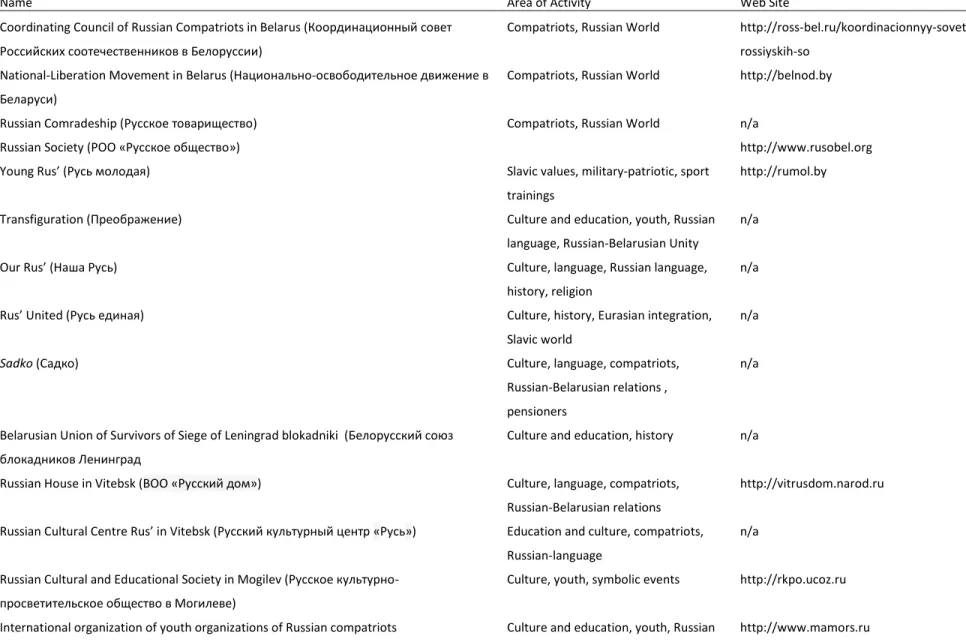
that operate in the EaP countries, there are numerous associations and local civil society organizations which often collaborate with them and others to promote and promulgate Russian interests. Examples of specific organizations and their areas of activity identified by experts in Belarus, Moldova and Ukraine can be found in Table 1.
In all three countries there is also some form of coordinating council for Russian compatriots, the loose term for ethnic Russians, Russian citizens and Russian speakers living outside the borders of the Russian Federation. These congresses or councils usually have close ties to the local Russian Embassy.
Transnational youth groups are often funded by Russian grants from Kremlin-approved foundations and agencies. Examples include the Eurasian Youth Movement, Young Eurasia or Sodruzhestvo (Lutsevych 2016: 22-23). Youth movements might actively promote Russian World values, such as Young Russia in Belarus (Kłysiński and Żochowski 2016: 27-28).
In addition, a variety of groups supporting Eurasian integration have emerged, and often at the same time promote an anti-EU narrative. These can address audiences in specific countries, such as the Recognition Foundation in Moldova, or they can work with local actors, such as Viktor Medvedchuk in Ukraine and his anti-EU NGO Ukrainian Choice (Lutsevych 2016: 20-22). In Belarus there are also organizations that promote Russian-Belarusian unity in particular. Table 1 presents an (non-exhaustive) overview10. In the majority of cases, there is a lack of transparency about where the grants and funds of these organizations originate from. Many websites include a list of links to ‘Partners’, but the nature of the partnership is usually not clear. In many cases, these partners are local Russian Embassies, and local offices of the Russkiy Mir Foundation and
Rosstrudnichestvo. One interesting example of a complicated network of connections can be found in Moldova. The League of Russian Youth from Moldova states on their home page that they receive no funding from Russia or other nations of the Commonwealth of Independent States (CIS). The head of the League is Igor Tulyantsev, who is also the founder of the local Community Fund, which provides grants to organizations in Moldova. This includes grants to the League of Russian Youth from Moldova. The Community Fund lists as its partners the
Russkiy Mir Foundation and the Russian Embassy in Moldova, but the nature of that partnership is not disclosed.
Table 1: Key Groups Promoting Russian Influence Active in Belarus, Moldova and Ukraine
A. Belarus
Name Area of Activity Web Site
Coordinating Council of Russian Compatriots in Belarus (Координационный совет
Российских соотечественников в Белоруссии)
Compatriots, Russian World
http://ross-bel.ru/koordinacionnyy-sovet-rossiyskih-so
National-Liberation Movement in Belarus (Национально-освободительное движение в
Беларуси)
Compatriots, Russian World http://belnod.by
Russian Comradeship (Русское товарищество) Compatriots, Russian World n/a
Russian Society (РОО «Русское общество») http://www.rusobel.org
Young Rus’ (Русь молодая) Slavic values, military-patriotic, sport
trainings
http://rumol.by
Transfiguration (Преображение) Culture and education, youth, Russian
language, Russian-Belarusian Unity
n/a
Our Rus’ (Наша Русь) Culture, language, Russian language,
history, religion
n/a
Rus’ United (Русь единая) Culture, history, Eurasian integration,
Slavic world
n/a
Sadko (Садко) Culture, language, compatriots,
Russian-Belarusian relations ,
pensioners
n/a
Belarusian Union of Survivors of Siege of Leningrad blokadniki (Белорусский союз
блокадников Ленинград
Culture and education, history n/a
Russian House in Vitebsk (ВОО «Русский дом») Culture, language, compatriots,
Russian-Belarusian relations
http://vitrusdom.narod.ru
Russian Cultural Centre Rus’ in Vitebsk (Русский культурный центр «Русь») Education and culture, compatriots,
Russian-language
n/a
Russian Cultural and Educational Society in Mogilev (Русское
культурно-просветительское общество в Могилеве)
Culture, youth, symbolic events http://rkpo.ucoz.ru
(Международная ассоциация молодежных организаций российских соотечественников -МАМОРС)
language, history
Belarusian civic organization Rus’ (Белорусское общественное объединение «Русь») Russians in Belarus n/a
Belarusian Literary Union Polotsk Branch (Белорусский литературный союз «Полоцкая ветвь»)
Culture, literature, Russian language https://polvetvby.wordpress.com
B. Moldova
Name Area of Activity Web Site
Coordinating Council of Russian Compatriots in Moldova (Координационный
совет российских соотечественников в Республике Молдова)
Compatriots, Russian World https://russkie.md
Congress of Russian Communities of Moldova (Конгресса русских общин
Республики Молдова)
Compatriots, Russian World http://krorm.ru
Community Fund (Фонд Содружество) Compatriots, Eurasian integration http://fond.md
Russian Community of the Republic of Moldova (Русская община Республики
Молдова)
Russian World, Russian language and
culture, Russian-speaking communities
http://rusmoldova.org
League of Russian Youth from Moldova (Лига русской молодежи Республики
Молдова)
Compatriots, Russian World, youth
groups
http://ligarus.org
Young Guard (Молодая Гвардия) Transnational youth group, joining
Eurasian Union
http://gardatinara.md
Women’s Association Rossiyanka (Ассоциация женщин Россиянка) - n/a
Centre for Russian Culture in Moldova (Центр русской культуры в Республике
Молдова)
Russian World, Russian language and
culture, Russian-speaking communities
http://ow.ly/Aa9L30cewSO
Association of Russian Artists from Moldova (Товарищество Русских
Художников Молдовы)
Russian World, Russian language and
culture
http://moldovart.com
Association of Russian Writers from Moldova (Ассоциация Русских Писателей
Республики Молдова)
Compatriots, Russian World, Russian
language and culture
https://www.facebook.com/arprmofficial/
Spiritual Russian Unity Movement (Движение «Русское духовное единство») Russian World, promoting Russian
language and culture
RUSI NGO Russian World, Russian culture
Informational, Analytical and Law Centre Advice to compatriots on moving to
Russia
n/a
C. Ukraine
Name Area of Activity Web Site
All-Ukraine Coordinating Council of Russian Compatriot Organizations
(Всеукраинский Координационный Совет организаций российских
соотечественников)
Compatriots, Russian World http://www.vksors.org
NGO Ukrainian Choice (Украинский выбор) Anti-EU http://vybor.ua
NGO Russian School (Русская школа) Education and culture, compatriots,
Russian-language, youth and sports
http://www.schoolru.com.ua
Kyiv Centre for Policy Research and Conflictology Policy research http://www.analitik.org.ua
3.4.
The Russian Orthodox Church
An actor that deserves special attention due to its importance as a channel for political influence and increasing reach is the Russian Orthodox Church (ROC).11 A recent survey has shown that there is a link between the self-identification as a member of the Orthodox Church and support for Russia’s role in the world as a ‘counterweight’ to the West in Central and Eastern Europe. The exception to this trend are citizens in Georgia and Ukraine (Pew Research Centre 2017).
The ROC is an important patron for initiatives aiming to link Orthodox Christians across Eastern Europe and to promote ideas of common identity. The Pew Survey quoted above showed that Russia was viewed as a protector of Orthodox Christians in the world by a majority of citizens of countries where orthodox religion was dominant. In Belarus, 76 % of citizens agreed with the statement that a strong Russia was needed to counterbalance the West, and in Moldova, 61 % agreed with the same statement. While only 22 % of Ukrainians agreed with the statement, the majority of those who agreed self-identified as Eastern Orthodox. The two most salient factors predicting support for Russia’s strong role in the world were the Orthodox religion and the belief that the respondent’s values differ from Western values.
According to some studies, while the ROC promotes a Russian cultural outlook, it does not always support the Kremlin’s political position (Hudson 2017: 31; Petro 2015). In Moldova’s latest elections, however, the branch of the Orthodox Church affiliated with the Moscow patriarchate took an overly political stance, conducting an aggressive campaign against pro-EU candidates.
The Church supports its own international events such as the Day of Baptism of Rus’ or organizations such as the charities of the so-called ‘Orthodox oligarchs’: the Foundation of St. Vasily or the Dialogue of Civilizations Endowment (Lutsevych 2016: 24-25). Some well-known public figures from the Orthodox Church have spread anti-EU rhetoric in Belarus and Moldova (Całus 2016: 69-70). Examples of such figures in Moldova are the bishop of Bălți, Marchel Mihaescu, or the priest and chair of the St. Matrona Christian Association, Anatolie Cibric. Moreover, the president of Moldova, Igor Dodon, decorated sixteen priests of the Orthodox Metropolitan Church of Moldova in July 2017 (Hendrik 2017) and has met with Patriarch Kirill of Moscow and All Russia four times since the beginning of his presidency during his official visits to Russia (The Russian Orthodox Church 2017). In Belarus the Metropolit Pavel of Minsk and Slutsk is also active in promoting ‘traditional’ values and organizing events such as the festival on Linii Stalina in 2015 and the youth educational forum Quo Vadis in 2016. The Belarusian Orthodox Church of the Moscow Patriarchate has been operating a number of so-called Orthodox military-patriotic clubs for many years (Kłysiński and Żochowski 2016: 32-33). Orthodox military patriotic clubs such as Druzjyna, Slavyane and Vitjaz are developed in theGrodno region of Belarus.
11
In Ukraine, it is important to distinguish between the positions of the Ukrainian Orthodox Church affiliated with the Moscow Patriarchate, which tends to be pro-Russian, and the Ukrainian Orthodox Church of the Kyiv Patriarchate, which is not recognized by the Moscow Patriarchate and is not pro-Russian. NGOs such as Orthodox Ukraine carry out youth and education projects with the Ukrainian Orthodox Church (affiliated to the Moscow Patriarchate).
The comparison between the role of the ROC in the three countries suggests that the church plays a politically salient and pro-Moscow role in both Belarus and Moldova. The military patriotic clubs organized in Belarus by the church are evidence that the church itself creates actors that promote pro-Russian ideas, for example the idea of the common Slavic roots. In Ukraine, the influence of the Russian affiliated branch of orthodoxy seems to be currently diminishing.
3.5.
Educational linkages
Higher education institutions in the Russian Federation are currently a popular destination for many students from EaP countries. Both Belarus and Moldova sent nearly 25,000 students each to study at Russian universities in 2014. The figures are lower for Ukraine: in the aftermath of the Euromaidan and the annexation of Crimea, Russia was the chosen destination for nearly 13,000 students from Ukraine. The number of Ukrainian citizens studying in Russian universities excluding the ones from Crimea is around 9,000. These make up approximately 15 % of the total number of Ukrainian students abroad, and represent 7 % of the foreign students studying in the Russian Federation. Remarkably, the number of Ukrainian students in the Russian Federation has actually increased almost by a third over the last two years. Such an increase is presumably caused by students coming from the conflict-zone territories of Donbas.
As the student numbers show, the situation in Ukraine stands out in the education field with its changing dynamics. There were multiple branches of Russian educational institutions in Crimea even before its annexation. However, currently there are no branches of Russian higher education institutions operating on Ukrainian territory that is controlled by the Ukrainian government.
The overview of linkages presented in this section and the examples of politically salient actions of pro-Russian actors and organizations appears to strengthen the existing interpretation of these actors as tools of Russian soft power. Coverage of organizations linked to Russia is also starting to become more prominent in the local media of EaP countries, reflecting both a potential intensification of these organizations’ activities, but also the increased awareness of their role in the region since the start of the conflict in Ukraine in 2014.
The (non-exhaustive) overview of linkages presented in this section also confirms our initial expectations that the landscape of organizations and actors would be influenced by the choices of gatekeeper political elites. In other words, domestic gatekeepers can to some extent prevent (as in the case of Ukraine), moderate, or enhance the influence of the Russian actors. The comparison between the actors and organizations active in the three countries reveals not only the downward trend in Ukraine, but also the density of organizations and actors linked to Russia in Moldova. Based on our discussion in the first part of this paper, we find that the abundance and diversity of linkages suggests both external interest to change political dynamics and choices in Moldova and the resonance with some Moldovan political elites. This abundance is very visible in both the business, cultural, and religious spheres and is enhanced by various competing groups in Moldova. In Belarus, the cultural and religious links are visible and appear stable for the last few years, whereas the business links seem much more covert and moderated by Lukashenka’s government.
In addition to the support or even the creation of local actors favourable to Russia, the media has been playing a significant role in spreading Russian messages targeting ‘the West’ as morally corrupt and weak. The news and perspectives promoted by Russian state-controlled TV have been a key element in spreading Russian influence (Lankina and Niemczyk 2014). What is less understood is the extent to which Russia’s narratives and the image it wants to project are reflected by national media in EaP countries, a gap which we address in the analysis presented here.
4.
Russia and the EU in the (National) News: A Three-Country Comparison
There is a separate and increasing set of Russian informational linkages based on media, including film, TV series and TV news. In Belarus and Moldova there is direct access to Russian media or repackaged reporting on local news drawing on Russian news agencies. In Belarus, for example, 90 % of the public is reported to watch Russian TV (Wilson 2015). Local branches of media projects such as Sputnik have the budget to attract quality local journalists from state and independent media (Bogomolov and Lytvynenko 2012: 8-10; Kłysiński and Żochowski 2016: 34-37).
A growing area of analysis concerns the spread of fake news and propaganda originating from Russia and targeting the EU member states or the EaP countries (Nimmo 2016; Pomerantsev and Weiss 2014; Potapova 2017). Analysing the spread of fake news and the reach of Russian propaganda is beyond the scope of this paper, but the importance of their increase should not be underestimated12. Think tanks, journalists and experts are increasingly monitoring propaganda and fake news and capturing the underlying narratives. Monitoring propaganda and fake news has uncovered their staggering scope, leading to calls by concerned
12 In recognition of the importance of this phenomenon, we provide an overview of some of the monitoring
experts and members of the European Parliament for an increase of the budget and staff of the EU’s EastStrat Com, the European External Service agency dealing with Russian disinformation (Bentzen 2017).
The EU features prominently in key narratives, being described as “weak and morally decaying” (Bentzen 2017). Recent research by the Wilfrid Martens Centre for European Studies shows that the Kremlin systematically spreads negative narratives about the EU to shape the opinion of the Russian speakers. The main narratives about the EU summarized in their study depict the EU as an aggressive and expansionist enemy, as a weak union that cannot deal with global challenges, and as a union lacking moral values (Potapova 2017). The content of narratives is as pernicious as the framing of messages, combining, in the words of Pomerantzev and Weiss (2014): “Soviet-era ‘whataboutism’ and Chekist ‘active measures’ with a wised-up, post-modern smirk that says everything is a sham”.
Russia’s investments into media and communications have been shown to cover three main areas: internally and externally focused media with a substantial online presence, use of social media, and discussion boards and language skills to engage target audiences (Giles 2015). In both Belarus and Moldova there are local editions of the Sputnik news portal, NTV and RTR television channels, the TASS news agency, as well as the newspapers Argumenty i Fakty and Komosomolskaya Pravda. In Ukraine local versions of various Russian news outlets have been banned since 2014.13 Even the independent online Russian TV station ‘Dozhd’, which is no cheerleader for Putin’s government, was banned in Ukraine in 2017.
In Belarus, there are also local branches of the Interfax and REGNUM news agencies. In Moldova, there are local versions of the Russian TV stations RenTV and STS. In addition, a feature of the information market in Moldova is the repackaging of material from Russia for Moldovan news channels. These include the newspapers United Gagauzia, Ekonomicheskoe Obozrenie and Trud, the news agencies Interlink and Infotag, and the web portal Russian TV of Moldova. Across the region there are also news sources which do not just repackage Russian news or have formal connections to Russian partners, but still take a pro-Russian stance. Examples include the online portals imho.by and zapadrus.su in Belarus as well as the newspaper Vesti in Ukraine.
Importantly, Russian information sources are very popular in Belarus and Moldova, where 91 % and 90 % of respondents respectively indicated their use. Russian TV channels are cited as the main source for news and current affairs programmes by 37 % of respondents in Belarus and 38 % in Moldova (Ecorys Annual Survey Report 2016). A project supported by the EaP civil society forum monitored news on the Russian channels watched in EaP countries in 201514. They found, not surprisingly, that the role of Russian channels as sources of information was more significant in the countries where they were freely available (Belarus, Moldova) than in countries where they were not (Azerbaijan, Georgia and Ukraine). On the general trend and tone of Russian channels, the study noted, as could be expected, the extremely limited range of topics and biased interpretations offered on Russian channels. For example, regarding Ukraine, the study found that “the main
13
Komsomolskaya Pravda in Ukraine changed its name to ‘KP’ in 2016 in response to the decommunization laws. While it typically takes a pro-Russia stance, it no longer has official ties to Russia.
14
An executive summary can be found via the memo 98 website:
Russian channels have been used as instruments of propaganda in the conflict between Ukraine and Russia, diverting attention from important domestic issues and challenges and instead focusing on the conflict in Ukraine” (Monitoring report executive summary, 2015: 3).
Notwithstanding the importance of Russian channels, national TV and media play an important role in opinion formation as they may be seen as more objective. National TV news are an important source of political news for the public in Belarus, Moldova and Ukraine. According to the Ecorys Annual Survey Report (2016), private and public TV stations are the most popular sources of national political news for 50 % of respondents in Belarus, for 56 % of respondents in Moldova, and for 62 % in Ukraine. However, there is no large private TV landscape in Belarus. Moreover, people from the EaP countries that have heard news about the EU, are most likely to have heard it on TV (81 % of respondents).
5.
TV-Monitoring: Russia and the EU in the National Evening News
5.1.
The objectives
For the analyses of Russia and the EU in local media in the three countries, we have focused on Belarusian, Moldovan, and Ukrainian TV stations with wide viewership. The media can be seen as proxies for political elites, who, as argued above, can act as gatekeepers filtering messages by different external actors. Therefore, we find domestic TV news a suitable departure point for our empirical investigation of the penetration of Russian messages and narratives in the societies in the EaP countries.
The major goal of the media monitoring and analysis presented in the second part of this paper is to provide not only a comprehensive picture of the news about Russia and the EAEU, but also of the view of the EU and its member states that regular people in Belarus, Moldova, and Ukraine are exposed to. We aim to identify the extent, tone, and type of coverage of Russia in the main evening news bulletins in the most watched TV stations. As argued above, democratization can be hampered not only by spreading pro-Russian messages, but also by undermining the democratizing actor in the region—the EU. For this reason, we look at the proportion of news devoted to Russia and to the EU, as well as the type and the tone of these messages. Furthermore, the potential tone or bias in news items about Russia or other external actors such as the EU may also resonate with existing discourses or, adversely, suggest a different world view. Exploring how Russia and the EU are presented in terms of tone in national news would further enhance our understanding of the informational environment in which citizens in the Eastern neighbourhood countries make their choices and judgments.
5.2.
Method
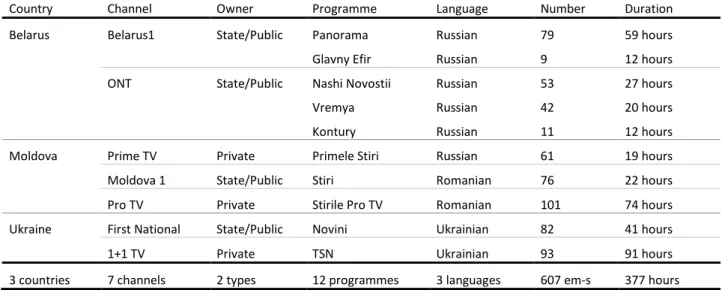
In each country, we covered the main evening news programme of the most popular TV stations (two TV stations in Ukraine and Belarus, and three in Moldova).15 The choice of channels to be monitored was driven by evidence about the most popular TV channels, where available, and by some country specific considerations.
15