THE NARRATIVE OF EMOTIONS TASK: A PSYCHOMETRIC STUDY OF SOCIAL COGNITION AND SOCIAL FUNCTIONING IN INDIVIDUALS WITH
SCHIZOPHRENIA
Benjamin Buck
A thesis submitted to the faculty of the University of North Carolina at Chapel Hill in partial fulfillment of the requirements for the degree of Master of Arts in the Department of Psychology.
Chapel Hill 2013
Approved by
David L. Penn
Donald H. Baucom
ABSTRACT
BENJAMIN BUCK: The Narrative Of Emotions Task: A psychometric study of social cognition and social functioning in individuals with schizophrenia
(Under the direction of David L. Penn)
Social cognitive deficits in schizophrenia are well documented and related to functional outcome. Current social cognition measures are often not psychometrically validated, too heterogeneous for standardization, and focus principally on one domain of social
TABLE OF CONTENTS
List of tables………...v
Section I. INTRODUCTION………6
II. METHODS………..10
Participants………...10
Development of the NET……….11
Social cognition measures………14
Functional measures……….16
Intellectual quotient……….17
Psychiatric symptoms………..17
Procedure……….17
Data analytic plan………18
III. RESULTS………20
Distributions………20
Reliability………20
Construct validity………21
Convergent and divergent validity………..22
Ecological validity……….………..22
LIST OF TABLES
Table
1. Index of the narrative domains, totaled across emotions……….……..30
2. List of all the social cognition indices………...31 totaled from narrative domains
3. Demographics of study participants……….…..32 4. Inter-correlations between the social cognition indices……….……33
and sociality score
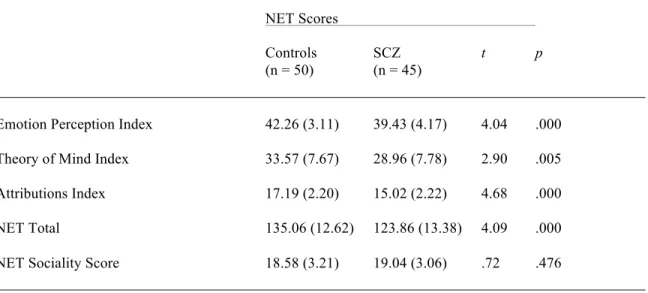
5. Means and standard deviations of schizophrenia and………34 control groups
6. Inter-correlations between the social cognition indices……….35 7. Ecological validity analyses showing correlations………36
1. Introduction
Individuals with schizophrenia show pronounced deficits in social cognition, a construct broadly understood as the ability of persons to think about themselves, others, and interactions (Penn, Sanna, & Roberts, 2007). These deficits have been shown to be non-redundant with neurocognitive impairments among individuals with schizophrenia (Couture, Penn, & Roberts, 2006). Relative to non-clinical controls, individuals with schizophrenia are impaired in theory of mind (d = -1.21) (Bora, Yucel, & Pantelis, 2009; Brune, 2005), emotion perception (d = -0.91) (Kohler et al., 2009), emotion processing (d = .64 to .72) (Cohen et al., 2008), and attributional style (Aakre et al., 2009). Though these deficits are generally not responsive to antipsychotic medication (Sergi et al., 2007), moderate-large treatment effects for emotion perception (d = 0.71 to 1.01) and small-moderate effects for theory of mind (d = 0.46) have been found as a result of social cognitive training programs (Kurtz & Richardson, 2011). In addition to being potentially amenable to psychosocial treatment, social cognition has been established as a predictor of functional outcomes (Couture et al., 2006; Fett et al., 2011; Kee et al., 2003).
Although the literature on social cognition in schizophrenia has grown
standards in the area (Yager & Ehrmann, 2006). Because of this, meta-analyses of this literature face methodological challenges because tasks representing a given construct (e.g., Theory of Mind) are sometimes heterogeneous (Hoekert et al., 2007). Thirdly, while social cognition tends to engage cognitive domains that are closely related if not largely overlapping (e.g., the simultaneous co-operation of interpreting another’s emotion while representing his or her mental state), most current measures attempt to focus
specifically on only one specific domain of social cognition. This is a methodological problem that could in part be addressed by a more thorough documentation of the factors that underlie social cognitive processing (Silverstein, 1997). Finally, many social
cognition tasks and measures involve non-personal stimuli (photos of unknown
individuals’ faces expressing a group of emotions) or otherwise contrived hypothetical scenarios that may be particularly detached from an individual’s experience of the world and social interaction (McDonald et al., 2003). This is a critical limitation in that it detracts from the measures’ ecological validity, as social interactions and their related processes are often fraught with personal significance.
with schizophrenia can be assessed through analysis of life stories (Lysaker et al., 2005). Pennebaker and others have used narrative to predict a variety of outcomes in a few different populations, including depressed young people (Rude et al., 2004) and those coping with trauma (Campbell & Pennebaker, 2003).
Narrative analysis has a number of advantages over standard social cognition measures. First, they provide insight into an individual’s personal sense-making of his or her environment, important others, and a range of emotions in a range of situations.
These modes of thinking could provide insight into individuals’ quality of social
cognition in a personalized and ecologically valid manner. Second, narrative speech
samples allow for simultaneous evaluation of the overlapping processes associated with
social cognition. Also, as this task captures a largely variable domain in a general
population, it is less likely that a narrative measure would suffer from ceiling effects than
a laboratory measure of discrete social cognition skill.
In recent years, narrative measures have been used with individuals with
emotional and social deficits. Losh and Capps (2006) conducted and coded interviews
with children with high-functioning autism (HFA) eliciting emotional narratives (e.g.,
“Tell me a time when you felt…”) covering a range of emotions including simple (happy,
sad), complex (curious, disappointed), self-conscious (proud, embarrassed), and
non-emotions (tired and sick). The most pronounced deficits for the HFA children (compared
to typically developing children) were for narratives pertaining to self-conscious
emotions, particularly the ability to organize narratives according to causal-explanatory
frameworks. Similar methodology was used by Gruber and Kring (2008) with a
narratives that were less appropriate to context, less “tellable” (a domain incorporating
elaboration, personal centrality, and grammar centrality), more detached (unclear
meaning, vague trailers, and many prompts), and less linear than those offered by
non-clinical controls.
For the present study, we adapted methods used by Losh and Capps (2006) and
Gruber and Kring (2008) into a measure of social cognition based on personal narratives
of people with schizophrenia, called the Narrative of Emotions Task (NET). Thus, the
primary aim was to examine the psychometric properties of the NET as a new measure of social cognition. Inter-rater reliability was examined via intraclass correlations between raters and a gold standard rater on a random sample of 23 interview transcripts. Construct validity was explored by examining group differences between participants with
schizophrenia and non-clinical controls; we hypothesized that controls would perform significantly better on the NET in all social cognition indices and total NET scores than participants with schizophrenia. Convergent validity was evaluated by examining the relationship between the NET social cognition indices (described in the Methods section) and current measures of social cognition. Ecological validity was evaluated in terms of the relationship between the NET and measures of social and role functioning. Finally, divergent validity was evaluated by examining the relationship between NET scores and performance on the verbal section of a brief IQ test, with the expectation that the
2. Methods
2.1. Participants
Fifty individuals meeting DSM-IV criteria for either schizophrenia or
schizoaffective disorder were recruited from the UNC Hospitals Schizophrenia Treatment and Evaluation Program (STEP), the Outreach and Support Intervention Services
(OASIS) program, and community mental health facilities in the Raleigh-Durham region. Interviewers reviewed participants’ medical charts, confirming diagnosis by
administering the Structured Clinical Interview for DSM-IV Patient Edition (SCID-P; First et al., 1996). In order to participate, individuals had to report difficulties interacting with others, as they were participating in a study evaluating the efficacy of social
cognition and interaction training (SCIT), a 20-24 week psychosocial intervention
targeting deficits in social cognition (Combs et al., 2007a; Roberts et al., 2006; Roberts & Penn, 2009). In order to meet this criterion, individuals had to receive a score of 2 or lower on select items of the social functioning scale (lower corresponds to greater impairment; SFS; Birchwood et al., 1990) or be referred from a clinician because of the presence of social functioning impairments. Individuals were excluded if they currently met DSM-IV criteria for substance dependence on the SCID-P, or scored an IQ of 80 or lower on the Wechsler Abbreviated Scales of Intelligence (WASI; Whitmyre & Pishkin, 1958). Participants continued their regular outpatient treatment and medications
A control group consisting of fifty English-speaking non-psychiatric controls from the Raleigh-Durham area was recruited with flyers and Internet postings. All non-psychiatric controls were between the ages of 20 and 65 years old and reported no first-degree relatives with a psychotic disorder, bipolar disorder, or autism. As summarized in Table 3, the groups were significantly different in marital status, education level, and on WASI performance total, as well as on the vocabulary and matrix reasoning subscales.
2.2. Development of the NET
2.2.3. The NET interview.
sociocultural norms or the expectations or appraisals of others (referred to here as self-conscious emotions) (Losh & Capps, 2006; Stipek, Recchia & McClintic, 1992). The NET includes emotions of all these types to provide a sampling of the kind of emotional experiences individuals might have in daily living.
2.2.3. Narrative of Emotions Task; item generation
Three research assistants (Ben Buck, Dr. Piper Meyer, and Betty Rupp) reviewed work on emotion narratives in schizophrenia and autism populations, consulting with researchers on the two most thorough studies in this area with these populations in recent years, Dr. Ann Kring (University of California at Berkeley) and Dr. Molly Losh
(Northwestern University). Drs. Kring and Losh provided anchors and supplementary documents from which the research assistants based their adapted rating scale. The three researchers reviewed all items from these prior projects, comparing and discussing items from the two previous scales as they applied to previously collected NET interviews. Items that achieved consensus for validity in social cognition assessment were added to the NET coding protocol, and anchor descriptions and responses were adapted to standardize all variables along a zero-to-three scale, with higher scores denoting better performance.
event elicited the target emotion), clarity of meaning, clarity of grammar, sociality (whether others were involved), and elaboration (the richness of narrative account, as evaluated by the amount of information provided about time, place, or other details). Because the scale aims to assess how the individual narrates events and engages in social cognition across events of differing emotional valence, these “narrative domains” are totaled across all emotions. See Table 1 for a full description of all items.
Narrative domains on the NET were, in turn, summed to create a variety of social cognition indices. Specifically, the definition of emotion and contextual appropriateness scales assess identification and understanding of emotional states. Therefore, they are summed to create an emotion perception index. A second index targets theory of mind. Social interaction draws on one’s theory of mind abilities in that individuals give
adequate amounts of information when aware of the listener’s relative lack of knowledge on a subject or story (Corcoran & Frith, 1996; Frith, 2004; Grice, 1975). Therefore, the level of specificity and richness one offers should be indicative of theory of mind
abilities. In addition, one’s ability to give a rich narrative of social or emotional events is dependent on one’s ability to represent the mental states of others, as well as the ability to reflect on and represent one’s own mental states in the past. As such, elaboration and presence of narrative scales assess the richness and coherence with which one explains emotional and social events. Therefore, they are summed together to create a theory of mind index. The causal inferences scale explores one’s explanation for why certain emotions were elicited during given events. Given the tendency of people with
how rich and nuanced a person’s attributions for emotional events are. Therefore, this causal inferences domain represents an attributional index.
The narrative domains of clarity of grammar and clarity of meaning are not totaled into a social cognition index, as there is no hypothesis regarding their relationship with social cognition; however, they are noted as potential object of future exploratory study with this measure and this population. Finally, the sociality narrative domain is totaled across emotions as well, and will be examined in the ecological validity analyses. See Table 2 for a full description of the social cognition indices.
2.3. Social cognition measures
2.3.1. Emotion perception.
Emotion perception was assessed using two related measures. The Face Emotion Identification Test (FEIT; Kerr & Neale, 1993) asks participants to identify the emotions expressed by 19 faces depicting six basic emotions (happy, sad, afraid, angry, surprised, and ashamed), and scores are totaled as number correct out of 19. The Face Emotion Discrimination Task (FEDT; Kerr & Neale, 1993) asks participants to determine whether two paired faces are expressing the same or different emotions out of a total of 30 pairs, with performance indexed as number correct out of 30. In the convergent validity analyses, each individual’s score on these measures will be converted to z-scores, and summed to create a composite index of emotion perception. In the schizophrenia sample, the FEIT and FEDT were significantly correlated, r = .43, p < .01, justifying the
combination of these measures as an aggregate Emotion Perception composite measure that considers two different methods of emotion identification.
Theory of Mind was assessed with two measures. The Hinting Task (Corcoran et al., 1995) involves participants interpreting ten brief written stories that require them to identify and make inferences involving others’ mental states. Scores range from 0 to 20 on the Hinting Task, with higher scores indicating better performance. The Awareness of Social Inference Test (TASIT; McDonald et al., 2003) consists of Yes/No questions related to four video-taped social vignettes requiring individuals to infer individual motives which may contradict verbal communication (e.g., sarcasm or “white lies”). The TASIT is scored based on number of correct responses out of 40 possible. In the
convergent validity analyses, these two scales will be converted into z-scores and summed to create a comprehensive measure of ToM (i.e. one that considers both verbal and visual ToM cues). In the schizophrenia sample, the Hinting Task and the TASIT were significantly correlated, r = .39, p < .01, justifying the combination of these measures as an aggregate Theory of Mind composite.
2.3.3. Attributional style.
The Ambiguous Intentions Hostility Questionnaire, Ambiguous Items (AIHQ-A; Combs et al., 2007b) consists of five second-person vignettes of negative social situations with ambiguous causal circumstances (e.g., “you are walking by a group of young people who laugh as you pass by”). The AIHQ-A breaks down into a hostility prompt (e.g., “Why did the teenagers laugh?”) an aggression prompt (e.g., “How would you
other (not at all to very much). These are standardized and totaled for an overall “blame index.” Following the interview, two independent raters compute a hostility bias related to interpretation of the other’s action (a Likert scale from 1 to 5, not at all hostile to very hostile) and an aggression bias related to the individual’s response to the action.
Therefore, three total indices will be included in convergent validity analyses: blame index, hostility bias, and aggression bias, and total.
2.4. Functional Measures
2.4.1. Social functioning.
The Social Skills Performance Assessment (SSPA; Patterson et al., 2001) is an observer-rated assessment of social skill performance in two three-minute role-play conversations with a confederate. First, the participant is instructed to role-play a conversation with a new neighbor who has just moved to the area and second, a
role plays for the total SSPA score, the relationship between total performance on each role play was examined, resulting in a significant correlation, r = .62, p < .001.
2.4.2. Role functioning.
The Role Functioning Scale (RFS; McPheeters, 1984) is an interviewer-rated assessment of functioning based on a semi-structured interview covering four domains: independent living, work performance, as well as immediate and extended work social relationships. Scores on this scale range from 1 to 7, with higher scores indicating better functioning.
2.5. Intellectual quotient
The Wechsler Abbreviated Scales for Intelligence (WASI) is a brief version of a full assessment of intelligence quotient, comprised of our subtests of the full Wechsler Adult Intelligence Scales (WAIS): block design, similarities, vocabulary, and matrix reasoning. To minimize the length of long study visits, only select subscales of the WASI were administered. Participants were administered the vocabulary subscale as
representative of Verbal IQ, and the matrix reasoning subscale as representative of Performance IQ.
2.6. Psychiatric symptoms
The Positive and Negative Syndrome Scale (PANSS; Kay et al., 1987) is an interview-based measure comprised of 30 items assessing for positive and negative symptoms of schizophrenia, as well as general psychopathology symptoms. Interviews were completed by graduate students or trained staff with experience working with a schizophrenia-spectrum population.
Advanced graduate students and staff with experience working with this
population conducted all interviews comprising NET, social cognition, and functioning measures. Coders were required to reach acceptable levels of inter-rater reliability (ICCs and Kappas > .80) on all interview-based measures.
All NET interviews were conducted during the baseline visit for each participant. These interviews (usually lasting between 7 and 10 minutes) were videotaped, and transcribed by research assistants. Transcripts of these interviews were then coded as stipulated by the NET coding scale by two advanced psychology-major undergraduate research assistants trained by developers of the adapted coding scale. Coders trained on up to five practice NET transcripts, then coded the remainder of transcripts according to the protocol attached in Appendix 1.
2.8. Data analytic plan
2.8.1 Reliability analyses.
Inter-rater reliability on the NET was evaluated by examining intraclass
correlations between all trained raters with a gold standard rater who developed the scale (BB) for the NET emotion perception index, NET theory of mind index, NET attribution index, NET sociality total and NET total score on a randomly generated subset of NET transcripts.
2.8.2. Construct validity analysis.
influence of general verbal intelligence on NET performance, as it is also a verbal task. We will also examine the inter-correlations among the social cognition indices for each group separately.
2.8.3. Convergent and divergent validity analysis.
Convergent validity was evaluated via the relationship between the NET and the social cognition measures. Specifically, the NET emotion perception index (combined domains of definition of emotion and contextual appropriateness) was correlated with the standardized emotion perception task (FEIT + FEDT). The NET theory of mind index (combined domains of presence of narrative and elaboration) was correlated with the standardized composite score from the two measures of theory of mind (The Hinting Task + TASIT). The NET attribution index (domain of causal inferences) was correlated with each scale of attributional bias: hostility bias, aggression bias, blame index, and AIHQ total. All correlations were hypothesized to be positive, except for the measures of attributional bias, which are hypothesized to be negative. The relationships of NET Total scores were also examined with all social cognition comparison measures. Divergent validity was evaluated by conducting a correlation between total NET score and WAIS IQ score, with the expectation that the relationship would be non-significant.
2.8.2. Ecological validity analysis.
Ecological validity was explored through a correlational analysis of the
3. Results
3.1. Distributions
In regard to the distribution of NET scores, we defined outliers as scores higher (or lower) than two standard deviations from the mean, finding nine total outlier data points across all subscales and total scores on the NET, from five individual participants, two from the control group, and three from the schizophrenia group. The influence of outliers was reduced by winsorizing them, so that they were within the two standard deviation range. We then examined the normality of NET total and subscales using the Shapiro-Wilk’s test of normality. Two subscales deviated from normality: the attributions index (.94, p = .04) in the schizophrenia sample and the sociality score among controls (.94, p = .02). The attributions index among participants with schizophrenia was slightly negatively skewed (skewness = -.28), while the sociality score among controls was highly leptokurtic (kurtosis = 3.28).1
3.2. Reliability
3.2.1. Inter-rater reliability
1 Transformations to correct for non-normal distributions were not conducted for the following reasons:
Intraclass correlations were calculated for the social cognition indices between two trained raters and a gold standard rater who co-developed the scale (BB) on a randomly-selected subset of NETs including both participants with schizophrenia (n = 17) and controls (n = 6). For the emotion perception index (ICC = .63, .69), theory of mind index (ICC = .83, .89), and NET total score (ICC = .84, .91), the intraclass coefficients were acceptable to very good. Both the sociality score (.55, .85) and attribution index (ICC = .45, .79) had one rater that did not reach acceptable reliability.
3.1.2. Internal consistency
Social cognition indices consisted of categories that were computed according to our hypothesized theory linking specific areas of narrative performance to social
cognition. Because of this, these factors were not created using exploratory factor analysis. Internal consistency was relatively high for the Theory of Mind index (α = .73), NET total score (α = .80), but was lower for the emotion perception (α = .52) and attribution indices (α = .47), and sociality scores (α = .52).
3.3. Construct validity
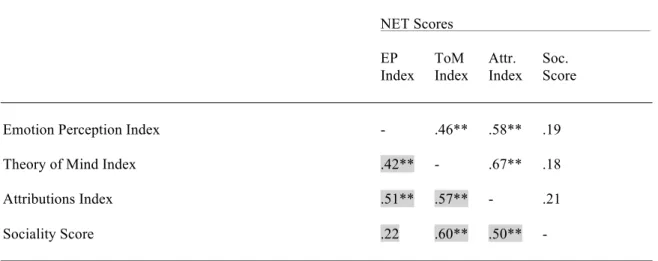
the schizophrenia group, with particularly high correlations between Theory of Mind Index and Attributions Index. A similar pattern was found in the control group; however, no subscales were inter-correlated with the Sociality score.
3.4. Convergent and divergent validity
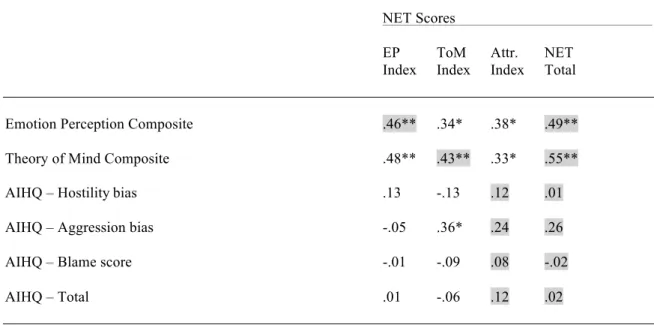
As summarized in Table 6, the Theory of Mind Index was significantly associated with the theory of mind composite measure (Hinting + TASIT), and the Emotion
Perception Index was significantly associated with the emotion perception composite measure (FEIT + FEDT). The attribution index was not associated with the AIHQ blame score, aggression, hostility bias, or total scores. As the NET is hypothesized to be an integrated measure of social cognition, we also examined the relationships between NET total scores and each domain. There were significant relationships between NET total scores, and the composite measures of emotion perception and theory of mind.
To examine divergent validity, NET total scores were correlated with
performance on the verbal portion of the WASI, resulting in a significant relationship, r = .34, p = .02. To account for the influence of Verbal IQ, the convergent validity analyses were repeated controlling for Verbal WASI; the results were unchanged.
3.4. Ecological validity
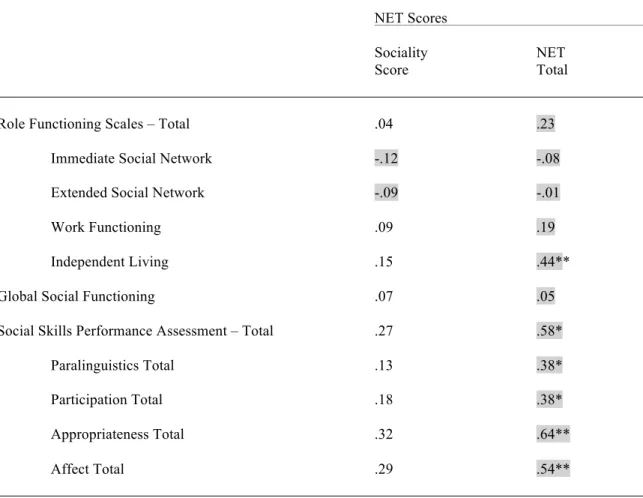
As summarized in Table 7, Total NET scores were significantly correlated with the paralinguistic, participation, appropriateness and affect scores, as well as overall performance on the SSPA (role play test). When controlling for Verbal IQ, the
4. Discussion
The present study sought to evaluate the psychometric properties of the Narrative of Emotions Task as an integrated and personalized measure of social cognition. Overall, the NET has good inter-rater reliability, is successful in differentiating between those with schizophrenia and non-clinical controls, and has evidence of convergent, divergent, and ecological validity. While the NET is not without limitations, this study supports its continued use and expansion. Further questions raised by the present study include the latent factor structure of the NET, as well as its use as an indicator of social cognition, social functioning, or a combination of the two. Nonetheless, most importantly, the present study provides initial evidence for the feasibility and effectiveness of measuring social cognition in an integrated and personalized manner via eliciting emotional
narratives.
one item per emotion narrative) or may have conceptual differences among items (emotion perception index draws on aspects of both one’s definition of the emotion, and their narrative), which may reduce reliability. Second, the NET involves performance across a range of emotions that could elicit differential performance consistent with the idea that some emotions are easier to identify than others (Kohler et al., 2003). While the present study was insufficient in sample size to conduct exploratory or confirmatory factor analysis, the hypothesized and tested structure provides a first attempt at examining the varying social cognitive skills involved in emotional narrative. Future research should examine factor structure, especially in light of the pattern of highly inter-correlated social cognition indices.
Convergent validity analyses lent support for the notion that the NET taps into aspects of emotion perception and theory of mind. These relationships were unchanged after controlling for verbal IQ. However, there is no evidence that it is associated with attributional bias. The lack of a relationship with attributional bias in the NET is consistent with early research on the factor structure of social cognition in individuals with schizophrenia, according to which measures of attributional style load on their own separate factor, distinct from (and uncorrelated with) measures of emotion perception and theory of mind (Mancuso et al., 2011). This could be a result of a separable attributional style factor, or could be a product of the methods of measuring attributional style (Combs et al., 2007), in that it is identified as a cognitive style, rather than a skill-based trait domain like theory of mind and emotion perception.
were not hypothesized: NET Theory of Mind index with composite emotion perception, NET emotion perception and composite theory of mind, as well as NET attributions index with both composite emotion perception and theory of mind. This again
underscores the point that while narrative performance is indicative of social cognition capacity, it remains unclear how specific domains within the NET are isolating subscores of each component of social cognition. The issue of conceptual and empirical overlap within social cognition measures is not unique to the NET; many social cognitive measures used in schizophrenia research have not been thoroughly reviewed for their factor structure or relationship to functional outcome. These concerns – along with other more general issues with reliability and validity – have prompted the Social Cognition Psychometric Evaluation (SCOPE) project (Pinkham et al., under review), which has tasked an expert panel with identifying social cognition domains, selecting tests to measure those domains, and a large-scale evaluation of the psychometric properties of those tests.
the product not only of skills competence, but also negative symptoms and other intervening factors like motivation, social environment and depressive symptoms (Harvey, 2010). Second, many have noted the small overlap between self-report of cognitive impairment and actual performance on a battery of cognitive assessment (as low as Pearson’s r of .04; Keefe, Poe, Walker, Kang & Harvey, 2006). Considering the complexity of functioning assessment in schizophrenia, it could be the case that the NET is an effective cognitive measure in predicting skill competence (as evidenced by the SSPA) but does not account for intervening factors between skill competence and measures of objective functioning.
The findings point to a number of issues that need to be considered in future research. First, the size of the study prevents the use of factor analysis to identify an empirically defined factor structure of the NET. Second, there was no evidence that the NET measures attributional style; taken together with the limited reliability and non-normality of the attribution index, the present study does not support its further use. Third, there also appeared to be little incremental validity provided with the NET
sociality score, which lacked significant relationships with measures of outcome and was not normally distributed. And fourth, there remain additional questions that should be asked about the NET and other narrative measures of social cognition in further research, including whether or not the NET exhibits short-term test-retest reliability,
responsiveness to treatment, and prediction of treatment and functional outcomes prospectively.
Table 1. Index of the narrative domains, totaled across all emotions. Narrative domain (scored on
every emotion)
Definition of the domain Anchors
1. Definition of emotion Whether participant correctly
defines the target emotion 0 = no response/I don’t know 1 = incorrect response 2 = correct example, but not a definition
3 = correct definition 2. Presence of narrative Whether the participant
presents narrative with two temporally ordered clauses of which the individual is the protagonist
0 = no response/I don’t know 1 = unspecific narrative event 2 = clauses do not connect temporally (no time passes) 3 = 2 temporally ordered clauses, specific event, participant is protagonist 3. Contextual
appropriateness
Extent to which narrative account is normative to the target emotion
0 = no response/I don’t know 1 = inappropriate context 2 = moderately appropriate 3 = appropriate
4. Causal inferences Whether the participant explains why the event elicited the target emotion
0 = no response/I don’t know 1 = no causal circumstances given
2 = causal circumstances after prompt
3 = causal circumstances in initial response
5. Clarity of meaning Extent to which overall response is clear with regards to content of overall response
0 = no response/I don’t know 1 = unclear
2 = moderately clear 3 = clear
6. Clarity of grammar Extent to which overall response contains clear grammar
0 = no response/I don’t know 1 = 3+ grammar errors 2 = 1-2 grammar errors 3 = 0 grammar errors
7. Elaboration Extent to which narrative
account is richly elaborated with additional details
0 = no response/I don’t know 1 = 0 additional details to event
2 = 1-2 additional details 3 = 3+ additional details
8. Sociality Extent to which others are
involved in the narrative
0 = no response/I don’t know 1 = no others involved 2 = others mentioned, but not as participants
3 = others involved as participants in the story All domains above are rated on all 8 emotions in the NET interview, overall performance on each narrative domain, therefore, scores range from 0 to 24.
Table 2. List of all the social cognition indices summed from the narrative domains on the NET.
NET social cognition index NET narrative domain Analysis
Emotion perception index 1. Definition of emotion
3. Contextual appropriateness Convergent validity #1: Pearson correlation with standardized composite of FEIT and FEDT.
Theory of mind index 2. Presence of narrative 7. Elaboration
Convergent validity #2: Pearson correlation with standardized composite of Hinting Task and TASIT.
Attribution index 4. Causal inferences Convergent validity #3:
Pearson correlation with AIHQ Aggression Bias, Hostility Bias, Blame Index and Total score.
Sociality score 8. Sociality Ecological validity #2:
Pearson correlation (sociality score and social scales of RFS, SSPA)
NET Total score 1. Definition of emotion
2. Presence of narrative 3. Contextual appropriateness 4. Causal inferences
5. Clarity of meaning 6. Clarity of grammar 7. Elaboration
Ecological validity #1:
Pearson correlation with SSPA Divergent validity #1:
Pearson correlation with WASI IQ
Construct validity #1: Group differences between
schizophrenia participants and non-patient controls.
Exploratory: Pearson correlation with composite social cognition measures (Untotaled into indices,
potential target for future research)
5. Clarity of meaning 6. Clarity of grammar
Table 3. Demographics of study participants.
Group
Controls SCZ Test for differences
(n = 50) (n = 45)
Age 39.86 (9.85) 38.54 (12.14) t = .58 p = .56
Education (years) 13.40 (1.18) 12.22 (1.30) t = 4.64 p = <.001
Gender Χ2= .005 p = .95
Male 33 (66.0%) 30 (66.7%)
Female 17 (34.0%) 15 (33.3%)
Race Χ2= .133 p = .71
White 34 (68.0%) 29 (64.4%)
Black 16 (32.0%) 16 (35.6%)
Marital Status Χ2= 24.66 p = <.001
Married 23 (46.0%) 1 (2.2%)
Single/Never Married 20 (40.0%) 31 (68.9%)
Divorced 7 (14.0%) 12 (26.7%)
Widowed 0 (0.0%) 1 (2.2%)
Age of first hospitalization - 23.09 (9.16) -
-Numberofprevioushospitalizations - 6.43 (7.13) -
-Symptom severity ratings
PANSS Positive - 16.13 (4.80)
PANSS Negative - 14.96 (4.38)
PANSS General - 33.44 (7.42)
PANSS Total - 64.53 (13.00)
WASI Total# 110.80 (15.00) 100.33 (15.12) t = 3.38 p < .01
WASI Vocabulary 56.26 (9.71) 48.18 (11.21) t = 3.77 p < .01
WASI Matrix Reasoning 55.50 (10.14) 51.36 (10.17) t = 1.99 p = .05
Table 4. Means and standard deviations for schizophrenia and control groups.
NET Scores
Controls SCZ t p
(n = 50) (n = 45)
Emotion Perception Index 42.26 (3.11) 39.43 (4.17) 4.04 .000
Theory of Mind Index 33.57 (7.67) 28.96 (7.78) 2.90 .005
Attributions Index 17.19 (2.20) 15.02 (2.22) 4.68 .000
NET Total 135.06 (12.62) 123.86 (13.38) 4.09 .000
NET Sociality Score 18.58 (3.21) 19.04 (3.06) .72 .476
Table 5. Inter-correlations between the social cognition indices and sociality score.
NET Scores
EP ToM Attr. Soc.
Index Index Index Score
Emotion Perception Index - .46** .58** .19
Theory of Mind Index .42** - .67** .18
Attributions Index .51** .57** - .21
Sociality Score .22 .60** .50** -
^P<.10; * P< 0.05; ** P < 0.01
Table 6. Convergent validity analyses showing correlations between the social cognition indices and measures of social cognition.
NET Scores
EP ToM Attr. NET
Index Index Index Total
Emotion Perception Composite .46** .34* .38* .49**
Theory of Mind Composite .48** .43** .33* .55**
AIHQ – Hostility bias .13 -.13 .12 .01
AIHQ – Aggression bias -.05 .36* .24 .26
AIHQ – Blame score -.01 -.09 .08 -.02
AIHQ – Total .01 -.06 .12 .02
^P<.10; * P< 0.05; ** P < 0.01
Table 7. Ecological validity analyses showing correlations between the social cognition indices and social functioning.
NET Scores
Sociality NET
Score Total
Role Functioning Scales – Total .04 .23
Immediate Social Network -.12 -.08
Extended Social Network -.09 -.01
Work Functioning .09 .19
Independent Living .15 .44**
Global Social Functioning .07 .05
Social Skills Performance Assessment – Total .27 .58*
Paralinguistics Total .13 .38*
Participation Total .18 .38*
Appropriateness Total .32 .64**
Affect Total .29 .54**
^P<.10; * P< 0.05; ** P < 0.01
Appendix 1:
Protocol for interviewers to follow for NET interviews (Formerly Titled Emotional Knowledge Task), as well as the sheet of emotions given to the participant during the
interview.
EMOTIONAL KNOWLEDGE TASK
**VIDEO-RECORD TASK**
What does mean? (give correct definition if they’re off base)
Can you tell me about a time you felt ? (give example if they can’t come up with account)
Why did that make you feel ____________? (complete statement using their example and emotion)
Afraid Happy Tired Guilty Angry Surprised Ashamed Sad Sick
Suspicious
Prompts
• If they are unable to relate an experience with the emotion in question, provide an example of a time that you felt that way (refer to scripted list) and inquire again. • Prompt for a specific time they felt the feeling in question (i.e., “I’m happy at holidays”
would be prompted “Can you tell me about a specific time you felt happy during a holiday?”
Definitions and scripts:
Afraid: scared, frightened;
I felt afraid when I heard a loud noise outside at night.
Happy: feeling good, cheery, glad, joyful;
I felt happy when I got just what just what I wanted for my birthday
Tired: sleepy;
I felt tired when I stayed up really late to get my work done
Guilty: feeling like you’ve done something wrong or immoral
I felt guilty once when I borrowed a book from my friend and I never returned it
Angry: mad;
I felt angry when somebody cut in front of me in line
Surprised: when something unexpected happens;
I felt surprised when my aunt came to town and I didn’t know she was coming
Ashamed: feeling disgraced, bad about something you did or how you acted I felt ashamed of myself once when I cheated on a test.
Sad: unhappy, down in the dumps; I felt sad when my dog ran away
Sick: ill, not healthy;
I felt sick when I was driving on windy roads after lunch yesterday. It made me feel like I was going to throw up
Afraid
Happy
Tired
Guilty
Angry
Surprised
Appendix 2:
NET (formerly titled Emotional Knowledge Task) coding protocol.
EMOTIONAL KNOWLEDGE TASK
CODING MANUAL
Adapted for use from:
Losh, M. and Capps, L. (2006) Understanding of Emotional Experience in Autism: Insights from the Personal Accounts of High-Functioning Children with Autism. Developmental Psychology, 42(5), 809-818.
Gruber, J. and Kring, A. (2008) Narrating Emotional Events in Schizophrenia. Journal of Abnormal Psychology, 117(3), 520-533.
Piper Meyer Betty Rupp Benjamin Buck David L. Penn
The emotional knowledge task assesses aspects of social cognition and experience based on a semi-structured interview that typically lasts between 8 and 12 minutes. The task is intended to assess knowledge of emotion, its integration into narrative, and one’s ability and clarity in communicating about personal emotional events in the past.
Task Structure and Coding Notes
There are a total of 10 emotions in this task. Each emotion consists of 3 different
responses that the participant is asked to provide. Interviewer questions are as follows: A. What does mean? (DEFINITION)
• Participant is asked to define the emotion
• If participant cannot come up with a definition, then the interviewer gives one • If participant’s definition is questionable or incorrect, then the interviewer may
add on to or correct the participant’s definition
• Emotions used in this task are listed below
• If interviewer asks for the extra emotions disgusted, contempt, proud, or
embarrassed, simply skip and do not code that section for that emotion. Only a small portion of interviews will include these. See below for the 10 emotions that will be coded.
1.Afraid 4. Guilty 7. Ashamed
2. Happy 5. Angry 8. Sad
3. Tired 6. Surprised 9. Sick
10. Suspicious
B. Can you tell me about a time when you felt ___ ? (MEMORY)
• Participant is asked to share a time when they felt the emotion
• If participant gives a general response, interviewer may prompt for a specific
time when the emotion was felt (see item 5 below)
• If participant cannot provide a time when they felt that emotion, then
interviewer may provide an example (see Emotional Knowledge Task for some of the examples used)
C. Why did that make you feel ____________? (PROMPT)
• Participant is asked why they felt the emotion
• Participant may give the why with their response to the MEMORY; interviewer
Coding Manual Layout and Coding Notes
1. The coding scheme is comprised of the following eight items with 0 – 3 points possible: a) Definition of emotion
b) Presence of narrative: coders will also tally the number of clauses in the MEMORY for this item but these will not be included in Total
c) Contextually appropriate circumstances
d) Causal inference: coders will also rate response as having internal, external/personal, or external/situational causality
e) Clarity of meaning: coders will also note if participant responses possess any of the following referents: contradictory statements, unspecified referents,
disorganized presentation, word substitution, tangential speech f) Clarity of grammar
g) Elaboration h) Sociality
2. Each emotion is categorized as follows and noted on the coding sheet next to each emotion header:
• simple (S)
• complex (C)
• self-conscious (SC)
• non-emotion (N)
3. As a general coding rule, please code the lower score when the response is an “even draw” between two ratings (i.e. if you can’t decide between a 2 and 3, code as a 2).
4. If there are “X’s” in the transcription for the parts of participant responses that are inaudible, rate as much as you can through inference of what is missing. If the coding of a response is completely impeded by “X’s”, then note this on the rating sheet and do not rate the response.
5. If a participant gives the MEMORY (and/or PROMPT) response immediately after the
DEFINITION before the interviewer asks for it, you may code as usual.
6. If a participant’s MEMORY response is a general statement (can you tell about a time you felt tired: “I’m tired in the mornings”), interviewers may prompt participants to provide a specific account (can you tell me a specific time you felt tired: “I was tired this morning”). The section of the reply used to score the MEMORY response should begin with the specific memory cited and not include the general statement.
7. If a participant gives multiple specific responses to the MEMORY response, code the first specific response unless the participant specifies which one they wish to use.
a) Definition of emotion: This scale is used to determine the correctness of the definition offered by the participant.
The following index can assist in determining whether the answer provided should be coded as correct (0-3): - Afraid: scared, frightened, fearful, feeling apprehension
- Happy: feeling good, cheerful, glad, joyful
- Tired: sleepy, worn out, worn down, exhausted, fatigued
- Guilty: feeling like you’ve done something wrong or immoral, culpable - Angry: mad, enraged, outraged
- Surprised: when something unexpected happens, to discover suddenly
- Ashamed: feeling disgraced, feeling embarrassed about something you did or how you acted - Sad: unhappy, down in the dumps, depressed, sorrowful, mournful
- Sick: ill, not healthy, ailing
- Suspicious: to suspect someone, to be distrustful, paranoid, to be questionable
0 = no response or “I don’t know”
1 = attempted but incorrect response; response is a related emotion or an example of a related emotion; response contains the emotion as an integral part of the definition
2 = response was an appropriate example but not a definition 3 = correct definition
1 = incorrect response: (ASHAMED)“worrying people to death”
related emotion: response is a definition of a similar emotion, response does not contain sufficient detail to distinguish the definition from a similarly positive/negative emotion; (TIRED)“being stressed out and stuff”, response is a related emotion because definition would be same for anxious
example of a related emotion: response is an example that could be used for a similar emotion; (SURPRISED)
“when you open presents, and uh, birthdays, and holidays and stuff”, response is a related example because it could describe happy as well
emotion as an integral part of the definition: response contains the emotion without enough other information to qualify as a definition or an example; (GUILTY) “ a guilty conscience”, (SURPRISE) “a birthday surprise”;
2 =appropriate example: (SICK) “you got a cold or flu or something”, (HAPPY)“like going to parties and stuff”
(ANGRY) ”like feeling really bad but in a mean way”
emotion is part of response but contains enough information to rate item higher: (GUILTY) “a guilty conscience, your conscience bothers you”; (SURPRISE) “a birthday surprise that is unexpected”
Note: If response contains 2+ possible ratings apply (i.e. both a 1 for an appropriate example AND a 3 for a correct definition), award the maximum points
b) Presence of narrative: This scale assesses whether a participant personalizes and integrates memories of emotional experiences into specific narrative accounts and is used only for MEMORY response. As part of this scale, coders will also tally the number of clauses within the MEMORY response to rate Length.
Clause: A subject and a verb along with its associated descriptors. Do not count clauses like “I guess” “I think,” “I felt tired when…” OR repeated clauses that provide the same information (“she went up on my hair… she went up on it” [one clause]).
- 1 clause = “I was tired when I walked around the track three times”
- 2 clauses = “I was tired whenI walked around the track three times, so I drank some water.” - 3 clauses =“I was tired when I walked around the track three times, so I drank some water. It was
hot.”
0 = no response, “I don’t know”, OR fewer than two clauses
1 = clauses do not cast participant as the protagonist in a specific narrative account 2 = clauses do not connect temporally (no time passes)
3 = two or more clauses, story is a specific narrative account (versus a general statement), story is told from a first-person evaluative perspective where the participant is cast as protagonist, and clauses are connected by some temporal arrangement (where time passes)
Figure 1. Decision tree for “Presence of narrative”
First,
Are there two or more clauses?
(See examples for length above)
NO, Code “0”
YES, move on to
next box
Second,
Is the participant cast as protagonist in a specific narrative account (the event described is specific, not general, and
happened to them)?
NO, Code “1”: “I’ve felt guilty a lot, like when I used to cheat on tests or like if someone steals a library book or something”.
YES, move onto next box: “I felt guilty when I forgot to pick up my son from school, he was disappointed in me.”
Third,
Are the two clauses temporally ordered
(time passes between
them)?
NO, Code “2”:
(HAPPY) “I wassurprised when I went to that amusement park”
YES, Code “3”:
Start: Is the event contextually appropriate for the emotion being
asked within the context of the MEMORY? (Yes/No)
Yes, fully appropriate;
Code “3”
Yes;
Code “2”
No: Does the event become contextually appropriate with
context from the PROMPT?
(Yes/No)
No;
Code “1”
Moderately appropriate;
Code “2”
c) Contextually appropriate circumstances: Assess the extent to which the overall narrative content matches the emotion being asked. Use content from both
MEMORY and PROMPT to code this, focus on the main event given within the MEMORY response.
0 = no response or “I don’t know” 1 = incorrect/inappropriate context
2 = moderately appropriate context/response is a rewording of example given by interviewer
3 = appropriate context
1 = a response was not normative with respect to the emotion being asked; MEMORY consists of actions and events that do not typically elicit the emotion being asked, even with context from the PROMPT (“I
was embarrassed when I got to help wash the car…because it was hot out”)
2 = a response was moderately appropriate but somewhat odd with respect to the emotion being asked; response elicits feelings that may match the emotion, but response does not contain sufficient detail or explanation to distinguish the emotion from a similarly positive/negative feeling (“I was sad when I stole
from the grocery store…because it was wrong”)
rewording = interviewer example: “I felt guilty when I cheated on a test. Can you think of anything like that?” participant response:“Yeah, I felt guilty when I cheated on a test back in high school.”
3 = a response was normative to the emotion being asked; accounts tend to elicit the emotion within the described context (“I was happy when I got to go to my favorite restaurant for my birthday”) or include explanations within the MEMORY clarifying why the particular event was associated with the emotion in question (“I felt guilty when I didn’t go to the movies after I told my friend I would meet her there”)
Figure 2. Decision tree for “Contextually appropriate circumstances”
d) Causal inferences: This scale assesses whether the participant explains why the described eventelicited the target emotion. If applicable, coders will also note whether the causal inference is internal/personal, external/personal, or
external/situational. Focus on the cause clause given within either the MEMORY or the PROMPT.
- Internal/Personal = causality is assigned to factors within the person, to variables that make the person responsible (TIRED) “…because I stayed up really late the night before”;
(HAPPY)“…because I got to help someone else.”
- External/Personal = causality is assigned to another person, to variables that make the other person responsible (TIRED) “…because my neighbor was having a party and it kept me up late”;
(HAPPY)“…because someone gave me a present.”
- External/Situational = causality is assigned to an outside factor, to something beyond the person’s control
(TIRED) “…because traffic noise kept me up all night”; (HAPPY)“…because the sun came out.”
- N/A = no causal inferences given; no response or “I don’t know”
0 = no response or “I don’t know”
1 = no causal circumstances given, or causal circumstances do not connect event to emotion
2 = causal circumstances included, but only with PROMPT
3 = causal circumstances included within the MEMORY (without PROMPT)
1 = causal circumstances that elicit the emotion are not present within the participant response, or they are not appropriately connected. (“Last week I felt angry when my boyfriend was late getting home”
[PROMPT] “It made me angry because he went to his brother’s birthday party”)
PROMPT is a rewording of the main event with no extra details. (MEMORY: “I was tired last night”
PROMPT “because I was tired”)
2 = causal circumstances that describe why an event elicited an emotion are explained, but only after the PROMPT is given. (“Last weekI felt angry when my boyfriend was late getting home”…
[PROMPT]“because he promised he would be home at 7pm.”)
e) Clarity of Meaning: This scale assesses whether the participant is clear in communicating their response. Rate overall for MEMORY and PROMPT while noting which of the below examples are present if applicable. Keep in mind the conversational context of the task, where the normal flow of conversation may be different than the normal written language.
- Contradictory Statements (CS): Two pieces of information within the same answer contradict one another (“I can’t be surprised but I was surprised when my friends came to see me”)
- Unspecified Referents (UR):Elements important to the answer are omitted, vague, or unclear (“I
was angry when it blew up”; “Maybe I was angry one time” )
- Disorganized Presentation (DP): Pieces of information are presented in a disorganized or confusing way (“When I had the flu, I was at home. I was sleeping and not sleeping and I was
sick”)
- Word Substitution (WS): Words are substituted for one another in the midst of an answer (“I felt
happy when I had a restaurant, I mean a party at a restaurant for my birthday”)
- Tangential (T): A piece of information provided does not answer the question and breaks up the flow or clarity of the intended response (“I really don’t know if I have ever been guilty. My
brother got in lots of trouble in school”)
0 = no response or “I don’t know”
1 = unclear; significant difficulty in making sense of the participant’s response OR 3 or more of the examples noted above
f) Clarity of grammar: This scale assesses the clarity of grammar in participant responses. Examples of grammatical errors are given. Keep in mind the normal conversational context of the task, understanding that some grammar principles are different between spoken and written language. Rate overall for MEMORY and PROMPT.
- Incorrect verb tense: Verb is incorrectly matched with an expression of time (“I seen her yesterday”; “He run by me”)
- Incorrect subject-verb agreement: Subject and verb don’t agree in number (“Their shoe were all in a row”;”The boys plays down there”)
- Incorrect sentence syntax: A sentence is grammatically unordered and unclear (“Maybe about how, a trip I wanted to go on, the thing I wanted to ride to”)
0 = no response or “I don’t know”
1 = unclear; grammatical errors greatly impairsentence structure and/or the ability to comprehend the response (usually around 3+ grammatical errors)
2 = moderately clear; some grammatical errors but they do not largely detract from the structural clarity of speech segment (usually 1-2 grammatical errors)
3 = clear; speech segment is free of grammatical errors
1 = unclear “The Pizza Hut under where I felt angry, by the Harris Teeter, cars was cutting me off by there.”
2 = moderately clear “I was angry down where by that Harris Teeter, there was where I felt angry.”
g) Elaboration: This scale assesses the degree of overall elaboration within the MEMORY and PROMPT responses. Count the extra information aside from the
main action of the MEMORY and the cause clause of the PROMPT. Do not count any elaborations prompted by interviewer (I: “On Christmas or your birthday?” P: “Last
Christmas). Do not count elaborations that are tangential to the main event.
Main Event – the clause which defines the main event of the MEMORY Response (HAPPY):
Probably drinking a milkshake at Burger King or something… Main Event
Cause Clause – the clause that specifically answers the “why” of the MEMORY or PROMPT
Response (HAPPY continued):
Because I hadn’t eaten in a while, so it filled me up. Cause Clause
For a piece of information to qualify as a piece of elaboration, one must answer YES to the following rule: If the piece of information were removed from the response, would the event still have any stand-alone meaning?
Example: “I was afraid coming here.”; ‘here’ would not function as an elaboration because without this detail, the event ceases to have any meaning.
Additional pieces of information may include:
- Why: any information that explains the causes of the main event aside from the cause clause ([event]“I bought a guitar …[cause clause] because my old one was broken…[extra elaboration]
and I really wanted a new Jazz Master .”)
- Who:any descriptors of others involved in the main event that are not the main character/s (“My
brother was there too”)
- When: any descriptors that place the main event as occurring at a certain time. Do not count statements such as “one time” or “everyday” (count “…late at night”, “yesterday…”)
- Where: any descriptors that describe location/s of the event (“…on Franklin Street”)
- What: other objects or events that are related to the main event (“…the 4th of July parade.”)
If response contains a string of consecutive details, only count as 1 piece of elaboration (“We had cookies, cake, pretzels, and hot dogs.”)
0 = no response or “I don’t know”
1 = not elaborated; 0 additional pieces of information
2 = moderately elaborated; 1-2 additional pieces of information 3 = very well elaborated; 3+ additional pieces of information
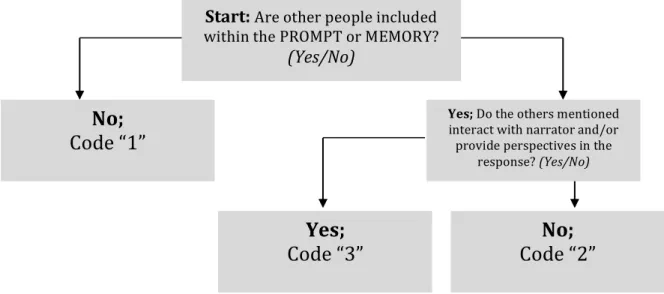
Start: Are other people included
within the PROMPT or MEMORY?
(Yes/No)
No;
Code “1”
Yes;
Code “3”
Yes; Do the others mentioned interact with narrator and/or provide perspectives in the
response? (Yes/No)
No;
Code “2”
h) Sociality: This scale assesses the overall sociality of the MEMORY and
PROMPT. Sociality is defined as the direct presence, interaction, or observation of others included within the participant’s response.
0 = no response or “I don’t know” 1 = no other people
2 = others characters only as objects in narrative 3 = other characters as interacting in narrative
1 = no other people are included within ether the PROMPT or MEMORY
2 = others are mentioned as objects within the response, but do not interact with the narrator or contribute any perspective (“I saw Jon Bon Jovi.”; “I saw the UNC Tar Heels play the finals,”; “I was naked in front of other people”)
3 = others are involved as characters within the narrative, they contribute perspective, AND/OR engage in actions that involve interaction with the narrator (“My brother was disappointed in me”)
Directions for Scoring Rating Sheet
1. For each emotion 1-10, you will award 0-3 points for each item a–h. Write your score in the space provide in the right column.
2. For b) Presence of narrative, make sure that you tally the number of clauses in the MEMORY response and note the sum on the score sheet in the space next to
Length.
3. For d) Causal Inferences, make sure that you check the box next to either Internal/personal or External/situational (as participant response allows).
4. For e) Clarity of meaning, make sure that you check the boxes of all examples present in the participant responses.
5. After scoring each emotion, you will tally the total points for that emotion and write in the space provided in the right column (maximum points 23).
6. Sum the total points for each emotion by emotion category (S, SC, N, C1, and C2). The 2 complex emotions, surprised (C1) and suspicious (C2), are summed separately as well. See page 3 of the Emotional Knowledge Task Rating Sheet, upper right column.
7. Sum the points for each item a–h separately across emotions, by emotion
category. See page 3 of the Emotional Knowledge Task Rating Sheet, lower right column.
References
Aakre, J. M., Seghers, J. P., St-Hilaire, A., & Docherty, N. (2009). Attributional style in delusional patients: A comparison of remitted paranoid, remitted nonparanoid, and current paranoid patients with nonpsychiatric controls. Schizophrenia Bulletin, 35(5), 994-1002. doi:10.1093/schbul/sbn033
Birchwood, M., Smith, J., Cochrane, R., Wetton, S., & Copestake, S. (1990). The Social Functioning Scale. The development and validation of a new scale of social adjustment for use in family intervention programmes with schizophrenic patients. The British Journal of Psychiatry, 157(6), 853-859. doi:10.1192/bjp.157.6.853
Bora, E., Yucel, M., & Pantelis, C. (2009). Theory of mind impairment in schizophrenia: Meta-analysis. Schizophrenia Research, 109(1-3), 1-9. doi:10.1016/j.schres.2008.12.020 Brune, M. (2005). “Theory of Mind” in schizophrenia: A review of the literature.
Schizophrenia Bulletin, 31(1), 21-42. doi:10.1093/schbul/sbi002
Bruner, J.S. (1985). Actual Minds, Possible Worlds. Cambridge, MA: Harvard University Press.
Bruner, J.S. (1990). Acts of Meaning. Cambridge, MA: Harvard University Press. Bruner, J.S. (2004) The narrative creation of self. In L. Angus & J. McLeod (Eds.) The Handbook of Narrative and Psychotherapy: Practice, Theory, Research. Sage
Publications: Thousand Oaks, CA.
Campbell, R.S., & Pennebaker, J.W. (2003). The secret life of pronouns: Flexibility in writing style and physical health. Psychological Science, 14, 60-65.
Capps, L., & Ochs, E. (1995). Constructing panic: the discourse of agoraphobia. Cambridge, MA: Harvard University Press.
Cohen, A. S., & Minor, K. S. (2008). Emotional Experience in Patients With
Schizophrenia Revisited: Meta-analysis of Laboratory Studies. Schizophrenia Bulletin, 36(1), 143-150. doi:10.1093/schbul/sbn061
Combs, D. R., Adams, S. D., Penn, D. L., Roberts, D., Tiegreen, J., & Stem, P. (2007a). Social Cognition and Interaction Training (SCIT) for inpatients with schizophrenia spectrum disorders: Preliminary findings. Schizophrenia Research, 91, 112-116. doi:10.1016/j.schres.2006.12.010
Combs, D. R., Penn, D. L., Wicher, M., & Waldheter, E. (2007b). The Ambiguous Intentions Hostility Questionnaire (AIHQ): A new measure for evaluating hostile social-cognitive biases in paranoia. Cognitive Neuropsychiatry, 12(2), 128-143.
Corcoran, R. & Frith, C.D. (1996) Conversational conduct and the symptoms of schizophrenia. Cognitive Neuropsychiatry, 1, 305-318.
Corcoran, R., Mercer, G., & Frith, C. D. (1995). Schizophrenia, symptomatology and social inference: Investigating “theory of mind” in people with schizophrenia.
Schizophrenia Research, 17(1), 5-13. doi:10.1016/0920-9964(95)00024-G
Couture, S. M., Penn, D.L., Roberts, D. (2006). The functional significance of social cognition in schizophrenia: A review. Schizophrenia Bulletin, 32, S44-S63.
doi:10.1093/schbul/sbl029
Fett, A.K. J., Viechtbauer, W., Dominguez, M.-de-G., Penn, D. L., van Os, J., & Krabbendam, L. (2011). The relationship between neurocognition and social cognition with functional outcomes in schizophrenia: A meta-analysis. Neuroscience &
Biobehavioral Reviews, 35(3), 573-588. doi:10.1016/j.neubiorev.2010.07.001
First, M.B., Spitzer, R.L., Gibbon, M., Williams, J.B. (1996) Structured clinical interview for the DSM-IV Axis I disorders (SCID I/P, Version 2.0). New York: Biometrics
Research Department, New York State Psychiatric Institute.
Frith, C.D. (2004) Schizophrenia and theory of mind. Psychological Medicine, 34, 385-389. doi: 10.1017/S0033291703001326
Green, M. F., Penn, D. L., Bentall, R., Carpenter, W. T., Gaebel, W., Gur, R. C., Kring, A. M., et al. (2008). Social cognition in schizophrenia: An NIMH workshop on
definitions, assessment, and research opportunities. Schizophrenia Bulletin, 34(6), 1211-1220. doi:10.1093/schbul/sbm145
Grice, H.P (1975). Logic and conversation. In P. Cole & J.L. Morgan (Eds.) Syntax and Semantics. Vol. 3 Speech Acts. (pp. 41-58) Academic Press: New York.
Gruber, J., & Kring, A. M. (2008). Narrating emotional events in schizophrenia. Journal of Abnormal Psychology, 117, 520-533. doi:10.1037/0021-843X.117.3.520
Harvey, P.D. (2010). Cognitive functioning and disability in schizophrenia. Current Directions in Psychological Science, 19, 249-254.
Hoekert, M., Kahn, R., Pijnenborg, M., & Aleman, A. (2007). Impaired recognition and expression of emotional prosody in schizophrenia: Review and meta-analysis.
Schizophrenia Research, 96(1-3), 135-145. doi:10.1016/j.schres.2007.07.023