Chapter 1—
An Overview of C
TEAMFLY
The purpose of this chapter is to present an overview of the C programming language, its origins, its uses, and its underlying philosophy. This chapter is mainly for newcomers to C.
A Brief History of C
C was invented and first implemented by Dennis Ritchie on a DEC PDP-11 that used the Unix operating system. C is the result of a development process that started with an older language called BCPL. BCPL was developed by Martin Richards, and it influenced a language called B, which was invented by Ken Thompson. B led to the development of C in the 1970s.
For many years, the de facto standard for C was the version supplied with the Unix operating system. It was first described in The C Programming Language by Brian Kernighan and Dennis Ritchie (Englewood Cliffs, N.J.: Prentice-Hall, 1978). In the summer of 1983 a committee was established to create an ANSI (American National Standards Institute) standard that would define the C language. The standardization process took six years (much longer than anyone reasonably expected).
The ANSI C standard was finally adopted in December 1989, with the first copies becoming available in early 1990. The standard was also adopted by ISO (International Standards
Organization), and the resulting standard was typically referred to as ANSI/ISO Standard C. In 1995, Amendment 1 to the C standard was adopted, which, among other things, added several new library functions. The 1989 standard for C, along with Amendment 1, became a base document for Standard C++, defining the C subset of C++. The version of C defined by the 1989 standard is commonly referred to as C89.
During the 1990s, the development of the C++ standard consumed most programmers' attention. However, work on C continued quietly along, with a new standard for C being developed. The end result was the 1999 standard for C, usually referred to as C99. In general, C99 retained nearly all of the features of C89. Thus, C is still C! The C99 standardization committee focused on two main areas: the addition of several numeric libraries and the development of some special-use, but highly innovative, new features, such as variable-length arrays and the restrict pointer qualifier. These innovations have once again put C at the forefront of computer language development.
C Is a Middle-Level Language
C is often called a middle-level computer language. This does not mean that C is less powerful, harder to use, or less developed than a high-level language such as BASIC or Pascal, nor does it imply that C has the cumbersome nature of assembly language (and its associated troubles). Rather, C is thought of as a middle-level language because it combines the best elements of high-level languages with the control and flexibility of assembly language. Table 1-1 shows how C fits into the spectrum of computer languages.
As a middle-level language, C allows the manipulation of bits, bytes, and addresses—the basic elements with which the computer functions. Despite this fact, C code is also very portable.
Portability means that it is easy to adapt software written for one type of computer or operating system to another type. For example, if you can easily convert a program written for DOS so that it runs under Windows 2000, that program is portable.
High level Ada Modula-2 Pascal COBOL FORTRAN BASIC
Middle level Java C++ C FORTH
Macro-assembler
Low level Assembler
All high-level programming languages support the concept of data types. A data type defines a set of values that a variable can store along with a set of operations that can be performed on that variable. Common data types are integer, character, and floating-point. Although C has several built-in data types, it is not a strongly typed language, as are Pascal and Ada. C permits almost all type conversions. For example, you may freely intermix character and integer types in an expression.
Unlike most high-level languages, C specifies almost no run-time error checking. For example, no check is performed to ensure that array boundaries are not overrun. These types of checks are the responsibility of the programmer.
In the same vein, C does not demand strict type compatibility between a parameter and an argument. As you may know from your other programming experience, a high-level computer language will typically require that the type of an argument be (more or less) exactly the same type as the
parameter that will receive the argument. Such is not the case for C. Instead, C allows an argument to be of any type so long as it can be reasonably converted into the type of the parameter. Further, C provides all of the automatic conversions to accomplish this.
C is special in that it allows the direct manipulation of bits, bytes, words, and pointers. This makes it well suited for system-level programming, where these operations are common.
Another important aspect of C is that it has only a small number of keywords, which are the
commands that make up the C language. For example, C89 defined 32 keywords, and C99 adds only 5 more. High-level languages typically have many more keywords. As a comparison, consider that most versions of BASIC have well over 100 keywords!
C Is a Structured Language
In your previous programming experience, you may have heard the term block-structured applied to a computer language. Although the term block-structured language does not strictly apply to C, C is commonly referred to simply as a structured language. It has many similarities to other structured languages, such as ALGOL, Pascal, and Modula-2.
NOTE
The reason that C is not, technically, a structured language is that
block-structured languages permit procedures or functions to be declared inside other
procedures or functions. However, since C does not allow the creation of functions
within functions, it cannot formally be called block-structured.
events that occur within them cause no side effects in other parts of the program. This capability makes it very easy for your C programs to share sections of code. If you develop compartmentalized functions, you need to know only what a function does, not how it does it. Remember, excessive use of global variables (variables known throughout the entire program) may allow bugs to creep into a program by allowing unwanted side effects. (Anyone who has programmed in standard BASIC is well aware of this problem.)
A structured language offers a variety of programming possibilities. For example, structured
languages typically support several loop constructs, such as while, do-while, and for. In a structured language, the use of goto is either prohibited or discouraged and is not the common form of program control (as is the case in standard BASIC and traditional FORTRAN, for example). A structured language allows you to place statements anywhere on a line and does not require a strict field concept (as some older FORTRANs do).
Here are some examples of structured and nonstructured languages:
Nonstructured Structured
FORTRAN Pascal
BASIC Ada
COBOL C++
C
Java
Modula-2
Structured languages tend to be of more recent creation. In fact, a mark of an old computer language is that it is nonstructured. Today, few programmers would consider using a nonstructured language for serious, new programs.
NOTE
New versions of many older languages have attempted to add structured elements.
BASIC is an example. However, the shortcomings of these languages can never be
fully mitigated because they were not designed along structured design principles from the beginning.
C's main structural component is the function—C's stand-alone subroutine. In C, functions are the building blocks in which all program activity occurs. They allow you to define and code
Another way to structure and compartmentalize code in C is through the use of blocks of code. A
code block is a logically connected group of program statements that is treated as a unit. In C, you create a code block by placing a sequence of statements between opening and closing curly braces. In this example,
if (x < 10) {
printf(''Too low, try again.\n"); scanf("%d", &x);
}
the two statements after the if and between the curly braces are both executed if x is less than 10. These two statements together with the braces represent a code block. They are a logical unit: One of the statements cannot execute without the other executing also. Code blocks allow many
algorithms to be implemented with clarity, elegance, and efficiency. Moreover, they help the programmer better conceptualize the true nature of the algorithm being implemented.
C Is a Programmer's Language
Surprisingly, not all computer programming languages are for programmers. Consider the classic examples of nonprogrammer languages, COBOL and BASIC. COBOL was designed not to better the programmer's lot, not to improve the reliability of the code produced, and not even to improve the speed with which code can be written. Rather, COBOL was designed, in part, to enable
nonprogrammers to read and presumably (however unlikely) to understand the program. BASIC was created essentially to allow nonprogrammers to program a computer to solve relatively simple problems.
In contrast, C was created, influenced, and field-tested by working programmers. The end result is that C gives the programmer what the programmer wants: few restrictions, few complaints, block structure, stand-alone functions, and a compact set of keywords. By using C, you can nearly achieve the efficiency of assembly code combined with the structure of Pascal or Modula-2. It is no wonder that C has become the universal language of programmers around the world.
The fact that C can often be used in place of assembly language was a major factor in its initial success. Assembly language uses a symbolic representation of the actual binary code that the computer executes directly. Each assembly-language operation maps into a single task for the computer to perform. Although assembly language gives programmers the potential to accomplish tasks with maximum flexibility and efficiency, it is notoriously difficult to work with when
Initially, C was used for systems programming. A systems program forms a portion of the operating system of the computer or its support utilities, such as editors, compilers, linkers, and the like. As C grew in popularity, many programmers began to use it to program all tasks because of its portability and efficiency—and because they liked it! At the time of its creation, C was a much longed-for, dramatic improvement in programming languages. In the years that have since elapsed, C has proven that it is up to any task.
With the advent of C++, some programmers thought that C as a distinct language would cease to exist. Such is not the case. First, not all programs require the application of the object-oriented programming features provided by C++. For example, applications such as embedded systems are still typically programmed in C. Second, much of the world still runs on C code, and those programs will continue to be enhanced and maintained. Third, as the new C99 standard shows, C is still a venue in which leading-edge innovation is taking place. While it is undeniably true that C will always be remembered as forming the foundation for C++, it will also be known as one of the world's great programming languages on its own.
Compilers vs. Interpreters
It is important to understand that a computer language defines the nature of a program and not the way that the program will be executed. There are two general methods by which a program can be executed. It can be compiled, or it can be interpreted. Although programs written in any computer language can be compiled or interpreted, some languages are designed more for one form of execution than the other. For example, Java was designed to be interpreted, and C was designed to be compiled. However, in the case of C, it is important to understand that it was specifically optimized as a compiled language. Although C interpreters have been written and are available in some environments (especially as debugging aids or experimental platforms like the interpreter developed in Part Six of this book), C was developed with compilation in mind. Therefore, you will almost certainly be using a C compiler and not a C interpreter when developing your C programs. Since the difference between a compiler and interpreter may not be clear to all readers, the following brief description will clarify matters.
In its simplest form, an interpreter reads the source code of your program one line at a time,
performing the specific instructions contained in that line. This is the way earlier versions of BASIC worked. In languages such as Java, a program's source code is first converted into an intermediary form that is then interpreted. In either case, a run-time interpreter is still required to be present to execute the program.
In general, an interpreted program runs slower than a compiled program. Remember, a compiler converts a program's source code into object code that a computer can execute directly. Therefore, compilation is a one-time cost, while interpretation incurs an overhead each time a program is run.
The Form of a C Program
Table 1-2 lists the 32 keywords defined by the C89 standard. These are also the C keywords that form the C subset of C++. Table 1-3 shows the keywords added by C99. The keywords, combined with the formal C syntax, form the C programming language.
In addition to the standard keywords, many compilers add nonstandard keywords that better exploit their operating environment. For example, several compilers include keywords to manage the memory organization of the 8086 family of processors, to support interlanguage programming, and to access interrupts. Here is a list of some commonly used extended keywords:
asm ds huge pascal
cdecl _es interrupt _ss
_cs far near
Your compiler may also support other extensions that help it take better advantage of its specific environment.
auto double int struct break else long switch case enum register typedef char extern return union const float short unsigned continue for signed void default goto sizeof volatile do if static while
_Bool _Imaginary restrict _Complex inline
Table 1 -3. Keywords Added by C99
In C, uppercase and lowercase characters are different: else is a keyword; ELSE is not. You may not use a keyword for any purpose other than as a keyword in a C program—that is, you may not use it as a variable or function name.
All C programs consist of one or more functions. As a general rule, the only function that must be present is called main( ), which is the first function called when program execution begins. In well -written C code, main( ) contains what is, in essence, an outline of what the program does. The outline is composed of function calls. Although main( ) is not a keyword, treat it as if it were. For example, don't try to use main as the name of a variable because you will probably confuse the compiler.
The general form of a C program is illustrated in Figure 1-1, where f1( ) through fN( ) represent user-defined functions.
The Library and Linking
Technically speaking, you can create a useful, functional C program that consists solely of
statements involving only the C keywords. However, this is quite rare because C does not provide keywords that perform such things as input/output (I/O) operations, high-level mathematical computations, or character handling. As a result, most programs include calls to various functions contained in C's standard library.
All C compilers come with a standard library of functions that perform most commonly needed tasks. Standard C specifies a minimal set of functions that will be supported by all compilers. However, your compiler will probably contain many other functions. For example, the standard library does not define any graphics functions, but your compiler will probably include some.
When you call a library function, the C compiler ''remembers" its name. Later, the linker combines the code you wrote with the object code already found in the standard library. This process is called
linking. Some compilers have their own linker, while others use the standard linker supplied by your operating system.
The functions in the library are in relocatable format. This means that the memory addresses for the various machine-code instructions have not been absolutely defined—only offset information has been kept. When your program links with the functions in the standard library, these memory offsets are used to create the actual addresses used. Several technical manuals and books explain this
Global declarations
int main(parameter list) {
statement sequence }
return-type f1(parameter list) {
statement sequence }
return-type f2(parameter list) {
statement sequence }
. . .
return-type fN(parameter list) {
statement sequence }
Figure 1-1
The general form of a C program
detail. However, you do not need any further explanation of the actual relocation process to program in C.
Many of the functions that you will need as you write programs are in the standard library. They act as building blocks that you combine. If you write a function that you will use again and again, you can put it into a library, too.
Separate Compilation
lets you compile each file separately. Once you have compiled all files, they are linked, along with any library routines, to form the complete object code. The advantage of separate compilation is that if you change the code of one file, you do not need to recompile the entire program. On all but the most simple projects, this saves a substantial amount of time. Separate compilation also allows multiple programmers to more easily work together on a single project, and it provides a means of organizing the code for a large project. (Strategies for separate compilation are discussed in Part Five of this book.)
Compiling a C Program
Creating an executable form of your C program consists of these three steps:
1. Creating your program
2. Compiling your program
3. Linking your program with whatever functions are needed from the library
Today, most compilers supply integrated programming environments that include an editor. Most also include stand-alone compilers. For stand-alone versions, you must have a separate editor to create your program. In either case, be careful: Compilers only accept standard text files for input. For example, your compiler will not accept files created by certain word processors because they contain control codes and nonprinting characters.
The exact method you use to compile your program will depend upon what compiler you are using. Also, how linking is accomplished will vary between compilers and environments; for example, it may be included as part of the compiler or as a stand-alone application. Consult your compiler's documentation for details.
C's Memory Map
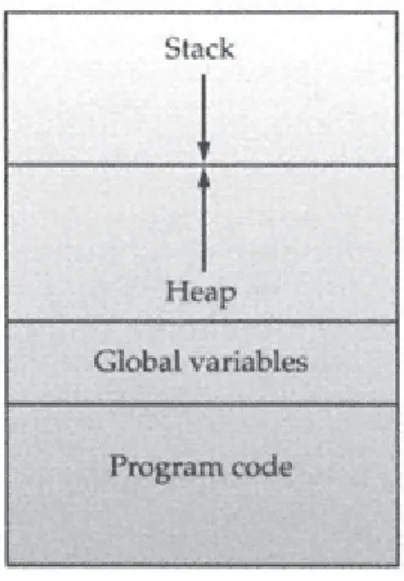
A compiled C program creates and uses four logically distinct regions of memory. The first region is the memory that actually holds the program's executable code. The next region is memory where global variables are stored. The remaining two regions are the stack and the heap. The stack is used for a great many things while your program executes. It holds the return addresses of function calls, arguments to functions, and local variables. It will also save the current state of the CPU. The heap
is a region of free memory that your program can use via C's dynamic memory allocation functions.
Although the exact physical layout of each of the four regions of memory differs among CPU types and C implementations, the diagram in Figure 1-2 shows conceptually how your C programs appear in memory.
TEAMFLY
Figure 1-2 Conceptualized memory
map of a C program
C vs. C++
Before concluding this chapter, a few words about C++ are in order. Newcomers are sometimes confused about what C++ is and how it differs from C. In short, C++ is an object-oriented
programming language that was built upon the foundation of C. In general terms, C is a subset of C++, or conversely, C++ is a superset of C.
In general, you can use a C++ compiler to compile a C program. In fact, today most compilers handle both C and C++ programs. Thus, most programmers will use a C++ compiler to compile their C code! However, since C++ was built upon the 1989 C standard, you must restrict your C code to the features defined by that standard (which are the features described in Part One of this book).
There is one thing that you must be careful about when using a C++ compiler to compile a C program: the file extension. By convention, C programs use the .C extension. C++ programs use .CPP. Don't accidentally give your C program a .CPP extension. Differences between the two languages might prevent a valid C program from being compiled as if it were a C++ program. By specifying the .C extension, you are telling the C++ compiler to perform a ''C compile."
NOTE
For a complete description of the C++ language, see C++: The Complete
Review of Terms
The terms that follow will be used frequently throughout the remainder of this reference. You should be completely familiar with them.
• Source code The text of a program that a user can read, commonly thought of as the program. The source code is input into the C compiler.
• Object code Translation of the source code of a program into machine code, which the computer can read and execute directly. Object code is the input to the linker.
• Linker A program that links separately compiled modules into one program. It also combines the functions in the Standard C library with the code that you wrote. The output of the linker is an executable program.
• Library The file containing the standard functions that your program can use. These functions include all I/O operations as well as other useful routines.
• Compile time The time during which your program is being compiled.