Can Citizens Discern? Information Credibility, Political Sophistication, and the Punishment of Corruption in Brazil
Rebecca Weitz-Shapiro, Brown University [email protected]
Matthew S. Winters, University of Illinois at Urbana-Champaign
1 When are citizens most likely to hold politicians to account for wrongdoing? In a crowded information environment, political accountability requires that credible information about
politician behavior is available and that citizens are able to identify credible information as such. Focusing on this second requirement, we argue that the ability to discern more from less credible information is increasing in citizens’ cognitive and political sophistication. Using data from an original survey experiment in Brazil, we show that all citizens react negatively to corruption allegations, but that more politically sophisticated respondents are the most likely to discern between sources of information that differ in their credibility. In particular, they are more skeptical of low credibility sources than their less-sophisticated counterparts. Our findings suggest a novel mechanism that may link increasing education with control of political
corruption: educated citizens are better able to discern and therefore act on credible corruption accusations.
Keywords: Corruption, information credibility, political sophistication, Brazil
Supplementary material for this article is available in the appendix in the online edition. Replication files are available in the JOP Data Archive on Dataverse
(http://thedata.harvard.edu/dvn/dv/jop). This research was reviewed and deemed exempt by
2 In a modern representative democracy, political corruption fundamentally violates the implicit contract in which elected politicians agree to govern on behalf of the citizens who have
selected them.1 Whether through direct bribe-taking, embezzlement, elaborate kickback schemes, or over-invoicing for public works projects, corruption diverts funds from public
coffers and diverts politician attention away from the public interest. Scholars have documented a number of negative economic and political consequences of corruption, ranging from
decreased growth and investment (e.g., Mauro 1995; Mauro 1998; Tanzi and Davoodi 1998) to
decreased trust in government (Seligson 2002). Citizens themselves also express great concern about government corruption. According to Transparency International’s 2013 Global
Corruption Barometer, for example, an average of 51 percent of respondents across 107 countries believe that corruption in the public sector is a “very serious problem” (the highest
category on a five-point scale) (Hardoon and Heinrich 2013).
In spite of public concern, there is plenty of evidence that corruption persists at high levels in many parts of the world, especially outside of the long-standing wealthy democracies
(Keefer 2007; Treisman 2007). The scale of corruption is particularly puzzling in democracies, where regular free and fair elections should present citizens with the opportunity to remove corrupt politicians from office. While other work has focused on the links between formal
political institutions and the control of corruption (e.g., Persson, Tabellini, and Trebbi 2003; Kunicova and Rose-Ackerman 2005), we explore how characteristics of both individuals and the
environment affect corruption punishment within a single institutional context. In particular, we call attention to the informational constraints citizens face in attempting to punish corruption. In some cases, voters lack any information at all about the corrupt behavior of particular politicians,
1
3 rendering electoral action against corruption unlikely. But even in settings where information about corruption is available, some political actors have incentives to report corruption
information accurately while others do not. As a result, corruption information is likely to be of variable credibility.2
In this paper, we examine how both the credibility of a source of corruption information and citizen characteristics affect citizen responses to corruption. In the first instance, we argue that most individuals are sensitive to the credibility of sources that provide corruption
information and calibrate their responses to that information accordingly. Beyond this, we also argue that cognitively and politically sophisticated voters are likely to be especially discerning of
the credibility of information they encounter. Using an original, nationally-representative survey experiment in Brazil, we provide evidence that the most educated and knowledgeable Brazilians are more likely to adjust their responses to corruption allegations depending on the credibility of
the source of those allegations—in our survey, a federal audit versus an opposition party. In our data, these sophisticated citizens are particularly skeptical of corruption information from less
credible sources. Together, these results point to the importance of the information environment in controlling corruption: the availability of more credible information about corruption should be associated with greater voter punishment of corruption. Our results also suggest a new
mechanism that may explain the documented macro-level correlation between education and corruption control (Glaeser and Saks 2006; Avelino, Biderman, and Mendes Lopes nd; Charron
2010; Persson, Tabellini, and Trebbi 2003). Rather than having systematically different
2
As we elaborate below, we define a source as credible for a particular piece of information
4 preferences over corruption, more educated citizens may simply be more likely to act on credible information about corruption, thus removing more corrupt politicians from office.
Information Availability versus Information Credibility
Democratic elections provide a clear opportunity for voters to pass judgment on politician performance, but citizens require information about government performance if they are to use that opportunity effectively to hold politicians to account (Manin, Przeworski, and Stokes 1999).
Highlighting the importance of information for accountability, scholars have shown that greater information availability facilitates the punishment of corruption (Brunetti and Weder 2003;
Chang, Golden, and Hill 2010; Chowdhury 2004; Freille, Haque, and Kneller 2007; Reinikka and Svensson 2005), improves government bureaucracy and rule of law (Adserá, Boix, and Payne 2003), and leads governments to respond better to natural disasters (Sen 1981; Besley and
Burgess 2002).
Whether making comparisons across or within countries, this literature has primarily
framed concerns about the quality of information in terms of its quantity. Where media outlets or news coverage are more plentiful, it is assumed that information will be better. Similarly, existing studies of citizen responses to corruption, almost without exception, compare the
presence of corruption information to either information about explicitly non-corrupt behavior or else to the absence of any relevant information at all (Ferraz and Finan 2008; Chong et al. 2015;
de Figueiredo, Hidalgo, and Kasahara 2010; Anduiza, Gallego, and Muñoz 2013; Klašnja and Tucker 2013; Konstantinidis and Xezonakis 2013; Winters and Weitz-Shapiro 2013).3
In doing
3
A working paper by Muñoz et al. (2013) using data from Spain is an important exception.
5 so, these authors assume, implicitly or explicitly, that the credibility of whatever information is disseminated is high and invariant.
The credibility of sources of political information in the real world, of course, often varies. Some actors – including, at times, certain government institutions, independent elements
of the media, and watchdog NGOs – have incentives to uncover and disseminate accurate information about government performance. In contrast, other actors have incentives to obscure, amplify, or even fabricate information to appeal to citizen preferences. In particular, political
actors with electoral aims will be motivated to employ information to their advantage in pursuit of votes, making it difficult for citizens to take politicians’ statements at face value. As
Przeworski (1999, fn. 18) states more generally, “[i]f the government is acting in self-interest, it will offer a self-serving explanation, while the opposition, wanting to defeat the incumbent, will contest it.” Incentives to obscure will be particularly strong for valence issues, where citizen
preferences are widely shared, and the advantages of appealing to those preferences are clear.
corruption accusations. Our study abstracts from party names, which allows us to evaluate
credibility effects for all respondents, including those with no party affiliation; our study is also distinguished by our examination of discernment across levels of political sophistication. A
paper by Botero et al. (2015) also uses the language of source credibility. However, these authors operationalize credibility using individual-level affinity between a listener and a source. They take three sources that have incentives to provide accurate information in the Colombian context
and examine whether respondents are more persuaded by sources they prefer. As such, their results reflect variation in individual source affinity rather than differences in source credibility
6 With respect to corruption, this means that citizen interest in punishing corruption creates countervailing pressures for the revelation of information about corrupt practices. Information
about corruption might be uncovered and disseminated by neutral, credible sources, and also by opposition politicians who are motivated to reveal that information to help them unseat
incumbent officials. At the same time, voter antipathy towards corruption may create incentives for some political actors to spread unsubstantiated or outright false allegations. As accusations of corruption proliferate, citizens must parse more from less credible accusations to maximize
their ability to hold politicians to account for corruption by punishing only those who have actually committed wrongdoing.
In this paper, we call attention to the possibility of variation in the credibility of
information about corruption and generate and test expectations about how that variation should affect citizen responses. We argue that corruption is most likely to be punished when two
conditions are met: first, that credible information about government performance is available, and second, that at least some citizens are able to identify that information as credible and
distinguish it from less credible sources of information.
Citizen Responses to Credible Information
We define information as credible when the source does not have incentives to lie about the information it disseminates.4
As such, source credibility is defined with respect to the
4
In defining credibility, we build on work by Lupia and McCubbins (1998), as well as
Austen-Smith (1990, 76), Przeworski (1999), and Chiang and Knight (2011). While Lupia and McCubbins emphasize two dimensions to credibility—a source’s expertise and its
7 relationship between a source and a particular piece of information it disseminates at a given time. Our definition thus distinguishes credibility from affinity, where the latter is defined with
respect to the relationship between a listener and a source. For instance, if a normally partisan newspaper were to report on corruption within the political party that it typically supports, this
information can be classified as relatively more credible (see Chiang and Knight 2011).5 In contrast, if the same newspaper were to report on corruption within a party it typically opposes, the newspaper would be a less credible source for that piece of information. Other sources,
including government bodies that are charged with disseminating truthful information, such as ombudsman’s offices and audit courts –should generally be expected to provide credible
information, so long as their employees’ career incentives reward accuracy and there is no political interference in their operation.
Credibility does not guarantee accuracy: for any particular piece of information, a
credible source may be inaccurate, and a less credible source may be accurate. In expectation, however, credible sources should be accurate more frequently than non-credible sources.6 To the
5
Another way to think of this is that disseminating information about an allied party is a costly signal. Lupia and McCubbins argue that when a source incurs a cost to disseminate some
information, citizens should view that as a sign of credibility and be particularly responsive to that information. They describe verification and penalties for lying as other factors that might lead individuals to take cues even from sources for which they have no affinity. See also Sobel
(1985) for a classic statement in economics on costly signals.
6
This assumes that access to information among sources is constant. If a credible source also has
8 extent citizens can recognize source incentives and understand the connection between
credibility and accuracy, citizens should respond more strongly to more credible sources of
information. This leads us to our first hypothesis.
H1: Citizens should be more likely to update their beliefs and behavior in response to information from more credible, as compared to less credible, sources.
Who Discerns? Credibility and Political Sophistication
Although we expect citizens, on average, to be sensitive to a source’s credibility, the
extent of that sensitivity should vary systematically across groups of citizens. We know from the existing literature that politically aware and sophisticated citizens process and learn political
information differently from their compatriots.7 Some scholars highlight how sophistication reduces sensitivity to new information and hence constrains political accountability. For
example, when face with well-reasoned arguments for and against contentious policy issues, political sophisticates are more likely to resist updating their beliefs or attitudes when compared with less sophisticated voters (Taber and Lodge 2006; Taber, Cann, and Kucsova 2009;
Slothuus and de Vreese 2010). The work of other scholars, however, suggests that sophistication improves information processing and hence may facilitate accountability: for example,
politically sophisticated individuals are better able to process certain heuristics (Lau and Redlawsk 2001) and incorporate and understand new political frames (Chong and Druckman
in contrast, because affinity is inherently a relational concept, we have no expectation that
sources preferred by a given individual are more likely to be accurate than less preferred sources.
7
Classic studies of political behavior in the U.S. demonstrate that politically knowledgeable citizens are the least sensitive to new information (Converse 1964, Zaller 1992), and similar
9 2007; Druckman and Nelson 2003).
We argue that politically sophisticated respondents should be more sensitive to source
credibility as compared to other respondents.8 Given our distinction between a source’s credibility and mere affinity for a source, to assess a source’s credibility, an individual must
evaluate the relationship between the source and the particular piece of information the source disseminates. In the context we examine, doing so requires a combination of cognitive ability and an understanding of how the political system works. At the most basic level, political
sophisticates are the most likely to recall the source of political information they encounter. In addition, sophisticates are the most likely to be capable of placing a source in its political
context. That is, compared to other respondents, political sophisticates are more likely to understand the range of actors who provide political information and the strategic incentives of such actors.9 For example, while many individuals understand politics as a competition between
opposing parties or candidates, we expect political sophisticates to take this a step further and to understand that an opposition may fabricate accusations against an incumbent politician. As
such, politically sophisticated citizens should be the most capable of making informed inferences about the credibility of a given source for the particular piece of information presented.
While we argue that sophistication should always increase discernment, the extent to
which we will be able to observe this depends on the presence of countervailing factors that dampen political sophisticates’ interest in acting on their capacity to discern. As noted above,
8
This view is similar to the arguments found in Alt et al. (2015), although developed
independently.
9
In our design, we are not able to independently identify the extent to which discernment is
10 others have found that politically sophisticated citizens are likely to employ motivated reasoning when responding to new information on issues that are contentious or evoke strong partisan
biases. However, not all issues in the political space divide political opinion in the same way as contentious issues like abortion or affirmative action. For issues that – like corruption – are best understood as valence issues, we expect that politically sophisticated citizens’ greater capacity to
evaluate political information should dominate. As a consequence, sophisticates should be the
most likely to respond differentially to valence information of variable credibility.10
This leads us
to our second hypothesis.
H2: More sophisticated citizens are more likely to respond to valence information in a way that varies with the credibility of the information source.
In particular, as compared to their less sophisticated counterparts, more sophisticated citizens
should . . .
H2A: give more credence to information that comes from more credible sources, and
H2B: give less credence to information that comes from less credible sources.
Empirical Setting: Corruption in Brazil
We test our hypotheses empirically through the use of experimental vignettes about municipal corruption embedded into a nationally representative survey in Brazil. In Brazil,
corruption can clearly be considered a negative valence issue of high importance to citizens. For example, in an open-ended survey question that asks respondents to list the single most “serious”
10
It is also possible that more sophisticated individuals have different preferences from their
fellow citizens and this also could produce different patterns in responses across groups. In our survey, respondent attitudes towards corruption are very similar across groups, and yet
11 problem facing their country, Brazilians have consistently listed corruption as one of the top issues of concern over the past decade.11
Both mass protests over the last few years and the
results of recent survey work demonstrate the depth of citizen frustration and dissatisfaction with what is understood to be institutionalized political corruption in Brazil (e.g., Winters and
Weitz-Shapiro 2014; Balán 2014; Winters and Weitz-Weitz-Shapiro 2013; Power and Taylor 2011).12 As a result, the information contained in our survey vignettes should be readily understood by respondents.
More generally, Brazil is a useful setting because it provides a very different context for the study of citizen discernment from those that have been used in the literature to date. Among
scholars who have explored citizen responsiveness to information of variable credibility, those tests have been limited to wealthy, highly educated, and relatively stable democracies. In a few studies, scholars have found evidence that source credibility matters to citizens in such settings
when they are making decisions of a more abstract nature13 and for political decisions, as well.14
11
In the 2006-2012 AmericasBarometer Surveys, the share of Brazilians who mentioned
corruption ranged from approximately 8 to 14%, and corruption ranged from the second to fourth
most frequent response.
12
Even scholars who highlight the ability of corrupt officials to be reelected point to Brazilian citizens’ distaste for corruption (e.g., Rennó 2011). The massive ongoing scandal surrounding Brazil’s state-owned oil company, Petrobras, emerged after our survey work was completed, but
citizen reactions to the scandal are indicative of widespread frustration with corruption. See
Arruda de Almeida and Zagaris (2015) for more details.
13
Lupia and McCubbins (1998) ask respondents to predict the outcome of a coin toss, while
12 In light of our second hypothesis (that sophistication facilitates discernment), Brazil can be understood as a hard case for testing our first hypothesis—that citizens as a whole will be
responsive to source credibility. Brazil’s historically low levels of educational achievement and quality (e.g., Birdsall and Sabot 1996; Hanushek and Woessmann 2012), should make it harder
for the average respondent to recall the source of information and to discern source credibility. In addition, the country’s relatively short recent history of democratic competition (dating to 1985)
and multiparty system with frequently shifting partisan alliances (e.g., Mainwaring 1999;
Desposato 2006; though see Figueiredo and Limongi 2000) may make it harder for citizens to understand the strategic incentives and behavior of political actors. Given these characteristics, if
we find evidence that Brazilian citizens are sensitive to source credibility (H1), we should expect
14
In the United States, Chiang and Knight (2011) examine the effects of “surprising” (i.e., more
credible) newspaper endorsements, while Druckman (2001) shows that respondents in a lab are more susceptible to framing effects from sources who are viewed as knowledgeable and
trustworthy. Druckman deems these sources to be credible, although the operationalization
makes it difficult to isolate source credibility from affinity. Papers by Alt et al. (2015) and Muñoz et al. (2013) examine the effects of information of differential credibility on economic
voting in Denmark and responses to corruption in Spain. In contrast to both of these studies, we do not include named political parties as information sources, which allows us to examine the effects of variable credibility for all citizens, not just partisans. This is important in light of the
many countries where partisan identity is limited or in decline (Whiteley 2011). Similar to our results here, Alt et al. (2015) find evidence that credibility effects are heightened among political
13 this result to travel widely.15
Varying Information Credibility in a Survey Experiment
To examine how Brazilians respond to variation in the credibility of information about
corruption, we conducted an original, nationally-representative survey experiment in May 2013. The survey was administered by IBOPE, Brazil’s oldest and largest survey firm, to 2,002
individuals across 25 of Brazil’s 27 states in a multi-stage sample, with PPS sampling of cities
across the states and then quota sampling at the level of the individual. The sample resembles the general population in terms of demographics. 16
We include a vignette in the survey that describes a hypothetical mayor and randomly vary elements of the vignette, including the credibility of the source of corruption information. As we describe in the online appendix, the characteristics of the respondents who received each
vignette are balanced across the treatment conditions. Describing a hypothetical mayor allows us to maintain significant control over the information environment and is a technique that has now
been used frequently in the study of citizen responses to different types of politician behavior, including clientelism (Weitz-Shapiro 2014) and corruption (Anduiza, Gallego, and Muñoz 2013; Klašnja and Tucker 2013; Muñoz, Anduiza, and Gallego 2013; Winters and Weitz-Shapiro
2013). Using a survey experiment that describes a hypothetical mayor allows us to ethically vary
15
On the other hand, the variation in educational attainment in Brazil may make it somewhat easier for us to find evidence of H2—that is, differences in discernment across groups of
citizens—as compared to a country with more uniform levels of education. We thank an anonymous reviewer for this point.
16
14 information credibility.17
In addition, with respect to our second hypothesis, which examines how political sophistication mediates responses to source credibility, by describing an invented
mayor, we eliminate the possibility that political sophistication merely serves as a proxy for preexisting knowledge about a real-world politician.
Respondents in the survey are randomly assigned to hear one of seven versions of the vignette. All versions begin by describing the same high-performing mayor:18
Imagine that you live in a neighborhood similar to your own but in a different city in Brazil. Let’s call the mayor of that hypothetical city in which you live Carlos. Imagine that Mayor Carlos is running for reelection. During the four years that he has been mayor, the municipality has experienced a number of improvements, including good economic growth and better health services and transportation.
The variation across the vignettes is contained in the next sentence, which presents different types of information about corrupt behavior by the politician. In a pure control condition, no information about corruption is provided, and in a “clean” condition, the mayor is explicitly
described as not engaging in corruption. The remaining five variants of the vignette include allegations of corruption, varying either the source of that information and/or the precise target
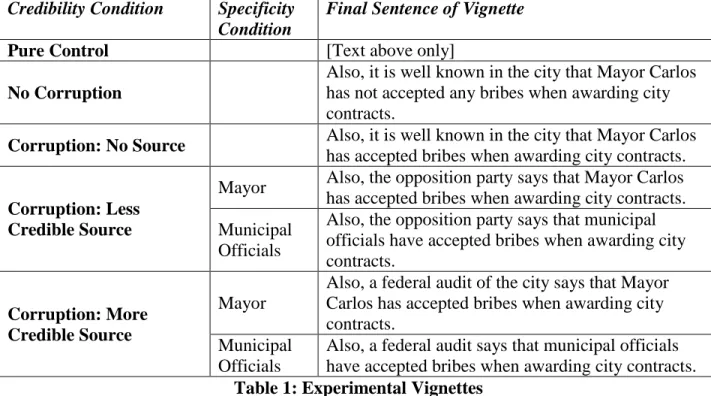
of the accusations. All seven versions are described in Table 1.
17
In contrast, if a field experiment on corruption provided unreliable information, this would raise ethical concerns. As such, the use of observational data and/or survey experiments is a preferable tool for examining the effects of misleading information on citizen behavior.
18
Following convention in Brazil, the mayor is referred to by his first name. We focus on health services and transportation because these are highly salient issues where municipalities exercise
15 As the table makes clear, some of the vignettes vary the target of the corruption
accusations, referring either to the mayor directly or to municipal officials.19
We explore that
variation elsewhere (Winters and Weitz-Shapiro 2016); here, we pool responses to prompts with the same source credibility, regardless of whether the mayor or city officials were mentioned.20
Credibility Condition Specificity Condition
Final Sentence of Vignette
Pure Control [Text above only]
No Corruption
Also, it is well known in the city that Mayor Carlos has not accepted any bribes when awarding city contracts.
Corruption: No Source Also, it is well known in the city that Mayor Carlos has accepted bribes when awarding city contracts.
Corruption: Less Credible Source
Mayor Also, the opposition party says that Mayor Carlos has accepted bribes when awarding city contracts. Municipal
Officials
Also, the opposition party says that municipal officials have accepted bribes when awarding city contracts.
Corruption: More Credible Source
Mayor
Also, a federal audit of the city says that Mayor Carlos has accepted bribes when awarding city contracts.
Municipal Officials
Also, a federal audit says that municipal officials have accepted bribes when awarding city contracts. Table 1: Experimental Vignettes
The source of corruption accusations is described as either “the [unnamed] opposition party” or “a federal audit.” Including these two contrasting sources allows us to vary the
credibility of the accusations for all respondents, with the opposition party accusations inherently
less credible than those coming from a federal audit. None of the vignettes mention a political
19
In Portuguese, the latter referenced “ocupantes de cargos na Prefeitura.” The full Portuguese
text of the prompts is found in the online appendix.
20
Compared to those reported here, results are substantively the same or even stronger if we replicate the analyses using only vignettes that mention the mayor. These results are reported in
16 party by name, which allows us to avoid cueing source affinity for most respondents.21
Recall that we define credibility by the relationship between a source and the information
it disseminates: a credible source has no incentives to lie about a particular piece of information. Beginning with the low credibility source, we treat accusations of corruption made by members
of an opposition party as inherently less credible because of the self-serving nature of those accusations. An opposition party in electoral competition with the incumbent stands to benefit directly from any electoral punishment of the incumbent.22 Accusations levied by an opposition
party may, of course, turn out to be true in any given case; however, the fact that those making the accusations stand to gain from them creates incentives for falsification and thus decreases the
credibility of those claims.
In contrast, we treat a “federal audit” as a relatively more credible source of corruption
information about Brazilian mayors. The Brazilian government – through the Office of the
Comptroller General (Controladoria-Geral da União, CGU) – maintains a system of federal
21
We discuss two possible exceptions in depth below: (1) in the absence of explicit reference to a named party, some respondents may project the partisan identity of the mayor of the
municipality in which they live onto the hypothetical mayor named in the vignette, and (2) PT partisans may react more strongly to information coming from the federal government.
22
Note that we would classify our sources similarly even if we followed Lupia and McCubbins
(1998) in defining credibility by both expertise and trustworthiness. This is because federal audits are both knowledgeable and trustworthy, while the opposing party is not trustworthy and
17 audits of municipal accounts for municipalities with populations under 500,000.23 These audits are conducted by highly skilled, well-paid bureaucrats who have been selected through
competitive processes. Drawing on public employee records, Bersch, Praça, and Taylor (2013) place the auditing agency well above the median federal agency in Brazil in terms of both
technical capacity and political autonomy. In contrast to an opposition party, CGU staffers have no positional incentive to fabricate information about corruption for personal gain.24
The audits the CGU produces are widely recognized by academics and policy makers as politically
impartial and competently executed. Furthermore, existing literature provides evidence that citizens take these audits seriously. For example, Ferraz and Finan (2008) show that mayoral
reelection rates are lower in municipalities where the CGU revealed corruption before an
election as compared to municipalities where the CGU revealed similar levels of corruption, but after voting had taken place. Timmons and Garfias (2015) show that citizens become less likely
to pay their property taxes and more likely to mobilize for the adoption of participatory budgeting institutions in municipalities where CGU audits reveal corruption. Also consistent
with the claim that the federal government is a more credible source of corruption information than an opposition party, public opinion surveys in Brazil show higher public confidence in the
23
Ferraz and Finan (2008; 2011), Brollo et al. (2013), and Litschig and Zamboni (2015) all
provide extensive details on the program.
24
Of course, any agency may make mistakes, and thus there is no guarantee that information about municipal corruption from a federal audit will be accurate; however, in expectation, it is
18 federal government than in political parties.25
Taken together, the institutional characteristics, positional incentives, and evidence from public opinion surveys all point to the greater credibility
of federal audits, as compared to an opposition party, as a source of corruption information about a sitting mayor.26
After hearing the vignette to which he or she was randomly assigned—high or low credibility, or one of the two control conditions—each respondent was asked a series of
questions, including two designed to gauge her opinion of the hypothetical mayor. We focus here
on a question that asked the respondent to evaluate how likely she would be to vote for the mayor, on a scale from one (not at all likely) to four (very likely).27
25
The 2010 AmericasBarometer survey in Brazil asked respondents their degree of
confidence/trust (“confiança”) in a variety of institutions. The mean response for the federal
government was 4.4 on a seven-point scale, and about 37 percent of respondents placed their
confidence in the highest two categories. In contrast, trust in political parties elicited a mean response of 2.97, with only 9 percent rating their trust as falling into the highest two categories. As survey responses, these results likely reflect affinity to some extent, but they are suggestive of
the relative credibility of the two sources we use.
26
Focus groups held by the authors in the city of Sao Paulo in August 2013 also support this
conclusion. For example, in a session held on August 13, 2013, when asked whether federal officials could detect corruption, one respondent replied, “I think so. Probably yes. Because
they will delay, but they go in-depth . . . If it were another candidate [making the accusations],
no, then I would try to find out if it was [really corruption], because another candidate is always trying to burn the other” [authors’ translation].
27
19 We expect the differences in source credibility to affect all respondents (H1), with more sophisticated respondents being particularly sensitive to these differences (H2), giving more
credence to accusations from the federal government (H2a) and being more skeptical of accusations from an opposition party (H2b).
Political sophistication can be understood as a “bundle” concept, one which combines elements of a variety of characteristics, including knowledge of specific political facts,
attentiveness to politics, and cognitive sophistication, and yet is not wholly made up of any one
of these (Sniderman, Brody, and Tetlock 1991; Gomez and Wilson 2007). In survey work in the United States, political sophistication is typically measured through a battery of questions on
specific knowledge of political actors and issues, although recent work points to some drawbacks of these questions and highlights the extent to which “don’t know” responses and wrong answers can be sensitive to question wording, time constraints, and incentives (Boudreau and Lupia 2011;
Prior and Lupia 2008; Mondak and Davis 2001). Much less is known about the appropriateness of such a knowledge battery in younger democracies like Brazil, where institutional weakness
and volatility may mean that specific factual knowledge about politics is less telling than in the
indicating a “terrible” mayor and 7 indicating an “excellent” one. In the online appendix, we
show that the results are robust to the use of this feeling thermometer. As we describe in the
online appendix, we believe that the vignettes were not administered in a completely random order in the field. However, examining balance on observable characteristics using two different methods, we find no more differences across treatment groups than we would expect due to
random chance. We nonetheless replicate the results reported in tables 2, 3, and 4 using
regression analyses that control for multiple covariates; the substantive results are unchanged in
20 United States.28 We thus rely on three possible measures of sophistication in our survey—
educational attainment, accuracy in answering two political knowledge questions, and frequency
of political discussion. While none of these is a perfect measure, each taps into a different element—cognitive ability, knowledge of the political system, and interest in politics—of the
constituent parts of political sophistication. As discussed below, these measures of sophistication are positively correlated yet also distinct, and we find support for our main hypotheses using all three measures.29
Punishing Corruption and Discerning Sources
We test our hypotheses using respondents’ vote intention on a four-point scale. Taking
advantage of the experimental nature of the data, we rely on simple difference-in-means tests throughout. Because of the small number of response categories, we also present significance
tests from Wilcoxon Rank Sum (Mann-Whitney) tests. Significance levels from the two tests are nearly identical for all comparisons.
To begin, we examine whether respondents expressed less support for mayors linked to corruption than for those not linked to corruption, comparing responses in our two control
28
In a setting where informal rules and institutions are equally or even more important than their formal counterparts (Helmke and Levitsky 2006), different types of political knowledge may be relevant or useful. As part of a related project, we are working on developing alternative
knowledge batteries.
29
See the online appendix for cross-tabulations showing the relationships between the three
21 conditions with those in the five conditions that contained any information about corruption.30 Our results clearly show the strong, negative effect of corruption information on respondent
intention to vote for the hypothetical mayor. In the two control conditions, support for the mayor reaches an average of 3.38 on the four-point scale. The high vote intention is likely explained by
the positive description of the mayor’s performance and the absence of any partisan
identification, eliminating a cue that might generate opposition among at least some respondents. Average support for the mayor across the five conditions that mention corruption of any type
drops dramatically to 2.21, a difference that is substantively large and statistically significant. These results are consistent with existing survey work that shows that, for a given level of
performance, politicians described as corrupt receive lower levels of support.
Our first hypothesis predicts that, on average, survey respondents will be more responsive
30
Uniquely for this literature, our experiment included two control conditions, which offer
insight into the assumptions that respondents make about political corruption when they do not receive information about that dimension of performance. In the pure control condition, survey respondents heard information only about the mayor’s strong performance; they received no
information—either positive or negative—about corruption. In the “clean” control condition, the positive information about performance was followed by information explicitly describing the
mayor as not engaged in corruption. (These are the first two vignettes listed in Table 1 above.) As Table 2 shows, responses to mayors described in these two vignettes are essentially identical. These results are consistent with those reported in Winters and Weitz-Shapiro (2013) where, in
the presence of information about strong public service delivery performance and no information about corruption, Brazilian voters respond in ways similar to when they are explicitly told that
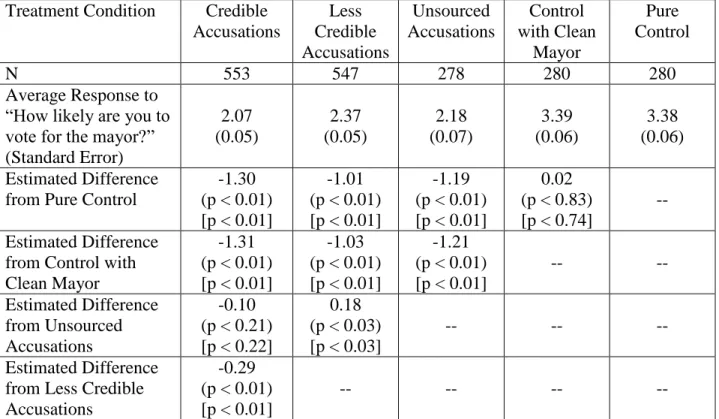
22 to more credible, as opposed to less credible, allegations of corruption (H1). The results in Table 2 show that this is indeed the case. The second row indicates that, among respondents who heard
the mayor or his administration accused of corruption by a federal audit, the mean intention to vote for the mayor is 2.07, whereas it increases to 2.37 among respondents who heard a similar
accusation of corruption attributed to an unnamed opposition party. Respondents have a less punitive response when accusations of corruption come from a relatively less credible source, and this difference is highly statistically significant. .
It is worth noting, as is evident in the first three columns, that all corruption information is punished, regardless of its source; respondents in both the pure control group, who hear no
corruption information, and in the control group where the mayor is explicitly described as clean report a much higher average vote intention of 3.38. This suggests that allegations of corruption, even those made by less credible sources, are treated as plausible by respondents. As noted
above, less credible information may in fact be accurate, and so it is not surprising that allegations that come from a less credible source are not discounted entirely.31
In a context like
Brazil, where many citizens believe that corruption is widespread, voters may rationally treat
31
In equilibrium, we would not expect opposition parties to play a strategy in which they always
make corruption accusations. Doing so runs the risk of driving their credibility to zero, since voters might update their priors to think of every opposition party accusation as “cheap talk.” An
opposition party that plays a strategy in which it sometimes makes false accusations and always
reiterates true accusations from other sources should lead voters to sometimes believe opposition party accusations. Our results therefore reflect a plausible real world equilibrium in which voters
23 even low credibility allegations of corruption as plausible.32
That said, even with an apparent inclination to believe corruption information, regardless of source, the shift in mean vote
intention prompted by the more credible accusations of corruption is substantial—about one-quarter of the size of the effect of any corruption accusations at all on vote intention. The
credibility of a source of information, therefore, has considerable additional explanatory power for understanding citizen reactions to corruption allegations.
Treatment Condition Credible Accusations Less Credible Accusations Unsourced Accusations Control with Clean Mayor Pure Control
N 553 547 278 280 280
Average Response to “How likely are you to vote for the mayor?” (Standard Error) 2.07 (0.05) 2.37 (0.05) 2.18 (0.07) 3.39 (0.06) 3.38 (0.06) Estimated Difference from Pure Control
-1.30 (p < 0.01) [p < 0.01]
-1.01 (p < 0.01) [p < 0.01]
-1.19 (p < 0.01) [p < 0.01]
0.02 (p < 0.83) [p < 0.74]
--
Estimated Difference from Control with Clean Mayor
-1.31 (p < 0.01) [p < 0.01]
-1.03 (p < 0.01) [p < 0.01]
-1.21 (p < 0.01) [p < 0.01]
-- --
Estimated Difference from Unsourced Accusations
-0.10 (p < 0.21) [p < 0.22]
0.18 (p < 0.03) [p < 0.03]
-- -- --
Estimated Difference from Less Credible Accusations
-0.29 (p < 0.01) [p < 0.01]
-- -- -- --
Table 2. Source Credibility and Vote Intention. Note: Cells in rows 3-6 present difference-in-means tests among
the means reported in row 2. p-values in parentheses are from a t-test of the null hypothesis of no difference in means between the two groups. p-values in brackets are from a Wilcoxon rank sum test of the null hypothesis of no difference in the distribution of the outcome variable between the two groups. p-values from randomization inference tests of the sharp null hypothesis of no unit-level treatment effect are identical.
Further highlighting the fact that respondents were attentive to the source of information
in the prompt, the third column of Table 2 shows that the mean vote intention for those who were
32
24 told about corruption but not given the information source falls between the mean vote intention of respondents who received a credible (federal audit) versus a less credible (opposition party)
cue, although it is only significantly different from the latter.33 As a group, our respondents appear to recognize the self-serving nature of corruption allegations and therefore discount the
accusations brought by the opposition party. On the whole, these results show that information credibility matters for citizen responses to corruption and also that a diverse group of voters can identify and respond to relatively subtle differences in source credibility.
Voter Sophistication and Information Credibility
Our second hypothesis is that more sophisticated individuals will be especially sensitive to the credibility of the source presenting information about politician malfeasance. This should
generate a larger gap in their responses to relatively more versus less credible allegations, whereas the least sophisticated will be less able to discern source credibility and hence have more similar reactions to information coming from more and less credible sources (H2). In the
context of our experiment, more sophisticated voters are more likely to understand that opposition accusations of corruption may be motivated by self-interest, making their veracity
more suspect, and they therefore should be less punitive than less sophisticated voters when they hear such accusations (H2b). More sophisticated respondents are also more likely to be familiar
with the federal bureaucracy’s reputation for competence and high capacity and therefore more
33
Note that when we replicate this table using vignettes with specific accusations against the
mayor only (and not those that contain accusations against municipal officials), both differences are at least marginally statistically significant at conventional levels. Results are reported in the
25 likely than less sophisticated respondents to punish accusations from such a source (H2a). In contrast, less sophisticated respondents should react to the vignettes in ways that suggest more
limited differentiation between the two sources of corruption allegations.
As noted above, we operationalize voter sophistication in three different ways, using the respondent’s level of educational attainment, her response to two political knowledge questions,
and her self-reported level of political discussion. We present results below using dichotomous measures that group respondents into the more- and less-sophisticated categories for each
variable.34 For education, we split the sample between the 15 percent of respondents who have some tertiary education and the remainder who do not. Knowledge was measured with two
factual questions that asked respondents to supply the number of states in Brazil and the name of Argentina’s president.35
Twenty-one percent of the sample answered one of the two questions correctly, while 17 percent responded correctly to both questions, and a clear majority—62
percent of respondents—answered neither question correctly.36 For political discussion, we
34
Results for the full range of each variable and for an additive index of all three variables are included in the appendix. They are consistent with those presented here in showing that
discernment increases with political sophistication, although in the case of political knowledge, respondents in the intermediate knowledge category show more limited discernment than either
high or low knowledge respondents.
35
We accepted either 26 or 27 as the correct answer for the number of states (accounting for the federal district) and any variant on Cristina Fernández de Kirchner’s name was counted as
correct. Precise wording is in the appendix.
36
The Spearman’s rho and Pearson’s r statistics for the correlation between education and
26 compare those who report discussing politics very frequently or frequently (23 percent of the sample) to those who rarely or never discuss politics.
How likely are you to vote for the mayor? Completed High School or Less (1) Some Tertiary Education or More (2) Less Politically Knowledge -able (3) Most Politically Knowledge -able (4) Less Political Discussion (5) Most Political Discussion (6) Less Credible Accusations 2.35 (0.05) N=457 2.44 (0.12) N=90 2.31 (0.05) N=443 2.60 (0.11) N=104 2.30 (0.05) N=419 2.60 (0.10) N=124 More Credible Accusations 2.10 (0.05) N=477 1.97 (0.12) N=76 2.08 (0.05) N=459 2.09 (0.11) N=94 2.06 (0.05) N=440 2.16 (0.11) N=104 Difference between Credible and Less Credible 0.25 (0.07) 0.47 (0.17) 0.23 (0.07) 0.51 (0.16) 0.24 (0.07) 0.43 (0.15)
p-value on H0: No Difference 0.01 [0.01] 0.01 [0.01] 0.01 [0.01] 0.01 [0.01] 0.01 [0.01] 0.01 [0.01]
p-value on H0: No Difference between CATEs
0.23 0.11 0.24
Table 3: Respondent Sophistication and Responsiveness to Source Credibility. Note: p-values for the null
hypothesis on the conditional average treatment effect (CATE) for each group and for the null hypothesis of different reactions to each treatment across the two groups are based on difference-in-means t-tests and (in brackets) Wilcoxon rank sum tests. p-values for differences across the CATEs are based on the randomization inference tests described in Gerber and Green (2012).
For each of the three political sophistication comparisons, Table 3 presents respondents’ mean vote intention for the mayor on a four-point scale, separated out by more credible and less
credible allegations. Differences in reactions to the more and less-credible accusations are found in the third row of the table and serve as an estimate of respondents’ propensity to discern
of political knowledge questions—most notably those conducted by Baker, Ames, and Renno (2006), Baker (2009) and the 2010 Brazilian Electoral Panel Study (Ames et al. 2013). The
correlation between education and political knowledge in those studies is very similar to what we find here. Cross-tabulations between all three measures of sophistication are included in the
27 between sources with differential credibility. We find clear support for H2 across all three
measures of sophistication. More educated respondents, more politically knowledgeable
respondents, and respondents who engage in more political discussion all show greater
discernment between more and less-credible information than do those who are less educated,
less politically knowledgeable, or less likely to discuss politics. While all respondents
differentiate between more and less credible sources, the estimated amount of differentiation (the difference in vote intention after hearing more versus less credible information) is about twice as
large among sophisticates.37
Table 3 also allows us to test H2a and H2b, which state that, compared to less
sophisticated citizens, individuals with greater sophistication should give more credence to credible information and less credence to less credible information. Beginning with the latter, we find relatively robust evidence that more sophisticated respondents are more forgiving of
corruption information when it comes from a less credible source. For all three measures of political sophistication, more sophisticated respondents have a higher vote intention for the
mayor than less sophisticated respondents when corruption information comes from the relatively less credible source (the opposition party). In addition, for two measures of
37
The differences in the estimated CATEs between more and less sophisticated respondents are
not statistically significant at conventional levels, but given the small number of sophisticates in our survey, we do not find that surprising. As we show in the online appendix, when we use the full range of the education measure, differences in discernment between the least and most
educated groups are statistically significant at the p < 0.06 level. When we limit the analysis to specific vignettes only, we find that the CATEs are at least marginally significantly different
28 sophistication (political knowledge and political sophistication), differences across more versus less sophisticated respondents are statistically significant.38
On the other hand, we do not find
evidence in favor of H2a. In the context of our survey, more- and less-sophisticated respondents treat accusations from the relatively more credible source (the federal audit) in a statistically
indistinguishable manner.39
Alternative Explanations and External Validity
Our results demonstrate that, as a group, Brazilian respondents distinguish between more
and less credible sources of corruption information. In addition, we find evidence that more sophisticated citizens differentiate most strongly between information provided by a federal audit
and an opposition party, and that this group is particularly wary of information provided by the latter. We argue that these effects are driven by political sophisticates’ greater ability to assess source credibility. To further support our claim, we also consider and ultimately reject an
38
For knowledge, δ = 0.29 (p < 0.02), and for discussion, δ = 0.30 (p < 0.01).
39
In future empirical work, we will explore whether this holds across different
operationalizations of the more credible source. Note that a series of additional comparisons
show that, for all three measures of sophistication (education, knowledge, and interest), the gap in vote intention between the control conditions and the credible accusation conditions is larger for more sophisticated respondents, although confidence intervals for these differences overlap
for more and less sophisticated respondents. These differences reflect the fact that more sophisticated respondents report higher vote intention for candidates in the control conditions.
29 alternative explanation for the patterns we observe: that the results reflect different attitudes among respondents towards specific political parties.40
Although the experimental vignette did not assign a specific partisan identity to either “Mayor Carlos” or the hypothetical local opposition party, it is possible that respondents
understood the survey with reference to the main ruling and opposition parties in national politics or to those governing in their own city.41
We explore both of these possibilities and show that while partisanship does affect responses to some degree, our results for H1 and H2 continue to
be supported even when we take into account partisan preferences among different groups of
40
Note that partisanship in Brazil is comparatively weak (see Samuels and Zucco 2014 and Samuels and Zucco 2015 for recent discussion). In our sample, only 37% of respondents report a
partisan identity, a share that is consistent with other recent work on partisanship in Brazil.
41
At the national level, the PT, or Worker’s Party (Partido do Trabalhadores) has held the presidency since the election of Luis Inácio Lula da Silva (Lula) in 2002. Brazil’s multi-party,
federal system makes it somewhat difficult to identify which parties are allies or opponents of the ruling PT. At the national level, the PSDB (Partido da Social Democracia Brasileira, a
center-right party) is clearly in the opposition. In the 2014 election, the PSDB candidate for President narrowly lost to the PT’s Dilma Rousseff, whose running mate came from the PMDB (Partido do
Movimento Democrático Brasileiro, a catch-all party). Nonetheless, coalitions in Brazil’s states
vary widely, and the PSDB and the PMDB are the only parties, apart from the PT, with more than a minimal number of partisans in the electorate (Samuels and Zucco 2014; Winters and
30 respondents.42
We begin with the possibility that, because the PT has held Brazil’s presidency since
2003, survey respondents who are PT sympathizers give more credence to information that comes from a federal audit. If this is the case and a sufficiently large number of respondents are
PT supporters, it is possible that our main results reflect greater affinity for the PT, rather than the relatively greater credibility of federal audits as a source of corruption information. To examine this possibility, we replicate our analyses for PT and non-PT sympathizers separately
(see the extensive discussion and replication of relevant tables in the online appendix). We do find evidence that, when compared to other respondents, PT sympathizers are more likely to
punish a mayor when accusations come from the federal audit. This suggests that, for these respondents, both credibility and affinity may be at play. At the same time, however, both PT and non-PT respondents react to opposition accusations in a very similar manner, showing
greater skepticism of this unnamed opposition party when compared to unnamed sources or the federal audit. To ensure our results are not driven by PT partisans, we replicate the tests of our
main hypotheses excluding PT partisans (about 27 percent of respondents). Results presented in the appendix show that even with this somewhat smaller sample, there is clear evidence of discernment between more and less credible sources (H1) and of greater discernment among
sophisticates (H2).
Separately, we also consider the possibility that, although respondents were explicitly
instructed to think of a “different city in Brazil” in the vignette, some respondents may project the partisan identity of their own city’s mayor onto the hypothetical “Mayor Carlos.” Because we
42
The fact that partisan preferences can affect citizen responses to corruption even in a context
31 know the city in which each respondent resides, we are able to identify the party of each
respondent’s local mayor at the time of the survey and combine that with the respondent’s own
self-reported partisan identity to create three categories: matched partisans (respondents who share a party identity with their sitting mayor), unmatched partisans (respondents who are
partisans of a party different from that of their sitting mayor), and non-partisans. Given the small number of self-reported partisans in the sample, and the fact that only some of these partisans reside in a city where the mayor is from their preferred party, the number of matched partisans in
our sample is very small. As we show in the appendix, we find some evidence that matched partisans have a somewhat higher vote intention for “Mayor Carlos” and also that this group is
less punitive when accusations come from a federal audit. At the same time, our results indicate that all groups of respondents—both matched partisans and others—punish corruption and discern between more and less credible accusations (H1). In addition, we find clear support for
H2 –sophisticates are most likely to discern most acutely between more and less credible sources of corruption information – even when we exclude all partisans from our sample.
Discussion
The availability of information about politician performance is widely acknowledged to
be crucial for political accountability for corruption as well as more broadly. However, for political accountability to be achieved, not just any type of information will do: citizens must be
able to identify credible information about politician performance. Although it is well established that citizens rely on cues from trusted sources to obtain political information and make political decisions, we know far less about whether and what types of citizens discern
32 hypotheses about citizen responsiveness to source credibility using original survey experimental data on reactions to political corruption in Brazil.
We first hypothesize that, on average, citizens are capable of discernment and will respond differently to corruption allegations based on the credibility of the source of that
information. Additionally, we expect to see variation across groups of citizens with regard to their ability to discern more credible from less credible information. In particular, we expect more sophisticated voters to have the cognitive skills and political understanding necessary for
better discernment, believing credible information more readily and being more skeptical of less credible information as compared to the least sophisticated citizens. Results from our survey
experiment provide clear evidence that information credibility affects how the vast majority of Brazilian respondents react to accusations of corruption. All except the least educated distinguish between more and less credible information, and politically sophisticated citizens discern the
most. In our study, this is particularly due to their greater skepticism of less credible sources. Our findings are useful in interpreting macro-level analyses of the correlates of
corruption. Recent work has argued that education is linked to better control of corruption, and there is some evidence for the association subnationally in the United States (Glaeser and Saks 2006), in other countries (Avelino, Biderman, and Mendes Lopes nd; Charron 2010), and
cross-nationally (Persson, Tabellini, and Trebbi 2003). Our study suggests a new mechanism through which high educational attainment might decrease corruption. We show that education may
improve accountability not through changes in preferences associated with educational
33 independent auditing and control units. As long as these agencies are able to maintain their reputation for high quality, we should expect their influence to grow as the population becomes
increasingly educated.
Acknowledgments:
This is part of an ongoing collaboration in which the position of first author alternates between the authors. Both authors contributed equally to this paper. A previous version of this paper circulated under the title “Discerning Corruption: Credible Accusations and the Punishment of Politicians in Brazil.” Thanks to Andy Baker, Matthew Cawvey, Gabriel Cepaluni, José
Cheibub, Miguel de Figueiredo, Danny Hidalgo, Jim Kuklinksi, Andrew Little, René Lindstaedt, Jeff Mondak, Jordi Muñoz, David Nickerson, Nara Pavão, Sergio Praça, Ashlea Rundlett, and Luis Schiumerini, as well as participants at seminars at the Autonomous University of Barcelona, Brown University, Columbia University, Harvard University, Michigan State University, MIT, São Paulo State University, the University of California–Riverside, the University of Illinois at Urbana-Champaign, the University of São Paulo, and the University of Texas-Austin for useful comments and conversations. Previous versions were presented at the 2014 annual meetings of the Midwest Political Science Association, European Political Science Association, and
American Political Science Association. Thanks to George Avelino, Fernando Limongi, the Fundação Getulio Vargas, and the University of São Paulo for help in organizing focus group discussions. Marina Merlo and Leandro Rodrigues provided excellent assistance in running the focus group discussions. Thanks to Eduardo Azevedo, Silvia Cervellini, Priscila Ratnieks, and the other staff at IBOPE. Camila Moraes and Jazmin Sierra provided excellent research
assistance. We thank the Latin American Public Opinion Project (LAPOP) and its major supporters (the United States Agency for International Development, the United Nations Development Program, the Inter-American Development Bank, and Vanderbilt University) for making data from that project available.
Works Cited
Adserá, Alicia, Carles Boix, and Mark Payne. 2003. “Are You Being Served? Political Accountability and Quality of Government.” Journal of Law, Economics and Organization 19 (2): 445–90.
Alt, James E., David D. Lassen, and John Marshall. 2015. “Credible Sources and Sophisticated Voters: When Does New Information Induce Economic Voting.” Harvard University. Ames, Barry, Fabiana Machado, Lucio R. Renno, David Samuels, Amy Erika Smith, and Cesar
Zucco. 2013. “The Brazilian Electoral Panel Studies (BEPS): Brazilian Public Opinion in the 2010 Presidential Elections.” IDB Technical Nove No. 508.
34 Arruda de Almeida, Monica, and Bruce Zagaris. 2015. “Political Capture in the Petrobus
Corruption Scandal: The Sad Tale of an Oil Giant.” Fletcher Forum of World Affairs 39: 87.
Austen-Smith, David. 1990. “Credible Debate Equilibria.” Social Choice and Welfare 7 (1): 75– 93.
Avelino, George, Ciro Biderman, and Marcos Felipe Mendes Lopes. nd. “Measuring Corruption: What Have We Learned?” FGV Working Paper
Baker, Andy. 2009. The Market and the Masses in Latin America: Policy Reform and
Consumption in Liberalizing Economies. Cambridge Studies in Comparative Politics. New York: Cambridge University Press.
Baker, Andy, Barry Ames, and Lucio R. Renno. 2006. “Social Context and Campaign Volatility in New Democracies: Networks and Neighborhoods in Brazil’s 2002 Elections.”
American Journal of Political Science 50 (2): 382–99.
Balán, Manuel. 2014. “Surviving Corruption in Brazil: Lula’s and Dilma’s Success Despite Corruption Allegations, and Its Consequences.” Journal of Politics in Latin America 6 (3): 67–93.
Bersch, Katherine, Sérgio Praça, and Matthew M. Taylor. 2013. “State Capacity and
Bureaucratic Autonomy Within National States: Mapping the Archipelago of Excellence in Brazil1.” In . Washington, D.C.
http://www.asmetro.org.br/portal/attachments/article/1140/bersch-praca-taylor-state-capacity-and-autonomy-may-1_lasa.pdf.
Besley, Timothy, and Robin Burgess. 2002. “The Political Economy of Government
Responsiveness: Theory and Evidence from India.” Quarterly Journal of Economics 117 (4): 1415–51.
Birdsall, Nancy, and Richard H. Sabot, eds. 1996. Opportunity Foregone: Education in Brazil. Washington, D.C.: Inter-American Development Bank.
Botero, Sandra, Rodrigo Castro Cornejo, Laura Gamboa, Nara Pavao, and David W. Nickerson. 2015. “Says Who? An Experiment on Allegations of Corruption and Credibility of Sources.” Political Research Quarterly 68 (3): 493–504.
Boudreau, Cheryl. 2009. “Closing the Gap: When Do Cues Eliminate Differences between Sophisticated and Unsophisticated Citizens?” The Journal of Politics 71 (03): 964–76. doi:10.1017/S0022381609090823.
Boudreau, Cheryl, and Arthur Lupia. 2011. “Political Knowledge.” Edited by James N. Druckman, Donald P. Green, James H. Kuklinski, and Arthur Lupia. Cambridge Handbook of Experimental Political Science.
http://groups.polisci.northwestern.edu/researchpool/Handbook.pdf#page=321. Brollo, Fernanda, Tommaso Nannicini, Roberto Perotti, and Guido Tabellini. 2013. “The
Political Resource Curse.” American Economic Review 103 (5): 1759–96. doi:10.1257/aer.103.5.1759.
Brunetti, Aymo, and Beatrice Weder. 2003. “A Free Press Is Bad News for Corruption.” Journal of Public Economics 87 (7): 1801–24.
Chang, Eric C. C., Miriam A. Golden, and Seth J. Hill. 2010. “Legislative Malfeasance and Political Accountability.” World Politics 62 (02): 177. doi:10.1017/S0043887110000031. Charron, Nicholas. 2010. “The Correlates of Corruption in India: Analysis and Evidence from
35 Chiang, Chun-Fang, and Brian Knight. 2011. “Media Bias and Influence: Evidence from
Newspaper Endorsements.” Review of Economic Studies 78 (3): 795–820. doi:10.1093/restud/rdq037.
Chong, Alberto, Ana L. De La O, Dean Karlan, and Leonard Wantchekon. 2015. “Does Corruption Information Inspire the Fight or Quash the Hope? A Field Experiment in Mexico on Voter Turnout, Choice, and Party Identification.” The Journal of Politics 77 (1): 55–71. doi:10.1086/678766.
Chong, Dennis, and James N. Druckman. 2007. “Framing Theory.” Annual Review of Political Science 10 (1): 103–26. doi:10.1146/annurev.polisci.10.072805.103054.
Chowdhury, Shyamal K. 2004. “The Effect of Democracy and Press Freedom on Corruption: An Empirical Test.” Economics Letters 85 (1): 93–101. doi:10.1016/j.econlet.2004.03.024. de Figueiredo, Miguel F.P., F. Daniel Hidalgo, and Yuri Kasahara. 2010. “When Do Voters
Punish Corrupt Politicians? Experimental Evidence from Brazil.” Yale University. Desposato, Scott W. 2006. “Parties for Rent? Ambition, Ideology, and Party Switching in
Brazil’s Chamber of Deputies.” American Journal of Political Science 50 (1): 62–80. doi:10.1111/j.1540-5907.2006.00170.x.
Druckman, James N. 2001. “On the Limits of Framing Effects: Who Can Frame?” Journal of Politics 63 (4): 1041–66. doi:10.1111/0022-3816.00100.
Druckman, James N., and Kjersten R. Nelson. 2003. “Framing and Deliberation: How Citizens’ Conversations Limit Elite Influence.” American Journal of Political Science 47 (4): 729– 45.
Ferraz, Claudio, and Frederico Finan. 2008. “Exposing Corrupt Politicians: The Effects of Brazil’s Publicly Released Audits on Electoral Outcomes*.” Quarterly Journal of Economics 123 (2): 703–45.
———. 2011. “Electoral Accountability and Corruption: Evidence from the Audits of Local Governments.” American Economic Review 101 (4): 1274–1311.
doi:10.1257/aer.101.4.1274.
Figueiredo, Argelina Cheibub, and Fernando Limongi. 2000. “Presidential Power, Legislative Organization, and Party Behavior in Brazil.” Comparative Politics 32 (2): 151–70. doi:10.2307/422395.
Freille, Sebastian, M. Emranul Haque, and Richard Kneller. 2007. “A Contribution to the Empirics of Press Freedom and Corruption.” European Journal of Political Economy 23 (4): 838–62. doi:10.1016/j.ejpoleco.2007.03.002.
Gerber, Alan S., and Donald P. Green. 2012. Field Experiments: Design, Analysis, and Interpretation. New York: W.W. Norton & Co.
Glaeser, Edward L., and Raven E. Saks. 2006. “Corruption in America.” Journal of Public Economics 90 (6–7): 1053–72. doi:10.1016/j.jpubeco.2005.08.007.
Gomez, Brad T., and J. Matthew Wilson. 2007. “Economic Voting and Political Sophistication: Defending Heterogeneous Attribution.” Political Research Quarterly 60 (3): 555–58. doi:10.1177/1065912907304642.
Hanushek, Eric A., and Ludger Woessmann. 2012. “Schooling, Educational Achievement, and the Latin American Growth Puzzle.” Journal of Development Economics 99 (2): 497– 512. doi:10.1016/j.jdeveco.2012.06.004.