www.intasc.org
Michael Russell, Damian Bebell, Jennifer Cowan, and Mary Corbelli
Technology and Assessment Study Collaborative
Boston College
332 Campion Hall
Chestnut Hill, MA 02467
An AlphaSmart for Each Student:
Does Teaching and Learning Change
With Full Access to Word Processors?
Michael Russell, Damian Bebell, Jennifer Cowan, Mary Corbelli Technology and Assessment Study Collaborative
Boston College Released April 2002
Introduction
Over the past decade, the presence of computers in schools has exploded. Whereas schools had one computer for every 125 students in 1983, they had one for every nine students in 1995, and 1 for every 6 students in 1998 (Market Data Retrieval, 1999). Among the many ways in which teachers use computers during instruction, computers are used most often for student writing (Becker, 1999). As several studies demonstrate, regular use of computers for writing over extended periods of time can lead to significant improvements to students’ writing skills (see Russell & Plati, 2001, for a fuller review of the literature on computers and writing). To capitalize on these benefits, a few schools have made computers available to all of their students (i.e., a 1:1 ratio of students to computers). In most schools, however, the relatively high cost of computers prohibits schools from acquiring a sufficient quantity of computers for all students to use simultaneously.
In attempts to provide an entire class of students with computer access, some schools place large numbers of computers into a shared computer lab. Other schools have experimented with mobile carts of laptop computers which teachers can sign out and bring into their classrooms as needed. While these strategies succeed in providing large numbers of students simultaneous access to computers, it often encourages teachers to treat working with computers as a special event rather than a practice central to their classroom teaching. Additionally, sharing limited resources across multiple classrooms is difficult with the demand exceeding the school’s com-puter resources. For example, an English teacher who wishes to bring his 10th grade
class into the computer lab for a word processing exercise can only do so if the lab is not being used by another teacher. To schedule multiple classes into a communal computer lab is often so difficult that many teachers do not depend on such access and forgo using computers with their students (Cuban, 2001).
However, the introduction of portable writing devices, such as AlphaSmarts, DreamWriters and eMates, provides schools with a more affordable option that allows all students to write with a word processor in their classrooms.
Picture of AlphaSmart 3000 Picture of students composing text with AlphaSmarts
These devices are capable of running basic word processing programs allowing students to compose, edit, cut-copy-and-paste text, print, and in some cases perform spell-checking. Moreover, schools are able to purchase six to eight portable writing devices for the same price as one desktop computer. Instead of sharing a limited number of computers in a classroom or taking turns using computers in a lab, por-table writing devices can enable all students within a classroom to write simultane-ously using word processors.
Although portable writing devices are relatively new to schools, their presence is increasing rapidly. At last estimate, there are between 800,000 and on million AlphaSmarts in approximately 40% of American schools. Although the number of computers in schools still outpaces the quantity of portable writing devices, schools are rapidly turning to portable writing devices as a strategy for providing all students regular and extended time writing with a word processor.
Although increasing numbers of schools are investing in portable writing devices, few have attempted to provide one device for each student. Instead, classroom sets of portable writing devices are often shared across classrooms or classrooms are equipped with a limited number of devices that are shared among students. As an example of the latter, Wellesley Public Schools, a suburban district near Boston, has placed six to eight AlphaSmarts in each third, fourth and fifth grade classrooms. Although students make regular use of the AlphaSmarts in their classrooms, students are often unable to access the device when needed because other students are using them. In the current study, we use a variety of methodological tools (teacher interviews, student interviews, student drawings, and over 50 classroom observations) to examine what happened in three Wellesley 4th grade classrooms when each student received their
own AlphaSmart. Before describing our methodology and presenting the results of this study, we first summarize the literature on the effects of computers and writing as well as research on laptops and portable writing devices in schools.
Computers and Writing
The research on computers and writing suggests many ways in which writing on computers may help students produce better work. Although much of this research was performed before large numbers of computers were present in schools, formal studies report that when students write on computer they tend to produce more text and make more revisions. Studies that compare student work produced on computer with work produced on paper find that for some groups of students, writing on com-puter also has a positive effect on the quality of student writing. This positive effect is strongest for students with learning disabilities, early elementary-aged students and college-aged students. Additionally, when applied to meet curricular goals, education technology provides alternative approaches to sustaining student interest, developing student knowledge and skill, and provides supplementary materials that teachers can use to extend student learning. As one example, several studies have shown that writ-ing with a computer can increase the amount of writwrit-ing students perform, the extent to which students edit their writing (Dauite, 1986, Vacc, 1987; Etchinson, 1989), and, in turn, leads to higher quality writing (Kerchner & Kistinger, 1984; Williamson & Pence, 1989; Hannafin & Dalton, 1987).
Research on Laptops and Portable Writing Devices
During the late 1990’s, a small number of schools began experimenting with providing every student with a laptop computer. In most cases, students were allowed to use the laptop in school and at home. These experimental programs were funded through special fund raisers (Stevenson, 1999), local donors and grants (Cromwell, 1999), and increases in tuition at private schools (Thompson, 2001).
Although much of the research on laptop programs is still on-going, preliminary findings report several positive effects. Focusing on laptop programs in Carmen Arce Middle School in Connecticut, Cromwell (1999) provides anecdotal evidence from staff and administrators that laptops have increased students’ sense of excitement about learning as well as their interest in research and writing. This finding is echoed by Rockman (1998) who reports that the use of laptops has led to an increase in student motivation and a movement toward student centered classrooms. In Town County Middle School in Georgia, Baldwin (1999) reports that after implementing a laptop program, average daily attendance increased, tardiness decreased, and dis-ciplinary referrals decreased. In addition, teachers reported an increase in students’ willingness to revise their work and an increased efficiency in introducing students to more advanced mathematics. Students also reported spending more time on home-work and less time watching television (Baldwin, 1999).
In Kent Center School in Connecticut, Guignon (1998) reports that the amount of literary analysis and the subsequent quality of analysis improved greatly when stu-dents were provided with their own laptops. Stevenson’s (1999) research in Beaufort County, South Carolina, reports that the standardized tests scores for students who participated in a laptop program for two years increased while scores for students who did not participate were unchanged. Stevenson also reports that improvements were greater for females and that students from poor economic backgrounds benefited the most from the project.
Overall, the small amount of research published to date on laptop programs sug-gests that providing one laptop for each student increases student motivation and can have positive impacts on student learning. In addition, the often-cited and controver-sial issue of equity is solved when each student is provided with the same resources. Unfortunately, the prohibitive cost of laptop computers make it difficult for most schools to provide each student individual laptops. As described above, however, portable writing devices provide a less expensive approach to providing each student with a digital writing tool. Despite the increasing use of portable writing devices in classrooms, our review of the literature failed to identify any published research on the impact these devices have on teaching or learning. Our search, however, did find one study archived in ERIC that focused on the use of eMates for journal writing in a single fifth grade class of sixteen students. This study reported that using eMates for journal writing resulted in students writing about the same number of words as when they used paper and pencil. The author, however, notes that students’ interest in jour-nal writing increased when students used eMates (Padgett, 2000).
The study reported here emerged from a question posed to us by the Wellesley (Massachusetts) Public Schools: “How does teaching and learning change when each student is provided with their own AlphaSmart?” In other words, what classroom practices change, if any, when the ratio of students to technology is increased from about 3 to 1 to 1 to 1? Specifically, what kind of changes occur in the way that stu-dents produce work, interact with each other, and interact with their teachers when they are provided full access to their own AlphaSmart. To provide an answer to the posed question, we devised a research design that included classroom observations before and after the AlphaSmart ratio was increased, student interviews, teacher interviews and student drawings. Below we detail our methodology and present the findings from this study.
Methodology
To examine the ways in which teaching and learning change when classrooms are equipped with one AlphaSmart for each student, a combination of data collection methodologies were employed. These methods included classroom observations, stu-dent interviews, teacher interviews, and drawings produced by stustu-dents of themselves working during Writer’s Workshop. Data collection occurred in three fourth grade classrooms in one elementary school located in Wellesley, Massachusetts. The three teachers were identified by the district and were selected because they all agreed to par-ticipate and taught in the same school. Prior to this study, their level of instructional uses of technology ranged from several times a day to once or twice a week. Although the district is generally regarded as serving students whose families are financially secure, the three classrooms also contained students who lived in a local public hous-ing unit. In addition, one or two students within each classroom participated in the METCO program which brings students from Boston to suburban schools. Finally, the classrooms were fully inclusive and included approximately twenty-four students with a range of special needs.
As in all fourth grade classrooms across the district, these classrooms were equipped with five computers (three or four being desktops and one or two being iBooks), six to eight AlphaSmarts, and at least one printer. Throughout this paper each classroom/teacher is identified and referred to by the letters: “A”, “B” and “C”.
At the start of the study, the teachers differed with respect to their instructional uses of technology. While all three used technology regularly for personal and profes-sional purposes, Teacher C used technology the most for instructional purposes. To assure that all students had an opportunity to use AlphaSmarts, Teacher C developed a rotation schedule that assigned students to computers, AlphaSmarts and paper-and-pencil each day. Teacher A also used technology often with her students, but did not require or actively encourage students to use AlphaSmarts or computers for writing. Instead, she allowed students to choose their preferred writing tool. While Teacher B often encouraged, and at times required, students to produce final drafts in digital format, she required students to perform all first drafts on paper. Only after students completed a first draft on paper could students in this classroom transcribe and then edit their work using an AlphaSmart or computer. It should also be noted that prior to this year, Teacher B had taught early elementary students.
A description of each methodological procedure is presented separately below.
Classroom Observations
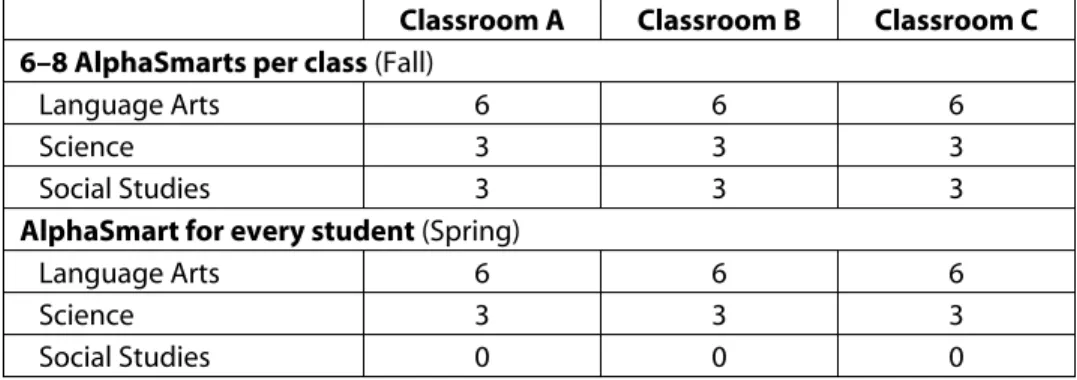
Classroom observations were conducted in each of the three classrooms during the late fall and then again during the late spring by a single blind observer. In the fall, each classroom was equipped with six to eight AlphaSmarts. Following winter recess, the number of AlphaSmarts in all three classrooms was increased so there was one AlphaSmart available for each student. Teachers were given three months to develop classroom policies and practices regarding the use of AlphaSmarts before the second set of classroom observations were conducted. To examine changes that may result due to the increased availability of AlphaSmarts, observations were conducted during science, social studies and language arts instruction (Writer’s workshop). Anticipating that the most use of AlphaSmarts would occur during language arts instruction, the majority of the observations within each classroom were conducted during Writer’s workshop. Due to the fact that the social studies curriculum had been covered in the three classrooms before the second set of observations occurred, no observations during social studies were recorded for Spring. Table 1 shows the number of observa-tions that occurred during each subject within each classroom.
Table 1:
Number of classroom observations conducted by subject area
Classroom A Classroom B Classroom C 6–8 AlphaSmarts per class (Fall)
Language Arts 6 6 6
Science 3 3 3
Social Studies 3 3 3
AlphaSmart for every student (Spring)
Language Arts 6 6 6
Science 3 3 3
All observations were conducted by an observer who was “blind” to the treat-ment. That is, the observer was not informed that the number of AlphaSmarts in each classroom was increased between the fall and the spring. This decision was made so as to increase the likelihood that the observer would not focus exclusively on those students who worked with AlphaSmarts. During the course of each observation, the observer was instructed to record as much of what occurred in the classroom as pos-sible. In particular, the observer was asked to focus on:
• the activities teachers and students engage in • the tools teachers and students use
• the location in which teachers and students work
• conversations and interactions between teachers and students
Thus, the observations became a running record of as many events that the observer was able to record within each observation period. For all observations, the observer recorded notes on a laptop computer and generally sat in one corner of the room. After each observation session, the observer would review, elaborate and edit his notes to produce a detailed description of what occurred during each period of instruction. During each observation, the period of instruction ranged from thirty to sixty minutes. The participating three teachers generously had an open-door policy with the observer who was free to drop in and visit classrooms without formally sched-uling dates and times.
After all observations were complete, the observation data was analyzed in three ways. First, the observer was asked to review his records and to identify any changes that he observed between the fall observations and the spring observations. Next, a second person who was also “blind” to the study and who had never visited the class-rooms was asked to review all of the observation transcripts and identify any changes he saw between the fall and the spring. Third, a formal analytic content analysis was conducted, for which observation records were systematically coded using Hyper-Research and patterns and changes over time were examined.
The codes used to categorize the observation texts were developed through a four-step process. First, drawing upon the observations of the observer and independent reader as well as literature on how computers impact teaching, learning and classroom culture, an initial list of codes was created. This list of codes was organized into four broad categories:
• Teacher Actions
• Individual Student Actions • Student-to-Student Actions • Classroom Environment
Next, the initial list of codes was applied by two different raters to a small sample of the observations. During this time, the coders were asked to develop new codes as needed. After reviewing the utility of the initial codes and the new codes that emerged through this trial period, a new list of codes was developed. This new list of codes was then applied to a second sample of five observation reports and the inter-rater reliabil-ity was assessed. When examining the inter-rater reliabilreliabil-ity, it became clear that the meaning of several codes remained ambiguous. For this reason, we again reviewed the codes, developed operational definitions for each code and retrained the raters so that
a common understanding for each code would be reached. The revised coding scheme was then applied by the two raters to a third set of classroom observations. The inter-rater was re-examined and found to be acceptable. A single researcher then coded all of the observation reports. The master list of all codes used in the content analysis of the classroom observations appears in Appendix A.
With a reliable and operationally defined coding scheme, two approaches were used to analyze the content analysis results. First, the quantity of each code applied within each classroom was compared over time (Fall versus Spring). Based on the initial pattern of changes, both specific codes of interest as well as those that appeared to change over time were used to identify issues to explore further. For this further exploration, the specific blocks of text associated with each code were examined to develop a deeper understanding of what actually changed, if anything.
Student Interviews
To develop a better understanding of how increased access to AlphaSmarts impacted the ways in which students worked in the classroom, six students from each of the three classrooms were interviewed by a researcher at the completion of the study. Within each classroom, teachers were asked to divide students into three groups: high achieving, average and low achieving. Two students from within each subgroup per classroom were randomly selected to be interviewed (n=18).
The interviews focused on the following seven questions:
1. In the fall, did you ever use an AlphaSmart? If so, describe how you used AlphaSmarts in the fall?
2. In the fall, did you prefer to write first drafts on paper or on an AlphaSmart? Why?
3. Did your use of AlphaSmarts change after your class was given one for each student? If so, how?
4. Do you produce better work when you work on paper or with an AlphaSmart?
5. What was your favorite and least favorite things about using AlphaSmarts?
6. Did your teacher have any rules or policies about when or how often you could use an AlphaSmart in the fall…in the spring? If so, what were they?
7. How would you feel if AlphaSmarts were removed from your class-room?
Notes were taken as students responded to each question. After all interviews were completed, the notes were coded using HyperResearch.
Student Drawings
Although student drawings are an unusual tool for collecting information about students and their classrooms, Haney and his colleagues have used drawings in this way on several occasions (see Wheelock, Bebell & Haney (2000) for a review). To trian-gulate information provided by the student interviews about their use of AlphaSmarts
during writing, all students were asked to participate in the drawing exercise after the completion of the study (Spring). Specifically, students in the three classes were asked to draw a picture of themselves at work during their Writer’s Workshop class. Spe-cific features of the drawings were then coded using an emergent analytic technique. The specific features coded in the drawings fell into four broad categories: Student Characteristics (what the students were doing), Technology Present (type of tech-nology depicted), Student Demeanor (whether the student was depicted positively, negatively, or neutral), and Other features (presence of teacher or other students, classroom decorations, multi-frame drawing).
Ideally, student drawings would have been collected at the beginning of the study (i.e.., in the fall) and at the completion of the study (i.e., in the spring). However, the participating teachers initially were reluctant to use student drawings, so they were not administered in the fall. After working with the classroom observer throughout the year, the teachers re-thought their decision about student drawings and granted permission to administer the prompt in the spring. Although it would have been more powerful to compare images produced in the fall and the spring, we are only able to present drawings produced in the spring.
Teacher Interviews
In addition to collecting information from the classroom itself (observations) and the students (student interviews, drawing exercise), the three participating teachers were interviewed after all observations were completed. Again, the researcher conduct-ing the interview recorded responses and results were coded and analyzed via content analysis.
Results
The current study aimed to document and analyze the changes that occur when there is a marked increase in the technology resources inside a self-contained elemen-tary school classroom. Specifically, multiple methods of inquiry were used to study how the classroom experience changed in three 4th grade classrooms when the ratio of AlphaSmarts to students was increased from 3:1 to 1:1. These results represent an amalgamation of teacher and student interviews, student drawings and over 50 class-room observations performed throughout the school year.
The results of the study are reported in two ways. First, the results of the class-room observations, student drawings and teacher interviews are summarized in tables below. The results of the different methodologies are then used to support five main findings of this study. Note that the range of responses provided by students during interviews could not easily be summarized in a table form. For this reason, the student interviews are not summarized in this section, but are integrated into the presentation of main findings.
Classroom Observations
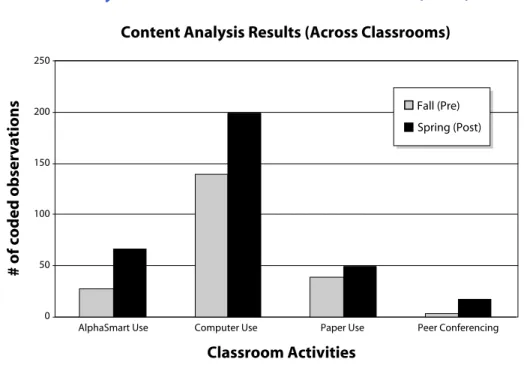
As previously discussed, the classroom observation were analyzed three ways. The blind observer offered a holistic impression of the observations after the observations were conducted, a second “blind” researcher read all of the transcripts and offered his own holistic impressions of what happened and the transcripts were empirically coded using content analysis. The chief findings of the content analysis are displayed in Figure 1.
Figure 1:
Content analysis of Classroom Observations Results (Total)
������� �������� ������� ������� �����������
�
�
��
�
�
��
�
�
��
��
��
��
�
�
��������� ����������
� ��������������� ������������� ����������� ����������������� ���
���
���
���
��
�
���������� �������������
Figure 1 shows the number of times different classroom activities were captured in the classroom observations both in the Fall before the increased technology was introduced and in the Spring when each student had his/her own AlphaSmart. First, it is evident that computer use is more prevalent than Alphasmart and paper and pencil use in the observations for both Spring and Fall. This does not mean that each student used the computer(s) more than AlphaSmarts or paper and pencil but that the number of times in which the classroom observer wrote about computers and computer use in the classroom was greater than the other technologies. When review-ing the transcripts of the observations, computer use is more often referred to because students typically took turns using the classroom computers during the course of a single observation. When students were using paper and pencil or AlphaSmarts they typically used that technology for the duration of the class. Therefore, when the class-room observer records each time a different student uses the computer, the frequency of computer use in the content analysis is inflated by the short and shared nature of its use. Despite this, it should be apparent that across the three classrooms students engaged in computer use, AlphaSmart use and paper and pencil use both in the Fall and Spring observations.
Figure 1 also shows that across the three classrooms AlphaSmart use, computer use, paper and pencil use and peer conferencing all increased in the Spring after the increased technology was introduced. Specifically, the most dramatic increase in the coded classroom observations was found for AlphaSmarts where use increased more than two-fold. This finding is espe-cially powerful considering that the frequency counts of the classroom obser-vations are biased towards those classroom activities that involved shuffling students and shared resources. In other words, the increase in AlphaSmarts as evidenced by the frequency codes of a content analysis of the observations is a conservative estimate of the increase in use that actually occurred in the classrooms. Computer use across the three classrooms also exhibited a nota-ble 30% increase in the content analysis codes. An increase was also found in the paper and pencil use across the three classrooms, although to a much lesser extent than AlphaSmart and computer use. Since one of the goals of the research was to look beyond just technology use we have examined if student to student interactions seemed to change after the increased technology was introduced. To this end, we see that the number of times peer conferencing was coded in the content analysis before the influx of new technology was virtually non-existent and rose to 17 separately coded events in the Spring observations across the three classrooms, a substantial increase.
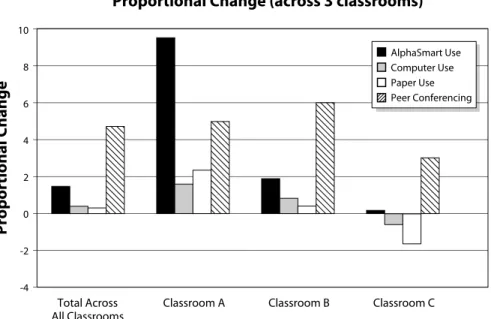
An alternative approach to examining changes in the types of classroom behavior is to express the propotional change in number of times a given event is captured in the spring observations relative to the fall. For each code presented in Figure 1, a proportional change was calculated by dividing the large number of codes assigned during one time period by the number of codes assigned during the other time period and then subtracting one (so that no change is represented as a 0). If the number of coded observations increased between the fall and the spring, the propotional change is positive. If the number of codes decreased between the fall and spring, the propotional change is negative. For example, the overall number of coded observations containing AlphaSmart use in the Fall and Spring was 27 and 66, respec-tively. By dividing 66 by 27 and then subtracting one, it is possible to acquire a sense of the relative increase in use that occurred after the additional tech-nology was introduced to the classrooms, which in this case is an increase of 1.4. If there was no difference in the frequency of codes from Fall to Spring the effect difference would be 0. Figure 2 shows the proportional change for AlphaSmart use, computer use, paper and pencil use, and peer conferencing across all classrooms and within each individual classroom.
Figure 2:
Proportional change for the three participating classrooms
������������ ������ ������� � ����������� ��
�
�
�
�
�
��
��
�
��
�
�
��
��
�
��
�
�
��
�
�
� ������������� ������������ ������������ ����������� � ��������������
�������������� ������������ ��������� �����������������
Figure 2 shows that the increase in AlphaSmart use was evident for each of the classrooms, however, the extent of the increase varied greatly. This effect difference ranged from classroom A’s nearly ten-fold increase to classroom C’s fairly insignificant 0.2 increase. Computer use also rose for two of the participating classrooms (A and B) but fell slightly for classroom C in the Spring. The same general pattern was repeated for paper and pencil use with greatest increases in classroom A, very little difference in classroom B and a nearly two-fold drop in classroom C. Peer conferencing rose fairly dramatically in classroom A and B and to a lesser extent in classroom C. However, it is important to remember that the large effect increases in peer conferencing are undoubtedly a product of the fact that peer conferencing codes were almost nonex-istent in the Fall observations. From these findings it is evident that the classrooms changed after the technology was introduced. It is also evident that the type and degree of change was not “constant” across the three participating classrooms.
Student Drawings
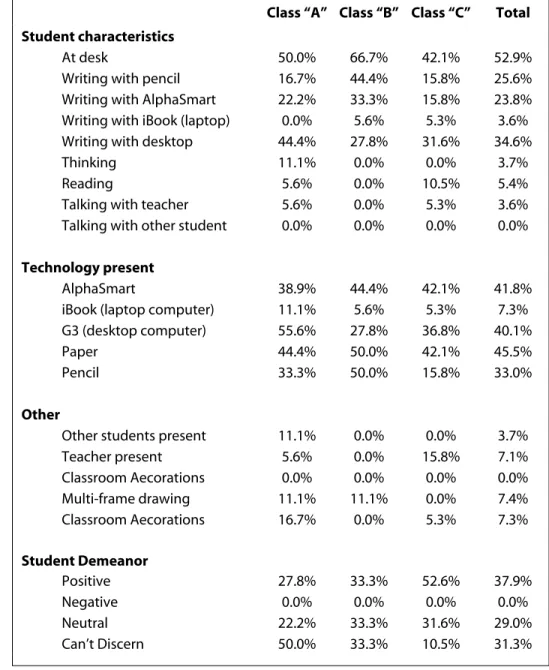
In addition to the classroom observations, we also attempted to get the often overlooked student perspective through a post-study exercise where students were asked to depict themselves working in their writing class. The drawings were exam-ined holistically and then coded using an emergent analytic coding matrix developed specifically for this drawing prompt. Table 2 displays the frequency of different con-tent areas coded in the student drawings across the three classrooms.
Table 2:
Characteristics of the student drawings for the three classrooms
Class “A” Class “B” Class “C” Total Student characteristics
At desk 50.0% 66.7% 42.1% 52.9%
Writing with pencil 16.7% 44.4% 15.8% 25.6% Writing with AlphaSmart 22.2% 33.3% 15.8% 23.8% Writing with iBook (laptop) 0.0% 5.6% 5.3% 3.6% Writing with desktop 44.4% 27.8% 31.6% 34.6%
Thinking 11.1% 0.0% 0.0% 3.7%
Reading 5.6% 0.0% 10.5% 5.4%
Talking with teacher 5.6% 0.0% 5.3% 3.6%
Talking with other student 0.0% 0.0% 0.0% 0.0%
Technology present
AlphaSmart 38.9% 44.4% 42.1% 41.8%
iBook (laptop computer) 11.1% 5.6% 5.3% 7.3% G3 (desktop computer) 55.6% 27.8% 36.8% 40.1%
Paper 44.4% 50.0% 42.1% 45.5%
Pencil 33.3% 50.0% 15.8% 33.0%
Other
Other students present 11.1% 0.0% 0.0% 3.7%
Teacher present 5.6% 0.0% 15.8% 7.1%
Classroom Aecorations 0.0% 0.0% 0.0% 0.0% Multi-frame drawing 11.1% 11.1% 0.0% 7.4% Classroom Aecorations 16.7% 0.0% 5.3% 7.3%
Student Demeanor
Positive 27.8% 33.3% 52.6% 37.9%
Negative 0.0% 0.0% 0.0% 0.0%
Neutral 22.2% 33.3% 31.6% 29.0%
The student drawing results shows that students across the three classrooms were about as likely to depict an AlphaSmart or computer as they were paper and pencil when depicting their writing class. Additionally, many students depicted their writing class as involving both high-tech tools (laptop computers) and more traditional tools (clipboards and pencils). The drawing reproduced below illustrates such a depiction.
Teacher Interviews
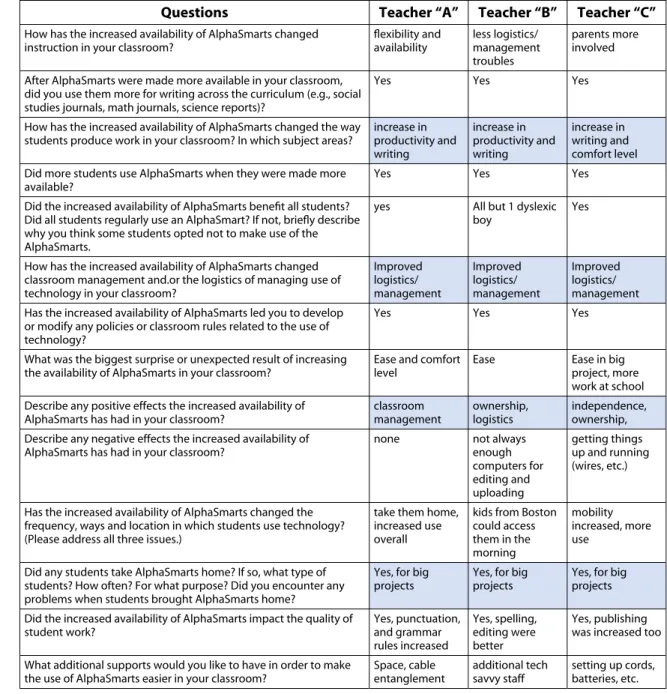
After all classroom observations were complete, the three participating teachers were interviewed. Their responses are truncated and reported in Table 3.
Table 3:
Teacher responses from the post-study teacher interview
Questions Teacher “A” Teacher “B” Teacher “C”
How has the increased availability of AlphaSmarts changed
instruction in your classroom? flexibility and availability less logistics/management
troubles
parents more involved After AlphaSmarts were made more available in your classroom,
did you use them more for writing across the curriculum (e.g., social studies journals, math journals, science reports)?
Yes Yes Yes
How has the increased availability of AlphaSmarts changed the way
students produce work in your classroom? In which subject areas? increase in productivity and
writing increase in productivity and writing increase in writing and comfort level Did more students use AlphaSmarts when they were made more
available?
Yes Yes Yes
Did the increased availability of AlphaSmarts benefit all students? Did all students regularly use an AlphaSmart? If not, briefly describe why you think some students opted not to make use of the AlphaSmarts.
yes All but 1 dyslexic
boy
Yes
How has the increased availability of AlphaSmarts changed classroom management and.or the logistics of managing use of technology in your classroom?
Improved logistics/ management Improved logistics/ management Improved logistics/ management Has the increased availability of AlphaSmarts led you to develop
or modify any policies or classroom rules related to the use of technology?
Yes Yes Yes
What was the biggest surprise or unexpected result of increasing the availability of AlphaSmarts in your classroom?
Ease and comfort level
Ease Ease in big
project, more work at school Describe any positive effects the increased availability of
AlphaSmarts has had in your classroom? classroom management ownership, logistics independence, ownership,
Describe any negative effects the increased availability of
AlphaSmarts has had in your classroom? none not always enough
computers for editing and uploading
getting things up and running (wires, etc.)
Has the increased availability of AlphaSmarts changed the frequency, ways and location in which students use technology? (Please address all three issues.)
take them home, increased use overall
kids from Boston could access them in the morning
mobility increased, more use
Did any students take AlphaSmarts home? If so, what type of students? How often? For what purpose? Did you encounter any problems when students brought AlphaSmarts home?
Yes, for big projects
Yes, for big projects
Yes, for big projects Did the increased availability of AlphaSmarts impact the quality of
student work? Yes, punctuation, and grammar
rules increased
Yes, spelling, editing were better
Yes, publishing was increased too What additional supports would you like to have in order to make
the use of AlphaSmarts easier in your classroom?
Space, cable entanglement
additional tech savvy staff
setting up cords, batteries, etc.
The agreement between the teachers is highly evident in their responses as well as their overall positive impression of the additional technology in their classroom. Specific responses and sets of responses are detailed below in the research findings and discussion section of this paper.
Research Findings
The purpose of this study was to examine how teaching and learning change, if at all, when each student is provided with his/her own AlphaSmart. The results pre-sented in table form above indicate that several aspects of teaching and learning did change when the ratio of students to AlphaSmarts increased from approximately 3: 1 to 1:1. Looking across all forms of data, including classroom observation, teacher interviews, student interviews and student drawings, five major findings were identi-fied. These findings include:
1. There was a clear increase in student’s use of AlphaSmarts after each classroom was equipped with one AlphaSmart per student. For many students, AlphaSmarts became the preferred tool for writing. This increased use of AlphaSmarts also altered the way desktop computers were used.
2. The 1:1 student to Alphasmart ratio led to changes in the way each teacher thought about and used technology with their class. This effect was evidenced in both policy and practice. When every student had the same resources (i.e., one AlphaSmart), the management of the technol-ogy was generally easier and less time consuming for the teachers. To this end, the teachers who made the most extensive use of technology in their lessons found the greatest degree of improvement in general classroom management.
3. When each student was given their own AlphaSmart, a high percentage of students saw word processors as a primary tool for writing. Having unfettered access to their own AlphaSmart also changed the way they approached writing and according to their teachers, nearly universally improved the quality of their work.
4. The 1:1 AlphaSmart to student ratio encouraged a greater sense of student ownership, responsibility and empowerment. This included allowing students without technology resources at home to take the AlphaSmarts home when needed.
5. The increase in AlphaSmarts led to varied results in the three classrooms. In other words, the way in which the new technology was incorporated into each teacher’s classrooms was somewhat unique and based upon their own philosophy, pedagogy and approach.
1. There was a clear increase in student’s use of AlphaSmarts after each
classroom was equipped with one AlphaSmart per student. For many
students, AlphaSmarts became the preferred tool for writing. This
increased use of AlphaSmarts also altered the way desktop computers
were used.
Across all three classrooms, the most obvious and dramatic change that occurred after the classrooms were provided with one AlphaSmart per student was an increased use of AlphaSmarts. The classroom observations documented increased use across subject areas including writer’s workshop, science, social studies and was reported by
teachers to have occurred even in math. Additionally, during the student interviews, eight students (44%) described how they used AlphaSmarts throughout the spring to take notes during class and for research projects. One teacher predicted that when the curriculum is revised and updated, the use of AlphaSmarts will be even greater (presumably because the teachers will be more accustomed to using AlphaSmarts in the classroom and because more emphasis will be placed on writing across the cur-riculum). While the student drawings cannot be used to examine change over time, they do provide confirmatory evidence that AlphaSmarts were used during Writer’s Workshop by many students.
More specifically, the holistic analysis of the Spring classroom observations recorded a large increase in the number of students who drafted using AlphaSmarts instead of paper, particularly in Writer’s workshop. In turn, students began using the classroom computers less often to draft papers and more often to finalize and “pub-lish” their products. The increase in AlphaSmart use was also evident in the content analyses of the observations. This increased use of AlphaSmarts was paralleled by an increased use of laptops and desktop computers. This use of computer-based tech-nologies was also evident in the student drawings. In two of the three classrooms, only 16% of the student drawings depicted students writing with a pencil, while over 50% of the students depicted themselves writing with a computer-based tool. Similarly, all of the students who participated in the post study interview (n=18) reported that they used Alphsmarts in the Spring as their main editing tool as compared to only about 65% in the Fall.
In addition, eleven students indicated in the interviews that they now preferred drafting directly on an AlphaSmart, whereas in the Fall only six students regularly drafted using an AlphaSmart. Those who preferred writing on an AlphaSmart stated that it is “easier” or “more convenient” to work with an AlphaSmart, that it takes less time to write and revise using an AlphaSmart, and that they preferred “typing” over writing by hand. A few students also indicated that they liked AlphaSmarts “now”, suggesting that the students had come to like them since using them more regularly. Other students explained that they could type faster than they can write by hand, that their hands get tired when writing on paper, and that it is more efficient to continu-ously edit while working on the AlphaSmart.
Finally, the observations documented a change in the way students used desktop computers. In the fall, students seemed to use desktop computers for a variety of rea-sons including writing, editing, and printing papers, performing searches for specific information and for more general, non-specific browsing. In the spring, students’ other use of desktop computers became more purposeful. Rather than simply brows-ing the internet, students seemed to perform specific searches. As the blind reader described, “when on the computers, students seemed focused a majority of the time on what they are looking for, as compared to before [in the fall] when half of their time was spent in research and the other half browsing.” While this change may not be entirely attributable to full access to AlphaSmarts, the emphasis placed on using dif-ferent technological tools for difdif-ferent tasks (e.g., drafting with an AlphaSmart, final-izing with a computer) may have helped students see computer-based technologies as tools rather than toys. Moreover, the universal increase in the use of technology that resulted after full access to AlphaSmarts was provided may have encouraged students to be more efficient in their use of desktop and laptop computers.
2. The 1:1 student to AlphaSmart ratio led to changes in the way each
teacher thought about and used technology with their class. When
every student had the same resources (i.e., one AlphaSmart), the
management of the technology was easier and less time consuming for
the teachers.
During the teacher interviews, all three teachers noted several times that the increase in AlphaSmarts allowed the learning environment to become more dynamic and flexible than in the fall. Several factors contributed to this change. First, the ability to have all students use an AlphaSmart at the same time decreased the need for teach-ers to manage whose turn it is to use AlphaSmarts and computteach-ers. Whereas the almost daily ritual of assigning which students could use technology and which students had to work on paper appeared regularly in the Fall observations, the ritual was absent from the Spring observations. This logistical improvement in the management of classroom technology was repeatedly noted by each of the teachers during interviews and was deemed one of the most important changes that resulted from full access to AlphaSmarts.
Second, full access to AlphaSmarts enabled the teacher to have all students work on the same activity at the same time. As a result, the teacher and aides were better able to identify students who were in need of assistance and to work individually with students as they worked on their writing or research. In turn the amount of whole class instruction decreased while the amount of individual attention provided to stu-dents by the teachers and aides increased.
Third, rather than a handful of students printing work, uploading and editing work on the laptop and desktop computers, and/or saving work to the server, all stu-dents performed these tasks on a regular basis when one AlphaSmart was available for each student. As a result, students’ comfort and skill with the technology increased as did the use of computer-based technologies in the classroom. In turn, the amount of time teachers spent helping students with “technical” problems decreased. As an example, during an observation conducted in the fall, the observer noted that “since the kids have started using computers [during the observed lesson] the teacher has spent 75–85% of her time helping students find files, websites and answer technical questions about saving files to the server.” In the spring, the amount of time teach-ers spent providing technical help decreased noticeably and was replaced by teachteach-ers working independently with students on their writing.
Fourth, the spring observations documented students working more with each other and in more creative ways. As an example, a small group of students in one class-room developed the idea of selecting their favorite stories written that year and com-bining them into an anthology. As the observer wrote, “These anthologies of student work are pretty easy to make because the students’ stories are all saved as files on the server. The teacher remarks that a lot of kids really like the idea and it was great…she only wishes that she had thought of it herself.”
Finally, full access to AlphaSmarts led teachers to change their policies regard-ing use of technology in the classroom. In one classroom, the Teacher encouraged all students to produce drafts on paper during the fall. Students could then use the AlphaSmarts or computers to type in their text and perform further edits. In the other
classrooms, throughout the fall students were free to use AlphaSmarts to produce drafts (when it was their turn to have an AlphaSmart), but they could also use computers to draft. In these two classrooms, the teachers did not seem to have any restrictions or specific rules about use of computers. However, during the spring all three teachers limited the use of desktop computers during Writer’s Workshop to editing and print-ing, only. One observation specifically described an incident in which a student asked several times to use a stationary computer for composing text but the teacher refused because the student had not yet completed a first draft using her AlphaSmart. A few minutes later, another student began drafting text on a desktop computer and the girl reported this to the teacher who then asked the student to stop using the computer and to use the AlphaSmart instead. This same teacher also began to monitor more closely the amount of time students spent working on the desktop computers so that everyone has a chance to upload and finalize work composed with an AlphaSmart.
3. When each student was given their own AlphaSmart, a high percentage
of students saw word processors as a primary writing tool. Having
unfettered access to their own AlphaSmart also changed the way they
approached writing and according to their teachers, nearly universally
improved the quality if their work.
When AlphaSmarts were made available to every student, the students began to more clearly see word processing as a primary writing tool. Across all three classrooms most students indicated that the ways in which and frequency with which they used AlphaSmarts changed between the fall and the spring. Before the additional technol-ogy was introduced, the majority of interviewed students reported that they usually wrote first, and often second drafts, on paper. Most of these students then transcribed their drafts to a digital format using either the shared AlphaSmarts or computers. While some students indicated that they performed edits as they transcribed their text from paper to computer, for most students this transcription process had little educa-tional value and was an inefficient use of AlphaSmarts.
In the Spring, however, most students composed text directly on an AlphaSmart. In addition, the majority of these students indicated that their editing process occurred concurrently with their drafting process. As they wrote text directly on the AlphaSmart they continually revised their work, sometimes changing individual words and sometimes moving or deleting more extended passages. Other students described pausing at the end of each paragraph to review what they had written so far, making changes as needed, and then continuing with their drafting. Still others indicated that they would complete an entire draft before starting the revising process. Finally, two students indicated that they would upload their text from an AlphaSmart to a computer and would then do all their editing on the computer. Both of these students indicated that it was easier to edit on the computer because their text was more visible (AlphaSmarts only display four lines of text). Despite the strategy stu-dents selected, the ability to compose and edit directly on the AlphaSmart increased the efficiency with which students were able to produce writing.
Perhaps more importantly, all three participating teachers reported that the increased technology led to higher quality student work. The teachers elaborated that students were more willing to write longer drafts of their papers for all subject areas
and they “are more apt to remember about paragraphs and quotation and punctua-tion marks.” Another Teacher explained that “once the students became comfortable with the AlphaSmarts they were writing longer, were taking more notes, were taking more risks (in their writing) because they could edit easier.” The same teacher also reported that she had witnessed “more note-taking, understanding of phrases versus sentences, more poetry, and more publishing” in the Spring. Teachers saw improve-ments in the quality of student work for nearly all of the students, with the single exception being a student with dyslexia who found composing her text on paper easier than with an AlphaSmart.
4. The 1:1 AlphaSmart to student ratio encouraged a greater sense of
student ownership, responsibility, independence and empowerment.
When each student no longer had to share a limited number of AlphaSmarts, the students in each class developed a greater sense of ownership, responsibility, indepen-dence and empowerment. The participating teachers all noted in the post-study inter-view that the technology was a motivational tool for the students and that by provid-ing each student with their own AlphaSmart to use, each student exhibited a greater sense of importance towards their work. All three teachers spoke of how the students became more responsible and empowered when they had their own AlphaSmart.
Several observations also describe how students took the AlphaSmarts to all cor-ners of the room and often into the hallway or library to write. As an example, one observation described the following: “At 1:45, six kids are using AlphaSmarts at their desks. The kids with the AlphaSmarts are both typing in previously written materials and the others are composing on the AlphaSmarts. Two students are using iBooks at their desks and the same two girls and one boy are working on the big stationary Macs in the back of the room… The [student] gets an AlphaSmart and reads his story to the aide from it…One boy gets an ibook and sits in the corner of the room. Another boy joins him with a clipboard and a draft of his story. The two boys ask each other about each others story.” In this way, students were free to choose where in the room they worked with the portable technologies.
In many ways, providing each student with his/her own AlphaSmart greatly reduced concerns about inequitable access and use of technology in the classroom and at home. In the classroom, all students could use an AlphaSmart at any time and began to refer to the AlphaSmarts as “mine” or “his/hers.” For those students who did not have a computer at home, having their own AlphaSmart enabled them to bring their written work home with them in a digital format. As one student explained, “I liked that we got to take them home…I wrote at home. When we were doing a report, I’d work on it at home…I also did some free writing at home…I liked being able to bring it home because I could use it to help my little brother.” While AlphaSmarts clearly are not as powerful as a standard computer, the ability to bring them home went a long way towards providing all students with a word processing tool that they could use anywhere and at any time.
5. Change occurred across all classrooms, but was mitigated by each
teacher’s prior instructional practices and uses of technology.
All of the changes described above were evident in each of the classrooms. However, the extent to which these changes occurred varied across classrooms. This variation was related to differences in the instructional practices and uses of technol-ogy that teachers employed within their classrooms prior to the provision of one AlphaSmart for each student.
In the Fall, Teacher C made a concerted effort to have all students use technology on a regular basis. Due to limited access to technology, this teacher created a schedule to assign students to different technologies each day. To assure that all students had equal opportunities to use various types of technologies in the classroom, this schedule was strictly followed. Since students used different types of technologies for differ-ent activities (e.g. studdiffer-ents used desktop and laptop computers for internet searches, desktops for curriculum specific software like Geometer’s SketchPad, AlphaSmarts for writing, etc.), the teacher organized classroom instructional time such that multiple activities occurred simultaneously. As a result, some students might be working on a writing activity using AlphaSmarts or paper-and-pencil, while some may be conduct-ing research for a Social Studies project usconduct-ing the laptops, and others worked with mathematics software on the desktop computers.
Teacher A also valued instructional uses of technology, but did not make a con-certed effort to have all students use technology. Instead, she allowed students to choose which tools they used. For students that preferred to work on paper, Teacher A did not actively encourage them to try writing with a word processor.
Among the three teachers, Teacher B was the least enthusiastic about technol-ogy, but was by no means a technophobe. In many ways, she was like the typical Teacher described by Cuban (2001) in that she used computers regularly outside of instruction and gladly used computers in the classroom when provided with ideas and guidance on how to use them for instructional purposes. For this reason, she tended to use technology for very specific purposes (e.g., mathematics software), but did not actively encourage students to use computer-based technologies on a regular basis. In fact, Teacher B required students to produce first drafts of their writing on paper rather than with a word processor. It should also be noted that although this teacher had taught for many years, this was the first time she had taught fourth grade. Among the three teachers, Teacher B also maintained the most tightly structured classroom environment in which all students were often engaged in the same activity.
After these classrooms were provided with one AlphaSmart for each student, instructional practices changed in all three classrooms. But the type of changed varied between classrooms. In classrooms A and B, universal access to AlphaSmarts led teachers to allow students to use them whenever they wanted. As seen in the classroom observations, there was a dramatic increase in the use of AlphaSmarts in these two classrooms (A and B). During the interviews, these teachers also described how access to AlphaSmarts allowed them to create a more dynamic learning environment. This was most evident in classroom B in which student workspace expanded from their desktops to all corners of the room and often spilled into the hallways. In classroom B, this led to a change in policy regarding the tools students could use when creating
first drafts: no longer were they limited to paper. As a result, students in classroom B worked more regularly with all writing tools in the classroom, including paper, AlphaSmarts, laptops and desktops.
In classroom C, however, the increase in AlphaSmart use was less dramatic. In the fall, Teacher C strongly encouraged all students to work with AlphaSmarts as well as other writing tools. The rotational schedule assured that on any given day, seven or eight students used an AlphaSmart in the fall. The number of AlphaSmarts, however, was a limiting factor in terms of how many students could work with AlphaSmarts at a given moment. In the spring, universal access to AlphaSmarts eliminated the need for a rotational schedule and allowed all students to use AlphaSmarts simultaneously. Thus, the major change in Classroom C between the fall and the spring was not the frequency with which AlphaSmarts were used during a given a class, but the number of students who could use them. Being an advocate for instructional uses of technol-ogy, the greatest benefit to having one AlphaSmart per student noted by Teacher C was the elimination of her need to manage and rotate student access to AlphaSmarts.
A second change that occurred in Classroom C related to the number of dif-ferent activities that occurred simultaneously within the classroom. In the fall, the teacher attempted to maximize student access to technology by having different sets of students work on different tasks. With full access to AlphaSmarts in the spring, all students were more often engaged in the same activity, especially during Writer’s Workshop. This focus on a single activity allowed the teacher to spend more time working individually with students.
The ways in which each teacher’s policies regarding uses of technology for writing also differed across the classrooms. Being an advocate for technology, the only change in Teacher C’s policy was to encourage all students to draft using an AlphaSmart rather than the desktops. Once all students were provided with their own AlphaSmart, Teacher C no longer needed to maximize students’ access to word processors by having as many students as possible use the limited AlphaSmarts and have others use the desktop and laptop computers. In addition, given that nearly all students were drafting on AlphaSmarts in the spring, the teacher attempted to maxi-mize the use of desktop and laptops for finalizing papers.
In Classrooms A, in which students were previously allowed to use AlphaSmarts but were not encouraged to do so, full access to AlphaSmarts led this teacher to start encouraging students to use the AlphaSmarts. In addition, this teacher instituted a strict policy that required students to write first drafts and/or to transcribe text origi-nally written on paper using an AlphaSmart. In this classroom, the desktop and laptop computers were reserved for performing Internet searches and for finalizing papers during Writer’s Workshop. At one point during the spring, however, this teacher became frustrated with the ways in which students were using technology when they were supposed to be writing. From the teacher’s perspective, students were spending too much time changing fonts and focusing on other aspects of formatting rather than on the content of their text. In response, the teacher briefly instituted a policy that all first drafts had to be written on paper and then transcribed to an electronic format. This policy, however, was short lived and was replaced by the prior policy that stu-dents had to compose text using an AlphaSmart or on paper and could only use the desktop and laptop computers for finalizing text.
In Classroom B, the teacher’s policy changed from requiring all students to draft on paper to allowing students to draft using an AlphaSmart or paper. Like Teacher A, there was a period of time when Teacher B again encouraged students to draft on paper, but this fluctuation was short lived.
Finally, the way in which uses of AlphaSmarts, desktops and laptops in other sub-ject areas changed also differed across the classroom. Beyond allowing all students to use technology at a given time, there was little change in the use of technology in other subject areas within Classroom C. In Classrooms A and B, however, increased access to AlphaSmarts and the resulting increased use of technology for writing seemed to spill over into the other subject areas. Whereas technology was infrequently used in Classrooms A and, especially, B for social studies and science (except to perform web searches) during the fall, technology was used much more often for these subject areas in the spring. Perhaps most notable was the universal use of AlphaSmarts by all stu-dents in both classrooms for a Social Studies project that required stustu-dents to select and write a report about a region or state within the country. For this project all stu-dents used AlphaSmarts to record notes and to then draft their reports. As Teacher A later explained, this was the first time she had students take notes and write their first drafts for this assignment using technology. Both Teachers A and B also noted that the use was so successful that they now cannot imagine requiring students to perform this assignment without AlphaSmarts.
In short, providing full access to AlphaSmarts allowed Teacher C to apply her philosophy regarding instructional uses of technology in a more universal manner and without the need to actively manage who had access to technology at a given time. In Classrooms A and B, full access to AlphaSmarts led to meangingful changes in beliefs about and policies regarding use of technology. While both these teachers’ policies fluctuated initially, they both ended the year with policies that were consistent with their current belief that drafting with a word processor makes the writing process more fluid and efficient and ultimately helps improve the quality of student writing.
Discussion
This study is unusual in several ways. First, it was initiated by a District that approached us with a relatively straightforward question: How does teaching and learning change, if at all, when each student is provided with his/her own AlphaSmart? The district sought an answer to this question in order to help inform a decision that could have significant budget implications, namely should the district dramatically increase its investment in AlphaSmarts.
Second, to answer the District’s question, multiple methods of data collection were employed. These methods included classroom observations and teacher views. To acquire the often overlooked perspective of students, this study also inter-viewed approximately a quarter of the students involved in the study and collected drawings of the students working in the classroom from all of the students.
Third, to examine change in practices, data was collected before and after the classrooms were provided with one AlphaSmart for each student. Recognizing that teachers and students would need some time to become accustomed to the increased technology, post-intervention data was not collected immediately after the number of
AlphaSmarts was increased. Instead, classrooms were given three months to experi-ment with the AlphaSmarts before post-intervention data was collected.
Finally, to avoid bias during the the data collection and interpretation stages of this study, a blind observer was employed to conduct all classroom observations. In addition, a blind reader was employed to review all classroom observation summary reports and was then asked to identify changes in practice. The holistic impressions provided by the blind observer and the blind reader were used to triangulate findings that emerged from more systematic coding and analyses of the observations, inter-views and drawings.
As described in greater detail above, this study found that providing classrooms with one AlphaSmart per student led to an increase in the use of AlphaSmarts for writing. Although this increase was most notable during Writer’s Workshop, the use of AlphaSmarts increased across all curricular areas.
This increased use, however, differed across classrooms. For the teacher who was previously the strongest advocate for and user of technology, the increased access allowed her to more fully and fluently implement her instructional philosophy regard-ing use of technology. For the teacher who was the least enthusiastic about instruc-tional uses of technology (but still used technology in and out of the classroom), the increased access led her to shift her beliefs which in turn led to a dramatic change in her policies regarding the use of technology for writing. Whereas students were previ-ously forbidden from using technology to draft papers, they were now allowed to draft directly on an AlphaSmart.
Cuban (2001) argues that to date access to technology to schools has not led to the types of changes in instructional practices that some advocates have hoped for. Specifically, Cuban argues that despite access to technology, teachers infrequently use technology for instructional purposes. In addition, the ways in which teachers “deliver” instruction have remained largely unchanged since the influx of technology. In some respects, the fall classrooms studied here were similar to those studied by Cuban with respect to access to technology, with one significant difference: in addi-tion to a printer and five computers, the Wellesley classrooms also had six to eight AlphaSmarts. Like Cuban’s classrooms, the instructional use of technology (especially for writing), differed among teachers.
Cuban and others have expressed concern that despite the investment in com-puters for schools and classrooms, they are not widely and regularly used for instruc-tional purposes and have not led to meaningful changes in instrucinstruc-tional practices. The results of this study, however, suggest that meaningful change can occur when full, rather than limited, access to technology is provided. This study also calls into question targets established by state departments of education and other advocates of technology that call for less than a 1:1 ratio. As seen in two of the three classrooms studied here, a ratio of approximately one word processing device (desktop, laptop or AlphaSmart) for every two students was associated with much less use of technology than occurred when every student was provided with their own AlphaSmart. And, even though AlphaSmarts were designed for word processing only, the provision and subsequent use of one AlphaSmart per student led to increased use of desktop and laptop computers. This increased use seemed to increase students comfort and skill with technology which in turn decreased the amount of time teachers spent providing
students with technical support. Full access and subsequent increased use of technol-ogy also led to an increase in peer conferencing and individual instruction as well as a decrease in whole group instruction.
Although this study was limited to three classrooms, the findings suggest that full access to word processors can have a positive impact on the use of technology in the upper elementary classroom. Given the relatively low cost of AlphaSmarts and the resulting benefits of providing each student with their own AlphaSmart found in this study, we strongly encourage technology leaders within schools as well as policy makers to consider policies and practices that promote full access to AlphaSmarts in upper elementary classrooms. While access alone will not guarantee that technology will be used, for those teachers who either advocate or have actively attempted to use technology for instructional purposes, full access to word processors eliminates many of the managerial and technical issues that impeded regular use of technology in the classroom.
We want to thank Tom Plati, Director of Libraries and Technology for Wellesley Public Schools, for inviting us to conduct this study. We also thank the three teachers and their students for opening their classrooms to us. Finally, we thank Wellesley Public Schools for providing funding to support classroom observations conducted for this study.
References
Baldwin, Fred A. (1999). Taking the classroom home. Appalachia January – April 1999 [On-line], Retrieved December 16, 2001 from http://arc.gov/ infopubs.appalach/janapr99
Becker, Henry Jay. (1999). Internet Use by Teachers: Conditions of Professional Use and Teacher-Directed Student Use. Irvine, CA: Center for Research on Information Technology and Organizations.
Cromwell, Sharon. (1999). Laptops change curriculum –- and students. Education World [On-line], Retrieved December 16, 2001 from
www.education-world.com/a_curr/curr178.shtml.
Cuban, Larry. (2001). Oversold and Underused: Computers in the Classroom. Cambridge, MA: Harvard University Press.
Daiute, Colette. (1986). Physical and cognitive factors in revising: insights from studies with computers. Research in the Teaching of English, 20 (May), p. 141–59.
Etchison, C. (1989). Word processing: A helpful tool for basic writers. Computers and Composition, 6(2), 33–43.
Guignon, Anne. (1998). Laptop computers for every student. Education World [On-line], Retrieved December 16, 2001 from
www.education-world.com/a_curr/curr048.shtml.
Hannafin, Michael J. & Dalton, David W. (1987). The effects of word processing on written composition. The Journal of Educational Research, 80 (July/Aug.) p. 338–42.
Kerchner, Leanne B. & Kistinger, Barbara J. (1984). Language processing/word processing: Written expression, computers, and learning disabled students. Learning Disability Quarterly, 7(4), 329–335.
Market Data Retrieval. (1999). Technology in Education 1999. Shelton, CT: Author.
Padgett, Ann L. Journal writing in the elementary school: Word processor vs. paper and pencil. Master of Arts Research Paper, Johnson Bible College. ERIC: ED441 255.
Rockman ET AL. (1998). Powerful Tools for Schooling: Second Year Study of the Laptop Program. San Francisco, CA: Rockman ET AL.
Russell, Michael & Plati, Tom. (2000). Mode of Administration Effects on MCAS Composition Performance for Grades Four, Eight and Ten. Report prepared for the Massachusetts Department of Education. Retrieved December 15, 2001, from http://www.nbetpp.bc.edu/statements/ws052200.pdf.
Stevenson, Ken. (1999). Learning by laptop: An experiment that allows students to tote their own terminals yields better attitudes and academic gains. American Association of School Administrators – Web Edition, Retrieved December 16, 2001 from www.aasa.org/publications/sa/1999_04/stevenson.htm.
Thompson, Bob. (2001, September 16). Learning to be wired. Washington Post Magazine, Retrieved September 20, 2001 from www.washingtonpost.com/ ac2/wp-dyn?pagename=article&node=style/postmagazine&contentld=A19640-2001Sep12.
Vacc, Nancy N. (1987). Word processor versus handwriting: A comparative study of writing samples produced by mildly mentally handicapped students. Exceptional Children, 54(2), 156–165.
Wheelock, Anne, Bebell, Damian, & Haney, Walt. (2000). Student self-portraits as test-takers: Variations, contextual differences, and assumptions about motivation. Teachers College Record [On-line]. Retrieved December 16, 2001 from www.tcrecord.org; ID Number: 10635.
Williamson, Michael L. & Pence, Penny. (1989). Word processing and student writers. In Bruce K. Britton & Shawn M. Glynn (Eds.), Computer Writing Environments: Theory, Research, and Design (pp. 96–127). Hillsdale, NJ: Lawrence Erlbaum & Associates.