Data Integration: A Theoretical Perspective
Maurizio Lenzerini
Dipartimento di Informatica e Sistemistica Universit `a di Roma “La Sapienza” Via Salaria 113, I-00198 Roma, Italy
[email protected]
ABSTRACT
Data integration is the problem of combining data residing at different sources, and providing the user with a unified view of these data. The problem of designing data integra-tion systems is important in current real world applicaintegra-tions, and is characterized by a number of issues that are interest-ing from a theoretical point of view. This document presents on overview of the material to be presented in a tutorial on data integration. The tutorial is focused on some of the the-oretical issues that are relevant for data integration. Special attention will be devoted to the following aspects: modeling a data integration application, processing queries in data integration, dealing with inconsistent data sources, and rea-soning on queries.
1.
INTRODUCTION
Data integration is the problem of combining data residing at different sources, and providing the user with a unified view of these data [60, 61, 89]. The problem of designing data integration systems is important in current real world applications, and is characterized by a number of issues that are interesting from a theoretical point of view. This tutorial is focused on some of these theoretical issues, with special emphasis on the following topics.
The data integration systems we are interested in this work are characterized by an architecture based on a global schema and a set of sources. The sources contain the real data, while the global schema provides a reconciled, inte-grated, and virtual view of the underlying sources. Model-ing the relation between the sources and the global schema is therefore a crucial aspect. Two basic approaches have been proposed to this purpose. The first approach, called global-as-view, requires that the global schema is expressed in terms of the data sources. The second approach, called local-as-view, requires the global schema to be specified in-dependently from the sources, and the relationships between
.
the global schema and the sources are established by defin-ing every source as a view over the global schema. Our goal is to discuss the characteristics of the two modeling mecha-nisms, and to mention other possible approaches.
Irrespectively of the method used for the specification of the mapping between the global schema and the sources, one basic service provided by the data integration system is to answer queries posed in terms of the global schema. Given the architecture of the system, query processing in data integration requires a reformulation step: the query over the global schema has to be reformulated in terms of a set of queries over the sources. In this tutorial, such a reformulation problem will be analyzed for both the case of local-as-view, and the case of global-as-view mappings. A main theme will be the strong relationship between query processing in data integration and the problem of query an-swering with incomplete information.
Since sources are in general autonomous, in many real-world applications the problem arises of mutually inconsistent data sources. In practice, this problem is generally dealt with by means of suitable transformation and cleaning procedures applied to data retrieved from the sources. In this tutorial, we address this issue from a more theoretical perspective. Finally, there are several tasks in the operation of a data in-tegration system where the problem of reasoning on queries (e.g., checking whether two queries are equivalent) is rele-vant. Indeed, query containment is one of the basic prob-lems in database theory, and we will discuss several notions generalizing this problem to a data integration setting. The paper is organized as follows. Section 2 presents our formalization of a data integration system. In Section 3 we discuss the various approaches to modeling. Sections 4 and 5 present an overview of the methods for processing queries in the local-as-view and in the global-as-view approach, re-spectively. Section 6 discusses the problem of dealing with inconsistent sources. Section 7 provides an overview on the problem of reasoning on queries. Finally, Section 8 con-cludes the paper by mentioning some open problems, and several research issues related to data integration that are not addressed in the tutorial.
2.
DATA INTEGRATION FRAMEWORK
In this section we set up a logical framework for data integra-tion. We restrict our attention to data integration systems
based on a so-called global schema (or, mediated schema). In other words, we refer to data integration systems whose aim is combining the data residing at different sources, and providing the user with a unified view of these data. Such a unified view is represented by the global schema, and pro-vides a reconciled view of all data, which can be queried by the user. Obviously, one of the main task in the design of a data integration system is to establish the mapping be-tween the sources and the global schema, and such a map-ping should be suitably taken into account in formalizing a data integration system.
It follows that the main components of a data integration system are the global schema, the sources, and the mapping. Thus, we formalize adata integration system I in terms of a triplehG,S,Mi, where
• Gis theglobal schema, expressed in a languageLGover
an alphabetAG. The alphabet comprises a symbol for
each element ofG(i.e., relation ifG is relational, class ifG is object-oriented, etc.).
• S is the source schema, expressed in a language LS
over an alphabet AS. The alphabet AS includes a
symbol for each element of the sources.
• Mis themapping betweenGandS, constituted by a set ofassertionsof the forms
qS ; qG,
qG ; qS
where qS and qG are two queries of the same arity,
respectively over the source schema S, and over the global schemaG. QueriesqS are expressed in a query
languageLM,S over the alphabetAS, and queriesqG
are expressed in a query language LM,G over the
al-phabet AG. Intuitively, an assertionqS ; qG
speci-fies that the concept represented by the queryqSover
the sources corresponds to the concept in the global schema represented by the query qG (similarly for an
assertion of type qG ; qS). We will discuss several
ways to make this intuition precise in the following sections.
Intuitively, the source schema describes the structure of the sources, where the real data are, while the global schema provides a reconciled, integrated, and virtual view of the underlying sources. The assertions in the mapping establish the connection between the elements of the global schema and those of the source schema.
Queries toIare posed in terms of the global schemaG, and are expressed in a query languageLQover the alphabetAG.
A query is intended to provide the specification of which data to extract from the virtual database represented by the integration system.
The above definition of data integration system is general enough to capture virtually all approaches in the literature. Obviously, the nature of a specific approach depends on the characteristics of the mapping, and on the expressive power of the various schema and query languages. For example, the
languageLGmay be very simple (basically allowing the
defi-nition of a set of relations), or may allow for various forms of integrity constraints to be expressed over the symbols ofAG.
Analogously, the type (e.g., relational, semistructured, etc.) and the expressive power ofLS varies from one approach to
another.
We now specify the semantics of a data integration system. In what follows, a database (DB) for a schemaT is simply a set of collection of sets, one for each symbol in the alphabet of T (e.g., one relation for every relation schema ofT, if T is relational, or one set of objects for each class of T, if T is object-oriented, etc.). We also make a simplifying assumption on the domain for the various sets. In particular, we assume that the structures constituting the databases involved in our framework (both the global database and the source databases) are defined over a fixed domain Γ. In order to assign semantics to a data integration system I = hG,S,Mi, we start by considering a source database forI, i.e., a databaseDthat conforms to the source schema S and satisfies all constraints in S. Based on D, we now specify which is the information content of the global schema G. We callglobal databaseforIany database forG. A global databaseBforIis said to belegal with respect toD, if:
• B is legal with respect to G, i.e., B satisfies all the constraints ofG;
• Bsatisfies the mappingMwith respect toD. The notion ofBsatisfying the mappingMwith respect toD depends on how to interpret the assertions in the mapping. We will see in the next section that several approaches are conceivable. Here, we simply note that, no matter which is the interpretation of the mapping, in general, several global databases exist that are legal forIwith respect toD. This observation motivates the relationship between data integra-tion and databases with incomplete informaintegra-tion [91], which will be discussed in several ways later on in the paper. Finally, we specify the semantics of queries posed to a data integration system. As we said before, such queries are ex-pressed in terms of the symbols in the global schema of I. In general, ifq is a query of arityn andDB is a database, we denote withqDBthe set of tuples (of arityn) inDBthat
satisfyq.
Given a source databaseDforI, the answerqI,Dto a query
q inIwith respect toD, is the set of tuplestof objects in Γ such thatt∈qB forevery global databaseBthat is legal for I with respect to D. The setqI,D is called the set of
certain answers toqinIwith respect toD.
Note that, from the point of view of logic, finding certain answers is a logical implication problem: check whether it logically follows from the information on the sources thatt satisfies the query. The dual problem is also of interest: find-ing the so-calledpossible answerstoq, i.e., checking whether t∈ qB for some global database B that is legal forI with
respect toD. Finding possible answers is a consistency prob-lem: check whether assuming thattis in the answer set of q does not contradict the information on the sources.
3.
MODELING
One of the most important aspects in the design of a data in-tegration system is the specification of the correspondence between the data at the sources and those in the global schema. Such a correspondence is modeled through the no-tion of mapping as introduced in the previous secno-tion. It is exactly this correspondence that will determine how the queries posed to the system are answered.
In this section we discuss mappings which can be expressed in terms of first order logic assertions. Mappings going be-yond first order logic are briefly discussed in Section 6. Two basic approaches for specifying the mapping in a data integration system have been proposed in the literature, called local-as-view (LAV), and global-as-view (GAV), re-spectively [89, 60]. We discuss these approaches separately. We then end the section with a comparison of the two kinds of mapping.
3.1
Local as view
In a data integration system I = hG,S,Mi based on the LAV approach, the mappingMassociates to each element sof the source schemaS a queryqGoverG. In other words,
the query language LM,S allows only expressions
consti-tuted by one symbol of the alphabetAS. Therefore, a LAV
mapping is a set of assertions, one for each elementsofS, of the form
s ; qG
From the modeling point of view, the LAV approach is based on the idea that the content of each source s should be characterized in terms of a viewqG over the global schema.
A notable case of this type is when the data integration system is based on an enterprise model, or an ontology [58]. This idea is effective whenever the data integration system is based on a global schema that is stable and well-established in the organization. Note that the LAV approach favors the extensibility of the system: adding a new source simply means enriching the mapping with a new assertion, without other changes.
To better characterize each source with respect to the global schema, several authors have proposed more sophisticated assertions in the LAV mapping, in particular with the goal of establishing the assumption holding for the various source extensions [1, 53, 65, 24]. Formally, this means that in the LAV mapping, a new specification, denotedas(s), is associ-ated to each source elements. The specificationas(s) deter-mines how accurate is the knowledge on the data satisfying the sources, i.e., how accurate is the source with respect to the associated viewqG. Three possibilities have been
con-sidered1:
• Sound views. When a sourcesissound(denoted with as(s) =sound), its extension provides any subset of the tuples satisfying the corresponding view qG. In 1In some papers, for example [24], different assumptions on
the domain of the database (open vs. closed) are also taken into account.
other words, given a source databaseD, from the fact that a tuple is insDone can conclude that it satisfies
the associated view over the global schema, while from the fact that a tuple is not insDone cannot conclude that it does not satisfy the corresponding view. For-mally, whenas(s) =sound, a databaseBsatisfies the assertions ; qGwith respect toDif
sD⊆qGB
Note that, from a logical point of view, a sound source s with arityn is modeled through the first order as-sertion
∀xs(x)→qG(x)
wherexdenotes variablesx1, . . . , xn.
• Complete views. When a source s is complete (de-noted with as(s) = complete), its extension provides any superset of the tuples satisfying the corresponding view. In other words, from the fact that a tuple is insD one cannot conclude that such a tuple satisfies
the corresponding view. On the other hand, from the fact that a tuple is not in sD one can conclude that such a tuple does not satisfy the view. Formally, when as(s) =complete, a databaseB satisfies the assertion s ; qGwith respect toDif
sD⊇qGB
From a logical point of view, a complete sourceswith aritynis modeled through the first order assertion
∀xqG(x)→s(x)
• Exact Views. When a sourcesisexact(denoted with as(s) =exact), its extension is exactly the set of tuples of objects satisfying the corresponding view. Formally, whenas(s) =exact, a databaseB satisfies the asser-tions ; qG with respect toDif
sD=qGB
From a logical point of view, an exact sources with aritynis modeled through the first order assertion
∀xs(x)↔qG(x)
Typically, in the literature, when the specification ofas(s) is missing, source s is considered sound. This is also the assumption we make in this paper.
Information Manifold [62], and the system presented in [78] are examples of LAV systems. Information Manifold ex-presses the global schema in terms of a Description Logic [8], and adopts the language of conjunctive queries as query lan-guages LQ, and LM,G. The system described in [78] uses
an XML global schema, and adopts XML-based query lan-guages for both user queries and queries in the mapping. More powerful schema languages for expressing the global schema are reported in [42, 59, 22, 21]. In particular, [42, 59] discusses the case where various forms of relational integrity constraints are expressible in the global schema, including functional and inclusion dependencies, whereas [22, 21] con-sider a setting where the global schema is expressed in terms of Description Logics [11], which allow for the specification of various types of constraints.
3.2
Global as view
In the GAV approach, the mapping Massociates to each elementginGa queryqS overS. In other words, the query
languageLM,G allows only expressions constituted by one
symbol of the alphabetAG. Therefore, a GAV mapping is
a set of assertions, one for each elementgofG, of the form g ; qS
From the modeling point of view, the GAV approach is based on the idea that the content of each elementgof the global schema should be characterized in terms of a viewqS over
the sources. In some sense, the mapping explicitly tells the system how to retrieve the data when one wants to evalu-ate the various elements of the global schema. This idea is effective whenever the data integration system is based on a set of sources that is stable. Note that, in principle, the GAV approach favors the system in carrying out query pro-cessing, because it tells the system how to use the sources to retrieve data. However, extending the system with a new source is now a problem: the new source may indeed have an impact on the definition of various elements of the global schema, whose associated views need to be redefined. To better characterize each element of the global schema with respect to the sources, more sophisticated assertions in the GAV mapping can be used, in the same spirit as we saw for LAV. Formally, this means that in the GAV mapping, a new specification, denotedas(g) (eithersound,complete, or exact) is associated to each elementgof the global schema. When as(g) = sound (resp., complete,exact), a database B satisfies the assertion g ; qS with respect to a source
databaseDif
qSD⊆gB (resp., qDS ⊇gB, qDS =gB)
The logical characterization of sound views and complete views in GAV is therefore through the first order assertions
∀xqS(x)→g(x), ∀xg(x)→qS(x)
respectively.
It is interesting to observe that the implicit assumption in many GAV proposals is the one of exact views. Indeed, in a setting where all the views are exact, there are no constraints in the global schema, and a first order query language is used asLM,S, a GAV data integration system enjoys what we can
call the “single database property”, i.e., it is characterized by a single database, namely the global database that is obtained by associating to each element the set of tuples computed by the corresponding view over the sources. This motivates the widely shared intuition that query processing in GAV is easier than in LAV. However, it should be pointed out that the single database property only holds in such a restricted setting.
In particular, the possibility of specifying constraints inG greatly enhances the modeling power of GAV systems, espe-cially in those situations where the global schema is intended to be expressed in terms of a conceptual data model, or in terms of an ontology [16]. In these cases, the languageLG
is in fact sufficiently powerful to allow for specifying, either implicitly or explicitly, various forms of integrity constraints on the global database.
Most of current data integration systems follow the GAV approach. Notable examples are TSIMMIS [51], Garlic [30], COIN [52], MOMIS [10], Squirrel [92], and IBIS [17]. Anal-ogously to the case of LAV systems, these systems usually adopt simple languages for expressing both the global and the source schemas. IBIS is the only system we are aware of that takes into account integrity constraints in the global schema.
3.3
Comparison between GAV and LAV
The LAV and the GAV approaches are compared in [89] from the point of view of query processing. Generally speaking, it is well known that processing queries in the LAV approach is a difficult task. Indeed, in this approach the only knowl-edge we have about the data in the global schema is through the views representing the sources, and such views provide only partial information about the data. Since the mapping associates to each source a view over the global schema, it is not immediate to infer how to use the sources in order to answer queries expressed over the global schema. On the other hand, query processing looks easier in the GAV approach, where we can take advantage that the mapping directly specifies which source queries corresponds to the el-ements of the global schema. Indeed, in most GAV systems, query answering is based on a simple unfolding strategy. From the point of view of modeling the data integration sys-tem, the GAV approach provides a specification mechanism that has a more procedural flavor with respect to the LAV approach. Indeed, while in LAV the designer may concen-trate on declaratively specifying the content of the source in terms of the global schema, in GAV, one is forced to spec-ify how to get the data of the global schema by means of queries over the sources. A throughout analysis of the dif-ferences/similarities of the two approaches from the point of view of modeling is still missing. A first attempt is reported in [19, 18], where the authors address the problem of check-ing whether a LAV system can be transformed into a GAV one, and vice-versa. They deal with transformations that are equivalent with respect to query answering, i.e., that enjoy the property that queries posed to the original system have the same answers when posed to the target system. Results on query reducibility from LAV to GAV systems may be use-ful, for example, to derive a procedural specification from a declarative one. Conversely, results on query reducibility from GAV to LAV may be useful to derive a declarative characterization of the content of the sources starting from a procedural specification. We briefly discuss the notions of query-preserving transformation, and of query-reducibility between classes of data integration systems.Given two integration systems I = hG,S,Mi and I0 =
hG0,S,M0i over the same source schema S and such that all elements of G are also elements ofG0, I0 is said to be
query-preservingwith respect toI, if for every queryqtoI and for every source databaseD, we have that
qI,D=qI0,D
In other words, I0 is query-preserving with respect toI if, for each query over the global schema ofIand each source database, the certain answers to the query with respect to the source database that we get from the two integration
systems are identical. A class C1 of integration systems is
query-reducibleto a classC2 of integration systems if there
exist a functionf:C1→ C2 such that, for eachI1 ∈ C1 we
have thatf(I1) is query-preserving with respect toI1.
With the two notions in place, the question of query re-ducibility between LAV and GAV is studied in [18] within a setting where views are considered sound, the global schema is expressed in the relational model, and the queries used in the integration systems (both the queries on the global schema, and the queries in the mapping) are expressed in the language of conjunctive queries. The results show that in such a setting none of the two transformations is pos-sible. On the contrary, if one extends the framework, al-lowing for integrity constraints in the global schema, then reducibility holds in both directions. In particular, inclu-sion dependencies and a simple form of equality-generating dependencies suffice for a query-preserving transformation from a LAV system into a GAV one, whereas single head full dependencies are sufficient for the other direction. Both transformations result in a query-preserving system whose size is linearly related to the size of the original one. Although in this paper we mainly refer to the LAV and GAV approaches to data integration, it is worth noticing that more general types of mappings have been also discussed in the literature. For example, [49] introduces the so-called GLAV approach. In GLAV, the relationships between the global schema and the sources are established by making use of both LAV and GAV assertions. More precisely, in a GLAV mapping as introduced in [49], every assertion has the formqS ;qG, whereqSis a conjunctive query over the
source schema, andqGis a conjunctive query over the global
schema. A databaseBsatisfies the assertionqS ; qGwith
respect to a source databaseDifqD
S ⊆qBG. Thus, the GLAV
approach models a situation where sources are sound. Inter-estingly, the technique presented in [19, 18] can be extended for transforming any GLAV system into a GAV one. The key idea is that a GLAV assertion can be transformed into a GAV assertion plus an inclusion dependency. Indeed, for each assertion
qS ; qG
in the GLAV system (where the arity of both queries isn), we introduce a new relation symbolrof aritynin the global schema of the resulting GAV system, and we associate tor the sound viewqSby means of
r ; qS
plus the inclusion dependency r ⊆ qG.
Now, it is immediate to verify that the above inclusion de-pendency can be treated exactly with the same technique in-troduced in the LAV to GAV transformation, and therefore, from the GLAV system we can obtain a query-preserving GAV system whose size is linearly related to the size of the original system.
4.
QUERY PROCESSING IN LAV
In this section we discuss query processing in the LAV ap-proach. From the definition given in Section 3, it is easy
to see that answering queries in LAV systems is essentially an extended form of reasoning in the presence of incomplete information [91]. Indeed, when we answer a query over the global schema on the basis of a LAV mapping, we know only the extensions of the views associated to the sources, and this provides us with only partial information on the global database. As we already observed, in general, there are sev-eral possible global databases that are legal for the data integration system with respect to a given source database. This observation holds even for a setting where only sound views are allowed in the mapping. The problem is even more complicated when sources can be modeled as complete or exact views. In particular, dealing with exact sources essen-tially means applying the closed world assumption on the corresponding views [1, 85].
The following example rephrases an example given in [1]. Consider a data integration systemIwith global relational schemaG containing (among other relations) a binary rela-tioncouple, and two constantsAnnand Bill. Consider also two sources female and male, respectively with associated views
female(f) ; {f, m|couple(f, m)} male(m) ; {f, m|couple(f, m)}
and consider a source databaseDwithfemaleD={Ann}and maleD = {Bill}, and assume that there are no constraints
imposed by a schema. If both sources are sound, we only know that some couple hasAnnas its female component and Billas its male component. Therefore, the query
Q = {x, y|couple(x, y)}
asking for all couples would return an empty answer, i.e., QI,Dc =∅. However, if both sources are exact, we can
con-clude that all couples have Annas their female component andBillas their male component, and hence that (Ann,Bill) is the only couple, i.e.,QI,Dc ={(Ann,Bill)}.
Since in LAV, sources are modeled as views over the global schema, the problem of processing a query is traditionally calledview-based query processing. Generally speaking, the problem is to compute the answer to a query based on a set of views, rather than on the raw data in the database [89, 60].
There are two approaches to view-based query processing, calledview-based query rewriting andview-based query an-swering, respectively. In the former approach, we are given a query q and a set of view definitions, and the goal is to reformulate the query into an expression of a fixed language LR that refers only to the views and provides the answer
to q. The crucial point is that the language in which we want the rewriting is fixed, and in general coincides with the language used for expressing the original query. In a LAV data integration setting, query rewriting aims at re-formulating, in a way that is independent from the current source database, the original query in terms of a query to the sources. Obviously, it may happen that no rewriting in the target languageLRexists that is equivalent to the
orig-inal query. In this case, we are interested in computing a so-calledmaximally contained rewriting, i.e., an expression that captures the original query in the best way.
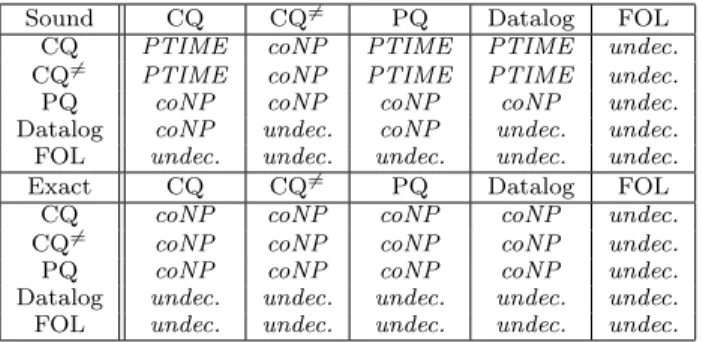
Sound CQ CQ6= PQ Datalog FOL
CQ PTIME coNP PTIME PTIME undec. CQ6= PTIME coNP PTIME PTIME undec.
PQ coNP coNP coNP coNP undec. Datalog coNP undec. coNP undec. undec. FOL undec. undec. undec. undec. undec. Exact CQ CQ6= PQ Datalog FOL
CQ coNP coNP coNP coNP undec. CQ6= coNP coNP coNP coNP undec.
PQ coNP coNP coNP coNP undec. Datalog undec. undec. undec. undec. undec. FOL undec. undec. undec. undec. undec.
Table 1: Complexity of view-based query answering
In view-based query answering, besides the queryqand the view definitions, we are also given the extensions of the views. The goal is to compute the set of tuplestsuch that the knowledge on the view extensions logically implies that t is an answer toq, i.e., t is in the answer to q in all the databases that are consistent with the views. It is easy to see that, in a LAV data integration framework, this is ex-actly the problem of computing the certain answers toqwith respect to a source database.
Notice the difference between the two approaches. In query rewriting, query processing is divided in two steps, where the first one re-expresses the query in terms of a given query language over the alphabet of the view names, and the sec-ond one evaluates the rewriting over the view extensions. In query answering, we do not pose any limitations on how queries are processed, and the only goal is to exploit all possible information, in particular the view extensions, to compute the answer to the query.
A large number of results have been reported for both ap-proaches. We first focus on view-based query answering. Query answering has been extensively investigated in the last years [1, 53, 43, 66, 4, 21]. A comprehensive framework for view-based query answering, as well as several interesting results, is presented in [53]. The framework considers var-ious assumptions for interpreting the view extensions with respect to the corresponding definitions (closed, open, and exact view assumptions). In [1], an analysis of the com-plexity of the problem under the different assumptions is carried out for the case where the views and the queries are expressed in terms of various languages (conjunctive queries without and with inequalitites, positive queries, Datalog, and first-order queries). The complexity is measured with respect to the size of the view extensions (data complexity). Table 1 summarizes the results presented in [1]. Note that, for the query languages considered in that paper, the exact view assumption complicates the problem. For example, the data complexity of query answering for the case of conjunc-tive queries is PTIME under the sound view assumption, and coNP-complete for exact views. This can be explained by noticing that the exact view assumption introduces a form of negation, and therefore it may force to reason by cases on the objects stored in the views.
In [24], the problem is studied for a setting where the global schema models a semistructured database, i.e., a labeled directed graphs. It follows that both the user queries,
and the queries used in the LAV mapping should be ex-pressed in a query language for semistructured data. The main difficulty arising in this context is that languages for querying semistructured data enable expressing regular-path queries [2, 15, 45]. A regular-regular-path query asks for all pairs of nodes in the database connected by a path con-forming to a regular expression, and therefore may contain a restricted form of recursion. Note that, when the query con-tains unrestricted recursion, both view-based query rewrit-ing and view-based query answerrewrit-ing become undecidable, even when the views are not recursive [43].
Table 2 summarizes the results presented in [24]. Both data complexity, and expression complexity (complexity with re-spect to the size of the query and the view definitions) are taken into account. All upper bound results have been ob-tained by automata-theoretic techniques. In the analysis, a further distinction is proposed for characterizing the do-main of the database (open vs. closed dodo-main assumption). In the closed domain assumption we assume that the global database contains only objects stored in the sources. The re-sults show that none of the cases can be solved in polynomial time (unless P = NP). This can be explained by observing that the need for considering various forms of incompleteness expressible in the query language (due to union and tran-sitive closure), is a source of complexity for query answer-ing. Obviously, under closed domain, our knowledge is more accurate than in the case of the open domain assumption, and this rules out the need for some combinatorial reason-ing. This provides the intuition of why under closed domain the problem is “only” coNP-complete in all cases, for data, expression, and combined complexity. On the other hand, under open domain, we cannot exclude the possibility that the database contains more objects than those known to be in the views. For combined complexity, this means that we are forced to reason about the definition of the query and the views. Indeed, the problem cannot be less complex than comparing two regular path queries, and this explains the PSPACE lower bound. Interestingly, the table shows that the problem does not exceed the PSPACE complexity. Moreover, the data complexity remains in coNP, and there-fore, although we are using a query language that is powerful enough to express a (limited) form of recursion, the prob-lem is no more complex than in the case of disjunctions of conjunctive queries [1].
While regular-path queries represent the core of any query language for semistructured data, their expressive power is limited. Several authors point out that extensions are re-quired for making them useful in real settings (see for ex-ample [14, 15, 80]). Indeed, the results in [24] have been extended to query language with the inverse operator [26], and to the class of union of conjunctive regular-path queries in [28].
Turning our attention to view-based query rewriting, several recent papers investigate the rewriting question for different classes of queries. The problem is investigated for the case of conjunctive queries (with or without arithmetic compar-isons) in [66, 84], for disjunctive views in [4], for queries with aggregates in [87, 37, 56], for recursive queries and nonre-cursive views in [43], for queries expressed in Description Logics in [9], for regular-path queries and their extensions
domain views Complexity
data expression combined all sound coNP coNP coNP closed all exact coNP coNP coNP arbitrary coNP coNP coNP all sound coNP PSPACE PSPACE open all exact coNP PSPACE PSPACE arbitrary coNP PSPACE PSPACE
Table 2: Complexity of view-based query answering for regular-path queries
in [23, 26, 27], and in the presence of integrity constraints in [59, 44]. Rewriting techniques for query optimization are described, for example, in [34, 3, 88], and in [46, 80, 82] for the case of path queries in semistructured data.
We already noted that based query rewriting and view-based query answering are different problems. Unfortu-nately, their similarity sometimes gives raise to a sort of confusion between the two notions. Part of the problem comes from the fact that when the query and the views are conjunctive queries, the best possible rewriting is express-ible as union of conjunctive queries, which is basically the same language as the one of the original query and views. However, for other query languages this is not the case. Ab-stracting from the language used to express the rewriting, we can define a rewriting of a query with respect to a set of views as a function that, given the extensions of the views, returns a set of tuples that is contained in the answer set of the query in every database consistent with the views. We call the rewriting that returns precisely such set theperfect rewriting of the query with respect to the views. Observe that, by evaluating the perfect rewriting over given view extensions, one obtains the same set of tuples provided by view-based query answering. i.e., in data integration termi-nology, the set of certain answers to the query with respect to the view extension. Hence, the perfect rewriting is the best rewriting one can obtain, given the available informa-tion on both the definiinforma-tions and the extensions of the views. An immediate consequence of the relationship between per-fect rewriting and query answering is that the data com-plexity of evaluating the perfect rewriting over the view ex-tensions is the same as the data complexity of answering queries using views. Typically, one is interested in queries that can be evaluated in PTIME (i.e., are PTIME functions in data complexity), and hence we would like rewritings to be PTIME as well. For queries and views that are conjunc-tive queries (without union), the perfect rewriting is a union of conjunctive queries and hence is PTIME [1]. However, al-ready for very simple query languages containing union the perfect rewriting is not PTIME in general. Hence, for such languages it would be interesting to characterize which in-stances of query rewriting admit a perfect rewriting that is PTIME. By establishing a tight connection between view-based query answering and constraint-satisfaction problems, it is argued in [27] that this is a difficult task.
5.
QUERY PROCESSING IN GAV
Most GAV data integration systems do not allow integrity constraints in the global schema, and assume that views
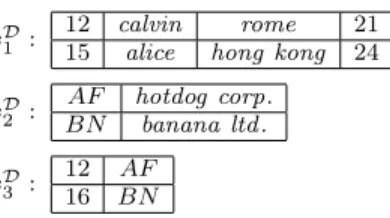
sD 1 :
12 calvin rome 21 15 alice hong kong 24
sD 2 :
AF hotdog corp. BN banana ltd. sD
3 :
12 AF
16 BN
Figure 1: Extension of sources for the example
are exact. It is easy to see that, under these assumptions, query processing can be based on a simple unfolding strat-egy. When we have a query q over the alphabet AG of
the global schema, every element ofAGis substituted with
the corresponding query over the sources, and the resulting query is then evaluated at the sources. As we said before, such a strategy suffices mainly because the data integration system enjoys the single database property. Notably, the same strategy applies also in the case of sound views. However, when the language LG used for expressing the
global schema allows for integrity constraints, and the views are sound, then query processing in GAV systems becomes more complex. Indeed, in this case, integrity constraints can in principle be used in order to overcome incompleteness of data at the sources. The following example shows that, by taking into account foreign key constraints, one can obtain answers that would be missed by simply unfolding the user query.
LetI=hG,S,Mibe a data integration system, whereG is constituted by the relations
employee(Ecode,Ename,Ecity) company(Ccode,Cname) employed(Ecode,Ccode) and the constraints
key(employee) = {Ecode} key(company) = {Ccode} employed[Ecode] ⊆ employee[Ecode] employed[Ccode] ⊆ company[Ccode]
The source schema S consists of three sources. Sources1,
of arity 4, contains information about employees with their code, name, city, and date of birth. Source s2, of arity 2,
contains codes and names of companies. Finally, Source s3, of arity 2, contains information about employment in
companies. The mappingMis defined by employee ; {x, y, z|s1(x, y, z, w)}
company ;: {x, y|s2(x, y)}
employed ;: {x, w|s3(x, w)}
Now consider the following user queryq, asking for codes of employees:
{x|employee(x, y, z)}
Suppose that the data stored in the source databaseDare those depicted in Figure 1: by simply unfoldingqwe obtain the answer {12}. However, due to the integrity constraint employed[Ecode]⊆employee[Ecode], we know that 16 is the code of a person, even if it does not appear in sD
1. The
do not know any value for the attributes of the employee whoseEcode is 16.
Given a source database D, let us call “retrieved global database” the global database that is obtained by popu-lating each relation r in the global schema according to the mapping, i.e., by populatingrwith the tuples obtained by evaluating the query that the mapping associates toq. In general, integrity constraints may be violated in the re-trieved global database (e.g., the rere-trieved global database for the above example). Regarding key constraints, let us assume that the query that the mapping associates to each global schema relationr is such that the data retrieved for rdo not violate the key constraint ofr. In other words, the management of key constraints is left to the designer (see next section for a discussion on this subject). On the other hand, the management of foreign key constraints cannot be left to the designer, since it is strongly related to the incom-pleteness of the sources. Moreover, since foreign keys are interrelation constraints, they cannot be dealt with in the GAV mapping, which, by definition, works on each global relation in isolation.
The assumption of sound views asserts that the tuples re-trieved for a relationr are a subset of the tuples that the system assigns tor; therefore, we may think of completing the retrieved global database by suitably adding tuples in or-der to satisfy foreign key constraints, while still conforming to the mapping. When a foreign key constraint is violated, there are several ways of adding tuples to the retrieved global database to satisfy such a constraint. In other words, in the presence of foreign key constraints in the global schema, the semantics of a data integration system must be formulated in terms of asetof databases, instead of a single one. Since we are interested in the certain answersqI,Dto a query q,
i.e., the tuples that satisfyqin all global databases that are legal forI with respect toD, the existence of several such databases complicates the task of query answering. In [17], a system called IBIS is presented, that takes into account key and foreign key constraints over the global rela-tional schema. The system uses the foreign key constraints in order to retrieve data that could not be obtained in tradi-tional data integration systems. The language for express-ing both the user query and the queries in the mappexpress-ing is the one of union of conjunctive queries. To process a query q, IBIS expands q by taking into account the foreign key constraints on the global relations appearing in the atoms. Such an expansion is performed by viewing each foreign key constraintr1[X]⊆r2[Y], whereXand Yare sets ofh
at-tributes andYis a key forr2, as a logic programming [77]
rule
r20(X, f~ h+1(X~), . . . , fn(X~)) ← r01(X, X~ h+1, . . . , Xm)
where eachfiis a Skolem function,X~ is a vector ofh
vari-ables, and we have assumed for simplicity that the attributes involved in the foreign key are the firsthones. Each r0
i is
a predicate, corresponding to the global relationri, defined
by the above rules for foreign key constraints, together with the rule
r0i(X1, . . . , Xn) ← ri(X1, . . . , Xn)
Once such a logic program ΠG has been defined, it can be
used to generate the expanded query expand q associated to the original query q. This is done by performing a par-tial evaluation [40] with respect to ΠG of the body ofq0,
which is the query obtained by substituting inqeach predi-cateriwithri0. In the partial evaluation tree, a node is not
expanded anymore either when no atom in the node uni-fies with a head of a rule, or when the node is subsumed by (i.e., is more specific than) one of its predecessors. In the latter case, the node gets an empty node as a child; intuitively this is because such a node cannot provide any answer that is not already provided by its more general pre-decessor. These conditions guarantee that the construction of the partial evaluation tree for a query always terminates. Then, the expansionexpand qofqis a union of conjunctive queries whose body is constituted by the disjunction of all nonempty leaves of the partial evaluation tree. It is possible to show that, by unfoldingexpand q according to the map-ping, and evaluating the resulting query over the sources, one obtains exactly the set of certain answers ofqtoIwith respect toD[17].
6.
INCONSISTENCIES BETWEEN
SOUR-CES
The formalization of data integration presented in the pre-vious sections is based on a first order logic interpretation of the assertions in the mapping, and, therefore, is not able to cope with inconsistencies between sources. Indeed, if in a data integration systemI=hG,S,Mi, the data retrieved from the sources do not satisfy the integrity constraints of G, then no global database exists forI, and query answering becomes meaningless. This is the situation occurring when data in the sources are mutually inconsistent. In practice, this situation is generally dealt with by means of suitable transformation and cleaning procedures to be applied to data retrieved by the sources (see [12, 50]). In this section, we address the problem from a more theoretical perspective. Several recent papers aim at formally dealing with inconsis-tencies in databases, in particular for providing informative answers even in the case of a database that does not sat-isfy its integrity constraints (see, for example, [13, 6, 7, 54]). Although interesting, such results are not specifically tai-lored to the case of different consistent data sources that are mutually inconsistent, that is the case of interest in data integration. This case is addressed in [76], where the authors propose an operator for merging databases under constraints. Such operator allows one to obtain maximal amount of information from each database by means of a majority criterion used in case of conflict. However, also the approach described in [76] does not take explicitly into account the notion of mapping as introduced in our data integration setting.
In data integration, according to the definition of mapping satisfaction as given in Section 3, it may be the case that the data retrieved from the sources cannot be reconciled in the global schema in such a way that both the constraints of the global schema, and the mapping are satisfied. For example, this happens when a key constraint specified for the relationr in the global schema is violated by the tuples retrieved by the view associated tor, since the assumption of sound views does not allow us to disregard tuples from
r with duplicate keys. If we do not want to conclude in this case that no global database exists that is legal forI with respect toD, we need a different characterization of the mapping. In particular, we need a characterization that allows us support query processing even when the data at the sources are incoherent with respect to the integrity con-straints on the global schema.
A possible solution is to characterize the data integration systemI=hG,S,Mi(withM = {r1 ; V1, . . . , rn ;
Vn}), in terms of those global databases that
1. satisfy the integrity constraints ofG, and
2. approximate at best the satisfaction of the assertions in the mappingM, i.e., that areas sound as possible. In other, the integrity constraints ofGare considered strong, whereas the mapping is considered soft. Given a source databaseD forI, we can now define an ordering between the global databases forIas follows. IfB1 andB2 are two
databases that are legal with respect toG, we say thatB1
isbetter thanB2 with respect toD, denoted asB1 DB2,
if there exists an assertionri ; ViinMsuch that
- (rB1
i ∩ViD)⊃(rBi2∩ViD), and
- (rB1
j ∩VjD)⊇(rjB2∩VjD), for allrj ; Vj inMwith
j6=i;
Intuitively, this means that there is at least one assertion for whichB1 satisfies the sound mapping better thanB2, while
for no other assertionB2 is better thanB1. In other words,
B1 approximates the sound mapping better thanB2.
It is easy to verify that the relationDis a partial order.
With this notion in place, we can now define the notion ofB satisfying the mappingMwith respect toDin our setting: a database B that is legal with respect to G satisfies the mappingMwith respect toDifBis maximal with respect toD, i.e., for no other global databaseB0that is legal with
respect toG, we have thatB0 DB.
The notion of legal database forI with respect to D, and the notion of certain answer remain the same, given the new definition of satisfaction of mapping. It is immediate to verify that, if there exists a legal database for I with respect toDunder the first order logic interpretation of the mapping, then the new semantics and the old one coincide, in the sense that, for each queryq, the setqI,D of certain
answers computed under the first order semantics coincides with the set of certain answers computed under the new semantics presented here.
The problem of inconsistent sources in data integration is addressed in [64], in particular for the case where:
• the global schema is a relational schema with key and foreign key constraints,
• the mapping is of type GAV,
• the query languageLM,S is the language of union of
conjunctive queries,
• the views in the mapping are intended to be sound. In such a setting, an algorithm is proposed for computing the certain answers of a query in the new semantical framework presented above. The algorithm checks whether a given tu-pletis a certain answer to a queryqwith respect to a given source database D in coNP data complexity (i.e., with re-spect to the size ofD). Based on this result, the problem of computing the certain answers in the presented framework can be shown to be coNP-complete in data complexity.
7.
REASONING ON QUERIES
Recent work addresses the problem of reasoning on queries in data integration systems. The basic form of reasoning on queries is checking containment, i.e., verifying whether one query returns a subset of the result computed by the other query in all databases. Most of the results on query con-tainment concern conjunctive queries and their extensions. In [33], NP-completeness has been established for conjunc-tive queries, in [63, 90], Πp2-completeness of containment of conjunctive queries with inequalities is proved, and in [86] the case of queries with the union and difference operators is studied. For various classes of Datalog queries with inequal-ities, decidability and undecidability results are presented in [35] and [90], respectively. Other papers consider the case of query containment in the presence of various types of constraints [5, 39, 32, 69, 71, 70, 20], and for regular-path queries and their extensions [47, 25, 28, 41].
Besides the usual notion of containment, several other no-tions have been introduced related to the idea of comparing queries in a data integration setting, especially in the con-text of the LAV approach.
In [79], a query is said to be contained in another query relative to a set of sourcesmodeled as views, if, for each ex-tension of the views, the certain answers to the former query are a subset of the certain answers to the latter. Note that this reasoning problem is different from the usual contain-ment checking: here we are comparing the two queries with respect to the certain answers computable on the basis of the views available. The difference becomes evident if one considers a counterexample to relative containment: Q1 is
not contained in Q2 relative to views V if there is a tuple
tand an extensionE ofV, such that for each databaseDB consistent withE (i.e., a database DBsuch that, the result VDB of evaluating the views overDB is exactlyE), tis an answer ofQ1 toDB, but there is a databaseDB0consistent
withE such thattis not an answer ofQ2 toDB0. In other
words,Q1is not contained inQ2 relative to viewsVif there
are two databasesDBandDB0such thatVDB=VDB0 and
QDB
1 =QDB
0
2 .
In [79], it is shown that the problem of checking relative con-tainment is ΠP
2 complete in the case of conjunctive queries
and views. In [74], such results are extended to the case where views have limited access patterns.
(where “p” stands for power): a view setVis said to be p-contained in another view set W, i.e., W has at least the answering power ofV, ifWcan answer all queries that can be answered usingV.
The notion of “information content” of materialized views is studied in [57] for a restricted class of aggregate queries, with the goal of devising techniques for checking whether a set of views is sufficient for completely answering a given query based on the views.
One of the ideas underlying the above mentioned papers is the one of losslessness: a set of views islosslesswith respect to a query, if, no matter what the database is, we can answer the query by solely relying on the content of the views. This question is relevant for example in mobile computing, where we may be interested in checking whether a set of cached data allows us to derive the requested information without accessing the network, or in data warehouse design, in par-ticular for the view selection problem [36], where we have to measure the quality of the choice of the views to materialize in the data warehouse. In data integration, losslessness may help in the design of the data integration system, in par-ticular, by selecting a minimal subset of sources to access without losing query-answering power.
The definition of losslessness relies on that of certain an-swers: a set of views is lossless with respect to a query, if for every database, we can answer the query over that database by computing the certain answers based on the view extensions. It follows that there are at least two ver-sions of losslessness, namely, losslessness under the sound view assumption, and losslessness under the exact view as-sumption.
The first version is obviously weaker than the second one. If viewsV are lossless with respect to a queryQunder the sound view assumption, then we know that, from the in-tensional point of views, V contain enough information to completely answerQ, even though the possible incomplete-ness of the view extensions may prevent us form obtaining all the answers thatQwould get from the database. On the other hand, ifVare lossless with respect to a queryQunder the exact view assumption, then we know that they contain enough information to completely answerQ, both from the intensional and from the extensional point of view.
In [29], the problem of losslessness is addressed in a context where both the query and the views are expressed as regular path queries. It is shown that, in the case of the sound view assumption, the problem is solvable by a technique that is based on searching for a counterexample to losslessness, i.e., two databases that are both coherent with the view exten-sions, and that differ in the answers to the query. Different from traditional query containment, the search for a coun-terexample is complicated by the presence of a quantification over all possible view extensions. The key observation in [29] is that, under the sound view assumption, we can restrict our attention to counterexamples that are linear databases, and this allows devising a method that uses, via automata-theoretic techniques, the known connection between view-based query answering and constraint satisfaction [27]. As far as the computational complexity is concerned, the
prob-lem is PSPACE-complete with respect to the view defini-tions, and EXPSPACE-complete with respect to the query. It is interesting to observe that, for the case of exact views, the search for a counterexample cannot be restricted to lin-ear databases. Actually, the question of losslessness under the exact view assumption is largely unexplored. To the best of our knowledge, the problem is open even for a set-ting where both the query and the views are conjunctive queries.
8.
CONCLUSIONS
The aim of this tutorial was to provide an overview of some of the theoretical issues underlying data integration. Sev-eral interesting problems remain open in each of the topics that we have discussed. For example, more investigation is needed for a deep understanding of the relationship be-tween the LAV and the GAV approaches. Open problems remain on algorithms and complexity for view-based query processing, in particular for the case of rich languages for semistructured data, for the case of exact views, and for the case of integrity constraints in the global schema. Query processing in GAV with constraints has been investigated only recently, and interesting classes of constraints have not been considered yet. The treatment of mutually inconsis-tent sources, and the issue of reasoning on queries present many open research questions.
Moreover, data integration is such a rich field that several important related aspects not addressed here can be identi-fied, including the following.
• How to build an appropriate global schema, and how to discover inter-schema [31] and mapping assertions (LAV or GAV) in the design of a data integration sys-tem (see, for instance, [83]).
• How to (automatically) synthesize wrappers that present the data at the sources in a form [] that is suitable for their use in the mapping.
• How to deal with possible limitations in accessing the sources, both in LAV [84, 67, 68] and in GAV [75, 48, 73, 74].
• How to incorporate the notions of quality (data qual-ity, quality of answers, etc.) [81], and data cleaning [12] into a formal framework for data integration.
• How to learn rules that allow for automatically map-ping data items in different sources (for example, for inferring that two key values in different sources actu-ally refer to the same real-world object [38]).
• How to go beyond the architecture based on a global schema, so as, for instance, to model data exchange, transformation, and cooperation rather than data tegration (see, e.g., [55]), or to devise information in-tegration facilities for the Semantic Web.
• How to optimize the evaluation of queries posed to a data integration system [3].
We believe that each of the above issues is characterized by interesting research problems still to investigate.
9.
ACKNOWLEDGMENTS
I warmly thank Diego Calvanese, Giuseppe De Giacomo and Moshe Y. Vardi, with whom I carried out most of my research work on data integration during the last years. Also, I thank all colleagues that I have been working with in several data integration projects, in particular Andrea Cal`ı, Domenico Lembo, Daniele Nardi, Riccardo Rosati, and all participants to the ESPRIT LTR project “DWQ (Data Warehouse Quality)”, and the MIUR (Italian Ministry of University and Research) project “D2I (From Data To In-formation)”.
Finally, this is the first paper I can dedicate to my son Domenico, and for that I want to thank his mother.
10.
REFERENCES
[1] S. Abiteboul and O. Duschka. Complexity of answering queries using materialized views. In Proc. of the 17th ACM SIGACT SIGMOD SIGART Symp. on Principles of Database Systems (PODS’98), pages 254–265, 1998. [2] S. Abiteboul, D. Quass, J. McHugh, J. Widom, and J. L. Wiener. The Lorel query language for semistruc-tured data. Int. J. on Digital Libraries, 1(1):68–88, 1997.
[3] S. Adali, K. S. Candan, Y. Papakonstantinou, and V. S. Subrahmanian. Query caching and optimization in dis-tributed mediator systems. InProc. of the ACM SIG-MOD Int. Conf. on Management of Data, pages 137– 148, 1996.
[4] F. N. Afrati, M. Gergatsoulis, and T. Kavalieros. An-swering queries using materialized views with disjunc-tion. InProc. of the 7th Int. Conf. on Database Theory (ICDT’99), volume 1540 ofLecture Notes in Computer Science, pages 435–452. Springer, 1999.
[5] A. V. Aho, Y. Sagiv, and J. D. Ullman. Equivalence among relational expressions.SIAM J. on Computing, 8:218–246, 1979.
[6] M. Arenas, L. E. Bertossi, and J. Chomicki. Consis-tent query answers in inconsisConsis-tent databases. InProc. of the 18th ACM SIGACT SIGMOD SIGART Symp. on Principles of Database Systems (PODS’99), pages 68–79, 1999.
[7] M. Arenas, L. E. Bertossi, and J. Chomicki. Specify-ing and querySpecify-ing database repairs usSpecify-ing logic programs with exceptions. InProc. of the 4th Int. Conf. on Flexi-ble Query Answering Systems (FQAS’00), pages 27–41. Springer, 2000.
[8] F. Baader, D. Calvanese, D. McGuinness, D. Nardi, and P. F. Patel-Schneider, editors. The Description Logic Handbook: Theory, Implementation and Applications. Cambridge University Press, 2002. To appear.
[9] C. Beeri, A. Y. Levy, and M.-C. Rousset. Rewriting queries using views in description logics. In Proc. of the 16th ACM SIGACT SIGMOD SIGART Symp. on Principles of Database Systems (PODS’97), pages 99– 108, 1997.
[10] D. Beneventano, S. Bergamaschi, S. Castano, A. Corni, R. Guidetti, G. Malvezzi, M. Melchiori, and M. Vincini. Information integration: the MOMIS project demon-stration. InProc. of the 26th Int. Conf. on Very Large Data Bases (VLDB 2000), 2000.
[11] A. Borgida. Description logics in data management. IEEE Trans. on Knowledge and Data Engineering, 7(5):671–682, 1995.
[12] M. Bouzeghoub and M. Lenzerini. Introduction to the special issue on data extraction, cleaning, and reconcil-iation.Information Systems, 26(8):535–536, 2001. [13] F. Bry. Query answering in information systems with
integrity constraints. InIFIP WG 11.5 Working Conf. on Integrity and Control in Information System. Chap-man & Hall, 1997.
[14] P. Buneman. Semistructured data. InProc. of the 16th ACM SIGACT SIGMOD SIGART Symp. on Principles of Database Systems (PODS’97), pages 117–121, 1997. [15] P. Buneman, S. Davidson, G. Hillebrand, and D. Su-ciu. A query language and optimization technique for unstructured data. InProc. of the ACM SIGMOD Int. Conf. on Management of Data, pages 505–516, 1996. [16] A. Cal`ı, D. Calvanese, G. De Giacomo, and M.
Lenz-erini. Accessing data integration systems through con-ceptual schemas. InProc. of the 20th Int. Conf. on Con-ceptual Modeling (ER 2001), 2001.
[17] A. Cal`ı, D. Calvanese, G. De Giacomo, and M. Lenz-erini. Data integration under integrity constraints. In Proc. of the 14th Conf. on Advanced Information Sys-tems Engineering (CAiSE 2002), 2002. To appear. [18] A. Cal`ı, D. Calvanese, G. De Giacomo, and M.
Lenz-erini. On the expressive power of data integration sys-tems. Submitted for pubblication, 2002.
[19] A. Cal`ı, G. De Giacomo, and M. Lenzerini. Mod-els of information integration: Turning local-as-view into global-as-view. InFoundations of Models for Infor-mation Integration. On line proceedings,http://www.
fmldo.org/FMII-2001, 2001.
[20] D. Calvanese, G. De Giacomo, and M. Lenzerini. On the decidability of query containment under constraints. In Proc. of the 17th ACM SIGACT SIGMOD SIGART Symp. on Principles of Database Systems (PODS’98), pages 149–158, 1998.
[21] D. Calvanese, G. De Giacomo, and M. Lenzerini. Answering queries using views over description logics knowledge bases. InProc. of the 17th Nat. Conf. on Ar-tificial Intelligence (AAAI 2000), pages 386–391, 2000. [22] D. Calvanese, G. De Giacomo, M. Lenzerini, D. Nardi, and R. Rosati. Description logic framework for infor-mation integration. In Proc. of the 6th Int. Conf. on Principles of Knowledge Representation and Reasoning (KR’98), pages 2–13, 1998.
[23] D. Calvanese, G. De Giacomo, M. Lenzerini, and M. Y. Vardi. Rewriting of regular expressions and regular path queries. InProc. of the 18th ACM SIGACT SIG-MOD SIGART Symp. on Principles of Database Sys-tems (PODS’99), pages 194–204, 1999.
[24] D. Calvanese, G. De Giacomo, M. Lenzerini, and M. Y. Vardi. Answering regular path queries using views. In Proc. of the 16th IEEE Int. Conf. on Data Engineering (ICDE 2000), pages 389–398, 2000.
[25] D. Calvanese, G. De Giacomo, M. Lenzerini, and M. Y. Vardi. Containment of conjunctive regular path queries with inverse. In Proc. of the 7th Int. Conf. on Principles of Knowledge Representation and Reasoning (KR 2000), pages 176–185, 2000.
[26] D. Calvanese, G. De Giacomo, M. Lenzerini, and M. Y. Vardi. Query processing using views for regular path queries with inverse. InProc. of the 19th ACM SIGACT SIGMOD SIGART Symp. on Principles of Database Systems (PODS 2000), pages 58–66, 2000.
[27] D. Calvanese, G. De Giacomo, M. Lenzerini, and M. Y. Vardi. View-based query processing and constraint sat-isfaction. InProc. of the 15th IEEE Symp. on Logic in Computer Science (LICS 2000), pages 361–371, 2000. [28] D. Calvanese, G. De Giacomo, M. Lenzerini, and M. Y.
Vardi. View-based query answering and query contain-ment over semistructured data. In Proc. of the 8th Int. Workshop on Database Programming Languages (DBPL 2001), 2001.
[29] D. Calvanese, G. De Giacomo, M. Lenzerini, and M. Y. Vardi. Lossless regular views. InProc. of the 21st ACM SIGACT SIGMOD SIGART Symp. on Principles of Database Systems (PODS 2002), pages 58–66, 2002. [30] M. J. Carey, L. M. Haas, P. M. Schwarz, M. Arya,
W. F. Cody, R. Fagin, M. Flickner, A. Luniewski, W. Niblack, D. Petkovic, J. Thomas, J. H. Williams, and E. L. Wimmers. Towards heterogeneous multi-media information systems: The Garlic approach. In Proc. of the 5th Int. Workshop on Research Issues in Data Engineering – Distributed Object Management (RIDE-DOM’95), pages 124–131. IEEE Computer So-ciety Press, 1995.
[31] T. Catarci and M. Lenzerini. Representing and using interschema knowledge in cooperative information sys-tems.J. of Intelligent and Cooperative Information Sys-tems, 2(4):375–398, 1993.
[32] E. P. F. Chan. Containment and minimization of posi-tive conjuncposi-tive queries in oodb’s. InProc. of the 11th ACM SIGACT SIGMOD SIGART Symp. on Principles of Database Systems (PODS’92), pages 202–211, 1992. [33] A. K. Chandra and P. M. Merlin. Optimal implementa-tion of conjunctive queries in relaimplementa-tional data bases. In Proc. of the 9th ACM Symp. on Theory of Computing (STOC’77), pages 77–90, 1977.
[34] S. Chaudhuri, S. Krishnamurthy, S. Potarnianos, and K. Shim. Optimizing queries with materialized views. In Proc. of the 11th IEEE Int. Conf. on Data Engineering (ICDE’95), Taipei (Taiwan), 1995.
[35] S. Chaudhuri and M. Y. Vardi. On the equivalence of recursive and nonrecursive Datalog programs. InProc. of the 11th ACM SIGACT SIGMOD SIGART Symp. on Principles of Database Systems (PODS’92), pages 55–66, 1992.
[36] R. Chirkova, A. Y. Halevy, and D. Suciu. A formal perspective on the view selection problem. In Proc. of the 27th Int. Conf. on Very Large Data Bases (VLDB 2001), pages 59–68, 2001.
[37] S. Cohen, W. Nutt, and A. Serebrenik. Rewriting ag-gregate queries using views. InProc. of the 18th ACM SIGACT SIGMOD SIGART Symp. on Principles of Database Systems (PODS’99), pages 155–166, 1999. [38] W. W. Cohen. Integration of heterogeneous databases
without common domains using queries based on tex-tual similarity. In Proc. of the ACM SIGMOD Int. Conf. on Management of Data, pages 201–212, 1998. [39] A. C. K. David S. Johnson. Testing containment
of conjunctive queries under functional and inclusion dependencies. J. of Computer and System Sciences, 28(1):167–189, 1984.
[40] G. De Giacomo. Intensional query answering by par-tial evaluation. J. of Intelligent Information Systems, 7(3):205–233, 1996.
[41] A. Deutsch and V. Tannen. Optimization properties for classes of conjunctive regular path queries. InProc. of the 8th Int. Workshop on Database Programming Lan-guages (DBPL 2001), 2001.
[42] O. Duschka. Query Planning and Optimization in In-formation Integration. PhD thesis, Stanford University, 1997.
[43] O. M. Duschka and M. R. Genesereth. Answering re-cursive queries using views. InProc. of the 16th ACM SIGACT SIGMOD SIGART Symp. on Principles of Database Systems (PODS’97), pages 109–116, 1997. [44] O. M. Duschka and A. Y. Levy. Recursive plans for
information gathering. In Proc. of the 15th Int. Joint Conf. on Artificial Intelligence (IJCAI’97), pages 778– 784, 1997.
[45] M. F. Fernandez, D. Florescu, J. Kang, A. Y. Levy, and D. Suciu. Catching the boat with strudel: Experi-ences with a web-site management system. InProc. of the ACM SIGMOD Int. Conf. on Management of Data, pages 414–425, 1998.
[46] M. F. Fernandez and D. Suciu. Optimizing regular path expressions using graph schemas. In Proc. of the 14th IEEE Int. Conf. on Data Engineering (ICDE’98), pages 14–23, 1998.
[47] D. Florescu, A. Levy, and D. Suciu. Query contain-ment for conjunctive queries with regular expressions. InProc. of the 17th ACM SIGACT SIGMOD SIGART Symp. on Principles of Database Systems (PODS’98), pages 139–148, 1998.